


Building a business web application is not primarily a framework-selection exercise. It is a sequence of product and engineering decisions: identify the costly business workflow, model the people and systems that participate in it, choose an architecture that can evolve, and release it with enough measurement to learn safely. The best first version is the smallest system that can prove the business outcome without creating avoidable operational risk.
This guide gives founders, product leaders, and engineering teams a practical path from discovery to launch. It includes a worked B2B workflow, architecture choices, data and integration patterns, scaling diagnostics, security controls, a staged release plan, and a decision framework for deciding what to build now versus later.
1. Define the business problem before choosing technology

Start with a workflow, not a list of features. For example, a distributor may spend two days reconciling purchase orders, inventory updates, and shipment status across email and spreadsheets. “Build a portal” is not yet a product requirement; “let a buyer submit an order, see an accurate availability estimate, and resolve exceptions without a support ticket” is closer to one.
Map the current process from trigger to outcome. Record who initiates each step, what information they need, which system owns that information, where people re-enter data, and what happens when something is missing. A swimlane diagram for buyer, sales operations, warehouse, and finance often reveals that the apparent software problem is actually an ownership or policy problem.
Define measurable outcomes
Before design begins, define a baseline and a measurable outcome. If the goal is to reduce order handling time, measure the current median and the high-percentile time, plus the rate of corrections. A release that makes the interface faster but increases order errors is not a business improvement.
Use a compact discovery brief with these fields:
- User and job: Who is doing what, and what result are they trying to achieve?
- Current cost: Time, rework, support volume, delay, or risk in the existing process.
- Target outcome: A metric and a measurement window, not a vague ambition.
- Constraints: Existing systems, data residency, customer contracts, accessibility, and procurement rules.
- Failure consequence: What users lose or what the business must do if the feature is unavailable or wrong.
Turn the brief into acceptance examples before deciding on architecture. For an order workflow, examples might include a buyer with permission to order for two subsidiaries, an item whose inventory is stale, a duplicate submission after a network timeout, and an order that requires manual approval. These cases are useful design inputs because they expose authorization, consistency, idempotency, and exception handling early.
Prioritize the first release by risk reduction and learning value. A useful first release may support one customer segment, one approval path, and a limited set of integrations. It should still prove the end-to-end outcome. A beautiful dashboard that cannot safely complete the underlying transaction only demonstrates that the dashboard can render.
2. Select an architecture that matches the product

Architecture is the way responsibilities and failure boundaries are arranged. It should make the important business workflow understandable and changeable. For many B2B products, a modular monolith is a strong starting point: one deployable application with clear internal modules, a shared database boundary, and explicit interfaces between business capabilities.
A modular monolith can deliver quickly without making every feature a separate service. A team might separate identity and access, customer accounts, catalog, orders, billing, and notifications into modules. The modules can live in one repository and deploy together, while their contracts make later extraction possible if a real scaling or ownership problem appears.
Choose service boundaries deliberately
Microservices add independent deployment and scaling boundaries, but they also add network failure, service discovery, distributed authorization, versioned contracts, tracing, and data-consistency work. Choose them when teams need independent release cycles or a component has a distinct scaling or reliability profile that cannot be handled economically inside the existing application. Do not choose them only because the product is expected to grow.
Separate the user-facing request from work that can safely happen later. A synchronous request is appropriate when the user needs an immediate answer, such as validating an order’s required fields. A queue is useful for work that may take longer or can be retried, such as generating a report, importing a large file, or notifying several downstream systems.
Map a baseline request path
The following baseline is a practical starting point, not a universal vendor blueprint:
- Browser or mobile client calls a versioned HTTPS API.
- An edge layer terminates TLS, applies request limits, and routes traffic.
- The application authenticates the caller and enforces tenant and role permissions.
- Business modules validate commands and persist transactional state.
- A worker processes durable queued jobs and records outcomes.
- A relational database stores authoritative business records; object storage holds large files.
- Logs, metrics, traces, and audit events make operation observable.
Keep the first architecture diagram honest. Show the systems that actually exist, the direction of data flow, trust boundaries, synchronous calls, asynchronous jobs, and the source of truth for each entity. Do not place a cache or message broker in the diagram merely because a reference architecture includes one. Each component adds a failure mode and an operating cost.
Choose a relational database when the business needs transactions across related records, constraints, reporting, and well-understood query behavior. A normalized order model might separate orders, order_items, and approval_events, with foreign keys and a transaction for the state change. Choose a document or key-value store only when its access patterns and data model offer a concrete advantage; explain how relationships, reporting, updates, and backups will work.
Decide where to host and when to revisit
For a first release, decide where the system runs by comparing the team’s operational capacity, expected workload, support model, compliance needs, and total cost. A managed application platform can reduce routine server maintenance. Containers can improve packaging and portability, but they do not automatically reduce operating effort. Kubernetes is justified when its scheduling and platform capabilities solve an observed organizational problem, not as a default requirement for every web app.
Write down the architecture decision and its revisit trigger. For example: “Use one application and one relational database for the first three customer deployments. Reconsider service extraction if order processing requires an independent release cadence or if measured load requires different scaling characteristics.” This keeps future work evidence-based instead of turning a prediction into a permanent commitment.
3. Model tenants, data, and integrations explicitly

In B2B products, an account boundary is a security boundary. Decide whether a tenant is a company, a subsidiary, a workspace, or another contractual entity. Then make the boundary visible in the data model and authorization checks. Do not rely on a tenant identifier supplied by the browser as proof that the caller may access that tenant.
For a shared-database design, tenant-owned records should carry a tenant key, and every read or write path should derive the allowed tenant from the authenticated identity and membership record. A query such as:
SELECT * FROM invoices WHERE id = ?;- Reject the request if invoice identifiers can be guessed and authorization is not checked.
- Verify the user’s membership and scope the lookup to both the invoice and the authorized tenant.
Test tenant boundaries and data ownership
Test isolation as a negative case. Create two test tenants, each with an administrator and a standard user. Sign in as tenant A and try to read, update, export, and delete tenant B’s records by changing identifiers in API requests. Each attempt should fail with a response that does not expose whether the other tenant’s record exists.
Plan data ownership and lifecycle before importing customer data. For each entity, answer who can create it, who can change it, what becomes immutable, when it is retained, how it is exported, and how deletion requests work. Classify sensitive fields and avoid placing secrets or unnecessary personal data in logs, analytics events, test fixtures, or support exports.
Design integrations for failure and retries
Treat integrations as unreliable dependencies. A customer’s CRM, ERP, identity provider, or payment service may be slow, rate-limited, unavailable, or return an unexpected response. Define timeouts, retry rules, idempotency, and reconciliation. Retry transient failures with bounded exponential backoff and jitter; do not retry permanent validation errors indefinitely.
For a webhook receiver, verify the signature against the raw request body, reject timestamps outside the permitted window, record the event identifier, and make handling idempotent. If the same event arrives twice, the second delivery should not create a duplicate payment or order. Store a processing state so operators can distinguish received, completed, retriable, and permanently failed events.
Protect application secrets
Keep secrets out of source code and client bundles. Use the platform’s secret store or protected environment configuration, grant each service only the credentials it needs, rotate credentials through a tested procedure, and avoid logging them. Separate development, staging, and production credentials; a test environment should not have a production database password “for convenience.”
4. Scale from measurements and remove the actual bottleneck
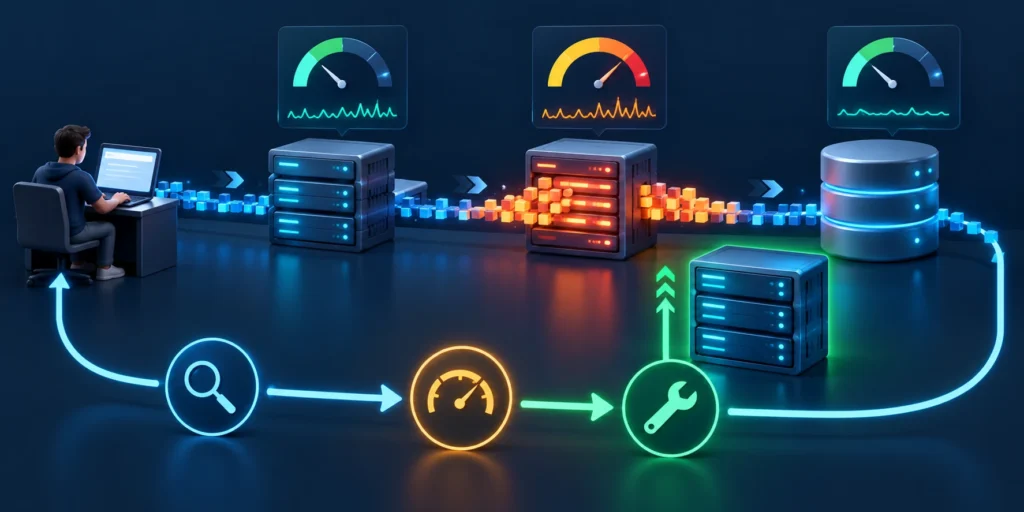
Scalability is not the same as having many servers. First define the workload: requests per second, concurrent users, file sizes, background jobs, seasonal peaks, and the response-time objective for the actions that matter. A quote-screen target might be a 95th-percentile response under 800 milliseconds at 150 concurrent users, measured with representative data. The exact target depends on the product and must come from user and business needs.
Instrument the critical journey before tuning. For each request, capture latency, status, route, dependency duration, and a correlation identifier. Avoid high-cardinality labels such as raw customer IDs in metric dimensions. Use traces to see whether time is spent in application code, database queries, remote APIs, or queue waits.
Diagnose the measured bottleneck
When the application slows down, gather evidence before increasing capacity. Compare application CPU and memory, database connections and slow queries, cache hit rate, queue depth and age, external API latency, and error rates. A database query that scans millions of rows will not be fixed by adding more web instances; a saturated application pool will not be fixed by adding database replicas.
Use a short diagnostic sequence:
- Reproduce the slow action with representative test data and record the time range.
- Compare the affected route with a healthy route and inspect its trace or request log.
- Identify the largest measured wait: application, database, queue, file storage, or external service.
- Change one cause at a time, such as adding an index for a demonstrated query pattern.
- Rerun the same load and compare latency, errors, and resource use.
- Keep the change only if the measured outcome improves without breaking correctness.
Scale horizontally when independent instances can safely process work. Keep session state in a shared store or signed token rather than in one server’s memory. Make background jobs safe for duplicate delivery and allow a worker to shut down cleanly. If a twofold increase in instances does not create a comparable throughput increase, look for lock contention, a shared database limit, a serial step, or an external dependency.
Caching is a performance tool, not a substitute for correct data ownership. Cache public or slow-changing reference data first. For tenant-specific records, include the authorization scope in the cache key and define invalidation behavior. A cache key that omits tenant identity can expose one company’s data to another. Set a short expiration or invalidation path and make the application correct when the cache is empty.
Use queues when work can finish later
Use asynchronous processing when work can be accepted and completed later. Return a job identifier, show a clear state such as queued or failed, and give the user a way to retry or download the result. Track queue age as well as queue depth; a modest queue that contains jobs waiting for hours may be more urgent than a large queue that drains in seconds.
Load tests should model realistic user behavior, data distribution, and dependency limits. Increase load gradually, include a sustained period, and record where latency or errors begin to rise. Do not use a test that sends every request to one customer or one record if production traffic is distributed differently. A spike test can reveal whether the system recovers after a burst; a soak test can reveal memory growth or slow resource leaks.
5. Build security, reliability, and recovery into delivery

Security requirements begin with assets and misuse cases. Identify customer data, administrative actions, payment or contract flows, tokens, and privileged integrations. Then ask what an unauthenticated user, a compromised customer account, or a malicious tenant administrator could attempt. Translate each concern into a control and a test rather than a paragraph that says the system is secure.
For example, an invitation endpoint should verify that the inviter can manage users in the tenant, restrict the role they may grant, expire the invitation, and prevent reuse after acceptance. A file upload should restrict size and type, store content outside executable paths, use randomized object keys, and ensure the download route checks authorization. These are concrete test cases for the features, not a generic security checklist.
Turn security requirements into verifiable controls
Use a recognized security requirements source to organize coverage. The OWASP Application Security Verification Standard gives development teams a structured basis for testing web application security controls. Select the requirements that match the product’s data and risk; do not claim certification merely because the team used the standard as a checklist.
For a WordPress-focused example of operational security controls, see our guide to the WordPress security protocol for business sites.
Separate identity and authorization
Make authentication and authorization distinct. Authentication answers who the caller is; authorization answers what that identity may do to a particular resource in a particular tenant. Enforce authorization in server-side business operations, not only by hiding buttons in the user interface. Use least privilege for both people and machine identities, and audit high-impact actions such as role changes, exports, and billing updates.
Reliability goals should describe user-visible behavior. An uptime percentage alone does not tell the team whether a buyer can submit an order or whether an approval queue will recover after an outage. Define service-level indicators for key tasks: successful transaction rate, response time, job completion delay, and data freshness. Use service-level objectives to guide release decisions and alerting.
Make backup and health checks operational
Prepare recovery for the data you cannot recreate. Back up database and file storage on a schedule that matches the recovery point objective. Encrypt backups, restrict access, and test restoration in an isolated environment. A backup job that says “success” is not evidence that the application can restore; record the last restore test, its duration, and any missing dependencies.
Separate application health from dependency health. A readiness check should prevent an instance from receiving traffic when it cannot serve requests; a liveness check should identify a process that needs restart. Do not make a short external API outage fail every application health check and trigger a restart loop. Use timeouts, circuit breaking where appropriate, bounded retries, and a user-visible fallback for non-critical functions.
Prepare a release safety plan
Create a release safety plan for a risky change. Before a database migration, take a recoverable backup, verify the migration on staging data, and use an expand-and-contract approach when old and new code may overlap. First add a compatible field, deploy code that can read both forms, backfill data, and only later remove the old field. For an unsafe migration, define a tested rollback or forward-fix before release.
6. Launch through a staged release and a feedback loop
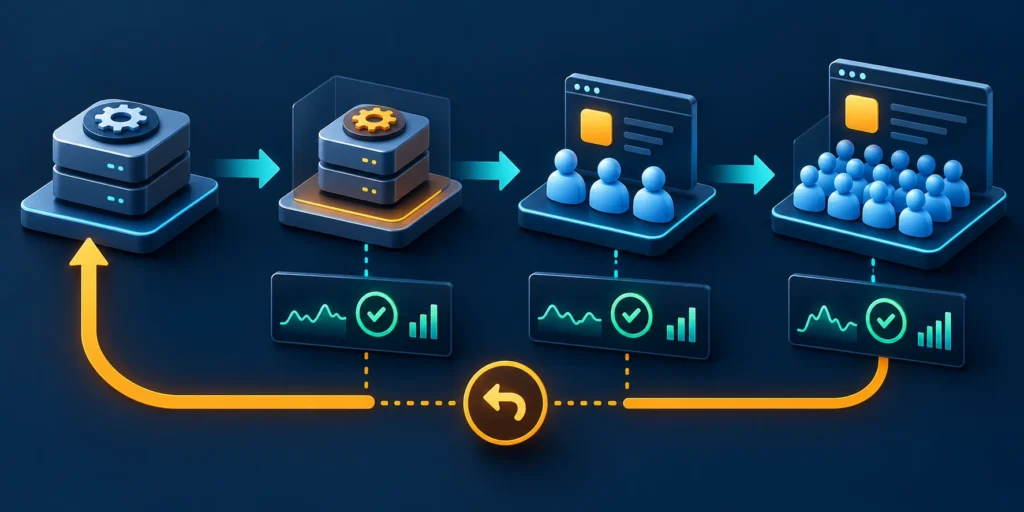
A launch is a controlled transition, not the instant a deployment finishes. Start with a release checklist that names the owner, the change, affected customers, database changes, observability, support coverage, rollback trigger, and the person who can make the stop decision. Keep it short enough to use, but specific enough to prevent “everyone thought someone else was watching.”
Deploy the build to a staging environment that resembles production in configuration and integration boundaries. Use synthetic or anonymized data, never copy sensitive production data into staging without an approved protection process. Verify the customer journey with at least one account, one restricted user, one failure case, and one recovery path.
Expand exposure in controlled stages
Use progressive exposure when the product can support it. Release to internal users first, then a small customer cohort, and expand when the error rate, task completion, and support signals remain within agreed limits. A feature flag can separate deployment from exposure, but it needs an owner, an expiration or cleanup plan, and a safe default if the flag service is unavailable.
Before a migration, test the exact migration and rollback sequence on a production-like copy. Confirm that the backup can be restored and that the application version can read the resulting schema. For a backward-compatible change, deploy code that tolerates both old and new fields, migrate data, then remove the old path in a later release.
Monitor outcomes and define rollback triggers
During launch, monitor a small set of signals tied to the product outcome. For an ordering application, monitor successful order submissions, duplicate order rate, validation failures, median and 95th-percentile response time, and queue age. A dashboard with dozens of unowned charts is less useful than a handful of signals with thresholds and a named responder.
Define a rollback trigger in advance. For example, pause cohort expansion if the error rate exceeds the agreed threshold for a sustained interval, if duplicate orders occur, or if the business-critical task cannot complete. Roll back when it restores a safe state; if the database change is not reversible, use the documented forward-fix. Communicate the current status to customer support so they do not give contradictory instructions.
Review outcomes after release
After the release, compare the target metric with the baseline and collect feedback from the people who used the workflow. Check whether support tickets shifted to a different step, whether customers completed the task without assistance, and whether the new process created work for operations. Turn findings into a prioritized backlog and record decisions so future releases do not repeat the same discovery.
7. Control cost and keep the operating model sustainable

Total cost includes more than the monthly hosting bill. Count developer and operations time, support work, monitoring, backups, data transfer, integration fees, incident recovery, and future migration effort. A managed service may have a higher line-item price but lower staffing cost. Self-hosting may look cheaper until patching, availability, and on-call coverage are included.
Estimate cost from a workload model. For example, calculate requests per month, average and peak compute, database storage growth, backup retention, file storage, egress, and observability volume. Mark each estimate with its confidence and the assumption behind it. Use a pilot to replace estimates with measured values before committing to long-term capacity.
Track cost drivers and remove waste
Set budgets or alerts on variable services and define an owner for each. Track cost per meaningful business unit, such as per active tenant or per completed workflow, as well as total spend. A rising bill is easier to diagnose when the team can see whether it comes from more customers, inefficient queries, repeated job retries, or high-volume logs.
Avoid premature cost optimization that weakens recovery or security. Removing backups, disabling audit logs, or using a shared administrator account can reduce this month’s expense while increasing the expected cost of an incident. First remove waste with evidence: idle resources, redundant environments, oversized instances, unbounded log retention, and expensive queries that can be fixed.
Turn cost reviews into decisions
Use a regular review cadence that matches the product’s rate of change. A small team may review reliability, cost, security findings, and support trends at each release or monthly. The review should result in decisions: accept a known risk with an owner and date, fix a defect, adjust capacity, or change the service objective. A meeting without an owner or follow-up is not a control.
8. FAQ
1. Should a B2B web app start as a monolith or microservices?
Start with a modular monolith when one team can own the product and the workload does not require independent service scaling. Keep business boundaries clear and write module contracts. Split a service when measured scaling, isolation, or team release needs justify the extra operating complexity. Reassess using real deployment and performance evidence, not a growth forecast alone.
2. What should be decided before choosing a cloud provider?
Write down regions and data residency, required integrations, identity model, availability objective, expected workload, support capacity, procurement limits, and exit constraints. Compare providers against those requirements and include migration and operating costs. A familiar platform that satisfies the constraints is often safer than a theoretically ideal service the team cannot operate.
3. How do we prevent one B2B tenant from seeing another tenant’s data?
Derive tenant access from the authenticated membership, then enforce it on every server-side read and write. Include the tenant scope in database queries and cache keys. Test cross-tenant access by changing record IDs in API requests, including exports, files, background jobs, and administrative endpoints. Treat a missing scope check as a release defect.
4. When should a web app use a queue?
Use a queue for work that can finish after the request returns, may take longer than a normal response, or benefits from controlled retry. Examples include imports, report generation, and notifications. Give each job an identifier and visible state, make processing idempotent, and monitor the oldest waiting job. Keep actions requiring immediate user confirmation synchronous.
5. Do we need a cache to make the first release scalable?
Not necessarily. Measure response time and identify the bottleneck before adding a cache. Start with clear database queries, indexes that match real access patterns, and appropriate pagination. If caching is justified, define key scope, expiration, invalidation, and behavior when the cache is empty. Tenant identity must be part of any tenant-specific cache key.
6. How can we estimate capacity before launch?
Define the key workload assumptions, then test representative user journeys with realistic data and dependency limits. Increase concurrency gradually and observe latency, errors, CPU, memory, database load, and queue age. Capacity estimates should include a safety margin and a plan for scaling or limiting traffic. Revisit the estimate after real customer behavior replaces assumptions.
7. What should a B2B app’s first security review cover?
Start with tenant isolation, authentication and authorization, privileged actions, secrets, file handling, input validation, audit trails, backups, and the security of external integrations. Create tests for misuse cases rather than relying on a generic statement that the product is secure. Use a structured source such as OWASP ASVS to identify applicable controls.
8. How do we release a database change without downtime?
Use a compatible sequence: add the new schema, deploy code that can work with both forms, migrate or backfill data, verify results, and remove the old schema in a later release. Test the exact migration on staging data and prepare a restore or forward-fix. Do not assume that reversing a database migration is safe just because the code can be rolled back.
9. What should we monitor during the first customer rollout?
Monitor task completion, errors, response time at a high percentile, queue age, integration failures, and a business-specific correctness metric such as duplicate transactions. Name an owner for each alert and agree on the cohort-expansion and rollback triggers before release. Review customer support feedback alongside technical telemetry because a successful HTTP response can still represent a failed workflow.
10. How do we know when to split a service out of the application?
Consider extraction when a module needs a different scaling profile, release cadence, security boundary, or ownership model and the benefit exceeds the cost of network calls, deployment, tracing, and data consistency. Measure the current pain first. Define the new service’s API, data owner, failure behavior, and migration path before moving code.
9. Conclusion: make the first release prove the right thing

A sound B2B web application grows from a real workflow, explicit tenant boundaries, architecture that fits the team, and operational evidence. Begin with the smallest end-to-end release that can prove the user outcome, then measure the bottlenecks and improve the system where the data points.
Before launch, verify one representative customer journey, one restricted-user case, one failure path, and one recovery procedure. Roll out gradually when possible, watch signals that reflect business correctness as well as system health, and expand only when the evidence supports it. This keeps architecture decisions practical and makes the next investment easier to justify.



Leave a Reply