

Build a practical digital marketing strategy with consulting support for positioning, content, SEO, paid media, analytics, automation, and revenue alignment. Learn how Fase Network helps B2B teams turn fragmented channels into a measurable growth system.
What a Digital Marketing Strategy Consulting Firm Does

A digital marketing strategy consulting firm helps leaders decide where growth should come from, which capabilities matter, and how marketing should support revenue.
Its value is not another campaign calendar. Its value is a connected decision system that turns business priorities into measurable marketing choices.
Strategy begins before channel selection
Many companies begin with channels. They ask whether to invest in SEO, LinkedIn, Google Ads, webinars, email, partnerships, or an emerging AI platform.
Those questions matter, but they come later. A useful strategy first defines the business problem, customer, offer, buying process, constraints, and desired outcome.
Review these practical points for Strategy begins before:
- Which customer segments create attractive revenue and operational fit?
- Which problems are urgent enough to justify action?
- Why should those buyers trust this company?
- Which buying-group members influence the decision?
- Where does demand already exist?
- Where must the company create or educate demand?
- What happens after a prospect becomes a lead?
Consultants organize evidence around these questions. They identify assumptions, resolve contradictions, and show leadership which decisions deserve priority.
The resulting strategy explains what the company will pursue, what it will postpone, and what it will deliberately avoid.
Consulting connects marketing with the revenue system
Digital marketing does not produce business value in isolation. It depends on positioning, sales response, customer data, service delivery, pricing, and retention.
A consulting firm therefore examines the complete path from market attention to qualified opportunity, closed revenue, expansion, and advocacy.
Consider these operating checks for Consulting connects marketing:
- Market and competitor signals
- Brand positioning and messaging
- Website architecture and conversion paths
- Organic search and content systems
- Paid acquisition and retargeting
- CRM stages, ownership, and automation
- Sales qualification and follow-up
- Analytics, attribution, and forecasting
- Team roles, vendors, and governance
This wider view prevents a common failure: optimizing a channel while the surrounding commercial system remains unable to convert demand.
More traffic will not repair a confusing offer. More leads will not solve slow follow-up. Better attribution will not improve an undefined sales process.
Consultancy, agency, fractional leadership, or internal hire?
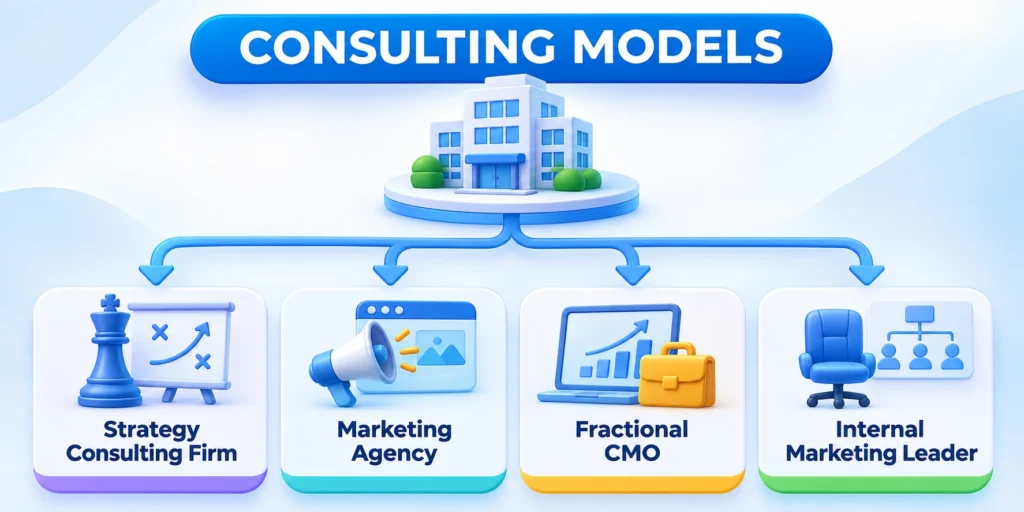
The operating model determines who diagnoses problems, owns decisions, performs delivery, and builds lasting marketing capability.
Choose the model after defining the decision gap, available leadership, delivery capacity, timeline, and expected transfer of knowledge.
Compare responsibility before selecting a model
A strategy problem needs different authority than a production backlog. Separate diagnosis, governance, execution, and permanent ownership before comparing providers.
The right arrangement may combine models, but every responsibility still needs one accountable owner and an observable acceptance condition for each handoff at every transition and review point.
Compare these responsibilities before selecting a model:
- Diagnosis and strategic choices across markets
- Daily delivery and cross-team coordination
- Executive ownership and operating governance
- Long-term capability transfer
These models overlap, yet they solve different problems. Choosing the wrong model creates frustration even when the provider performs competently.
A consultancy primarily diagnoses, prioritizes, designs, and guides. An agency primarily executes. Fractional leadership manages the function. Internal hires build lasting capability.
| Model | Primary role | Fit and constraint |
|---|---|---|
| Strategy consulting firm | Diagnosis, roadmap, and governance | Complex choices; may lack delivery capacity |
| Marketing agency | Campaign and channel delivery | Clear strategy; may miss systemic issues |
| Fractional CMO | Ongoing leadership and direction | Senior guidance; relies on delivery capacity |
| Internal leader | Permanent ownership and development | Daily ownership; slower hiring and inherited bias |
The strongest engagements often combine models. A consultancy designs the system, internal leaders own decisions, and specialized teams execute defined workstreams.
That division should be explicit. Ambiguous ownership causes duplicated work, delayed approvals, and expectations that no provider can satisfy.
Use this ownership split to coordinate execution:
- Consultants frame evidence and choices
- Internal leaders own final decisions
- Specialists execute defined workstreams
Explore Fase Network’s digital marketing strategy consulting approach to see how strategic planning can connect acquisition, technology, and revenue operations.
When Your Business Needs Strategic Marketing Consulting

Consulting is most useful when the cost of unclear decisions exceeds the cost of obtaining an independent, structured assessment.
The trigger is rarely “we need more marketing.” It is usually a pattern of stalled growth, wasted effort, weak coordination, or uncertain investment.
Growth has plateaued despite sustained activity
A company may publish frequently, run advertisements, attend events, and use automation while qualified pipeline remains flat.
This pattern suggests a system problem. The issue may involve positioning, audience selection, offer strength, conversion, measurement, or sales coordination.
Use these decision criteria for Growth has plateaued:
- Traffic grows, but qualified inquiries do not.
- Lead volume rises, but opportunity creation falls.
- Cost per lead looks acceptable, but customer acquisition cost worsens.
- Content receives attention without influencing buying conversations.
- Sales rejects most marketing-generated leads.
- Leadership cannot explain which investments create pipeline.
A consultant separates symptoms from causes. That distinction matters because each cause requires a different response.
For example, weak lead quality may reflect targeting. It may also reflect misleading messaging, a premature conversion offer, or inconsistent qualification definitions.
Marketing and sales use different definitions
Misalignment becomes visible when teams disagree about a qualified lead, a target account, an acceptable response time, or the next pipeline stage.
These disagreements are not merely interpersonal. They reveal missing operating rules, inconsistent data, or incentives that reward conflicting behaviors.
Compare these priorities for Marketing sales use:
- Define the ideal customer profile and explicit exclusions.
- Document lifecycle stages in plain language.
- Set entry and exit criteria for every stage.
- Assign an owner and response expectation.
- Record disqualification reasons consistently.
- Review quality and progression together.
A strategic consultant facilitates these agreements and translates them into CRM fields, workflows, reports, and management routines.
The consultant should not impose abstract terminology. Definitions must reflect the company’s real sales motion, deal value, capacity, and buyer behavior.
A major transition changes the commercial equation

A merger, product launch, regional expansion, repositioning, or pricing change can invalidate assumptions behind the existing marketing plan.
Reassess audiences, offers, channels, capacity, measurement, and sales dependencies before scaling activity under the new commercial conditions.
Rebuild assumptions around the transition
Document what changed, which decisions became uncertain, and what evidence can confirm whether the previous strategy still applies.
Protect ongoing revenue while testing the new direction through bounded experiments, explicit owners, and predefined review dates.
Reassess these factors during a major transition:
- Customer priorities and buying triggers
- Positioning and offer relevance
- Channel and sales dependencies
- Measurement baselines and decision thresholds
Expansion into a new market changes audience assumptions, competitors, messages, channels, economics, and operational demands.
The same applies to a new product, acquisition, repositioning, international launch, pricing change, or shift from founder-led selling.
Review these practical points for major transition changes:
- New geographic market or language
- Move from small business to enterprise buyers
- Launch of a higher-value service
- Transition from projects to recurring revenue
- Merger of separate brands or databases
- Adoption of account-based marketing
- Replacement of a core CRM or automation platform
Consulting reduces avoidable assumptions before resources become committed. It creates a testable entry plan rather than a large, irreversible launch.
A sensible roadmap might validate demand, messaging, and sales readiness before expanding media investment or rebuilding the technology stack.
Leadership lacks a shared investment thesis
Budget debates become unproductive when every channel owner presents different metrics, time horizons, and assumptions.
Executives need a common model connecting spend, capacity, pipeline, sales cycles, margins, and strategic learning.
Consider these operating checks for Leadership lacks shared:
- What outcome is the investment expected to influence?
- What leading indicators should change first?
- How long can evidence reasonably take?
- Which variables remain outside marketing’s control?
- What decision follows each possible result?
A consulting process makes these assumptions visible. Leaders can then debate the model instead of defending isolated channels.
That clarity also protects productive long-term work from being judged by short-term signals that cannot represent its contribution.
Core Components of a Revenue-Aligned Digital Strategy

A credible strategy explains how several connected components will work together. A list of channel recommendations is not enough.
Each component should include a decision, supporting evidence, operating implication, responsible owner, measurement approach, and review cadence.
Market segmentation and ideal customer profile
Segmentation determines where the company will compete. It should use characteristics that change buying needs, economics, access, or delivery fit.
Firmographics alone rarely provide enough precision. Two companies with similar size and industry can have very different urgency, maturity, and purchasing constraints.
Use these decision criteria for Market segmentation ideal:
- Business model and revenue structure
- Operational complexity
- Technology maturity
- Regulatory environment
- Trigger events and strategic priorities
- Buying authority and procurement process
- Problem severity and cost of delay
- Ability to implement the solution
The ideal customer profile should also define exclusions. A broad profile increases apparent market size while weakening messaging and lead quality.
Explicit exclusions help sales and marketing avoid opportunities that consume attention without realistic potential for value or retention.
Positioning, value proposition, and message architecture
Positioning defines the relevant market context, distinctive value, credible evidence, and customer for whom the claim matters.
It is not a slogan. It is the strategic logic that keeps websites, campaigns, sales conversations, and proposals coherent.
Compare these priorities for Positioning value proposition:
- Name the customer’s current situation without exaggeration.
- Describe the meaningful problem or opportunity.
- Explain the business consequence of inaction.
- Present the approach in understandable terms.
- Show why the approach is credible and differentiated.
- Offer an appropriate next step for the buyer’s readiness.
A message architecture adapts this logic for executives, technical evaluators, users, procurement teams, and internal champions.
Every role needs different evidence. Executives may prioritize risk and return, while practitioners evaluate workflow impact and implementation demands.
Buying journey and demand architecture
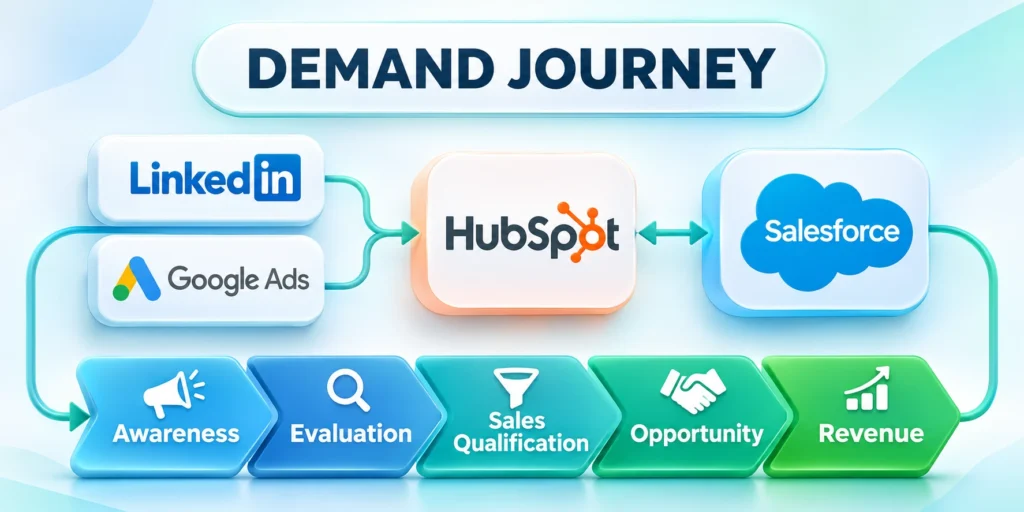
Demand architecture connects buyer questions, content, channels, conversion paths, qualification, sales action, and revenue evidence across the full journey.
Design the system around decisions buyers make rather than forcing every account through one linear campaign sequence.
Connect every stage with accountable evidence
Each stage needs a defined purpose, audience signal, next action, owner, and measurement rule that both marketing and sales understand.
Map exceptions and inactive paths so teams can diagnose stalled demand without adding indiscriminate campaigns or automation.
Map these elements across the demand journey:
- Buyer questions and evidence needs
- Channels and conversion paths
- Qualification and ownership rules
- Opportunity and revenue feedback
A buying journey maps decisions, questions, concerns, stakeholders, and evidence requirements. It should not assume a neat linear funnel.
B2B buyers move between problem recognition, research, consensus building, validation, and procurement. They may pause or revisit earlier questions.
| Buyer task | Strategic question | Useful marketing support |
|---|---|---|
| Recognize a problem | Is the current situation costly enough to change? | Diagnosis, benchmarks, and problem education |
| Explore approaches | What options could solve the problem? | Guides, frameworks, comparisons, and webinars |
| Build consensus | Can stakeholders agree on priorities and risk? | Business cases, role evidence, and internal tools |
| Validate providers | Which partner can deliver credibly? | Method, proof, references, and clear scope |
| Make a decision | Is the expected value worth the commitment? | Proposal, roadmap, assumptions, and plan |
Demand architecture assigns channels and content to these buyer tasks. It prevents every asset from making the same premature sales request.
It also distinguishes demand capture from demand creation. Search advertising captures expressed intent, while expert content can shape future consideration.
Channel portfolio and content system
Channels should receive defined jobs. A channel portfolio works when each activity supports a buyer task and contributes to a shared commercial objective.
No company needs every channel. Concentration usually produces better learning and execution than spreading limited resources across fashionable platforms.
Review these practical points for Channel portfolio content:
- SEO can capture durable problem and solution demand.
- Paid search can test high-intent terms quickly.
- LinkedIn can reach professional audiences and buying groups.
- Email can nurture known contacts with relevant progression.
- Webinars can demonstrate expertise for complex decisions.
- Partnerships can transfer trust and improve market access.
- Retargeting can support consideration without replacing qualification.
A content system turns recurring buyer questions into reusable intellectual assets. One strong research effort can support articles, sales tools, events, and campaigns.
Reuse should preserve context. Copying fragments everywhere creates noise unless each format serves the audience’s situation.
Conversion, CRM, and revenue operations
Conversion design connects interest with an appropriate commitment. It includes offers, forms, scheduling, routing, qualification, follow-up, and consent.
A strategy should define more than a conversion rate. It should protect prospect experience while capturing the information needed for useful action.
Consider these operating checks for Conversion CRM revenue:
- Match the offer to the buyer’s readiness.
- Request only information required for the next action.
- Confirm what will happen after submission.
- Route the inquiry by fit and urgency.
- Notify the accountable person immediately.
- Record the outcome using standardized reasons.
- Use outcomes to improve targeting and messaging.
Revenue operations provides the shared definitions, data model, automation, and reporting that keep this path reliable.
Without these foundations, teams debate incomplete dashboards and optimize toward activities that appear measurable rather than outcomes that matter.
Operating model and governance
Strategy becomes operational through ownership, decision rights, standards, resources, and review routines. Without governance, a roadmap remains a presentation.
Governance should be light enough to support speed and strong enough to protect quality, brand consistency, data integrity, and budget discipline.
Use these decision criteria for Operating model governance:
- Executive sponsor for priorities and tradeoffs
- Marketing owner for roadmap coordination
- Sales owner for qualification and feedback
- Data owner for definitions and integrity
- Channel owners for execution and learning
- Legal or privacy review where required
- Scheduled operating and executive reviews
A good consulting firm designs governance around the client’s real capacity. It should not create committees that slow routine decisions.
The goal is accountable autonomy: teams can act quickly within agreed boundaries, while material changes receive the right scrutiny.
How a Strategy Consulting Engagement Works

A well-designed engagement moves from evidence to decisions, then from decisions to an executable operating plan.
The exact scope varies, but clients should understand the phases, participants, inputs, decisions, and outputs before work begins.
Phase one: alignment and decision framing
The opening phase defines the business question. “Improve marketing” is too broad to guide analysis or determine success.
A sharper mandate might prioritize enterprise pipeline, launch a new service, reduce acquisition waste, or build a repeatable demand system.
Compare these priorities for Phase one alignment:
- Business objectives and financial context
- Leadership expectations and unresolved disagreements
- Target markets, offers, and strategic constraints
- Known performance issues
- Available data and access limitations
- Decisions that the engagement must support
- Stakeholders who can approve change
The consultant should translate objectives into explicit questions. This prevents a broad audit from producing observations that cannot guide action.
Alignment also establishes boundaries. The team identifies what is included, excluded, dependent on others, or unavailable within the timeframe.
Phase two: discovery and evidence collection
Discovery combines quantitative evidence, qualitative insight, direct observation, and organizational context. No single dashboard can explain the entire system.
Data shows patterns. Interviews reveal assumptions and processes. Customer evidence clarifies language, motivations, objections, and decision criteria.
Review these practical points for Phase two discovery:
- Review strategy, financial goals, and previous plans.
- Interview executives, marketing, sales, service, and operations.
- Analyze website, search, media, content, CRM, and pipeline data.
- Inspect campaign setup and conversion tracking.
- Review customer research, calls, proposals, and objections.
- Compare competitors, alternatives, and category expectations.
- Document data quality and evidence limitations.
Access should follow least-privilege principles. Consultants need enough visibility for analysis, not unrestricted control over every system.
Clients should use appropriate user accounts, permissions, confidentiality terms, and revocation procedures. Shared personal credentials create unnecessary risk.
Phase three: diagnosis and opportunity sizing

Diagnosis converts collected evidence into a prioritized explanation of constraints, opportunities, dependencies, and uncertainties affecting commercial performance.
Opportunity sizing compares potential value with confidence, effort, risk, reversibility, time to evidence, and organizational readiness.
Prioritize opportunities using comparable evidence
Separate observed facts from interpretations and assumptions. Record where missing data could materially change the recommended priority or investment level.
Use ranges and scenarios instead of presenting uncertain forecasts as precise commitments. Assign an owner to validate each influential assumption.
Score opportunities with these shared decision criteria:
- Expected customer or revenue impact
- Evidence quality and uncertainty
- Effort, dependencies, and risk
- Speed and reversibility of testing
Diagnosis explains why current results occur. It distinguishes controllable constraints from market conditions and separates evidence from plausible hypotheses.
A responsible consultant also communicates uncertainty. Precision unsupported by reliable data can create more confidence than the evidence deserves.
| Observation | Possible causes | Evidence needed |
|---|---|---|
| High traffic, low pipeline | Weak intent, offer, conversion, or routing | Query mix, behavior, form data, and lead outcomes |
| Rising acquisition cost | Competition, fatigue, targeting, price, or sales | Media, funnel, margin, and cohort trends |
| Long sales cycle | Consensus, urgency, procurement, or follow-up gaps | Stage time, notes, objections, and stakeholders |
| Low content engagement | Distribution, relevance, or measurement gaps | Audience, search, content, and sales evidence |
Opportunity sizing should use ranges and assumptions. It should never present an aspirational revenue figure as a guaranteed forecast.
The purpose is comparison. Leaders need to understand which opportunities appear attractive, achievable, defensible, and aligned with company capacity.
Phase four: strategy formulation and choices
Strategy formulation converts findings into a coherent set of choices. Each choice should resolve a specific diagnosis and support the engagement mandate.
Recommendations should identify alternatives considered, selection criteria, expected contribution, dependencies, risks, and conditions that would change the decision.
Consider these operating checks for Phase four strategy:
- Priority segments and excluded segments
- Positioning and message hierarchy
- Offer and conversion architecture
- Channel roles and investment logic
- Content themes and buying-stage coverage
- Data, CRM, and measurement changes
- Team, vendor, and governance model
Tradeoffs are essential. A strategy that declares every segment, channel, and initiative important provides no practical guidance.
Leaders should leave this phase able to explain the strategic logic simply, including why certain appealing activities are not immediate priorities.
Phase five: roadmap and resource design
The roadmap sequences work according to value, dependency, risk, learning speed, and resource availability.
It should not be a backlog sorted by enthusiasm. Foundational work often must precede visible campaigns.
Use these decision criteria for Phase five roadmap:
- Protect essential tracking, consent, and data quality.
- Resolve positioning and qualification definitions.
- Repair critical conversion and routing failures.
- Launch focused experiments against the strongest opportunities.
- Document learnings and update assumptions.
- Scale initiatives that demonstrate commercial relevance.
- Retire activities that lack strategic purpose.
A 90-day plan offers useful detail, while a longer horizon communicates direction without pretending distant conditions are predictable.
Every initiative needs an owner, contribution hypothesis, dependencies, milestone, measurement method, and decision date.
Phase six: activation, enablement, and optimization
Implementation oversight keeps the strategic logic intact as teams encounter real constraints. It also helps convert recommendations into internal capability.
Useful enablement includes playbooks, templates, working sessions, decision criteria, quality reviews, and coaching for the people who will own the system.
Compare these priorities for Phase six activation:
- Weekly workstream review for blockers and decisions
- Monthly performance review for learning and allocation
- Quarterly strategic review for assumptions and priorities
- Change log for major decisions
- Experiment register for hypotheses and outcomes
- Training plan for new tools and processes
The consultant’s role should become smaller as client capability grows. Permanent dependence is not the same as successful knowledge transfer.
An ongoing advisory relationship can still add value, but its purpose should evolve toward challenge, coordination, and strategic renewal.
Deliverables You Should Expect

Deliverables should help people make decisions and perform work. Polished documents without operational usefulness do not justify a strategic engagement.
The right package depends on scope, yet several artifacts commonly distinguish a complete strategy from a presentation of observations.
Executive diagnosis
The diagnosis summarizes material findings, supporting evidence, limitations, and commercial consequences. It should prioritize rather than catalog every issue.
Executives need a clear explanation of the current system, important constraints, avoidable risks, and highest-leverage opportunities.
Review these practical points for Executive diagnosis:
- Business context and engagement mandate
- Current-state performance narrative
- Root causes and supporting evidence
- Strategic risks and dependencies
- Opportunity areas with confidence levels
- Immediate decisions required from leadership
The document should distinguish facts, interpretations, and hypotheses. That discipline allows teams to challenge conclusions constructively.
It should also state what the consultant could not verify. Missing evidence is an important finding, not an inconvenience to hide.
Audience and positioning framework
This framework defines priority segments, buying groups, needs, alternatives, value propositions, proof requirements, and message hierarchy.
Teams should be able to apply it to a landing page, sales conversation, campaign brief, and product narrative without guessing.
Consider these operating checks for Audience positioning framework:
- Ideal customer profile and exclusions
- Buying-group role map
- Problem and outcome hierarchy
- Competitive alternatives
- Core positioning statement
- Message pillars and supporting evidence
- Common objections and responsible responses
The framework should use language grounded in credible customer evidence. Internal terminology may not match how buyers describe their situation.
It should remain specific without stereotyping. Buyer roles guide relevance, but real people have varied motivations and decision authority.
Integrated channel and content plan
The channel plan assigns a purpose, audience, offer, measurement approach, and investment rule to each selected channel.
The content plan maps buyer questions and evidence needs to formats, distribution, reuse, ownership, and maintenance.
| Plan element | Decision it should clarify |
|---|---|
| Channel role | What specific job does this channel perform? |
| Audience | Which segment or buying role should it reach? |
| Offer | What useful next step matches readiness? |
| Content | What question or evidence need will it address? |
| Economics | What cost and return assumptions guide investment? |
| Decision rule | Which result triggers scaling, revision, or a stop |
A complete plan also identifies dependencies. Paid acquisition may depend on landing-page changes, while SEO may depend on technical repairs and subject expertise.
This sequencing prevents teams from blaming a channel for failures created elsewhere in the system.
Measurement and data specification

A measurement specification defines each metric, population, event, source, owner, refresh cadence, limitation, and decision it supports.
This shared contract prevents dashboards from presenting conflicting numbers that look authoritative but describe different populations or business rules.
Define evidence before building dashboards
Start from the decision, then identify the smallest trustworthy dataset that can inform it. Document exclusions and known blind spots.
Test calculations against representative records and reconcile discrepancies before leaders use the metric for investment, compensation, or forecasting.
Specify these fields for every important metric:
- Business definition and population
- System source and calculation
- Owner and refresh cadence
- Limitations and supported decisions
A measurement specification defines events, lifecycle stages, sources, ownership, quality checks, attribution boundaries, dashboards, and review routines.
It should tell implementers exactly what data is needed and tell leaders how that data supports decisions.
Use these decision criteria for Measurement data specification:
- Metric dictionary with formulas and owners
- Conversion and key-event map
- CRM field and lifecycle-stage requirements
- Campaign naming and source standards
- Data-quality monitoring rules
- Dashboard audiences and decision purposes
- Known gaps and acceptable uncertainty
Metrics need stable definitions. If departments calculate pipeline, acquisition cost, or qualified leads differently, reports cannot support shared decisions.
The specification should be realistic about privacy, consent, browser restrictions, offline activity, and incomplete identity resolution.
Prioritized roadmap and operating playbook
A prioritized roadmap states what happens, when, why, by whom, and with which dependencies. Its companion playbook explains how recurring work should operate.
Together, these artifacts convert a strategic direction into coordinated action that survives the end of the consulting engagement.
Compare these priorities for Prioritized roadmap operating:
- Thirty-day stabilization priorities
- Ninety-day initiatives and experiments
- Six-to-twelve-month capability direction
- Resource and skill requirements
- Decision rights and approval paths
- Review cadence and escalation rules
- Risk register and mitigation owners
Clients should request editable working files where appropriate. A strategy locked inside static slides becomes harder to maintain.
Ownership terms should be clear before the engagement. Confidential data, reusable consultant methods, and client-specific outputs may require different treatment.
Measurement, Attribution, and Executive Reporting

Measurement should improve decisions, not decorate reports. The useful question is not “What can we count?” but “What action will this evidence inform?”
A consulting firm should connect operational metrics with buyer progression, pipeline quality, unit economics, and strategic learning.
Build a measurement hierarchy
Different metrics answer different questions. Combining them without hierarchy creates dashboards that are comprehensive yet difficult to use.
A measurement hierarchy connects daily execution with intermediate buyer behavior and eventual business outcomes.
| Level | Examples | Decision supported |
|---|---|---|
| Activity | Spend, campaigns, content, outreach | Did planned work occur? |
| Exposure | Reach, impressions, rankings, account coverage | Did the intended audience encounter it? |
| Engagement | Qualified visits, engagement, replies, and events | Did the audience show meaningful interest? |
| Progression | Inquiries, accepted leads, meetings, opportunities | Did engagement advance the buying process? |
| Business | Pipeline, revenue, margin, acquisition, retention | Did the system create sustainable value? |
Activity metrics help manage execution, but they should not substitute for outcomes. Business metrics matter, but they may appear too late for daily optimization.
Leading and lagging indicators belong together. The strategy should explain their expected relationship and the delay between them.
Define metrics precisely
A metric name is not a definition. “Marketing-sourced pipeline” can produce several valid calculations with materially different results.
Definitions should cover formula, source system, timestamp, inclusion criteria, exclusions, currency treatment, owner, and refresh frequency.
Review these practical points for Define metrics precisely:
- Qualified lead acceptance rate
- Lead-to-opportunity conversion
- Opportunity win rate
- Stage velocity and aging
- Pipeline generated by segment
- Customer acquisition cost
- Lifetime value assumptions
- Payback period and gross-margin contribution
Consultants should challenge metrics that encourage harmful behavior. A low cost per lead can reward low-quality volume and overload sales.
Quality-adjusted metrics reveal more. Cost per accepted lead or qualified opportunity may support better allocation than cost per form submission.
Use attribution as one input, not absolute truth

Attribution models distribute credit according to chosen rules; they do not reveal every influence, conversation, or decision shaping a complex B2B purchase.
Use attribution alongside experiments, pipeline evidence, customer research, sales feedback, cohort analysis, and channel economics.
Interpret attribution within explicit boundaries
Publish the model assumptions, identity rules, lookback window, exclusions, and data gaps beside every attribution report.
Compare several views when decisions are material. A stable conclusion across imperfect models is more useful than false precision from one formula.
Review these limits before acting on attribution:
- Identity and tracking coverage
- Model and lookback assumptions
- Offline and sales influences
- Incrementality and economic evidence
Attribution assigns credit to measured touchpoints. It does not observe every influence or prove that a touchpoint caused a purchase.
Google Analytics offers data-driven and last-click attribution approaches, while its path reports show sequences that precede key events.
Consider these operating checks for Use attribution one:
- Last-click models emphasize the final measured interaction.
- First-touch views emphasize initial measurable discovery.
- Data-driven models distribute credit using observed path data.
- Self-reported attribution captures the buyer’s remembered influence.
- CRM influence models connect contacts, campaigns, and opportunities.
- Experiments estimate incremental impact under controlled conditions.
No model resolves every limitation. Buying groups, offline conversations, dark social sharing, consent choices, and cross-device behavior create unavoidable gaps.
Good consultants triangulate. They compare analytics, CRM outcomes, sales evidence, customer feedback, controlled tests, and market context.
Design reports around decisions
An executive report should explain performance, material changes, likely causes, uncertainty, and recommended decisions. It should not reproduce an operational dashboard.
Channel teams need diagnostic detail. Executives need patterns, economics, risks, resource implications, and decisions requiring sponsorship.
Use these decision criteria for Design reports around:
- Restate the strategic objective and current assumptions.
- Show outcome and progression metrics against relevant expectations.
- Explain meaningful changes without overstating causality.
- Identify data-quality concerns and confidence levels.
- Recommend scaling, correction, continuation, or stopping.
- Record the decision and the next review date.
This format turns reporting into management. It ensures that evidence changes priorities instead of merely describing the past.
Reporting frequency should match the decision horizon. Daily volatility should not determine a strategy designed for a long enterprise sales cycle.
Illustrative measurement example
Consider a hypothetical B2B technology company that wants more enterprise opportunities. Existing reports celebrate lead volume, but sales accepts few leads.
The consultant reframes measurement around target-account engagement, accepted leads, opportunities, stage progression, projected gross margin, and reasons for rejection.
Compare these priorities for Illustrative measurement example:
- Hypothesis: narrow positioning will improve qualified response.
- Leading indicator: target-account visits to high-intent pages.
- Progression indicator: accepted meetings from priority accounts.
- Business indicator: qualified pipeline and expected margin.
- Learning indicator: objections and disqualification reasons.
- Decision date: after sufficient sales-cycle evidence accumulates.
This is not a claimed case result. It illustrates how measurement can shift attention from superficial volume toward commercially relevant progress.
The most important change is managerial: marketing and sales evaluate the same system using agreed definitions.
AI, Data, Privacy, and Modern Marketing Operations

AI can accelerate research, analysis, production, personalization, and operations. It can also scale weak assumptions, inconsistent data, and low-quality customer experiences.
A modern consulting firm should treat AI as an operating capability governed by strategy, data quality, risk controls, and human accountability.
Begin with use cases, not tool enthusiasm
Tool-first adoption often creates overlapping subscriptions and disconnected experiments. Use-case selection begins with a valuable task and observable improvement.
The team should define the user, input, desired output, review requirement, failure risk, data sensitivity, and success measure.
Review these practical points for Begin use cases:
- Summarizing customer-call themes for human review
- Classifying lead-routing exceptions
- Generating first drafts from approved source material
- Recommending content reuse across defined formats
- Identifying anomalies in campaign performance
- Suggesting next actions within controlled workflows
- Personalizing messages using verified customer context
High-risk use cases need stronger controls. Automated claims, sensitive profiling, legal advice, pricing decisions, and unsupervised customer communication require careful review.
The consultant should help the client select proportionate safeguards rather than making unsupported promises about accuracy or autonomy.
Data readiness determines practical value
AI systems depend on relevant context. Fragmented, duplicated, stale, or inaccessible data limits usefulness even when the underlying model is capable.
Salesforce’s 2026 research reports persistent access gaps across sales, service, and commerce data, illustrating why integration remains a strategic concern.
Consider these operating checks for Data readiness determines:
- Inventory customer and marketing data sources.
- Identify authoritative systems for each field.
- Standardize identifiers, lifecycle stages, and definitions.
- Resolve duplicates and critical completeness gaps.
- Document consent and permitted uses.
- Restrict access according to role and purpose.
- Monitor drift, failures, and unexpected outputs.
This foundation supports conventional analytics as well as AI. Data governance is not a separate technical project with no marketing consequence.
It determines whether teams can trust segmentation, automation, attribution, personalization, and revenue reporting.
Keep human accountability visible

AI can accelerate research, drafting, classification, analysis, and routing, but accountable people must remain visible at consequential decision points.
Define who approves outputs, reviews exceptions, monitors harm, corrects data, handles incidents, and decides whether automation should continue.
Design review around business consequences
Higher-impact uses need stronger evidence, narrower permissions, clearer escalation, and more frequent review than reversible internal assistance.
Preserve inputs, instructions, outputs, approvals, and monitoring results when traceability supports customer trust or operational recovery.
Assign these controls before deploying marketing AI:
- Named decision and system owners
- Approval and exception paths
- Monitoring and incident response
- Scheduled performance and risk reviews
Automation can recommend or execute actions, but an accountable person should own the purpose, permissions, quality standard, and escalation path.
Human review should be designed around risk. Routine classification may use sampling, while public claims may require approval before release.
| Risk level | Example | Possible control |
|---|---|---|
| Low | Internal topic clustering | Periodic quality sampling |
| Moderate | Drafting campaign variations | Human approval before activation |
| High | Customer-facing recommendation | Verified data, boundaries, monitoring, escalation |
| Very high | Sensitive eligibility or legal determination | Specialist review or exclusion from automation |
Governance should include model or vendor changes. A workflow that performs acceptably today may behave differently after an update.
Teams need version awareness, test cases, rollback options, and an incident process for material failures.
Design for privacy and trust
Privacy is not only a compliance topic. It affects data availability, customer confidence, measurement design, vendor selection, and brand reputation.
A strategic plan should collect information for defined purposes, limit unnecessary retention, respect consent, and prevent informal data sharing.
Use these decision criteria for Design privacy trust:
- Purpose limitation for collected data
- Clear consent and preference management
- Documented access and retention rules
- Vendor and data-processing review
- Secure transfer and storage practices
- Response procedures for access or deletion requests
- Measurement plans that acknowledge missing data
The consulting firm should identify where specialist legal or security advice is required. Marketing consultants should not present general guidance as jurisdiction-specific counsel.
Trust grows when companies explain value and choices clearly. Hidden data practices can undermine the relationship that personalization attempts to improve.
How to Evaluate and Choose the Right Consulting Firm

The right firm should improve decision quality, challenge assumptions respectfully, and leave the organization more capable than before.
Selection should therefore evaluate strategic thinking, relevant experience, working method, communication, implementation realism, and commercial alignment.
Start with a clear brief
A good brief describes the business situation, desired decisions, relevant markets, constraints, stakeholders, available evidence, timing, and expected support.
It should not prescribe every solution. Doing so may prevent the firm from challenging the assumptions that created the problem.
Compare these priorities for Start clear brief:
- Business context and strategic priority
- Problem statement and known symptoms
- Decisions the project must enable
- Stakeholders and approval structure
- Systems and data likely involved
- Implementation capabilities and gaps
- Budget range or commercial constraints
- Desired start and decision timeline
A defined brief makes proposals comparable. It also helps firms identify whether they are qualified and available for the work.
If the situation remains unclear, begin with a bounded diagnostic instead of requesting a comprehensive transformation proposal.
Evaluate the methodology
Ask how the firm moves from evidence to recommendations. A credible answer should explain research, analysis, collaboration, prioritization, and validation.
Beware of proprietary language that obscures ordinary work. A distinctive method can be useful, but clients should still understand what will happen.
Review these practical points for Evaluate methodology:
- What evidence will you collect?
- Which process will test internal assumptions?
- How do you distinguish findings from hypotheses?
- What participation will stakeholders provide?
- Which criteria prioritize recommendations?
- How will missing or unreliable data be handled?
- What transfers the strategy into execution?
The best answer is specific without pretending the diagnosis is known before discovery.
A proposal that already promises exact outcomes may rely on assumptions the firm has not yet earned.
Examine relevant expertise and evidence
Relevant expertise may involve industry, business model, sales cycle, channel, market, technology, or transformation challenge.
An identical past client is not always necessary. The firm should demonstrate transferable reasoning and understand what makes your context different.
Consider these operating checks for Examine relevant expertise:
- Named team members and their actual roles
- Examples of comparable strategic problems
- Work samples with confidential information removed
- References appropriate to the engagement stage
- Explanation of methods and limitations
- Evidence of implementation understanding
- Clear distinction between client results and firm contribution
Case studies deserve careful reading. Look for starting conditions, scope, timeframe, other contributors, and the exact evidence supporting each outcome.
Results from another organization cannot guarantee yours. Their value lies in demonstrating disciplined work and relevant problem-solving.
Assess collaboration and knowledge transfer
Strategy work requires access, candor, and disagreement. The working relationship matters because uncomfortable findings may challenge established priorities.
Evaluate whether the firm listens carefully, explains reasoning, invites challenge, and adapts communication for executives and practitioners.
Use these decision criteria for Assess collaboration knowledge:
- Who leads the work after the sale?
- What client time is required?
- Where are decisions and changes documented?
- Which process handles disagreement?
- What training or enablement is included?
- Which files and models remain with the client?
- What support exists after delivery?
Senior participation should be explicit. A compelling sales conversation does not guarantee that the same expertise will remain involved.
Clients should also designate capable counterparts. Consultants cannot replace timely decisions, system access, internal context, or executive sponsorship.
Review scope and commercial terms
A strong proposal connects fees with scope, seniority, depth, duration, and responsibility. Price alone reveals little about comparative value.
Review assumptions, client responsibilities, deliverables, acceptance, changes, expenses, confidentiality, data handling, ownership, termination, and conflicts.
| Commercial model | Useful when | Watch for |
|---|---|---|
| Fixed project | Scope and outputs are sufficiently defined | Rigid boundaries when discovery changes needs |
| Monthly advisory | Leadership needs ongoing strategic guidance | Unclear deliverables or unused access |
| Phased engagement | Diagnosis should inform later scope | Decision gates and phase pricing must be clear |
| Time and materials | Needs are variable or embedded | Budget control and prioritization discipline |
| Performance component | Outcomes and influence can be defined fairly | Perverse incentives and attribution disputes |
No commercial model removes uncertainty. The goal is alignment between responsibility, risk, flexibility, and the evidence available.
Request clarity before signature. Ambiguity that appears convenient during procurement often becomes expensive during delivery.
Recognize warning signs
Warning signs do not prove incompetence, but they justify deeper questions before committing sensitive data, leadership time, and budget.
Pay particular attention when confidence remains high despite limited discovery or when strategic recommendations resemble a predetermined service package.
Compare these priorities for Recognize warning signs:
- Guaranteed rankings, leads, revenue, or return
- Recommendations before understanding economics and sales
- Vague team composition
- Reluctance to discuss limitations
- Heavy emphasis on vanity metrics
- Proprietary dashboards without data portability
- Unclear ownership of accounts and assets
- Pressure to buy tools before defining requirements
- No plan for client capability transfer
The inverse is encouraging: transparent assumptions, careful questions, bounded claims, accessible reasoning, and willingness to recommend less work when appropriate.
A trusted advisor protects the client from unnecessary complexity, even when greater complexity would increase the engagement.
Building the Business Case: Budget and ROI

The business case should compare the engagement’s total cost with realistic value pathways, avoided waste, reduced risk, and improved organizational capability.
It should not assume that every improvement belongs entirely to the consultant or that projected pipeline will become revenue.
Calculate the full investment
Consulting fees are one component. Implementation, technology, media, creative, data work, training, and internal time may exceed the advisory cost.
Budget planning should include the resources required to act on recommendations. Buying a strategy without implementation capacity creates stranded value.
Review these practical points for Calculate full investment:
- Consulting and research fees
- Internal stakeholder time
- Creative and technical production
- Media and distribution
- Technology, integration, and data cleanup
- Training and change management
- Contingency for validated scope changes
A phased budget can reduce risk. Leadership funds diagnosis first, then approves implementation after reviewing evidence and priorities.
This approach is especially useful when unreliable data or unresolved positioning makes an accurate execution scope impossible.
Model several value pathways
Marketing strategy can create value through growth, efficiency, speed, risk reduction, better retention, and stronger internal capability.
The model should identify which pathways apply and avoid counting the same benefit twice.
Consider these operating checks for Model several value:
- Higher conversion from existing demand
- Improved win rate through stronger positioning
- Reduced wasted media or technology spend
- Shorter response and sales-cycle delays
- Greater retention or expansion support
- Faster market-entry learning
- Reduced dependence on one channel
- Improved data and management confidence
Some benefits support estimation. Others are strategically important but difficult to monetize credibly. Present both without forcing artificial precision.
Use conservative, base, and upside scenarios. State conversion, margin, timing, capacity, and attribution assumptions for each.
Use decision thresholds instead of promises
A decision threshold defines the evidence needed to continue, scale, revise, or stop an initiative.
This approach manages uncertainty better than a single forecast that becomes politically difficult to revise.
Use these decision criteria for Use decision thresholds:
- Define the hypothesis and economic rationale.
- Set the minimum viable test.
- Identify early quality indicators.
- Allow enough time for the buying cycle.
- Establish a maximum acceptable investment.
- Record the decision criteria before results arrive.
- Review evidence and update the model.
Predefined rules reduce hindsight bias. They also make experimentation accountable without demanding certainty from inherently uncertain work.
The consultant should explain which outcomes depend on marketing, sales, product, pricing, market conditions, and client execution.
Turning Strategy into an Operating System

A strategy creates value only when people use it to allocate resources, coordinate work, evaluate evidence, and change direction.
The final test is not whether the presentation was persuasive. It is whether the organization can make better recurring decisions.
Translate priorities into routines
Recurring routines make strategy visible. They connect workstream progress, market learning, performance evidence, and leadership decisions.
Each meeting should have a purpose, required inputs, decision owner, documented outcome, and next review date.
Compare these priorities for Translate priorities into:
- Weekly execution review for dependencies and blockers
- Biweekly experiment review for hypotheses and learning
- Monthly revenue review with marketing and sales
- Quarterly strategic review for assumptions and allocation
- Annual or event-driven strategy refresh
Meetings should not repeat dashboards. Participants should review evidence beforehand and use shared time for interpretation and decisions.
Action logs prevent the same unresolved issue from returning without ownership or progress.
Manage a portfolio of initiatives
A portfolio view balances immediate demand, long-term market development, operational foundations, experimentation, and capability building.
It prevents urgent campaign requests from consuming every resource while essential strategic work remains unfinished.
| Portfolio category | Purpose | Example |
|---|---|---|
| Protect | Maintain proven revenue support | High-intent search and conversion reliability |
| Improve | Remove known constraints | Qualification, routing, and follow-up redesign |
| Build | Create future capability | Customer research and content system |
| Test | Resolve important uncertainty | New segment, offer, message, or channel pilot |
| Stop | Release resources from weak work | Duplicated tools or purposeless campaigns |
Every initiative should compete for resources using comparable strategic criteria, not the influence of its sponsor.
The portfolio should remain small enough for the organization to execute well. Capacity is a strategic constraint, not a scheduling detail.
Build learning into execution
Markets change, competitors respond, channels evolve, and internal capabilities improve. Strategy therefore needs controlled adaptation.
Teams should record what they expected, what occurred, what they learned, and which assumption changed.
Review these practical points for Build learning into:
- State the assumption in testable language.
- Choose an observable signal.
- Limit the test’s cost and exposure.
- Protect measurement quality.
- Review results against the original threshold.
- Update the strategy, not only the tactic.
This discipline converts marketing activity into organizational knowledge. It also prevents failed tests from becoming repeated habits.
Learning should be accessible across teams. Sales insight, customer success evidence, and marketing data become more valuable when interpreted together.
Know what to do next
If your company faces fragmented activity, unclear attribution, inconsistent pipeline, or a major growth transition, begin with a focused strategic diagnosis.
Prepare business goals, current plans, recent performance, customer evidence, system access, and the decisions leadership cannot resolve internally.
Consider these operating checks for Know what do:
- Identify one material business question.
- Name the executive sponsor.
- Gather available evidence without hiding gaps.
- Map the teams affected by the decision.
- Define the timeframe and practical constraints.
- Interview firms using consistent criteria.
A focused first conversation should clarify fit, likely scope, missing evidence, and whether consulting is the right intervention.
Contact Fase Network to discuss your digital marketing strategy and determine the most useful next step for your current growth challenge.
FAQ
What does a digital marketing strategy consulting firm do?
It diagnoses growth constraints, aligns marketing with revenue goals, defines strategic choices, designs a roadmap, and helps teams establish measurement and governance.
Some firms also support implementation. Scope should clarify whether the provider advises, executes, leads vendors, trains internal teams, or combines these roles.
How is a strategy consulting firm different from a digital marketing agency?
A consulting firm primarily focuses on diagnosis, choices, architecture, and organizational alignment. An agency primarily delivers campaigns, content, media, or channel operations.
Many providers combine both. Buyers should evaluate the actual team, method, deliverables, and responsibilities rather than relying on the company label.
When should a company hire a digital marketing strategy consultant?
Common triggers include stalled growth, fragmented channels, weak lead quality, sales misalignment, a new market, unclear measurement, or a major technology transition.
Consulting is most valuable when leadership faces consequential choices and internal teams lack time, independence, specialized expertise, or a shared decision framework.
How long does a digital marketing strategy engagement take?
A focused diagnostic may take several weeks. A broader strategy involving research, data analysis, alignment, and roadmap design may take several months.
Timing depends on scope, stakeholder access, data quality, decision speed, market complexity, and whether activation support is included.
How much does digital marketing strategy consulting cost?
Fees vary with scope, seniority, research depth, duration, market complexity, data work, and implementation responsibility.
Compare total investment and decision value, not only fees. Include internal time, technology, production, media, training, and implementation resources.
What information should we prepare before speaking with a consulting firm?
Prepare business objectives, target markets, offers, current plans, performance summaries, sales-cycle information, technology inventory, customer evidence, and known constraints.
Also list unresolved decisions. Honest gaps are useful because they help the firm scope discovery and avoid unsupported assumptions.
What deliverables should a digital marketing strategy include?
Typical deliverables include an executive diagnosis, audience model, positioning framework, buying journey, channel plan, content architecture, measurement specification, roadmap, and governance playbook.
Each deliverable should support a decision or recurring activity. Request editable working artifacts where appropriate and clarify ownership before signing.
Can a consulting firm guarantee leads or revenue?
No responsible firm can control every factor affecting leads or revenue. Market demand, pricing, competition, sales execution, capacity, and customer behavior also matter.
A credible firm can define assumptions, decision thresholds, measurement methods, responsibilities, and expected contribution without guaranteeing outcomes beyond its control.
Should the consulting firm also implement the strategy?
Implementation support can preserve continuity, but it may also create bias toward services the firm sells. Transparent separation of diagnosis and delivery helps.
Choose based on internal capacity, accountability needs, specialist requirements, and procurement preferences. Confirm who owns every workstream.
How should we measure whether the consulting engagement succeeded?
Measure decision quality, strategic clarity, roadmap adoption, capability transfer, data improvement, execution milestones, buyer progression, pipeline quality, and relevant financial outcomes.
Agree on baselines, definitions, responsibilities, time horizons, and limitations before work begins. Separate engagement quality from outcomes controlled by the wider organization.
Conclusion

A digital marketing strategy consulting firm should create more than recommendations. It should help leaders make coherent choices and build a system capable of learning.
The strongest engagements connect market insight, positioning, channels, content, sales, technology, data, economics, people, and governance.
Choose clarity, evidence, and capability
Hire a firm that explains its reasoning, respects uncertainty, challenges unnecessary complexity, and defines how strategy will survive beyond the engagement.
Evaluate the team that will perform the work, not only the brand. Examine methodology, relevant evidence, collaboration, commercial terms, and knowledge transfer.
Use these decision criteria for Choose clarity evidence:
- Begin with a material business decision.
- Demand transparent assumptions and boundaries.
- Connect every recommendation with evidence.
- Budget for implementation and change.
- Measure progression and economics together.
- Build internal ownership from the start.
The goal is not a perfect plan. It is a disciplined operating system that helps the company act, learn, and allocate resources with greater confidence.
If that is the capability your organization needs, start a conversation with Fase Network about your market, constraints, and next decision.
Turn strategy into the next decision
Translate the selected priorities into named owners, evidence requirements, decision dates, resource commitments, and conditions that would justify changing direction.
Begin with the smallest coordinated actions that can expose weak assumptions without fragmenting the broader marketing and revenue system.
Carry these commitments into the first operating cycle:
- Named decisions and accountable owners
- Baseline evidence and review dates
- Resource limits and escalation rules
Review results against the original commercial problem. Preserve useful learning even when an initiative stops, changes scope, or produces an unexpected result.
A durable strategy becomes valuable through disciplined choices, coordinated execution, and repeated evidence-based decisions rather than through the document alone.
Contact Us on LinkedIn
Discuss your Digital Marketing Strategy Consulting priorities directly through LinkedIn.
 Sergio TimóteoConsulting EngineerDigital Marketing Strategist, CRM Certified Professional, SEO Expert, AI, Social Media, Paid Ads, Real Estate, B2C and B2B Sales. 22+ Years Growing Businesses and Startups with Technology and Innovation.LinkedIn profile