

Extend your B2B marketing capacity with a nearshore agency aligned to United States teams, time zones, goals, and reporting. Explore practical support for strategy, content, SEO, paid media, automation, analytics, and coordinated campaign delivery.
What nearshore B2B digital marketing means

Nearshore B2B digital marketing places an external marketing team in a nearby country with meaningful working-hour overlap and practical access to the client’s revenue organization.
For international companies, Brazil can support that model when the agency combines B2B specialization, English-language delivery, disciplined operations, and secure access to commercial systems.
Nearshore describes an operating model
Nearshore is often treated as a synonym for lower-cost outsourcing. That definition is incomplete and can lead to a poor purchasing decision.
The real distinction concerns how people collaborate. Location matters because it affects meeting availability, response times, cultural context, and access to specialized talent.
Review these practical points for Nearshore describes operating:
- Onshore: provider works in the client’s country, usually with closest legal and cultural alignment.
- Nearshore: the provider works in a nearby region with substantial business-hour overlap.
- Offshore: provider works farther away, often with fewer synchronous hours and more written handoffs.
These labels do not predict quality. An offshore specialist may outperform a local generalist, while a nearby agency may still communicate poorly.
Buyers should evaluate the operating system behind the label. That includes ownership, staffing, documentation, security, quality control, and measurable revenue responsibilities.
B2B changes the agency requirements
B2B marketing supports decisions involving several people, longer evaluation periods, technical questions, procurement controls, and financial scrutiny.
A campaign can generate many responses without creating qualified pipeline. Volume alone says little when the accounts, roles, problems, or buying timing are wrong.
Consider these operating checks for B2B changes agency:
- Marketing must define the ideal customer profile with sales.
- Content must answer questions from different buying roles.
- Campaigns need clear qualification and routing rules.
- CRM data must connect activity to opportunity progression.
- Reporting must distinguish demand capture from demand creation.
A B2C agency may understand creative production and paid reach yet lack experience with account hierarchies, sales stages, buying committees, or CRM attribution.
The relevant question is whether the agency can operate inside a B2B revenue process. Its location is useful only after that requirement is satisfied.
Agency, managed team, and staff augmentation

Nearshore marketing can provide a defined project, managed capability, individual specialists, or advisory support with materially different responsibilities.
Select the engagement model by the ownership gap, internal management capacity, required continuity, delivery risk, and desired knowledge transfer.
Match authority with the contracted delivery model
A project needs bounded acceptance criteria, while a managed team needs roadmap authority, operating cadence, specialist coverage, and outcome review.
Staff augmentation supplies capacity but leaves daily direction and quality ownership with the client. Advisory work leaves execution with designated teams or vendors under documented decision rules.
Clarify these responsibilities before selecting a model:
- Strategy and roadmap ownership
- Daily management and approvals
- Quality and delivery accountability
- Knowledge retention and continuity
Test the selected model against a representative campaign and handoff before committing broader scope, budget, and access.
A nearshore engagement can take several forms. The right structure depends on the problem, internal capacity, and level of strategic ownership required.
| Model | Provider role | Fit and client role |
|---|---|---|
| Project agency | Defined deliverable and schedule | Projects; client owns approvals and adoption |
| Managed marketing team | Roadmap, specialists, and reporting | Programs; client sets business priorities |
| Staff augmentation | Individual specialist capacity | Skill gaps; client manages quality daily |
| Advisory partner | Diagnosis, design, and governance | Transformation; client or vendors execute |
Many failed engagements begin with an unclear model. The client expects strategic leadership while the contract funds only production capacity.
A useful proposal states who makes decisions, who performs each activity, and which internal resources must be available. That clarity is more important than agency terminology.
Validate the model with a real workflow
Trace one representative request through briefing, execution, review, approval, measurement, and correction to reveal where responsibility changes hands.
Confirm how the model handles urgent work, unavailable specialists, disputed quality, delayed client decisions, and priorities that change after new evidence.
Why Brazil for nearshore B2B marketing

Brazil offers a large professional-services market, established technology communities, and working hours that overlap with North American teams better than many distant delivery locations.
Those advantages create a useful starting point, not a guarantee. A buyer still needs to verify language, specialization, management quality, and contractual safeguards.
Business-hour overlap with the Americas
São Paulo, Rio de Janeiro, and Brasília use UTC−3. Brazil ended daylight saving time nationally in 2019, so that offset remains stable throughout the year.
Most United States locations change clocks seasonally. Therefore, the difference between Brazil and a US team changes during the year.
| Client location | Typical relationship to São Paulo | Operational implication |
|---|---|---|
| US Eastern Time | São Paulo is commonly one or two hours ahead | Broad overlap for meetings and campaign work |
| US Central Time | São Paulo is commonly two or three hours ahead | Business-hour collaboration remains practical |
| US Pacific Time | São Paulo is commonly four or five hours ahead | Shared hours exist, but meetings need planning |
| Western Europe | Brazil generally works later | Overlap often concentrates in European afternoons |
The schedule is strongest for East Coast and Central teams. Pacific collaboration can work well, but claims of complete overlap are usually inaccurate.
Buyers should place actual working hours in the contract. They should also define coverage for launches, incidents, and deadlines outside the ordinary schedule.
Access to digital and professional talent
Brazil has a broad base of software, data, design, media, and professional-services practitioners. That breadth can help agencies assemble multidisciplinary B2B teams locally.
OECD reporting also shows substantial public-sector digital capability in Brazil. This does not prove agency quality, but it indicates a mature national digital environment.
What talent depth should enable
Talent depth matters when marketing depends on technical SEO, analytics engineering, CRM administration, automation, or custom integration work.
A buyer should examine the proposed team, not the country’s reputation. Ask for named roles, seniority, allocation, backup coverage, and examples relevant to the assignment.
Validate these advantages with operational evidence:
- Useful business-hour overlap
- Relevant specialist depth
- Verified communication capability
Cost can be favorable, but arbitrage is not a strategy
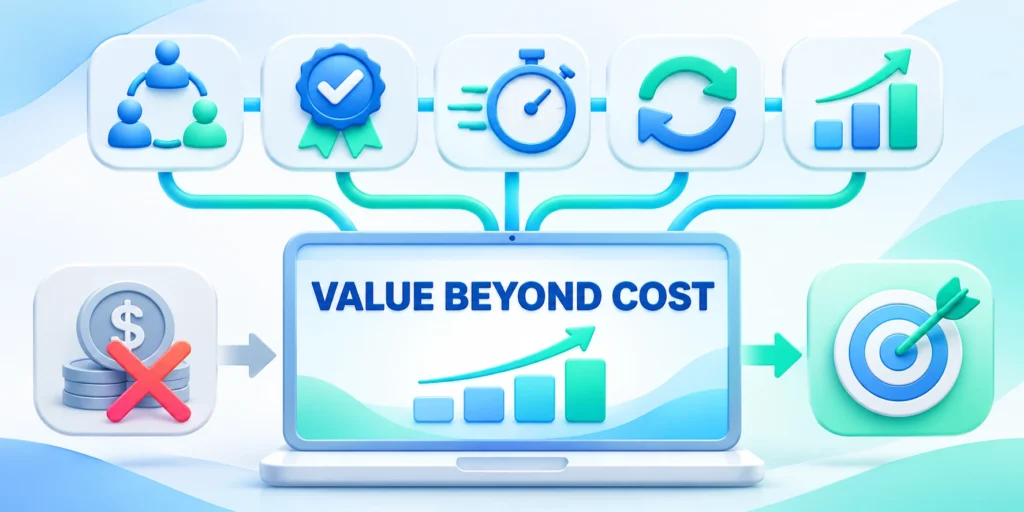
Nearshore economics may improve access to capable specialists, yet hourly comparisons ignore management effort, rework, continuity, speed, and commercial impact.
Evaluate the total operating model and the outcomes it can sustain rather than treating geographic labor differences as the strategy.
Compare total value and delivery risk
Include onboarding, tools, internal coordination, quality assurance, turnover, delays, taxes, currency, and knowledge loss when comparing options.
A higher nominal rate may create better economics when experienced contributors reduce rework, expose risks earlier, and improve decision quality.
Compare these factors beyond the hourly rate:
- Collaboration and management effort
- Quality and avoidable rework
- Continuity and specialist coverage
- Speed to measurable business evidence
Exchange rates and local compensation structures may produce a lower price than comparable US or European delivery. The difference varies by role, seniority, and contract.
Published percentages such as “30% to 50% savings” should not be accepted without comparable scopes. Two retainers rarely include identical people, tools, or responsibilities.
Use these decision criteria for Cost can be:
- Compare effective senior hours, not only total monthly fees.
- Separate software, media, research, and production expenses.
- Include management, onboarding, and quality-assurance time.
- Estimate the internal effort required from sales and subject experts.
- Model currency and tax treatment with qualified advisers.
The strongest business case usually combines access, speed, and capability. Lower cost helps, but it cannot compensate for weak positioning or unreliable execution.
Language and cultural alignment require evidence
Brazilian professionals working in international technology markets may operate fluently in English. That capability varies and should be tested for every client-facing role.
Compare these priorities for Language cultural alignment:
- Run the discovery call with the people who will perform the work.
- Review an English deliverable written by the proposed team.
- Test how they explain a complex product without internal jargon.
- Ask them to summarize a meeting and record decisions.
- Evaluate whether feedback is clarified before work proceeds.
Cultural alignment also depends on the client. The agency must understand the target market, not merely share some business habits with the client team.
A Brazil-based agency selling into the United States must research US buyers, regulations, language, category conventions, and competitive expectations for that market.
Nearshore B2B marketing operating model

A nearshore relationship succeeds when both organizations create one working system. Shared hours help, but they do not replace decision rights, documentation, or quality controls.
The model should connect business priorities to weekly work while protecting the client from unnecessary meetings, unclear ownership, and dependency on one individual.
Start with an accountable client owner
The agency cannot resolve internal disagreements about positioning, pricing, sales qualification, or product priorities. A client owner must settle those decisions.
That owner does not need to manage every task. The role protects access to information, approvals, and executive direction.
Review these practical points for Start accountable client:
- Approve quarterly priorities and budget boundaries.
- Provide access to subject-matter experts.
- Resolve conflicts between sales and marketing definitions.
- Escalate legal, security, and brand questions.
- Accept or reject material changes in scope.
Without this role, the agency may optimize isolated channels while the client’s larger commercial constraints remain unresolved.
Define a small core team and specialist access
A credible proposal distinguishes recurring team members from specialists who participate only when needed. Both can be valuable, but the allocation must be visible.
| Role | Primary responsibility | Common involvement |
|---|---|---|
| Engagement lead | Priorities, risks, coordination, and reporting | Continuous |
| B2B strategist | Market, positioning, offers, and campaigns | Continuous or scheduled |
| Content or SEO lead | Research, editorial system, organic acquisition | Based on program |
| Demand specialist | Paid campaigns, audiences, and experiments | Based on program |
| RevOps specialist | CRM, lifecycle, routing, attribution, governance | Milestones plus support |
| Designer or developer | Creative systems, landing pages, and integrations | Planned capacity |
Ask whether senior people remain involved after the sale. A senior-led proposal with junior-only delivery creates risk unless supervision is explicit and funded.
Use a clear decision and approval path
Every deliverable should have one client approver and one agency owner. Group review can provide input, but consensus should not become an undefined requirement.
Consider these operating checks for Use clear decision:
- The agency submits the deliverable with its purpose and decision request.
- Reviewers place comments in one agreed system.
- The client owner resolves conflicting feedback.
- The agency records changes and questions.
- Final approval accepts the deliverable or requests specific corrections.
Approval times belong in the delivery plan. A five-day client delay should not silently become an agency performance failure or compress the remaining quality checks.
Document work where both teams can find it
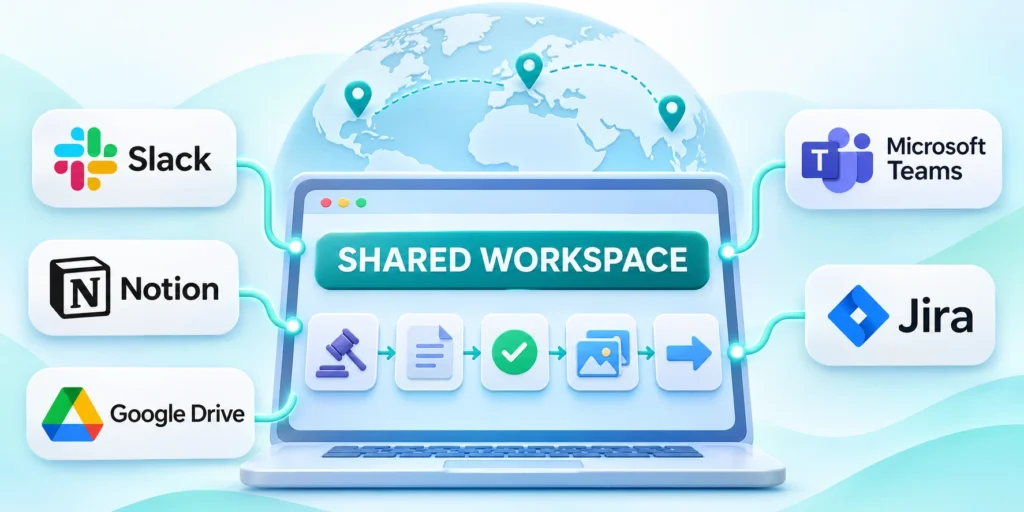
A shared workspace keeps briefs, decisions, owners, approvals, assets, risks, and current status available across the client and nearshore team.
Documentation should reduce dependence on meetings without becoming a second delivery system that nobody maintains.
Create one dependable operating record
Choose authoritative locations for plans, tasks, files, decisions, and measurement. Link systems rather than copying conflicting versions across tools.
Define naming, access, update ownership, review cadence, and archival rules so contributors can locate the current evidence quickly.
Keep these records accessible to both teams:
- Current priorities and accountable owners
- Approved briefs and asset versions
- Decisions, assumptions, and exceptions
- Metrics, risks, and next reviews
Synchronous communication is valuable for discovery and decisions. Durable execution still requires written records that survive staff changes and busy schedules.
Use these decision criteria for Document work where:
- Business goals and current assumptions
- Ideal customer profile and exclusions
- Messaging and evidence library
- Campaign briefs and approval status
- CRM definitions and field ownership
- Experiment log and decision history
- Access inventory and offboarding checklist
A shared workspace reduces repeated explanations. It also gives the client a recoverable operating record if the relationship changes.
For a deeper model covering handoffs, ownership, and shared revenue definitions, review the RevOps playbook for sales and marketing alignment.
Maintain the record as work changes
Update the authoritative record when priorities, owners, dates, scope, evidence, or approvals change, rather than relying on chat history.
Use short decision notes that preserve context, alternatives, assumptions, the chosen action, and the next review trigger.
Audit these records during every operating review:
- Current priorities and owners
- Latest approved assets
- Open risks and decisions
Archive obsolete versions clearly so contributors do not revive superseded decisions, assets, or instructions during later delivery cycles.
Core nearshore B2B marketing capabilities

A nearshore agency should not sell an undifferentiated menu. Its capabilities must connect to a defined commercial problem, internal gap, and measurable operating outcome.
The client rarely needs every service at once. A focused sequence usually produces better learning and less coordination cost than a broad simultaneous launch.
Market research and positioning
Effective execution starts with a clear market hypothesis. The agency should understand the buyer’s problem, existing alternatives, purchase risks, and evidence required for trust.
Compare these priorities for Market research positioning:
- Interview customers, prospects, salespeople, and product leaders.
- Analyze win-loss notes, call transcripts, and CRM patterns.
- Map competitors by buyer problem and positioning claim.
- Define ideal accounts, disqualifiers, and buying triggers.
- Create a messaging hierarchy grounded in available evidence.
The output should guide pages, campaigns, sales conversations, and product content. A slide deck that never changes execution has limited value.
B2B SEO and expert-led content
B2B organic growth depends on matching distinct buyer questions to useful pages. It also requires technical foundations that let search engines discover and understand those pages.
Review these practical points for B2B SEO expert-led:
- Inventory existing pages, performance, and search intent.
- Identify overlaps, gaps, and pages with a conversion role.
- Build topic groups around real buyer decisions.
- Interview internal experts for proprietary knowledge.
- Publish, connect, and update content based on evidence.
High-volume terms may be irrelevant for a specialized seller. Commercial intent, account fit, and contribution to sales conversations deserve greater weight than raw traffic.
For companies entering several markets, the international SEO strategy guide for SaaS expansion explains localization, architecture, and governance in greater depth.
Demand generation and paid acquisition
Paid media can capture active demand, reach defined accounts, and test messages quickly. It cannot repair an unclear offer or an unusable sales process.
Consider these operating checks for Demand generation paid:
- Google Ads for explicit problem and solution searches
- LinkedIn campaigns for account, role, and industry targeting
- Retargeting designed around meaningful buyer progression
- Landing pages aligned to one audience and action
- Offline conversion imports from qualified CRM stages
The agency should disclose media fees, management fees, creative costs, and platform dependencies. Campaign economics remain impossible to judge when these costs are blended.
The B2B demand generation masterclass provides a fuller framework for offers, buying groups, qualification, and pipeline measurement.
Account-based marketing

Account-based marketing coordinates evidence, messages, content, advertising, sales activity, and measurement around selected organizations and their buying groups.
Nearshore execution works best when account selection, ownership, personalization boundaries, and sales follow-up remain explicit.
Coordinate account engagement across teams
Define why each account belongs in the program, which buying roles matter, and which observable signals justify additional investment.
Connect campaign activity with CRM history and sales feedback so the team can distinguish engagement from genuine commercial progression.
Align these elements before launching account programs:
- Account selection and tier criteria
- Buying roles and evidence needs
- Personalization and channel boundaries
- Sales action and progression measures
Account-based marketing coordinates attention around a limited set of valuable accounts. It works best when sales and marketing share account selection and progression criteria.
Use these decision criteria for Account-based marketing:
- Define the account universe and required firmographic evidence.
- Tier accounts according to value and information available.
- Map roles, problems, and proof for each buying group.
- Coordinate advertising, content, outreach, and executive involvement.
- Measure account engagement, meetings, opportunities, and movement.
Personalization should reflect known account conditions. Changing a company name inside generic copy does not create a meaningful account experience.
See the detailed guide to account-based marketing with LinkedIn Ads for account tiers, buying groups, campaign sequences, and CRM coordination.
Revenue operations and CRM architecture
RevOps connects marketing activity to shared lifecycle definitions, data ownership, routing, sales follow-up, forecasting, and customer outcomes.
A nearshore team can support this work, but system changes need controlled access, testing, documentation, and an accountable client administrator.
Compare these priorities for Revenue operations CRM:
- Lifecycle and lead-status definitions
- Required fields and data-quality rules
- Lead, account, and opportunity routing
- Marketing automation and suppression logic
- Campaign and source governance
- Dashboards for pipeline and revenue
- Change logs and rollback procedures
The agency should never promise a universal five-minute response rule without operational evidence. Appropriate service levels depend on coverage, lead type, routing, and sales capacity.
Web, conversion, and integration work
Some growth problems sit between marketing and engineering. Examples include slow landing pages, unreliable forms, disconnected systems, and analytics that cannot identify qualified outcomes.
Review these practical points for Web conversion integration:
- Build or improve conversion-focused service pages.
- Connect forms to CRM records and consent fields.
- Implement server-side or offline conversion workflows.
- Create gated resources with practical access controls.
- Integrate approved systems through documented APIs.
- Test accessibility, performance, and failure handling.
Custom development should solve a defined operational problem. It should not become an expensive substitute for configuring a supported feature already available in the client’s stack.
AI-assisted workflows with human accountability
Generative AI can accelerate research organization, drafts, classification, and repetitive analysis. It does not remove the need for approved data, expert review, or factual verification.
Consider these operating checks for AI-assisted workflows human:
- Define approved and prohibited data before tool use.
- Separate public information from confidential material.
- Record where human review is mandatory.
- Test output quality against representative cases.
- Monitor errors, drift, and unintended disclosure.
- Keep final commercial decisions with accountable people.
An agency should explain which tools receive client data, how access is controlled, and whether client content trains third-party models under the selected terms.
Build a B2B demand system

Services create value when they operate as one learning system. Research informs offers, campaigns create signals, sales provides feedback, and CRM data improves the next decision.
A nearshore team can manage much of this loop during shared hours, while internal leaders retain control over product, pricing, customer evidence, and revenue commitments.
Step 1: define the commercial problem
“Generate more leads” is rarely specific enough. The team needs to know which pipeline constraint the program should address.
Use these decision criteria for Step 1 define:
- Too few qualified accounts know the company.
- Existing demand goes to competitors.
- Traffic reaches pages that do not support decisions.
- Sales receives unsuitable or incomplete inquiries.
- Opportunities stall because buyers lack evidence.
- Marketing cannot connect activity to revenue stages.
Each constraint requires a different program. Increasing campaign volume can make a qualification problem worse by sending more unsuitable demand to sales.
Step 2: agree on the ideal account and buying group
The ideal customer profile defines organizations that can receive value, buy successfully, and remain economically attractive to serve.
It should include exclusions. Clear disqualifiers reduce wasted media, irrelevant content, and sales conversations that cannot progress.
Compare these priorities for Step 2 agree:
- Industry and business model
- Company size or operational complexity
- Technology or process conditions
- Geographic and regulatory constraints
- Trigger events and urgency
- Minimum value or implementation fit
- Known reasons to disqualify
The buying group adds people to the account definition. Economic buyers, technical reviewers, users, legal teams, and procurement may need different evidence.
Step 3: create offers for real decisions
An offer gives the buyer a useful reason to act. It may be a consultation, assessment, benchmark, calculator, workshop, trial, or implementation plan.
The offer should reduce uncertainty about the next decision. Generic ebooks often collect contacts without revealing serious purchase intent.
| Buyer need | Useful offer | Evidence created |
|---|---|---|
| Understand current risk | Structured assessment | Prioritized gaps and recommended next step |
| Compare approaches | Decision guide or workshop | Requirements and evaluation criteria |
| Estimate impact | Scenario model | Assumptions and economic range |
| Validate execution | Limited pilot | Operational evidence and remaining risks |
The agency must avoid turning an assessment into disguised sales copy. A credible deliverable should remain useful even if the buyer delays the purchase.
Step 4: select channels by buyer behavior

Channel selection should follow where target buyers research, compare, validate, and respond rather than the agency’s preferred production capability.
Match each channel with a specific buyer behavior, offer, conversion path, owner, economic assumption, and review threshold.
Build a purposeful channel portfolio
Use search when active demand exists, professional networks for targeted reach, and educational formats when buyers need evidence before considering providers.
Limit the initial portfolio until measurement and follow-up operate reliably. Expansion should follow demonstrated learning, not activity pressure.
Evaluate these inputs before choosing each channel:
- Buyer behavior and intent
- Offer and evidence requirements
- Conversion and follow-up capacity
- Economics and learning thresholds
Channel selection should follow the audience and problem. It should not follow the agency’s preferred service or an isolated benchmark.
Review these practical points for Step 4 select:
- Use search when buyers express a recognizable need.
- Use LinkedIn when professional targeting matters.
- Content supports buyers who need education or evidence.
- Use email for consented follow-up and customer communication.
- Use partner channels when trust transfers through an ecosystem.
- Live events help when complex evaluation benefits from direct interaction.
A multi-channel plan needs a reason for each channel. Repeating the same message everywhere increases activity without necessarily improving understanding.
For a focused comparison, review Google Ads versus LinkedIn Ads for enterprise SaaS.
Step 5: connect response, qualification, and follow-up
The journey does not end when a person submits a form. The team must define what happens next, who owns it, and how the result is recorded.
Consider these operating checks for Step 5 connect:
- Validate required fields and consent.
- Match the person to an existing account when possible.
- Apply transparent qualification rules.
- Route the record to the correct owner.
- Create a response task with an appropriate deadline.
- Record disposition and follow-up outcome.
- Return aggregate feedback to marketing.
The exact workflow depends on CRM design and sales coverage. Automation should support accountability, not hide unclear ownership behind technical complexity.
Step 6: learn from pipeline evidence
Channel metrics help diagnose delivery. Commercial decisions require account quality, opportunity movement, revenue, sales feedback, and enough time for the buying cycle.
The team should review cohorts rather than celebrate every early fluctuation. A small number of enterprise opportunities can distort monthly ratios.
Use these decision criteria for Step 6 learn:
- Which accounts responded, and why were they targeted?
- Which buying roles engaged?
- What percentage met agreed qualification?
- Which offers created useful sales conversations?
- Where did opportunities stall?
- Which assumptions changed?
Learning is a deliverable. Even when a test underperforms, disciplined evidence can prevent larger spending on an invalid assumption.
Security privacy and cross-border governance

A nearshore agency may access advertising accounts, analytics, customer records, sales notes, and unpublished strategy. Security therefore belongs in vendor selection, not only onboarding.
Brazilian data-protection law provides a relevant legal framework, but geography alone does not establish compliance with every client obligation or target-market law.
Understand the legal roles before granting access
The parties should determine who controls each processing purpose and who processes data on documented instructions. Contract language should reflect the actual workflow.
The Brazilian LGPD applies under defined territorial and processing conditions. International transfers also require a valid legal basis and an authorized transfer mechanism.
International transfer implications
Brazil’s data authority issued an international transfer regulation in 2024. It covers mechanisms including standard contractual clauses, specific clauses, and binding corporate rules.
These requirements should be reviewed with qualified counsel. An agency should not present LGPD familiarity as automatic GDPR or CCPA compliance.
Apply least-privilege access
Each person should receive only the access required for assigned work. Shared administrator accounts undermine accountability and complicate offboarding.
Compare these priorities for Apply least-privilege access:
- Create named accounts through approved client systems.
- Require multi-factor authentication where supported.
- Assign the lowest practical role.
- Separate production, testing, and reporting access.
- Review access at agreed intervals.
- Remove access promptly after role or contract changes.
For API work, credentials should remain in approved secret-management systems. They should not appear in tickets, chat messages, spreadsheets, or source files.
Minimize data used for marketing work
Many marketing tasks can use aggregated, pseudonymized, or restricted data. The team should challenge requests for broad CRM exports when a smaller dataset is sufficient.
Review these practical points for Minimize data used:
- Document the purpose of each data access.
- Limit fields to those needed for that purpose.
- Set retention and deletion expectations.
- Control downloads and local copies.
- Review subprocessors and connected applications.
- Define incident notification and cooperation duties.
A client should know where records are stored, which systems receive them, and whether team members work from managed devices.
Preserve client control over accounts and assets
Advertising accounts, analytics properties, domains, source repositories, and primary CRM instances should normally remain under client ownership.
The contract should address ownership of campaign structures, creative files, code, research, documentation, and reusable agency materials.
Consider these operating checks for Preserve client control:
- Define ownership before work begins.
- Record third-party license limitations.
- Require exportable source files and documentation.
- Maintain a current access inventory.
- Use an offboarding checklist with confirmed revocation.
This structure protects continuity without preventing the agency from using its own general methods, templates, and pre-existing intellectual property.
How to evaluate a nearshore B2B marketing agency in Brazil

A strong selection process tests how the agency thinks, delivers, protects data, and learns. Credentials matter, but evidence from the proposed working team matters more.
The goal is not to find a provider that agrees with every assumption. The goal is to find one that can challenge assumptions constructively and execute reliably.
Evaluate B2B understanding
Ask the team to explain the buying group, sales process, evidence needs, and operational handoffs for your market.
Generic channel fluency is insufficient when decisions require technical accuracy, long cycles, multiple stakeholders, and disciplined follow-up.
Use these decision criteria for Evaluate B2B understanding:
- How do you distinguish an inquiry from a qualified opportunity?
- How do you research a buying committee?
- What evidence changes by role and sales stage?
- How do you work with sales on qualification?
- How do you measure programs with long buying cycles?
Good answers acknowledge uncertainty and context. Be cautious when every problem receives the same channel, funnel, or campaign framework.
Inspect relevant work without accepting vanity evidence
A case study should explain the initial condition, intervention, time period, client contribution, and measurement limitations.
Traffic growth may be valuable, but it does not prove pipeline impact. Lead volume may rise while account fit deteriorates.
Compare these priorities for Inspect relevant work:
- Ask which parts of the result the agency controlled.
- Request examples resembling the buyer’s complexity.
- Check whether the team handled strategic and operational work.
- Understand what failed and how the approach changed.
- Verify references with client permission when material.
Confidentiality can limit disclosure. In that case, the agency should still describe its process, decisions, and safeguards without inventing unsupported performance claims.
Meet the delivery team
Sales presentations often feature agency leaders. Delivery quality depends on the people assigned after the contract is signed.
Review these practical points for Meet delivery team:
- Names, roles, location, and working hours
- Relevant experience and language responsibilities
- Expected allocation and concurrent clients
- Senior review and quality-assurance process
- Backup plan for absence or turnover
- Use of subcontractors and required approvals
Run part of the evaluation in the normal working language. This tests communication more accurately than a generic claim about fluency.
Review the proposed operating plan
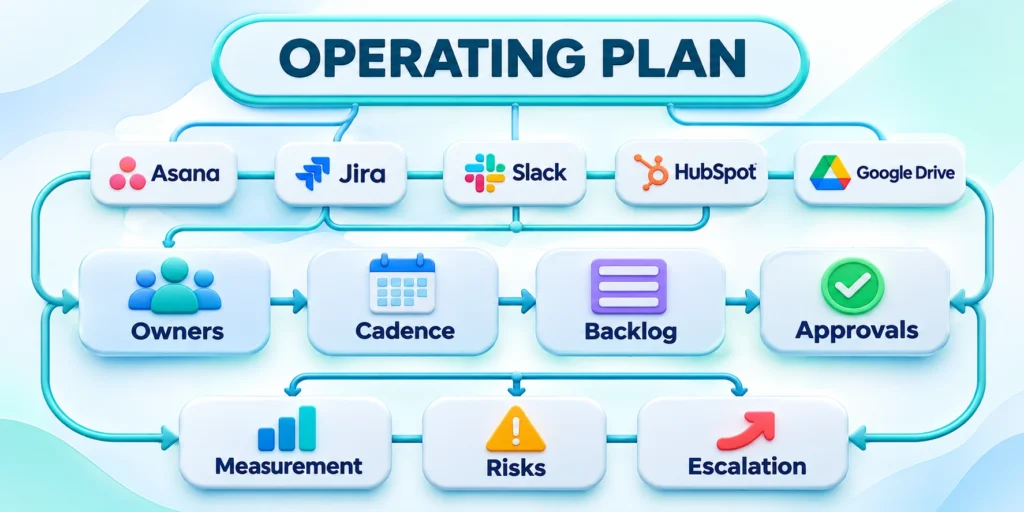
The proposed operating plan should explain how priorities become work, how decisions move, and how performance, risk, and capacity remain visible.
Review the actual named team, allocation, cadence, tools, approvals, dependencies, escalation, measurement, and continuity protections before contracting.
Test whether the plan can operate daily
Walk through a representative request, urgent change, delayed approval, quality failure, and staff absence using the proposed workflow.
Ask who notices each problem, who decides, which evidence is preserved, and how the schedule or scope changes afterward.
Test these operating-plan elements before approval:
- Named roles and decision rights
- Cadence, backlog, and approvals
- Quality, metrics, and reporting
- Risks, backups, and escalation
The proposal should translate goals into a sequence of decisions, deliverables, dependencies, and measurements. A list of services is not an operating plan.
| Area | What a credible proposal explains |
|---|---|
| Scope | Scope, exclusions, assumptions, and changes |
| Team | Roles, allocation, oversight, and backups |
| Cadence | Meetings, updates, reviews, and response times |
| Measurement | Baseline, metrics, systems, limits, and decisions |
| Security | Access, devices, credentials, vendors, incidents |
| Commercials | Fees, tools, expenses, taxes, and termination |
If a proposal depends on client data or access, those dependencies should be stated. Otherwise, an unrealistic schedule may appear firm while remaining impossible to start.
Compare total value, not headline rates
A low retainer can become expensive when the client must rewrite deliverables, manage every task, or repair systems after undocumented changes.
Consider these operating checks for Compare total value:
- Monthly and one-time fees
- Media, software, data, and production costs
- Expected internal client hours
- Ramp-up and knowledge-transfer time
- Contract flexibility and transition costs
- Risk created by undocumented dependencies
Use comparable scenarios. A senior strategy engagement and a production-only retainer should not be scored as interchangeable options.
Watch for avoidable red flags
Investigate vague ownership, hidden subcontracting, guaranteed outcomes, weak documentation, unclear measurement, and reluctance to discuss failure scenarios.
A credible provider states dependencies, limits, uncertainty, escalation paths, and the client participation required for effective delivery.
Use these decision criteria for Watch avoidable red:
- Guaranteed rankings, revenue, or lead counts without defensible conditions
- Unclear ownership of accounts, data, code, or creative assets
- No access to the proposed delivery team
- Administrative access requested before a security review
- Reporting limited to impressions, clicks, and form fills
- Unexplained dependence on proprietary dashboards or accounts
- Pressure to launch every channel simultaneously
- Claims that Brazil automatically ensures legal compliance
One concern may be correctable. A pattern of vague ownership, aggressive guarantees, and weak controls signals a structural risk.
Ninety-day nearshore marketing pilot

A pilot can reduce commitment risk when it tests a meaningful workflow. It should produce evidence about collaboration, execution, and commercial assumptions.
The pilot should not promise full revenue transformation within three months. Its purpose is to establish foundations, launch bounded work, and assess leading evidence responsibly.
Days 1–30: discovery and baseline
The first month should replace assumptions with a shared view of the market, systems, data, constraints, and current performance.
Compare these priorities for Days 1 30:
- Confirm goals, scope, owners, and decision rights.
- Interview sales, marketing, product, and customer teams.
- Review positioning, offers, pages, campaigns, and content.
- Audit CRM definitions, routing, and reporting availability.
- Establish access through approved security controls.
- Document baseline metrics and known data limitations.
- Select one bounded demand or operations hypothesis.
A useful first-month deliverable is a prioritized plan with assumptions, dependencies, owners, and reasons. It should not become a long undifferentiated audit.
Days 31–60: build and launch
The second month turns the selected hypothesis into working assets and controls. The scope should be large enough to test collaboration and small enough to govern.
Review these practical points for Days 31 60:
- Approve the audience, offer, message, and success criteria.
- Build the required content, page, workflow, or campaign.
- Complete technical and security review.
- Test forms, routing, analytics, and CRM records.
- Launch with controlled spend or volume.
- Record issues and corrective actions.
The team should test the entire buyer path before launch. A working advertisement cannot compensate for a broken form or missing sales notification.
When paid campaigns depend on CRM outcomes, the guide to tracking offline CRM conversions in Google Ads explains the technical connection.
Days 61–90: optimize and decide
The final month should improve execution using observed evidence. It should also prepare an explicit decision about continuing, changing, expanding, or ending the engagement.
Consider these operating checks for Days 61 90:
- Review delivery quality and approval reliability.
- Analyze audience, engagement, and qualification signals.
- Inspect CRM routing and sales follow-up.
- Identify data gaps that limit interpretation.
- Document what changed and why.
- Recommend the next 90 days with resource requirements.
- Complete knowledge transfer for all pilot assets.
The decision should separate partnership performance from market evidence. A well-run test may reveal that the offer or audience assumption needs revision.
Choose a pilot that exposes real operating conditions
A superficial pilot tests production speed but reveals little about strategic judgment, data handling, sales coordination, or revenue measurement.
| Pilot | What it tests | Likely limitation |
|---|---|---|
| CRM and lifecycle audit | RevOps depth, data reasoning, and documentation | Limited direct market feedback |
| High-intent search sprint | Positioning, paid search, landing page, routing | Demand volume may be small |
| Account-based campaign | Research, personalization, and orchestration | Revenue outcome may need more time |
| Expert content program | Interviews, technical accuracy, quality, and SEO | Organic performance develops slowly |
The best pilot addresses a current business constraint and exercises the capabilities required in a longer relationship.
Measure nearshore B2B marketing performance

Performance should show whether the partnership executes reliably and whether marketing contributes to useful commercial outcomes. One dashboard rarely answers both questions.
A balanced review combines delivery, audience, qualification, pipeline, revenue, and learning. The mix changes according to program maturity and sales-cycle length.
Measure delivery quality first
Commercial results take time and involve factors beyond the agency. Delivery indicators reveal whether the operating system is functioning now.
Use these decision criteria for Measure delivery quality:
- Milestones completed against agreed dates
- Approval turnaround and blocked time
- Defect or revision patterns
- Response to incidents and unexpected changes
- Documentation completeness
- Access and security review status
- Budget use against approved scope
These indicators should not reward speed at the expense of accuracy. A rushed campaign that creates bad data is not successful delivery.
Separate channel signals from business outcomes
Channel metrics show exposure and response, while business outcomes depend on qualification, sales execution, customer fit, timing, and economics.
Report the layers separately so leaders can locate constraints without crediting or blaming marketing for every downstream result.
| Layer | Example measures | Main question |
|---|---|---|
| Delivery | Milestones, defects, approvals, spend | Did the team execute the agreed work? |
| Audience | Qualified reach, visibility, account engagement | Did the right market encounter the program? |
| Response | Relevant inquiries, meetings, content use | Did buyers take a meaningful next step? |
| Pipeline | Accepted leads, opportunities, stage movement | Did commercial evaluation progress? |
| Revenue | Won value, acquisition cost, payback contribution | Did the program support economic results? |
| Learning | Validated and rejected assumptions | Did the organization improve its next decision? |
Channel metrics remain useful for diagnosis. Click-through rate can identify a message problem, but it should not be reported as proof of revenue impact.
Use agreed qualification definitions
Marketing and sales need a shared definition of a useful handoff. Otherwise, lead quality debates become subjective and repetitive.
Compare these priorities for Use agreed qualification:
- Account fit criteria
- Role or buying influence
- Problem relevance
- Timing or trigger evidence
- Required contact information
- Reasons for rejection
- Expected follow-up action
Definitions should be tested against real opportunities. They may change as the company learns which customers implement successfully and remain valuable.
Treat attribution as evidence with limits
B2B purchases involve multiple people and interactions. No attribution model reconstructs every influence with certainty.
Use consistent campaign tracking, CRM associations, and offline conversions. Then interpret them alongside sales notes, account activity, and timing.
Review these practical points for Treat attribution evidence:
- Document what the model counts.
- Identify missing channels and untracked interactions.
- Keep source and campaign naming governed.
- Avoid changing models to favor a preferred channel.
- Use ranges when precise allocation is unsupported.
Reporting becomes credible when limitations are visible. False precision can produce worse budget decisions than a careful directional conclusion.
Set review horizons by program type
Paid campaigns can generate delivery and response data quickly. Enterprise opportunities and organic search effects often need longer observation.
Consider these operating checks for Set review horizons:
- Weekly: delivery, spend, technical problems, and immediate signals
- Monthly: audience quality, qualification, experiments, and pipeline creation
- Quarterly: opportunity progression, economics, strategic changes, and resource allocation
- Longer cycle: closed revenue, retention implications, and durable organic contribution
A review cadence should match decision speed. It should not force conclusions before enough evidence exists.
Engagement pricing and contract

The commercial model should reflect the work’s uncertainty and the client’s management capacity. No pricing format is inherently best for every B2B program.
A useful contract makes responsibilities, assumptions, costs, data handling, ownership, and transition obligations clear before the relationship becomes difficult to change.
Common commercial models
| Model | Strength | Risk |
|---|---|---|
| Fixed project | Clear deliverable and budget | Discovery changes can complicate fixed scope |
| Monthly retainer | Continuity and flexible prioritization | Capacity and outcomes may remain vague |
| Managed team | Dedicated multidisciplinary ownership | Needs sufficient scope and governance |
| Time and materials | Fits uncertain technical work | Needs strong prioritization and cost visibility |
| Performance component | Can align incentives around measurable outcomes | Attribution dependencies can distort incentives |
Performance pricing requires an agreed baseline, controllable outcome, reliable data, and rules for sales capacity, pricing changes, seasonality, and existing demand.
If those conditions are absent, a performance fee may reward low-quality volume or trigger disputes about attribution.
Questions to resolve before signing
Resolve material commercial, operational, security, ownership, and termination questions in writing before work begins.
Ambiguity at contracting usually becomes delivery friction when priorities change, access is delayed, or performance expectations diverge.
Use these decision criteria for Questions resolve before:
- Which deliverables, channels, markets, and systems are included?
- What assumptions can change the timeline or fee?
- How much specialist capacity is committed?
- Which tools and data providers require separate payment?
- How are media budgets approved and reconciled?
- Who owns accounts, files, code, and research?
- Which subprocessors may receive client information?
- How are security incidents handled?
- What notice, transition, and knowledge-transfer duties apply?
- Which country’s law and dispute process govern the contract?
Legal and tax advice should come from qualified professionals. The agency can explain its normal structure, but it should not decide the client’s obligations.
Build currency and payment clarity
Cross-border agreements should state the billing currency, payment method, due date, banking charges, tax documentation, and treatment of exchange-rate changes.
A fixed foreign-currency fee may simplify the client’s budget while transferring more exchange risk to the agency. Other structures distribute that risk differently.
Compare these priorities for Build currency payment:
- Record the invoicing entity and jurisdiction.
- Confirm purchase-order and vendor-onboarding requirements.
- Identify withholding or documentation questions early.
- Separate pass-through expenses from professional fees.
- Require approval before unplanned external costs.
Commercial clarity protects both parties. It lets the agency staff responsibly and lets the client compare proposals on a consistent basis.
When a nearshore agency may be the wrong choice
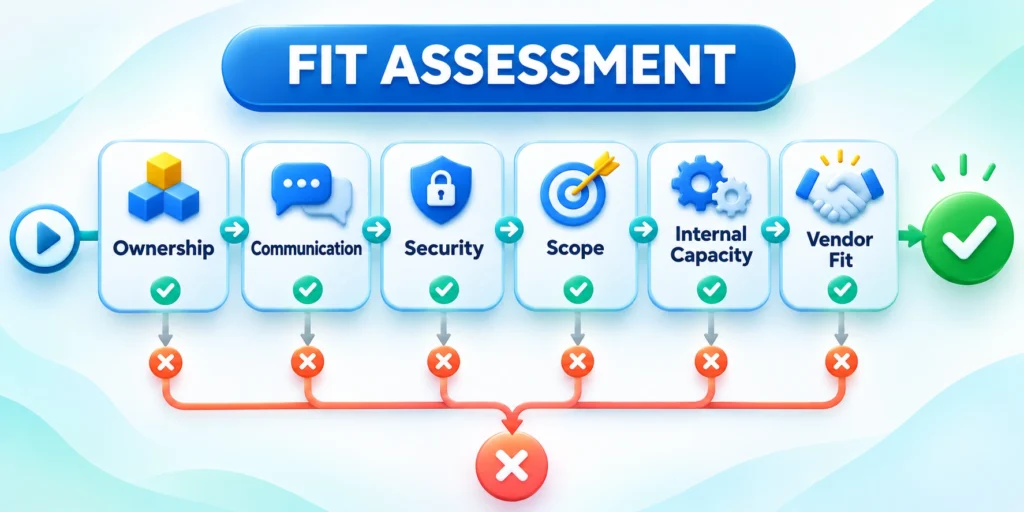
Nearshore delivery cannot compensate for absent ownership, inaccessible evidence, undefined priorities, unsuitable access rules, or unwillingness to collaborate across organizations.
A different model may fit when work requires constant physical presence, internal authority, highly restricted access, or daily direction the client cannot provide.
Assess readiness before outsourcing responsibility
Identify the internal owner, available subject-matter experts, approval capacity, security constraints, and systems the provider would need before requesting proposals.
Delay or narrow the engagement when foundational decisions remain unresolved. A bounded advisory assessment may be safer than immediate execution.
Check these readiness conditions before nearshore delivery:
- Accountable internal ownership
- Accessible evidence and systems
- Timely decisions and collaboration
- Compatible security and operating constraints
Nearshore delivery is useful, but it does not fit every company, stage, or assignment. A candid evaluation should include reasons to choose another model.
An early startup without clear product ownership may need internal commercial leadership before adding an external multidisciplinary team.
Review these practical points for When nearshore agency:
- Choose an employee when the role requires continuous institutional authority.
- Choose a local regulated specialist when jurisdiction-specific practice dominates the assignment.
- A narrow consultant fits work where diagnosis matters more than recurring execution.
- Choose staff augmentation when the client already manages the complete marketing system.
- Delay the engagement when product, pricing, or customer ownership remains unresolved.
A company may also need onshore delivery when contractual restrictions require work within a specific territory or security-cleared environment.
Conversely, a distant offshore specialist may be appropriate for well-documented production work that does not require frequent live collaboration.
Test internal readiness
Even an excellent agency struggles when nobody can approve priorities, provide evidence, answer product questions, or follow up with qualified buyers.
Consider these operating checks for Test internal readiness:
- An executive sponsor can resolve cross-functional decisions.
- Sales can provide timely disposition feedback.
- Subject experts can support scheduled interviews.
- Security and legal owners can review access.
- Baseline data is available or its absence is acknowledged.
- The organization can implement recommendations it approves.
If several conditions are missing, begin with a smaller readiness project. That project can define ownership, clean essential data, and prepare a realistic pilot.
The decision is therefore comparative. Select the delivery model that matches the work’s authority, collaboration, risk, and knowledge-transfer requirements.
FAQ
What is a nearshore B2B digital marketing agency?
It is a marketing provider in a nearby country or region that supports B2B growth with substantial working-hour overlap and cross-border collaboration.
The model may include strategy, content, SEO, paid media, RevOps, analytics, design, and development. B2B specialization matters more than the geographic label alone.
Why hire a nearshore marketing agency in Brazil?
Brazil can offer substantial overlap with North American working hours, a broad digital talent market, and access to multidisciplinary teams.
Buyers should verify the actual team, English delivery, target-market knowledge, security practices, and commercial fit. Nationality does not guarantee those capabilities.
How much does a Brazilian nearshore B2B agency cost?
Fees vary by team seniority, scope, capacity, technology, media responsibility, and contract structure. A defensible price comparison requires equivalent responsibilities and included costs.
Request a transparent breakdown of professional fees, tools, media, production, data, and expenses. Avoid relying on a universal savings percentage.
What is the difference between nearshore and offshore marketing?
Nearshore teams generally operate in a nearby region with more shared business hours. Offshore teams are farther away and may depend more on asynchronous handoffs.
Neither model is automatically better. Specialization, operating discipline, communication, security, and total value determine whether a provider fits the work.
Can a Brazilian agency work during US business hours?
Teams in São Paulo and Brasília use UTC−3, which creates broad overlap with US Eastern and Central working hours.
US daylight saving changes the difference seasonally. Pacific teams retain some overlap, but meeting windows need more deliberate scheduling.
Do Brazilian B2B marketing agencies work in English?
Some Brazilian agencies deliver international work in English, but capability varies by person and task. Test the proposed team during evaluation.
Review written work, hold a working session, and assess how team members explain technical subjects. Do not rely only on sales-stage fluency.
Is it safe to share CRM data with a nearshore agency?
It can be safe when the parties use appropriate contracts, limited access, approved devices, secure credentials, data minimization, monitoring, and reliable offboarding.
The client should complete legal and security review before access. LGPD familiarity does not automatically satisfy GDPR, CCPA, or company-specific requirements.
Which services should be outsourced first?
Start with a bounded problem that exposes the capabilities needed later. Examples include a CRM audit, high-intent campaign, expert content program, or ABM pilot.
Avoid outsourcing product truth, pricing authority, customer relationships, and final legal decisions. The agency needs access to those owners, not control over them.
How long does nearshore B2B marketing take to produce results?
Delivery and initial campaign signals may appear within weeks. Qualified pipeline, organic visibility, and closed revenue usually require longer, depending on the sales cycle.
Set separate horizons for execution, audience response, pipeline movement, and revenue. Do not interpret an early channel metric as a final business result.
How should a company measure a nearshore agency?
Measure delivery quality, qualified audience response, accepted handoffs, opportunity progression, revenue contribution, budget use, and learning.
Agree on definitions and data sources before launch. Interpret attribution with known limitations, especially when several people and channels influence the purchase.
Choose the next step

Brazil can be a strong base for nearshore B2B marketing when the agency provides relevant expertise, secure operations, clear ownership, and evidence-based measurement.
The decision should begin with the client’s constraint. Location improves collaboration, but the operating model determines whether that access becomes commercial value.
Use these decision criteria for Choose next step:
- Choose a CRM or lifecycle audit when data and handoffs are unreliable.
- Choose a high-intent campaign when demand exists but acquisition is inefficient.
- Use expert content when buyers lack useful evidence.
- Choose an ABM pilot when a limited account set matters most.
- Choose positioning work when channels produce attention without qualified response.
Fase Network can assess the current demand system, define a bounded pilot, and assemble the nearshore capabilities required for the approved scope.
Discuss a nearshore B2B marketing engagement with Fase Network and bring the current goals, markets, systems, constraints, and available baseline data.
Prepare a bounded nearshore starting point
Choose one commercially meaningful scope that exposes collaboration, quality, access, measurement, and decision-making under representative operating conditions.
Define the baseline, owners, constraints, evidence, review date, and expansion conditions before the nearshore team begins delivery.
Confirm these conditions before starting the engagement:
- One accountable client owner
- Accessible evidence and approved systems
- Clear outcomes and review criteria
Use the first cycle to validate working assumptions rather than promising an immediate transformation across every marketing function.
Expand only when the operating model produces reliable collaboration, useful evidence, and business progress without creating hidden management burden.
Review the first cycle before expanding
Compare delivery, collaboration, quality, and commercial evidence with the baseline and document which assumptions changed during execution.
Decide whether to expand, revise, pause, or end the engagement using predefined criteria rather than momentum or sunk cost.
Contact Us on LinkedIn
Discuss your Nearshore B2B Digital Marketing priorities directly through LinkedIn.
 Sergio TimóteoConsulting EngineerDigital Marketing Strategist, CRM Certified Professional, SEO Expert, AI, Social Media, Paid Ads, Real Estate, B2C and B2B Sales. 22+ Years Growing Businesses and Startups with Technology and Innovation.LinkedIn profile