

Improve organic visibility and WordPress performance through coordinated SEO consulting, technical development, content architecture, analytics, and conversion planning. See how Fase Network connects search strategy with a maintainable website built for measurable business growth.
What integrated SEO consulting and WordPress development services include

SEO consulting and WordPress development services connect search strategy with the code, templates, content systems, and operating practices that determine whether recommendations produce durable results.
The combined model gives one accountable team responsibility for diagnosis, prioritization, implementation, measurement, and continuous improvement across the website.
Why strategy and implementation belong together
Many SEO programs stall between a recommendation and a release. Consultants identify problems, developers interpret tickets, and marketing waits for capacity.
That separation creates ambiguity about ownership. A technically correct audit may still fail when nobody translates business priorities into safe WordPress changes.
Review these practical points for Why strategy implementation:
- Research identifies how qualified prospects search, compare options, and evaluate expertise.
- Technical analysis shows which crawling, indexing, rendering, performance, or template issues limit visibility.
- Development converts priorities into maintainable themes, blocks, plugins, integrations, and deployment procedures.
- Editorial architecture gives writers reusable structures without removing necessary flexibility.
- Measurement connects releases with organic discovery, engagement, leads, pipeline, and operating cost.
An integrated partner does not treat SEO as a final checklist. Search requirements influence information architecture, component design, content models, migrations, and quality assurance from the beginning.
Development also improves consulting quality. Recommendations become more realistic when the strategist understands the current stack, release process, dependencies, and maintenance burden.
What a serious engagement should cover
The exact scope depends on the website, but a complete engagement normally combines strategic, technical, editorial, development, and governance work.
| Workstream | Primary question | Typical output |
|---|---|---|
| Search strategy | Which demand and audiences matter? | Opportunity map and priorities |
| Technical SEO | Can search engines discover and interpret it? | Validated issue backlog |
| WordPress engineering | Can the platform implement the strategy safely? | Code, templates, blocks, and tests |
| Content architecture | Can editors publish consistent, useful pages? | Taxonomy, models, and briefs |
| Performance | Is the experience fast under real conditions? | Budgets, remediation, and monitoring |
| Measurement | Does organic visibility create business value? | Dashboards and decision rules |
The deliverable is not merely a larger website. It is a controlled publishing and acquisition system that supports discovery, conversion, governance, and future change.
That distinction matters when selecting a provider. Attractive pages are valuable, but they cannot compensate for weak indexing controls, confused intent, or fragile templates.
When a business needs an SEO-first WordPress partner

A combined partner is most useful when organic growth depends on changes that cross marketing, content, design, analytics, infrastructure, and development responsibilities.
The need becomes urgent when teams repeatedly diagnose the same problems, delay implementation, or release fixes that create new technical debt.
Common signals of an execution gap
Consider these operating checks for Common signals execution:
- SEO audits accumulate while the development roadmap remains unchanged.
- Organic traffic grows, but qualified inquiries and opportunities do not.
- New templates launch without canonical, schema, heading, or indexation review.
- Editors depend on developers for routine changes or use inconsistent workarounds.
- Performance improvements disappear after plugins, campaigns, or design updates.
- Migrations cause broken links, lost metadata, or unexpected visibility declines.
- Several agencies provide conflicting instructions without a shared technical owner.
These symptoms rarely come from one isolated setting. They usually reveal a system where strategy, implementation, and quality control operate with different incentives.
A combined engagement creates a common backlog and definition of success. It also gives stakeholders one place to resolve tradeoffs before code reaches production.
Organizations that benefit most
Service businesses benefit when expertise must be translated into discoverable pages, persuasive proof, and clear conversion paths for complex purchasing decisions.
B2B companies benefit when content supports multiple roles, long sales cycles, regional markets, integrations, gated resources, and attribution beyond a simple form submission.
Use these decision criteria for Organizations that benefit:
- Growing businesses: need scalable templates before publishing volume increases.
- Enterprise teams: need governance across stakeholders, markets, permissions, and release environments.
- E-commerce operations: need controlled category architecture, product discovery, performance, and indexation.
- Publishers: need efficient taxonomies, archives, internal links, and editorial workflows.
- Replatforming teams: need migration planning that protects valuable URLs and content signals.
The model is less suitable when a business only needs a small visual change or a narrowly defined task with no search implications.
It is also unnecessary when capable internal owners already coordinate SEO, engineering, content, analytics, and release quality with sufficient capacity.
Consulting, project delivery, or ongoing partnership
Advisory consulting works when an internal team can implement recommendations. The consultant should still validate releases and remain accountable for prioritization quality.
Project delivery fits a redesign, migration, performance initiative, or new content system with a defined outcome and acceptance criteria.
Compare these priorities for Consulting project delivery:
- Consulting fits a team that has delivery capacity but lacks specialized guidance.
- A project fits an outcome whose boundaries can be defined responsibly.
- Ongoing support fits publishing, testing, and optimization that continue every month.
- Use a hybrid model when strategy and implementation intensity change across phases.
Technical SEO foundations in WordPress

Technical SEO creates the conditions for discovery, interpretation, and reliable delivery. WordPress supplies useful foundations, but configuration and custom code determine the final behavior.
The goal is not to satisfy a tool score. It is to remove barriers, clarify meaning, and preserve a stable experience for people and search systems.
Crawling, indexing, and canonical control
Search engines must reach important URLs before they can evaluate them. Navigation, internal links, sitemaps, response codes, and robots directives shape that discovery process.
Indexing decisions require additional clarity. Canonical references, duplicate variants, thin archives, parameters, pagination, and rendering behavior can create conflicting signals.
Review these practical points for Crawling indexing canonical:
- Map every indexable template and explain its user purpose.
- Identify duplicate URL paths created by parameters, archives, search, or integrations.
- Return accurate status codes for useful, redirected, missing, and unavailable resources.
- Keep XML sitemaps limited to canonical URLs intended for search.
- Ensure important pages receive contextual links from relevant, crawlable locations.
- Test rendered output when essential content depends on client-side scripts.
A robots directive is not a substitute for architecture. Blocking a crawl can hide evidence without resolving duplicates, weak navigation, or wasteful URL generation.
Canonical tags also require discipline. They express a preferred version, but redirects, internal links, sitemaps, and content should reinforce the same choice.
Information architecture and internal linking
Information architecture organizes offerings, expertise, industries, resources, and decision-support content around understandable relationships. It should serve visitors before it serves keyword mapping.
A strong structure helps users move from a broad problem toward evidence, alternatives, requirements, and an appropriate commercial next step.
Consider these operating checks for Information architecture internal:
- Assign one primary intent and role to each important page.
- Use descriptive labels that match the reader’s vocabulary.
- Build clusters around meaningful questions, not keyword variations alone.
- Link between related pages where the transition helps a real decision.
- Avoid orphan pages that depend entirely on an XML sitemap.
- Keep navigation manageable instead of exposing every URL globally.
For a deeper treatment of enterprise crawl paths and template relationships, review the guide to technical SEO architecture for large web applications.
The integrated service uses that technical discipline while keeping this engagement focused on WordPress implementation and commercial outcomes.
Metadata, headings, and structured information
Titles and descriptions should explain the page honestly. Templates need safe defaults, but important pages deserve deliberate wording based on their distinct purpose.
Heading structure should help readers scan ideas. It should not be chosen for visual size or filled with repetitive phrases.
Use these decision criteria for Metadata headings structured:
- Provide one descriptive page title through the approved template.
- Use headings in a logical order without skipping levels casually.
- Give images meaningful alternative text when they convey information.
- Generate structured data from real content and verified business details.
- Avoid duplicate schema supplied by several plugins or custom modules.
- Validate important templates after releases, not only during initial setup.
Structured data can improve machine understanding, but it cannot repair weak content or guarantee enhanced search presentation.
The development team should therefore treat markup as one tested output within a complete template, not an isolated growth tactic.
SEO-first WordPress architecture and development

SEO-first development means search, accessibility, performance, editorial control, and maintainability influence technical decisions before a template is approved.
It does not mean every design decision follows a keyword. The website must balance brand expression, usability, conversion, governance, and technical sustainability.
Themes, blocks, and component systems
A good theme produces semantic, predictable output. It should support accessible navigation, correct landmarks, responsive media, clean headings, and intentional loading behavior.
Reusable blocks reduce inconsistency when they encode appropriate constraints. Editors gain speed without rebuilding important page patterns for every publication.
Compare these priorities for Themes blocks component:
- Separate content from presentation wherever future reuse is likely.
- Define supported variants instead of unlimited styling controls.
- Preserve semantic HTML even when visual layouts become complex.
- Load component assets only when the page needs them.
- Document editorial purpose, required fields, and expected behavior.
- Test components with realistic content lengths and media.
Page builders can be useful when governed carefully. The risk comes from uncontrolled nesting, duplicated assets, inconsistent components, and layouts that nobody can maintain safely.
The correct choice depends on team capability, publishing needs, design complexity, integrations, performance expectations, and the cost of future changes.
Custom post types, taxonomies, and fields
Structured content becomes valuable when a business repeatedly publishes comparable entities, such as services, locations, resources, team members, events, or case studies.
The model should reflect real relationships. Creating a custom type for every visual variation increases complexity without improving discovery or editorial clarity.
Review these practical points for Custom post types:
- Define what each content type represents and why it deserves a distinct archive.
- Decide which fields are required, optional, repeatable, or derived.
- Specify whether each archive, taxonomy, and item should be indexed.
- Create stable URLs that survive design and campaign changes.
- Plan relationships that support useful navigation and internal links.
- Provide migration rules before replacing an existing structure.
For organizations evaluating this broader foundation, the guide to enterprise WordPress development explores architecture, security, and scalability in greater depth.
This service applies those principles proportionally. A smaller website needs clear ownership and maintainable decisions, not unnecessary enterprise complexity.
Plugin and integration governance
Plugins accelerate delivery, but each dependency adds code, data behavior, update risk, and possible overlap with other components.
An SEO-first team evaluates purpose, maintenance, permissions, performance, compatibility, data ownership, and removal cost before approving a dependency.
Consider these operating checks for Plugin integration governance:
- Keep an owner and business purpose for every active plugin.
- Remove abandoned or duplicate functionality through a controlled process.
- Test updates in an appropriate nonproduction environment.
- Monitor integrations for failures that affect content or conversion.
- Avoid exposing confidential credentials in themes or page content.
- Prefer supported extension points over edits to core or vendor files.
Traditional, decoupled, and headless approaches
Traditional WordPress can deliver strong search performance with a disciplined theme, caching strategy, content model, and deployment process.
Decoupled or headless architecture can support demanding experiences, but it introduces rendering, preview, routing, metadata, caching, and operational responsibilities.
| Approach | Strong fit | Main SEO risk |
|---|---|---|
| Traditional WordPress | Content-led marketing sites | Theme and plugin bloat |
| Hybrid or decoupled | Selective application experiences | Inconsistent rendering and ownership |
| Fully headless | Complex multichannel platforms | Missing parity, preview, or metadata |
Headless is an architectural option, not an automatic performance upgrade. The business must fund the additional engineering and governance it creates.
A consulting partner should recommend it only when measured requirements outweigh the simplicity and mature publishing experience of an appropriate traditional build.
Performance engineering and Core Web Vitals

Performance affects usability, conversion, crawling efficiency, and operational resilience. Sustainable improvement requires engineering discipline rather than a collection of emergency optimizations.
Core Web Vitals provide shared measures for loading, interaction, and visual stability. They are important indicators, but they do not describe every user experience problem.
Understand field and laboratory evidence
Field data reflects eligible real visits across devices, networks, locations, and behaviors. It is valuable for understanding what users actually experience.
Laboratory tests offer repeatable diagnostics under controlled conditions. They help teams isolate causes, compare changes, and detect regressions before release.
Use these decision criteria for Understand field laboratory:
- Largest Contentful Paint: evaluates when the main visible content finishes rendering.
- Interaction to Next Paint: evaluates responsiveness across user interactions.
- Cumulative Layout Shift: evaluates unexpected movement during the page lifecycle.
- Supporting diagnostics: reveal server, asset, rendering, script, and layout causes.
One fast test does not prove that a template performs well for real visitors. Likewise, a field decline does not identify the responsible component automatically.
The team should combine both evidence types, segment important templates, and connect changes to release history.
Build a performance budget
A performance budget defines acceptable limits for page weight, scripts, fonts, image behavior, server work, and user-facing metrics.
Budgets turn speed from a cleanup project into a release requirement. They also make tradeoffs visible before a new feature becomes permanent.
Compare these priorities for Build performance budget:
- Group pages by meaningful template instead of testing only the homepage.
- Identify the largest content element and its complete request path.
- Measure third-party scripts by business value and execution cost.
- Reserve layout dimensions for media, embeds, and dynamic interfaces.
- Reduce unused code and prevent duplicate libraries.
- Set regression thresholds within deployment quality checks.
The detailed guide to Core Web Vitals on heavy B2B WordPress sites covers remediation patterns for demanding implementations.
Within this integrated engagement, those patterns are prioritized against search opportunity, conversion value, engineering effort, and regression risk.
Typical WordPress performance bottlenecks
Review these practical points for Typical WordPress performance:
- Slow server processing caused by database work, uncached requests, or inefficient application logic.
- Oversized images or unsuitable formats delivered without responsive variants.
- Render-blocking styles, fonts, and scripts loaded on every page.
- Heavy third-party tags that compete for main-thread and network resources.
- Uncontrolled builder output with deeply nested markup and duplicate assets.
- Personalization or consent logic that changes layouts after rendering.
- Cache rules that ignore logged-in, regional, or dynamic behavior.
Optimization should begin with evidence. Removing a dependency, changing a template, or delaying a script can affect analytics, accessibility, conversion, or editorial workflows.
Safe performance work therefore includes baselines, acceptance criteria, representative tests, monitoring, and rollback planning.
Content architecture, templates, and editorial workflows
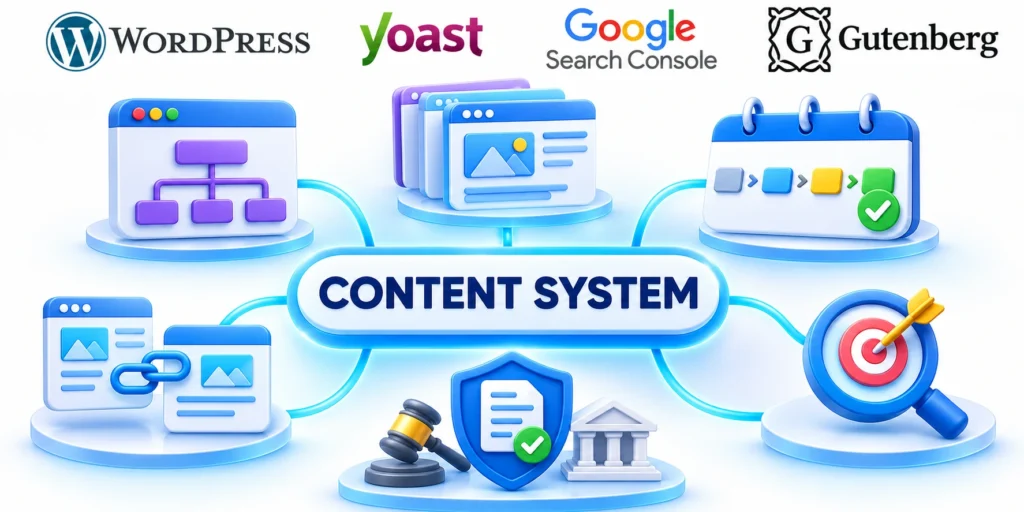
Organic growth depends on what a business can publish consistently. WordPress should make high-quality work easier without encouraging generic pages at uncontrolled scale.
The consulting team translates search demand and buyer questions into a content system with clear roles, templates, relationships, and review standards.
Map intent before designing templates
A template should support a recurring communication need. Starting with components before understanding intent often produces rigid pages filled with irrelevant sections.
Commercial pages, comparisons, guides, case studies, resources, and support content serve different decisions. They deserve different evidence and conversion patterns.
Consider these operating checks for Map intent before:
- Define the audience, problem, decision stage, and desired next action.
- Identify mandatory evidence and optional supporting material.
- Specify reusable fields only where consistency improves quality.
- Allow narrative flexibility where expertise requires explanation.
- Connect related content through useful, governed relationships.
- Review the indexation value of generated archives and filters.
This approach prevents a common failure: hundreds of structurally valid pages that provide little independent value to a reader.
Quality must remain visible in the workflow through briefs, sources, ownership, review gates, and update responsibilities.
Create an editor experience that protects quality
Editors should understand what a field controls, where it appears, and whether it affects search, accessibility, or conversion.
Helpful constraints prevent missing titles, unclear links, inaccessible images, broken layouts, and inconsistent calls to action.
Use these decision criteria for Create editor experience:
- Use descriptive field labels and concise instructions.
- Provide previews or examples for complex components.
- Limit controls that create unsupported visual combinations.
- Validate required information before a sensitive release.
- Preserve revision history and clear publishing permissions.
- Train editors on purpose, not only interface steps.
A well-designed workflow reduces both technical defects and dependence on developers. It also helps new contributors reach the expected standard faster.
Automation can flag omissions, but it cannot judge originality, accuracy, usefulness, or whether the page fulfills its promise.
Prevent cannibalization and content debt
Content debt grows when teams publish overlapping pages without ownership, update plans, or a clear role inside the site architecture.
The solution is not automatically deleting similar pages. Teams should compare intent, current performance, links, business value, and audience before deciding.
Compare these priorities for Prevent cannibalization content:
- Maintain an inventory of published, drafted, and planned URLs.
- Assign a primary intent and owner to strategic pages.
- Check existing coverage before approving a new brief.
- Update strong pages when the new contribution belongs there.
- Consolidate only with a migration and redirect plan.
- Monitor queries and landing pages for unexpected competition.
Security, maintenance, and organic traffic protection

SEO growth depends on availability, integrity, and trust. A compromised or neglected WordPress site can lose content, expose visitors, break conversions, and disrupt discovery.
Maintenance is therefore part of acquisition risk management. It should combine prevention, monitoring, tested updates, recovery, and accountable response.
Protect the complete delivery chain
Security does not come from one plugin. It depends on hosting, identities, code, dependencies, configuration, integrations, devices, and operating procedures.
The consulting team should identify critical assets, plausible threats, access paths, recovery requirements, and ownership for each control.
Review these practical points for Protect complete delivery:
- Use unique accounts, least privilege, and strong authentication.
- Keep WordPress, themes, plugins, and runtimes within supported versions.
- Remove unused software and stale administrative access.
- Protect secrets outside public repositories and page content.
- Monitor suspicious changes, failed access, availability, and certificate status.
- Maintain recoverable backups and test restoration procedures.
Search-specific monitoring should also detect unexpected indexation, injected pages, altered metadata, redirects, or links that indicate compromise.
Fast detection reduces exposure, but recovery plans must define clean restoration, credential rotation, validation, and communication.
Use a controlled update process
Updates reduce known risk and improve compatibility, yet an uncontrolled change can break templates, integrations, forms, tracking, or rendering.
A maintenance process balances urgency with verification. The appropriate depth depends on the change, business impact, and available rollback path.
Consider these operating checks for Use controlled update:
- Record the current version, dependencies, and expected behavior.
- Confirm a recent recovery point before material changes.
- Review release information and known compatibility concerns.
- Test representative templates, forms, navigation, search, and integrations.
- Deploy through an approved path with ownership and timing.
- Monitor errors, performance, analytics, and organic landing pages afterward.
The service should document what is covered, how incidents are classified, expected response windows, exclusions, and who can authorize recovery actions.
Without those definitions, a maintenance agreement may promise activity while leaving the most important business risks unowned.
The SEO consulting and development lifecycle

A mature engagement follows an evidence-based lifecycle. Each phase reduces uncertainty and produces decisions that the next phase can use.
The sequence may overlap, but teams should not begin broad implementation before understanding goals, constraints, ownership, and current behavior.
Phase 1: discovery and alignment
Discovery establishes what the website must accomplish, which audiences matter, how leads become revenue, and which constraints shape delivery.
The team interviews stakeholders, reviews analytics, maps systems, inventories content, and confirms the release environment.
Use these decision criteria for Phase 1 discovery:
- Business objectives and commercial priorities
- Audience segments and buying questions
- Current organic acquisition patterns
- WordPress architecture and dependencies
- Editorial roles and approval flows
- Measurement and data limitations
- Security, compliance, and operational constraints
Discovery should end with agreed success measures, scope boundaries, decision owners, and known assumptions.
When evidence is incomplete, the plan should identify what must be measured rather than presenting estimates as facts.
Phase 2: audit and opportunity model
The audit connects technical findings with search demand, content quality, user journeys, conversion, and business value.
A useful finding describes the evidence, affected scope, likely consequence, recommended action, dependencies, validation method, and priority rationale.
| Priority factor | Question |
|---|---|
| Business value | Which revenue or strategic outcome could improve? |
| Reach | How many important users or pages are affected? |
| Confidence | How strong is the evidence behind the diagnosis? |
| Effort | What work and testing are required? |
| Risk | What could regress or create exposure? |
| Dependency | What must happen before or after this change? |
This model prevents a long list of warnings from becoming the roadmap. High-severity labels alone do not determine what a business should implement first.
Priorities should be revisited when new evidence, releases, campaigns, or business decisions change the expected value.
Phase 3: solution design
Solution design translates findings into architecture, content models, components, migration rules, analytics requirements, and acceptance criteria.
Design decisions should be recorded with alternatives and consequences. This creates continuity when people, vendors, or priorities change.
Compare these priorities for Phase 3 solution:
- Describe the current behavior and desired behavior.
- Identify affected templates, content, data, and integrations.
- Define redirects, canonicals, metadata, and schema implications.
- Specify performance, accessibility, and security requirements.
- Create test cases for normal and failure conditions.
- Plan migration, rollback, and monitoring responsibilities.
Prototypes can clarify interaction and editorial behavior before full development. They should use realistic content, not idealized placeholders that hide edge cases.
For migrations, the design must preserve valuable URLs or define precise replacements. Redirect mapping should be reviewed before launch.
Phase 4: implementation and quality assurance
Implementation should produce reviewable changes in manageable increments. Each increment needs clear acceptance criteria and a responsible reviewer.
Quality assurance covers more than appearance. It includes rendered HTML, accessibility, search directives, content integrity, forms, analytics, performance, and failure handling.
Review these practical points for Phase 4 implementation:
- Review code and configuration through version-controlled workflows.
- Test representative content across supported devices and browsers.
- Crawl the nonproduction environment with appropriate safeguards.
- Compare metadata, links, headings, and structured output.
- Confirm analytics and conversion events with test submissions.
- Validate backups, deployment steps, and rollback readiness.
Testing should focus on risk. A navigation change deserves different checks from a copy edit, payment integration, or full template migration.
Stakeholder acceptance should confirm business behavior while specialists verify technical requirements. Neither review replaces the other.
Phase 5: release, monitoring, and improvement
A launch changes the evidence available. Teams should verify production behavior promptly and watch metrics over appropriate timeframes.
Immediate checks cover availability, rendering, indexation controls, analytics, forms, redirects, and critical journeys.
Consider these operating checks for Phase 5 release:
- Record the release time, scope, and responsible owner.
- Verify production output rather than assuming deployment succeeded.
- Monitor errors, uptime, performance, conversions, and crawl behavior.
- Annotate analytics so future reviewers can explain changes.
- Separate expected transition effects from actual defects.
- Feed validated learning into the next planning cycle.
Measuring SEO and development business impact

Measurement should explain whether the website reaches qualified people, helps them evaluate the business, and creates valuable commercial actions.
No single metric can answer that question. Teams need a connected view from technical reliability through search visibility to revenue outcomes.
Use a metric hierarchy
Use these decision criteria for Use metric hierarchy:
- Operational metrics: uptime, errors, deployment frequency, publishing time, and maintenance backlog.
- Technical metrics: indexation, crawl patterns, template defects, performance, and structured output.
- Search metrics: qualified impressions, clicks, landing pages, query themes, and visibility.
- Behavior metrics: engagement with relevant content, navigation, resources, and conversion paths.
- Commercial metrics: qualified leads, opportunities, pipeline influence, revenue, and acquisition cost.
Upstream metrics diagnose how the system works. Downstream metrics reveal whether that work contributes to business performance.
A strong program uses both. Revenue alone moves slowly, while rankings alone can improve without attracting suitable buyers.
Establish baselines and annotations
Before implementation, record performance by template, market, device, conversion type, and meaningful content group.
Baselines should include known measurement gaps. Tracking changes can create artificial gains or losses that resemble business outcomes.
Compare these priorities for Establish baselines annotations:
- Annotate releases, migrations, campaigns, outages, and tracking changes.
- Compare periods with appropriate seasonality and business context.
- Separate branded and nonbranded discovery when useful.
- Review query intent, not only aggregate traffic.
- Connect forms and calls with CRM disposition where possible.
- Document attribution limits instead of overstating precision.
An illustrative example shows the difference. A service page may lose visits after refinement while producing more qualified consultations.
That result could be positive if irrelevant queries declined and the sales team confirmed better fit. The interpretation requires multiple measures.
Evaluate return without false certainty
SEO often influences discovery and evaluation across several visits. A single attribution model will not describe every contribution accurately.
Decision-makers should examine incremental business value, avoided risk, operating efficiency, and reusable platform capability alongside directly attributed revenue.
Review these practical points for Evaluate return without:
- Value qualified outcomes more than raw sessions.
- Include sales feedback on fit and progression.
- Estimate avoided costs from defects, downtime, and rework cautiously.
- Track editorial efficiency without rewarding low-quality volume.
- Review the durability of gains after campaigns end.
- State assumptions behind every financial model.
How to choose the right WordPress SEO partner

The right partner must connect recommendations with implementation quality. Buyers should examine working methods, evidence, ownership, and long-term maintainability.
A polished proposal is not enough. The evaluation should reveal how the team handles uncertainty, tradeoffs, access, testing, releases, and measurement.
Capabilities to verify
Consider these operating checks for Capabilities verify:
- Search strategy: connects demand, intent, content, architecture, and conversion.
- WordPress engineering: understands themes, blocks, plugins, data, hosting, and deployment.
- Technical SEO: diagnoses crawling, indexing, rendering, structured data, and migrations.
- Performance: uses real evidence, budgets, monitoring, and regression controls.
- Content systems: creates useful models and practical editorial governance.
- Analytics: relates technical releases to qualified business outcomes.
- Operations: documents ownership, access, security, testing, and recovery.
Ask who will perform each discipline and how specialists collaborate. A broad capability list can hide a delivery model built on disconnected subcontractors.
Subcontracting is not automatically harmful, but responsibilities, review standards, security controls, and communication paths should be explicit.
Questions for a selection process
Use these decision criteria for Questions selection process:
- How do you convert audit findings into a prioritized development backlog?
- Which changes require stakeholder approval, and who owns final decisions?
- How do you prevent regressions after plugins, content, or templates change?
- What evidence determines whether a recommendation is successful?
- How do you handle migrations, redirects, canonicals, and production verification?
- Which assets, accounts, code, and documentation will the client own?
- How are incidents, urgent requests, and out-of-scope work managed?
- How do you protect credentials and limit production access?
- What happens when data contradicts the original strategy?
- How will internal teams operate the system after handoff?
Good answers describe a repeatable process and acknowledge limits. Be cautious when a provider promises guaranteed rankings, instant results, or proprietary access that creates dependency.
The partner should be willing to distinguish established facts, informed judgment, experiments, and unresolved questions.
Compare proposals on total value
| Proposal area | What to inspect |
|---|---|
| Scope | Included systems, testing, and exclusions |
| Team | Roles, availability, oversight, and continuity |
| Method | Discovery, delivery, QA, and monitoring |
| Ownership | Code, accounts, data, documentation, and licenses |
| Risk | Security, rollback, dependencies, and changes |
| Measurement | Baselines, outcomes, reporting, and limits |
The lowest initial fee may become expensive when a provider creates fragile code, licensing surprises, repeated rework, or knowledge that never transfers.
Conversely, a larger scope is not automatically better. Every deliverable should connect to a defined need, risk, or measurable opportunity.
A practical 90-day engagement blueprint

A 90-day plan can create momentum without pretending that organic growth follows a fixed calendar. The period should establish control, deliver priorities, and improve measurement.
Actual sequencing depends on access, platform condition, internal availability, and release risk. This model is illustrative, not a guaranteed result.
Days 1–30: establish evidence and control
Compare these priorities for Days 1 30:
- Confirm goals, audiences, commercial priorities, owners, and decision rights.
- Inventory WordPress, hosting, plugins, themes, integrations, content, and analytics.
- Review crawlability, indexation, templates, internal links, performance, and conversion paths.
- Identify urgent security, availability, tracking, or migration risks.
- Create a prioritized backlog with evidence and acceptance criteria.
- Define reporting baselines and release annotations.
The first month should also produce quick corrections when evidence is strong and release risk is limited.
Teams should resist broad redesign or plugin replacement until dependencies and business consequences are understood.
Days 31–60: implement high-confidence priorities
Review these practical points for Days 31 60:
- Correct critical template, metadata, canonical, sitemap, and response issues.
- Improve navigation and internal links for priority journeys.
- Refine one strategic template or component system.
- Address measured performance bottlenecks with regression tests.
- Repair analytics and CRM connections needed for qualified measurement.
- Create editorial guidance for upcoming content and page updates.
This phase should deliver visible improvements while establishing reusable patterns. Work should be documented so later changes follow the same standards.
When implementation uncovers new constraints, the backlog should change openly. Protecting an outdated plan is less valuable than responding to better evidence.
Days 61–90: expand, validate, and plan
Consider these operating checks for Days 61 90:
- Validate production behavior and early search or conversion signals.
- Expand successful patterns to additional templates or content groups.
- Train editors and technical owners on the new operating model.
- Document architecture, release checks, access, and maintenance responsibilities.
- Review outstanding risks, dependencies, and measurement gaps.
- Create the next roadmap based on business value and observed effort.
By day 90, the most important result is not a traffic promise. It is a better system for making and validating growth decisions.
The business should know what changed, why it changed, what evidence exists, which risks remain, and what the next investment should accomplish.
What the client must contribute
Even a full-service partner needs timely access, stakeholder knowledge, brand guidance, sales context, and decision-making participation.
Delays often come from unclear approvals or unavailable subject matter experts rather than development complexity.
Use these decision criteria for What client must:
- Provide secure, appropriate access to systems and data.
- Name one accountable decision-maker for competing priorities.
- Make subject matter experts available for factual review.
- Share sales qualification, objections, and customer language.
- Review deliverables within agreed response windows.
- Communicate campaigns, releases, and business changes early.
To discuss a scope built around your current platform and commercial priorities, contact Fase Network for an initial assessment.
The conversation should clarify the problem first. A responsible recommendation may begin with consulting, a focused project, or a phased ongoing engagement.
Scope, pricing, and commercial models

Pricing should reflect the problem, delivery risk, required expertise, and ongoing responsibility. A page count alone rarely describes the real effort.
Two websites with similar size may have very different integrations, governance, performance constraints, content quality, and migration exposure.
Primary cost drivers
Compare these priorities for Primary cost drivers:
- Platform condition: undocumented customizations and fragile dependencies require more investigation and testing.
- Template variety: each meaningful page system creates design, development, content, and validation work.
- Content volume: migration, cleanup, mapping, and quality review increase with affected records.
- Integrations: CRM, commerce, membership, analytics, search, and localization add dependencies and failure cases.
- Performance goals: demanding budgets may require hosting, architecture, asset, and third-party changes.
- Governance: regulated environments and distributed teams need additional approvals, permissions, and documentation.
- Release risk: high-value traffic, revenue, or operations justify deeper testing and rollback preparation.
A discovery phase reduces pricing uncertainty. It gives both parties evidence for estimating the work and separating essential outcomes from optional enhancements.
Without discovery, a fixed estimate often contains large contingency or hidden assumptions. Those assumptions can later become disputes, delays, or change requests.
Fixed scope, retainer, and dedicated capacity
A fixed-scope project works when outputs, dependencies, acceptance criteria, and client responsibilities can be defined with reasonable confidence.
It is suitable for a technical audit, migration plan, template implementation, analytics correction, or a bounded performance initiative.
| Model | Best use | Important control |
|---|---|---|
| Fixed scope | Defined outcome and deliverables | Acceptance and change rules |
| Monthly retainer | Continuous optimization and support | Priority and capacity transparency |
| Dedicated capacity | Large evolving backlog | Team composition and governance |
| Advisory | Internal implementation team | Decision rights and validation access |
| Hybrid | Discovery followed by phased delivery | Clear transition between phases |
A retainer is appropriate when priorities change and improvement continues. The agreement should explain included capacity, response expectations, rollover, and urgent work.
Dedicated capacity supports a substantial roadmap, but the client still needs product ownership. Buying hours without a decision system can accelerate low-value work.
What a proposal should make explicit
Review these practical points for What proposal should:
- Business objective and current problem
- Included deliverables and affected systems
- Named responsibilities for provider and client
- Assumptions, dependencies, and exclusions
- Acceptance criteria and review timing
- Access, security, and data handling requirements
- Change management and additional work rates
- Ownership of code, content, accounts, and licenses
- Support, warranty, maintenance, and exit conditions
Commercial clarity protects the relationship. It allows both teams to identify whether a delay comes from scope, evidence, access, approval, or unexpected technical conditions.
The proposal should also state what success will not mean. No contract should imply guaranteed rankings, traffic, or revenue beyond the provider’s control.
Plan for ownership and exit
A sustainable engagement leaves the client with usable assets, controlled accounts, current documentation, and a platform another qualified team can maintain.
Vendor dependency becomes risky when essential code, credentials, analytics, or infrastructure remain inaccessible outside the provider’s private systems.
Consider these operating checks for Plan ownership exit:
- Use client-owned production accounts where practical.
- Define intellectual property and license obligations.
- Maintain repositories, deployment notes, and environment records.
- Document custom components and significant architectural decisions.
- Provide a handoff process for access and open work.
- Remove provider access safely when the engagement ends.
Exit planning does not signal distrust. It improves operational discipline and lowers risk for both parties throughout the engagement.
A confident partner should welcome these controls because they make responsibility, quality, and business continuity easier to verify.
Migration and redesign risk control
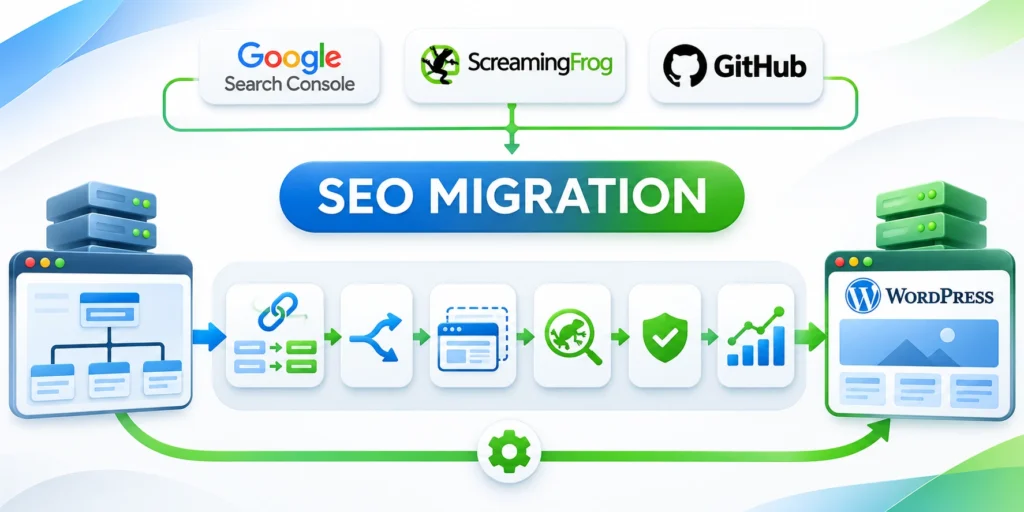
A redesign or platform migration can improve growth, yet it can also erase accumulated search signals when URLs, templates, links, or rendering change without control.
SEO requirements therefore belong in discovery, architecture, acceptance criteria, and release planning. They cannot be postponed until the new site is ready for launch.
Use these decision criteria for Migration redesign risk:
- Baseline current search and conversion performance.
- Approve URL mapping before migration work begins.
- Test critical templates with explicit acceptance criteria.
- Schedule post-launch monitoring and rapid remediation.
Build a migration inventory before development
The inventory should connect every valuable URL with its purpose, traffic, links, conversions, replacement destination, and responsible owner before templates are rebuilt.
Teams also need a dated crawl, analytics exports, Search Console evidence, backlink samples, and current metadata. These records create a defensible comparison baseline.
Compare these priorities for Build migration inventory:
- Map every retained URL to one canonical destination.
- Preserve high-value content and internal relationships.
- Document redirects, removals, and consolidation decisions.
- Assign owners for unresolved mapping conflicts.
Validate release behavior and recovery options
Staging tests should cover redirects, canonicals, indexability, structured data, navigation, sitemaps, analytics, and representative rendering across important templates and devices.
After release, compare server responses, crawling, indexation, rankings, conversions, and error patterns. Predefined rollback thresholds prevent teams from debating evidence during an incident.
Review these practical points for Validate release behavior:
- Crawl staging with production-like access rules.
- Test redirect chains and destination relevance.
- Monitor priority URLs immediately after launch.
- Keep rollback instructions and accountable contacts ready.
A migration is complete only after priority URLs stabilize and responsible teams understand remaining exceptions. Launch day is the start of verification, not the finish.
The review cadence should tighten during early risk and relax only when crawling, indexation, traffic, conversions, and support evidence show controlled behavior.
Consider these operating checks for Validate release behavior:
- Track unresolved exceptions with owners and dates.
- Compare outcomes with the preserved baseline.
- Escalate material losses before expanding changes.
- Close migration work through documented acceptance.
Analytics, consent, and conversion data integrity

SEO decisions become unreliable when analytics events, consent behavior, CRM stages, or attribution rules change without documentation. Clean dashboards cannot repair inconsistent source data.
Measurement architecture should define which business decisions each event supports, when collection is permitted, and how website behavior connects with qualified commercial outcomes.
Use these decision criteria for Analytics consent conversion:
- Connect organic sessions with qualified business outcomes.
- Preserve definitions across templates and campaigns.
- Limit collection to justified and permitted data.
- Investigate discrepancies before reporting performance.
Design a governed measurement specification
A useful specification names each event, trigger, required parameter, consent dependency, destination, validation method, owner, and expected use in reporting or optimization.
Implementation should separate diagnostic activity from meaningful outcomes. Page views and rankings remain useful, but they cannot substitute for leads, opportunities, purchases, or retention.
Compare these priorities for Design governed measurement:
- Define events from business decisions, not dashboard convenience.
- Document consent and regional collection requirements.
- Use stable names and controlled parameter values.
- Assign ownership for validation and changes.
Protect continuity through releases
Every template, form, checkout, consent, or tag change can affect historical comparisons. Release notes should identify measurement changes alongside design and engineering changes.
Automated checks can confirm expected requests and events, while manual scenario tests verify meaning. CRM reconciliation then reveals missing, duplicated, or misclassified conversions.
Review these practical points for Protect continuity through:
- Test consent states and blocked collection paths.
- Validate priority events before and after release.
- Reconcile website conversions with downstream records.
- Annotate dashboards when definitions or coverage change.
Data quality reviews should sample real journeys, not only configuration screens. A technically firing event can still carry the wrong meaning or commercial context.
When privacy choices reduce observable data, reporting should state that limitation directly. Modeling and directional evidence must never be presented as exact user-level certainty.
Consider these operating checks for Protect continuity through:
- Sample real journeys across consent states.
- Check event meaning against business definitions.
- Report coverage gaps and attribution limits.
- Retire unused tags and duplicate collection.
Adapt SEO engineering to the business model

A corporate website, ecommerce catalog, local service network, and multilingual platform require different templates, structured information, conversion paths, and operational controls.
The provider should translate the business model into explicit search requirements before selecting plugins or copying a generic checklist across every page type.
Use these decision criteria for Adapt SEO engineering:
- Ecommerce: protect catalog clarity and availability signals.
- International: coordinate language and regional intent.
- Local: maintain accurate locations and service coverage.
- B2B: connect expertise with complex buying journeys.
Model the search surface and its dependencies
Ecommerce depends on product availability, variants, categories, merchant data, reviews, pricing, and faceted navigation. Each dependency can create duplication or stale search experiences.
International and local programs add language, regional URLs, location details, ownership, and verification requirements. Governance matters because operational data changes more often than templates.
Compare these priorities for Model search surface:
- Identify every indexable template and business owner.
- Define canonical, language, and location relationships.
- Control filters, archives, and generated URL states.
- Map structured data to verified source fields.
Choose platform controls that editors can maintain
Custom fields and reusable blocks should make required information obvious, validate important relationships, and prevent editors from creating unsupported page combinations or incomplete records.
Automation can reduce repetitive work, but overrides and exception logs remain necessary. Business teams need clear recovery paths when feeds, integrations, or scheduled updates fail.
Review these practical points for Choose platform controls:
- Provide defaults without hiding consequential decisions.
- Validate feeds and generated metadata regularly.
- Expose ownership and freshness for critical records.
- Test exceptions before scaling automation.
Requirements should also reflect update frequency, inventory volatility, sales geography, buying complexity, and the teams authorized to change underlying business records.
A technically elegant model fails when owners cannot maintain it. Field design, permissions, validation, training, and exception handling determine whether search quality survives daily operations.
Consider these operating checks for Choose platform controls:
- Match controls with real maintenance capacity.
- Test representative records before broad rollout.
- Monitor freshness and incomplete business data.
- Review generated pages for continuing usefulness.
Accessibility and semantic search quality
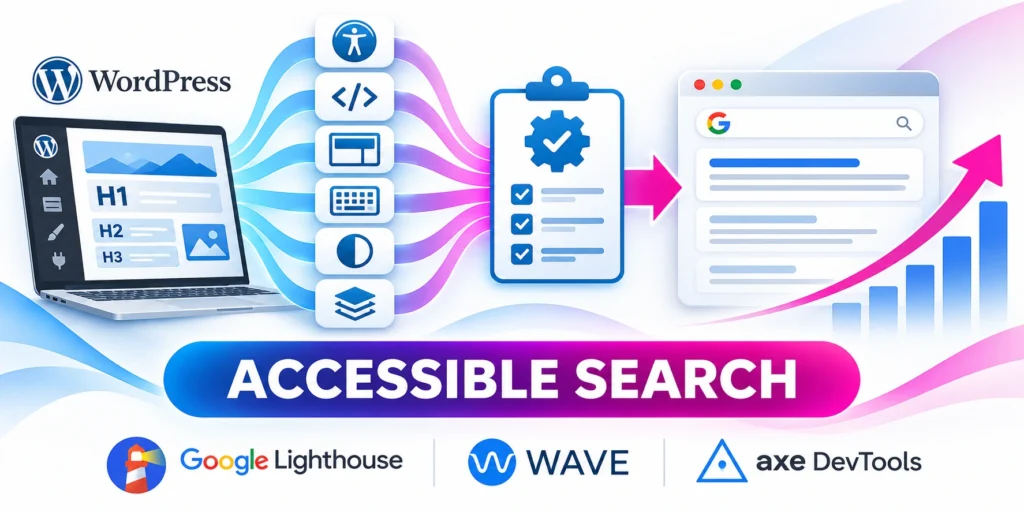
Accessibility and search quality share several foundations: meaningful structure, understandable content, predictable interaction, descriptive alternatives, and interfaces that work across different technologies.
Neither discipline should be reduced to an automated score. Tools identify patterns, while representative manual tests confirm whether people can understand and complete important tasks.
Use these decision criteria for Accessibility semantic search:
- Treat accessibility as an acceptance criterion.
- Use semantic HTML before additional scripting.
- Prioritize defects by user and business impact.
- Track remediation through normal delivery governance.
Build semantics into components and editorial rules
Templates should provide one clear page topic, logical headings, useful landmarks, descriptive links, accessible controls, and relationships that remain understandable without visual positioning.
Editors need fields and guidance for alternatives, labels, transcripts, table context, and link purpose. Reusable components reduce variation when their defaults are genuinely accessible.
Compare these priorities for Build semantics into:
- Use headings to describe structure, not appearance.
- Write links that explain their destination or action.
- Provide meaningful alternatives for informative media.
- Keep controls labeled and keyboard operable.
Combine automated evidence with task testing
Automated checks can detect missing attributes, contrast failures, invalid relationships, and recurring component defects. They cannot judge clarity, context, focus order, or task completion alone.
Test priority journeys with keyboard navigation, screen-reader review, zoom, responsive layouts, and real content. Record defects by component so one correction improves many pages.
Review these practical points for Combine automated evidence:
- Test navigation, forms, search, and conversion paths.
- Verify focus visibility and logical interaction order.
- Review errors and instructions for understandable recovery.
- Retest shared components after significant changes.
Accessibility findings should enter the same backlog, ownership, testing, and release process as performance, security, and SEO work. Separate reports often become separate neglect.
Prioritization should consider blocked tasks, repeated component impact, legal exposure, audience importance, and conversion dependency while preserving a plan for complete remediation.
Consider these operating checks for Combine automated evidence:
- Correct shared components before isolated symptoms.
- Include affected users in acceptance decisions.
- Preserve evidence from tests and releases.
- Recheck accessibility after design-system changes.
Govern SEO as an operating system

Durable organic growth depends on repeated decisions across marketing, content, product, engineering, security, legal, analytics, and leadership. A one-time audit cannot govern those decisions.
An operating model converts evidence into owned work, applies review proportionate to risk, and preserves enough history to explain why the website changed.
Use these decision criteria for Govern SEO operating:
- One backlog for cross-functional organic growth work.
- Clear acceptance criteria for every consequential change.
- Shared release evidence and decision records.
- Continuous learning from outcomes and regressions.
Define decision rights and delivery controls
Every recommendation should identify an accountable owner, affected systems, evidence, dependencies, acceptance criteria, release path, and measurement plan before implementation begins.
Low-risk editorial work can move quickly. Template, migration, tracking, security, and structured-data changes require deeper review because one error can affect many pages.
Compare these priorities for Define decision rights:
- Name accountable owners for every priority.
- Separate approval from implementation when risk warrants.
- Store decisions beside tickets and releases.
- Define rollback and escalation paths before deployment.
Maintain a living evidence and improvement cycle
Backlogs should combine technical defects, content opportunities, user evidence, commercial priorities, and operational risk. Scoring remains useful only when assumptions are visible and revisited.
Regular reviews compare expected and observed outcomes, retire invalid tasks, and revise standards. This prevents old audits from controlling a platform after conditions have changed.
Review these practical points for Maintain living evidence:
- Review evidence and priorities on a defined cadence.
- Connect releases with monitoring and annotations.
- Update standards after recurring defects or incidents.
- Archive obsolete recommendations with their rationale.
Governance should shorten responsible delivery, not introduce ceremonial approval. Standard changes need predefined evidence, while unusual risks receive deeper review from the right specialists.
The operating model succeeds when teams know what they can decide, what requires consultation, where evidence lives, and how to recover from an unsuccessful change.
Consider these operating checks for Maintain living evidence:
- Standardize repeatable low-risk change paths.
- Escalate novel risks to qualified reviewers.
- Measure delivery quality and business outcomes.
- Improve controls when evidence reveals friction.
Frequently asked questions
These questions address common commercial and operational concerns about combining SEO consulting with WordPress development.
Specific recommendations still require a review of the website, business model, team, data, and technical environment.
1. What is included in SEO consulting and WordPress development services?
The scope can include research, technical audits, architecture, content models, custom development, performance, analytics, migrations, maintenance, quality assurance, and ongoing optimization.
A strong proposal identifies exactly which templates, systems, deliverables, tests, and responsibilities are included. It should also state assumptions and exclusions.
2. How is this different from hiring an SEO agency?
Some SEO agencies focus mainly on research, content, and recommendations. An integrated provider also owns or directly coordinates the technical implementation inside WordPress.
The distinction is delivery accountability, not the agency label. Buyers should verify actual engineering capability, access controls, testing, documentation, and release ownership.
3. Do we need a new WordPress website to improve SEO?
Not necessarily. Many websites improve through targeted template changes, architecture corrections, content updates, performance work, and better operational controls.
A rebuild is justified when the current foundation blocks important requirements or costs more to repair than replace. Evidence should support that decision.
4. How long does an SEO and WordPress engagement take?
A focused audit or correction can take weeks, while redesigns, migrations, and ongoing growth programs may require several months or continuous support.
Timeline depends on scope, platform condition, content volume, integrations, approvals, access, and release risk. A credible proposal explains these dependencies.
5. Can a provider guarantee first-page rankings?
No responsible provider can guarantee a particular organic ranking. Search results depend on many external, competitive, technical, and content factors.
A provider can guarantee defined work standards, transparent reporting, tested implementation, and agreed deliverables. Performance expectations should remain evidence-based and qualified.
6. Will adding more plugins improve WordPress SEO?
Plugins can manage useful functions, but they do not replace strategy, architecture, content quality, or engineering. Overlapping plugins may create conflicts and maintenance risk.
Choose dependencies for a documented need. Configure them correctly, test their output, monitor updates, and remove obsolete tools through a controlled process.
7. Is headless WordPress better for SEO?
Headless WordPress can support excellent SEO, but it is not inherently better. Results depend on rendering, routing, metadata, content parity, performance, and operational execution.
Use it when product and multichannel requirements justify the added engineering. Traditional WordPress is often simpler and fully capable for content-led websites.
8. How should SEO success be measured?
Measure technical reliability, qualified visibility, useful engagement, conversions, sales progression, and revenue contribution. Select metrics that match the business model and buying cycle.
Record baselines and releases, then interpret changes with context. Rankings and traffic are diagnostic signals, not complete business outcomes.
9. Can an internal development team work with an external SEO consultant?
Yes. This model works when responsibilities, ticket quality, decision rights, access, acceptance criteria, and release validation are explicit.
The consultant should understand implementation constraints, while developers should receive the evidence and business rationale behind each priority.
10. What should we prepare before requesting a proposal?
Prepare business goals, priority audiences, website access details, known problems, analytics availability, important integrations, team roles, timing constraints, and previous audit findings.
You do not need a complete specification. A discovery process should help define the right scope before major implementation commitments are made.
Build organic growth into the WordPress system

SEO consulting and WordPress development create greater value when they operate as one decision system rather than separate streams of recommendations and tickets.
The integrated approach connects demand, architecture, content, performance, security, measurement, and release quality around outcomes the business can evaluate.
Use these decision criteria for Build organic growth:
- Start with evidence and commercial priorities.
- Design maintainable templates and content relationships.
- Implement changes with acceptance criteria and rollback planning.
- Measure qualified outcomes instead of isolated vanity metrics.
- Improve the platform continuously as evidence changes.
A practical program starts by identifying which decisions remain blocked by weak evidence, fragmented ownership, platform constraints, or missing implementation capacity.
The first roadmap should balance immediate risk reduction with durable capabilities. Quick wins matter, but they should not create another layer of unmanaged exceptions.
Compare these priorities for Build organic growth:
- Confirm the business outcomes and priority audiences.
- Baseline technical, editorial, and commercial evidence.
- Select improvements with clear owners and acceptance criteria.
- Release changes through controlled, measurable workflows.
Leadership should expect transparent assumptions, dated evidence, decision records, and measurable constraints. These controls make recommendations easier to challenge and improve.
Teams should also preserve ownership of accounts, code, data, documentation, and publishing access. Operational independence protects continuity when priorities or providers change.
Review these practical points for Build organic growth:
- Keep production systems and critical accounts client-controlled.
- Document custom components and significant decisions.
- Monitor regressions after every consequential release.
- Review the roadmap as evidence and markets change.
The result should be a WordPress system that makes sound publishing, engineering, and measurement decisions easier to repeat as the organization grows.
If your organization needs strategy and implementation under shared accountability, speak with Fase Network about the current WordPress platform and growth priorities.
Consider these operating checks for Build organic growth:
- Define the problem and confirm material constraints.
- Select an engagement proportional to the opportunity.
- Record accountable owners for the agreed next actions.
Contact Us on LinkedIn
Discuss your SEO Consulting WordPress Development priorities directly through LinkedIn.
 Sergio TimóteoConsulting EngineerDigital Marketing Strategist, CRM Certified Professional, SEO Expert, AI, Social Media, Paid Ads, Real Estate, B2C and B2B Sales. 22+ Years Growing Businesses and Startups with Technology and Innovation.LinkedIn profile