

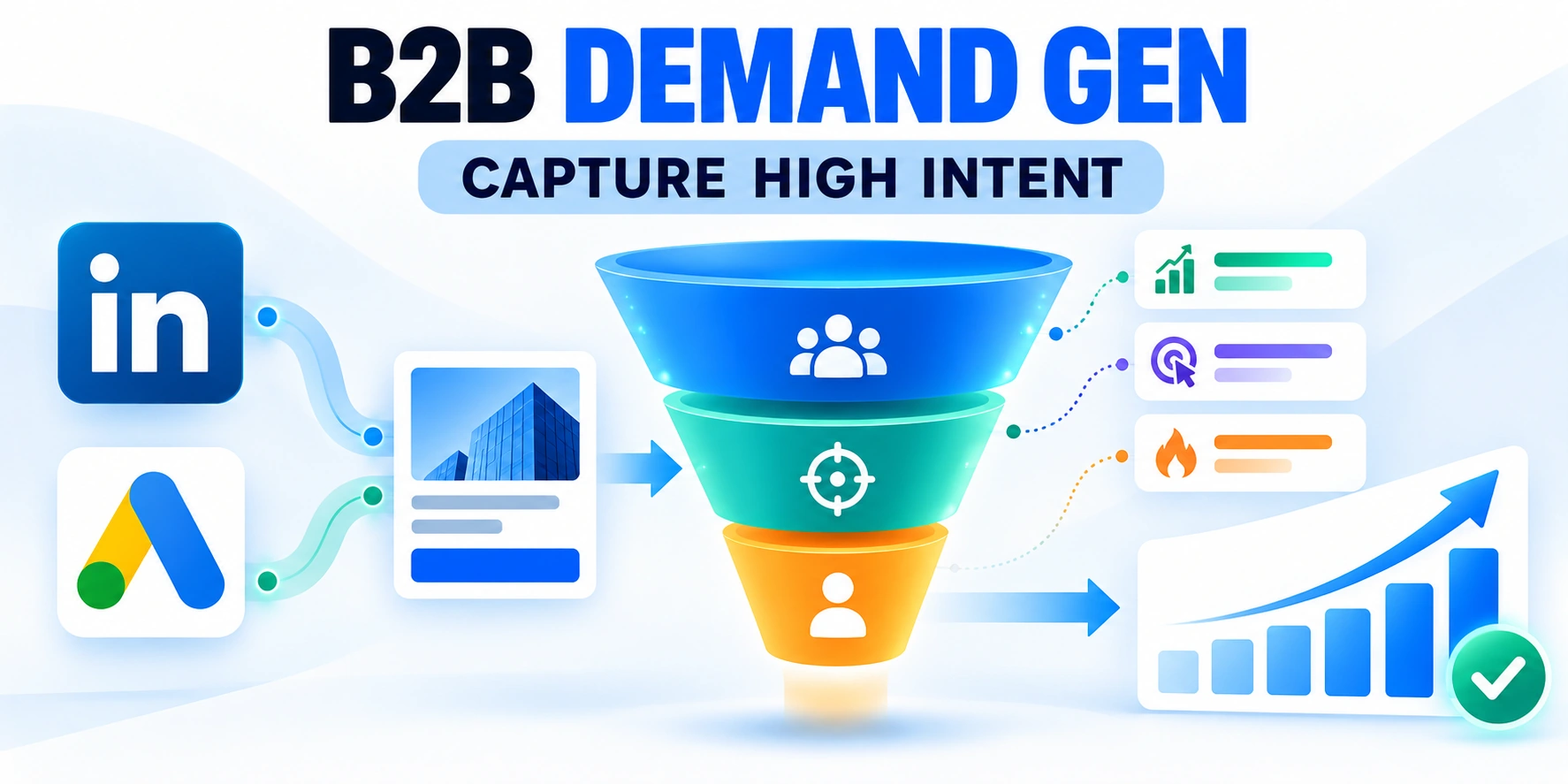
What B2B Demand Generation Is—and What It Is Not

Demand generation is the coordinated work of creating awareness, building understanding, capturing existing interest, and helping suitable buyers take a next step.
In B2B, this work spans more than one person and more than one channel.
Buying Committees Need Role-Specific Evidence
A finance leader may care about risk and payback, an operations lead may care about implementation effort, and a technical evaluator may care about integration and security.
A useful program gives each participant relevant evidence without pretending that they all have the same concern.
Use One Operating Definition
The word “demand” can cause confusion. Some people use demand generation to mean campaigns that introduce a problem or solution to an audience that is not actively searching.
Others use it broadly for the activities that generate and capture pipeline. For operating a business, agree on the scope internally.
Define Demand Generation in Business Terms
A practical definition is: demand generation creates qualified buying interest and makes it possible to identify, serve, and measure that interest.
The definition should identify the buyer evidence, accountable owner, measurable outcome, and next action that distinguishes meaningful demand from activity volume.
Use a useful lifecycle, not a rigid funnel
For practical coordination, define lifecycle stages using observable business events:
Track lifecycle movement through these observable business events:
- Known audience member: a person or account identifiable through legitimate interaction or permissioned sources.
- Engaged audience: people or accounts showing attention through webinar attendance or returning to technical resources.
- Qualified lead: facts meet agreed fit and intent criteria and justify a specific next step.
- Sales-accepted lead: sales has reviewed the handoff and accepted responsibility for follow-up.
- Opportunity: the buyer has a defined problem, plausible decision path, and active commercial conversation.
- Customer: an agreed purchase event has occurred and is recorded accurately.
These labels have no universal definitions.
A “qualified lead” at a consultancy may require a project scope and decision-maker access; at a software company, it may require a product use case and an appropriate account.
Make Lifecycle Transitions Observable

Write the definitions in plain language, name the owner, and specify which fields or events establish each transition.
Do not make a lifecycle transition depend on a label alone. A contact can meet demographic criteria and still have no project, timing, authority, or interest.
Use Rules to Guide Judgment
Conversely, a person with an unusual job title may be a credible evaluator at a target account.
The rules should help a team decide what to do next, not replace thoughtful judgment.
Separate activity from business outcomes
An impression, click, video view, page visit, download, form submission, qualified conversation, opportunity, and closed sale describe different events. Reporting that treats them as interchangeable creates bad incentives.
If a campaign is rewarded only for cheap form submissions, it can find people who complete forms but never fit the offer.
Balance Short-Term and Long-Term Outcomes
If it is judged only on closed revenue inside a short reporting window, it may undervalue education that supported a longer buying journey.
Choose a primary outcome for each campaign and keep intermediate indicators visible. A campaign introducing a new category may be assessed through engaged target accounts and later progression.
Match Outcomes to Campaign Intent
A high-intent search campaign can aim at a qualified consultation. Retargeting can help an already-known account return to a comparison or implementation resource.
Those activities should not share one undifferentiated “lead” target.
Write a campaign outcome before launch
Before launch, write one sentence that states the intended outcome. For example: “This program should create qualified conversations with mid-market operations teams that are replacing disconnected CRM and marketing processes.”
Then write what would count as evidence, which team owns the next action, and which result would mean the strategy needs revision.
Audit lifecycle movement regularly
Review representative records across transitions and compare the recorded event, evidence, owner, timestamp, follow-up, and eventual commercial outcome.
Audit lifecycle reliability through these recurring checks:
- Confirm every transition has observable supporting evidence.
- Compare assigned owners with actual follow-up responsibility.
- Trace rejected transitions to definitions or data failures.
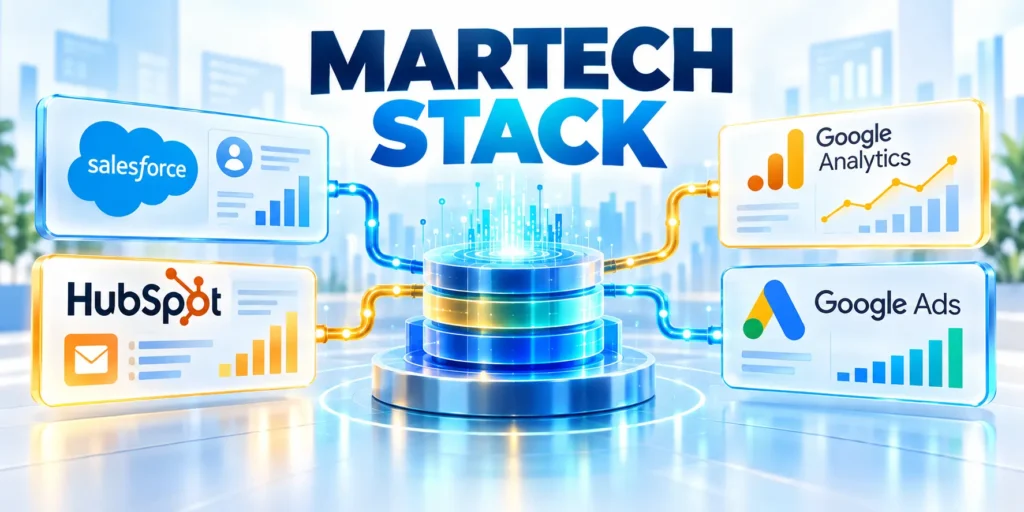
Use mismatches to improve definitions, routing, or reporting without rewriting historical values. Review the MarTech stack when gaps recur across integrations.
Start with an ICP, Buying Committee, and Intent Signals

An ideal customer profile (ICP) describes the type of organization that is most likely to gain measurable value from the offer and be served successfully.
It should be specific enough to guide choices, but not so narrow that it merely restates a list of familiar logos.
Build the ICP from Successful Customers
Start with customers whose needs, implementation conditions, adoption, and economics were healthy—not only those who signed a contract.
Describe the ICP through observable factors: industry, business model, company size when relevant, service region, technology environment, regulatory needs, and trigger events.
Separate requirements from preferences
List hard requirements separately from preferences. A supported geography may be required; familiarity with one CRM may only be preferred.
A requirement determines whether the account can succeed, while a preference improves prioritization without automatically excluding an otherwise viable opportunity.
Turn the ICP into an operating profile
Build a small profile card for one use case before expanding to adjacent segments:
Define the operating profile through these buyer facts:
- Problem: what costly or risky condition is the organization trying to change?
- Account fit: which organizations experience that condition and can realistically adopt the solution?
- Trigger: what event makes the issue more urgent now?
- Value: what operational or commercial result could be improved?
- Constraints: what would make the engagement unsuitable, unsafe, or unprofitable?
- Evidence: which observed customer examples support these assumptions?
Use the card to exclude poor-fit accounts as well as identify likely buyers.
An account may be unsuitable when it is too small, lacks a required system, or expects an outcome the provider cannot deliver.
Choose the Right Next Step for a Poor-Fit Account
Provide a relevant educational resource when it serves the account better than an unsupported sales conversation.
Use a transparent explanation, helpful alternative, or respectful closure instead of moving an unsupported opportunity into a sales queue.
Map the buying committee by decision responsibility
B2B purchases often involve several people who contribute different forms of risk and approval. A practical map does not require a perfect org chart.
Map buying responsibility through these decision roles:
- Problem owner: experiences the operational problem and wants a change.
- Champion: organizes information internally and helps the solution gain consideration.
- Technical evaluator: reviews architecture, integration, data handling, security, and support.
- Economic buyer: owns or approves the budget and business case.
- Procurement or legal reviewer: checks contract, supplier, privacy, or compliance requirements.
- Executive sponsor: resolves priority conflicts or authorizes a high-impact decision.
Create a content map using the questions each role is likely to ask. A technical evaluator may need a data-flow explanation.
Adapt Evidence to Each Buying Role
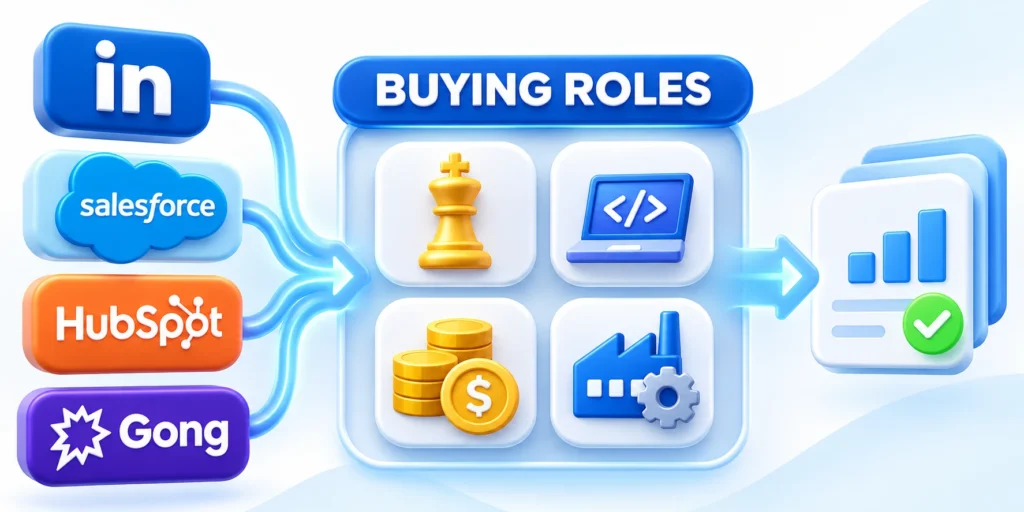
The economic buyer may need assumptions behind a payback estimate. The operating team may need migration steps and training requirements.
Use a shared core explanation and add role-specific evidence where it materially improves the decision.
Combine fit and intent instead of trusting one signal
Fit answers “could this account benefit and be served?” Intent answers “is there credible evidence that it may be exploring the issue now?” Neither is sufficient by itself.
A perfect-fit account with no current need may belong in education or a future nurture path.
Route Fit and Intent to Different Actions
A person who requests a demo from an unsuitable market may need a respectful explanation rather than a sales handoff.
Classify account fit through these qualitative signals:
- Strong fit: the account matches the customer profile and required delivery environment.
- Partial fit: the problem is relevant, but one important condition needs clarification.
- Weak fit: the account is outside the service model or lacks an essential requirement.
- High intent: the buyer asks for a consultation, pricing, migration plan, or technical evaluation.
- Medium intent: the account revisits relevant content, attends an event, or engages with comparisons.
- Low or unknown intent: the evidence is a single passive view or is unavailable.
Review the resulting acceptance, disqualification, response, and opportunity evidence so qualitative categories remain useful rather than becoming permanent assumptions.
Sequence evidence by decision responsibility
Begin with the shared business problem, then give each role the risk, implementation, financial, security, or operational evidence needed for its decision.
Avoid sending every participant the same asset when their questions, authority, and evaluation criteria differ materially.
Preserve role context
Record which role engaged, what evidence it reviewed, and which unresolved question prevents the buying group from advancing.
Use that context to coordinate helpful follow-up without implying that one individual’s activity represents approval from the entire account.
Translate fit and intent into a next action

Routing should convert evidence into an accountable response rather than merely attaching another score or lifecycle label to the record.
Route combined evidence through these next actions:
- Strong fit + high intent: route for human review and a direct response.
- Strong fit + medium intent: send a relevant follow-up.
- Partial fit: clarify the one missing condition.
- Weak fit: do not pass it to sales just to meet a volume target.
Define who reviews the evidence, which action is appropriate, when it should occur, and how the outcome returns to marketing.
Make Scores Explainable
If a scoring model is justified, keep the reason codes visible.
A score such as “72” is not actionable if a salesperson cannot see which events and fit factors produced it.
Review Signal Recency and Buying-Group Activity
Review whether recent, specific actions outweigh old activity; do not let repeated page views from one person masquerade as a buying committee.
Record why the signal matters, when it occurred, which role produced it, and whether other participants confirm a coordinated evaluation.
Use intent data as evidence, not proof
Intent data has limits. A platform may report account-level activity without telling you who performed it, and third-party intent signals can be modeled or aggregated.
Treat them as prioritization hints, not proof that an individual has requested contact. A direct inquiry should carry more weight than an inferred topic signal.
Apply Intent Signals Carefully
For a deeper example of aligning handoffs between revenue teams, see our RevOps playbook.
Use it to define shared ownership and feedback; the present guide focuses on identifying and serving qualified demand.
Define a reversible response
Use human review for ambiguous or high-impact cases and keep low-confidence signals away from irreversible automation or aggressive sales sequences.
The response should be easy to correct when new account, role, timing, or consent evidence changes the interpretation.
Review routing outcomes
Compare accepted handoffs, response quality, disqualification reasons, opportunity creation, and buyer feedback across each routing path.
Revise evidence thresholds when a path repeatedly creates poor experiences, unsupported work, or missed qualified conversations.
Match Channels to the Intent You Can Actually Observe
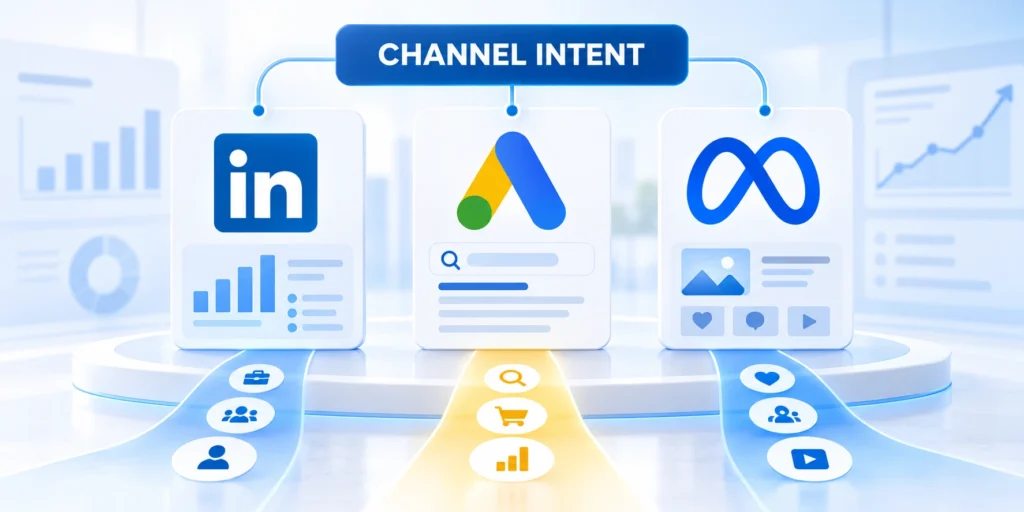
A channel should be selected for the audience, signal, creative format, offer, and operating capability it can support.
Use the paid demand generation guides to compare tactics against buyer intent, audience readiness, and the outcome you can measure.
Match Channels to Buyer Intent
Begin with a buyer question and ask where credible evidence of that question can be observed.
Search is useful when people describe a problem, service, or product category in their own words.
Choose a Channel by Its Strength
Professional networks can help reach defined business roles or accounts and can support offers such as a technical guide, webinar, or Lead Gen Form.
Educational video and content can introduce a problem to buyers who are not actively searching.
Use Retargeting for a Relevant Next Step
Retargeting can remind a relevant visitor or account about the next useful resource, subject to consent, privacy, and platform controls.
Limit frequency and duration, exclude converted or unsuitable audiences, and connect every message to the resource previously viewed.
Give each channel a job and a boundary
Write a one-line role for every channel in the plan:
Assign every channel through these operating boundaries:
- Search: capture explicit problem or solution research, then route the query to a matching page.
- LinkedIn: reach professional audiences or named account groups with role-relevant proof or an appropriate form.
- Educational content and video: clarify a problem, approach, or decision before requesting high-commitment action.
- Retargeting: help prior visitors resume decisions with new evidence, not repeated generic ads.
- Email: send requested information lawfully, with clear expectations and preference controls.
- Partner or event activity: borrow credibility where a trusted community already discusses the problem.
Boundaries prevent duplication.
If a LinkedIn campaign and a search campaign both send every visitor to the same generic “Contact us” page, the channel distinction is not reflected in the experience.
Coordinate Channel Boundaries
If a person already asked for pricing, showing them an introductory awareness ad may be wasteful. Coordinate exclusions and follow-up rules across systems where that is technically and legally appropriate.
Document channel ownership, audience exclusions, offer differences, handoff rules, and measurement dependencies before campaigns share the same account population.
Check platform settings and lead-quality trade-offs

Review conversion settings, audience rules, form behavior, CRM feedback, attribution limits, and sales capacity together because each can change the resulting lead mix.
Platform features and campaign menus change. Keep the strategic design stable and confirm current settings inside the advertising account before launch.
Google Ads: Optimize for Qualified Leads
For Google campaigns that optimize toward leads, Google's own guidance emphasizes defining the lead journey and using meaningful conversion events rather than a shallow form count.
Its current recommendations discuss qualified or converted leads, data freshness, and measurement with first-party data. Use the official Google Ads lead-quality guidance to check current setup details.
LinkedIn Forms Trade Off Friction and Intent
LinkedIn Lead Gen Forms use profile information to reduce typing and can connect collected data to a CRM or marketing system.
The trade-off is that an in-platform submission may require less effort but could produce a different mix of intent than a visit to a detailed landing page.
Measure Quality Beyond Form Submissions
Compare qualified-opportunity outcomes, not just cost per form.
Review the official LinkedIn Lead Gen Forms overview and adjust the experience to your offer and privacy notice.
Choose a portfolio that can be operated
Channel breadth should reflect the team’s ability to maintain creative, targeting, landing pages, integrations, sales response, measurement, and privacy controls.
A smaller portfolio produces stronger learning when each channel has a distinct role and every captured response receives an appropriate next action.
Choose a Maintainable Channel Mix
Choose channels by the buyer decision they support. Use a community-led growth strategy when ongoing peer discussion helps buyers evaluate a technical problem.
Smaller teams may operate one high-intent campaign, one helpful content path, and disciplined follow-up better than five channels without shared measurement.
Check Operational Capacity
Start with channels whose account access, creative, landing pages, CRM workflow, and budget can be maintained.
Use a decision table before allocating spend:
| Decision | Evidence |
|---|---|
| Audience | Account, role, geography, or search need |
| Signal | Query, form, event, or segment |
| Next step | Read, compare, register, or request review |
| Quality | Accepted stage, opportunity, or revenue |
| Stop rule | Poor fit, weak economics, or capacity limits |
Approve the operating configuration
Capture the settings that materially affect audience eligibility, conversion measurement, form friction, optimization, exclusions, ownership, and feedback before launch.
Approve platform readiness through these operating checks:
- Verify optimization events represent meaningful buyer progress.
- Confirm exclusions prevent unsuitable or converted audiences.
- Test CRM routing and downstream quality feedback.
Recheck them after platform changes or unexplained quality shifts because campaign behavior can change without a new strategic decision.
Design Offers That Earn the Next Commitment

An offer is the exchange that gives a buyer a reason to take the next action.
It can be an assessment, a guide, a benchmark, a webinar, a product trial, a consultation, a technical workshop, a quote, or a demonstration.
Match the Offer to Buyer Readiness
The right offer depends on the decision the buyer is ready to make and the value of the information they receive.
Do not ask every audience member to book a sales call. A high-commitment action is appropriate when the buyer has a specific need and understands what the conversation will cover.
Offer a Proportionate Next Step
An early-stage visitor may need a clear explanation or a practical worksheet first. A buyer evaluating an active project may value a scoped diagnostic or implementation workshop.
Ask for greater buyer commitment only when the promised value, delivery effort, and commercial relevance justify the additional friction.
Define the deliverable and value exchange
The offer should be specific enough that the buyer can decide whether it is worth exchanging time or information. “Get insights” is vague.
“Review your CRM lead-routing workflow and leave with a prioritized list of ownership gaps” explains an outcome.
Promise Only What the Offer Delivers
Avoid promising a guaranteed business result unless you can substantiate and operationally deliver it.
State format, scope, timing, prerequisites, and follow-up expectations accurately so the buyer can evaluate the exchange before submitting information.
Match the offer to decision readiness
An offer should solve the buyer’s current information problem without demanding commitment that the available evidence does not yet justify.
Match early offers through these readiness stages:
- Problem education: a practical article, checklist, or explainer for a buyer clarifying the issue.
- Approach evaluation: a comparison, architecture example, workshop, or vendor-selection guide for a buyer exploring options.
- Fit assessment: a diagnostic, requirements discussion, or self-assessment when buyers need situational clarity.
- Commercial evaluation: a scoped consultation, demo, proposal, or pilot after problem and decision context clarify.
- Implementation confidence: a migration plan, security review, onboarding outline, or service-level discussion assessing delivery risk.
For each offer, answer four questions before creating the campaign:
Evaluate each offer through these buyer questions:
- What problem does the offer help the buyer understand or solve?
- Delivery: what will the person receive, and when?
- Required information: which details are necessary to provide it?
- Next action: what happens when fit is confirmed, uncertain, or outside scope?
Progress from education to comparison, assessment, and commercial discussion as the buyer’s questions, risk, and willingness to engage become more specific.
Make the value exchange clear

State the deliverable, time commitment, eligibility, and follow-up expectation near the call to action. If a consultation is a sales conversation, say so.
If a resource triggers email delivery or sales follow-up, disclose both. Use B2B email automation triggers that match what the buyer requested.
Explain the Value Exchange
A clear exchange can reduce raw submissions while improving trust and the proportion of responses that fit the offer.
Connect every requested field to delivery, qualification, security, scheduling, or routing rather than collecting information merely because the form supports it.
Collect Only Useful Qualification Data
Ask only for fields that improve delivery or a justified next decision. A simple resource download might require an email address and perhaps a role or company.
A complex enterprise assessment might need organization, region, current system, and project timing.
Balance Form Depth with Completion
Every added field has a cost: fewer people may complete the form, and some may provide inaccurate answers to proceed.
Remove unused fields, stage later questions deliberately, and review abandonment alongside qualified outcomes rather than optimizing completion alone.
Use a landing page that continues the same promise
The ad, post, email, and landing page should describe the same problem and outcome. If the ad promises an implementation checklist, the destination should show that checklist clearly.
If the campaign offers a demo for a particular workflow, the page should not send the buyer into a generic product homepage with no explanation.
Build a Landing Page That Fulfills the Promise
A useful landing page typically includes:
Build the landing page through these promise elements:
- A headline that restates the problem or offer in the buyer's language.
- A short description of what the person receives and who it is for.
- Relevant evidence, such as a real example, process, or transparent limitation.
- A visible next action with no misleading scarcity or unsupported guarantee.
- Form fields limited to information needed for delivery or routing.
- Privacy notice and preference expectations appropriate to the collected data.
The page should work on mobile, load reliably, and confirm successful submission. Test the full journey: click, page, form, thank-you state, email delivery, CRM creation, owner assignment, and follow-up.
An ad platform can record a form submit while the CRM integration silently drops the record; that is not a successful capture system.
Build Capture, Qualification, and Sales Follow-Up Together

Begin with the buyer's next experience. Someone who requests a quote expects a timely response about that request.
Someone who downloads an introductory guide may expect the resource first and a transparent, relevant follow-up—not an immediate sequence of messages that assumes purchase intent.
Record lifecycle stages and ownership
Document the lifecycle and ownership in a shared source.
A practical CRM setup commonly includes account, contact, source/campaign, offer, first relevant activity, fit status, intent evidence, lifecycle stage, current owner, next action, and a timestamp.
Reuse Clear CRM Fields
Use fields already available when they are clear; do not create duplicate custom fields with slightly different meanings.
For related examples on CRM workflow, see our HubSpot automation and lead-scoring guide.
Keep Implementation Guidance in Scope
This article stays focused on demand generation strategy; use the implementation guide when configuring specific automation paths.
Share enough detail to set expectations, then move confidential architecture, credentials, and customer records into an approved secure process.
Write the handoff as a service contract
A handoff is not complete because an automation copied a record into another queue.
It is complete when the receiving team knows why the person is being routed, what the person asked for, what context is reliable, and what response is expected.
Document the Handoff Contract
Define a handoff contract that includes:
Define the handoff through these service commitments:
- Trigger: which exact action or reviewed combination creates a sales task?
- Evidence: which fit and intent facts must be visible on the record?
- Owner: which person or team receives it, including an absence or territory rule?
- Response expectation: what service window is realistic for the request type and team capacity?
- First action: reply, call, clarify, schedule, or acknowledge the resource request?
- Disposition: accepted, nurtured, disqualified, duplicate, or unable to contact, with a reason.
- Feedback: how does the receiving team return the reason and outcome to marketing?
Set response expectations based on actual staffing and urgency. A same-day response might be right for an active consultation request; it may not be appropriate for an educational download.
Do not publish a service-level promise the business cannot keep. Measure whether the process meets the agreed expectation and change the expectation or staffing if it does not.
Qualify without turning the form into an interrogation
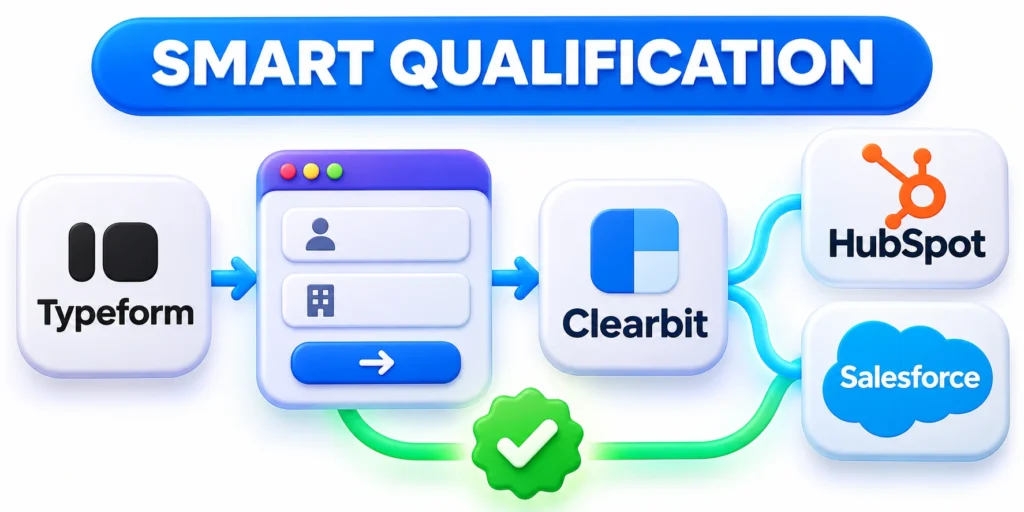
Qualification should establish fit and next-step relevance. It should not force a buyer to provide every internal detail before receiving a simple resource.
Collect a few facts at first contact. Ask for more only before a high-commitment action or when you need details to scope the work.
Example: a B2B services inquiry
Start with the facts needed to scope a useful first response:
Scope the first response through these essential facts:
- Organization.
- Business problem.
- Current environment.
- Approximate project timing.
- Preferred contact method.
Budget can be important, but a person may not yet have an approved range. Offer a reasonable “not sure yet” option instead of forcing false precision.
Collect qualification details in stages
For a product demo, collect the use case and team context that will make the demonstration useful. Avoid requesting confidential data in a marketing form.
If a technical assessment requires architecture diagrams or customer records, establish a secure process and clarify who may access the information before requesting it.
Turn Disqualification into Campaign Learning
Use disqualification reasons to improve targeting and offers. If many responses are outside a supported geography, adjust geographic settings or the campaign copy.
If buyers say the offer does not address their project stage, revise the content.
Progressively collect missing context
Use enrichment, prior interactions, and later conversations to avoid repeatedly asking buyers for information the organization already holds legitimately.
Request sensitive or detailed material only through a secure process when it becomes necessary for a defined assessment or delivery step.
Remove unused questions
Audit whether each answer changes delivery, qualification, routing, scheduling, security, or preparation for the promised next step.
Delete fields that nobody reviews or that cannot be connected to a documented operational decision.
Choose a Respectful Next Step

Use the buyer’s request, permission, fit, and readiness to choose whether the next step should be a response, resource, nurture path, or closure.
When a suitable contact is not ready, provide a nurture path rather than treating that outcome as a failure.
Protect privacy and set accurate communication expectations
Collect personal information only for a defined and communicated purpose.
Tell people why the form asks for their information and provide the relevant privacy notice where you collect it.
Prelaunch privacy checklist
Review privacy readiness through these practical safeguards:
- Restrict access, define retention, and verify applicable laws across audience and business locations.
- Business email is not exempt; the FTC says CAN-SPAM covers commercial messages, including B2B email.
- Identify the sender accurately and use truthful subject lines.
- Include a physical postal address.
- Provide an opt-out and honor requests.
- Clarify vendor responsibility for the messages.
Other countries and regions may impose different or additional requirements.
Have the business's qualified legal or privacy reviewer confirm obligations for the actual audience and use case. See the FTC's CAN-SPAM compliance guide.
Separate service and promotional follow-up
Keep service messages distinct from promotional subscriptions where the system and law require different handling. A request for a download does not by itself justify indefinite marketing contact.
Record consent and communication preferences where needed, make opt-out straightforward, and suppress people promptly when required.
Match follow-up to stated expectations
Respond within the timeframe promised by the offer and identify the sender, reason for contact, useful context, and available alternatives clearly.
Do not convert one request into unrelated outreach merely because the contact entered a marketing or sales system.
Protect the buyer relationship
Make declining, postponing, changing channels, or choosing self-service straightforward, and preserve those preferences across connected tools.
A respectful closure can protect trust and future demand better than repeated contact unsupported by current intent.
Measure Pipeline Quality from First Touch to Revenue

Start by agreeing on the event names and definitions before campaigns launch. “Lead,” “qualified,” “accepted,” and “opportunity” should mean the same thing to marketing, sales, and operations.
Define the source system for each event and how corrections, duplicates, and delayed updates are handled.
Measure the Journey in Stages
Track a small set of measures across the journey:
Measure demand progression through these commercial stages:
- Reach and engagement: target account reach, useful content engagement, and relevant visits.
- Capture: form completion, requested consultations, event registrations, and valid contactability.
- Qualification: fit rate, intent evidence, accepted handoffs, and disqualification reasons.
- Pipeline: opportunities created, stage progression, time in stage, and sourced or influenced value.
- Revenue: closed-won value, gross margin where available, sales cycle, retention, and expansion.
- Operations: response time, routing accuracy, duplicate rate, and records with a next action.
Do not place every measure on every campaign. Choose one primary outcome and a few diagnostic measures that help explain it.
A demand-creation program may need longer observation and account-level engagement, while a high-intent request campaign can be evaluated more directly on qualified conversations and opportunity progression.
Define each stage and formula in business language
Use simple formulas that a team can reproduce:
Calculate demand performance through these reproducible formulas:
- Cost per captured inquiry = attributable campaign spend ÷ valid inquiries.
- Cost per qualified lead = attributable campaign spend ÷ leads meeting the agreed fit and intent definition.
- Lead-to-opportunity rate = opportunities created ÷ qualified leads in the same defined cohort.
- Opportunity win rate = closed-won opportunities ÷ opportunities with a completed outcome.
- Pipeline return = qualified pipeline value ÷ spend, with stated window and attribution.
- Customer acquisition cost = eligible acquisition costs ÷ new customers acquired during the same defined period.
The cohort matters. A campaign launched last week may have many new contacts but no mature opportunities yet.
Comparing its current cost per customer with a campaign that has had six months to close is not a fair comparison.
Compare Cohorts on the Same Timeline
Use a consistent date window, account for the sales cycle, and label results as early, mature, or incomplete.
Separate recent and mature groups, preserve the qualification definition, and disclose material differences in audience, offer, channel, or follow-up capacity.
Report Pipeline Value with Context
Be precise about pipeline value. A single large opportunity can make a small campaign appear successful even if the outcome is not representative.
Show both totals and useful rates, and inspect the deals behind the numbers. If a pipeline value is a rough estimate, say so; do not present it as booked revenue.
Connect campaign activity to sales outcomes carefully
The first touch, last touch, and several interactions before a purchase can all provide useful context. None automatically proves that one advertisement caused the sale.
B2B decisions can involve multiple people, offline conversations, referrals, brand familiarity, and delayed CRM updates. Attribution reports should be treated as models that distribute credit under assumptions.
Maintain a reliable data trail
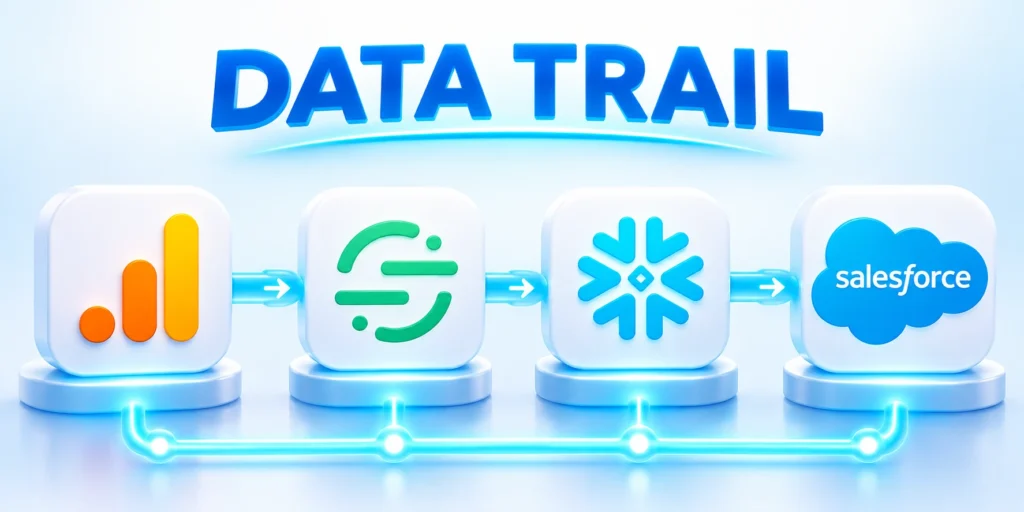
Use a consistent source hierarchy: preserve the original campaign and interaction data, record meaningful lifecycle transitions, and require sales to capture outcome information in the CRM.
When an offline event becomes important—such as a qualified opportunity or closed sale—return the permitted outcome signal to the advertising platform only through a compliant and tested integration.
Connect Campaigns to Downstream Outcomes
Google Ads currently describes enhanced conversions for leads and lead journey mapping as ways to connect qualified downstream events to campaign measurement.
The implementation and available APIs can change, so confirm the current setup guide in the account before deploying.
Protect Data Use and Privacy
Hashing or uploading data does not remove the need for an appropriate legal basis, notice, security, and data minimization.
Limit identifiers and event data to approved purposes, restrict access, document retention, and preserve consent or preference signals across connected systems.
Estimate incremental impact with care
Consider controlled experiments when a decision is material and the business can keep other conditions comparable.
A holdout, geographic test, or time-based test may help estimate incremental effect better than comparing two campaigns with different audiences.
State Experimental Uncertainty
If the sample is too small, report the uncertainty and use the result as directional rather than claiming statistical proof.
Describe selection limits, attribution assumptions, external changes, sample size, and evidence that could reverse the current interpretation.
Use quality feedback to improve campaigns
Review not only which campaigns produced opportunities but also which leads sales accepted, which were disqualified, why they were disqualified, and how long the next action took.
Reasons such as wrong company size, no relevant project, unsupported technology, or unclear offer can point to different fixes.
Turn Findings into Specific Decisions
Create a monthly or campaign-end review with one decision per finding:
Convert campaign evidence through these improvement decisions:
- Keep the segment and change the offer if fit is good but conversion is weak.
- Narrow or exclude a segment if repeated submissions cannot be served.
- Improve the landing-page explanation if buyers misunderstand the deliverable.
- Fix data capture or routing if valid requests are delayed or lost.
- Reduce spend or pause the experiment if the team cannot process demand responsibly.
- Expand only when the business can show quality, capacity, and acceptable economics.
Avoid optimizing to the lowest-cost event when downstream quality is unavailable.
If a platform sees only form submits, its automated bidding may find more form submits, not necessarily more profitable customers.
Improve the Signal Before Bidding
Improve the signal quality first; if the data is too sparse for reliable optimization, use a realistic interim event and label it as a proxy.
Repair conversion definitions, routing, feedback, and offline outcome imports before asking an advertising system to optimize against unreliable events.
Run a 90-Day Demand Generation Operating Plan

A 90-day plan is a way to create learning and operating discipline, not a promise that a complex B2B program will reach statistical certainty inside one quarter.
Organize the quarter around decisions that can be made from early evidence.
->Give Each Month a Clear Purpose
The first month establishes definitions and infrastructure. The second tests a small number of offers and audiences.
During month three, the team reviews quality, improves the strongest path, and decides whether to scale, revise, or stop.
Set a Budget the Team Can Support
Before choosing a spend target, confirm that the company can answer inquiries, fulfill the offer, and store data responsibly.
Budget should reflect the business's ability to serve potential buyers and the size of the decision being tested.
Treat Platform Budget Suggestions as Inputs
Do not copy a platform's suggested budget as if it were a forecast of return.
Set spend from business economics, test design, delivery capacity, and acceptable risk rather than treating a platform recommendation as a commitment.
Make responsibilities explicit
Assign a single accountable owner for the overall program and named owners for campaign operations, content, CRM changes, sales follow-up, and privacy review.
A small team can combine these roles, but the responsibilities still need names and deadlines.
Days 1–30: establish the foundation
Use the first month to make the system understandable before adding complexity:
Establish the first month through these foundations:
- Select one audience segment and one commercial problem supported by evidence.
- Document the ICP, buying roles, exclusion conditions, and evidence that indicates intent.
- Agree on lifecycle stages, handoff criteria, lead dispositions, and ownership.
- Select one early-stage offer and one appropriate action for high-intent buyers.
- Review the landing page, forms, privacy notice, CRM fields, deduplication, and response process.
- Test the entire event path from campaign click through CRM creation and sales notification.
- Establish baseline definitions, reporting cohorts, conversion events, and the person who will review them.
Record what is known and what is only assumed.
For example, if sales says most wins come from mid-market firms using a particular CRM, check the recent customer records before building the audience around that claim.
Resolve Data Quality Before Launch
If data quality is poor, make data cleanup a prerequisite rather than treating a guess as fact.
Keep the channel plan small during setup. One high-intent capture path and one educational path may provide enough contrast to test.
Launch When Tracking and Ownership Work
Use the first month to ensure the assets and ownership work.
A campaign that starts late with reliable tracking can be more valuable than a campaign that starts immediately but produces records nobody can interpret.
Days 31–60: run controlled tests
Choose one or two hypotheses that can lead to a concrete decision.
Keep the test narrow enough to explain, operationally support, and review against a previously documented outcome and stopping rule.
Use Concrete Hypotheses
Example: “A technical migration checklist will generate fewer inquiries than a general guide, but a higher share will match our supported environment.”
Another: “A consultation offer will work for high-intent search traffic but not for early-stage video audiences.”
Change Variables Deliberately
Change one major variable at a time when practical: audience, offer, message, landing page, or follow-up. If every variable changes together, a result may be difficult to explain.
This is not a requirement for laboratory perfection; it is a way to preserve enough clarity to choose the next action.
Document the test before launch
A written test plan protects interpretation when platforms, audiences, sales capacity, or campaign conditions change during the observation period.
Document each experiment through these test conditions:
- The question and expected buyer behavior.
- Audience conditions for inclusion or exclusion.
- Selected channel and offer.
- Primary outcome and early indicators.
- The minimum operational condition for continuing, such as accurate routing.
- The date and owner for reviewing the result.
It also gives marketing and sales one reference for deciding whether the result supports scaling, optimization, repositioning, or closure.
Run a launch-readiness review
Test ad or referral parameters, landing behavior, forms, consent, CRM creation, ownership, notifications, follow-up timing, reporting, and failure alerts together.
Use representative devices and paths, including rejection and duplicate scenarios, so a successful form submission does not hide a broken downstream handoff.
Keep a rollback path
Document who can pause spend, disable a form, correct routing, restore settings, and notify affected teams when launch evidence becomes unreliable.
Retain the approved baseline so corrections do not depend on memory or undocumented platform defaults.
Days 61–90: decide what to improve or scale

Review mature cohorts and distinguish them from recent activity. Compare the intended audience with the organizations that actually engaged.
Inspect sales acceptance, opportunity creation, disqualification reasons, response quality, and the experience of buyers who converted.
Choose an Action Based on Evidence
Make one of four decisions for each campaign:
Choose the next cycle through these evidence paths:
- Scale carefully: quality is strong, economics plausible, follow-up reliable, and the team has delivery capacity.
- Optimize: audience is relevant but the offer, creative, page, or handoff has a fixable weakness.
- Reposition: the current message attracts the wrong problem or role despite high engagement.
- Stop or pause: campaign lacks quality, violates constraints, overwhelms operations, or relies on poor data.
Scaling should be staged. Increase coverage, budget, or segments in increments the team can monitor. Preserve a stable baseline where possible so that new results can be compared.
Add a channel only when its job and measurement are clear. Evaluate podcast sponsorship and syndication against audience fit and awareness goals.
Record Decisions for the Next Cycle
Finish the quarter with a concise decision record: what changed, which evidence supported the decision, what remains uncertain, and what the next owner will do.
That record prevents the team from repeating an old test simply because its result was never captured.
Separate signal from noise
Compare mature cohorts with stable definitions and investigate whether changes in quality reflect audience, offer, seasonality, sales response, tracking, or delivery capacity.
Use representative records beside aggregate metrics so a favorable average does not conceal poor-fit segments or operational failures.
Scale only supported learning
Increase budget, reach, or channel breadth in increments that preserve measurement, follow-up quality, customer experience, and service capacity.
Pause expansion when uncertainty, data gaps, or operational constraints prevent a responsible interpretation of additional volume.
Conclusion

A dependable B2B demand program helps suitable organizations understand a meaningful problem, evaluate credible evidence, and choose a relevant next step.
It connects buyer context, offers, channels, qualification, sales response, measurement, privacy, and operational capacity through one learning system.
Operate demand as a shared system
Marketing can create and capture interest, but qualified pipeline also depends on accurate routing, responsive sales ownership, useful delivery context, and honest outcome feedback.
Keep the operating model reliable through these controls:
- Define audience, buying roles, intent, and qualification evidence.
- Match offers and channels to observable buyer readiness.
- Test capture, ownership, response, and measurement together.
- Review disqualification, opportunity, revenue, and capacity outcomes.
- Record uncertainty and preserve responsible stopping rules.
Define responsibilities before launch so each team understands what evidence triggers action and how the resulting quality returns to campaign decisions.
Improve one constraint at a time
Use mature cohorts and representative records to identify whether the primary constraint is audience fit, message, offer, channel, form, handoff, tracking, or delivery capacity.
Choose a change that can produce interpretable evidence, document the expected buyer behavior, and preserve a stable comparison where practical.
Scale only after quality holds
Increase spend, reach, segments, or channel breadth gradually while monitoring buyer experience, qualified outcomes, sales response, economics, privacy, and service capacity.
Stop expansion when missing data, inconsistent definitions, poor routing, or unsupported volume prevents a responsible interpretation of results.
Preserve the next learning cycle
Finish each review with the decision, supporting evidence, known limits, accountable owner, next action, review date, and condition that would change the conclusion.
That record prevents teams from repeating unclear experiments and gives future planning a trustworthy starting point.
Continue with channel-specific planning
For a focused companion topic, read YouTube Ads for B2B Demand Generation: Strategy and Targeting.
Apply its channel guidance within the same qualification, handoff, privacy, measurement, and capacity controls established throughout this demand-generation system.
FAQ
These answers clarify common B2B demand-generation planning, qualification, measurement, and operating questions.
What is B2B demand generation?
B2B demand generation helps suitable organizations understand a problem, evaluate an offer, and take a relevant next step through coordinated education and campaigns.
It connects awareness, intent capture, qualification, sales response, and feedback to qualified pipeline rather than treating contact volume as the final outcome.
How is demand generation different from lead generation?
Lead generation captures contact information or responses, while demand generation also develops understanding, offers, channels, qualification, handoffs, and measurement across the buying journey.
A form can support the system, but collecting a contact does not prove fit, intent, buying-group alignment, or commercial value.
What makes a B2B lead high intent?
High intent combines recent, specific behavior with suitable account characteristics and a next step that matches the buyer’s apparent evaluation stage.
Direct requests usually provide stronger evidence than passive views, modeled topic interest, or repeated activity from one unidentified participant.
How many channels should a demand program use?
Use only the channels the team can maintain, measure, connect to CRM outcomes, and support with appropriate buyer follow-up.
Add a channel when it has a distinct audience, offer, operating owner, measurement path, and role that existing channels do not fulfill.
Should every demand campaign use a lead form?
No. Ungated education can help buyers understand a problem without unnecessary friction, while forms are useful when delivery or response requires contact details.
Request only information needed for the promised value, qualification, secure preparation, scheduling, routing, or legally supported communication.
What separates demand creation from demand capture?
Demand creation introduces or clarifies a problem for buyers who may not be actively searching, while demand capture responds to observable existing interest.
They require different messages, offers, expectations, and primary outcomes even when they support the same commercial strategy.
How should marketing and sales define a qualified lead?
Define observable fit and intent, required evidence, the accepting owner, response expectation, disqualification reasons, and the next action appropriate to the offer.
Review real handoffs together and revise criteria when they create unsupported work, missed opportunities, or poor buyer experiences.
Which demand-generation metrics matter most?
Track valid inquiries, fit, intent, response time, sales acceptance, opportunities, revenue, disqualification reasons, campaign cost, and operational capacity.
Choose a primary outcome for each campaign role and retain intermediate measures as diagnostic evidence rather than interchangeable success claims.
How long does demand generation take to produce pipeline?
Timing depends on the buyer, offer, price, risk, awareness, sales cycle, response quality, and the maturity of available measurement.
Label cohorts as recent, mature, or incomplete so early engagement is not compared directly with opportunities that had sufficient time to develop.
How can a small team start responsibly?
Choose one customer segment, business problem, useful offer, observable-intent channel, accountable response owner, and measurable commercial outcome.
Verify capture and follow-up, review lead quality, document learning, and expand only when the existing system operates reliably.






Leave a Reply