

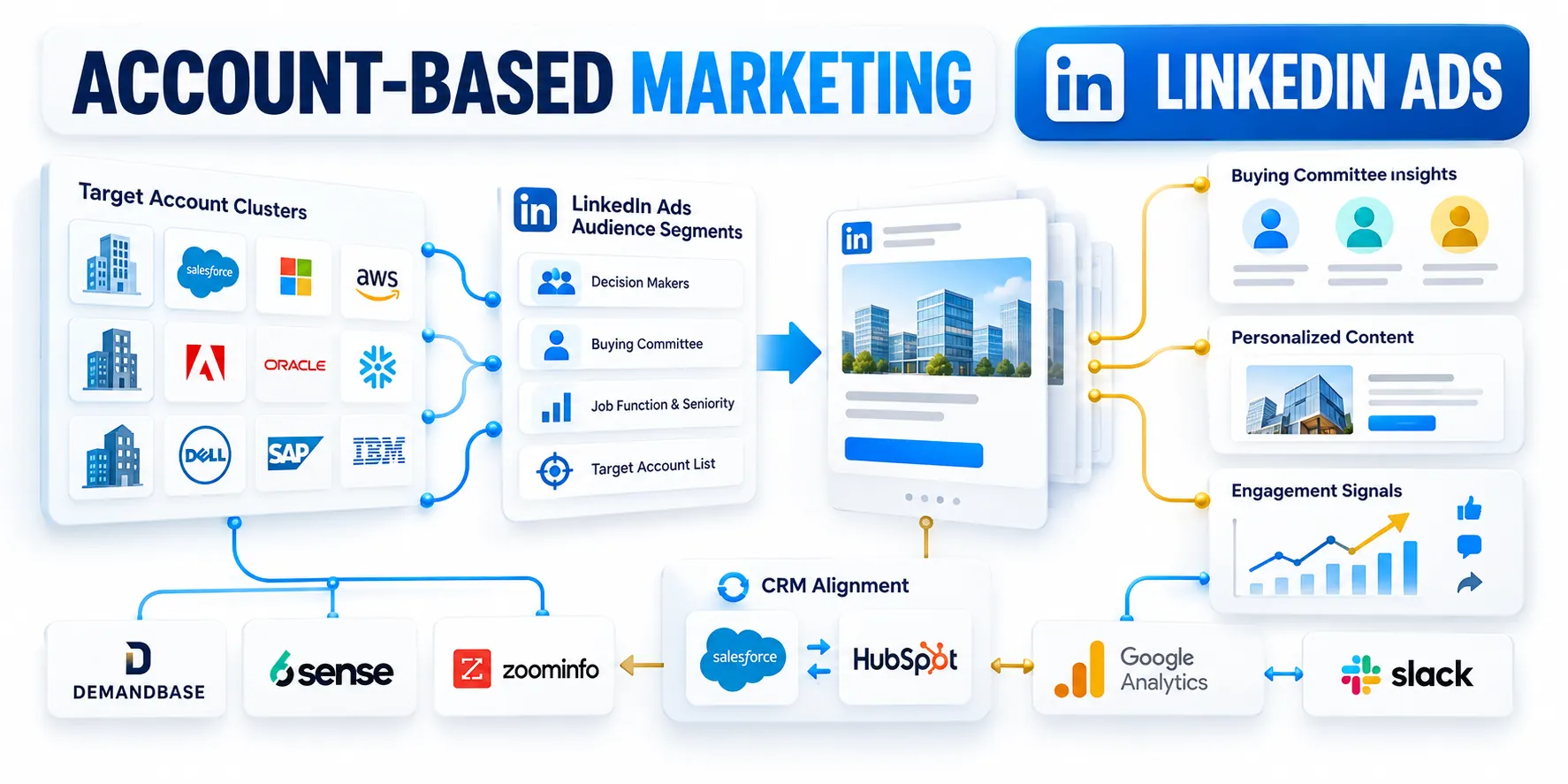
Build an ABM Foundation Around Account Fit
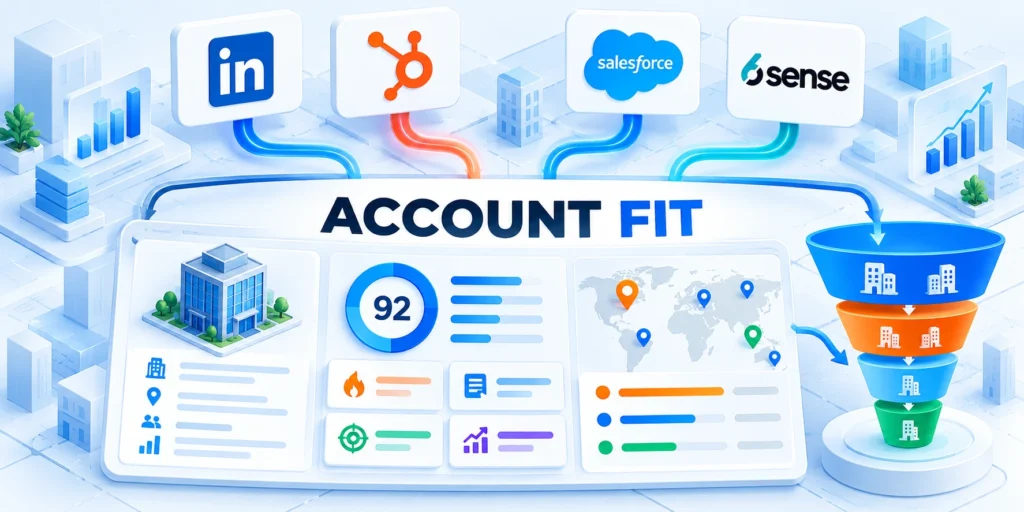
LinkedIn account-based marketing starts with a business choice: which organizations merit coordinated sales and marketing attention, and why?
LinkedIn Ads can extend that program, but they cannot compensate for weak account selection, unclear ownership, or an offer buyers do not value.
Define the account-level problem first
Pick one measurable problem, such as reaching more buying roles in qualified accounts or creating meetings in a defined market segment.
Write down the audience, expected business outcome, sales owner, conversion event, and review period before building the first campaign.
Define the foundation with these shared fields:
- Audience: the named companies and buying roles the team can serve.
- Outcome: a sales-accepted meeting, qualified opportunity, or another defined milestone.
- Owner: the person responsible for follow-up at each target account.
- Evidence: CRM fields and campaign events that will show whether progress occurred.
Confirm service capacity and outcome ownership
Estimate how many accounts sales can research, contact, and review without weakening response quality. ABM scope must fit operational capacity across the complete campaign window.
Name the business outcome, account owner, campaign owner, and review date before activation. Shared responsibility without explicit ownership usually creates delayed or duplicated follow-up.
Keep account selection evidence reviewable
Store the fit rationale, buying trigger, exclusion reason, and supporting source beside every selected account. Review uncertain entries rather than presenting the list as certainty.
Refresh evidence when markets, services, territories, or account status change. A stale account universe can waste both advertising budget and sales attention.
Choose an ABM motion that matches account value

Not every target account needs the same treatment. Use the expected value, buying complexity, and available sales capacity to choose how much personalization is practical.
Define the research, content, media, and sales effort available for each tier. The motion should reflect real delivery capacity, not an aspirational label.
| Motion | Useful when | Trade-off |
|---|---|---|
| One-to-one | Few high-value complex accounts | Deep research and coordination |
| One-to-few | Cluster shares problem or trigger | Requires genuine commonality |
| One-to-many | Larger list shares one offer | Needs relevant segmentation |
These labels describe practical operating patterns, not rigid campaign rules. A team can use different motions for different account tiers.
For example, reserve custom executive outreach for six strategic accounts, create industry-specific campaigns for two clusters, and use a shared educational program for the broader list.
Set qualification and exclusion rules
Document the conditions that make an account eligible, then record exclusions such as customers, competitors, unsupported regions, or companies with no serviceable use case.
Use sales evidence and CRM history to refine the ideal customer profile. Do not treat company size or industry as proof of intent by itself.
Use these steps to review account fit:
- Choose a product or service that solves a documented account-level problem.
- List the company traits associated with successful customers.
- Identify buying triggers and disqualifying conditions.
- Ask sales to review a sample of accounts before launch.
- Record why each account was added or excluded.
Salesforce describes ABM as a coordinated approach to selected high-value accounts. Treat that as a strategy across teams, not simply a LinkedIn audience setting.
Create a Sales-Aligned Target Account List
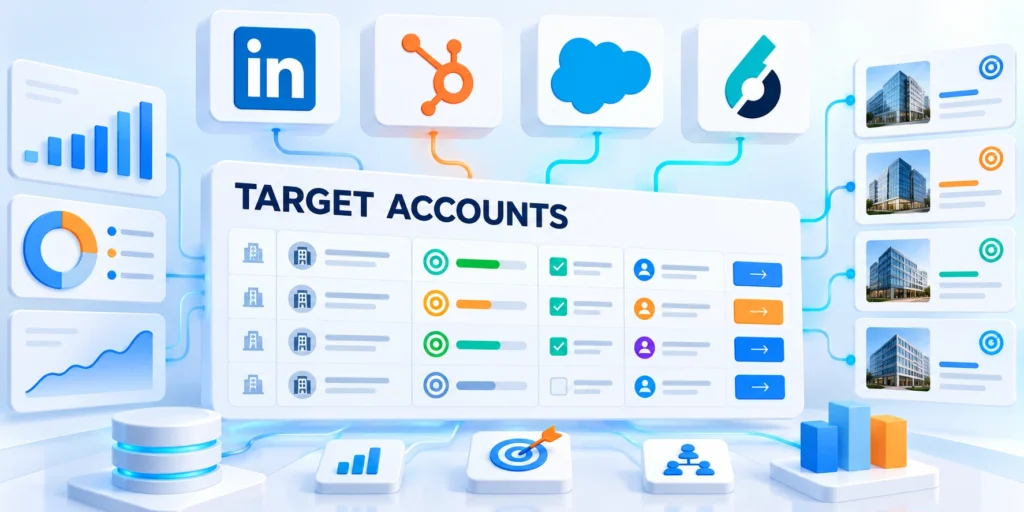
A usable target list connects marketing selection to a sales owner, account context, and a next action.
Resolve duplicates and confirm ownership before uploading CRM records. If expanding beyond a named-account list, use first-party CRM data for modeled audiences only where supported and permitted.
Score fit without pretending the score is certainty
A lightweight score helps teams make consistent choices. It should prioritize review, not replace account research or sales judgment.
| Factor | Example evidence | Scale |
|---|---|---|
| Commercial fit | Use case and serviceability | 0 to 5 |
| Revenue potential | Contract and expansion value | 0 to 5 |
| Buying readiness | Active project or engagement | 0 to 5 |
| Reachability | Sales access and relevant roles | 0 to 5 |
For a pilot, rate each factor consistently and review the top accounts with sales. The scales are a local prioritization aid, not a forecast.
If two accounts receive the same total, prefer the one with clearer customer fit, a real business trigger, and an assigned sales owner.
Validate account selection with sales
Review representative accounts with sales before freezing the pilot list. Confirm service fit, territory, current relationship, buying context, and capacity for relevant follow-up.
Record why disputed accounts remain, move tiers, or leave the program. Those reasons improve future scoring and future list governance more than an unexplained numeric rank.
Use these checks before approving target accounts:
- Confirm the account fits the current service
- Verify territory and ownership are current
- Check active opportunities and customer status
- Document the buying trigger or hypothesis
Agree on tiers, ownership, and handoffs

Define what each tier receives, how often sales reviews activity, and what action follows meaningful engagement.
Assign one accountable owner for each account and one backup route for absences. Handoffs should specify the evidence, timing, action, and CRM update required.
Apply these operating patterns across account tiers:
- Strategic tier: named owner, account brief, tailored offer, and coordinated one-to-one outreach.
- Cluster tier: cluster-specific message, shared account review, and relevant sales follow-up.
- Scale tier: scalable campaign, qualification rules, and routing when intent becomes meaningful.
Set a review cadence that sales can actually maintain. A weekly review may fit an active pilot; a mature program may review exceptions weekly and the whole list monthly.
Record the tier, account owner, fit rationale, exclusion status, last review date, and next step in a shared system.
Clean and govern the list
Resolve parent-child organizations, renamed companies, closed businesses, and CRM duplicates. Agree whether the campaign targets a corporate group, a business unit, or a location.
Keep one owner for list changes. If sales removes an account, capture the reason so marketing does not re-add it during the next refresh.
Govern the account list through these controls:
- Export the target accounts from the CRM with stable company identifiers.
- Remove duplicates and records that fail the eligibility rules.
- Confirm account ownership, tier, market, and allowed campaign purpose.
- Have sales approve the initial list and disputed entries.
- Save a dated version and document who can update the source.
Use a pilot list small enough for sales to review, but large enough to support the audience and geographic reach required by the platform.
Map Buying Groups and Build LinkedIn Audiences

Enterprise purchases involve groups of people with different questions, influence, and approval responsibilities.
Map those roles at the account level, then use LinkedIn’s company and contact targeting options to reach relevant professional audiences.
Map the people involved in the decision
Use CRM contacts, sales notes, and customer interviews to identify roles. Treat role labels as hypotheses until sales confirms how the buying process works.
Map these responsibilities inside each buying group:
- Economic buyer: evaluates business impact, investment, and approval.
- Technical evaluator: examines security, integration, architecture, or operational fit.
- Business champion: coordinates the problem internally and builds support.
- Daily user or operator: cares about adoption, workflow, and practical outcomes.
- Procurement or legal: reviews commercial terms, risk, and compliance.
One person can hold multiple roles, and some accounts will not expose every role. The map is a planning aid, not a claim that a complete committee is known.
Confirm roles against the real buying process
Ask sales which roles initiate, evaluate, approve, implement, and operate the solution. Titles vary, so map responsibilities before translating them into targeting filters.
Distinguish required roles from optional influencers. This prevents a broad title collection from masquerading as a defined buying-group strategy.
Document unknown buying-group gaps
Mark roles that remain unidentified and the evidence needed to confirm them. Account-level reach does not prove the campaign reached every necessary participant.
Use early engagement and sales conversations to refine the map. Preserve the previous version so changes remain attributable and reviewable.
Build a LinkedIn Matched Audience carefully
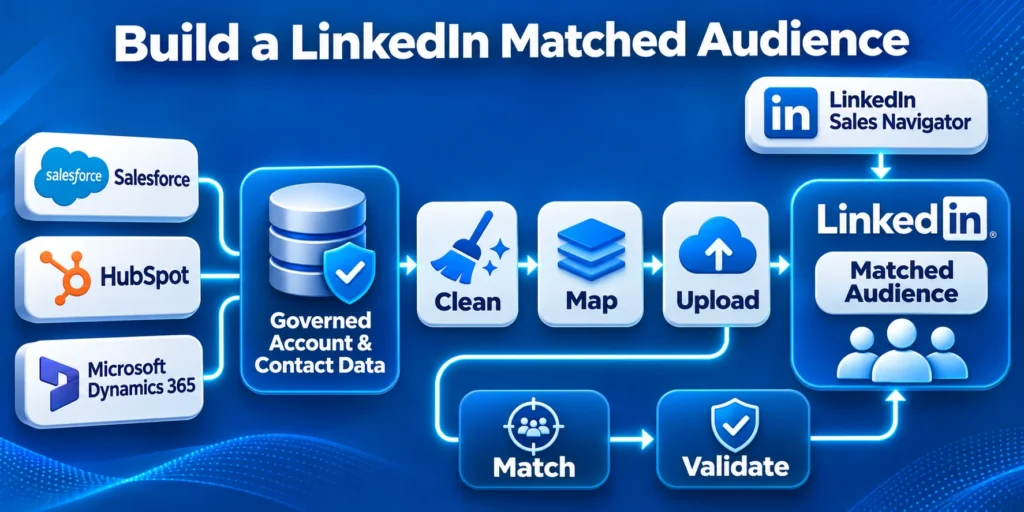
LinkedIn Matched Audiences can use company lists, contact lists, website visitors, and engagement sources. Choose only data the team is permitted to use for advertising.
For a company list, include accurate company names and identifiers. LinkedIn says company-page URLs or company websites can improve matching.
Prepare the matched audience through these steps:
- In Campaign Manager, open Plan and then Audiences.
- Create a Matched Audience from a company list and upload the approved account file.
- Check the list’s processing status and review the matched-account count.
- Build an ad set that includes the ready audience and a relevant location.
- Preview the estimated reach after all inclusions and exclusions are applied.
LinkedIn’s current help notes a minimum 300 rows for a company-list upload and at least 300 matched member accounts for an active ad set.
Its company-list guidance recommends 1,000 or more organizations where practical. Location and other filters can reduce reach, so verify the final audience estimate.
Refine reach without hiding the audience definition
Company targeting identifies organizations; role, seniority, or function filters can narrow the people reached. Each added filter may reduce scale.
Begin with the smallest set of filters needed to reach relevant roles. Compare the resulting audience size against the account list and campaign objective.
Refine reach using these documented controls:
- Use company attributes to define the account universe.
- Use job-related filters only when they map to a real buying role.
- Exclude customers or active opportunities only when that matches the campaign purpose.
- Document each inclusion and exclusion so sales can understand who may see the ads.
Do not target sensitive personal traits or infer protected characteristics. Keep the audience definition business-relevant and consistent with platform rules and privacy obligations.
Check LinkedIn’s company-list targeting guidance before uploading because minimums and interface labels can change.
Sequence LinkedIn Ads Across the Buying Journey

An account list becomes useful when the message answers a question the buying group is likely asking now.
Sequence campaigns by information need and account progress, rather than showing every contact the same offer repeatedly.
Match content to the account’s next decision
| Buying need | Useful content | Next action |
|---|---|---|
| Recognize costly problem | Diagnostic guide or benchmark | Read useful resource |
| Understand approaches | Architecture or comparison | Explore the approach |
| Assess implementation risk | Security or migration detail | Review requirements |
| Evaluate provider | Case study or workshop | Request specialist conversation |
Use one offer per campaign objective. A low-commitment educational asset should not promise a sales meeting as its only next step.
Keep claims specific and supportable. Avoid implying that an account has a known problem just because its company matches the audience list.
Design a controlled campaign sequence
Build the sequence with these controlled steps:
- Choose one account tier and one commercial problem for the pilot.
- Select the roles that need the first message and a useful next resource.
- Create a follow-up message for the next decision, not a duplicate impression.
- Use exclusions or audience windows to suppress irrelevant follow-up where available.
- Set a review date and a sales response process before launch.
Campaign structure should reflect the test. Separate ad sets only when audience, offer, objective, or measurement differs enough to justify independent control.
For broader campaign setup and bidding trade-offs, see this LinkedIn Ads guide for enterprise contracts.
Coordinate ads with sales outreach
Sales should know which campaign is active, which offer it promotes, and what engagement means operationally.
Coordinate sales outreach through these shared actions:
- Notify owners when a target account reaches a defined engagement threshold.
- Give representatives the campaign theme and the resource the buyer may have seen.
- Let sales record outcomes such as no project, active evaluation, or meeting accepted.
- Suppress outreach when a customer or open opportunity requires a different conversation.
Use privacy-safe, account-level engagement summaries where possible. Avoid exposing individual ad activity as a claim in unsolicited outreach.
Connect Campaign Engagement to CRM Outcomes

LinkedIn reporting can show delivery and engagement, but an ABM decision also needs account and opportunity context.
Connect campaign identifiers to analytics and CRM records so the team can distinguish reach, lead response, and actual sales progression.
Tag landing-page URLs consistently
Use a shared naming convention for source, medium, campaign, and content. Google’s UTM URL guidance explains campaign parameters, whose values are case-sensitive.
A sample paid-social URL can include utm_source=linkedin&utm_medium=paid_social&utm_campaign=abm_target_accounts&utm_content=technical_guide.
Define a small, reliable data map
| Field | Purpose | Owner |
|---|---|---|
| CRM account ID | Connects people to organization | CRM operations |
| Campaign ID and UTMs | Identifies campaign source | Marketing operations |
| Contact or lead ID | Links response to CRM person | Demand generation |
| Opportunity ID and dates | Shows sales stage movement | Sales operations |
| Campaign outcome | Records follow-up status | Sales owner |
Use stable IDs rather than matching records by company name alone. Names vary across subsidiaries, punctuation, and CRM systems.
Before sharing contact data with an advertising platform, confirm the approved legal basis, notices, access controls, and retention rules for the relevant market.
Measure progression with explicit definitions
Measure progression through these account-level indicators:
- Account coverage: target accounts reached divided by eligible target accounts.
- Buying-group coverage: distinct required roles reached or engaged within reached accounts.
- Engaged-account rate: accounts meeting a documented engagement threshold divided by reached accounts.
- Opportunity progression: eligible accounts entering a defined opportunity stage during the review window.
- Pipeline contribution: value associated with opportunities, reported with attribution limits clearly stated.
Define meaningful engagement before seeing campaign results. A click alone may be too weak; combine relevant actions without treating every interaction as buying intent.
Separate opportunities sourced by the program from opportunities merely influenced by it. One sale can have multiple meaningful touches, so avoid adding its full value repeatedly.
Reconcile the campaign to the CRM
Reconcile campaign records through these verification steps:
- Confirm the campaign ID and UTMs appear on test visits and form submissions.
- Check that leads attach to the intended account and campaign record.
- Verify sales status fields and timestamps reflect real outcomes.
- Compare platform delivery, analytics sessions, CRM responses, and sales acceptance.
- Investigate missing or duplicated records before changing budgets.
For a small pilot, reconcile a sample of records manually with the sales owner. Fix field mapping or routing before expanding the audience.
Document discrepancies and ownership before expanding the audience. A reliable reconciliation distinguishes reporting gaps from genuine account progression or stalled sales follow-up.
Optimize ABM Campaigns Using Account Progress
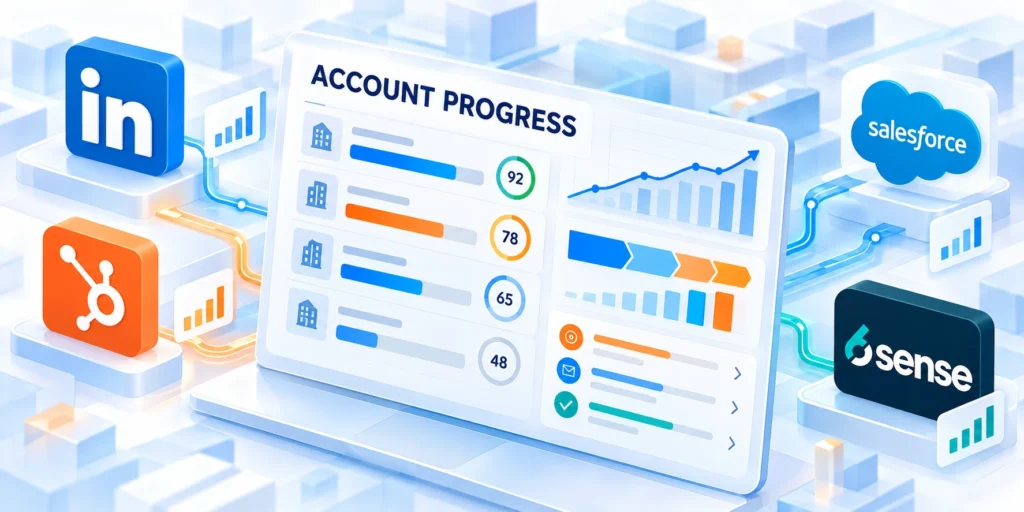
Optimization should answer whether the program is progressing the right accounts, not merely whether ads produced inexpensive clicks.
Review delivery, buying-group reach, CRM quality, and sales feedback together before changing the audience or offer.
Run a weekly pilot review
Run each pilot review through these decisions:
- Check whether the intended accounts received impressions and enough relevant roles were reachable.
- Review clicks, landing-page behavior, and form quality by campaign and account tier.
- Ask sales whether engagement created useful context or a timely conversation.
- Compare account movement with the baseline and the agreed review window.
- Choose one change, assign an owner, and record the expected result.
Do not label a campaign a failure because an enterprise deal did not close during a short flight. Track leading indicators and downstream outcomes over appropriate time windows.
Use the review to confirm one decision, one owner, and one expected signal. Avoid changing audience, message, destination, and routing simultaneously.
Diagnose the stage where progress stops
| Observed pattern | First checks | Next adjustment |
|---|---|---|
| Little account reach | Match, location, role filters | Fix identifiers or segment |
| Weak engagement | Message, creative, offer | Test clearer proof |
| Few conversions | Promise, form, speed | Align page and reduce fields |
| Sales rejects leads | Criteria, routing, account fit | Fix handoff before spending |
Change one major variable at a time when practical. If audience, offer, creative, and landing page all change together, the team cannot learn which change mattered.
When the program reaches too few accounts, review list quality and constraints before adding broad filters. More impressions do not automatically mean more buying-group coverage.
Scale only after the operating model works
Before adding accounts, confirm that the team can review engagement, route responses, and maintain the CRM data required for measurement.
Scale only after confirming these operating safeguards:
- Expand a cluster only when its accounts share a defensible problem and offer.
- Protect sales capacity by matching outreach volume to owner availability.
- Refresh exclusions and account status on an agreed schedule.
- Keep a holdout or comparison where practical and appropriate for the campaign.
- Record what changed so the next review has context.
ABM is a coordinated operating approach. Paid media contributes reach and engagement, while sales execution, relevant content, and clean data determine whether accounts move forward.
Conclusion

LinkedIn Ads can support ABM when account selection, buying-group messaging, sales ownership, campaign sequencing, and CRM measurement operate as one coordinated program.
The platform supplies targeted reach, but useful progress depends on clean account data, relevant content, reliable handoffs, and explicit definitions for account movement.
Start with an operating model sales can support
Choose a manageable account cohort and define one meaningful progression outcome. Assign owners before launch so engagement reaches the correct sales context without delay.
Keep tiers, exclusions, audience logic, messages, and review dates visible in shared systems. This prevents campaign delivery from drifting away from account strategy.
Use these priorities to guide the ABM program:
- Select accounts using fit and service capacity
- Map roles around a real buying decision
- Match content to the next account step
- Preserve campaign and CRM identifiers
- Review progression before increasing reach
Scale only when account progress remains credible
Increase coverage when matching, delivery, qualification, routing, and sales response remain dependable across the current tier. Preserve the baseline before changing spend or audience scope.
Stop or redesign when the market, offer, data, or operating model cannot support the intended outcome. A smaller verified program is more valuable than inflated account engagement.
Preserve the learning between account cohorts
Keep account decisions, audience versions, creative themes, handoff outcomes, and CRM discrepancies in one reviewable record after every pilot cycle.
That evidence supports a stronger next cohort and prevents teams from repeating targeting or routing assumptions that the previous campaign already disproved.
FAQ
These answers clarify practical LinkedIn ABM decisions involving account selection, audience matching, buying-group engagement, sales handoffs, measurement, and controlled scaling.
What is account-based marketing with LinkedIn Ads?
It is a coordinated sales and marketing program that selects target companies, maps relevant buying roles, and uses LinkedIn advertising to support account-specific engagement.
How many target accounts should a pilot include?
Choose a cohort sales can review and the platform can reach. LinkedIn audience minimums apply after matching and targeting, so verify the final estimated audience before launch.
Can LinkedIn Ads target a list of companies?
Yes. LinkedIn Matched Audiences supports company-list targeting, subject to list processing, match quality, audience-size minimums, location, and platform eligibility rules.
Which metrics matter most in an ABM campaign?
Track account coverage, relevant buying-group engagement, qualified responses, opportunity progression, and pipeline with explicit definitions and attribution limits.
Should every engaged account receive sales outreach?
No. Agree on a meaningful engagement threshold and account context with sales, then prioritize outreach that adds value and respects the buyer’s situation.
How should sales territories affect ABM account lists?
Assign accounts to current territory owners before launch, then document how transfers, shared coverage, and disputed ownership will be handled.
How are buying-group roles measured?
Measure relevant role coverage by account, engagement with useful content, qualified responses, and progression without claiming that every buyer is known.
What if LinkedIn cannot match many accounts?
Review identifiers, company names, websites, location filters, and list quality. Do not broaden targeting until the resulting audience remains commercially relevant.
How should account engagement be handed to sales?
Define an account-level threshold, provide campaign context, assign an owner, and record the outcome so marketing can improve routing and qualification.
When should an ABM pilot stop or scale?
Scale after reliable targeting, follow-up, and measurement. Stop or redesign when the audience, offer, data, or sales process cannot support the intended outcome.





Leave a Reply