


Define Target Markets by Buying Intent and Local Fit

An international SEO strategy for SaaS begins with a market decision, not a translation request. Search demand matters, but it does not prove product or sales readiness.
Choose a market where buyer interest, product fit, commercial readiness, and operating capacity overlap. Organic visits have little value when buyers cannot evaluate or purchase.
Score markets using evidence
Shortlist two to four markets. Record the evidence behind each opportunity rather than assigning an unsupported market-size score.
Use CRM location data, sales-call language, support tickets, keyword patterns, product usage, and partner feedback. Note the source and confidence.
| Signal | Review | Practical check |
|---|---|---|
| Buyer demand | Qualified prospects and nonbranded queries | Compare query language with sales conversations |
| Product fit | Integrations, workflows, and availability | Ask sales and support to list recurring blockers |
| Commercial readiness | Pricing, contracts, and payment options | Walk through a realistic purchase scenario |
| Delivery capacity | Support hours and implementation coverage | Name an owner and estimate continuing work |
Use these signals to qualify a market candidate:
- Relevant nonbranded demand and sales evidence
- Supported product and integration fit
- Commercial and contractual readiness
- Implementation and support capacity
- Local buyer terminology and competitor context
- Reliable measurement access and CRM attribution
- Market-specific procurement and compliance constraints
Reject markets that show traffic without a supported buyer task, credible conversion path, accountable owner, or operational capacity to fulfill the localized promise.
Revisit the score when product availability, pricing, integrations, regulation, sales coverage, service hours, or the observed mix of qualified opportunities changes materially.
Separate Language Strategy from Country Strategy
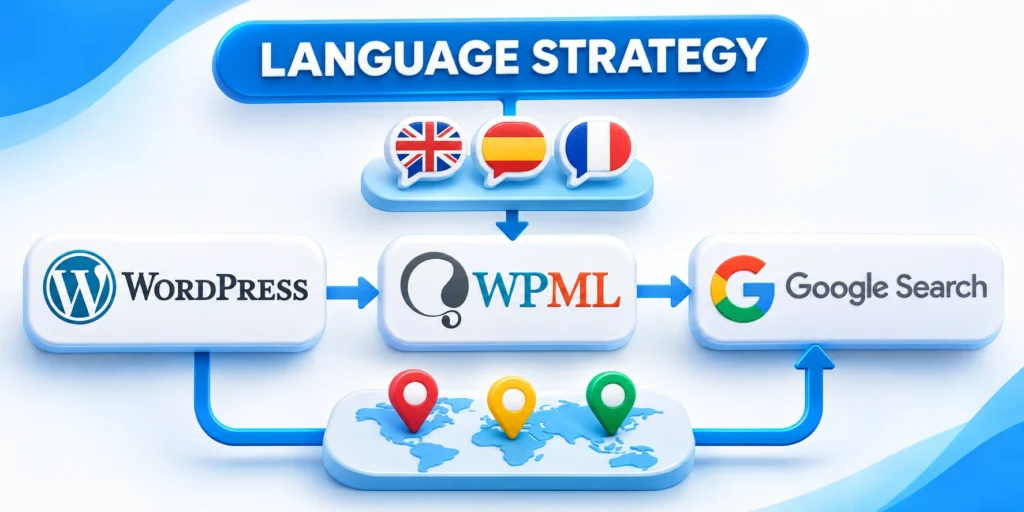
Language coverage and country expansion require different evidence, ownership, commercial decisions, and delivery commitments even when prospective buyers share the same written language.
Treat the distinction as a market-design decision, not a naming exercise, because it affects URLs, search demand, content, pricing, proof, support, and measurement.
Separate language from country
Language and country are related, but they are not interchangeable. One language may serve several countries with different commercial expectations.
Decide whether a page targets a language audience, a regional buying context, or both. This affects examples, keywords, pricing, and support details.
Use these actions to separate language from country:
- Use one language page when the offer and buying experience are genuinely shared.
- Create regional versions when availability, pricing, customer proof, or buyer intent meaningfully differs.
- Do not create country pages merely to add a location name to a headline.
Start with evidence about how buyers describe the problem, evaluate vendors, purchase, implement, receive support, and interpret product or legal terminology.
A shared language page is efficient only when the offer and conversion journey remain materially equivalent across the countries it serves.
Choose a pilot with a clear outcome
Set a pilot goal before publishing. For example, validate qualified demo demand in one market over a defined review period.
Track the pages, query themes, qualified leads, and delivery effort included. That makes the next investment easier to justify.
Confirm these pilot controls before expanding coverage:
- Named market and buyer task
- Supported offer and conversion path
- Qualified demand and delivery measure
- Owner, budget, and review date
Set an owner for content, technical signals, lead routing, sales response, and post-pilot review so the result reflects the complete market experience.
Use the pilot to discover operational gaps before multiplying URLs, translation work, advertising, support commitments, or reporting complexity.
Choose a URL Architecture You Can Operate

Your URL architecture helps users and crawlers reach the right locale. It cannot compensate for thin or inaccurate localization.
Compare country-code domains, subdomains, and subdirectories against ownership, analytics, technical capacity, and regional business needs.
Compare the maintenance trade-offs
| Structure | Best fit | Trade-off |
|---|---|---|
| Country domain: example.de | Distinct regional operation | Separate domain maintenance |
| Subdomain: de.example.com | Separated regional property | Ownership may fragment |
| Subdirectory: example.com/de/ | Shared infrastructure | Requires locale governance |
Google documents these patterns and their operational pros and cons. It recommends distinct URLs for language versions rather than changing content only through cookies or browser settings.
Review Google’s guidance on multi-regional and multilingual sites before choosing a pattern.
Write the URL rule before launch
Document locale codes, path placement, lowercase rules, trailing slashes, and slug translation. Editors and developers should apply the same convention.
Follow this sequence to write the url rule before launch:
- List each locale and its intended audience.
- Choose one URL pattern and record example URLs.
- Confirm redirects, canonical behavior, analytics, and sitemap ownership with engineering.
- Test the pattern on a few pages before scaling it.
Include lowercase conventions, translated paths, trailing slashes, parameters, redirects, ownership, and exception handling so implementations remain consistent across teams and releases.
Plan migrations before changing URLs
Changing architecture later can require redirects, canonical updates, sitemap edits, and internal-link changes. Avoid an early decision based only on what looks familiar.
Make the choice with the people who will maintain it. Record who owns each locale and how future pages will be added.
Validate market assumptions in a pilot
Before expanding a locale, run a focused test with a small group of high-intent pages. Define the target audience, query theme, conversion action, and accountable owner.
Record what would change your decision. A pilot is useful when its result affects investment, staffing, product availability, or the next set of pages.
Use these actions to validate market assumptions in a pilot:
- Choose one measurable outcome, such as qualified demo requests.
- Set a review date that matches the sales cycle.
- Note limitations in data volume before interpreting results.
Map Localized Pages, hreflang, and Canonical Rules

International SEO becomes difficult when teams cannot tell which pages are genuine alternatives. A pricing page and a product overview may serve different needs.
Maintain a locale map before generating alternate-language annotations. It helps developers, editors, and search engines receive consistent signals.
Create a page-equivalence inventory
Use one row per URL. Record page purpose, locale, canonical URL, equivalent URLs, owner, translation status, and launch status.
Only link pages that answer substantially equivalent user needs. Do not point an unfinished translation to the homepage or a loosely related category.
| Page and locale | Canonical | Action |
|---|---|---|
| Product overview — US English | US product URL | Review local pricing |
| Product overview — UK English | UK product URL | Review currency and terms |
| Implementation guide — German | German guide URL | Do not force an alternate |
Implement hreflang reciprocally
Use hreflang when pages are real language or regional alternatives. Each version should identify itself and the other valid alternatives.
Use recognized language and region codes. The IANA language subtag registry provides the official subtags.
Choose one implementation method
Choose one method your team can maintain: HTML annotations, HTTP headers, or an XML sitemap. Google treats the methods as equivalent for this purpose.
See Google’s localized versions documentation for reciprocal-link rules and supported implementations.
Keep canonical signals consistent
A localized page intended for indexing usually points its canonical to itself. The alternate relationship then connects it to other valid locales.
Test a sample group before release. Confirm each page loads, uses the expected canonical, and links back to every valid alternate.
Use these actions to keep canonical signals consistent:
- Check that every alternate URL returns the intended language and region.
- Find missing return links and mistyped locale codes.
- Confirm the mapping when a locale page is added, removed, or redirected.
Create a locale registry
Keep locale codes, page ownership, equivalents, launch status, canonical targets, and review dates in one maintained inventory.
Use this registry to drive QA and publishing work. Avoid manually maintaining conflicting URL lists across spreadsheets, templates, and team documents.
Use these actions to create a locale registry:
- Assign one owner to approve changes to locale mappings.
- Flag missing or redirected pages before each release.
- Retire alternates when a page no longer serves its intended audience.
Localize the Product and Conversion Journey

Translation alone does not make a SaaS experience local. Buyers may still face unavailable features, unfamiliar billing, unsupported forms, or inaccurate service promises.
Review the full journey: search result, landing page, proof, pricing, form, onboarding, and support. Keep the promise consistent at every step.
Walk through the conversion path
Ask a local sales, success, or implementation colleague to complete a realistic buyer journey. Record friction instead of using a generic translation approval.
Follow this sequence to walk through the conversion path:
- Search a real category or problem phrase used by local buyers.
- Check whether the result and landing page match that intent.
- Review terminology, proof, currency, availability, and product claims.
- Submit a form using a plausible local company and contact detail.
- Confirm CRM routing, response timing, and the next sales step.
- Assign each mismatch and retest after the correction.
A demo form might reject local phone formats or offer no reasonable meeting times. Fix these operational barriers before scaling traffic.
Use local proof without inventing claims
Use customer stories and examples that are true for the market. Explain why a global customer case matters to local buyers.
Do not imply regional availability, compliance, integrations, or support coverage unless the business can substantiate those claims.
Make commercial details explicit
Explain the applicable currency, contract terms, taxes, billing cycle, and sales process. If the offer is global, state that clearly.
A high-intent page that cannot fulfill its implied offer can attract poor-fit leads and damage trust.
Test operational follow-through
Localization also depends on what happens after a form is submitted. Confirm that the correct regional owner receives the lead and can respond in the expected language.
Run a test submission before launch. Check routing, notifications, calendar availability, CRM fields, and the first follow-up message.
Use these actions to test operational follow-through:
- Confirm local working hours and response expectations.
- Check that consent and required form fields match the market process.
- Record who handles a lead when the named owner is unavailable.
Build a Market-Specific Content Plan

Keyword lists are inputs to an editorial plan, not a publishing queue. A query may signal research, comparison, implementation, or local vendor intent.
Classify the buyer’s task before deciding to translate an existing page or create a distinct resource.
Build a query-to-page brief
Combine search data with sales language and support questions. Search-volume estimates alone may understate or misrepresent a specialized B2B market.
Record the locale, query wording, buyer stage, page purpose, evidence, reviewer, and intended conversion action.
| Brief field | Example | Purpose |
|---|---|---|
| Market and language | Germany, German | Defines the audience and reviewer |
| Buyer task | Compare workflow automation platforms | Clarifies the search intent |
| Evidence | Search terms and CRM notes | Shows why the topic matters |
| Page decision | Adapt the global comparison guide | Prevents low-value duplicate pages |
| Conversion path | Request a local-language demo | Connects content to an action |
Require these fields in every localized content brief:
- Market, language, and accountable reviewer
- Buyer task and query evidence
- Existing page and overlap decision
- Local proof and conversion path
A brief should explain why the market needs the page, which buyer task it owns, and how it differs from existing global or regional coverage.
Keep the evidence beside the page decision so later editors can update, consolidate, or retire the asset without reconstructing the original rationale.
Set approval and refresh triggers
Assign approval for terminology, product claims, local proof, conversion paths, and technical mappings before the page moves from brief to production.
Schedule review when the product, market, offer, query evidence, support model, canonical intent, or responsible owner changes materially.
Govern Localized Content and Market Intent

Localized content needs an accountable workflow that separates translation, adaptation, and genuinely new market pages according to buyer intent and operational differences.
Define ownership before drafting so reviewers can verify terminology, product claims, local proof, conversion paths, technical signals, and the page’s reason to exist.
Decide whether to adapt or create
Adapt a page when the buyer task remains the same and local examples, language, proof, or commercial details add value.
Create a page when intent, product availability, implementation, or regional requirements call for a genuinely different explanation.
Key considerations for decide whether to adapt or include:
- Keep one stronger page when the only difference is a swapped country name.
- Create locale-specific pages when the content answers distinct buyer questions.
- Assign an owner to review the page after product or market changes.
Record the decision in the content inventory, including the evidence, owner, canonical intent, alternate mapping, conversion path, and expected review trigger.
That record prevents future editors from creating a near-duplicate because the original market reasoning was invisible or scattered across tools.
Review overlaps before publishing
Compare the proposed page with global and regional versions. Check titles, examples, calls to action, internal links, canonical choices, and locale mappings.
This review helps prevent near-duplicates and gives each page a clear reason to exist for its intended audience.
Check topic overlap before assignment
Compare each proposed topic with existing global and regional pages before assigning it. Search the site inventory by query intent, not only by matching words in titles.
If two pages answer the same buyer question, decide which page should own that intent. Improve or localize the stronger page unless the markets genuinely need different guidance.
Use these actions to check topic overlap before assignment:
- Record the primary buyer task for each proposed URL.
- Identify an existing page that already serves the same task.
- Document why a new page adds distinct local value.
For a broader framework for scaling organic acquisition, see our guide to enterprise B2B SEO strategy, then adapt its priorities to local search demand and market readiness.
Measure Demand and Expansion Performance

Measure whether the program attracts the intended audience and supports commercial progress. Indexing alone does not show whether pages help buyers.
Set a baseline before launch. Annotate changes such as redirects, new pages, pricing updates, and regional campaigns.
Use a compact market scorecard
| Layer | Measure | Question |
|---|---|---|
| Technical | Locale URL and canonical coverage | Can users and crawlers find the right version? |
| Search | Impressions and clicks for relevant query groups | Is visibility growing for useful topics? |
| Engagement | Qualified sessions and next-step actions | Does the page meet the buyer’s need? |
| Pipeline | Accepted leads and sales opportunities | Is demand creating real conversations? |
| Operations | Response times and implementation capacity | Can the team deliver what the page promises? |
Keep metric definitions consistent where practical. Document exceptions when one locale uses partners and another sells directly.
Define every metric, currency, lifecycle stage, attribution window, and exclusion so comparisons reflect equivalent evidence instead of inconsistent regional reporting practices.
Review the market on a regular cadence
Review the scorecard with marketing, sales, product, and delivery owners. Compare similar page groups and launch periods.
A new locale should not be judged against a mature home market without context. Record constraints that affect the comparison.
Choose keep, improve, or expand
Use these actions to choose keep improve or expand:
- Keep: maintain stable pages and monitor product or market changes.
- Improve: fix a known issue, such as form friction or missing locale mappings.
- Expand: add a market only with evidence, ownership, and support capacity.
Bing’s Webmaster Guidelines emphasize discoverable URLs and current canonical URLs in sitemaps.
Use search-engine guidance for crawlability. Use qualified leads and delivery data to judge commercial readiness.
Separate leading indicators from outcomes
Search impressions and index coverage can show whether pages are discoverable. Qualified opportunities and implementation capacity show whether the market is becoming commercially useful.
Review both kinds of evidence together. More visits with unchanged qualified demand may indicate weak intent, poor localization, or a conversion path that needs attention.
Use these actions to separate leading indicators from outcomes:
- Use search metrics to find pages and query groups needing review.
- Apply CRM stages to separate raw leads from accepted opportunities.
- Rely on delivery data to check whether the team can fulfill demand.
Coordinate Localization With Product Operations
Confirm product availability, onboarding, billing, contracts, support, privacy, integrations, and service hours before promoting a locale as fully supported.
When only part of the journey is localized, explain scope honestly and avoid sending buyers into unsupported forms, documentation, or sales paths.
Govern Translation and Terminology
Maintain approved terminology, product names, claims, legal text, examples, and style guidance with qualified reviewers and clear update ownership.
Use translation memory carefully, but review each page in context because identical words can imply different intent, audience, or commercial scope.
Validate Locale Routing and Fallbacks
Test language selectors, regional defaults, redirects, canonical URLs, hreflang groups, cookies, geolocation, and direct access without trapping users.
Allow people and crawlers to reach valid alternatives explicitly; automatic routing should not prevent access to another supported market or language.
Protect Analytics Comparability Across Markets
Use consistent events and lifecycle definitions while preserving market context, currency, consent, channel mix, sales cycle, and data availability.
Do not rank markets by raw leads alone; compare qualification, delivery capacity, opportunity maturity, cost, support burden, and customer outcomes.
Maintain, Consolidate, or Exit a Locale

International SEO includes the decision to maintain, consolidate, or retire a locale when demand, product coverage, economics, ownership, or delivery capacity changes.
Plan that lifecycle before launch so URLs, customers, contracts, search signals, content, analytics, redirects, and support remain controlled during a market transition.
Plan Market Exit and Consolidation
Review qualified demand, customer obligations, product availability, service capacity, maintenance effort, and strategic value before deciding whether a locale should continue.
Choose consolidation only when another destination genuinely serves the same audience and task; otherwise preserve a useful explanation or explicit transition path.
Control the transition scope
Control these elements during every locale transition:
- Customer, contract, and support obligations
- URL, redirect, and canonical mapping
- Hreflang and sitemap removal
- Analytics annotation and final reporting
- Content owner and rollback condition
- Sales routing and customer communication timing
- Final verification and archived decision evidence
Coordinate redirects with canonical and hreflang changes so retired URLs stop sending contradictory signals to users, crawlers, analytics, and internal teams.
Synchronize customer communications and search implementation dates so neither audience encounters unsupported promises, missing destinations, or inconsistent access during the transition.
Verify the resulting experience
Retest priority URLs, conversion routes, analytics events, CRM routing, language selectors, sitemaps, and direct access from the affected market after deployment.
Document the destination, evidence, owner, effective date, and reason for retirement so future teams do not recreate obsolete pages without new market readiness.
FAQ
These answers address common questions about domains, translation, hreflang, shared languages, market selection, keyword research, URLs, review, support, and consolidation.
Should SaaS companies use a separate domain for every country?
No. Separate country domains make sense when regional operations or legal needs justify extra maintenance. Shared subdirectories may be simpler for one team.
Is translating the English site enough?
Usually not. Review terminology, examples, pricing, forms, product availability, proof, support, and sales follow-up. Buyers need a useful local experience.
Do all language versions need hreflang?
Use hreflang for genuine language or regional alternatives. Each valid page should identify itself and the other pages in its group.
Can one English page serve several countries?
Yes, when content, pricing, availability, and the buying experience are substantially the same. Otherwise, consider distinct regional pages.
How should a team choose its first market?
Combine observed demand with product fit, sales readiness, support, and delivery effort. Run a measurable pilot before expanding.
Should every locale have separate keyword research?
Yes, when language, buyer terminology, market conditions, competition, or search intent differs enough to affect the page and offer.
How are translated URLs selected?
Use stable, descriptive, maintainable paths aligned with the site architecture; do not translate URLs when doing so creates avoidable operational risk.
Can machine translation publish without review?
Not for material customer-facing pages unless qualified review confirms meaning, terminology, claims, usability, legal requirements, and market fit.
What should happen when a locale lacks support?
State limitations, route buyers appropriately, avoid unsupported promises, and delay expansion until accountable delivery and service paths exist.
When should international pages be consolidated?
Consolidate when audience, offer, content, and operations are genuinely equivalent and a tested redirect and hreflang plan preserves access.
Conclusion

A reliable international SEO strategy connects market evidence, language and country decisions, URL architecture, localized content, technical signals, conversion paths, and delivery capacity.
Expansion works best as a controlled operating system rather than a translation project that multiplies pages before the company can support their promises.
Expand through evidence-based stages
Begin with one market where observed demand, product fit, commercial readiness, accountable ownership, and support capacity create a credible learning opportunity.
Use that pilot to test discovery, landing relevance, product claims, forms, CRM routing, sales response, onboarding, analytics, and continuing maintenance before broadening coverage.
Require these signals before adding another locale:
- Qualified demand matches the supported offer
- Technical mappings remain complete and reciprocal
- Conversion and CRM routes work locally
- Sales and support can fulfill promises
- Ownership and review cadence are funded
Keep every locale maintainable
Maintain a registry connecting each locale to its audience, owner, canonical intent, alternates, commercial scope, conversion path, terminology, review date, and operational dependencies.
When evidence weakens, improve the specific gap, narrow the promise, consolidate equivalent coverage, or retire the locale through a documented and reversible transition.
Review these controls throughout the locale lifecycle:
- Search demand and qualified pipeline
- Product, pricing, and support accuracy
- Canonical, hreflang, and sitemap integrity
- Content overlap and local differentiation
- Maintenance effort and customer impact
Connect this work to the broader enterprise B2B SEO strategy so regional decisions support one coherent acquisition and revenue system.
Scale only when the organization can keep the localized experience accurate, discoverable, measurable, commercially honest, and useful after the initial launch.







Leave a Reply