

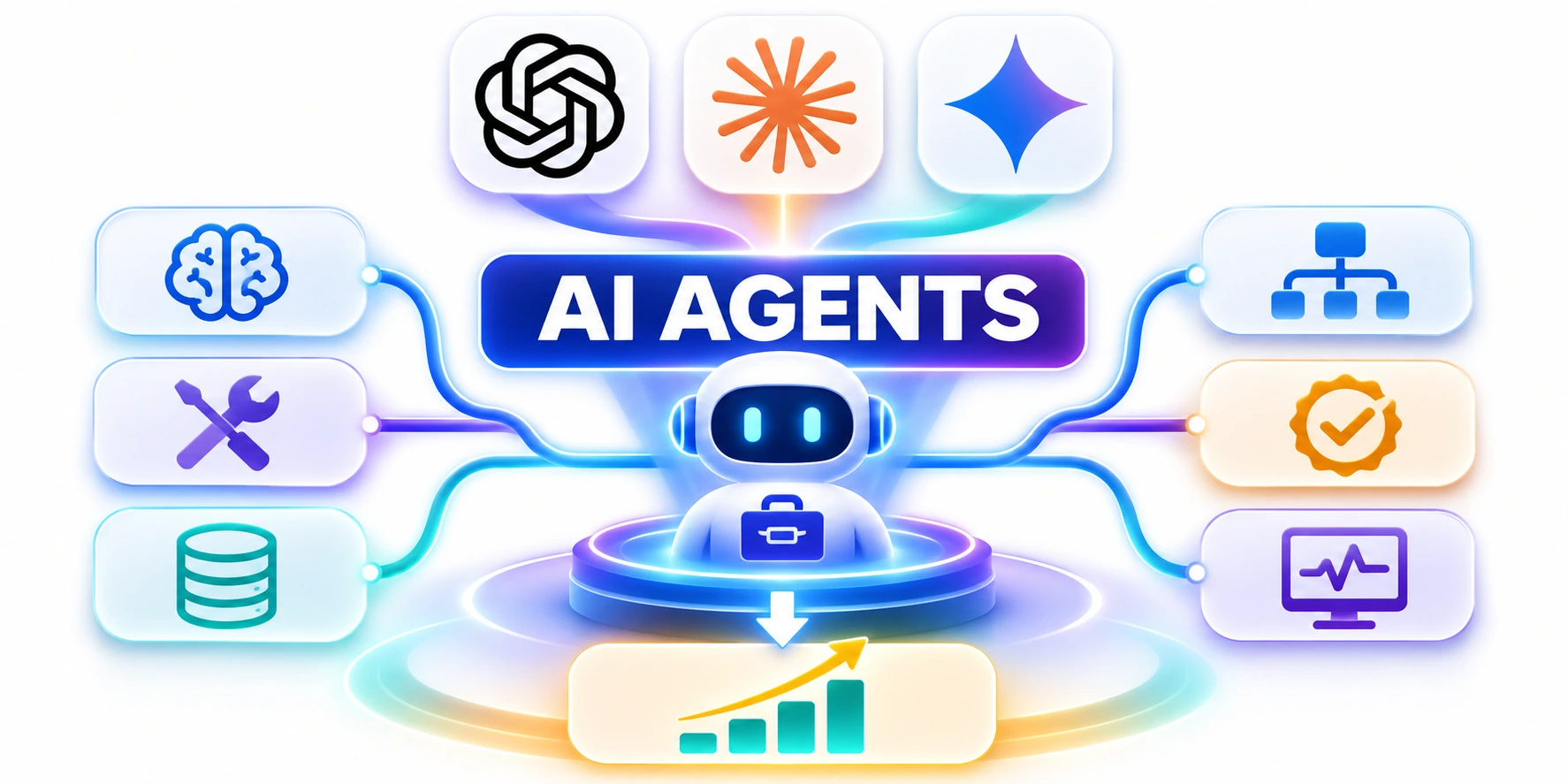
Define an AI Agent in Business Terms

AI agents for business combine a model with instructions, context, tools, and an execution loop that can pursue a bounded objective across several steps.
The business definition should describe outcomes, decisions, allowed actions, evidence, limits, and ownership rather than treating autonomy as the primary benefit.
Separate agents from chat and fixed automation
A chatbot mainly exchanges messages, while deterministic automation follows predefined rules. An agent can interpret changing context and choose among permitted actions.
That flexibility creates value when the path cannot be fully scripted, but it also introduces uncertainty that requires evaluation, controls, monitoring, and recovery.
Use these actions to separate agents from chat and fixed:
- Bounded business objective
- Defined triggers and inputs
- Allowlisted tools and actions
- Completion and stop conditions
- Human owner and escalation
Define the trigger, objective, available information, tools, action limits, completion criteria, escalation, and records before choosing models or orchestration technology.
Keep the objective observable. Vague instructions such as improve sales invite unpredictable behavior, while a bounded research or follow-up task can be tested.
Define the agent’s operating contract
Treat the agent as a software service with an owner, users, dependencies, versions, service expectations, risks, costs, and a process for change.
Do not imply human legal or organizational authority. The agent acts through delegated technical permissions that remain accountable to named people.
Use these actions to define the agent’s operating contract:
- Name the service owner
- Set measurable outcomes
- Document prohibited actions
- Require evidence and audit
- Define safe failure behavior
A useful agent can stop, explain uncertainty, request missing input, and escalate when evidence or permissions do not support safe progress.
The operating contract makes later architecture, testing, security, and rollout decisions traceable to a real business purpose.
Select Bounded and Valuable Use Cases

The best first agent use cases combine meaningful effort, repeatable context, available data, clear outcomes, manageable exceptions, reversible actions, and practical human review.
Start from a workflow constraint instead of an agent demonstration. Identify waiting, coordination, research, classification, drafting, monitoring, or follow-up work that consumes capacity.
Prioritize value that can be verified
Break the workflow into decisions and actions. Some steps may remain deterministic, while only the ambiguous interpretation or planning step needs a model.
Estimate frequency, handling time, delay, error cost, customer impact, and improvement potential using an existing baseline rather than speculative savings.
Use these actions to prioritize value that can be verified:
- Research and evidence gathering
- Ticket or record enrichment
- Draft preparation and review
- Knowledge retrieval and synthesis
- Monitoring and exception detection
Good early candidates include internal research, ticket enrichment, draft preparation, account summaries, knowledge retrieval, quality review, and approval-ready recommendations.
Higher-risk actions include payments, employment decisions, legal commitments, production changes, sensitive outreach, access grants, and irreversible customer or data operations.
Avoid autonomy where consequences are unclear
Score each candidate by business value, model uncertainty, data readiness, integration effort, reversibility, review burden, and the consequences of an incorrect action.
Prefer narrow scope with representative complexity. A useful pilot should expose real uncertainty without granting broad authority before controls are proven.
Key considerations for avoid autonomy where consequences are include:
- Measure current handling effort
- Score action reversibility
- Identify required human review
- Confirm data and tool readiness
- Start with bounded authority
Document why rejected candidates are unsuitable now. Missing data, unclear ownership, weak process definitions, or disproportionate risk may be corrected later.
A strong portfolio sequences learning so early agents build reusable evaluation, identity, tool, monitoring, and governance capabilities for later use cases.
Design the Agent Architecture
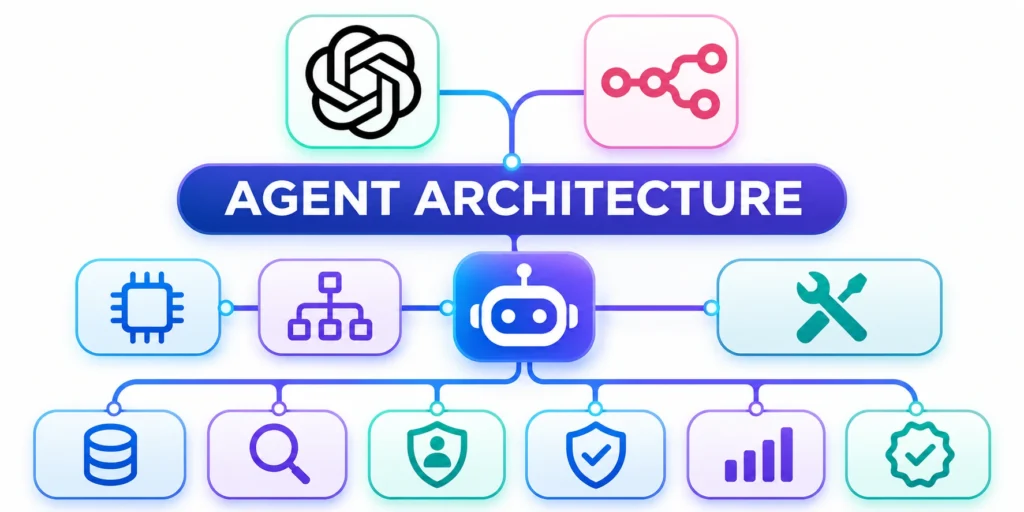
An agent architecture connects models, instructions, orchestration, business context, retrieval, tools, identity, policy, memory, approvals, observability, and user experience.
Design each component around the operating contract. Additional frameworks and memory increase complexity and should solve a measured need rather than signal sophistication.
Separate reasoning from deterministic control
Use deterministic software for permissions, validation, calculations, routing, limits, schemas, and irreversible controls. Use models for interpretation, planning, extraction, and generation where uncertainty exists.
Constrain model outputs through structured formats, tool schemas, explicit state, and validation before another system receives or acts on them.
Use these actions to separate reasoning from deterministic control:
- Model and routing layer
- Orchestration and task state
- Retrieval and business context
- Tool and identity gateway
- Policy and approval controls
- Observability and evaluation
Retrieval should respect source authority, recency, access, and relevance. Store citations or identifiers so users can inspect evidence behind consequential recommendations.
Memory requires purpose and retention rules. Persist only information needed for the workflow, with clear separation between user, account, task, and organizational context.
Make every dependency observable
Choose model routing by capability, latency, cost, data policy, and fallback needs. A single model is rarely optimal for every step.
Isolate tools behind an integration layer that enforces authentication, authorization, rate limits, input validation, idempotency, and audit records.
Use these actions to make every dependency observable:
- Validate structured outputs
- Limit retained memory
- Separate tools from prompts
- Version every behavior change
- Capture traceable execution evidence
| Layer | Primary role | Control focus |
|---|---|---|
| Model | Reason and generate | Routing and limits |
| Context | Ground the task | Access and recency |
| Tools | Read or act | Permission and validation |
| Operations | Run the service | Monitor and recover |
Capture prompts, versions, retrieved sources, tool requests, tool results, decisions, approvals, errors, cost, and completion status with appropriate redaction.
A modular architecture makes model or tool changes safer because behavior can be evaluated without rebuilding the entire business workflow.
Control Tools, Actions, and Permissions

An agent becomes operationally consequential when it can read systems, create records, send messages, change configurations, trigger workflows, or commit resources.
Treat every tool as an API permission boundary. The model may request an action, but deterministic controls should decide whether execution is allowed.
Grant the smallest useful authority
Use allowlisted tools with narrow schemas, validated parameters, scoped credentials, contextual authorization, rate limits, and explicit separation between read and write operations.
Avoid giving the agent general user sessions, shared administrator credentials, shell access, or broad database permissions when a purpose-built operation can suffice.
Key considerations for grant the smallest useful authority include:
- Read-only information access
- Internal reversible record changes
- External communication actions
- Financial or contractual commitments
- Production and security changes
Classify actions by consequence and reversibility. Low-risk reads may execute automatically, while external communication or data changes can require approval.
Set limits on recipients, value, volume, frequency, environment, geography, record type, and time. Reject requests outside the operating contract.
Design actions for safe retry and recovery
Build idempotent operations where possible so retries do not duplicate payments, messages, tickets, orders, or configuration changes.
Use preview, dry-run, staging, and confirmation patterns before high-impact actions. Preserve enough state to resume safely after interruption.
Use these actions to design actions for safe retry and:
- Separate read and write tools
- Validate every parameter
- Require scoped credentials
- Limit frequency and value
- Support idempotency and rollback
Log the requested action, validated parameters, policy decision, credential identity, result, error, and rollback evidence without exposing protected secrets.
Tool design should make unsafe behavior difficult even when the model misunderstands instructions, receives malicious input, or generates an invalid plan.
Keep Humans in Consequential Decisions
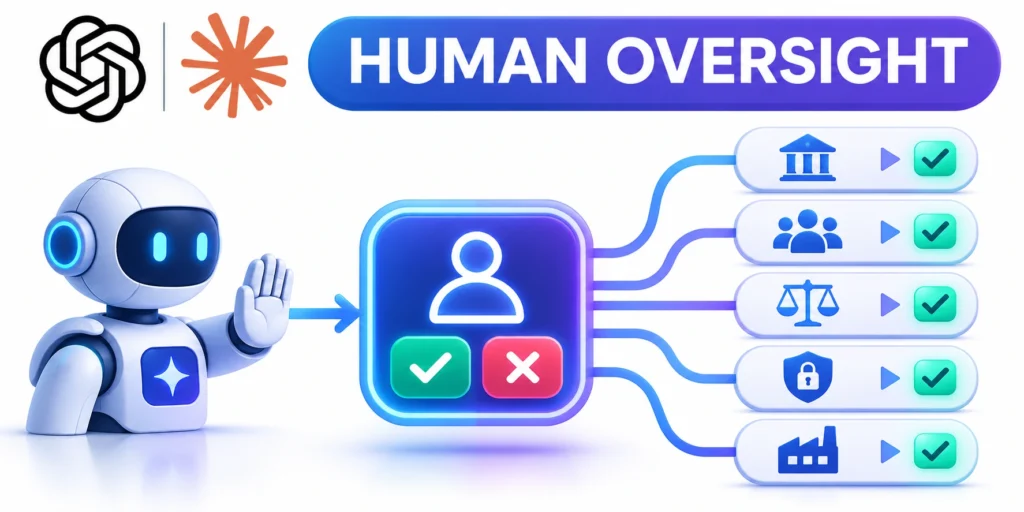
Human oversight should protect decisions where error, bias, uncertainty, or authority can materially affect customers, employees, finances, security, rights, or operations.
A person clicking approve is not sufficient when the interface hides evidence, alternatives, uncertainty, downstream actions, or the ability to reject safely.
Place review where judgment changes outcomes
Place review before irreversible or externally consequential actions, and after complex analysis when expert judgment is necessary to interpret evidence.
Use confidence, policy, value, novelty, exception, and risk thresholds to route tasks instead of requiring identical review for every low-impact step.
Key considerations for place review where judgment changes include:
- Financial and contractual actions
- Customer-facing commitments
- Employment and access decisions
- Security and production changes
- High-impact or uncertain exceptions
Give reviewers the original request, relevant context, sources, proposed action, rationale, uncertainty, conflicts, and expected effect in a usable format.
Allow edit, reject, request evidence, reduce scope, or escalate. Approval mechanisms that permit only acceptance encourage automation bias.
Make approval informed and accountable
Assign reviewer roles based on authority and expertise. Legal, financial, security, operational, and customer decisions may need different owners.
Measure review volume, wait time, override rate, error detection, and reviewer disagreement. Excessive queues indicate poor thresholds or unsuitable use cases.
Use these actions to make approval informed and accountable:
- Show evidence and uncertainty
- Allow rejection and editing
- Route to qualified authority
- Measure overrides and queues
- Preserve decision records
Retain decisions and reasons for learning, audit, and appeal where appropriate. Protect sensitive records according to business and legal requirements.
The goal is calibrated delegation: automate routine work while preserving meaningful human control over consequential choices and exceptions.
Evaluate Reliability Before Deployment

Agent reliability includes planning, retrieval, tool selection, parameters, action order, stopping, escalation, and recovery. A fluent response does not prove safe operation.
Build evaluation sets from representative normal cases, edge conditions, past failures, ambiguous inputs, missing data, conflicting instructions, and adversarial attempts.
Test complete trajectories, not isolated answers
Define success at the trajectory level: correct outcome, acceptable path, allowed tools, valid evidence, policy compliance, bounded cost, and appropriate escalation.
Score deterministic properties automatically and use qualified human review for judgment, usefulness, tone, ambiguity, and context-sensitive business outcomes.
Use these actions to test complete trajectories not isolated answers:
- Representative successful tasks
- Ambiguous and incomplete inputs
- Tool and permission failures
- Adversarial instruction attempts
- High-impact edge cases
- Recovery and escalation behavior
Test tools with simulated systems before production. Include timeouts, partial results, duplicate requests, stale data, permission failures, and unexpected response formats.
Evaluate multi-turn behavior because small errors can compound. Check whether the agent revises faulty assumptions or continues confidently after contradictory evidence.
Use release gates tied to business risk
Compare model, prompt, tool, retrieval, and policy changes against a fixed baseline. Version the evaluation set alongside the agent release.
Set thresholds by consequence. A recommendation assistant may tolerate reviewable uncertainty, while an automated production change needs substantially stronger controls.
Apply these criteria to release gates tied to business risk:
- Version tests with releases
- Measure complete task trajectories
- Inspect severe failure categories
- Define risk-based thresholds
- Document known limitations
Investigate failure categories instead of averaging them away. Rare unsafe actions can matter more than high overall completion accuracy.
Deployment approval should identify tested scope, known limitations, monitoring, rollback, human ownership, and conditions that require disabling the agent.
Protect Business Information and Access
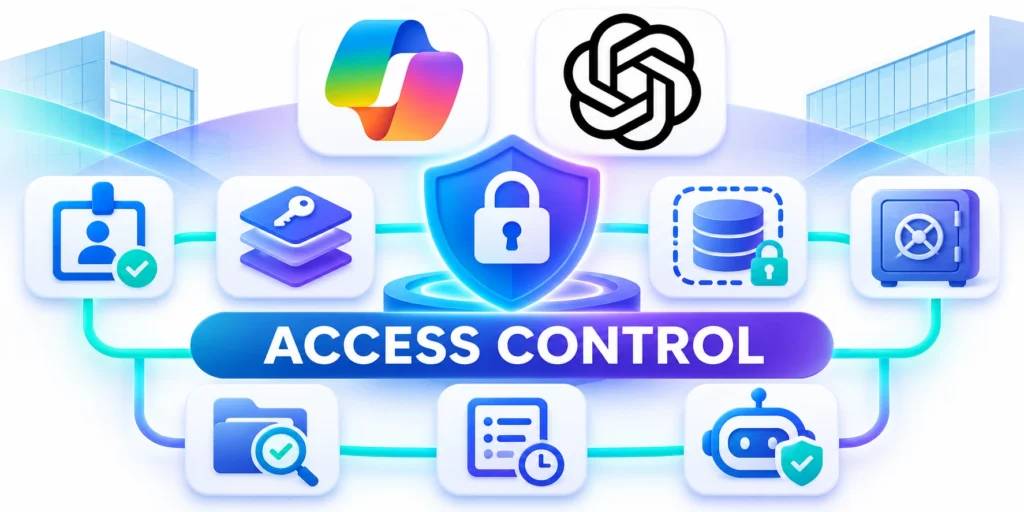
Agents combine models with business data and tools, creating access paths that cross prompts, retrieval, memory, logs, integrations, users, providers, and execution environments.
Map information flows before deployment. Identify data categories, sources, destinations, retention, regional constraints, subprocessors, and the actions each component can perform.
Apply identity and data boundaries end to end
Use named workload identities and least-privilege credentials. Separate development, testing, and production, and avoid sharing user tokens beyond the required task.
Enforce access when retrieving data, not only when displaying results. The agent should not receive documents or records the current task cannot use.
Use these actions to apply identity and data boundaries end:
- Identity and credential scope
- Retrieval authorization boundaries
- Sensitive data minimization
- Provider and subprocessor terms
- Logging and retention controls
- Incident and credential response
Minimize prompts and logs, redact sensitive values where practical, encrypt data in transit and storage, and define retention and deletion procedures.
Review provider data-use settings, model training terms, regional processing, incident obligations, export options, and changes that could affect approved handling.
Treat untrusted content as untrusted instructions
Prompt injection can arrive through documents, messages, websites, tickets, or tool output. Content should not gain authority merely because the model can read it.
Separate instructions from data, label trust boundaries, validate tool calls, constrain destinations, and require approval for actions influenced by untrusted sources.
Use these actions to treat untrusted content as untrusted instructions:
- Separate instructions from data
- Validate untrusted content paths
- Restrict tool destinations
- Monitor denied actions
- Test credential revocation
Monitor unusual retrieval, tool use, volume, destinations, errors, and denied actions. Create an incident path for disabling credentials and preserving evidence.
Security is an operating responsibility across design, rollout, access changes, provider updates, incidents, and retirement rather than a one-time prompt review.
Run a Controlled Agent Pilot

A controlled pilot tests one real workflow with bounded permissions and consequences. For lead workflows, include those boundaries in the AI marketing automation scope.
Define the baseline, target outcome, scope, users, test period, data, tools, human review, support, rollback, and decision owner before enabling production actions.
Prove value and control together
Start in simulation or read-only mode when possible. Compare recommendations with actual decisions before allowing the agent to change records or contact external parties.
Choose representative work, including common cases, exceptions, peak volume, missing information, and failures. A demonstration set is too clean to establish readiness.
Key considerations for prove value and control together include:
- Current workflow baseline
- Bounded users and systems
- Defined review and support
- Representative evaluation cases
- Rollback and stop authority
Measure handling time, waiting, quality, completion, review effort, overrides, errors, escalations, cost, user trust, and downstream business outcomes.
Separate model improvement from process improvement. The pilot may reveal missing ownership, poor data, unnecessary approvals, or workflow problems unrelated to AI.
Expand through explicit evidence gates
Provide a visible support channel and incident owner. Users need a way to report unexpected behavior, recover work, and understand current limitations.
Review traces and failures frequently during the pilot. Correct controls, tools, instructions, or scope before simply increasing autonomy.
Key considerations for expand through explicit evidence gates include:
- Begin with read-only operation
- Review traces and overrides
- Measure downstream outcomes
- Expand one boundary at once
- Stop when assumptions fail
Set gates for more users, higher volume, additional tools, reduced review, or broader data. Each expansion should have evidence and a rollback path.
End or redesign the pilot when value remains weak, review burden is excessive, risks cannot be bounded, or the workflow should be simplified first.
Scale Agents with Operational Ownership

Scaling agents means supporting more users, volume, tools, data, models, and business processes without losing ownership, visibility, reliability, security, or cost control.
Assign a service owner for every production agent and named owners for product outcomes, technical operation, data, security, evaluation, and incident response.
Operate agents as governed services
Maintain inventories of agents, versions, prompts, tools, credentials, data sources, models, users, approvals, dependencies, costs, and current operating status.
Use controlled release processes with evaluation, change records, staged rollout, monitoring, rollback, and communication for model, prompt, retrieval, tool, or policy changes.
Key considerations for operate agents as governed services include:
- Named service and risk owners
- Agent and dependency inventory
- Versioned release and evaluation
- Monitoring and incident response
- Cost and outcome accountability
Monitor completion, failure, escalation, latency, tool errors, denied actions, review queues, cost, quality, and business outcomes using stable definitions.
Create incident procedures for unsafe actions, data exposure, unexpected cost, provider failure, degraded quality, unavailable tools, and widespread incorrect behavior.
Build a reusable agent platform carefully
Standardize identity, tool gateways, trace formats, evaluation, approvals, secrets, observability, and cost allocation when reuse reduces risk and duplicated effort.
Avoid a platform that forces every workflow into one architecture. Different consequence levels may require different models, controls, review, and isolation.
Use these actions to build a reusable agent platform carefully:
- Standardize common control layers
- Preserve workflow-specific isolation
- Review provider and model changes
- Retire unused agents deliberately
- Revalidate value after scale
The commercial artificial intelligence consulting services page explains how strategy, agents, workflow automation, integration, and operational controls can form one engagement.
Scale only agents that continue producing verified value after operating cost, review effort, incidents, maintenance, and organizational change are included.
Conclusion
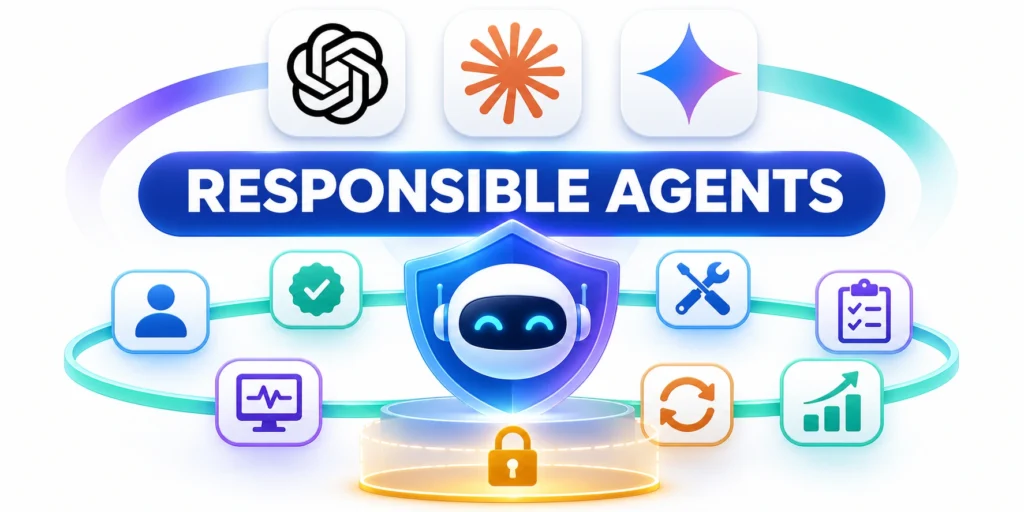
AI agents can reduce coordination and extend business capacity when they pursue bounded objectives through controlled tools, reliable evidence, and explicit human ownership.
They also combine model uncertainty with operational authority, creating risks that ordinary chat experiences do not expose until an agent can act.
Build bounded autonomy around accountable value
Start with a workflow constraint, measurable baseline, and reversible use case. Avoid beginning with broad autonomy or a platform selected without operating requirements.
Separate probabilistic reasoning from deterministic permissions, validation, limits, schemas, approvals, logging, idempotency, and recovery.
Use these actions to build bounded autonomy around accountable value:
- Choose bounded valuable workflows
- Constrain tools and permissions
- Evaluate complete task trajectories
- Preserve meaningful human oversight
- Operate agents as services
Keep humans in decisions where authority, consequence, uncertainty, rights, finances, customers, security, or production risk require accountable judgment.
Evaluate complete trajectories with representative cases, tool failures, adversarial inputs, and risk-based thresholds before expanding data, actions, users, or volume.
Keep agents measurable, controllable, and reversible
Protect information through identity, least privilege, retrieval authorization, minimization, retention, provider review, untrusted-content boundaries, and incident response.
Operate each production agent as a versioned service with owners, monitoring, evaluation, support, change control, cost visibility, and a retirement path.
Use these actions to keep agents measurable controllable and reversible:
- Monitor value and failure
- Version every behavior change
- Keep rollback available
- Review access and providers
- Retire agents without value
Scale through evidence gates and stop when review burden, operating cost, weak value, or unbounded risk contradicts the original business case.
Responsible agents do not remove accountability. They make delegation explicit, observable, limited, and improvable while preserving human authority over consequential outcomes.
FAQ
These answers cover business agent definitions, starting use cases, human approval, tool permissions, evaluation, prompt injection, pilots, ownership, operations, and retirement.
What is an AI agent for business?
It is a model-based software service that uses context and permitted tools to pursue a bounded objective across steps under defined controls, ownership, and monitoring.
How is an AI agent different from a chatbot?
A chatbot primarily exchanges messages. An agent can plan, select tools, change systems, retain task state, and pursue completion within delegated permissions.
Which AI agent use cases are safest to start?
Start with reversible internal work such as research, enrichment, drafting, retrieval, monitoring, and approval-ready recommendations with available data and clear outcomes.
Should an AI agent act without human approval?
Low-impact reversible actions may be automated after evaluation. Consequential financial, customer, legal, security, access, or production actions usually require meaningful human control.
How should AI agent permissions be designed?
Use allowlisted purpose-built tools, least-privilege workload identities, validated schemas, scoped destinations, rate limits, consequence thresholds, audit records, idempotency, and rollback.
How can a company evaluate an AI agent?
Test complete trajectories across representative, ambiguous, failing, and adversarial cases, measuring outcomes, tools, evidence, policy, escalation, cost, and severe failure categories.
What is prompt injection in an agent system?
Prompt injection occurs when untrusted content tries to influence agent instructions or actions. Separate trust boundaries and validate tool calls deterministically.
What should an AI agent pilot measure?
Measure time, waiting, quality, completion, review effort, overrides, errors, escalations, cost, user trust, incidents, and downstream business outcomes against a baseline.
Who owns a production AI agent?
A named service owner should coordinate product outcomes, technical operation, data, security, evaluation, incidents, access, cost, change, and retirement responsibilities.
When should an AI agent be retired?
Retire or redesign it when value remains weak, controls cannot bound risk, operating or review costs exceed benefit, or the underlying workflow materially changes.




Leave a Reply