


Choose Processes Worth Automating

AI workflow automation creates value when it removes waiting, repetitive handling, inconsistent decisions, or coordination effort from a clearly understood business process.
Begin with the outcome and baseline rather than a tool demonstration. Record volume, handling time, delays, errors, rework, exceptions, and current ownership.
Start with a measurable workflow constraint
A strong candidate has repeatable inputs, accessible systems, measurable results, manageable exceptions, and enough frequency to justify design and operating effort.
Separate the complete process into tasks. Some steps may need deterministic automation, while only interpretation, classification, extraction, or drafting requires AI.
Use these actions to start with a measurable workflow constraint:
- High process frequency
- Measurable handling effort
- Accessible structured inputs
- Manageable exception volume
- Reversible business actions
Estimate value using current labor, delay, quality, conversion, customer impact, or risk. Avoid assuming that every automated minute becomes realized savings.
Include review, integration, monitoring, support, model usage, and maintenance in the business case because automation creates an operating service.
Reject weak automation candidates early
Avoid starting with unstable processes, missing ownership, disputed policies, inaccessible data, rare work, or consequences that cannot be reversed safely.
Use a simple scorecard so business and technical teams can compare candidates through the same evidence rather than enthusiasm for a particular platform.
Key considerations for reject weak automation candidates early include:
- Confirm a named owner
- Measure the current baseline
- List expected exceptions
- Estimate operating cost
- Define a stop condition
Select a bounded workflow that matters enough to prove value but remains narrow enough to test failures, controls, and adoption without broad disruption.
The first successful automation should create reusable integration, evaluation, review, and monitoring capabilities that reduce effort for later workflows.
Map the Current Workflow and Exceptions

A workflow map should show how work actually moves across people, systems, queues, decisions, approvals, data, and exceptions rather than reproducing an outdated procedure.
Observe representative cases and compare them with written policy. Informal workarounds often reveal missing information, unclear ownership, or controls that automation must address.
Document decisions, handoffs, and evidence
Record the trigger, inputs, steps, decisions, responsible roles, systems, outputs, service expectations, dependencies, and completion criteria for the current process.
Mark every wait state and handoff. Delays frequently come from missing context, unavailable authority, duplicate entry, or unclear routing rather than task execution.
Use these actions to document decisions handoffs and evidence:
- Trigger and required inputs
- Decision and approval points
- Systems and data owners
- Handoffs and waiting states
- Exceptions and recovery paths
Collect normal cases, edge cases, incomplete requests, conflicting data, unavailable systems, rejected approvals, duplicates, cancellations, and previous failures.
Quantify exception frequency and consequence. A workflow with many undocumented variations may need process redesign before AI can operate reliably.
Design the future state deliberately
Distinguish business policy from historical system limitations. Automation should not preserve unnecessary steps simply because the existing tools required them.
Design the future state with explicit automation, human review, fallback, recovery, and escalation paths while preserving accountability for each decision.
Use these actions to design the future state deliberately:
- Observe real work
- Capture undocumented variations
- Remove unnecessary handoffs
- Assign every decision owner
- Version the future-state map
Validate the map with frontline users, process owners, system owners, and reviewers because each group sees different failure modes and hidden dependencies.
Keep the map versioned after launch. Process, policy, system, and model changes can invalidate assumptions even when the automation still appears operational.
Separate Deterministic Rules from AI Tasks

Reliable automation separates predictable business logic from tasks that require interpretation, language understanding, extraction, summarization, classification, or generation under changing context.
Deterministic code should enforce permissions, calculations, thresholds, required fields, schemas, routing, duplication checks, limits, and irreversible controls whenever rules are knowable.
Use each method for its strongest work
Use AI for ambiguity that cannot be expressed economically through fixed logic, while constraining its outputs before another system or person relies on them.
A model can propose a category, draft, priority, or action plan. Deterministic software can validate structure, allowed values, authority, and execution conditions.
Apply these criteria to each method for its strongest work:
- Rules for permissions
- Code for calculations
- Schemas for outputs
- AI for interpretation
- Humans for consequential judgment
Do not ask the model to calculate values that ordinary code can derive accurately. Provide the calculated result as context when language reasoning needs it.
Define confidence, evidence, novelty, consequence, and exception thresholds that determine automatic continuation, human review, retry, fallback, or rejection.
Keep authority outside probabilistic outputs
Require structured outputs with documented fields and allowed values. Validate every result before saving records, triggering tools, or composing customer-facing communication.
Preserve the original inputs and transformation steps needed to explain how the workflow reached a consequential result without exposing protected information.
Use these actions to keep authority outside probabilistic outputs:
- Validate every AI result
- Route uncertain cases
- Keep actions reversible
- Log decision evidence
- Review boundaries after failures
| Workflow element | Preferred method | Primary control |
|---|---|---|
| Known decision | Deterministic rules | Tests and limits |
| Ambiguous input | AI interpretation | Schema and review |
| System change | Purpose-built API | Permission and audit |
| High-impact choice | Human judgment | Evidence and authority |
Review model and rule boundaries after failures. Some ambiguity can become a stable rule, while brittle rules may need better context or human judgment.
This separation improves testing, security, maintainability, and cost because each component has a clear purpose and independently observable behavior.
Connect Systems and Business Context
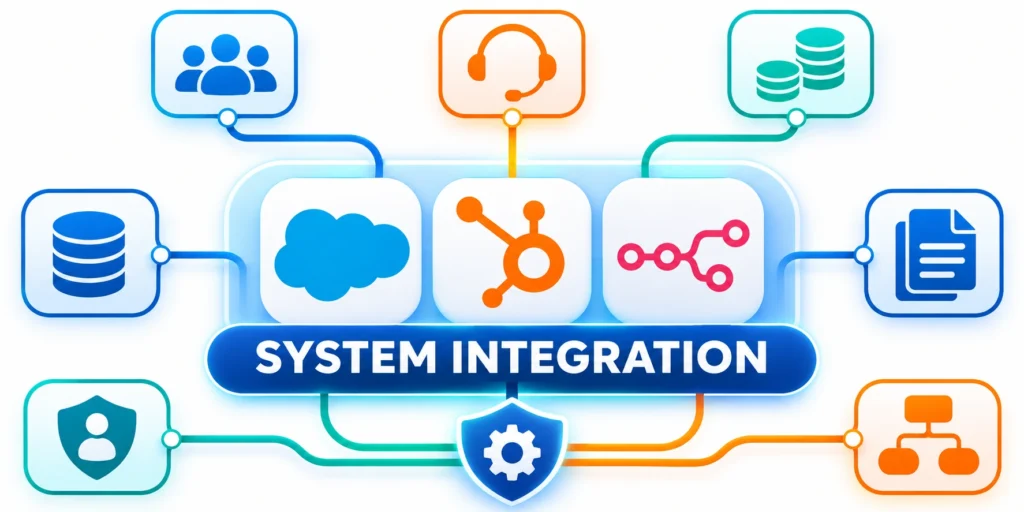
AI automation becomes useful when it can receive trusted business events, retrieve relevant context, update approved systems, and preserve state across a complete workflow.
Choose an authoritative source for each customer, account, ticket, transaction, task, document, and status instead of copying conflicting values across tools.
Build integrations around authoritative events
Define events precisely, including origin, identifier, timestamp, required fields, permissions, expected volume, duplicate behavior, and the system responsible for truth.
Use purpose-built APIs and integration operations rather than shared user sessions, broad administrator credentials, screen scraping, or unrestricted database access.
Use these actions to build integrations around authoritative events:
- Authoritative business event
- Stable record identifier
- Scoped system identity
- Idempotent write operation
- Traceable workflow state
Apply named workload identities, least privilege, scoped destinations, secret management, encryption, rate limits, and separation between development and production.
Make write operations idempotent where practical so retries cannot duplicate messages, tickets, tasks, orders, or changes after a timeout.
Protect identity, data, and state
Preserve correlation identifiers across events, AI calls, tool operations, approvals, and outcomes so teams can reconstruct a workflow without searching disconnected logs.
Retrieve only context needed for the current task and user authority. More data can increase cost, latency, exposure, and conflicting evidence.
Use these actions to protect identity data and state:
- Minimize retrieved context
- Validate required fields
- Detect duplicate events
- Handle stale information
- Monitor integration failures
Handle stale, missing, conflicting, or unavailable data explicitly. The workflow should stop or escalate instead of inventing a complete business record.
Integration design determines whether automation remains supportable when systems, fields, credentials, ownership, providers, or business processes change.
Design Prompts, Knowledge, and Outputs
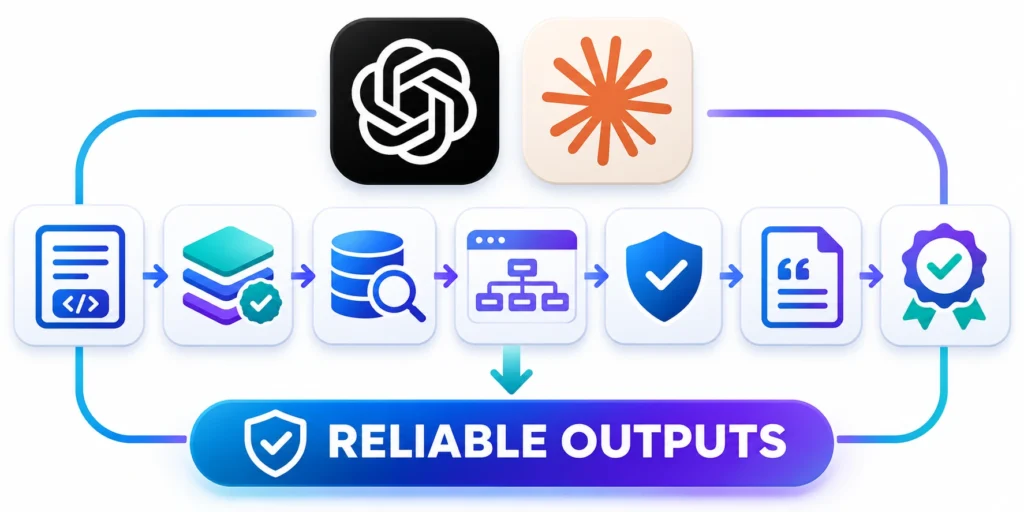
Prompts should describe the task, business context, allowed evidence, output contract, uncertainty behavior, prohibited actions, and escalation conditions without relying on hidden assumptions.
Separate stable instructions from user input, retrieved content, examples, tool results, and untrusted text so each source has a visible authority boundary.
Make context explicit and testable
Provide only knowledge relevant to the current decision. Define source authority, access, recency, retrieval filters, citations, and behavior when evidence conflicts.
Use representative examples for ambiguous classifications or formats, but avoid examples that silently redefine policy or encourage imitation beyond the intended case.
Use these actions to make context explicit and testable:
- Clear task objective
- Trusted context boundaries
- Required output schema
- Evidence and citation rules
- Uncertainty and escalation behavior
Require structured outputs when another system consumes the result. Specify fields, types, allowed values, required evidence, and conditions that produce no answer.
Validate structure and business constraints deterministically. A syntactically valid output can still contain unsupported claims, incorrect identifiers, or prohibited actions.
Treat prompts as versioned software behavior
Ask the workflow to surface missing information and uncertainty rather than forcing completion. Confident fabrication creates downstream work and hidden operational risk.
Version prompts, retrieval settings, models, examples, tools, and schemas together because behavior depends on their combined configuration.
Use these actions to treat prompts as versioned software behavior:
- Version prompts and models
- Test representative cases
- Validate business constraints
- Reject unsupported completion
- Record change evidence
Evaluate every meaningful change against fixed representative cases before release. Review failures by category instead of relying on one average quality score.
Good prompt design reduces ambiguity, but dependable automation comes from the surrounding context, validation, tools, review, monitoring, and recovery system.
Place Human Review at the Right Decisions

Human review should protect decisions where uncertainty, authority, error, or bias can materially affect customers, employees, finances, rights, security, or production systems.
Review every step only when required. Excessive approval queues can remove the speed advantage while encouraging rushed acceptance and automation bias.
Match oversight to consequence and uncertainty
Route tasks using consequence, confidence, value, novelty, policy, customer impact, and exception thresholds rather than one identical rule for all work.
Place approval before external communication, financial commitment, access changes, record deletion, production actions, or other changes that are difficult to reverse.
Key considerations for match oversight to consequence and include:
- External customer communication
- Financial commitments
- Access and permission changes
- Production system actions
- High-uncertainty exceptions
Give reviewers the original request, relevant context, evidence, proposed result, uncertainty, policy conflicts, and expected downstream action in one usable view.
Allow editing, rejection, evidence requests, reduced scope, and escalation. An interface that permits only approval does not provide meaningful human control.
Make review informed and efficient
Assign reviewers with appropriate expertise and authority. Business, legal, financial, security, technical, and customer decisions may need different roles.
Measure queue time, review duration, override rate, disagreement, detected errors, repeated corrections, and outcomes to improve routing thresholds and instructions.
Use these actions to make review informed and efficient:
- Show evidence and uncertainty
- Permit rejection and editing
- Route to qualified owners
- Measure review burden
- Tune thresholds with evidence
Use reviewer corrections as evaluation evidence, not automatically as training truth. Human decisions can also be inconsistent, incomplete, or policy dependent.
The desired state is calibrated delegation: routine work proceeds efficiently while consequential or uncertain decisions retain accountable human judgment.
Handle Failures and Unexpected Inputs
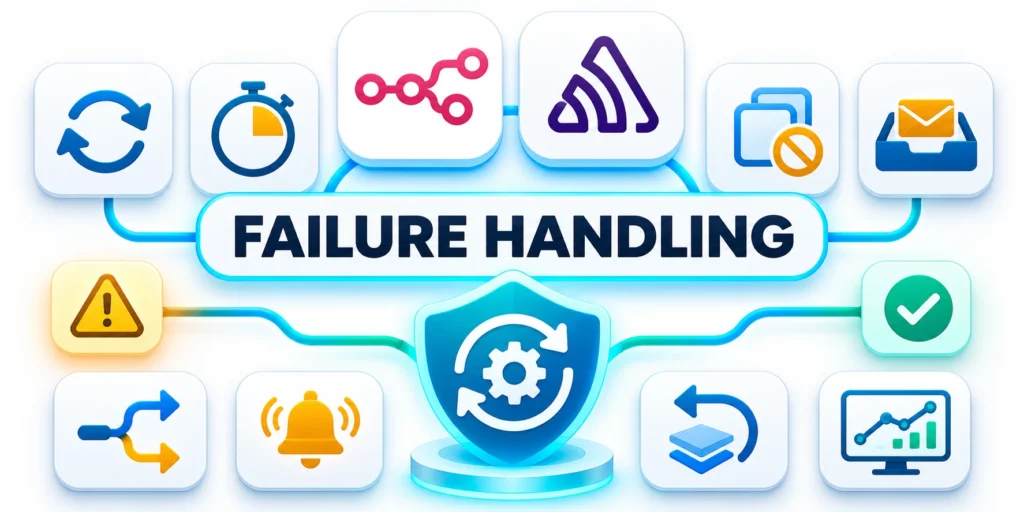
Automation must expect missing data, malformed input, conflicting instructions, provider errors, slow systems, duplicate events, invalid outputs, denied permissions, and partial completion.
List failure modes during design and assign detection, retry, fallback, escalation, recovery, and ownership for each consequential step.
Design recovery before production
Validate inputs before model or tool usage. Reject unsupported file types, missing identifiers, invalid states, prohibited destinations, and requests outside the operating contract.
Use bounded retries with backoff for transient problems. Unlimited retries can duplicate actions, increase cost, overload dependencies, or hide persistent defects.
Use these actions to design recovery before production:
- Missing or invalid inputs
- Unavailable external systems
- Invalid AI outputs
- Duplicate business events
- Partial action completion
- Denied permissions
Store workflow state so a safe retry can continue from a known checkpoint instead of repeating completed actions or losing the original request.
Provide deterministic fallback for appropriate cases, such as routing to a queue, using a simpler rule, requesting information, or preserving a draft.
Make failures visible and bounded
Create a dead-letter or exception queue with enough context for support teams to understand, correct, replay, or close failed work safely.
Monitor failure rate, retry volume, unresolved exceptions, duplicate prevention, recovery time, provider availability, and downstream inconsistencies using stable definitions.
Use these actions to make failures visible and bounded:
- Use bounded retries
- Preserve workflow checkpoints
- Route unresolved exceptions
- Monitor recovery time
- Maintain a kill switch
Define a kill switch and rollback path for widespread incorrect behavior, unexpected cost, compromised credentials, data exposure, or material quality degradation.
A reliable workflow does not avoid every failure. It contains impact, preserves evidence, communicates clearly, and returns work to a recoverable state.
Evaluate Quality, Speed, and Cost

AI workflow automation should improve a measurable business outcome while maintaining acceptable quality, latency, cost, review effort, reliability, and operational risk.
Establish the current baseline before launch so teams can distinguish actual improvement from novelty, selective examples, or work shifted to reviewers.
Measure complete business outcomes
Build evaluation sets from normal cases, edge conditions, missing data, conflicting evidence, previous failures, provider errors, and adversarial or irrelevant instructions.
Measure the complete trajectory, including trigger, context, model result, tool selection, parameters, approvals, final action, recovery, and downstream outcome.
Use these actions to measure complete business outcomes:
- Business outcome improvement
- Output quality and accuracy
- End-to-end processing time
- Human review effort
- Operating and model cost
- Failure and recovery rate
Use deterministic checks for schemas, fields, tools, limits, permissions, and calculations. Use qualified human review for usefulness and context-sensitive judgment.
Track completion, precision, severe errors, escalation, overrides, latency, model usage, integration cost, support effort, and realized business value.
Use release gates instead of demonstrations
Segment results by workflow type, customer, language, region, input quality, exception, model, and release because averages can conceal damaging failure patterns.
Set thresholds according to consequence. A reviewable internal draft can tolerate more uncertainty than an external or irreversible business action.
Apply these criteria to release gates instead of demonstrations:
- Use representative test sets
- Measure complete trajectories
- Inspect severe failure classes
- Set consequence-based thresholds
- Compare every release
Compare changes against a fixed baseline and inspect regressions before release. Faster or cheaper execution should not silently reduce reliability.
Evaluation becomes an operating capability when results inform release, routing, review, rollback, provider, and retirement decisions throughout the workflow lifecycle.
Roll Out Automation in Controlled Stages

A staged rollout proves workflow value and control before expanding users, volume, data, tools, actions, autonomy, or consequences across the organization.
Begin with offline evaluation, then shadow operation and a limited pilot. Define those stages in the AI automation implementation scope before granting production access.
Expand authority through evidence gates
Define entry and exit criteria for every stage, including quality, failure, review, latency, cost, adoption, support, security, and business outcome thresholds.
Expand one meaningful boundary at a time so teams can attribute changes in behavior and recover without diagnosing several new risks simultaneously.
Key considerations for expand authority through evidence gates include:
- Offline evaluation
- Read-only shadow mode
- Internal approval pilot
- Limited production scope
- Measured expansion
Communicate current capabilities, limitations, ownership, support, and escalation to users. Hidden experimental behavior damages trust when workflows affect real work.
Assign a service owner and operational owners for process outcomes, integrations, models, data, access, evaluation, incidents, cost, and change management.
Operate automation as a service
The related AI agents for business guide explains controls for workflows that plan and act across multiple tools.
Maintain versioned releases, representative evaluations, monitoring, incident procedures, rollback, dependency inventories, and provider review after production launch.
Key considerations for operate automation as a service include:
- Name every service owner
- Define stage exit criteria
- Expand one boundary
- Keep rollback available
- Retire weak automation
Revisit the business case when volume, process, policy, systems, model performance, review burden, cost, or organizational ownership changes materially.
Scale only workflows that continue producing verified value. Retire automation when maintenance, risk, review, or process change outweighs the measured benefit.
Conclusion
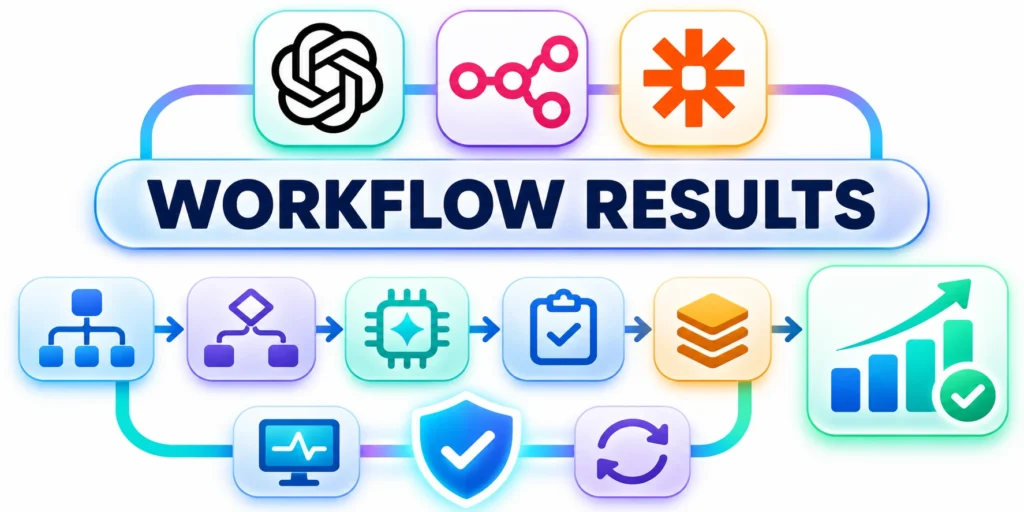
AI workflow automation works best when it improves a defined process through an intentional combination of deterministic logic, AI interpretation, integrations, and human judgment.
Start with a measurable constraint and a current-state map rather than choosing a platform before the workflow, evidence, and ownership are understood.
Build automation around accountable outcomes
Separate rules from probabilistic tasks, validate every output, and keep authority, permissions, calculations, thresholds, and irreversible controls in deterministic layers.
Connect authoritative events and minimum necessary context through purpose-built integrations with scoped identity, idempotency, traceability, and explicit failure behavior.
Use these actions to build automation around accountable outcomes:
- Choose measurable processes
- Map decisions and exceptions
- Separate rules from AI
- Validate every system action
- Preserve human accountability
Design prompts, knowledge, and schemas as versioned software behavior supported by representative evaluation instead of relying on fluent demonstrations.
Place meaningful human review at consequential or uncertain decisions while measuring queue time, overrides, errors, and reviewer effort.
Keep every workflow observable and reversible
Prepare for missing data, unavailable systems, invalid outputs, duplicates, and partial actions through validation, checkpoints, bounded retries, fallback, escalation, and rollback.
Measure business outcomes alongside quality, latency, cost, review, reliability, and severe failures so optimization does not hide transferred work or risk.
Use these actions to keep every workflow observable and reversible:
- Evaluate complete outcomes
- Monitor failures and cost
- Expand through evidence
- Keep recovery available
- Retire low-value workflows
Roll out in controlled stages, expand one boundary at a time, and operate every production automation with named ownership, monitoring, support, and change control.
Sustainable automation remains useful because it is bounded, testable, recoverable, and accountable as processes, systems, policies, providers, and business needs evolve.
FAQ
These answers cover suitable processes, deterministic rules, human review, failure handling, evaluation, tools, pilots, operations, and retirement for AI workflow automation.
What is AI workflow automation?
AI workflow automation combines models, business rules, integrations, context, and human review to complete bounded process steps under measurable controls.
Which processes are best for AI automation?
Choose frequent workflows with measurable effort, accessible inputs, manageable exceptions, reversible actions, clear ownership, and interpretation tasks that fixed rules cannot handle economically.
How is AI automation different from traditional automation?
Traditional automation follows predefined logic. AI can interpret ambiguous language or context, while deterministic controls should still validate permissions, outputs, limits, and actions.
Should every workflow step use AI?
No. Use ordinary code for calculations, rules, schemas, routing, permissions, and known decisions. Use AI only where interpretation or generation adds measurable value.
Where should human review be required?
Require meaningful review for consequential, uncertain, external, financial, security, access, legal, employment, or production decisions that cannot be safely reversed.
How should AI workflow failures be handled?
Validate inputs, use bounded retries, preserve checkpoints, make writes idempotent, route unresolved exceptions, monitor recovery, and maintain rollback and stop controls.
How can automation quality be measured?
Evaluate representative end-to-end cases and track business outcomes, quality, severe errors, overrides, latency, review effort, operating cost, failures, and recovery.
What tools are needed for AI workflow automation?
Typical components include event triggers, orchestration, models, retrieval, integrations, identity, validation, approval interfaces, state storage, observability, evaluation, and incident controls.
How should an AI automation pilot start?
Begin with evaluation or read-only shadow mode, then a bounded internal pilot with approval, named ownership, representative work, monitoring, support, rollback, and exit criteria.
When should an automated workflow be retired?
Retire or redesign it when measured value remains weak, the process changes, controls cannot bound risk, or maintenance and review costs exceed benefits.







Leave a Reply