

Define Business Outcomes Before Technology
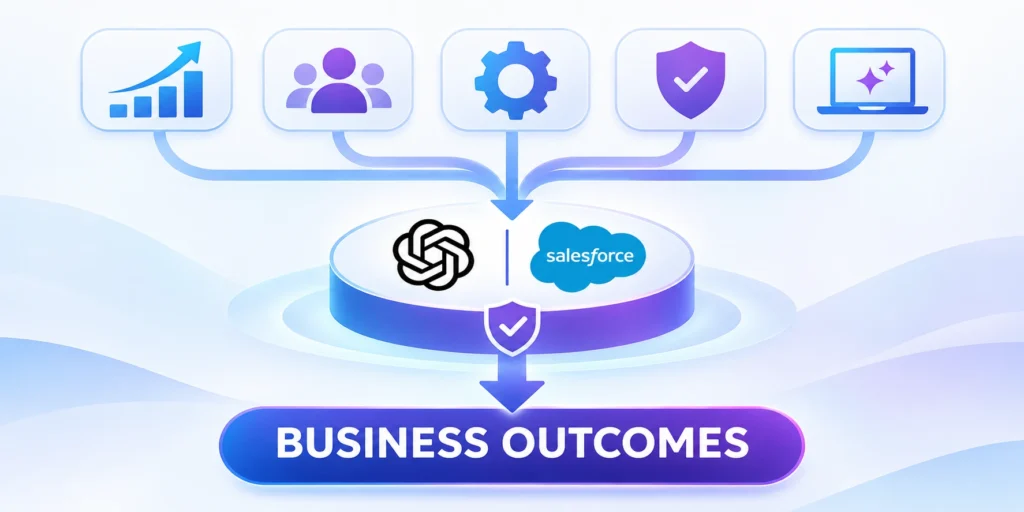
An enterprise AI strategy begins with business outcomes that matter to customers, employees, operations, revenue, cost, quality, speed, resilience, or risk.
Technology choices should follow those outcomes because models and platforms create value only when they improve decisions, workflows, products, or services.
Translate strategy into measurable decisions
Connect each proposed initiative to a strategic priority, accountable executive, affected process, current baseline, target result, and a credible measurement method.
Describe the decision or work that will change. Broad objectives such as become AI driven cannot guide architecture, investment, ownership, or evaluation.
Key considerations for translate strategy into measurable decisions include:
- Revenue and conversion
- Customer experience
- Operational productivity
- Quality and reliability
- Risk reduction
Separate productivity, revenue, customer, quality, and risk outcomes because each requires different evidence, adoption, time horizons, and financial treatment.
Define who benefits and who may experience additional review, change, or risk. Local efficiency can create hidden work elsewhere in the organization.
Set boundaries for the AI program
Record constraints involving authority, customer commitments, security, privacy, data residency, industry obligations, intellectual property, explainability, and human oversight.
Set program principles for build-versus-buy decisions, shared platforms, access, evaluation, approvals, provider use, and when experimentation must stop.
Use these actions to set boundaries for the ai program:
- Name the executive owner
- Record the current baseline
- Define the target change
- Identify affected stakeholders
- Document program boundaries
Choose a small number of outcome themes so the portfolio can concentrate investment and reuse capabilities instead of funding disconnected demonstrations.
Clear outcomes make later prioritization, architecture, governance, adoption, and ROI discussions comparable because every initiative has an explicit business purpose.
Build a Portfolio of AI Opportunities
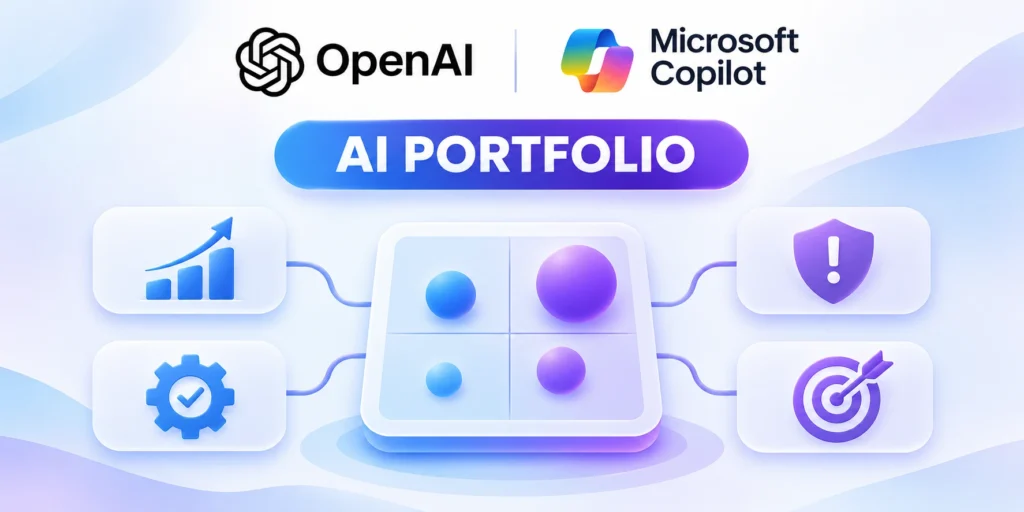
A portfolio converts enterprise priorities into a governed set of use cases that can be compared, sequenced, funded, tested, expanded, paused, or retired.
Collect opportunities from business units through structured discovery rather than open idea lists that favor visible demonstrations over meaningful workflow constraints.
Compare opportunities through one evidence model
Describe each opportunity through users, process, decision, data, systems, expected outcome, current baseline, AI role, human role, exceptions, and operating owner.
Score value, feasibility, data readiness, integration effort, model uncertainty, adoption effort, consequence, reversibility, reuse, and time to evidence.
Use these actions to compare opportunities through one evidence model:
- Business value
- Technical feasibility
- Data readiness
- Operating risk
- Capability reuse
- Time to evidence
Separate opportunities that need generative AI, predictive models, optimization, computer vision, traditional automation, analytics, or process redesign without AI.
Avoid choosing use cases only because they are easy. A balanced portfolio should include learning initiatives and strategic capabilities with credible business value.
Balance quick wins with strategic capability
Group related opportunities around shared data, integrations, evaluation, identity, knowledge, workflow, or operating capabilities to reduce duplicated platform effort.
Identify dependencies and sequencing. One reliable customer knowledge layer may enable several use cases, while separate pilots could create conflicting repositories.
Key considerations for balance quick wins with strategic include:
- Use one scoring model
- Document rejected candidates
- Map shared dependencies
- Set evidence gates
- Review the portfolio quarterly
Maintain explicit statuses for discovery, evaluation, pilot, production, scale, paused, rejected, and retired, with evidence required to cross each gate.
Portfolio governance should reallocate resources when assumptions fail instead of protecting every approved initiative from new evidence or changing business priorities.
Assess Organizational and Technical Readiness
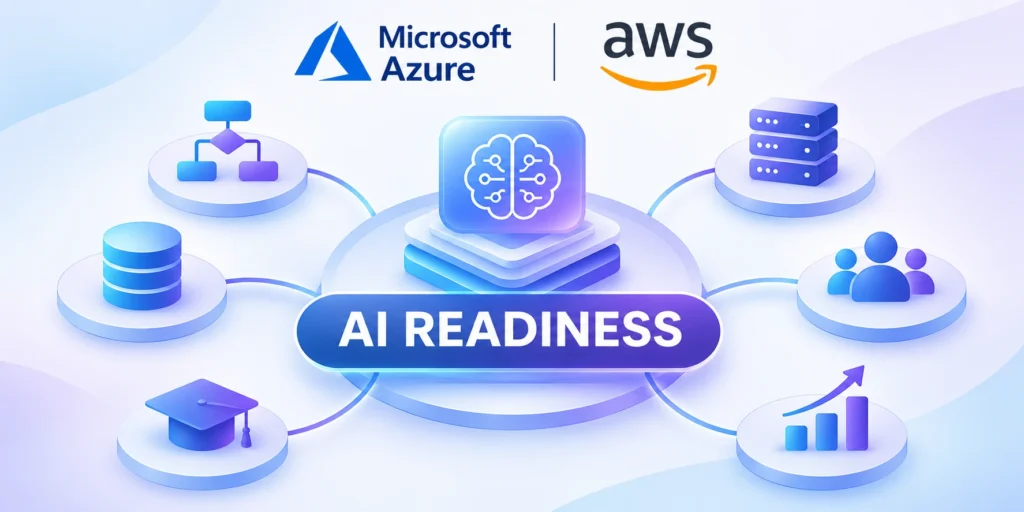
Enterprise readiness includes process clarity, data quality, integration, architecture, security, legal review, product ownership, evaluation, operations, adoption, and change capacity.
A company may be ready for one bounded use case while remaining unprepared for broad self-service or automated actions across sensitive systems.
Measure readiness by capability, not enthusiasm
Assess whether target workflows have stable ownership, documented decisions, measurable baselines, representative cases, accessible data, and understood exception paths.
Map data sources, authority, quality, recency, access, lineage, retention, regional constraints, retrieval needs, and the consequences of missing or conflicting information.
Use these actions to measure readiness by capability not enthusiasm:
- Process and ownership
- Data and access
- Architecture and integration
- Security and risk
- Evaluation and operations
- Skills and adoption
Review integration maturity, identity, secrets, environments, APIs, event handling, observability, incident response, release management, and recovery practices.
Evaluate skills across business analysis, product management, domain expertise, data, engineering, security, evaluation, operations, procurement, and organizational change.
Turn gaps into sequenced work
Identify decision owners for use cases, platforms, models, data, risk, access, vendors, release, incidents, cost, and retirement before production work begins.
Assess vendor and contract readiness, including data handling, model changes, regional processing, service commitments, export, incident obligations, and termination options.
Key considerations for turn gaps into sequenced work include:
- Score by use case
- Separate pilot from scale gaps
- Assign capability owners
- Sequence prerequisite work
- Reassess after expansion
| Readiness area | Pilot evidence | Scale evidence |
|---|---|---|
| Process | Owner and baseline | Stable operating model |
| Data | Accessible sample | Governed production access |
| Technology | Working integration | Reliable supported service |
| People | Pilot users | Adoption and support capacity |
Turn findings into prerequisites, pilot tasks, and rollout decisions. Scope AI consulting for marketing workflows around unresolved gaps before expanding permissions.
Repeat readiness assessments as the portfolio changes because broader users, tools, data, or consequences can require capabilities that an earlier pilot did not need.
Create an AI Operating Model
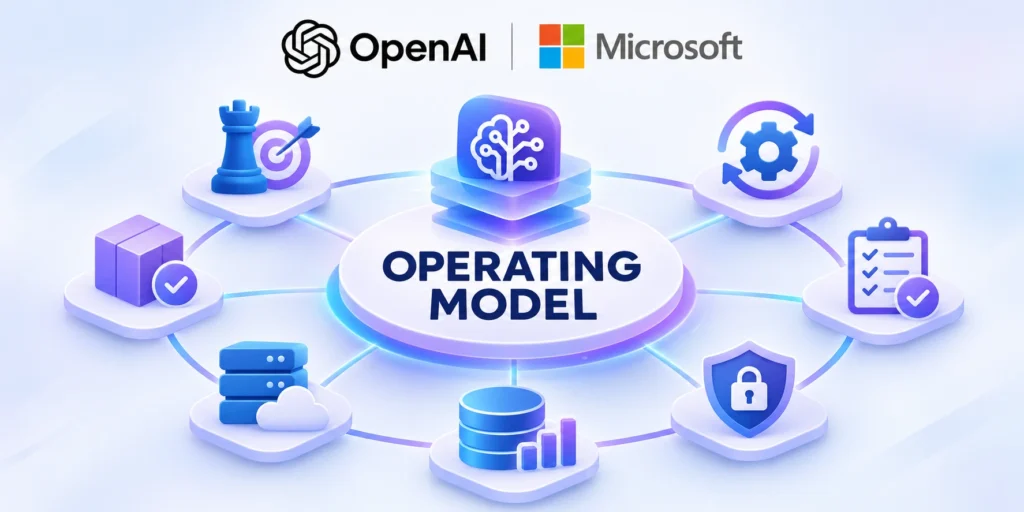
An AI operating model defines how the enterprise discovers, prioritizes, designs, approves, builds, evaluates, releases, operates, changes, funds, and retires AI capabilities.
It should connect executive direction with business ownership and technical operation without placing every decision inside one central review committee.
Assign durable ownership across the lifecycle
Assign an accountable product or service owner for each production capability and named owners for data, platform, security, evaluation, incidents, cost, and adoption.
A central enablement team can provide architecture, identity, tools, evaluation, vendor standards, coaching, and shared services while business teams own outcomes.
Use these actions to assign durable ownership across the lifecycle:
- Executive portfolio direction
- Business outcome ownership
- Shared platform enablement
- Risk and security oversight
- Production service operation
Define decision rights for use-case approval, risk classification, provider selection, model changes, production release, reduced review, access, exceptions, and shutdown.
Use lightweight paths for bounded low-consequence experiments and stronger evidence for sensitive data, external decisions, automated actions, or enterprise-wide deployment.
Combine standards with business accountability
Create common artifacts such as use-case records, model and dependency inventories, evaluation reports, release evidence, incident procedures, and ownership maps.
Fund shared capabilities separately from individual use cases when identity, integration, retrieval, observability, and evaluation support a broader portfolio.
Key considerations for combine standards with business accountability include:
- Publish decision rights
- Name every service owner
- Standardize evidence artifacts
- Fund reusable capabilities
- Review operating friction
Measure the operating model through decision speed, reuse, production outcomes, failure recovery, review burden, cost visibility, compliance, and retirement discipline.
The model should evolve from real delivery evidence rather than becoming a policy layer that delays learning without materially reducing risk.
Choose When to Build, Buy, or Partner

Build, buy, and partner decisions should reflect differentiation, requirements, data, integration, control, speed, talent, cost, provider risk, and long-term operating responsibility.
Buying can accelerate standard capabilities when the workflow fits the product, integrations are adequate, controls are acceptable, and switching costs remain manageable.
Compare strategic differentiation and operating burden
Building is appropriate when proprietary workflows, data, user experience, performance, or control create strategic value that packaged products cannot provide.
A specialist partner can accelerate discovery, architecture, integration, evaluation, delivery, or capability transfer when internal experience or capacity is limited.
Use these actions to compare strategic differentiation and operating burden:
- Strategic differentiation
- Time to useful evidence
- Control and extensibility
- Internal operating capability
- Total lifecycle cost
- Provider concentration risk
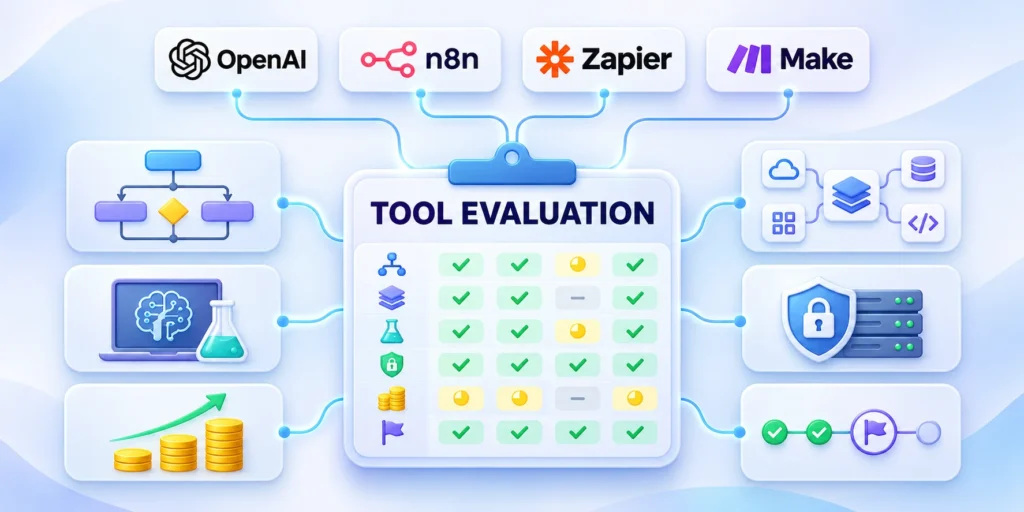
Compare the complete solution rather than model access alone. Include orchestration, retrieval, data, identity, integration, evaluation, observability, support, and change management.
Evaluate provider data use, regional processing, security, model lifecycle, export, extensibility, service levels, incidents, pricing, and termination before committing.
Preserve flexibility across the technology stack
Avoid locking the business process directly to one provider’s proprietary behavior when an abstraction or documented interface can preserve practical optionality.
Do not overengineer portability when it adds permanent complexity without a credible switching scenario or measurable resilience requirement.
Key considerations for preserve flexibility across the technology include:
- Compare complete solutions
- Review exit options
- Preserve internal knowledge
- Avoid theoretical portability
- Reassess after scale
Define which capabilities must remain internal, which can be standardized, and how knowledge, code, data, prompts, evaluations, and operations transfer between parties.
Revisit the decision as volume, strategic importance, platform maturity, provider capability, internal skills, cost, and risk change over time.
Design a Reusable AI Architecture
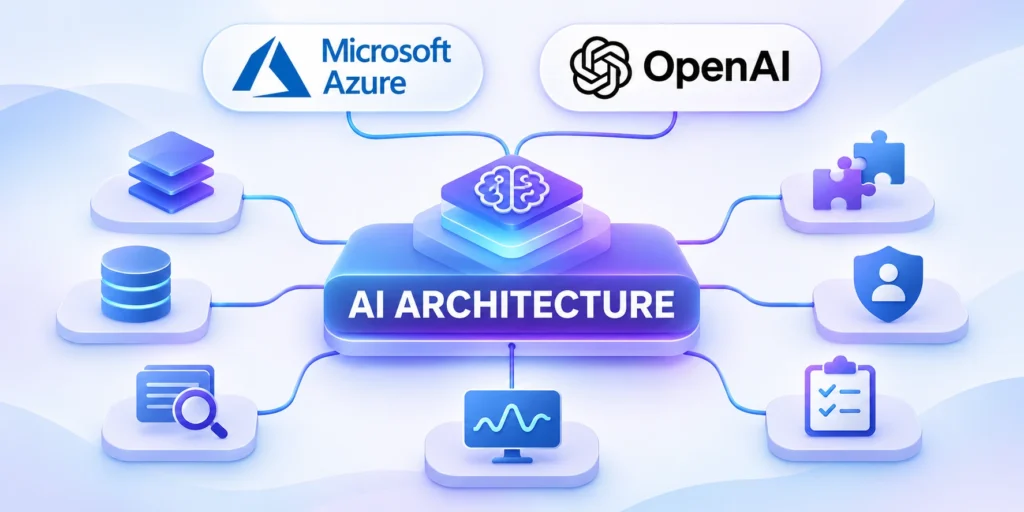
A reusable enterprise architecture provides approved paths for models, data, retrieval, integrations, identity, policy, evaluation, observability, human review, and workflow state.
The goal is not one platform for every use case. It is deliberate reuse where common controls reduce duplicated effort and inconsistent risk.
Separate shared capabilities from use-case logic
Separate user experience and business workflow from model routing, retrieval, tool gateways, identity, validation, evaluation, and operational telemetry.
Use deterministic software for permissions, calculations, schemas, limits, routing, and irreversible controls while models handle appropriate interpretation or generation tasks.
Use these actions to separate shared capabilities from use-case logic:
- Model gateway
- Retrieval and knowledge
- Tool and integration layer
- Identity and policy
- Evaluation and observability
- Workflow and review state
Design retrieval around source authority, access, recency, relevance, citations, retention, and behavior when evidence is missing or conflicting.
Place integrations behind purpose-built operations with scoped identity, validated inputs, idempotency, rate limits, audit records, and recovery behavior.
Make every dependency observable and replaceable
Support model routing by capability, latency, cost, data policy, availability, and evaluation rather than embedding one provider throughout business logic.
Capture versioned prompts, models, sources, tool calls, approvals, outputs, failures, cost, and outcomes with appropriate minimization and redaction.
Use these actions to make every dependency observable and replaceable:
- Use structured contracts
- Enforce least privilege
- Version behavior changes
- Preserve trace evidence
- Test component replacement
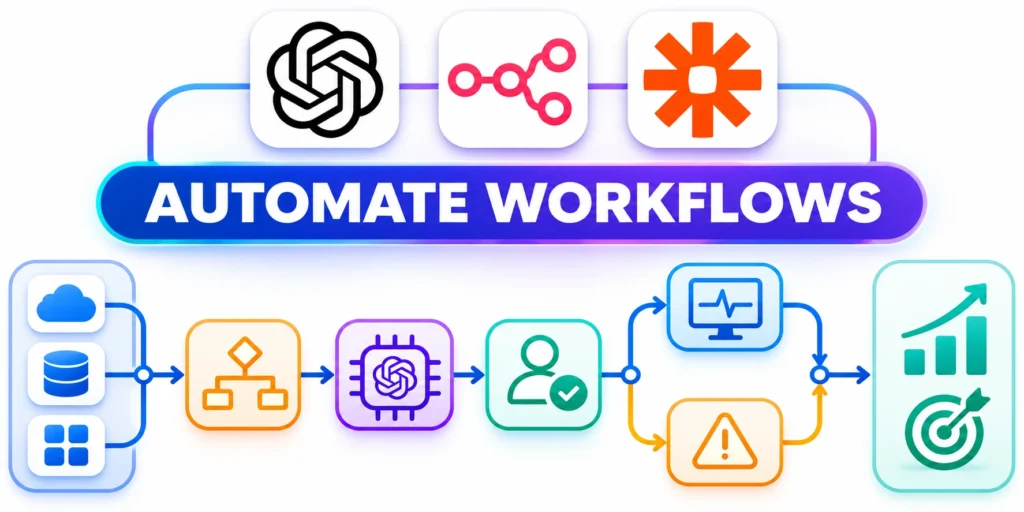
The related AI workflow automation guide explains how these capabilities support bounded end-to-end processes.
Architecture remains useful when teams can change a model, data source, integration, or policy and evaluate the impact without rebuilding every application.
Set Decision Rights and Risk Controls
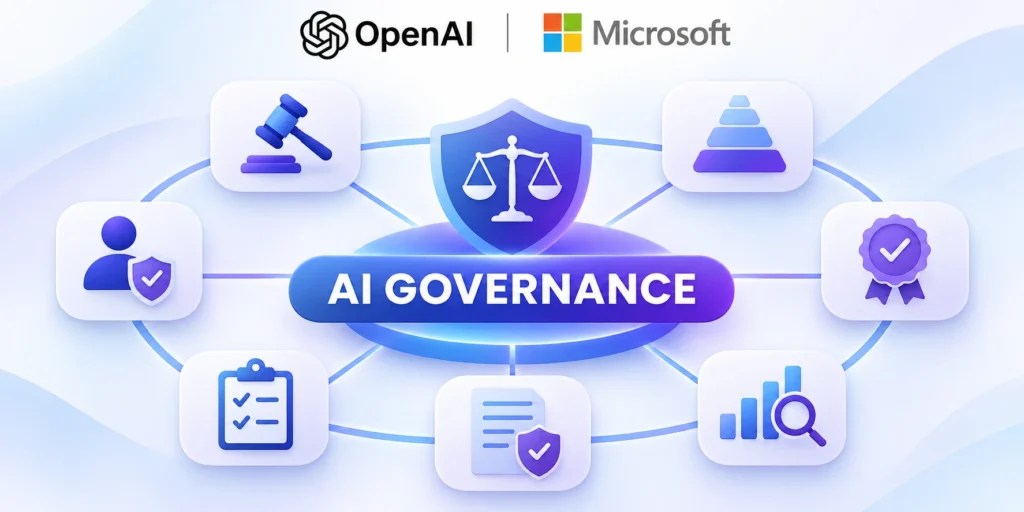
Enterprise AI governance should clarify who can approve use cases, data, providers, models, access, release, reduced review, exceptions, incidents, and retirement.
Controls should scale with consequence, uncertainty, affected people, data sensitivity, reversibility, external exposure, and the authority delegated to the system.
Scale governance according to consequence
Classify use cases into practical risk tiers with required evidence, owners, review, testing, monitoring, approval, documentation, and incident response for each tier.
Apply stronger gates to financial, employment, customer, legal, security, access, production, health, or other decisions with material effects.
Key considerations for scale governance according to consequence include:
- Use-case approval
- Data and provider approval
- Production release authority
- Human-review thresholds
- Incident and shutdown authority
Keep human oversight meaningful by showing reviewers the request, evidence, proposed result, uncertainty, conflicts, downstream action, and safe rejection options.
Require evaluation before production and after material model, prompt, retrieval, tool, policy, or provider changes using representative and adversarial cases.
Keep controls testable and operational
Maintain inventories of use cases, models, providers, data sources, tools, identities, users, versions, approvals, incidents, costs, and current operating status.
Monitor denied actions, unusual access, quality degradation, severe errors, overrides, review queues, cost anomalies, provider changes, and recovery effectiveness.
Use these actions to keep controls testable and operational:
- Use consequence-based tiers
- Test every material change
- Maintain current inventories
- Monitor severe failures
- Practice rollback procedures
Define pause, rollback, credential revocation, communication, evidence preservation, and incident ownership before a production capability can create material impact.
Good governance enables faster responsible delivery because teams know the evidence and authority needed at each stage instead of negotiating every control from scratch.
Estimate Investment and Business Value

An enterprise AI business case should compare expected outcomes with the complete investment required to design, integrate, evaluate, adopt, operate, support, and improve the capability.
Separate one-time discovery, data, architecture, integration, security, change, and implementation costs from recurring models, infrastructure, licenses, review, support, and maintenance.
Build a complete economic model
Value may come from additional revenue, faster cycles, reduced handling, improved quality, lower loss, stronger retention, better decisions, or avoided risk.
Do not convert every saved minute into financial return. Confirm whether capacity is redeployed, demand grows, service improves, or actual spending changes.
Use these actions to build a complete economic model:
- Implementation investment
- Recurring operating cost
- Human review effort
- Adoption and change cost
- Measured business outcome
- Downside exposure
Model adoption explicitly because unused capability creates no value. Include training, workflow changes, incentives, confidence, support, and the time required for new behavior.
Estimate uncertainty through conservative, expected, and strong scenarios with documented assumptions for volume, quality, adoption, cost, failure, and time to scale.
Update the case with production evidence
Use unit economics such as cost per completed case, accepted recommendation, qualified opportunity, resolved ticket, generated asset, or avoided manual review.
Include downside scenarios involving rework, incorrect actions, incidents, vendor changes, unexpected usage, review queues, integration failures, and delayed adoption.
Key considerations for update the case with production include:
- Use scenario ranges
- Define unit economics
- Track realized adoption
- Separate transferred work
- Reforecast after pilots
Track realized results against the original baseline and assumptions, separating process improvement, AI contribution, demand change, and external factors.
Investment decisions improve when the organization can stop, redesign, or expand initiatives based on evidence rather than defending an initial forecast.
Build a Phased Enterprise AI Roadmap
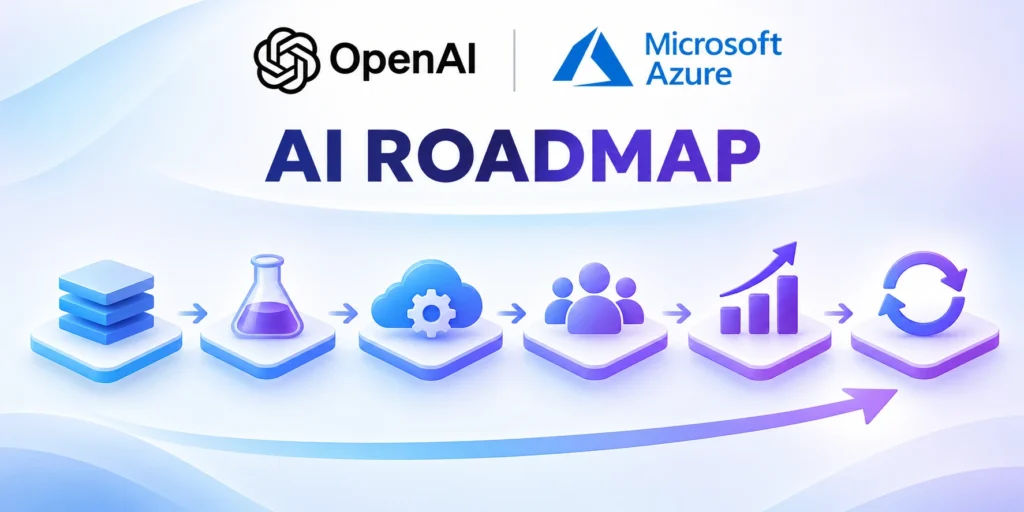
A useful roadmap sequences business outcomes, portfolio decisions, shared capabilities, use-case delivery, governance, adoption, operations, and organizational learning across evidence-based stages.
It should show dependencies and decision gates rather than presenting a fixed calendar that assumes every pilot will justify production and scale.
Sequence foundations, evidence, and scale
Begin with foundations needed for the first portfolio, such as ownership, identity, approved providers, data access, evaluation, integration, monitoring, and incident paths.
Run bounded pilots that test representative work, human review, technical reliability, adoption, operating cost, and business outcomes against documented baselines.
Key considerations for sequence foundations evidence and scale include:
- Program foundations
- Bounded use-case pilots
- Limited production releases
- Reusable capability scaling
- Portfolio optimization
Move successful use cases into limited production with named service ownership, release management, support, monitoring, rollback, and change procedures.
Scale through reusable capabilities and measured expansion of users, volume, data, tools, geography, or autonomy rather than one broad launch.
Treat the roadmap as a portfolio instrument
Include capability work for skills, product management, architecture, evaluation, platform operations, vendor management, security, and organizational change.
Set portfolio reviews that can accelerate, pause, redesign, consolidate, or retire work when evidence, dependencies, business priorities, providers, or risks change.
Use these actions to treat the roadmap as a portfolio:
- Map shared dependencies
- Define stage evidence
- Expand one boundary
- Review the portfolio
- Retire weak initiatives
Communicate what is experimental, approved, production-ready, restricted, or retired so employees and leaders understand current capability and responsibility.
The roadmap succeeds when it creates repeatable delivery and operating capacity, not merely a sequence of prototypes or technology procurement milestones.
Conclusion
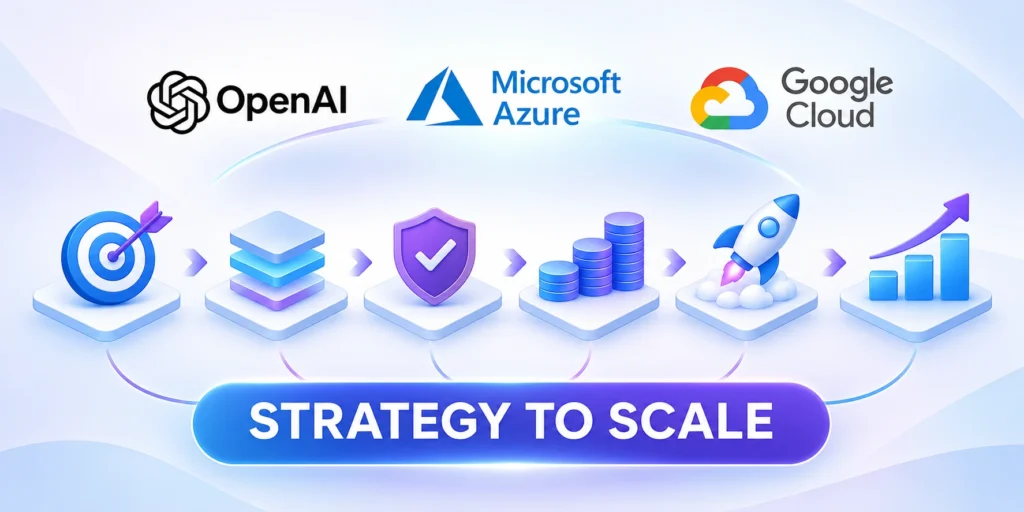
Enterprise AI strategy connects business outcomes with a portfolio, operating model, architecture, governance, investment case, adoption plan, and phased roadmap.
Begin with measurable decisions and workflows rather than technology procurement, broad transformation language, or isolated demonstrations without accountable business owners.
Build enterprise AI as an operating capability
Prioritize opportunities through consistent evidence covering value, feasibility, data, integration, adoption, risk, reversibility, reuse, and time to results.
Assess readiness by use case and distinguish what blocks a pilot from what blocks broader production authority or enterprise scale.
Use these actions to build enterprise ai as an operating:
- Start from business outcomes
- Prioritize a balanced portfolio
- Build reusable capabilities
- Govern by consequence
- Measure realized value
Assign durable owners for outcomes, services, data, platforms, risk, evaluation, incidents, access, cost, adoption, and retirement across the lifecycle.
Use reusable architecture where identity, retrieval, integration, evaluation, observability, and controls reduce duplication without forcing every workflow into one design.
Keep strategy connected to verified outcomes
Scale governance with consequence and make review, evaluation, monitoring, rollback, and incident controls operational rather than relying on policy statements alone.
Estimate complete investment and realized value, including review, operations, adoption, failures, support, provider change, and work transferred to other teams.
Use these actions to keep strategy connected to verified outcomes:
- Assign durable ownership
- Expand through evidence
- Monitor production behavior
- Preserve rollback paths
- Retire weak investments
Build the roadmap around evidence gates that can expand, pause, redesign, consolidate, or retire initiatives as assumptions and priorities change.
A durable strategy improves the enterprise’s ability to choose, deliver, operate, and govern valuable AI systems repeatedly rather than betting on one model or project.
FAQ
These answers summarize enterprise AI strategy, portfolio prioritization, readiness, operating models, architecture, governance, investment, roadmaps, and decisions to stop or redesign initiatives.
What is an enterprise AI strategy?
It is a coordinated plan connecting business outcomes, use cases, operating ownership, architecture, governance, investment, adoption, operations, and phased delivery across the enterprise.
How should a company prioritize AI use cases?
Compare business value, feasibility, data readiness, integration, adoption, uncertainty, consequence, reversibility, reuse, operating effort, and time to credible evidence.
What makes an organization ready for enterprise AI?
Readiness includes clear processes, accountable owners, accessible data, integrations, identity, security, evaluation, operations, incident response, adoption capacity, and appropriate vendor controls.
What is an AI operating model?
It defines decision rights, ownership, shared services, delivery paths, evidence, funding, risk oversight, production operation, change, incident response, and retirement.
Should an enterprise build or buy AI capabilities?
Buy standard capabilities when fit and controls are strong; build differentiated workflows when proprietary needs justify lifecycle effort; partner when expertise or capacity accelerates responsible delivery.
What belongs in an enterprise AI architecture?
Typical layers include models, routing, data, retrieval, integrations, identity, policy, validation, evaluation, observability, human review, workflow state, and incident controls.
How should AI governance scale across use cases?
Use consequence-based tiers so sensitive data, external decisions, automated actions, or irreversible impact require stronger evaluation, review, approval, monitoring, and rollback.
How can enterprise AI ROI be estimated?
Compare complete implementation and operating costs with measurable revenue, productivity, quality, speed, retention, or risk outcomes using adoption and uncertainty scenarios.
What should an enterprise AI roadmap include?
Include foundations, portfolio priorities, pilots, production releases, reusable capabilities, governance, skills, adoption, operations, evidence gates, dependencies, and retirement decisions.
When should an AI initiative be stopped?
Pause, redesign, or retire it when value remains weak, adoption fails, risk cannot be bounded, operating burden exceeds benefit, or strategic assumptions materially change.







Leave a Reply