


Watch the Article Overview
Start with Workflow Requirements

AI workflow automation tools should be evaluated against real business work, not attractive demonstrations, feature inventories, or vendor promises presented without operational context.
Begin with the trigger, participants, decisions, inputs, outputs, systems, exceptions, timing, service expectation, and accountable owner for each candidate workflow.
Define the work before comparing products
Document the current baseline for cycle time, handling effort, error rate, rework, backlog, abandonment, customer impact, and the cost of delayed decisions.
Separate deterministic steps from tasks needing interpretation, generation, classification, extraction, retrieval, planning, or judgment under defined human oversight.
Use these actions to define the work before comparing products:
- Business trigger
- Users and owners
- Inputs and outputs
- Systems and records
- Decisions and exceptions
- Service expectations
Describe required actions precisely, including record updates, notifications, approvals, calculations, document creation, system calls, retries, and safe recovery after partial completion.
Identify volume patterns, concurrency, peak periods, latency targets, retention, regional constraints, and availability expectations before testing platform capacity or pricing.
Turn requirements into observable tests
List every meaningful exception because ordinary happy-path demonstrations rarely reveal the orchestration, visibility, and recovery capabilities needed in production.
Define who may create, approve, publish, pause, troubleshoot, export, and retire automations across development, testing, and production environments.
Key considerations for turn requirements into observable tests include:
- Record the baseline
- Define acceptance criteria
- Include failure cases
- Assign decision rights
- Confirm production constraints
Convert requirements into acceptance criteria that can be observed through representative cases, logs, outputs, costs, recovery behavior, and user outcomes.
A requirements-first process keeps evaluation grounded when vendors package similar capabilities under different terminology, interfaces, and commercial models.
Understand the Main Tool Categories
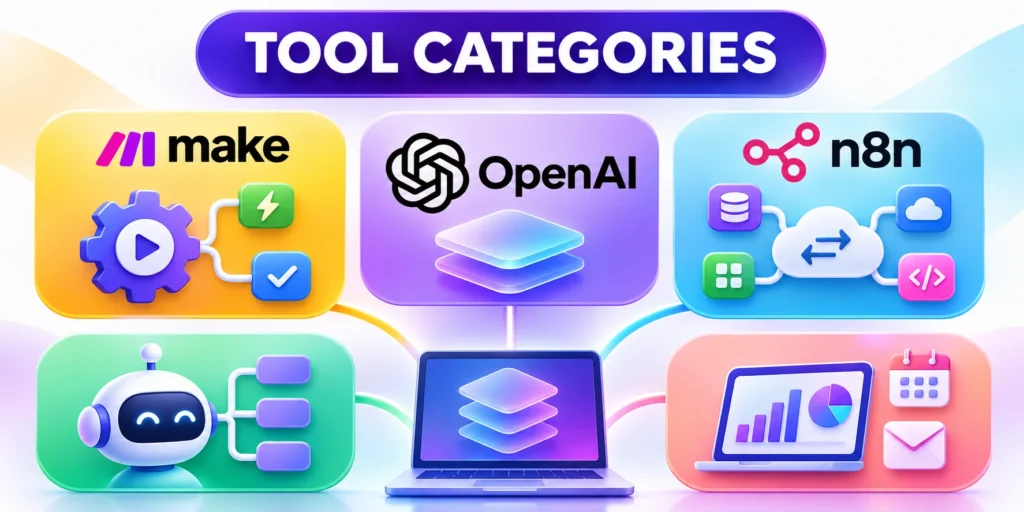
The market combines integration platforms, workflow builders, robotic process automation, business application automation, model services, agent frameworks, and specialized AI products.
Each category solves a different portion of the problem, although modern vendors increasingly bundle connectors, orchestration, AI features, governance, and monitoring.
Distinguish platforms by their operating role
Integration platforms emphasize moving data and events across systems through connectors, APIs, webhooks, mappings, transformations, schedules, and reusable technical components.
Workflow builders emphasize business-friendly construction, conditional paths, approvals, forms, notifications, templates, and manageable automation for common departmental processes.
Key considerations for distinguish platforms by their operating include:
- Integration platforms
- Workflow builders
- Robotic process automation
- Application-native automation
- Model services
- Agent frameworks
Robotic process automation operates interfaces when reliable APIs are unavailable, but screen-driven execution can introduce brittleness, maintenance, and environment dependencies.
Business application platforms automate deeply within their own CRM, service, marketing, productivity, or cloud ecosystems while providing different levels of external integration.
Expect category boundaries to overlap
Model services provide generation, extraction, classification, embeddings, tool calling, and evaluation capabilities but do not automatically supply complete business orchestration.
Agent frameworks coordinate model reasoning, tools, memory, and multi-step behavior, creating flexibility alongside additional uncertainty, evaluation, and operational responsibility.
Key considerations for expect category boundaries to overlap include:
- Clarify each operating role
- Identify feature overlap
- Limit duplicated orchestration
- Prefer supported interfaces
- Compare complete solutions
Specialized AI products can accelerate a defined use case through packaged workflows, data models, interfaces, controls, and support with less implementation freedom.
Choose the smallest combination that satisfies requirements because overlapping platforms create duplicated logic, fragmented monitoring, inconsistent controls, and avoidable cost.
Compare Orchestration and AI Capabilities
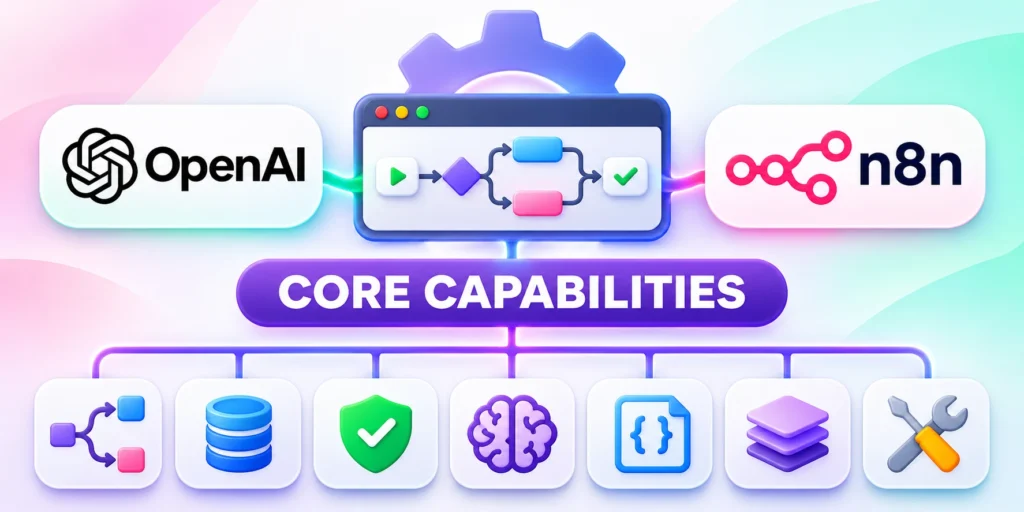
Orchestration determines how reliably a platform coordinates triggers, state, branches, loops, approvals, timers, dependencies, retries, compensation, and completion across systems.
AI capabilities determine how models receive context, produce structured results, call tools, use knowledge, handle uncertainty, and remain observable inside that execution.
Test the complete execution model
Compare event, schedule, webhook, queue, form, file, database, and manual triggers against the workflow sources required by actual business processes.
Test branching, parallel work, waiting, resumption, subflows, reusable components, versioning, environment promotion, and long-running state under realistic conditions.
Use these actions to test the complete execution model:
- Triggers and schedules
- State and branching
- Retries and recovery
- Structured model outputs
- Tool permissions
- Human approvals
Evaluate structured output enforcement, schema validation, model choice, prompt management, retrieval, tool calling, memory, citations, fallback, and human review.
Keep deterministic permissions, calculations, limits, destinations, and irreversible actions outside unconstrained model decisions whenever ordinary logic can enforce them.
Separate flexible reasoning from reliable control
Use the related AI workflow automation guide to separate process design from platform selection.
Inspect how the platform exposes each execution, input, output, model request, tool call, decision, error, retry, approval, and final business result.
Use these actions to separate flexible reasoning from reliable control:
- Test long-running work
- Inspect every execution
- Constrain irreversible actions
- Define provider fallbacks
- Measure complete outcomes
| Capability | Representative test | Evidence |
|---|---|---|
| Orchestration | Failure and recovery | Execution history |
| AI behavior | Structured edge cases | Scored outputs |
| Integration | Real systems and limits | Logs and timing |
| Controls | Roles and approvals | Audit records |
Test degraded behavior when providers time out, schemas fail, context is missing, tools reject requests, or human approval arrives after workflow expiration.
The strongest platform is not the one with the longest feature list but the one that executes required behavior predictably under representative stress.
Evaluate Integrations and Extensibility

Integration quality depends on supported operations, authentication, event coverage, pagination, limits, error handling, version stability, and maintainability rather than connector count.
A connector may expose only basic records while the workflow requires associations, custom objects, attachments, bulk operations, streaming events, or administrative functions.
Verify connectors through real operations
Build representative integrations with the exact CRM, service desk, database, collaboration, storage, identity, analytics, and custom systems used by the organization.
Confirm whether triggers use webhooks, polling, schedules, queues, or application events and how delays, duplicates, ordering, and missed events are handled.
Use these actions to verify connectors through real operations:
- Required operations
- Event delivery
- Authentication and secrets
- Limits and quotas
- Custom extension paths
- Version stability
Inspect OAuth, service accounts, secrets, token rotation, scoped permissions, environment separation, connection ownership, and recovery when credentials expire.
Evaluate API, SDK, command, code, custom connector, and reusable component options for capabilities unavailable through packaged integrations.
Plan for change without unnecessary complexity
Review rate limits, concurrency, batching, pagination, payload size, execution duration, and vendor quotas with realistic volume and peak conditions.
Test schema changes, renamed fields, removed permissions, API revisions, and provider outages because integrations fail over time, not only during implementation.
Use these actions to plan for change without unnecessary complexity:
- Test exact applications
- Simulate expired credentials
- Measure peak volume
- Review maintenance skills
- Document connector gaps
Estimate the skills required to build, review, secure, test, deploy, monitor, and support custom extensions throughout their operating lifecycle.
Extensibility creates value when it closes important gaps without turning every workflow into proprietary code that only one specialist can maintain.
Review Access, Ownership, and Controls

Automation platforms can read sensitive records, modify systems, contact customers, create commitments, and trigger downstream actions, making access, ownership, and operational continuity central evaluation criteria.
Review single sign-on, multifactor authentication, role-based access, workspace isolation, environment separation, service identities, session controls, and privileged administration.
Treat automation as production software
Test whether permissions distinguish viewing, building, editing, testing, approving, publishing, running, pausing, exporting, credential management, and audit administration.
Confirm that workflows use dedicated service identities with minimum permissions instead of personal accounts that create hidden dependency and weak accountability.
Use these actions to treat automation as production software:
- Identity and authentication
- Role-based permissions
- Service account ownership
- Secret management
- Production approvals
- Audit evidence
Evaluate secret storage, encryption, rotation, redaction, connection sharing, audit history, export controls, retention, deletion, and regional processing options.
Inspect approval gates for production changes, higher-risk actions, new integrations, model changes, data access expansion, and emergency overrides.
Make accountability visible before deployment
Assign named owners for workflow outcomes, platform administration, access, integrations, models, evaluation, incidents, cost, support, and business continuity.
Use the AI agents rollout framework when evaluating tools that can choose and execute actions autonomously.
Use these actions to make accountability visible before deployment:
- Apply least privilege
- Separate environments
- Name every owner
- Review emergency access
- Test audit retrieval
Verify audit records connect users, versions, credentials, model calls, tool actions, approvals, errors, and deployments without exposing protected data unnecessarily.
Controls should enable useful delivery while keeping consequential actions authorized, attributable, reviewable, reversible where possible, and recoverable after failure.
Build a Representative Evaluation Set
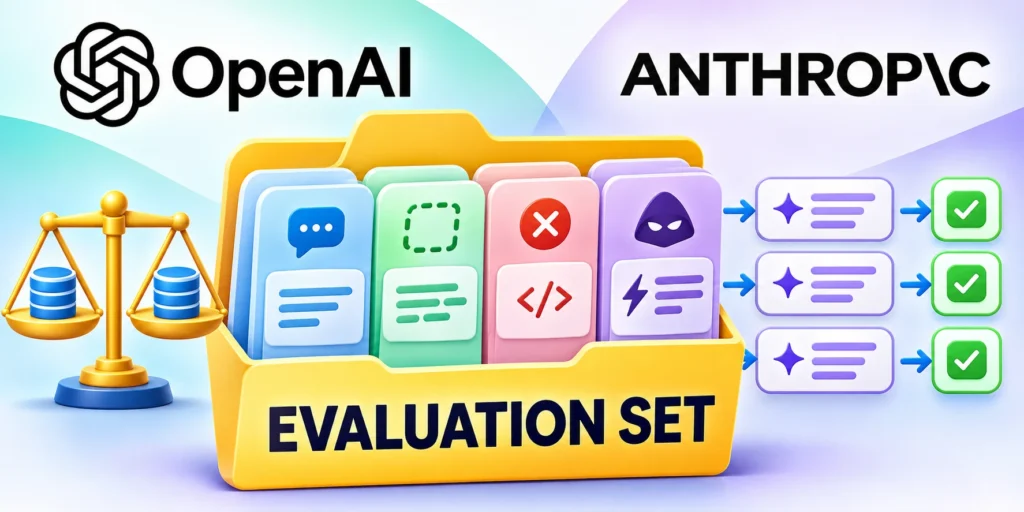
A representative evaluation set prevents teams from selecting a platform through curated demonstrations that omit ambiguity, missing data, exceptions, failures, and operating constraints.
Collect real workflow cases across ordinary work, peak demand, unusual inputs, conflicting records, delayed approvals, permission failures, and incomplete downstream responses.
Compare tools using the same evidence
Define expected outcomes, acceptable variation, required evidence, prohibited actions, escalation behavior, recovery expectations, and the business consequence of failure.
Use identical cases across platforms while allowing each vendor to configure a credible implementation rather than forcing every product into one artificial design.
Use these actions to compare tools using the same evidence:
- Normal workflow cases
- Edge and failure cases
- Permission errors
- Adversarial inputs
- Expected outcomes
- Recovery requirements
Measure correctness, completeness, consistency, latency, setup effort, maintainability, observability, recovery, user effort, model usage, and complete operating cost.
Include adversarial and safety cases involving prompt injection, unauthorized data requests, malicious documents, unexpected tool outputs, and attempts to bypass approval.
Include difficult cases before procurement
Version the dataset, workflow configuration, connectors, prompts, models, expected outcomes, scoring guidance, and platform release used in every comparison.
Ask qualified business, technical, security, and operational reviewers to score the dimensions they understand using shared definitions and documented evidence.
Use these actions to include difficult cases before procurement:
- Use identical evidence
- Version every dependency
- Score complete outcomes
- Inspect severe failures
- Retain the baseline
Investigate severe failures individually because a strong average can hide one unacceptable action, data exposure, silent loss, or unrecoverable process outcome.
Retain the evaluation set after selection so future upgrades, model changes, connector revisions, and competing platforms can be compared against the same baseline.
Run a Time-Boxed Pilot
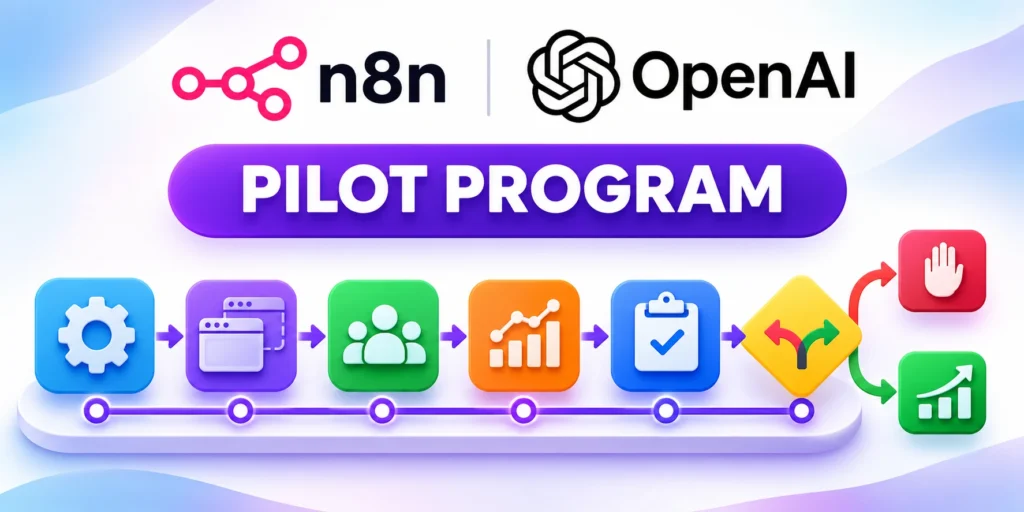
A pilot should answer defined selection questions within a fixed period, bounded workflow, controlled user group, approved data scope, and measurable operating conditions.
Choose a workflow that represents important complexity without exposing the organization to disproportionate customer, financial, legal, security, or operational consequence.
Test production assumptions within a boundary
Set entry criteria covering requirements, access, integrations, evaluation cases, owners, training, support, monitoring, rollback, and approved production boundaries.
Begin with development and shadow execution before limited production, allowing teams to compare recommendations and actions against existing work without immediate dependency.
Use these actions to test production assumptions within a boundary:
- Fixed evaluation period
- Bounded workflow scope
- Controlled user group
- Approved data access
- Measured operating conditions
- Named decision owner
Measure quality, completion, correction, exception handling, latency, reliability, user effort, adoption, support demand, model usage, and end-to-end cost.
Record setup effort and maintenance work because an impressive result may depend on custom configuration that becomes expensive across many workflows.
Finish with an explicit decision
Expose the pilot to realistic volume, provider delays, credential expiry, data changes, invalid inputs, human absence, duplicate events, and partial downstream failure.
Review evidence weekly with business, technical, security, and operational owners while resisting uncontrolled scope additions that prevent a clear conclusion.
Key considerations for finish with an explicit decision include:
- Start in shadow mode
- Test realistic failures
- Track maintenance effort
- Prevent scope drift
- Apply exit criteria
Use predefined stop, extend, redesign, select, or reject criteria instead of allowing sponsorship, sunk effort, or vendor pressure to determine the outcome.
End the pilot by documenting results, unresolved gaps, required mitigations, ownership, total cost, implementation path, and the decision supported by evidence.
Compare Pricing and Operating Costs

Platform pricing may combine users, builders, tasks, executions, operations, connectors, environments, data, storage, model tokens, support, and enterprise governance features.
Normalize vendor estimates against the same workflows, volumes, models, environments, retention, support level, growth assumptions, and expected failure rates.
Calculate cost across the complete lifecycle
Include implementation, integration, migration, testing, security review, training, documentation, monitoring, incident response, maintenance, and future platform change.
Model costs for successful runs, retries, polling, branching, loops, duplicate events, failed calls, human review, evaluation, and nonproduction testing.
Use these actions to calculate cost across the complete lifecycle:
- Licenses and builders
- Tasks and executions
- Model and cloud usage
- Implementation effort
- Support and maintenance
- Migration and exit
Separate platform charges from model, cloud, database, search, observability, communication, and third-party application costs triggered by each automation.
Estimate internal labor for administration, workflow ownership, connector maintenance, prompt updates, evaluation, access reviews, support, and business change.
Relate spend to completed business outcomes
Calculate unit economics through completed outcomes such as resolved cases, approved records, qualified opportunities, processed documents, or accepted workflow results.
Use ranges for adoption, volume, token use, exception rate, retries, and growth because precise forecasts often hide assumptions that matter more than arithmetic.
Key considerations for relate spend to completed business include:
- Normalize volume assumptions
- Include failed executions
- Price human review
- Model growth ranges
- Compare outcome economics
Review contractual minimums, overages, premium connectors, environment limits, support terms, data export, termination, and migration assistance before commitment.
The lowest subscription price can produce the highest operating cost when gaps require custom code, manual review, fragmented tooling, or repeated recovery.
Use a Transparent Decision Scorecard

Build a decision scorecard around requirements, pilot evidence, cost, and ownership. For B2B marketing automation, include campaign measurement and CRM handoffs.
Define criteria and weights before final vendor demonstrations so attractive presentations cannot quietly replace priorities agreed by business and technical stakeholders.
Weight criteria before final demonstrations
Use categories for functional fit, orchestration, AI capability, integrations, extensibility, access, governance, observability, reliability, usability, support, cost, and exit.
Set minimum gates for requirements that cannot be traded through weighted averages, including critical security, data, recovery, permission, or contractual conditions.
Key considerations for weight criteria before final demonstrations include:
- Functional fit
- Integration coverage
- Security and governance
- Reliability and recovery
- Usability and support
- Total operating cost
Score observable evidence from representative tests and pilots rather than product claims, roadmap statements, marketplace counts, or analyst positioning alone.
Record the source, evaluator, assumptions, configuration, version, date, uncertainty, unresolved gap, and mitigation behind every material score.
Preserve evidence behind every score
Invite business, architecture, engineering, security, operations, procurement, support, and frontline users to evaluate only the dimensions they can judge credibly.
Run sensitivity analysis by changing uncertain weights and assumptions to see whether the preferred platform remains stable under plausible business priorities.
Key considerations for preserve evidence behind every score include:
- Weight criteria early
- Set nonnegotiable gates
- Cite test evidence
- Record uncertainty
- Test decision sensitivity
Document why the selected option wins, what weaknesses remain, which controls are required, how success will be measured, and what would trigger reconsideration.
Keep the scorecard as a baseline for renewal and expansion. When commissioning AI marketing automation, use it to define implementation and acceptance criteria.
Conclusion
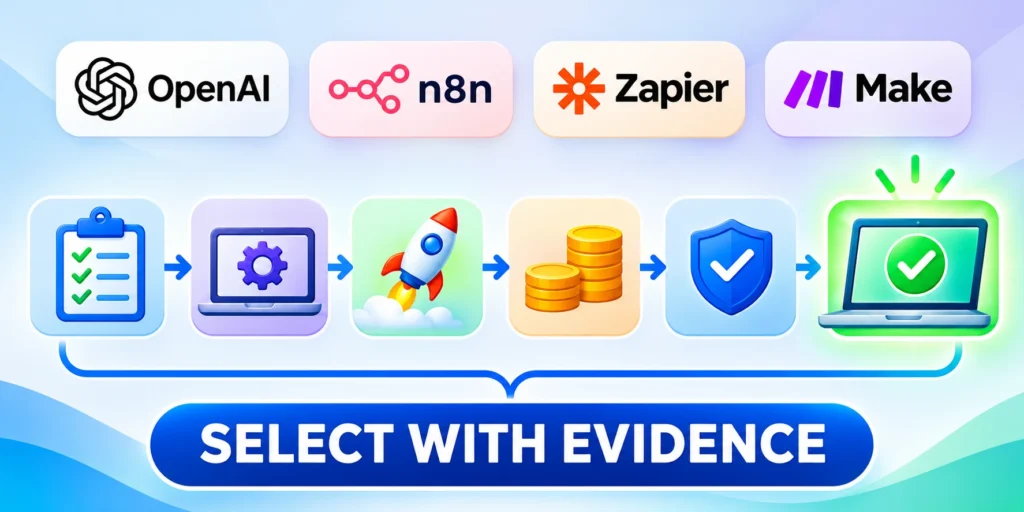
AI workflow automation tools create value when their capabilities match defined business work, production constraints, human responsibilities, and measurable operating outcomes.
Begin with workflow requirements and baseline evidence before comparing platforms, connectors, models, agent features, templates, or commercial packaging.
Select the tool that fits the operating system
Distinguish tool categories and determine which combination can orchestrate required work without creating duplicated logic, fragmented monitoring, or avoidable complexity.
Test orchestration, AI behavior, integrations, access, controls, observability, recovery, and cost through the same representative cases across credible implementations.
Use these actions to select the tool that fits the:
- Requirements before products
- Representative evidence
- Controlled pilot
- Complete operating cost
- Transparent decision
- Named ownership
Use a bounded pilot to verify production assumptions, user adoption, maintenance effort, exception handling, and complete outcome economics before broad commitment.
Keep deterministic controls around permissions, limits, destinations, calculations, approvals, and irreversible actions even when models support flexible interpretation.
Reevaluate as workflows and platforms change
Apply a transparent scorecard that weights agreed criteria, preserves evidence, sets nonnegotiable gates, and exposes uncertainty rather than hiding tradeoffs.
Select the platform with the strongest complete operating fit, not the largest feature inventory, lowest headline price, or most polished demonstration.
Key considerations for reevaluate as workflows and platforms include:
- Preserve the test baseline
- Monitor production outcomes
- Review platform changes
- Reassess major expansion
- Retire weak automations
Retain evaluation cases and scorecards for upgrades, renewals, expansion, provider changes, and future alternatives because platform capabilities evolve quickly.
Evidence-based selection turns automation tooling into a governed business capability that can improve safely as workflows, models, systems, and priorities change.
FAQ
These answers summarize tool categories, evaluation evidence, pilots, pricing, controls, scorecards, and selection decisions for AI workflow automation platforms.
What are AI workflow automation tools?
They coordinate business steps, systems, data, models, approvals, and actions. Products vary from integration platforms to specialized applications and agent frameworks.
How should a company start evaluating tools?
Start with a documented workflow, baseline, owners, exceptions, systems, controls, production constraints, and observable acceptance criteria before comparing products.
Which tool category is best?
No category is universally best. The right category depends on orchestration, integration, AI, governance, usability, support, and operating requirements.
What capabilities should be tested first?
Test critical triggers, state, branches, integrations, structured outputs, permissions, approvals, observability, recovery, and complete workflow outcomes.
How many platforms should enter a pilot?
Use a small credible shortlist. Too many pilots dilute implementation quality, reviewer attention, and evidence needed for a defensible decision.
Why are representative cases important?
They expose ambiguity, exceptions, failures, permissions, recovery, and maintenance that polished demonstrations commonly omit from product comparisons.
How long should an automation pilot run?
Choose enough time to encounter representative volume and exceptions while preserving a fixed decision date and controlled evaluation scope.
How should pricing be compared?
Normalize workloads and include licenses, executions, models, integrations, hosting, people, support, failures, maintenance, and migration or exit costs.
What belongs in a decision scorecard?
Include functional fit, integration, controls, reliability, usability, support, cost, evidence quality, uncertainty, nonnegotiable gates, and required mitigations.
When should a selected platform be reevaluated?
Reevaluate after major workflow expansion, provider changes, repeated incidents, rising costs, weak outcomes, contractual renewal, or credible alternatives.







Leave a Reply