


Prepare the Audit Asset and Account Inventory
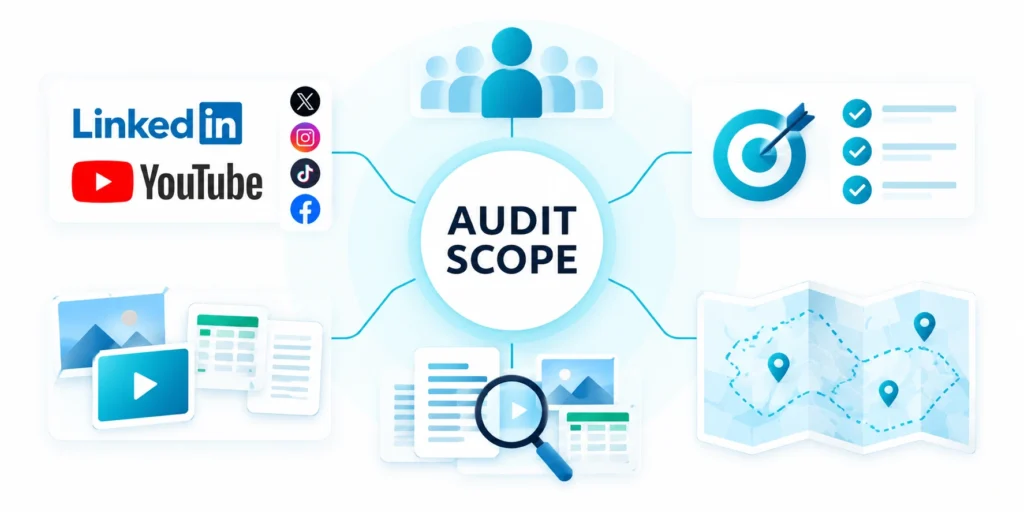
Begin the social media audit with a verified inventory of official accounts, regional pages, executive profiles, advertising identities, tools, integrations, and owned assets.
Record status, purpose, audience, owner, administrator, recovery contact, authentication method, connected systems, last activity, and known business dependency for every item.
Reconcile platform access with organizational ownership
Ask platform administrators, marketing, sales, support, recruiting, legal, and regional teams to identify accounts that may not appear in the central documentation.
Verify owners in account settings and flag shared credentials or unclear recovery paths. If a nearshore B2B marketing agency helps execute campaigns, document its access separately.
Capture each account through these inventory fields:
- Canonical URL
- Business purpose
- Named owner
- Admin access
- Recovery method
- Connected tools
Include pixels, conversion APIs, social scheduling tools, analytics properties, lead forms, webhooks, CRM connections, content libraries, and paid media accounts linked to each profile.
Prioritize immediate access and continuity risks
Separate missing ownership, weak authentication, unapproved accounts, expired integrations, inaccessible assets, and dependency on one person from routine documentation gaps.
Assign a deadline and responsible owner for every critical issue. Do not disable a questionable account until legal, customer, campaign, and recovery consequences are understood.
Preserve evidence before changing access
Export current administrators, integrations, settings, campaign history, and relevant account identifiers before remediation. Store the snapshot in the controlled audit record.
Use individual access, least privilege, multifactor authentication, approved recovery methods, and documented offboarding. Never publish credentials or secrets inside the audit report.
Check Brand Identity Consistency Across Channels

Brand consistency means audiences can recognize the same organization across channels while each platform still uses formats appropriate to its community and purpose.
Compare account names, handles, profile images, descriptions, links, contact information, disclaimers, product language, visual systems, pinned content, and current campaign claims.
Create a controlled brand reference
Use the approved brand system, legal names, audience positioning, product taxonomy, and current website as references. Document intentional regional or business-unit differences.
Check whether profile language reflects the audience and business purpose assigned to that channel. Consistency should clarify identity without forcing identical copy everywhere.
Review channel identity through these elements:
- Account name
- Profile image
- Description
- Primary link
- Contact path
- Pinned message
Record mismatches as accuracy, recognition, compliance, conversion, or maintenance issues. This distinction helps teams prioritize corrections that materially affect users.
Test the path from profile to destination
Open the declared destination, verify the canonical domain, and compare the promise in the profile with the page users receive after clicking.
Check campaign parameters, redirects, language, regional availability, forms, accessibility, mobile behavior, and whether old landing pages still represent the current offer.
Govern exceptions instead of hiding them
Document why a regional handle, acquired brand, recruiting page, executive profile, or customer community intentionally differs from the corporate account.
Assign review dates to every exception. Remove outdated variations when their business reason disappears, while preserving necessary legal and historical records.
Analyze Historical Content Performance

Historical analysis should explain which content helped a defined audience take a meaningful action, not merely identify the posts with the largest visible counts.
Choose a representative period that includes ordinary publishing, major campaigns, product announcements, seasonality, paid support, platform changes, and known data gaps.
Normalize the dataset before comparison
Export post-level data with publication time, format, topic, audience, distribution type, spend, reach, engagement, clicks, conversions, and relevant downstream outcomes.
Separate organic and paid exposure in the audit. For LinkedIn Ads for enterprise accounts, reconcile campaign delivery with qualified opportunities and flag any gaps in tracking.
Segment historical content through these dimensions:
- Audience
- Topic
- Format
- Funnel purpose
- Distribution type
- Publishing period
Use the definitions in our B2B social media KPI guide when comparing qualified response, downstream outcomes, and measurement limits.
Connect platform behavior to business evidence
Compare qualified visits, content consumption, form completion, meeting creation, opportunity influence, support deflection, recruiting response, or customer education when those outcomes apply.
Use consistent identifiers and attribution windows. Audit the B2B retargeting strategy separately for audience overlap and view-through credit before interpreting social media’s contribution.
Review winners and weak performers qualitatively
Read the creative, comments, destination, offer, timing, and surrounding campaign. Performance patterns become useful only when teams understand what audiences actually received.
Preserve counterexamples that challenge the preferred narrative. They can reveal segment differences, fatigue, measurement errors, or topics whose value appears later.
Build a Competitor Benchmarking Matrix

Competitor benchmarking should reveal strategic choices and audience expectations without turning the audit into imitation or an unreliable ranking contest.
Select direct competitors, category alternatives, admired publishers, and customer-information sources for explicit reasons. Record the date and scope because channel behavior changes quickly.
Compare observable strategy instead of vanity totals
Review channel purpose, audience, topics, formats, cadence, interaction, executive participation, community response, destination quality, paid signals, and recurring calls to action.
Use public observations and authorized tools. Do not infer private revenue, spend, targeting, conversion, or customer data from incomplete external signals.
Benchmark competitors through these visible dimensions:
- Channel role
- Audience focus
- Topic coverage
- Format mix
- Publishing cadence
- Response pattern
Normalize counts by period and channel maturity when practical. A larger audience or older account does not automatically represent stronger execution or better customer value.
Identify gaps that fit company capabilities
Look for underserved questions, weak evidence, missing implementation guidance, inconsistent executive expertise, slow response, inaccessible formats, or destinations that fail audience intent.
Test whether the company has credible expertise and resources to address each gap. Opportunity depends on relevance and execution, not simply competitor absence.
Translate observations into bounded tests
Choose one audience, topic, format, channel, owner, baseline, success signal, and review date. Preserve the comparison group so the test can generate useful learning.
Do not copy protected creative, wording, or distinctive campaigns. Use benchmarking to sharpen original positioning and evidence, not to reproduce another organization’s identity.
Audit the Funnel, Links, UTMs, and Routing

Every social profile and campaign should lead users through a working, measurable, and appropriate path from message to destination, form, CRM record, owner, and response.
Test organic links, paid ads, profile links, lead forms, link hubs, shortened URLs, regional destinations, app links, event pages, downloads, and frequently reused templates.
| Stage | Evidence | Decision |
|---|---|---|
| Profile | Audience and link | Keep or revise |
| Content | Qualified response | Refine topic |
| Website | Intent and action | Improve path |
| CRM | Owner and status | Fix routing |
Trace representative journeys end to end
Start from the exact social placement and follow redirects on mobile and desktop. Confirm the destination matches the message, audience, language, geography, and offer.
Submit controlled test records where authorized. Verify consent text, validation, confirmation, analytics events, CRM fields, source values, ownership, notifications, and follow-up expectations.
Inspect each funnel through these checkpoints:
- Working URL
- Correct destination
- Consistent UTM
- Recorded conversion
- Assigned owner
- Expected response
Use synthetic identifiers and remove test records according to policy. Never submit real customer data merely to confirm tracking or routing behavior.
Standardize campaign parameters and redirects
Define source, medium, campaign, content, term, capitalization, separators, naming ownership, and exception handling. Store the convention where publishers can use it.
Preserve useful redirects when destinations change, but avoid chains and misleading substitutions. Update high-use source links when a direct canonical destination remains available.
Reconcile analytics and CRM evidence
Compare platform clicks, web sessions, conversion events, form records, CRM creation, qualified routing, and response. Differences identify instrumentation or operational loss.
The audit should name the failing step, affected audience, evidence, owner, impact, and retest condition instead of reporting a vague attribution discrepancy.
Check Audience Demographics and ICP Alignment

Audience alignment asks whether the people reached, engaged, and converted resemble the stakeholders the business can responsibly serve through that channel and offer.
Begin with the documented ideal customer profile and buying committee. Separate firmographic fit, professional role, problem relevance, lifecycle context, geography, and permitted engagement.
Compare platform audiences with business definitions
Use available first-party analytics, CRM outcomes, survey evidence, campaign responses, and aggregated platform insights. Treat inferred demographics and interest categories cautiously.
Review whether targeting excludes relevant stakeholders or attracts broad attention that cannot progress. A large audience can still be commercially and editorially misaligned.
Assess audience alignment through these dimensions:
- Company fit
- Professional role
- Problem relevance
- Lifecycle context
- Geography
- Permitted use
Avoid sensitive profiling, unsupported identity inference, or unnecessary personal data. Apply consent, platform policy, privacy, access, retention, and regional requirements.
Inspect engagement by segment and intent
Compare content topics, formats, response quality, destination behavior, qualified actions, and sales acceptance across meaningful segments with sufficient representation.
Do not optimize solely toward segments that produce easy clicks. Protect strategic audiences whose decisions require longer education, private evaluation, or several stakeholders.
Resolve disagreement with observable evidence
When marketing and sales interpret fit differently, sample actual records and define acceptance reasons, exclusions, missing context, and follow-up outcomes together.
Revise the ICP, channel role, targeting, content, or handoff only after identifying which assumption failed. Preserve the earlier definition for later comparison.
Identify Resource Leaks and Budget Inefficiencies
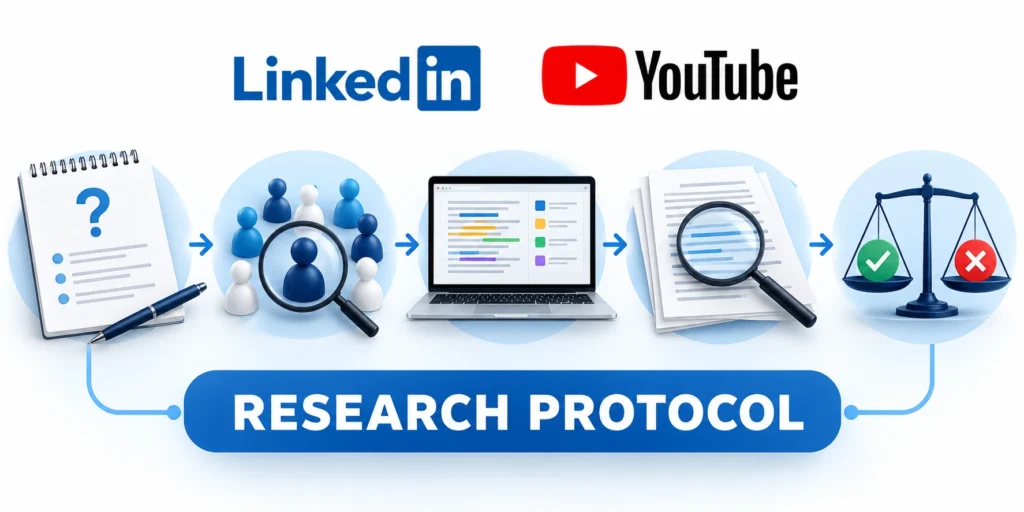
Resource analysis should reveal where time, media, tools, creative, approvals, agencies, and operational effort fail to support a defined audience or business decision.
Inventory fixed and variable costs alongside internal hours, external services, software, production, community management, reporting, governance, and downstream follow-up demand.
Map cost to channel purpose and outcome
Assign each expense to a channel, audience, campaign, asset, or shared capability. Record the intended result and the evidence available to evaluate continued investment.
Separate necessary infrastructure from activity volume. Authentication, accessibility, governance, measurement, and customer response may remain valuable without direct attribution to revenue.
Review resource efficiency through these categories:
- Media spend
- Production time
- Tool cost
- Agency scope
- Approval effort
- Follow-up capacity
Identify duplicate tools, unused licenses, repeated manual exports, unnecessary format variants, low-value approvals, orphaned campaigns, and paid distribution without a qualified destination.
Evaluate marginal value before cutting
Compare what the next unit of budget or effort is expected to change. Historical averages can hide saturation, audience fatigue, operational bottlenecks, or strategic learning.
Protect experiments with clear hypotheses and limits. Stop tests when evidence cannot answer the intended question, safeguards fail, or follow-up capacity disappears.
Reallocate with operational safeguards
Name the owner, amount, source, destination, expected effect, measurement window, dependency, and rollback condition for every significant reallocation.
Monitor service levels and audience quality after cuts. Savings are not efficient when they create unresolved inquiries, inaccessible content, broken measurement, or preventable risk.
Structure the Post-Audit Action Roadmap

The roadmap converts findings into sequenced decisions with owners, dependencies, evidence, deadlines, and acceptance criteria instead of leaving a static list of recommendations.
Group findings by access, accuracy, customer impact, compliance, measurement, content, workflow, tooling, and strategic opportunity. Distinguish immediate containment from durable improvement.
Prioritize by impact, urgency, and dependency
Score the affected audience, business consequence, legal or security exposure, reversibility, effort, confidence, and prerequisite work using definitions stakeholders understand.
Resolve critical access, misleading claims, broken customer paths, privacy concerns, and uncontrolled spending before expanding content volume or automation.
Define each roadmap item through these fields:
- Finding evidence
- Affected audience
- Named owner
- Required dependency
- Acceptance test
- Target date
Avoid ranking solely by ease. Quick wins can proceed, but they should not consume the capacity needed to address structural risks or high-value dependencies.
Separate correction, experiment, and capability work
Corrections restore an expected condition, experiments test uncertainty, and capability work creates repeatable systems. Each type needs different evidence and completion criteria.
Use bounded experiments for strategy questions. Preserve a comparison, define the decision in advance, and stop when the result cannot guide responsible action.
Publish a decision-ready operating view
Show status, owner, dependency, evidence link, due date, latest decision, blocker, and next review. Keep technical detail in supporting records rather than hiding accountability.
Review the roadmap with channel operators. If audit findings require cross-channel budget or ownership changes, digital marketing strategy consulting can help prioritize the work.
Establish the Audit Cadence and Governance

A social media audit becomes useful when selected controls run continuously and deeper reviews occur after meaningful changes, incidents, campaigns, or shifts in business strategy.
Assign business, platform, security, privacy, legal, analytics, content, paid media, and customer-response responsibilities. One accountable owner should coordinate the complete audit record.
Choose cadence according to risk and change
Review access, broken links, paid delivery, lead routing, and active claims more frequently than slow-moving strategic positioning or historical content patterns.
Trigger additional reviews after administrator turnover, acquisitions, rebrands, platform migrations, policy changes, tracking releases, incidents, or unexplained performance shifts.
Schedule governance through these review layers:
- Access review
- Link monitoring
- Campaign review
- Quarterly audit
- Change-triggered audit
- Annual strategy
Document the scope, evidence window, reviewers, completion criteria, exceptions, and next date for each layer. A calendar reminder alone does not establish governance.
Preserve a controlled audit history
Store snapshots, exports, findings, decisions, owners, approvals, corrections, tests, and closure evidence in an access-controlled location with appropriate retention.
Version definitions and measurement rules. Future reviewers must understand why a result changed without assuming every difference represents better or worse execution.
Close findings through verified evidence
A task is complete only when the changed state passes its acceptance test and affected workflows remain intact. Record unresolved risk and approved exceptions explicitly.
Use recurring reviews to retire obsolete controls, improve automation, and focus human judgment on ambiguous or consequential issues that tools cannot settle safely.
Conclusion

A useful B2B social media audit connects platform activity to audience needs, working customer paths, responsible ownership, measurable business decisions, and a verified remediation roadmap.
Begin with the account inventory, access, identity, links, tracking, routing, and active claims. These controls protect customers and operations before teams increase publishing or spending.
Prioritize evidence and accountable action
Compare historical content, audience fit, competitor behavior, funnel performance, resources, and downstream outcomes using consistent definitions and documented limitations.
Use these final audit controls:
- Verified inventory
- Relevant audience
- Working funnel
- Owned roadmap
- Recurring review
Assign each finding an owner, dependency, acceptance test, target date, and review point. Separate urgent correction from strategic experiments and longer capability work.
Preserve learning across audit cycles
Store snapshots, definitions, decisions, remediation evidence, exceptions, and results. Version changes so future reviewers can distinguish improvement from measurement drift.
Review the roadmap with operators who manage channels, systems, customer responses, and compliance. Their evidence makes priorities realistic and exposes missing dependencies.
Expand only after essential controls work
Increase content, automation, or media only when access, accuracy, measurement, routing, response capacity, and governance can support the additional demand responsibly.
The strongest audit is not a scorecard. It is a repeatable management process that helps teams decide what to protect, repair, test, stop, and scale.
Keep the next review evidence-ready
Assign owners to preserve exports, definitions, decisions, test results, corrections, and unresolved exceptions throughout the operating period.
A prepared evidence record shortens the next audit and helps leadership distinguish genuine improvement from changed measurement, audience, scope, or platform behavior.
FAQ
These answers clarify social media audit scope, timing, metrics, tools, ownership, budget, niche markets, pipeline alignment, review cadence, and emerging operational priorities.
What should a B2B social media audit include?
It should review accounts, access, audiences, brand accuracy, content, paid activity, links, tracking, routing, costs, governance, risks, and a prioritized action roadmap.
How long does a complete audit take?
Timing depends on channel count, data access, campaign complexity, regions, integrations, and risk. Define scope and evidence requirements before estimating effort.
What is the most common audit mistake?
Teams often report platform activity without tracing audience relevance, customer paths, CRM outcomes, ownership, and operational dependencies that determine whether activity creates value.
Which metrics matter most?
Use metrics tied to channel purpose, such as qualified reach, useful engagement, destination behavior, conversion evidence, routing quality, response time, and downstream outcomes.
Which tools support the audit?
Platform exports, web analytics, CRM records, link checkers, campaign documentation, access records, and approved reporting tools can support evidence collection and reconciliation.
How does the audit support sales pipeline goals?
It verifies whether appropriate audiences reach useful destinations, become accurately attributed records, receive an owner, and progress through defined follow-up and qualification decisions.
How should audit budget be estimated?
Estimate internal time, specialist review, tools, data preparation, remediation, testing, and follow-up. Complexity and risk matter more than follower count.
Can audits work for highly niche B2B markets?
Yes. Niche audits can emphasize account relevance, buying committees, expert content, qualitative response, and qualified outcomes instead of broad reach.
How often should leadership review social media?
Use risk-based cadences, frequent operational checks, quarterly reviews, and additional audits after major organizational, platform, campaign, policy, or tracking changes.
Which changes deserve attention next?
Expect greater scrutiny of access, AI-assisted production, disclosure, provenance, privacy, platform dependency, measurement quality, and integration between social engagement and customer operations.







Leave a Reply