


Define the Business Role of Enterprise SEO

Enterprise SEO should support a defined business decision, not just increase visits.
Connect the goal to pages, buyer behavior, and outcomes the team can measure.
Start with the decision SEO should improve
An enterprise B2B SEO strategy is the coordinated work of making useful business information discoverable, understandable, and actionable across a large organization’s website.
Its role is broader than increasing visits. It supports buyers who are comparing approaches, validating vendors, estimating risk, and building an internal case.
Connect the business goal to page behavior
A strategy becomes practical when it connects audience needs to business decisions, page experiences, technical access, and measurable outcomes.
Define which reader action, operational signal, and business decision the page should influence before selecting a search metric or content format.
Translate commercial goals into search outcomes
Begin with a business outcome such as more qualified evaluations, stronger adoption of a strategic product, or fewer sales conversations spent correcting basic misunderstandings.
Then identify the search behaviors and content experiences that could contribute to that outcome. Do not assume every organic visit is equally valuable.
Prioritize relevant search behavior
For example, a company selling cloud cost management may care more about visits to migration, governance, and evaluation material than broad traffic about cloud computing.
That distinction gives the team a useful question: which search experiences help the right buying group take a better next step?
Separate indicators from business outcomes
Search impressions, clicks, qualified visits, and engagement can indicate whether discovery and page relevance are improving.
Sales-accepted opportunities, influenced pipeline, and revenue are business outcomes, but they depend on product fit, pricing, sales execution, and timing too.
Report contribution without overstating causation
Organic touchpoints can contribute to a purchase without causing it alone. Report the relationship honestly and avoid claiming that attribution proves causation.
For a fictional SaaS firm, a useful goal might be to improve discovery of implementation guidance among target accounts, then monitor whether sales teams see better-informed evaluations.
Frame executive alignment through these decision inputs:
- Business objective and affected audience.
- Search behavior and current baseline.
- Operational owner and delivery constraint.
- Evidence required for the next decision.
Build a baseline before setting targets

Choose a consistent observation period and record what the organization currently knows. Keep branded and non-branded search activity distinct where the data permits.
Establish the baseline through these measurable records:
- Document qualified organic sessions for solution, comparison, implementation, and support content.
- Record indexing and crawl concerns that affect important page groups.
- Agree with sales on the customer questions that repeatedly delay evaluation.
- Note how CRM stages and campaign source data are currently defined.
A baseline is not a promise of future performance. It is a reference that lets the team test whether its work changes the signals it intended to influence.
Make assumptions visible, especially when traffic is low, tracking changed recently, or multiple teams own related pages.
Choose a manageable operating scope
Large sites tempt teams to begin with an enormous audit. Start with the areas tied to a defined business goal and a clear decision owner.
A pilot might cover one product family, one region, and a limited set of high-intent journeys. It should still include the teams needed to ship improvements.
Bound the work before the audit
Set a review date, a scope boundary, and an explicit decision about what happens after the pilot.
For background on choosing application architecture around business needs, see our B2B web app architecture guide.
Define the next decision after the pilot
Between internal references, explain the current SEO scope in plain language so the reader understands how the two topics connect.
Record what evidence would justify expansion, revision, maintenance, or closure so the pilot cannot succeed merely by producing activity.
Preserve comparable baseline conditions
Record seasonality, releases, migrations, campaigns, sales capacity, measurement gaps, and page changes that could affect the comparison.
Use equivalent cohorts and disclose material differences before presenting a target as evidence of strategy performance.
Build an Enterprise SEO Operating Model

An enterprise SEO operating model clearly connects business priorities, search evidence, technical dependencies, content work, approvals, measurement, and accountable decisions across teams.
Its purpose is not to centralize every task; it makes ownership, service levels, evidence, escalation, and completion criteria visible before work enters production.
Assign decision rights and service levels
Name who proposes, reviews, approves, implements, measures, and maintains each recurring class of SEO work.
Define the operating model through these responsibilities:
- Assign owners for technical and editorial decisions.
- Set response targets for blocked releases.
- Document approval and rollback authority.
- Keep maintenance ownership after publication.
Service levels should reflect business impact, reversibility, regulatory risk, deployment complexity, and the cost of waiting rather than one universal deadline.
Connect evidence to the work queue
Every request should state the affected page or template, observed evidence, expected reader outcome, dependencies, risk, owner, and next decision.
Use this compact model to route enterprise SEO work:
| Work type | Evidence | Decision owner |
|---|---|---|
| Technical defect | Crawl or render test | Engineering lead |
| Content gap | Buyer-task evidence | Editorial lead |
| Template change | Page and release risk | Product owner |
| Measurement gap | Missing outcome data | Analytics owner |
Reject requests that provide only a preferred tactic, because the queue cannot compare value or verify completion without a defined problem and outcome.
Run one decision cadence
A shared cadence should review blocked work, material evidence, dependency changes, completed tests, unresolved risks, and decisions that require executive sponsorship.
Keep routine reporting outside the meeting unless it changes priority, ownership, scope, release timing, or the interpretation of an earlier result.
Escalate changes by risk
Escalate migrations, directive changes, rendering changes, shared templates, canonical rules, and high-traffic page removals before release.
Low-risk improvements can use lighter approval when owners preserve evidence, test affected pages, and retain a practical rollback path.
Research Buying-Group Search Intent

Enterprise search intent reflects different roles in a buying group.
Gather evidence from customer-facing teams before mapping queries to pages.
Map the buying group, not just a keyword list
Enterprise purchases involve people with different responsibilities. A practitioner may investigate workflows, while an executive evaluates risk, cost, and organizational impact.
Search research should reflect those different jobs without inventing personas from job titles alone.
Gather evidence across customer-facing teams
Interview sales, customer success, product, and support teams about recurring questions. Compare those observations with query data and existing site behavior.
Keep direct evidence separate from assumptions. A phrase in a search report does not reveal a person’s role, authority, or readiness by itself.
Classify intent by the task the reader is trying to complete
Useful intent groups include learning a concept, diagnosing a problem, comparing options, evaluating a provider, planning implementation, and supporting ongoing operation.
One query can serve several tasks. Review the language and the available results, then decide what a strong page should help the reader do.
Match the answer to the task
For a fictional data platform, “data governance framework” may call for a clear model and adoption guidance. “Data governance software comparison” calls for evaluation criteria.
Do not force both intents into a single page if the reader would need to search again for the missing answer.
Prioritize research inputs
Combine search data with sales conversations, support questions, product usage, win-loss evidence, and subject-matter review.
Prioritize research through these evidence sources:
- Buyer questions from customer-facing teams.
- Search queries and landing-page behavior.
- Product, support, and implementation evidence.
- Sales acceptance and objection patterns.
Treat gaps between sources as research questions rather than forcing one dataset to represent the complete buying group.
Create an evidence-backed query-to-page map

Start with a small table that connects business need, query theme, intent, current page, evidence, and the next content decision.
Map search opportunities through these evidence fields:
- Group query variants when they lead to the same reader task and a coherent answer.
- Separate topics when the audience, decision, or required evidence materially differs.
- Flag unclear cases for a short review with a subject-matter expert.
- Record the source and date of each material assumption.
This map helps prevent several teams from commissioning similar pages with different labels.
It also shows where the site lacks a useful answer, rather than merely lacking a phrase in the copy.
Prioritize opportunities with a transparent scorecard
Do not present a score as an objective forecast. Use it as a documented way to compare candidate work under current constraints.
A practical scorecard can assess buyer relevance, strategic fit, evidence of demand, current page quality, delivery effort, and measurement readiness.
Define criteria before ranking work
Give each dimension a simple, consistent scale, and define what its endpoints mean before scoring candidates.
For example, a topic may have strong buyer relevance but weak delivery readiness because the product facts and expert review are unavailable.
Turn scores into practical next actions
That does not mean the topic has no value. It means the team should resolve the dependency or choose a ready opportunity.
Translate each score band into a documented action, owner, evidence requirement, review date, and condition that would change the priority.
Validate the map with real conversations
Review a sample of queries and landing pages with people who hear customer questions directly. Ask what the page should enable, not whether it contains every preferred keyword.
When sales reports that prospects repeatedly misunderstand an implementation dependency, look for evidence in calls, support cases, and page behavior.
Use feedback to refine the page plan
Use an SEO content gap analysis to decide whether to improve an existing explanation, create a new resource, or change the path between pages.
After the change, document what would count as a useful signal. This keeps research connected to action instead of becoming a one-time spreadsheet exercise.
Build Topic Architecture Around Buyer Decisions

Topic architecture organizes useful answers around related buyer decisions.
Distinct page roles reduce duplication, especially in B2B commerce portals with complex taxonomies.
Organize topics by shared decisions
A topic architecture is a planned set of pages that help a defined audience move through related questions without unnecessary duplication.
It should follow meaningful relationships between problems, options, implementation, and outcomes. A cluster is not simply a group of pages that repeat one phrase.
Give each cluster page a distinct role
For an enterprise analytics product, a coherent group might cover data readiness, governance, integration choices, rollout planning, and measurement.
Each page needs a distinct task, a clear audience, and a reason to exist beside the others.
Give every page a clear role
For each candidate page, write a one-sentence purpose before drafting. Name the intended reader, the question answered, and the decision the page supports.
Then compare that purpose with existing pages, drafts, product pages, and sales resources. Similar vocabulary can hide different intentions, and different titles can hide duplication.
Resolve overlap with a documented decision
Use a decision record when two teams disagree. Describe the overlap, audience difference, evidence, and proposed relationship between the pages.
Choose one of four practical actions: maintain, improve, combine after review, or defer. Never merge URLs automatically from a similarity score.
Design a hub and supporting paths that help readers
A central guide can explain the landscape and link to deeper material. Supporting pages should answer focused questions that the central guide cannot fully resolve.
The hub should not be a thin directory. It needs enough synthesis to help a reader understand how the pieces fit together.
Validate architecture through these page-role decisions:
- Assign one primary buyer task per page.
- Separate education from commercial evaluation.
- Resolve overlapping intent before production.
- Connect pages through useful next questions.
Keep the central guide useful on its own

A central guide should answer the primary enterprise SEO decision before supporting pages add implementation depth, examples, or specialized evidence.
Its structure should orient readers, resolve the main uncertainty, and connect only to supporting material that advances the current decision.
Keep the central guide useful through these functions:
- Use descriptive link text that explains the destination.
- Place links near the explanation that makes them useful.
- Review whether a link sends readers to the right level of detail.
- Remove links that only repeat a navigation menu without supporting the task.
Do not create a fixed number of supporting pages just to make a cluster look complete.
Publish when an answer is ready and useful, not when an arbitrary page count has been reached.
Choose architecture that can evolve
Enterprise topics change as products, regulations, and customer workflows change. Record page owners and review signals so the structure can evolve safely.
Use stable URLs and clear naming. Avoid date-based slugs unless the content is inherently time-bound and the organization has a deliberate expiration plan.
Make URL changes deliberate
Before changing a published page, preserve its URL and useful content, capture its current state, and inspect links that depend on it.
If a page must move, document the reason, replacement, redirect behavior, and validation owner. Keep the old URL available when the destination cannot satisfy the same task.
Use an example to make the architecture concrete
Imagine an enterprise SaaS company selling identity administration to organizations with several business units.
One page could explain how to assess identity sprawl. Another could compare centralized and federated operating models. A third could guide migration planning.
Connect page roles in a practical example
The overview page should explain how those decisions connect, then link to deeper material at the moment a reader needs it.
Do not create separate pages for every phrase variation if each would deliver the same answer.
Test the guide as a standalone answer
A hub should resolve the primary decision without forcing readers to open every supporting page before they understand the recommended approach.
Use supporting pages for depth, examples, implementation, or evidence that would overwhelm the central guide.
Run a Reliable Enterprise Content Operation

Enterprise content depends on clear ownership across teams and stages.
A repeatable workflow connects briefs, review, publishing, and maintenance.
Make ownership explicit from brief to maintenance
Enterprise content crosses marketing, product, legal, subject experts, localization, web operations, and analytics. Each step needs a named owner and a handoff definition.
Ownership does not mean one person performs every task. It means someone is accountable for resolving the next decision and moving the work forward.
Turn the brief into clear responsibilities
A useful brief defines audience, intent, page role, evidence needs, proposed structure, internal links, media needs, and review participants.
Keep the brief focused on decisions. A long checklist cannot replace an agreed purpose or an expert who can validate the details.
Use a workflow with clear acceptance criteria
Before work begins, define what must be true for the draft to move to review. Include factual accuracy, technical review, accessibility, and publishing fields.
Use a short status model such as brief, drafting, expert review, editing, production, published, and maintenance.
Define the handoff conditions
Define each content handoff through these acceptance conditions:
- Brief: intent, audience, scope, and evidence plan are understood.
- Draft: the page answers the named task with practical detail and sources.
- Review: subject experts resolve accuracy questions and record remaining uncertainty.
- Production: URL, metadata, links, media, and accessibility fields are prepared.
- Maintenance: an owner and review trigger are recorded.
Set realistic review windows and escalate only decisions that threaten accuracy, compliance, or the agreed launch.
When a review is delayed, capture the unresolved question instead of silently treating silence as approval.
Protect quality during localization and reuse
Translating a page is not always enough. Search language, product availability, legal obligations, terminology, and local examples may differ across markets.
Give local reviewers the source intent and the decisions the page supports. Let them identify where a market requires a different explanation.
Review more than translated wording
Reuse approved facts, diagrams, and technical instructions carefully. Confirm that the product behavior and configuration still match the destination market.
Maintain a record of canonical versions and translations, including relationships between URLs where the site uses language alternates.
Keep content production connected to subject expertise

Experts are often busy, so ask targeted questions. A concise review request should identify statements that need validation rather than asking for an unbounded rewrite.
For a security statement, provide the exact claim and the system context. Ask whether the claim is accurate, what assumptions apply, and what caveat matters.
Validate claims at the right scope
Record the expert’s name, review date, and the material scope reviewed. Do not imply that a whole article was independently tested when only one detail was checked.
If no qualified reviewer is available, narrow the claim, link to authoritative documentation, or defer publication until it can be supported.
Design for maintenance before publishing
Assign an owner, a review trigger, and a change log when publishing content that depends on product interfaces or operational guidance.
Useful triggers include a major product release, a documented policy change, a broken dependency, a material performance shift, or repeated customer confusion.
Choose meaningful review triggers
A calendar reminder alone is weak if the owner cannot identify what evidence to review. Describe the facts or signals that make a review worthwhile.
For more on connecting lead generation work to sales outcomes, see our B2B demand generation guide.
Connect maintenance to related content
Read the linked guide for campaign context, then return here to map those buyer needs into a durable content operation.
When one page changes, review dependent links, claims, templates, localized variants, structured data, and measurement definitions that may now be inconsistent.
Plan the first 90 days
A useful first-quarter plan builds a baseline, resolves a small number of important issues, and turns the results into the next investment decision.
Sequence the first ninety days through these priorities:
- Baseline (Days 1–30): select one product area, map buyer tasks, and establish operational baselines.
- Improve (Days 31–60): fix verified access or duplication, improve high-intent pages, and assign owners.
- Decide (Days 61–90): compare signals and sales feedback; then expand, revise, or pause.
Use the end-of-quarter review to choose the next scope. If the measurement chain is unreliable, improve it before attributing business outcomes to SEO work.
A successful pilot yields a better decision and a repeatable process, even when traffic or revenue has not changed measurably yet.
Protect Crawlability Across Large Web Applications

Large applications can make important pages difficult to discover or render.
Trace how URLs are generated, fetched, and evaluated before changing crawl rules.
Establish what must be crawlable and indexable
Search engines need to discover a URL, fetch it successfully, and find content they can process. Passing those technical conditions makes a page eligible, not guaranteed, to appear.
Start with the pages that matter to the selected business goal. Confirm their canonical URLs, response behavior, internal links, and intended index status.
Separate access from search selection
Distinguish crawling from indexing. A crawler can access a page without the search engine choosing to include it in results.
Likewise, a URL may be discovered through links even when the site owner has not submitted a sitemap.
Audit the request path from URL to rendered content
Test representative URLs from each important page type. Confirm they return an appropriate success response and do not depend on an inaccessible session or accidental authorization gate.
Check robots directives and meta robots instructions together. A robots.txt block controls crawling; it is not a reliable way to remove an already known URL from results.
Check crawl directives and rendered information
If content is rendered through JavaScript, inspect whether the main information is available to the search engine after rendering.
Use server logs or trusted crawl data to understand actual bot requests. Do not infer that every crawl anomaly harms rankings.
Control URL variation in large applications
Filters, faceted navigation, tracking parameters, sorting options, and internal search can create many URLs with overlapping or low-value content.
Document which variants should remain discoverable, which should consolidate, and which should stay out of search results.
Choose a rule for each URL pattern
Use canonical signals only when the selected URL is a suitable representative of substantially equivalent content.
Govern URL patterns through these explicit search rules:
- Inventory URL patterns generated by filters and parameters.
- Identify the user task each pattern supports.
- Choose crawl, index, and consolidation behavior with the platform team.
- Validate representative URLs after configuration changes.
Test representative URLs before release and document how the chosen rule affects discovery, indexing, consolidation, navigation, and reporting.
Use sitemaps as discovery support, not a ranking shortcut

An XML sitemap should reflect the site’s canonical, useful URLs. Keep deleted, redirected, and noncanonical entries out of the current sitemap.
Accurate last-modified values can help systems understand material changes. Do not update every URL’s date merely because a sitemap was regenerated.
Keep sitemap entries and freshness signals accurate
Submission helps expose a URL set but does not guarantee crawling, indexing, or ranking.
For a large site, split sitemaps by meaningful page type or region when that makes monitoring and ownership clearer.
Monitor rendering, reliability, and deployment changes
Template and routing changes can affect thousands of pages at once. Test representative templates in staging and compare the rendered HTML with the intended page behavior.
Record a baseline of response codes, canonical behavior, robots directives, and sampled internal links before launch.
Test template changes before launch
After deployment, monitor affected templates and review error logs, crawl reports, and index coverage for unexpected changes.
If a new deployment blocks an important page type, restore the previous configuration or correct the blocking rule before expanding the rollout.
Respond to discovery regressions
Google’s technical requirements explain access, successful responses, and indexable content. These are eligibility conditions, not an indexing guarantee.
Compare affected templates, URL patterns, deployments, directives, rendered content, server behavior, and Search Console evidence before changing individual pages.
Triage an important URL that is not indexed
Triage indexing failures through these ordered checks:
- Open the page signed out; confirm a successful response without login.
- Check robots.txt, page-level robots directives, canonical signals, and the rendered primary content.
- Confirm a useful internal link and appropriate sitemap inclusion, when applicable.
- Inspect the URL in Search Console; record the reason, time, and template group.
- Correct the diagnosed issue, then request recrawling only when appropriate and monitor related URLs.
The expected result is that the page is accessible and eligible for processing. Inclusion in search results is not guaranteed after technical issues are resolved.
If several URLs share the same template issue, involve engineering and test a representative fix before rolling it out broadly.
Strengthen On-Page Relevance and Internal Links

On-page relevance comes from clear answers, evidence, and useful navigation.
Use contextual links to service pages when those pages help readers make the next decision.
Make the page’s task obvious
A strong page helps a reader understand what it covers, who it serves, and how to use the information.
Write a descriptive title and headings that reflect the actual content. Avoid repeating target phrases where they make the explanation less natural.
Lead with the answer and supporting detail
Answer the central question directly, then add the detail the reader needs to act. Definitions, comparisons, examples, caveats, and next steps can each serve different tasks.
Do not write a generic opening that delays the answer. The excerpt, title, and first section should set accurate expectations.
Use evidence and examples where they reduce uncertainty
Technical and operational advice should explain how to apply it. State prerequisites, steps, expected results, and common failure checks when they matter.
For a configuration example, identify the appropriate interface or file, show a safe sample, and explain how to confirm the setting took effect.
Show a safe, verifiable procedure
Distinguish verified product behavior from a hypothetical illustration. Label assumptions and avoid inventing customer outcomes.
When a recommendation depends on a software version or vendor policy, point readers to the authoritative documentation near the relevant explanation.
Create internal links around the reader’s next question
An internal link should help the reader continue a task, understand a prerequisite, or compare a related decision.
Use link text that makes the destination clear without requiring surrounding text to guess.
Review relevance as one complete experience
Evaluate the title, opening answer, headings, examples, evidence, links, next step, and technical signals as one response to a buyer task.
Use representative queries and buyer tasks to verify that page promises, evidence, links, and next steps remain coherent together.
Check page relevance through these reader outcomes:
- The primary task is immediately clear.
- Evidence reduces a real uncertainty.
- Links support the next useful question.
- Commercial guidance matches service reality.
Place links where they help the reader

Avoid linking every occurrence of a term. Excessive links can interrupt reading and obscure the most helpful next step.
Check that the destination still exists, loads successfully, and answers the expected question.
Keep product pages and educational content aligned
Educational pages should explain trade-offs. When optimizing SaaS feature pages, explain what the product offers and whom it fits.
Link between them when the relationship serves the reader. A practical implementation guide can link to relevant product capabilities without turning every section into a sales pitch.
Keep product references useful and accurate
Keep claims consistent across marketing, documentation, and sales materials. Assign an owner for facts that appear in multiple locations.
If a feature changes, review the educational guidance that depends on it rather than merely updating a marketing description.
Review the complete page, not isolated ranking signals
Search systems evaluate pages in context. No one metadata field guarantees a result, and a checklist cannot replace a useful, accurate answer.
Review the page as a reader: can the intended audience find the key explanation, compare alternatives, understand limitations, and take the next step?
Check page usefulness and technical signals together
Then confirm technical fields such as canonical URL, title, description, and structured data using the site’s existing implementation.
Avoid adding duplicate schema or metadata when a site plugin already emits the correct information.
Use links to continue the decision
A contextual link can answer the reader’s next question or provide proof. Design case studies around search intent and conversion so that proof supports a useful next step.
Evaluate link value through these practical checks:
- Anchor text describes the destination.
- The destination advances the current task.
- Adjacent links do not compete for attention.
- The linked page remains accurate and available.
Remove links added only for quota, because they dilute attention and make maintenance harder without improving the reader’s decision.
Govern Quality, Ownership, and Change

SEO governance defines who can approve and maintain changes.
Clear decision rights reduce inconsistent edits across content and engineering.
Define editorial and technical decision rights
SEO governance is a practical agreement about who can decide, review, implement, and monitor changes that affect organic discovery.
It should clarify which decisions belong to content, engineering, product, legal, analytics, and regional teams.
Set escalation boundaries
Do not centralize every small edit. Central teams can set stable standards while local teams make decisions within clear boundaries.
Escalate changes that affect URL behavior, privacy, indexability, product claims, or a large number of templates.
Use change management for high-impact work
Before a major migration or template release, document expected effects, owners, test cases, rollback conditions, and monitoring responsibilities.
For a URL migration, map old and new URLs, confirm that each destination preserves the original task, and test redirects and internal links.
Record rollout and rollback decisions
For a template change, select representative pages and inspect page titles, headings, content availability, canonical tags, and structured data.
Keep a change log with the date, scope, decision, and evidence used to evaluate the outcome.
Set quality standards around reader outcomes
Review factual support, specificity, usability, accessibility, and consistency with current product behavior.
In technical sections, replace vague statements with a concrete procedure or example when the task naturally supports one.
Make governance visible in the workflow
Governance should identify decision rights, required evidence, review thresholds, release controls, exceptions, and maintenance ownership without creating ceremonial approvals.
Apply governance through these workflow controls:
- Assign accountable owners before work starts.
- Match review depth to change risk.
- Record exceptions and approval evidence.
- Preserve rollback and maintenance responsibility.
Measure whether governance reduces preventable rework, unclear ownership, delayed decisions, inconsistent pages, and unmanaged release risk.
Translate standards into observable page quality

Use headings, lists, and tables to make complex relationships easier to scan. Do not add empty separators or artificial subheads to satisfy a layout rule.
Record the source for material claims and distinguish documented facts from expert interpretation.
Protect trust in regulated or high-risk topics
Some enterprise topics affect privacy, security, financial exposure, or legal obligations. The review path should reflect the risk of a misleading instruction.
Use primary documentation for claims about platform behavior. Ask qualified reviewers to check instructions that could expose data or disrupt production systems.
Match review effort to the risk
Explain where advice is conditional. A configuration that works for one architecture may fail in another.
Do not promise safety, compliance, rankings, or revenue outcomes that the evidence cannot support.
Make governance measurable and lightweight
Track operational signals such as review lead time, unresolved ownership, outdated critical pages, and the time needed to resolve technical defects.
Use those measures to remove bottlenecks, not to reward page volume.
Use operational measures to reduce bottlenecks
Review the governance model when teams, products, or publishing systems change.
A useful operating standard makes the safest correct action clear while leaving room for expert judgment.
Turn standards into review evidence
A useful standard describes the reader outcome, observable evidence, responsible reviewer, acceptable exception, and action required when the page fails.
Review standards through these observable signals:
- Claims match approved evidence and scope.
- The page answers its assigned buyer task.
- Technical signals support intended discovery.
- Ownership and review dates remain current.
Avoid scoring systems that reward formatting while overlooking inaccurate claims, duplicated intent, broken journeys, or unsupported commercial promises.
Calibrate reviewer judgment
Review representative pages together so editors, specialists, and technical owners interpret evidence thresholds and exceptions consistently.
Document disagreements that reveal an unclear standard, missing owner, unsupported claim, or unmeasured reader outcome.
Measure Organic Contribution to Pipeline

Measurement should connect search work to buyer progress and pipeline.
Choose indicators that answer the business question without overstating attribution.
Connect measurement to the original business question
Measurement should answer whether the work changed discovery or buyer progress in the way the team expected.
Start with a small set of measures tied to the goal. Avoid collecting every available metric without a decision that the data will inform.
Choose the page-level signals
For a strategy focused on implementation readiness, monitor relevant pages, qualified visits, meaningful next actions, and feedback from sales or customer success.
Do not treat an increase in sessions as proof that the page helped the business.
Build a measurement chain with explicit definitions
Document how search exposure, visits, conversions, CRM stages, and revenue are recorded.
Agree on definitions for qualified lead, sales-accepted opportunity, influenced pipeline, and closed revenue before comparing reports.
Document how each outcome is classified
For each metric, identify its system of record, owner, refresh timing, and known limitations.
If campaign tagging or CRM association changes, mark the measurement break. Do not compare periods as if the definitions were identical.
Use Search Console for search performance questions
Google Search Console reports clicks, impressions, click-through rate, and average position for eligible search results.
These measures describe visibility and interaction in Google Search. They are not a complete record of buyer intent, pipeline, or revenue.
Interpret search trends with their limitations
Segment queries and pages around the chosen business topic. Inspect trends over comparable periods and account for seasonality or material site changes.
Search Console data is aggregated and may not include every query or URL. Avoid treating a partial report as a complete customer journey.
Connect search activity with CRM carefully
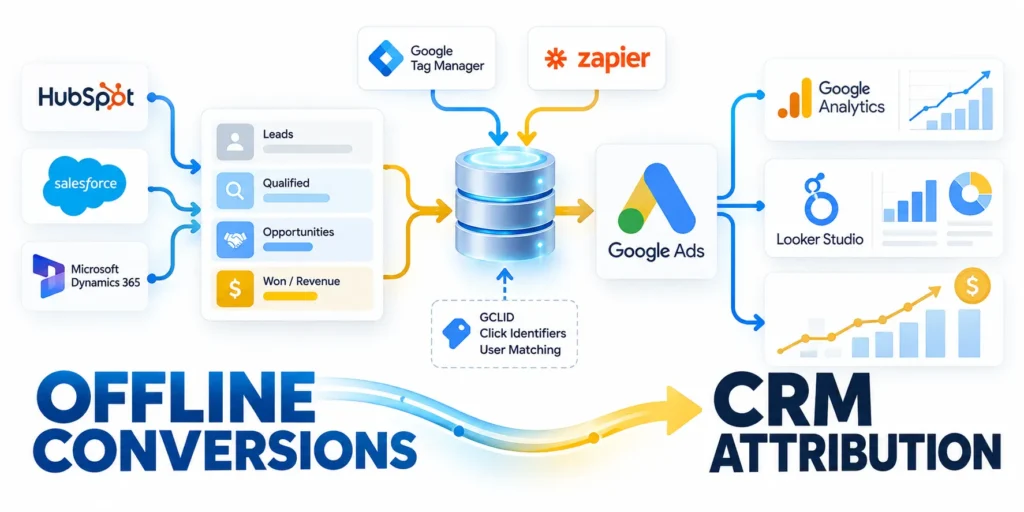
Use privacy-aware analytics and consistent campaign attribution to connect organic landing experiences with later CRM outcomes.
Preserve the original acquisition source when the CRM supports it. Separate first touch, latest touch, and influenced interactions rather than collapsing them into one label.
Connect reporting through these evidence layers:
- Search visibility and qualified landing visits.
- Meaningful page actions and known limitations.
- CRM acceptance and opportunity progression.
- Business decisions influenced by the evidence.
Avoid single-touch attribution claims

For a fictional SaaS company, a prospect may first arrive through an educational page, return through a branded search, and later contact sales directly.
That journey suggests several interactions may matter. It does not prove the first page caused the purchase.
Run experiments and interpret results cautiously
When possible, define a test before implementation. State the change, expected direction, observation period, and what evidence would alter the next decision.
Document seasonality, competitor activity, releases, and algorithm changes before interpreting an SEO test. If visibility declines, follow a core update recovery process to test likely causes.
Record conditions that affect comparisons
Prefer a bounded comparison or staged rollout when a change could affect many URLs.
If results are inconclusive, say so. Do not convert correlation into a confident causal claim.
Report decisions, not just charts
A useful report explains what changed, what remains uncertain, and which action follows.
For example, if qualified visits improve while sales acceptance does not, investigate lead fit, page expectations, and sales handoff before expanding the content program.
Turn findings into a next decision
If crawl coverage improves but impressions remain stable, check whether the newly accessible pages serve real demand and provide distinct value.
Keep the reporting cycle short enough to support decisions, but long enough to avoid reacting to ordinary fluctuation.
Run a monthly reporting review
Run monthly reporting through these decision questions:
- Compare query and landing-page trends for the agreed topic group against a consistent prior period.
- Separate search visibility from qualified sessions, conversions, and CRM outcomes.
- Review material site releases, tracking changes, seasonality, and known data gaps.
- Ask sales or customer success whether the content answered recurring buyer questions.
- Record one next action, one owner, and one uncertainty that needs better evidence.
Use the review to guide experiments and maintenance. Avoid producing pages when evidence points to weak usefulness, tracking problems, or a technical defect.
The review is complete when the team agrees what to do next and what result would cause it to reconsider that decision.
Conclusion

An enterprise B2B SEO strategy works best as an operating system for buyer discovery and decision support, not a list of keywords or a promise of rankings.
Start with one business question, map the people and tasks involved, and build a small, evidence-backed set of pages that help them move forward.
Take the next step with evidence
Coordinate content, engineering, product, sales, and analytics around clear owners and change controls.
Measure discovery and pipeline separately, report uncertainty honestly, and expand only when evidence supports the next investment.
Maintain an enterprise SEO decision log
Enterprise programs accumulate assumptions across content, engineering, analytics, legal, and sales. Record important decisions so later teams can distinguish evidence from inherited convention.
Preserve strategy history through these decision-log fields:
- Decision and responsible owner.
- Evidence and known limitations.
- Affected templates or content groups.
- Measurement window and review date.
- Rollback or revision trigger.
Record the evidence, uncertainty, decision, owner, implementation date, affected assets, review date, and condition that would justify reversal.
Apply release controls to high-impact changes
Navigation, rendering, canonical, robots, localization, and template changes can affect thousands of URLs. Treat them as releases with defined scope, tests, monitoring, and recovery.
Validate a representative URL set before broad deployment. Include indexable pages, filtered states, international variants, paginated collections, structured data, and important conversion paths.
Budget for maintenance capacity
Organic growth creates maintenance work. Pages need evidence updates, internal links change, products evolve, redirects accumulate, and measurement definitions require review.
Budget ongoing maintenance through these operating commitments:
- Prioritize business-critical page groups.
- Set evidence-based refresh triggers.
- Assign technical and editorial owners.
- Review performance with limitations stated.
- Archive superseded decisions and guidance.
Reserve capacity for monitoring, content updates, technical regressions, redirects, localized variants, measurement repair, and ownership changes after launch.
Extend the strategy to international markets
For a focused companion topic, read International SEO Strategy for Global SaaS Expansion.
Keep this pillar focused on the enterprise operating system; use the dedicated international guide for market, locale, URL, hreflang, and localization decisions.
FAQ
These answers clarify common enterprise SEO planning, architecture, operations, measurement, governance, and indexing questions.
What is enterprise B2B SEO?
Enterprise B2B SEO coordinates useful content, technical access, internal ownership, and measurement across a large organization’s website.
Its purpose is to help relevant buying groups discover and use information that supports real decisions, while avoiding promises of guaranteed rankings or revenue.
How is enterprise SEO different from small business SEO?
The core goals are similar, but large organizations often manage more products, regions, platforms, stakeholders, and legacy URLs.
That complexity makes governance, technical change management, and consistent measurement especially important.
How should an enterprise prioritize SEO work?
Prioritize work by buyer relevance, strategic fit, evidence, current page quality, delivery effort, and measurement readiness.
Record the scoring criteria and assumptions so the ranking informs discussion instead of pretending to forecast outcomes.
How many pages should an enterprise topic cluster include?
There is no required page count. Create only the pages needed to answer distinct audience questions and decisions.
A smaller, well-connected set is preferable to repetitive pages created to reach an arbitrary quota.
Do XML sitemaps guarantee indexing?
No. A sitemap helps search engines discover a set of URLs, but it does not guarantee crawling, indexing, or ranking.
Keep it limited to canonical, useful URLs and investigate access and page-quality issues separately.
Which SEO metrics should enterprise teams report?
Choose measures that answer the program’s business question. Common signals include impressions, clicks, qualified organic visits, useful next actions, and CRM outcomes.
Define terms consistently and explain the limitations of attribution and incomplete data.
How often should an enterprise SEO strategy be reviewed?
Use an operating cadence for regular decisions and event-based reviews for material product, policy, or technical changes.
Review critical guidance when its underlying facts change, not only when a calendar reminder arrives.
Should enterprise teams create separate pages for every keyword?
No. Group phrase variants when they represent the same task and can receive a coherent answer on one page.
Create separate pages only when intent, audience, or required evidence materially differs.
Can SEO be tied directly to sales revenue?
Organizations can connect organic interactions to CRM outcomes, subject to tracking, privacy, and attribution limits.
Such reporting can show contribution or association, but should not claim that SEO alone caused a sale.
What should a team do when an important page is not indexed?
Check the response status, public accessibility, robots directives, canonical signals, internal links, and the page’s distinct usefulness.
Use Search Console’s URL inspection and indexing reports to investigate. Fix the diagnosed issue, then allow time for recrawling.




Leave a Reply