


Decide Whether LinkedIn Ads Fits the Contract Economics

LinkedIn Ads for enterprise contracts can help sellers reach professionals by company and work-related attributes.
That access creates value only when the audience, offer, sales process, and contract economics fit.
Begin with the business case
An enterprise campaign should start with a commercial decision, not a format choice.
Define the customers the business can serve, the situations it can solve, and the pipeline needed to justify investment.
Start with the sale you can actually deliver
Write down the contract type, service area, implementation capacity, buying committee, and sales cycle.
If delivery cannot accept more qualified demand, media spend will not solve that constraint.
Check operational readiness
Ask whether the business can identify likely accounts, offer a useful next step, and follow up with relevant context promptly.
If any answer is no, fix it before expanding. A narrow test should answer a defined question, not disguise an unready sales process.
Check operational readiness through these commercial conditions:
- Account clarity: Can the team name the industries, company profiles, and buying situations that fit?
- Economic fit: Does expected contract value justify paid acquisition and sales effort?
- Proof: Can the offer demonstrate expertise through a concrete assessment, benchmark, workshop, or useful resource?
- Follow-up: Is one team responsible for responding, qualifying, and returning outcome data?
- Capacity: Can sales and delivery handle the opportunity volume the campaign might create?
Calculate a decision range, not a promised return
Build a simple model from the business’s historical data.
Do not borrow another advertiser’s click price or conversion rate as if it predicts this account’s results.
Set assumptions from the company’s data
Suppose a company wants to test a consulting offer using its own historical funnel data.
For example, assume a $60,000 first-year contract, a 55% gross margin, and an acquisition allowance of 12% of expected gross profit.
Calculate the illustrative customer ceiling
These are hypothetical inputs, not industry benchmarks.
The contract’s gross profit is $33,000. The illustrative acquisition ceiling is $3,960 per customer before retention, implementation costs, sales labor, and risk tolerance.
Work backward through the funnel
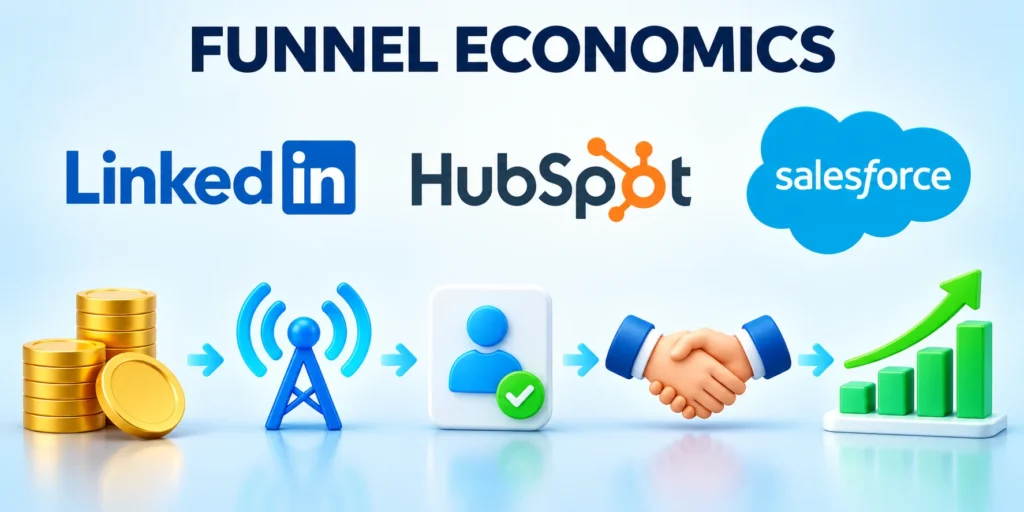
Work backward from customers to opportunities and leads.
If CRM data shows one in four qualified opportunities becomes a customer, the modeled ceiling per qualified opportunity is $990.
Translate the opportunity ceiling into lead economics
If one in five accepted leads becomes a qualified opportunity, the modeled ceiling per accepted lead is $198.
Recalculate the range when expected contract value, lead quality, or sales capacity changes materially.
Keep the estimate honest
This is a planning ceiling, not a cost LinkedIn guarantees.
Replace every example input with company data. Calculate conservative, expected, and optimistic scenarios separately.
Compare LinkedIn with the actual alternatives
LinkedIn is not automatically the best channel for every enterprise contract.
Search can capture active demand. LinkedIn can reach selected professionals before they search. Partners can lend trust, while outbound focuses human effort on named accounts.
Choose the channel that addresses the bottleneck
The trade-off is operational. Search may have limited volume in specialized categories, while LinkedIn may require patient education.
Outbound can be precise but consumes sales time. Partners can add credibility but require enablement and coordination.
Match the channel to the conversion problem
Use the channel that addresses the current bottleneck. Account targeting may help when the company needs more qualified accounts.
If traffic converts poorly, a new channel may send more people into a broken experience.
Connect channel choice to the wider demand plan
For a broader demand-generation sequence, connect paid reach with the company’s B2B demand generation system. This guide stays focused on enterprise LinkedIn campaigns.
Use channel comparisons to expose role differences instead of forcing every channel into identical performance expectations.
Give each channel a distinct job
LinkedIn can introduce ideas to professional audiences. Search can respond to active queries, while sales adds account-specific context.
Give each channel a clear measurement role.
Compare channels by buying stage
For high-intent search, compare this role with the B2B Google Ads pipeline playbook.
The channels can support different buying stages; compare qualified account progression and sales effort, not clicks alone.
Anchor the funnel estimate
Start with opportunity value, realistic close rates, and the amount of sales work required after a response.
Update the estimate when pricing, delivery capacity, lead quality, or sales-cycle evidence changes.
Set the economic baseline
Set opportunity value before estimating acceptable acquisition cost.
Recalculate assumptions when conversion evidence or delivery capacity changes.
Use these inputs to test funnel economics:
- Expected contract value and gross margin.
- Qualified-opportunity and close rates.
- Sales effort and delivery capacity.
Map the Buying Committee and Prioritize Accounts

High-value contracts rarely involve one profile. The person who feels the problem may not control budget, security approval, vendor selection, or implementation.
Map the buying group before building the audience. A job title alone does not describe authority, need, timing, or influence.
Create a buying-group map
For each customer situation, record the roles involved and the question each role needs answered. Use interviews, sales-call notes, lost-deal reviews, support patterns, and existing customer research.
| Buying role | Typical concern | Useful campaign evidence |
|---|---|---|
| Business sponsor | Revenue, risk, speed, or strategic fit | Business case, operating model, or outcomes |
| Daily user or team lead | Workflow, adoption, and workload | Demo, process map, or implementation example |
| Technical evaluator | Architecture, integration, security, and support | Technical brief, architecture, or review session |
| Finance or procurement | Cost, terms, risk, and vendor process | Scope, decision checklist, and procurement steps |
| Executive approver | Strategic priority and accountable ownership | Recommendation, risk summary, and milestones |
This table is a planning aid, not a claim that every deal uses the same committee.
Smaller contracts may involve fewer people; regulated or complex purchases may involve additional reviewers.
Tailor messages to real role differences
Give each role a distinct message only when its concern is genuinely different. Do not create five campaigns just because the map contains five rows.
Document each role’s questions and objections before assigning creative themes or conversion paths.
Validate committee evidence
Use recent opportunities to confirm which roles shaped evaluation, security review, procurement, implementation, and final approval.
Treat missing-role assumptions as hypotheses until sales evidence confirms their influence on the decision.
Map influence across the committee
Identify economic, technical, operational, and user stakeholders.
Record each role’s questions, authority, and evidence needs.
Check committee evidence through these source records:
- CRM contact roles and opportunity notes.
- Sales interviews and procurement documentation.
- Implementation plans and customer success handoffs.
Build an account definition sales can use
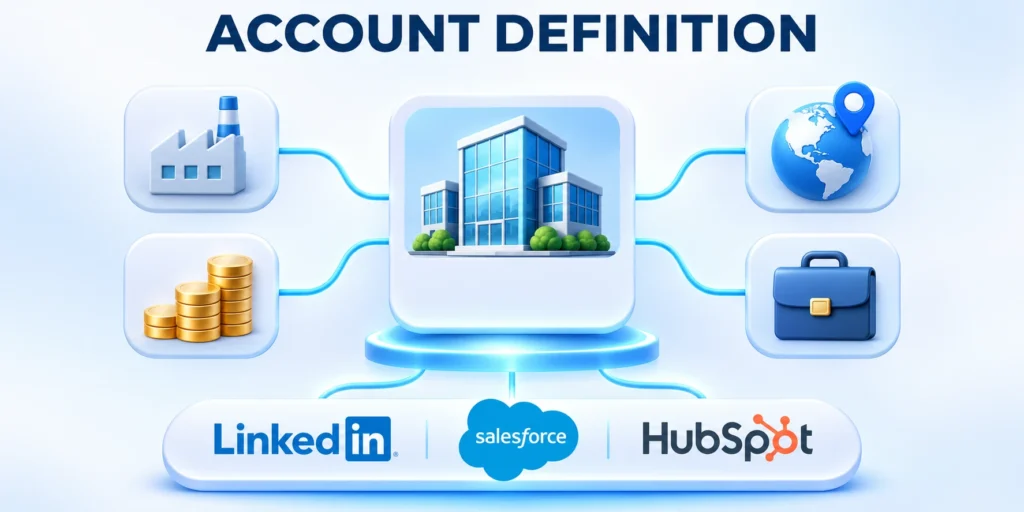
Translate customer knowledge into observable account criteria.
Include firmographic fit, operating context, problem evidence, geography, exclusions, and a timely reason for sales to care.
Validate the account definition with sales
For example, a fictional integration consultancy might prioritize companies with multiple systems, an active migration, a named platform team, and implementation capacity. “Large company” alone is not enough.
Ask sales to review sample accounts. Label each fit, possible fit, or poor fit. Compare reasons and refine the definition if teams disagree.
Keep the initial account list actionable
Keep the first account list manageable. Exclude former customers for net-new offers, active opportunities owned by sales, and organizations outside delivery limits.
Remove accounts that lack verified fit, reachable roles, or realistic sales ownership during the test.
Set account tiers and owners
Tiering helps coordinate spend and sales effort. It does not mean every account in a tier deserves the same message or the same budget.
Assign account tiers through these ownership rules:
- Tier A: Named accounts with strong fit and a specific reason for coordinated one-to-one outreach.
- Tier B: Accounts matching priority characteristics that can receive a shared segment-level message.
- Use Tier C for broader learning and test whether the market definition is too narrow.
For each tier, assign an account owner, audience source, offer, follow-up expectation, and progress measure. Record exceptions so lists do not drift without ownership.
Coordinate campaigns with active sales conversations
When sales already has active conversations, coordinate campaign timing.
Ads should reinforce useful discussions or educate other committee members, not create confusing parallel outreach.
Resolve disputed fit criteria
Sales should reject definitions that cannot be applied consistently during account selection, routing, and weekly review.
Record disputed criteria separately so the pilot can test them without obscuring the agreed baseline.
Test disputed fit criteria
Compare each disputed criterion against recent qualified opportunities.
Assign an owner to approve temporary exceptions and document their limits.
Design Campaign Architecture Around the Buying Journey
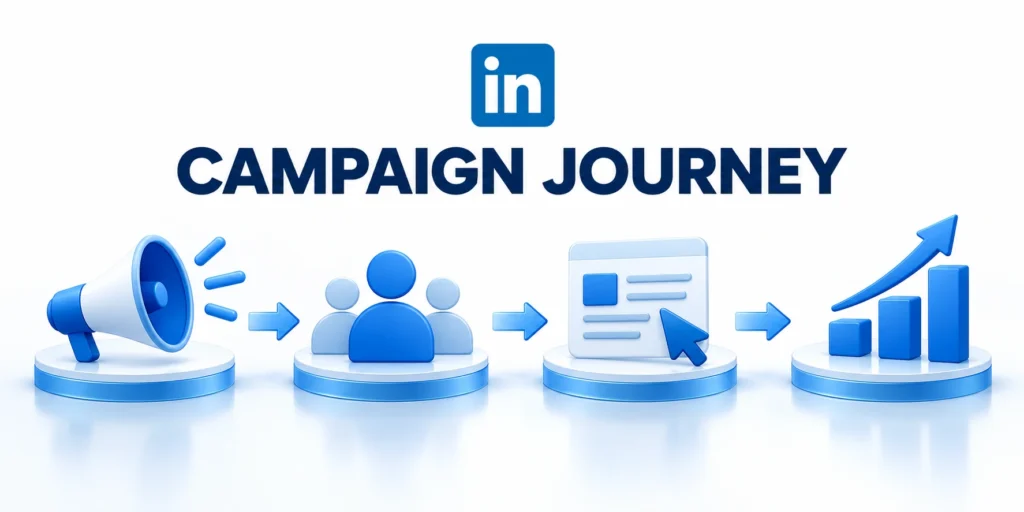
Campaign structure should make decisions understandable. A simple architecture connects an objective, account segment, role, offer, creative, destination, and CRM outcome.
Use the hierarchy shown in the active Campaign Manager account. Settings can vary; LinkedIn’s setup guidance covers objectives, audiences, formats, budgets, schedules, and measurement.
Separate campaigns only when the decision changes
Separate campaigns when audience, objective, offer, destination, budget owner, or reporting needs differ materially.
Otherwise, combine comparable activity to gather enough delivery for learning.
Illustrate the split with distinct decisions
An enterprise software firm might separate an architecture workshop from an executive cost guide.
The audiences overlap, but the decision, destination, and success signal differ.
Avoid campaign fragmentation
Do not divide a small audience into near-identical campaigns for appearance. Fragmentation can obscure results and reduce delivery in each segment.
Consolidate segments when separate budgets cannot generate enough observations to support a reliable decision.
Use a naming convention the team can scan
Use a naming pattern colleagues can scan. Encode region, account tier, role, objective, offer, and launch period without personal data.
For example, a campaign name can record region, account tier, audience role, objective, offer, and launch period. This is an internal convention, not a platform requirement.
Match funnel stage to a real next step
An enterprise buyer may move from problem recognition to exploring approaches, evaluating vendors, procurement, and implementation planning.
The journey is not always linear, and several roles may enter at different points.
Preserve comparable learning
Use budget isolation only when separate learning justifies slower data accumulation and additional operational work.
Keep naming, conversion definitions, review windows, and ownership consistent enough to compare campaign decisions.
Separate campaigns only when justified
Split audiences only when message, offer, or ownership changes.
Preserve comparable naming, budgets, and conversion definitions across every campaign.
Separate campaigns for these material operating differences:
- Buyer readiness changes the offer or conversion path.
- Ownership requires independent budgets or review cycles.
- Audience evidence demands distinct messaging and measurement.
Match the next step to buyer readiness

Choose an action that fits the buyer’s readiness.
A cold audience may prefer a useful framework or live technical session over an immediate sales meeting.
| Buyer situation | Suitable next step | What the team should learn |
|---|---|---|
| Problem is not yet defined | Practical diagnostic or benchmark | Which problem language resonates |
| Solution approaches are being explored | Comparison guide or expert session | Which criteria shape evaluation |
| Vendor options are under review | Architecture review or scoped consultation | Fit, constraints, and buying-group concerns |
| Purchase is being planned | Implementation workshop or discovery call | Timing, decision process, and delivery readiness |
Avoid a long nurture sequence before confirming interest. Start with a useful asset and a clear follow-up path; add stages when behavior and sales feedback justify them.
Define what counts as progress
Record one primary campaign outcome and a few diagnostic measures.
For example, the primary outcome could be a sales-accepted opportunity. Diagnostics might include form completion, meeting attendance, and account engagement.
Distinguish platform activity from business outcomes
Separate a platform conversion from a business result. A form submission is a recorded action.
It becomes meaningful pipeline only after the organization validates fit, context, ownership, and opportunity status.
Record the business definition
Write this distinction into the campaign brief. It prevents dashboards from treating every contact as a qualified enterprise opportunity.
Before launch, make the brief usable by marketing, sales, and delivery:
Document campaign decisions through these shared definitions:
- Audience and stage: Which account profile, buying roles, and decision point does this campaign address?
- Offer and proof: What will the buyer receive, and what evidence supports the promise?
- Handoff: Who owns the response, what happens next, and which CRM outcome will be recorded?
Review the brief with the people who must deliver the offer and follow up. If the promise exceeds available proof or capacity, revise it before spend begins.
Build a Relevant Audience Without Overfiltering

LinkedIn offers professional and company audience attributes, matched audiences, and automated targeting.
Controls and eligibility can change; confirm current account options before implementation.
Treat targeting as a testable buyer hypothesis
Targeting should express a buyer hypothesis.
Do not stack filters until the audience merely appears precise.
Start with geography and company fit
Set locations where the business can sell and deliver. Choose a country, region, or smaller area, and align language with the creative and landing page.
Choose company criteria that reflect account fit. Depending on current controls, use company lists, industry, size, or other company attributes.
Check whether the criteria represent real fit
Do not treat industry as a substitute for customer research.
Companies in one industry can differ in operating model, buying triggers, technology, and readiness.
Add roles as buying-group hypotheses
Use functions, seniority, titles, skills, and available attributes to represent the roles in the buying map.
LinkedIn’s guidance warns against limiting targeting to a few titles; combine relevant role dimensions when appropriate.
Refine the audience without losing relevance
For security architecture, test technical and security leaders against account criteria. Give business sponsors a separate message when their concern differs.
Check the estimated audience in Campaign Manager. If it is too small, remove the least essential filter and reassess relevance.
Apply exclusions only when they fit the objective
Use exclusions deliberately. Exclude customers, employees, job seekers, or active opportunities only when the objective and account data support it.
Review exclusions after changes to territories, customer status, hiring plans, or active sales ownership.
Use first-party audiences carefully
Matched audiences can support account lists, contact programs, or website engagement, subject to current feature requirements and data permissions.
Confirm consent, source, retention, and activation rights before uploading any customer or prospect data.
Check the source and permitted use
Before uploading a list, verify its source, business purpose, field mapping, suppression, access, retention, and consent.
Hashing or platform matching does not make an improperly collected list appropriate.
Separate customer and prospect programs
Existing customers may need training, adoption, or cross-sell information. Prospects need evidence about the original problem and vendor fit.
Define exclusion windows so customers do not receive acquisition offers that conflict with active relationships.
Set a clear retargeting boundary
Treat retargeting as a reminder, not permission to follow people indefinitely.
Define audience duration, exclusions, frequency review, and a clear reason for each message.
Compare manual and automated audience approaches
Manual audience construction offers explicit control and makes the hypothesis easier to explain.
It can require more maintenance and become too narrow when filters are excessive.
Compare automated options against the same objective
Automated audience options may combine platform signals with advertiser inputs and reduce setup effort.
Still review locations, exclusions, conversion definitions, and alignment with the account strategy.
Avoid premature conclusions
When delivery allows, compare approaches using the same offer and business outcome.
Do not declare a winner from a few clicks or a short period without sufficient evidence.
Protect audience quality
Verify company fit before adding role-level precision.
Remove criteria that shrink reach without improving relevance.
Apply these checks before narrowing the audience:
- Confirm company fit before adding role filters.
- Remove criteria that reduce reach without improving relevance.
- Preserve enough eligible accounts for meaningful evaluation.
Match Offers, Formats, and Creative to Enterprise Decisions

Enterprise creative must earn attention with relevant evidence.
Polish cannot rescue a generic claim, unclear offer, or landing page that avoids the buyer’s question.
Make the offer specific to the buyer’s situation
State who the resource helps, what decision it supports, what the buyer receives, and what happens after responding.
Connect each promise to a concrete deliverable, qualification rule, and responsible follow-up owner.
Choose an offer that creates useful progress
Possible offers include a technical review, maturity assessment, executive briefing, checklist, benchmark, workshop, or focused guide.
Use an offer only when the company can deliver it well.
Define the scope and deliverable
For complex integration, an architecture review may outperform a generic consultation.
It can identify systems, data boundaries, failure handling, security constraints, ownership, and next decisions.
Set expectations for the deliverable
Say whether the offer is self-guided, live, preliminary, or a sales conversation.
Do not imply a completed audit when the form only requests contact information.
Select the format based on the experience
Sponsored content can introduce an idea in the feed. Pair LinkedIn Document Ads and Lead Gen Forms when a useful resource justifies a short request form.
A website can explain proof and qualification. Events support live education when the event itself adds value.
Match format to the buyer’s information need
Choose a format based on the action and information buyers need.
Do not assume the lowest-friction form produces useful opportunities; use this decision rule for the next step:
Choose conversion formats through these experience checks:
- If the offer needs detailed context, send people to a dedicated landing page.
- With a clear offer and simple qualification, compare lead forms against the website path.
- If expertise is best demonstrated live, test an event or expert session.
- For cold audiences, offer a meaningful learning step before requesting a lengthy sales meeting.
Review the current platform’s available formats and objective compatibility in the account. Availability can vary by account configuration and changes over time.
Write copy that answers buyer questions
Use one audience, problem, promise, and action per ad.
Avoid listing every feature or addressing the whole buying committee in one short message.
Write a claim the business can support

Example for a fictional consultancy: “Planning a CRM and finance-system migration? Join a 30-minute architecture session to map data ownership, failure handling, and cutover decisions.”
That copy names a situation and useful outcome. It does not promise savings or invent customer results.
Adapt the message to distinct buying concerns
Create distinct messages for materially different concerns. Technical evaluators may want system diagrams, while finance teams may prefer implementation-risk frameworks.
Keep the offer and qualification clear.
Record the creative brief before production
Use a creative brief before production. Keep fields short enough for marketing, sales, and subject-matter experts to review together:
Brief creative production through these decision fields:
- Audience: Which account profile and buying role should recognize themselves?
- Trigger: What business event or unresolved decision makes the offer timely?
- Claim: What can the company substantiate, and what should the ad avoid promising?
- Evidence: Which concrete example, process, or deliverable makes the claim credible?
- Action: What will the person receive or do after clicking?
- Qualification: Which fit signals matter, and which questions would create unnecessary friction?
For example, a cloud consultancy could offer IT leaders at companies consolidating identity systems a structured review of integration risks.
Support the claim with a sample agenda and deliverables.
Keep claims within the available evidence
The ad should not promise universal risk elimination or a specific cost reduction without evidence from a real customer and context.
Record the source, scope, date, and limitations of every performance or customer claim.
Make the landing experience complete
The landing page should restate the offer and answer questions introduced by the ad.
Include audience fit, deliverables, timing, prerequisites, privacy information, and the next step.
Test the conversion path end to end
Test the form on a phone and check confirmation behavior and CRM campaign context.
Tell visitors whether they will receive a resource, a call, or event confirmation.
Make qualification and pricing clear
Avoid hiding price or qualification details that materially affect fit. Clear expectations improve sales conversations.
Explain material eligibility, commercial, and scheduling constraints before asking the buyer to respond.
Set Budget and Test Campaigns With Business Guardrails

Budget should reflect an explicit learning or pipeline decision. A daily limit is not a strategy, and platform suggestions are not a forecast of profitable contracts.
Campaign Manager exposes budget, schedule, and bidding settings that can vary with campaign structure. Verify the current interface and use the account’s estimate as a planning input, not a guarantee.
Choose the test question first
Write a short hypothesis before launch. For example: “A technical architecture workshop will produce more sales-accepted opportunities from Tier B accounts than a general consultation offer.”
Specify the segment, offer, creative, destination, primary outcome, minimum review window, and stopping condition. Change one major variable at a time when practical.
Keep the experiment interpretable
If the team changes audience, offer, creative, landing page, and qualification simultaneously, the result will not explain which change mattered.
Preserve one stable comparison so the review can connect observed differences to a meaningful decision.
Set a spend limit from the learning budget
Use cash-flow limits, historical funnel conversion, and the time needed to observe outcomes.
Set a learning amount the business can afford to lose; do not present arbitrary daily spend as a forecast.
Allocate a controlled test budget
Suppose the company approves $4,000 for a six-week test across two comparable segments.
Reserve enough budget for the evidence window without implying that spend guarantees a result.
Release the budget as evidence accumulates
Reserve some for initial delivery and document what would justify later changes.
This is a scenario, not a benchmark. Allocation depends on pricing, audience size, competition, delivery, sales cycle, and financial controls.
Keep the test interpretable
Avoid dividing a modest budget across too many campaigns.
Consolidate comparable audiences when extra splits would make results hard to interpret.
Establish a learning and stop-loss rule
Define triggers to review, pause, or continue.
Examples include invalid tracking, ineligible delivery, poor-quality leads, broken handoff, or spend hitting its limit without a useful signal.
Control the learning budget
Define the decision question and evidence window before spending begins.
Stop or adjust when the agreed decision thresholds are reached.
Use these guardrails to control campaign learning:
- Define the decision question before approving spend.
- Set an evidence window and accountable owner.
- Stop or adjust when thresholds are reached.
Follow the planned review rule

Do not pause because a small sample looks weak or continue because click-through rate looks attractive.
Use the review window and business outcome agreed before launch.
Separate early signals from final outcomes
For long sales cycles, distinguish early indicators from final results.
Treat account engagement as one input when using intent data in LinkedIn Ads. Check CRM outcomes before attributing a contract to the campaign.
Test alternatives without declaring a premature winner
Useful test dimensions include account tier, offer, message, format, destination, or audience approach. Prioritize tests that can change a business decision.
Compare alternatives through these controlled test options:
- Offer test: Technical workshop versus implementation checklist.
- Message test: Risk reduction versus time-to-value, where both claims are supportable.
- Audience test: Defined job functions and seniority versus a carefully configured automated audience.
- Destination test: Lead form versus a detailed landing page.
Keep the test record with its dates, spend, audience, creative, lead qualification, and CRM outcome. Preserve a control when the team needs a meaningful comparison.
If volume is too low to distinguish results, report that uncertainty. A low-volume test can inform qualitative learning, but it should not be described as a statistically proven winner.
Keep the experiment record reusable
Save the audience, exclusions, creative, landing page, objective, budget approval, launch date, and CRM outcome definitions with the campaign.
This record makes the experiment repeatable without relying on one operator’s memory.
Close out what the test established
After a test, record what is known and what remains uncertain.
Registrations from target accounts do not prove that qualified opportunities resulted.
Reuse checks only when dependencies are unchanged
Reuse valid checks when nothing relevant changed.
Recheck dependencies affected by a new form, page, audience, event definition, or consent setting.
Keep conclusions scoped to the test
Avoid turning a small dataset into a universal audience rule.
A result from one region, offer, and quarter does not describe every enterprise buyer.
Connect Tracking, CRM, and Revenue Outcomes

The campaign becomes operationally useful when its signals continue through qualification and sales. Platform reporting alone rarely describes the complete enterprise buying journey.
Choose a source of truth for each event. The ad platform can report its view; the website can report form behavior; the CRM can record qualification, opportunity, and customer status.
Define events before installing tracking
Write each event as a business definition, not merely a tag name.
For example, define “qualified consultation” by account fit, problem, role, and follow-up acceptance.
Separate outcomes from diagnostics
A page view, form start, completed lead form, meeting, accepted opportunity, and won contract are different events.
Document the owner, trigger, source of truth, deduplication rule, and downstream use. Collect only data the business needs and may process.
Implement the Insight Tag or another supported signal
LinkedIn’s conversion-tracking documentation describes its website tag and other supported ways to share conversion data.
Confirm the current setup method and diagnostics in Campaign Manager before deploying.
Deploy and test one signal path
With Google Tag Manager, assign an owner, use change review and clear names, and test in preview before publishing.
Do not install a duplicate tag through a plugin or theme when the tag manager controls it.
Test form behavior and document rollback
Test the signal path in this order:
Validate form behavior through this launch sequence:
- Submit valid and invalid forms, cancel, refresh, and check duplicate handling.
- Test mobile behavior and declined consent.
- Confirm the event fires only for its defined action.
- Record tag location, triggers, consent, event identifier, test date, owner, and rollback step.
- Remove unnecessary personal or sensitive data from URLs, data layers, and event parameters.
Submit test records through every active form variant before launch and after material configuration changes.
Verify validation, consent, routing, notifications, and confirmation behavior without using real customer data.
Preserve campaign context in the CRM
Map campaign, ad, audience, offer, form, consent, and source into fields for sales and marketing.
Keep field definitions consistent across forms and integrations.
Define ownership and feedback stages
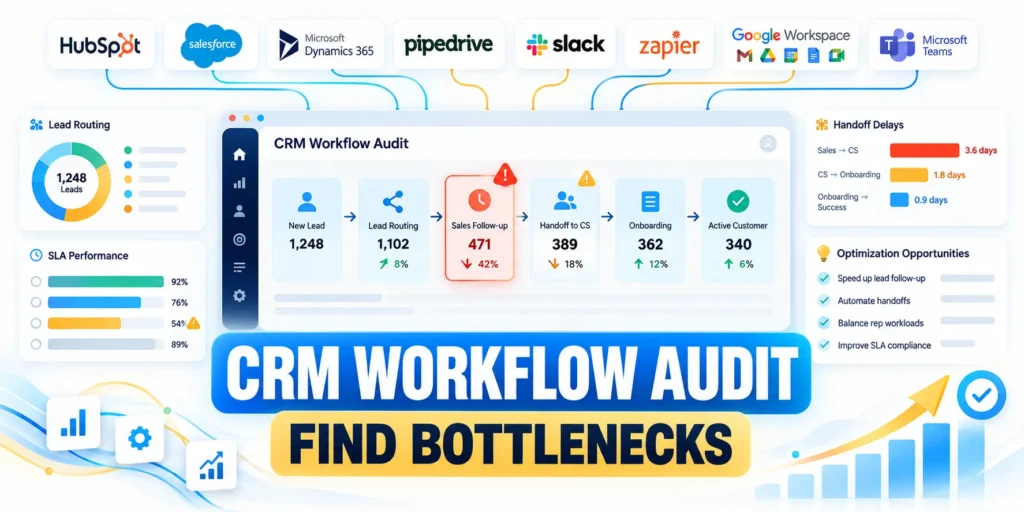
Assign an owner and response expectation. Unowned contacts may go untouched despite a valid buying signal.
Create stages such as new, contacted, accepted, disqualified, meeting held, opportunity created, and closed.
Keep disqualification reasons useful

Keep disqualification reasons useful for improving targeting and offers.
Structured disqualification data separates audience problems from offer, routing, or sales-capacity problems.
Test the CRM handoff
For an existing CRM, test a small record path first.
Verify deduplication, routing, notification, field mapping, and suppression before increasing volume.
Trace one test record from form to owner
Use a controlled test record and follow its path across systems:
Trace CRM handoffs through this verification sequence:
- Submit a clearly labeled test through the same form path as a prospect.
- Confirm the CRM records the campaign, offer, consent state, account context, and submission time correctly.
- Verify the expected owner receives the record and sees all information needed for follow-up.
- Test duplicate handling and the agreed accept, reject, or disqualify outcomes.
- Remove or clearly retain the test record according to the organization’s data-handling rules.
For example, a workshop record without an account name may be hard for sales to connect to a target company.
Add a question only when the information is necessary and its friction is acceptable. Document the decision and retest the handoff.
Reconcile reports without pretending attribution is perfect
Compare platform conversions with website records and CRM outcomes.
Differences may reflect attribution windows, consent, devices, duplicates, delayed qualification, or system rules.
Diagnose discrepancies before changing reports
Investigate the cause before “fixing” the number. Check whether a thank-you page loads without a successful form, events are counted twice, or imports arrive late.
Document expected platform, analytics, and CRM differences before labeling a report inaccurate.
Compare cohorts at similar maturity
A lead submitted yesterday cannot be judged against a cohort that has completed months of qualification and sales follow-up.
Use consistent date windows, account definitions, and outcome stages. Show missing or delayed records instead of silently treating them as failures.
Preserve the evidence level
Use multiple views to support a decision, not to manufacture one exact answer.
Distinguish observed events, modeled platform reporting, and CRM-confirmed revenue.
Extend the shared definitions into RevOps
The RevOps alignment playbook provides a companion framework for shared definitions and handoffs.
Reuse the same lifecycle definitions in campaign reviews, forecasts, pipeline meetings, and customer handoffs.
Assign ownership for reporting and follow-through
Keep campaign ownership explicit. Ad, marketing operations, and sales owners should know who updates each field and fixes broken handoffs.
Name who investigates missing records, resolves field conflicts, and communicates reporting limitations.
Optimize, Scale, and Govern the Program

Optimization should follow evidence through the buying group. Improving the cheapest click is not useful if the resulting accounts never qualify or sales cannot act on them.
Review campaign health on an agreed cadence. Match the cadence to delivery and the sales cycle; frequent changes can reset learning or make the program difficult to interpret.
Use a layered review
Review the program in this order:
Review campaign performance through these evidence layers:
- Delivery and integrity: Verify activation, audience eligibility, destination, routing, and tracking definitions.
- Audience relevance: Confirm engaged companies and roles, sales recognition, and accurate exclusions.
- Offer and experience: Review promise, landing page, form friction, qualification, follow-up, and confirmation.
- CRM progression: Compare similarly mature cohorts by accepted leads, meetings, opportunities, disqualifications, and account movement.
Begin with delivery and data integrity before interpreting creative or audience performance.
Then review buyer progression, sales response, pipeline quality, and operational constraints together.
Decide what to change
If relevant accounts are not seeing the campaign, review audience size, delivery settings, budget, creative eligibility, and geography. Relax the least essential restriction before broadening everything.
If clicks occur but the intended destination does not convert, inspect message continuity, page speed, mobile usability, proof, form length, and the clarity of the next step.
Diagnose lead quality and attribution issues
If forms complete but sales rejects most records, review audience fit, promise, qualification, routing, and acceptance criteria. More fields may not fix a sales-process issue.
If opportunities progress but reported platform conversions remain low, investigate event coverage and attribution before changing bids or replacing the offer.
Record the diagnosis and next experiment
Record the diagnosis, planned intervention, expected effect, owner, and review date. This change log prevents repeated experiments and helps new operators understand the account.
Preserve rejected explanations and unresolved uncertainty so later reviews do not repeat weak assumptions.
Scale with account and delivery limits in mind

Increase investment only when delivery can support more volume and opportunities remain relevant. Expand one dimension at a time: account tier, validated role, or geography.
Expansion should follow verified account fit, stable routing, sales capacity, and consistent evidence collection.
Protect sales capacity while expanding
Keep sales capacity visible. If response time degrades, either improve ownership or reduce demand until follow-up is reliable. More leads are not a success when the organization cannot respond.
Use account expansion carefully. A new segment should have a reason to fit, a message appropriate to its decision, and an owner prepared to review outcomes.
Run a practical launch checklist
Before launch, complete the following sequence and save the brief in the campaign record:
Launch campaigns through these operational checks:
- Confirm the offer, contract economics, target account definition, and delivery capacity.
- Ask sales to review sample accounts, roles, exclusions, and the handoff process.
- Select available campaign objectives, audience, format, destination, budget, schedule, and bidding approach.
- Review ad claims, offer scope, landing-page continuity, mobile behavior, privacy language, and confirmation.
- Test tracking, CRM field mapping, routing, deduplication, and consent behavior with realistic scenarios.
- Set the review date, learning question, spend limit, decision owner, and pause criteria.
- Launch with the approved scope and log any material change before making it.
After launch, check delivery and technical behavior, then allow a suitable observation window. Avoid presenting early activity as a final enterprise revenue result.
Define the Contract Economics Before Media Planning
Model contract value, margin, win rate, sales capacity, conversion delay, procurement effort, delivery constraints, and acceptable acquisition cost before setting campaign targets.
Use ranges and decision thresholds because enterprise outcomes are sparse; a precise forecast built on weak assumptions can hide more uncertainty than it resolves.
Map Account Eligibility and Exclusions
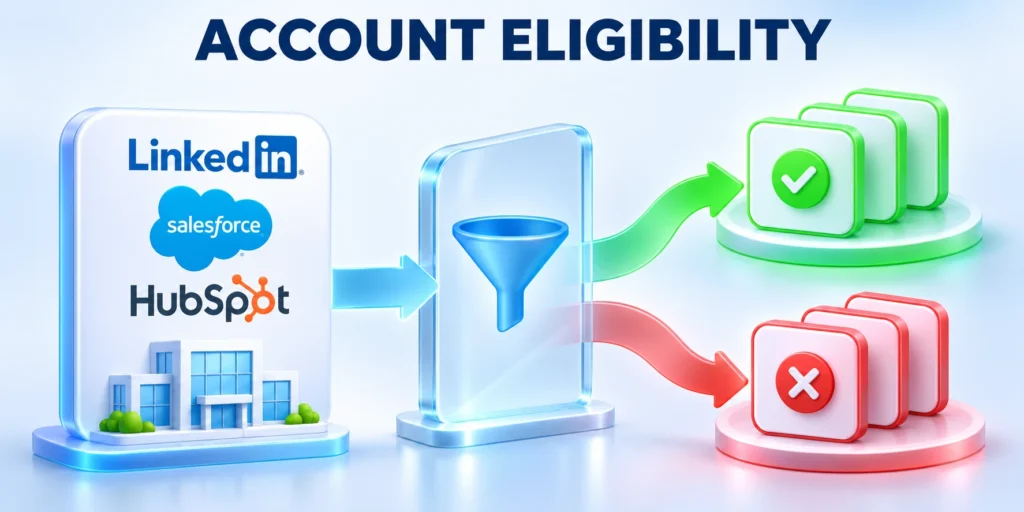
Define supported industries, regions, company attributes, use cases, contract requirements, existing relationships, customer status, open opportunities, competitors, and compliance restrictions.
Reconcile the account list with sales ownership and CRM data before activation so advertising does not conflict with active negotiations or unsuitable markets.
Represent the Buying Group Without Inventing Precision
Identify economic buyers, technical evaluators, operators, security, procurement, legal, finance, and executive sponsors according to the real decision process.
Use role hypotheses for targeting and messaging, then revise them with campaign, CRM, and sales evidence instead of assuming every account shares one committee.
Coordinate Account and Member Targeting
Treat company lists as an account-selection layer and professional attributes as a member-selection layer, each with distinct coverage, match, freshness, and privacy limitations.
Document every filter and exclusion, review the estimated audience after each change, and avoid combinations too narrow to deliver credible learning.
Build Message Continuity Across the Journey
Connect the advertisement, landing experience, form, confirmation, sales response, offer, and evidence around one audience problem and next decision.
A high-value contract rarely follows one click, so preserve campaign context while allowing later educational, technical, commercial, and procurement interactions to develop.
Design Offers for Enterprise Evaluation
Use benchmarks, implementation guides, assessments, technical workshops, business cases, migration reviews, and demonstrations only when each offer supports a genuine evaluation job.
State scope and commitment clearly; avoid presenting a sales conversation as an independent diagnostic or promising outcomes the delivery team cannot substantiate.
Set a Learning Budget and Stop Conditions
Allocate enough budget and time to test a defined audience, offer, message, and conversion path while respecting approved financial and operational limits.
Set conditions for pausing after poor match, unusable leads, tracking failure, capacity constraints, unsupported claims, or insufficient evidence to justify continued spend.
Define account eligibility
Confirm service fit, geography, contract potential, and ownership.
Exclude customers, conflicts, and unsupported delivery conditions.
Confirm account eligibility through these shared checks:
- Verify service fit, geography, and contract potential.
- Assign account ownership before campaign activation.
- Exclude customers, conflicts, and unsupported delivery conditions.
Validate Lead Capture and CRM Routing

Test fields, consent, campaign identifiers, account matching, duplicates, owners, territories, lifecycle stages, notifications, response timing, and failure handling with representative submissions.
The campaign cannot be evaluated reliably when sales receives incomplete records, loses source context, or handles the same account through conflicting workflows.
Measure Account Progression and Sales Effort
Track qualified engagement, accepted conversations, buying-group coverage, opportunities, stage movement, disqualification, cycle time, sales effort, pipeline, wins, and retained value.
Interpret indicators together; increased engagement may create no business value when it reaches the wrong accounts or consumes disproportionate sales capacity.
Use Controlled Comparisons Where Practical
Compare account cohorts, offers, messages, or activation rules with stable definitions and sufficient observation time while recording important market and sales changes.
When a clean experiment is impossible, present directional evidence with its limits rather than claiming that advertising caused every later enterprise outcome.
Govern Creative and Claim Maintenance
Assign owners to review proof, statistics, customer references, product capability, legal language, brand assets, accessibility, destination links, and regional suitability on a schedule.
Archive the active creative and approval context so teams can explain what an account actually saw when a later opportunity or complaint is reviewed.
Plan Expansion and Exit Before Scaling
Define how a validated campaign expands across accounts, regions, roles, offers, formats, budgets, and sales teams without changing every variable simultaneously.
Also document how audiences, leads, data, creative, tracking, and ownership will be handled when a campaign ends or the strategy changes.
Repeat routing verification
Repeat the trace after every form, CRM, consent, assignment, or notification change that could alter record handling.
Keep test records clearly labeled so sales reports and automation do not treat them as real demand.
Trace lead handling end to end
Trace test records from submission through CRM ownership.
Confirm consent, notifications, fields, and follow-up timing.
Trace lead handling through these operational checks:
- Submit clearly labeled test records.
- Verify consent, fields, and CRM ownership.
- Confirm notifications and follow-up timing.
Conclusion

LinkedIn Ads can support high-value enterprise contracts when targeting reflects evidence, messaging addresses real buying concerns, and measurement connects to sales outcomes.
The next step is to scale only while account quality, sales follow-up, and measurement remain reliable.
Move from fit to controlled growth
Move toward controlled growth through these priorities:
- Check contract economics and map the buying group.
- Choose a useful offer and an understandable campaign structure.
- Treat platform attributes as hypotheses; confirm relevance and progression in the CRM.
- Scale only when follow-up, delivery capacity, and evidence support expansion.
For a focused companion topic, read Google Ads vs LinkedIn Ads for Enterprise SaaS Lead Generation.
Maintain the smallest repeatable operating system that still supports responsible learning and timely decisions.
Protect the commercial decision
Keep the program tied to contracts the company can deliver, support, and evaluate with evidence.
When assumptions change, revisit account fit, buying roles, conversion definitions, and sales capacity before increasing spend.
Protect the decision through these recurring checks:
- Confirm the offer still matches buyer readiness.
- Verify sales can process the expected response.
- Recalculate economics with current conversion evidence.
Keep the operating record current
Campaign records should explain what changed, why it changed, and which evidence justified the decision.
A reusable record prevents later reviewers from treating partial platform data as a complete commercial conclusion.
Maintain the record through these evidence fields:
- Audience, exclusions, offer, and creative version.
- Budget, timing, ownership, and stop conditions.
- CRM outcomes, limitations, and next review trigger.
Expand only after evidence
Scale the program when qualified account progression improves without overwhelming sales or weakening delivery quality.
If evidence remains mixed, preserve the bounded test and resolve the most important uncertainty before expanding.
Apply evidence gates before expansion
Confirm account quality and consistent sales follow-through.
Verify measurement and delivery remain reliable before expanding campaign scope.
FAQ
These answers address common planning, targeting, measurement, and governance questions for enterprise LinkedIn advertising programs.
Are LinkedIn Ads a good fit for every enterprise contract?
No. They fit best when professional or company attributes help identify relevant buyers and the economics support a considered sales process. Compare other channels and delivery constraints first.
Should I target only exact job titles?
Usually not. Use titles as one signal alongside function, seniority, company context, and the buying-group map. LinkedIn’s current guidance warns against restricting a campaign to only a few titles.
Should every buying role get a separate campaign?
Only when the audience, message, offer, objective, or reporting decision differs enough to justify separation. Otherwise, keep the structure simpler and preserve enough delivery to learn.
Are LinkedIn lead-form submissions qualified opportunities?
No. A submission is an action. Qualification requires business rules, account fit, human or system review, and a record of how sales accepted the opportunity.
Should I use a lead form or a landing page?
Use a lead form when the offer is clear and capture should be simple. Choose a landing page when buyers need context or evidence. Test both when volume allows.
How should I decide the campaign budget?
Set it from approved learning spend, company funnel data, sales capacity, and the time needed to observe meaningful outcomes. Treat platform estimates as planning inputs, not guaranteed results.
How long should an enterprise LinkedIn test run?
There is no universal duration. The test needs enough relevant delivery and time for the offer, follow-up, and sales cycle to produce interpretable evidence. Define the review window before launch.
What should I measure beyond clicks?
Track valid conversions, sales acceptance, meetings held, opportunities created, pipeline progression, and contract outcomes. Keep clicks and engagement as diagnostics rather than substitutes for revenue evidence.
Can I upload a list of target accounts or contacts?
Use a supported matched-audience feature only after confirming data source, permissions, purpose, suppression rules, retention, and the current platform requirements in your account.
Why do LinkedIn reports and CRM numbers differ?
They can use different attribution rules and event sources. Consent, devices, duplicates, timing, and qualification also affect counts. Reconcile definitions before changing the campaign.







Leave a Reply