

Decide Whether Retargeting Fits the Buying Journey

A B2B retargeting strategy uses prior interactions to offer a relevant next step to a limited audience while respecting preferences and business context.
However, a visit can have many explanations; pricing or integration-page activity signals a question, not proof of purchase intent.
Define the campaign decision
Choose the decision first: educate buyers, compare approaches, prepare a technical review, or support sales; if no next step is clear, do not build an audience.
State the buyer problem, desired next step, responsible owner, and evidence that would justify continuing, revising, or stopping the campaign.
Start with the audience and the business case
Estimate eligible reach after matching, consent, exclusions, and platform minimums; site traffic alone does not equal an addressable audience.
However, platforms impose their own audience thresholds; LinkedIn, for example, documents a 300 matched-member minimum. Even then, eligibility does not guarantee qualified demand.
Check reach before allocating spend
Check each account’s current estimator; broaden a window only if intent remains meaningful, otherwise choose another channel or sales-support activity.
Compare estimated reach with sales capacity, audience quality, platform thresholds, expected frequency, and the minimum observation window needed for a useful decision.
Name the learning question
Ask a measurable question, such as whether an architecture-review offer outperforms a general consultation for integration-guide visitors.
Record segment, offer, destination, signal, and decision; clicks can diagnose ads but do not prove lead quality, opportunities, or revenue.
Confirm the team can act on the response
More form starts or repeat visits may not improve sales; define submission ownership, follow-up timing, and CRM qualification.
If sales cannot respond or the offer is not ready, fix that process first. Otherwise, more reminders to a weak handoff can increase noise for buyers and workload for staff.
Apply a viability check before launch
Frame campaign viability through these initial decisions:
- Can the team describe the buyer question? Otherwise clarify the offer and supported action.
- Is eligible reach sufficient? Estimate audiences after matching, consent, exclusions, and delivery rules.
- Can the business respond? Confirm landing page, routing, owner, and follow-up materials.
- Can outcomes be observed? Identify CRM or site events showing meaningful progress.
If an answer is no, fix the gap or choose another channel; document assumptions rather than treating a small audience as a complete demand strategy.
Approve the launch only when the audience, offer, destination, sales response, measurement, privacy controls, and stopping rule can support a responsible test.
Consider cost and opportunity cost

Include media and staff costs for data review, exclusions, creative, and follow-up; compare alternatives such as search improvements or account briefs.
Separately, platform conversions are inputs, not proof of causation; existing demand and sales can contribute. Design tests to separate response from broader outcomes.
Connect retargeting to the broader demand plan
For a broader demand system that connects paid reach with sales readiness, see the B2B demand generation masterclass. This article focuses on audience and message follow-up after a prior signal.
Clarify how retargeting supports search, content, events, outbound activity, and sales follow-up without claiming credit for interactions created elsewhere.
Define an eligible decision, not just an audience
Evaluate the business case through these cost factors:
- Write the buyer question that the campaign will answer.
- For an integration guide, it might be whether the buyer needs an implementation checklist.
- Name the next useful action, such as reading a checklist or requesting an architecture discussion.
- Match the action to the evidence already observed.
- Estimate the reachable audience after consent, matching and exclusions.
- Compare that estimate with platform delivery requirements and the budget needed to learn.
- Confirm the destination answers the promise; vague sales forms cannot rescue specific ads.
- Pause when offers end, audiences shrink, or sales cannot follow up.
An eligible audience should correspond to a useful business decision, such as education, technical evaluation, consultation, adoption, or reactivation.
Exclude records when the available message or destination cannot improve their current stage responsibly.
Separate account interest from individual readiness
Inventory governed data through these operational records:
- In a buying committee, one employee may research implementation while another controls procurement.
- Do not treat either interaction as proof that the whole account is ready.
- Plan distinct messages for technical evaluation and commercial review when the available signals justify them.
- Keep the offer useful even if identity resolution fails.
- For example, an integration-page visitor might see a compatibility checklist.
- A documented demo requester should leave that audience and enter the appropriate follow-up process.
- Document message evidence, transition ownership, and checks for mistaken assumptions.
Several visitors from one company may indicate account research without proving that each person welcomes the same message.
Use account context to guide analysis while respecting individual preferences, consent signals, roles, and lifecycle status.
Establish Privacy, Consent, and Data Governance First
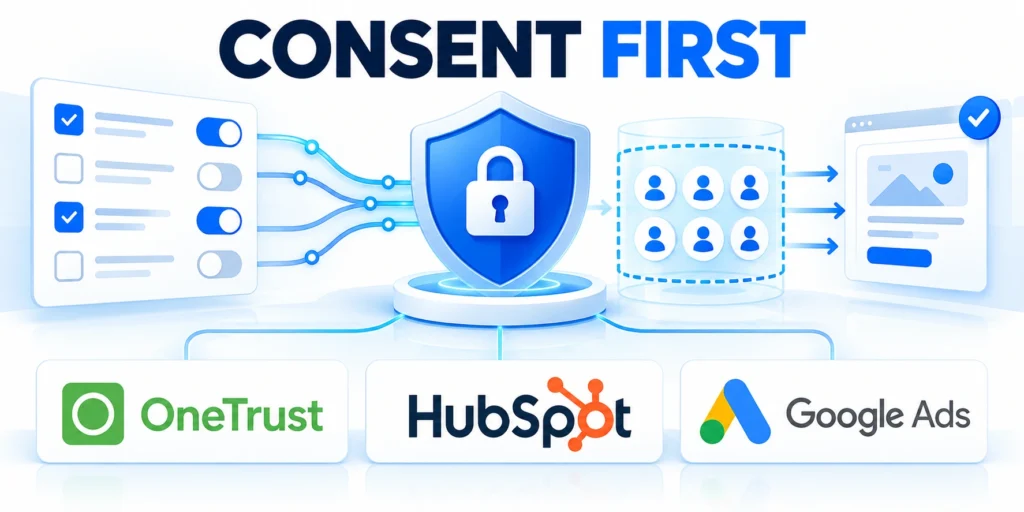
Before using tags, segments, or lists, record the data source, purpose, access, and how people can exercise their choices.
Consent rules vary by jurisdiction. UK ICO guidance generally addresses advertising technologies under PECR; assess requirements for your users and data flows.
Inventory the data and tags
Inventory advertising tags, analytics, forms, CRM syncs, and audience sources; record where each runs and why.
Use consent controls where required; test acceptance, decline, and withdrawal. Privacy notices, hashes, and platform settings do not replace legal review.
Define data minimization and boundaries
Collect only campaign-relevant signals; avoid sending sensitive URL, form, or data-layer details to ad platforms.
Avoid sensitive or impermissible targeting. LinkedIn warns against placing its Insight Tag on pages containing sensitive data; review terms and law.
Document list provenance and suppression
Before uploading records, document source, permission, purpose, retention, access, and suppression; hashing does not legitimize an improper list.
Maintain suppression for opt-outs and other excluded groups; assign an owner and refresh schedule so stale audiences do not persist.
Maintain a data-flow record
Document data flow from collection to platform and CRM, including purpose, permission, retention, owner, suppression, and consent withdrawal.
Separate campaign ownership from access administration; document approval rights and escalation for new events, uploads, or unexpected data.
Recheck jurisdiction and platform terms
Requirements depend on location, role, technology, and data. For regional campaigns, have the privacy owner confirm the approach and retain the decision.
Review local rules and current platform terms; platform approval is not your organization’s assessment. Pause uncertain data uses pending review.
Test the complete choice path
Review privacy readiness through these practical safeguards:
- Document each tag and audience purpose, vendor, fields, trigger, and retention decision.
- Test a fresh visit with no choice recorded.
- Check which requests occur before the relevant consent decision under the site’s approved configuration.
- Test acceptance, refusal, and withdrawal separately; verify tag behavior and suppression updates.
- Repeat on the key landing pages and forms, including routes that bypass the main navigation.
- Note discrepancies for the privacy owner.
- Retest after consent, tag, form, or integration changes; retain dated evidence.
Test consent, tags, audience rules, exclusions, destinations, forms, CRM creation, notifications, and preference changes as one connected journey.
Representative tests should include acceptance, refusal, withdrawal, duplicate records, expired windows, and failed integrations.
Keep audience uploads governed
Govern audience uploads through these control requirements:
- An upload should have an owner, a documented source and an approved purpose.
- Check that the record set excludes withdrawn permissions and people outside the intended campaign.
- Limit fields to those needed for matching.
- Assign access to named staff; store and delete exports under retention rules.
- Before a recurring sync, test sample inclusion and suppression cases.
- Review mismatches instead of assuming that a successful upload means the right people were matched.
- Send legal-basis, regional, or platform questions to qualified privacy counsel before activation.
Limit uploads to approved purposes, documented sources, required fields, authorized platforms, named owners, and defined retention periods.
Review match results, deletion procedures, access permissions, suppression behavior, and contractual requirements before recurring synchronization.
Build Segments From Useful Buyer Signals

A useful segment expresses a clear business question and supports relevant communication without becoming too small to deliver.
For example, use observable signals such as guide visits, webinar engagement, or form completion; each suggests a topic, not definite purchase readiness.
Separate anonymous site interest from known CRM context
Ad platforms match eligible users or accounts, while CRM records add sales and customer context. However, do not merge these sources casually.
Define authoritative systems for each status; use approved integrations and identity rules to avoid duplicate or conflicting records.
Use intent categories rather than an enormous menu
Start segmentation with these maintainable intent categories:
- Early learning: educational pages or broad guides.
- Problem evaluation: implementation, integration, or comparison content.
- Decision preparation: pricing, consultation, demo, or procurement resources.
- Existing relationship: customer education or a clearly scoped expansion offer.
Still, these are planning categories, not platform stages; adapt them to the sales cycle and avoid inferring intent from one page view.
Categories should be stable enough for measurement and distinct enough to support a different message, exclusion, destination, or review decision.
Give every segment a definition and owner
Use a short specification that includes:
| Field | Definition |
|---|---|
| Purpose | Enterprise architecture workshop |
| Audience | Integration-planning visitors |
| Exclusions | Customers, staff, opt-outs |
| Window | Observed buying-cycle evidence |
| Message | Architecture review with scope |
| Review | Permissions, exclusions, quality |
Avoid creating many near-identical audiences for cosmetic precision. If no one can explain what decision differs between two segments, combine them or remove one.
Reconcile segment changes
Compare definition changes with audience size, composition, exclusions, message, destination, and historical outcomes across equivalent observation windows before interpreting new performance carefully.
Version material changes so later reviews can distinguish market evidence, buyer behavior, delivery conditions, and measurement maturity from an altered segment rule, ownership decision, and later governance changes.
Use signals in combination, with restraint

Combining signals can clarify stage but shrink reach. For example, a webinar plus page visit may indicate evaluation, yet multi-step rules can exclude buyers researching across devices.
Use a few testable rules; explain each condition, distinguish inclusion from exclusion, and verify how platforms interpret URLs, events, and durations.
Keep identity resolution claims modest
Visitors, matched members, CRM contacts, and accounts are not identical; devices, job changes, and different matching rules limit certainty.
Describe audiences by available evidence, such as matched page visitors; document account-resolution limits instead of implying verified person-level knowledge.
Build a segment decision table
Combine buyer evidence through these restrained signals:
- List the observable signal, such as a product-comparison visit or completed technical webinar.
- Write at least two plausible meanings of that signal.
- A comparison visitor might be an active evaluator or a student researching the market.
- Choose messages helping both cases, or add qualifying signals before making narrower claims.
- Record exclusions, lookback, destination, and owner together for executable, reviewable segments.
- Test known eligible and excluded cases in the relevant platform before launch.
Document each segment’s purpose, evidence, exclusions, owner, destination, message, window, review trigger, and stopping condition.
Keep the table operationally small so teams can maintain definitions when products, consent, campaigns, or lifecycle stages change.
Audit segment value after launch
Audit segment value through these outcome checks:
- Compare qualified actions and sales feedback by segment, not only reach or click rate.
- A narrow segment can appear efficient while producing too few useful conversations.
- Record the hypothesis behind each segment and the date it was last reviewed.
- Retire a rule when it no longer changes the message or decision.
- When two audiences overlap, specify which offer takes priority.
- If the platforms cannot enforce priority across channels, document the limitation and monitor exposure.
- Avoid segments using data the team cannot explain or defend during privacy review.
Compare reach, frequency, engagement, valid responses, sales acceptance, opportunity movement, buyer feedback, and exclusions for each segment.
Retire segments that cannot support a distinct decision or whose maintenance burden exceeds their demonstrated value.
Set Lookback Windows, Exclusions, and Refresh Rules

Lookback duration controls how long an interaction qualifies; shorter windows preserve recency, while longer ones may suit lengthy buying cycles.
Then choose a window from observed time between buyer actions, and check current platform limits and account settings.
Use a window that preserves context
A long window can dilute recent intent; a short window can exclude stakeholders in complex purchases.
Compare cohorts from first signal to qualified action; with sparse data, document a conservative hypothesis and revisit later.
Build exclusions around lifecycle changes
Apply lifecycle exclusions through these common conditions:
- Completed action: remove someone from an offer campaign after the intended conversion.
- Customer status: suppress acquisition ads unless customers receive relevant adoption or expansion offers.
- Active opportunity: coordinate advertising with account owners and live sales conversations.
- Disqualification: suppress people outside service areas, account criteria, or stated purposes.
- Employee and test traffic: exclude internal users and test records where the platform allows it.
- Preference changes: propagate opt-outs or withdrawn consent through the consent and suppression systems.
Test exclusions with sample records before launch. A segment can appear correctly configured while a delayed CRM sync, identifier mismatch, or rule order still allows unwanted delivery.
Reconcile exclusions with CRM stages and preference records frequently enough to prevent stale audiences from receiving messages that no longer match their situation.
Map overlap and stop conditions
Define priority or suppression rules for overlapping audiences; coordinate lists when platforms cannot deduplicate and state that limitation.
Set explicit stop conditions for each goal, then test representative records to confirm forms, sales requests, and exclusions change audience state.
Review window interactions
Overlapping windows can expose one buyer to competing messages or preserve eligibility after the underlying question has changed.
Test representative lifecycle transitions and confirm that the newest valid state controls inclusion, suppression, destination, and follow-up.
Choose review triggers, not only calendar dates

Review triggers should respond to evidence changes, lifecycle transitions, audience decay, platform behavior, and business conditions rather than an arbitrary calendar alone.
Recheck segments after offer, consent, URL, CRM, policy, or audience-size changes; keep the owner and escalation path visible.
Refresh and retire old segments
Assign regular review of source, size, exclusions, and purpose; retire unhelpful audiences and refresh only when authorized.
LinkedIn and Google Ads apply platform-specific matching and eligibility. Therefore, a saved audience does not prove it can currently serve.
Estimate recency from observed transitions
Confirm platform readiness through these delivery checks:
- Measure time between qualifying and meaningful actions when the organization can do so appropriately.
- Group by buyer context.
- Short trials may need different windows from long enterprise procurement cycles.
- Do not copy one setting across all segments.
- Inspect the distribution, not only the average.
- A few delayed opportunities can distort a window that is too long for most buyers.
- Choose an initial window, record why it was selected, and set a review date.
- Confirm the platform’s current maximum and minimum options in the account.
Use CRM and analytics timestamps to estimate how quickly suitable buyers move between research, evaluation, consultation, opportunity, and customer stages.
Choose windows that reflect those transitions and disclose where incomplete identity or tracking limits the estimate.
Create a suppression test matrix
Retire aging segments through these review triggers:
- Test safely reviewed records across visitor, lead, opportunity, customer, and withdrawn-permission states.
- For each case, write the expected audience membership and message.
- Then check the actual result after the relevant sync delay.
- Investigate failures by tracing identifiers, data source, rule order and refresh timing.
- A correctly written exclusion may still fail when the source status is stale.
- Assign an owner to repeat this check after form, CRM stage, consent or integration changes.
- Keep the date and result in the campaign record.
Test customer, employee, applicant, partner, competitor, opt-out, converted, disqualified, and active-opportunity scenarios before launch.
Record the expected result and investigate every mismatch before broadening delivery.
Coordinate Channel Roles and Message Sequence
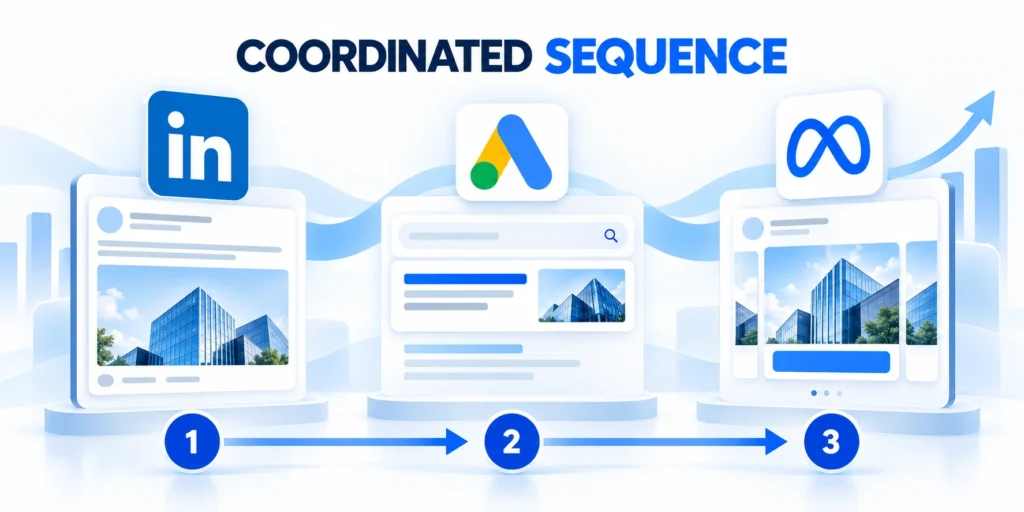
Cross-channel retargeting works when each message adds something useful. By contrast, repeating the same creative on every network can feel persistent without helping a buyer make progress.
Define each channel’s role from its audience source, message, and delivery rules; verify current account capabilities rather than assuming parity.
Use platform-specific strengths deliberately
For planning LinkedIn audience and campaign structure specifically, use the enterprise LinkedIn Ads strategy guide.
Assign each channel a role that fits its available signals, audience controls, creative formats, costs, and measurement limits.
Keep one shared journey map
To coordinate channels, use a simple table for the campaign team:
| Buyer context | Next message | Destination |
|---|---|---|
| Early research | Practical guide | Educational resource |
| Technical evaluation | Architecture workshop | Technical page |
| Vendor decision | Scope and proof | Consultation page |
| Customer adoption | Training resource | Education page |
Use a sequence only when the business can identify its stages and stop conditions. After a meaningful conversion, stop early-stage messages.
Maintain message continuity
Align ad promise, destination, form, and follow-up; explain workshop scope, audience, prerequisites, and what happens after submission.
Use one primary call to action. Avoid asking for an immediate sales meeting when the audience has only shown light educational interest, unless the buyer has clearly indicated readiness.
Coordinate with account-based outreach
Coordinate ads with sales outreach so other stakeholders get a consistent message; never imply a conversation that did not occur.
Assign responsibility for suppressing or adapting campaigns when the account enters a new stage. The CRM and campaign brief should make the change visible to marketing operations and sales.
Define the cross-channel handoff
A coordinated sequence should preserve one buyer question while allowing each platform to contribute a distinct and measurable role.
Coordinate the handoff through these shared decisions:
- Assign one purpose to every channel.
- Preserve exclusions across connected platforms.
- Keep destination and follow-up promises aligned.
- Record ownership for every transition.
Review the sequence when audiences, offers, destinations, sales capacity, consent, or platform capabilities change.
Coordinate the destination and follow-up

Check that the landing page fulfills the ad promise, answers the next question, and offers a clear action; keep forms proportionate, state follow-up, and verify tracking.
Match follow-up to consent and context; a content download is not automatically a sales request. Give sales useful context without guessing intent.
Assign a job to each channel
Assign each channel a distinct audience, message, destination, and measurement role; test whether duplicated campaigns are necessary.
Shared calendars and naming reveal overlap, but do not create universal cross-platform frequency caps.
Write a one-page journey contract
Coordinate channel sequence through these shared controls:
- Agree on each stage’s buyer signal, message, offer, destination, and stop event.
- Sales should review claims about follow-up.
- For example, a technical webinar attendee may receive a practical implementation worksheet.
- A consultation requester should move to a human response instead.
- Document handoff owners and realistic service expectations.
- Make the landing-page language match the actual process.
- Check whether the same person may receive conflicting offers on different networks.
- When shared suppression is unavailable, use scheduling and measurement as partial controls.
Record the audience, evidence, message, destination, follow-up, exclusions, owner, timing, and success decision shared across marketing and sales.
Update the contract when any dependent process changes rather than allowing channels to drift independently.
Review a destination as a buyer
Assign each channel through these distinct operating roles:
- Open the draft’s destination and confirm its headline fulfills the promise.
- Is the resource accessible?
- Is the action clear?
- Verify forms request necessary information and explain the next step.
- Test the path on a small screen and with the campaign parameters in place.
- Record broken links, duplicate events and unexpected redirects before spend begins.
- If the destination is not ready, postpone the campaign.
- A more precise audience cannot make a misleading or incomplete landing page useful.
Open the destination from representative devices and confirm that the promise, evidence, next step, privacy choices, and expected response remain coherent.
Remove distractions or claims that conflict with the advertisement and preserve useful context through the handoff.
Manage Frequency, Fatigue, and Buyer Experience
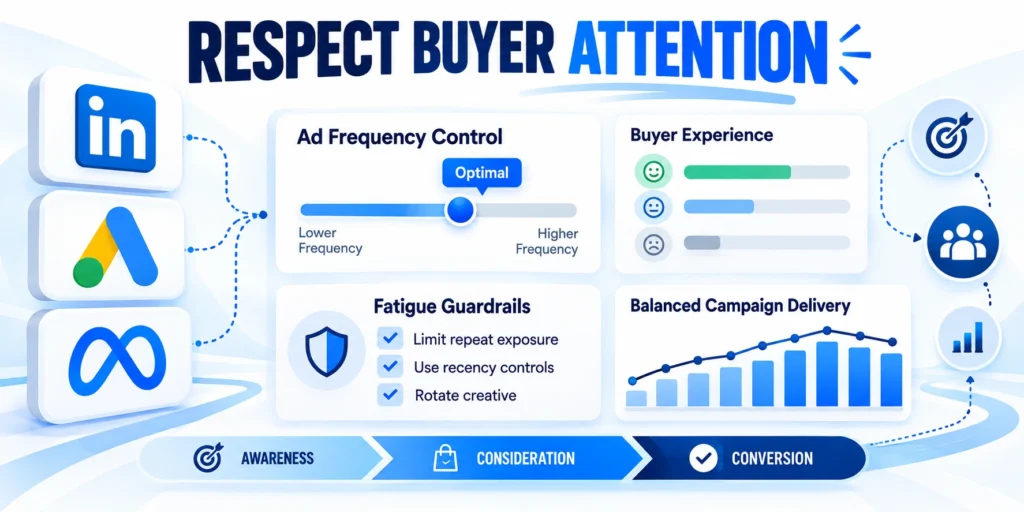
Repeated exposure can help a relevant message remain familiar, but excessive repetition can irritate people and waste budget.
Frequency is also difficult to coordinate across independent platforms because each system reports delivery differently.
Set a review rule instead of assuming a universal cap
Use available controls and review delivery, audience size, creative, feedback, and outcomes; choose caps for each objective and placement.
For that reason, track frequency with time, reach, and message variation. A high average can hide people with much higher exposure, while an acceptable average may still combine incompatible channels.
Refresh the message when the decision changes
Change creative when it becomes stale or the buyer’s question evolves. Do not refresh only the color or headline if the underlying offer remains irrelevant.
Use video in B2B performance campaigns to show how an implementation or integration works. Support each claim and deliver what the ad promises.
Watch for signs that the program is too persistent
Watch frequency, falling engagement, poor leads, opt-outs, and complaints; investigate duration, overlap, exclusions, and relevance before changing campaigns.
Use a shared calendar to coordinate overlap; claim person-level deduplication only when measurement supports it.
Review distribution, not only the average
Average frequency can hide concentrated exposure; compare reach, impressions, time periods, audience, and creative to find groups needing exclusions.
Treat complaints, comments, and sales feedback as clues; identify the related creative, placement, account list, or stage before broad changes.
Set an exposure response plan
Frequency decisions should combine distribution, recency, audience size, creative substance, buyer feedback, qualified outcomes, and channel overlap.
Respond to fatigue through these ordered actions:
- Confirm exclusions and audience eligibility.
- Inspect frequency distribution by segment.
- Refresh the buyer value or question.
- Reduce delivery when evidence remains weak.
Document the reason for each change so later reviewers can distinguish buyer protection from routine creative rotation.
Make creative changes useful

Change one major factor at a time when possible; record audience and creative exposure so results remain interpretable.
Check mobile headline, contrast, form usability, and loading; precise targeting cannot fix an unusable landing experience.
Use a weekly exposure review
Review destinations through these buyer-experience checks:
- Review reach, impressions, available frequency measures, audience size and conversion quality together.
- Note creative changes and overlapping campaigns.
- Look for a small audience receiving repeated impressions without meaningful progress.
- Compare that pattern with sales comments and opt-out signals where available.
- Adjust one variable at a time: duration, exclusion, creative, bid or channel allocation.
- Record the reason and expected result before changing it.
- Avoid presenting a platform frequency average as a unique cross-channel person count.
- The platforms may use different identities, windows and reporting rules.
Review frequency distribution, audience size, recency, exclusions, creative performance, negative feedback, qualified outcomes, and platform delivery changes.
Investigate material shifts through representative records before changing caps or creative.
Refresh substance before presentation
Monitor buyer fatigue through these observable warning signs:
- A new color palette is not a new answer to a buyer question.
- Update the offer when the audience has advanced or the existing material no longer helps.
- For evaluation-stage buyers, consider an implementation plan, comparison criteria or integration limitations.
- Support factual claims and show prerequisites openly.
- Archive the prior creative and destination.
- Preserve readable performance history and prevent repeated failed messages.
- Pause messages lacking suitable destinations, even with high click rates.
Change the underlying value, proof, question, or next step when the buyer decision changes rather than merely changing colors or decoration.
Preserve a record connecting each creative revision to observed evidence and its intended learning.
Preserve a learning baseline
Record the prior promise, proof, format, audience, destination, delivery conditions, and outcome maturity before replacing creative.
Change one meaningful element when practical so the next review can explain what improved or weakened buyer relevance.
Connect Advertising Signals to CRM Outcomes
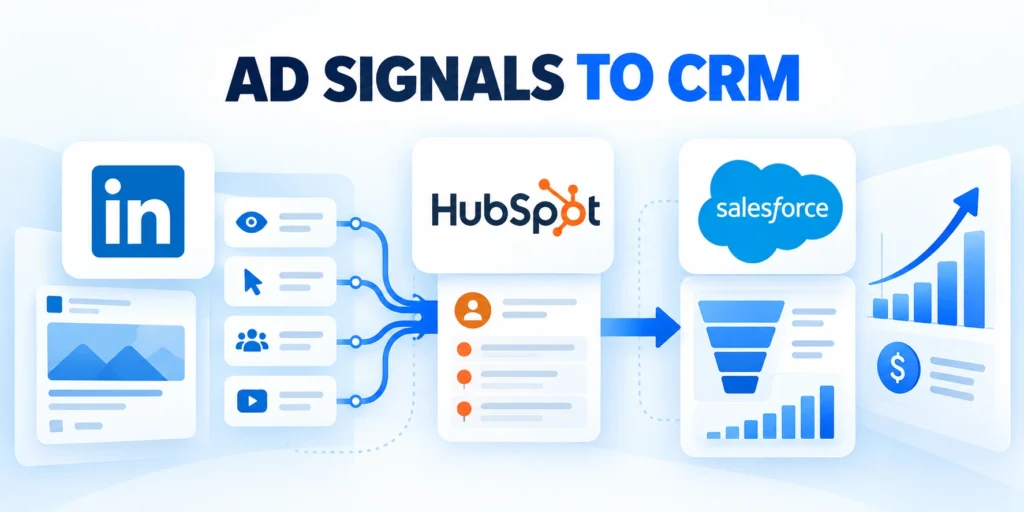
Retargeting should be evaluated beyond platform-reported conversions. A click, view, form submission, sales-accepted lead, qualified opportunity, and won contract represent different events.
Therefore, the framework below links ad activity to CRM milestones without treating platform reports as revenue.
Define events before configuring tags
Define each conversion event by trigger, source, owner, deduplication, and use; specify how the team accepts a sales opportunity.
LinkedIn, Google, and other platforms support different conversion methods; confirm the current setup and reporting window before comparing totals.
Preserve useful context in the CRM
Map campaign context and consent to CRM only where useful and permitted; align field definitions across teams.
Validate measurement through these complete-path checks:
- Submit the intended form or action using a controlled test.
- Confirm the correct event fires once and only for the defined action.
- Check the CRM record for source, offer, consent state, and relevant account context.
- Verify routing, notifications, deduplication, and the expected owner.
- Remove or retain the test record according to the organization’s data policy.
Do not include personal or sensitive details in URLs, campaign parameters, or event data. Ask the privacy and analytics owners to review the data map before adding new fields.
The RevOps playbook provides a companion model for shared definitions and handoffs across teams.
Reconcile differences without forcing a single number
Platform and CRM totals can differ because of attribution windows, consent choices, devices, matching, duplicate handling, delayed qualification, and different event definitions. Record the definitions before comparing performance.
Compare cohorts at similar maturity; separate observed events, modeled platform activity, and CRM-confirmed outcomes.
Audit representative records
Trace accepted, rejected, duplicated, delayed, and unmatched records across advertising, analytics, forms, CRM, and sales systems.
Use those examples to repair identifiers, timestamps, ownership, stage definitions, and processing failures before changing optimization decisions.
Separate attribution from incremental impact
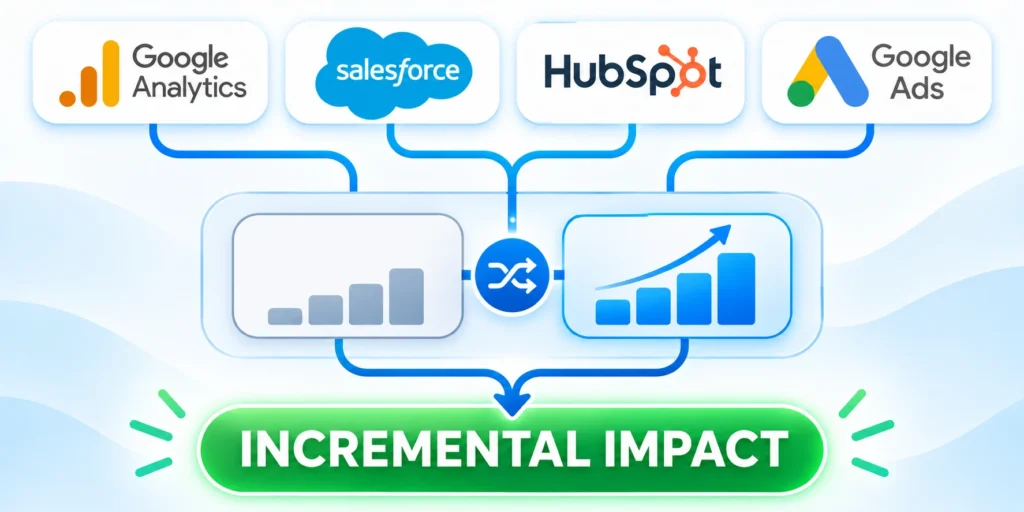
Attribution allocates credit but does not prove causation; state the model and window, and do not add platform totals as unique customers.
Use a reviewed holdout when feasible; otherwise call findings directional and combine platform reports with CRM, sales feedback, and cohort timing.
Protect data quality across handoffs
To protect records, use campaign names without personal data; document CRM mappings and duplicate or delayed events with clear stage definitions and dates.
When totals disagree, inspect events, consent, reporting windows, forms, deduplication, routing, and stages; fix causes rather than forcing matching metrics.
Define a measurement dictionary
Reconcile reporting gaps through these diagnostic steps:
- Create a shared table covering impressions, clicks, leads, sales acceptance, opportunities, and outcomes.
- Specify source and timestamp for each.
- Document attribution windows and deduplication rules separately for platform reporting and CRM reporting.
- A platform conversion may not represent a new qualified lead.
- Add offer or segment fields only when useful, permitted, and consistently populated.
- Avoid sending sensitive personal information in URL parameters.
- Have marketing, analytics and sales sign off on the definitions.
- Then build a dashboard that labels each number by its actual event and source.
Define every event, field, stage, owner, timestamp, attribution window, acceptable value, and known limitation used in campaign decisions.
Version the dictionary when systems or business processes change so reports remain interpretable.
Diagnose a reporting gap step by step
Prepare every experiment through these briefing elements:
- 1. Check whether the intended action fired once in a controlled test.
- 2. Check whether the consent state permits the relevant measurement path.
- 3. Confirm that the form created or updated the correct CRM record and owner.
- 4. Compare time zones, reporting windows, duplicate handling and stage definitions.
- 5. Record unresolved differences rather than adjusting counts to make dashboards agree.
- Use opportunity quality and pipeline progression while acknowledging delayed outcomes in long B2B cycles.
Trace one representative record through ad click, consent, analytics, form, CRM, qualification, opportunity, and revenue systems.
Compare identifiers, timestamps, ownership, duplicates, exclusions, and processing errors before changing campaign strategy.
Run a Practical Test and Optimization Cycle

A useful program is a sequence of documented decisions, not a set-and-forget audience.
Begin with a limited segment that can answer a meaningful question and has enough eligible reach to deliver.
Prepare a test brief
Include the business objective, audience definition, source, exclusions, lookback period, channel, offer, destination, budget owner, response owner, and primary CRM outcome. Add the privacy review and launch date.
Before launch, define when to continue, revise, pause, or retire the test. Base these criteria on delivery and the company’s economics rather than an unverified universal conversion benchmark.
Check the campaign in a sensible order
Set campaign decisions through these explicit thresholds:
- Eligibility: Is the segment processing and eligible in the intended network?
- Consent and source: Are tags and list sources approved, and are choice signals respected?
- Exclusions: Are customers, converted prospects, employees, and opt-outs handled as intended?
- Delivery: Are budget, location, placements, creative, and destination functioning?
- Experience: Does the page load, explain the offer, and work on mobile?
- Handoff: Does the response reach the expected person and enter the CRM correctly?
- Quality: Do target accounts engage and progress to the defined next stage?
Verify delivery, tracking, audience rules, exclusions, destination, form, CRM handoff, sales response, and outcome maturity before diagnosing market demand.
Fix the earliest failed stage and preserve downstream evidence for comparison.
Diagnose before broadening
When reach is small, inspect tags, URLs, consented traffic, matching, duration, and eligibility; broaden only criteria that preserve campaign intent.
If clicks fail to convert, inspect continuity, usability, proof, and form friction; for rejected leads, review fit, routing, and follow-up.
Investigate conversion and pipeline gaps
A rise in platform conversions without CRM opportunities calls for checking event definitions, duplicates, attribution, consent, and cohort maturity before changing campaigns.
Compare accepted and rejected records, response times, discovery notes, stage movement, values, and unresolved opportunities before attributing the gap to advertising.
Use a decision log for each iteration
For each iteration, log owner, evidence, change, expected effect, and review date; note simultaneous releases so performance changes remain interpretable.
Also record uncertainty about audience size, observation time, and sales maturity; use results to choose tests, not universal rules.
Apply an explicit continue, revise, or stop review
At review, assess eligibility, message fit, experience, and CRM outcomes; continue, revise, or stop based on evidence, permissions, relevance, and operating cost.
Then tell affected teams when decisions change; retire campaigns by stopping delivery, reviewing stored audiences, and following retention rules.
Record what the evidence can support

Evidence should support a bounded decision while clearly separating observed outcomes, plausible explanations, unresolved uncertainty, and conclusions that the available design cannot establish.
Keep audience, dates, creative, spend, delivery, CRM results, decisions, and uncertainty; never call a small sample a proven winner.
Make one decision per test
Document test conclusions through these evidence fields:
- State a hypothesis that can change an action.
- For example, an implementation worksheet may bring more qualified consultations than a generic ebook.
- Keep the audience, period, offer, destination and primary outcome in the test brief.
- Change one major factor when possible and log unavoidable changes.
- Agree on a minimum observation period and a decision rule before launch.
- Avoid declaring a winner from a few early clicks in a small audience.
- Review sales feedback and CRM progression alongside ad metrics.
- A cheaper lead can be worse if it consumes follow-up capacity without fit.
- At the end, decide to keep, revise or stop the program.
- Write what the evidence supports and what it cannot establish about incremental impact.
A test should isolate the decision it can support while documenting concurrent changes that prevent a clean interpretation.
Use a stable baseline and enough maturity for the relevant buying stage before adopting the result.
Use a controlled launch checklist
Approve launches through these operating controls:
- 1. Confirm the segment definition, consent review and eligible audience estimate.
- 2. Test positive and negative cases for inclusion, suppression and conversion.
- 3. Verify that every ad claim matches the destination and the follow-up process.
- 4. Confirm budget limits, ownership, reporting definitions and the date of first review.
- 5. Launch a limited scope, then inspect delivery and data quality before increasing spend.
- If a critical check fails, pause that audience and fix the cause.
- Preserve the test notes so the next iteration begins from evidence.
Confirm audience logic, consent, exclusions, destinations, creative, forms, CRM fields, notifications, ownership, budgets, and failure procedures.
Record approval evidence and resolve material exceptions before activating delivery.
Review outcomes at the right maturity
Maintain programs through these approval safeguards:
- Early response and later commercial outcomes mature on different schedules.
- Date each launch cohort to avoid comparing leads with unequal maturation periods.
- Before review, count records reaching sales, accepted records, and pending decisions.
- This distinction can reveal a routing problem that a platform dashboard cannot show.
- Ask sales to classify objections plainly: unclear scope, missing integrations, or wrong company size.
- Use those reasons to revise the offer or audience definition.
- If sample sizes are small, describe the observation and its uncertainty.
- Avoid converting a handful of outcomes into a precise return estimate.
- Treat simultaneous website, form, creative, and audience changes as program-level evidence.
- Keep a decision log to preserve traceability and prevent repeated inconclusive tests.
Separate recent cohorts from mature cohorts and compare outcomes only after the relevant sales and buying processes had reasonable time to progress.
Report open opportunities separately instead of labeling incomplete journeys as failures.
Set an approval path before launch

Name the marketing, sales, analytics, privacy, and platform owners who must approve audience use, messaging, measurement, and suppression before the campaign begins.
Record which changes require renewed review. A new data source, purpose, destination, region, or sales workflow can invalidate an earlier decision.
Schedule audience maintenance
Assign a recurring review for audience age, delivery, exclusions, match quality, permissions, and offer relevance. Tie the cadence to the buying cycle.
Retire audiences whose original purpose has ended. Keeping an unused segment available indefinitely increases operational ambiguity and makes future activation harder to govern.
Prepare a failure response
Define who pauses delivery when suppression, consent, tracking, destination, or CRM routing fails. Include a fast path for buyer complaints.
After containment, identify affected audiences and periods, correct the underlying control, document the decision, and verify recovery before resuming delivery.
Archive decisions for reuse
Store the test brief, audience definition, approvals, creative versions, dates, exclusions, outcome definitions, and final decision in an accessible campaign record.
Future teams can then reuse validated controls, understand prior limitations, and avoid repeating a test whose evidence already answered the same operational question.
Separate program changes from test changes
A website redesign, new form, CRM migration, or consent change can alter several campaign inputs simultaneously. Mark that period as a program change.
Do not attribute the resulting movement to one advertisement. Reestablish the measurement baseline before comparing later creative or audience tests.
Use sales feedback consistently
Give sales a short, stable set of disposition reasons for retargeting responses. Free-form notes alone are difficult to compare across representatives.
Review those reasons with recorded CRM stages. Repeated fit, timing, or expectation gaps can reveal whether the audience or message needs revision.
Record accountable launch approval
Approval should confirm that marketing, privacy, analytics, sales, and operations understand the audience, promise, measurement, ownership, and failure response.
Capture approval through these required records:
- Named owners and review dates.
- Audience, exclusion, and consent evidence.
- Message, destination, and follow-up agreement.
- Rollback and incident responsibilities.
Reapprove material changes rather than treating the original launch decision as permanent authorization.
Close campaigns deliberately
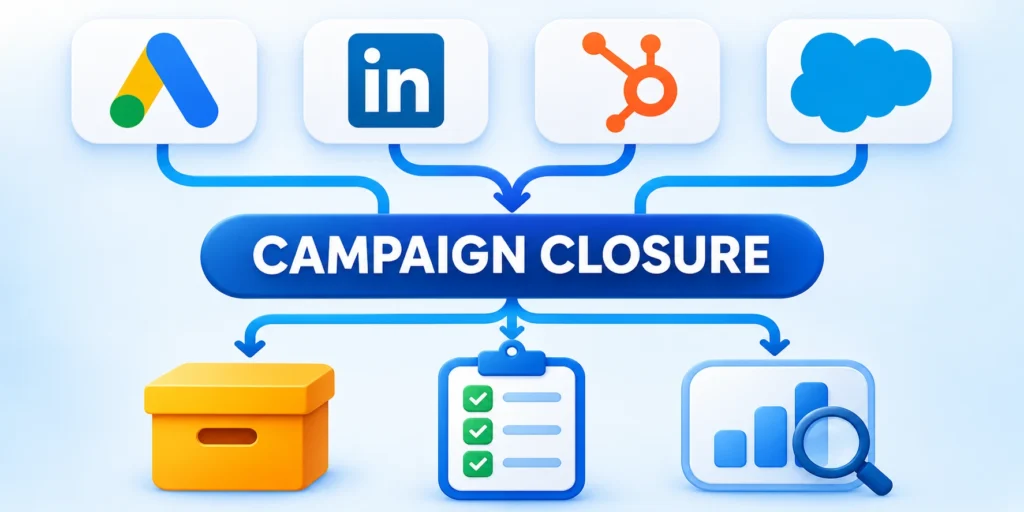
At campaign end, stop delivery, retire temporary audiences, preserve required records, and confirm that platform, analytics, and CRM owners share the final status.
Document the result, uncertainty, and next decision. A clear closure prevents stale segments or unfinished tests from being reactivated without context.
Define escalation thresholds
Agree which signals require investigation, campaign pause, or leadership review. Examples include suppression failure, unexpected audience growth, broken routing, or sustained buyer complaints.
Thresholds should reflect business risk rather than arbitrary dashboard movement. Record the evidence, responsible owner, response deadline, and conditions required before delivery resumes.
Recheck platform availability
Audience features, match requirements, consent controls, and reporting options change. Confirm the current account interface and official documentation before implementing an older campaign plan.
When a platform removes or changes a capability, revise the operating design. Do not reproduce the same behavior through an unreviewed workaround or broader audience.
Review buyer feedback as evidence
Route complaints, unsubscribe requests, sales objections, and support contacts into the campaign review. These signals reveal relevance problems that conversion dashboards may not show.
Classify feedback by audience, message, channel, and stage. A repeated mismatch should trigger corrective action even when delivery and click metrics appear healthy.
Assess whether the audience can deliver
Classify sales feedback through these decision categories:
- There is no universal site-traffic threshold.
- Measure eligible audiences after consent, exclusions, and current platform requirements.
- Broaden only when new members share the same buyer question.
- Otherwise use a different demand activity.
Confirm eligible reach after consent, exclusions, and match loss. If delivery remains unstable, prioritize contextual, partner, permitted email, or organic demand activity.
Estimate matched reach after exclusions and compare it with frequency, budget, expected response, and the minimum evidence required for a decision.
Map suppression to the buying stage
Assess delivery viability through these reach checks:
- Match exclusions to the offer and the next stage.
- Stop completed offers and acquisition messages for active sales processes.
- Continue evaluation messages only when purpose, permission, and ownership remain clear.
Use stage-based suppression instead of one global rule. A guide reader may need evaluation content, while a customer should leave acquisition campaigns.
Suppress or change messages when people become customers, active opportunities, applicants, employees, partners, opt-outs, or otherwise ineligible.
Conclusion

A durable B2B retargeting strategy begins with a useful buyer decision, governed data, explicit exclusions, coordinated messages, reliable destinations, and accountable follow-up.
Treat platform delivery as one part of an operating system that connects privacy, marketing, analytics, sales, customer context, and business outcomes.
Keep the program accountable
Assign owners for audience definitions, consent, exclusions, creative, destinations, CRM quality, sales response, measurement, and final campaign decisions.
Maintain accountability through these operating controls:
- Define every audience and stopping condition.
- Preserve consent and suppression evidence.
- Coordinate channel, destination, and follow-up roles.
- Review mature CRM and buyer outcomes.
- Document changes, uncertainty, and ownership.
Review ownership whenever systems, teams, offers, lifecycle stages, privacy requirements, or platform capabilities change materially.
Turn evidence into one decision
Close each test with the observed evidence, known limitations, decision, responsible owner, deadline, and condition that would justify reconsideration.
Do not let attractive platform metrics override unsuitable buyers, weak sales acceptance, poor opportunity progression, unresolved privacy concerns, or excessive exposure.
Preserve the learning record
Keep the approved baseline, audience rules, message versions, destinations, outcome definitions, review dates, incidents, and unresolved questions available for later comparison.
That record prevents teams from repeating failed tests or treating an undocumented configuration change as new market evidence.
Improve the earliest failed stage
When results disappoint, locate the first stage that diverges from expectations and assign the correction to the team controlling that stage.
Fix eligibility, tracking, message, destination, form, routing, response, qualification, or measurement before expanding spend and reach.
Protect buyer relevance while scaling
Expand gradually while qualified outcomes, buyer feedback, frequency distribution, privacy controls, sales capacity, and operational quality remain acceptable.
For a focused companion topic, read B2B Ad Copywriting Formulas That Drive Click-Through Rates.
FAQ
These answers clarify common planning, privacy, audience, frequency, measurement, and cross-channel questions for B2B retargeting programs.
What is B2B retargeting?
B2B retargeting uses eligible prior interactions to show later messages to matched people or accounts; sources and permissions vary by platform and organization.
The next message responds to known context instead of treating every visitor identically. Eligible signals may include a page visit, registration, request, or customer-list match.
Is retargeting suitable for every B2B company?
It may not fit low-traffic sites, short sales cycles, poor match rates, or teams unable to follow up; compare other channels.
The program also needs a meaningful next step. Strengthen intent definitions, exclusions, and sales follow-up before adding advertising when those foundations are missing.
How long should a retargeting audience last?
Choose a period based on observed buying behavior, the platform’s current limits, privacy requirements, and the message’s useful life. Review it when the sales cycle or offer changes.
Use the shortest window that reflects the supported decision. A recent pricing visit may justify a different period from an early educational download.
Should I retarget every visitor?
Usually not. Separate relevant business actions from accidental, internal, support, job-seeking, or otherwise irrelevant visits when the platform and permissions allow.
Broad pools mix incompatible needs and obscure results. Define each audience around one buyer question, then exclude visits that cannot reasonably signal that need.
What should I exclude?
Common exclusions include people who completed the offer, existing customers in a net-new campaign, employees, active opportunities when sales coordination requires it, and people who withdrew permission or opted out.
Document the exclusion system, owner, refresh frequency, and failure response. An outdated suppression list can undermine otherwise accurate targeting and creative.
Can retargeting work across several platforms?
It can, if each platform has eligible reach and coordinated messaging, exclusions, and measurement; audiences will differ across services.
Give each channel a role instead of duplicating one advertisement everywhere. Shared campaign names and CRM stages help reconcile activity without assuming identical attribution.
Is a click or lead form a qualified opportunity?
No. A click or form submission is an observed action. By contrast, a qualified opportunity requires the organization’s criteria and confirmation in its CRM or sales process.
Record intermediate events without renaming them as commercial outcomes. Compare audiences through consistently defined accepted leads, opportunities, pipeline, or revenue at suitable maturity.
How often should someone see a retargeting ad?
No universal cap fits every campaign; use platform controls, review exposure and response, and adjust stale or excessive delivery.
Interpret frequency with audience size, duration, creative variety, and buying stage. Small specialized audiences can accumulate exposure quickly without proving fatigue.
Do hashed contact lists automatically comply with privacy laws?
No. Hashing can support matching, but it does not establish the source, permission, purpose, or legal basis for using the underlying data. Review the applicable rules and platform terms.
Document data origin, notice, purpose, withdrawal, and retention. Privacy and legal owners should assess the implementation rather than relying on a technical transformation.
How do I compare ad-platform results with CRM results?
Define each event and attribution window, compare cohorts at similar maturity, investigate duplicates and consent-related gaps, and report platform activity separately from CRM-confirmed sales outcomes.
Reconcile platform conversions, captured leads, accepted leads, opportunities, and revenue for one campaign period. Investigate expected differences because each system observes different events.





Leave a Reply