


Define the Outcome Before You Hire
To hire a dedicated remote development team, define the business outcome and decision rights first. Vague backlogs create avoidable cost and unclear expectations.
For example, replace “build a modern platform” with “let account managers configure customer onboarding without engineering help.” The second statement points toward users, workflow, and measurable acceptance.
Turn the outcome into a first delivery slice
Write a one-page brief before contacting firms. Keep it short enough to compare proposals, but concrete enough to expose assumptions and dependencies.
Follow this sequence to turn the outcome into a first:
- Identify the user and the problem they need solved.
- Describe the smallest useful workflow that can be released.
- List systems, data, approvals, and people the work depends on.
- Define evidence of success, such as task completion or reduced manual handling.
- Name the person who can make product decisions and accept the work.
Separate requirements from preferences. “Must use our identity provider” is a constraint; “prefer a particular framework” may be negotiable if the team can explain the tradeoff.
Estimate capability needs, not just headcount
Map the work to responsibilities: product ownership, technical direction, backend, frontend, quality assurance, design, and operations. One person may cover multiple responsibilities in a small team.
Ask which capability is needed continuously and which can be supplied occasionally. A fractional security review can be more sensible than adding a full-time specialist to a small product squad.
Use these actions to estimate capability needs not just headcount:
- Portal team: client product owner, technical lead, two full-stack engineers, shared design and QA support.
- Add a product designer for complex customer-facing workflows.
- Include security and infrastructure specialists when risk requires.
Use a readiness checklist before requesting proposals
Apply these criteria to a readiness checklist before requesting proposals:
- A business owner can explain why the work matters.
- A product decision-maker can answer questions each week.
- Known integrations and data sensitivities are documented.
- The first release can be described without prescribing every implementation detail.
- Budget, start window, and procurement constraints are recorded.
If several items are unknown, run a short discovery engagement first. It should produce an agreed scope, risk list, and delivery plan, not an open-ended workshop.
Confirm who can approve that output and fund the first delivery slice. Readiness depends on decision capacity, not documentation volume.
Choose a Dedicated Team Model That Fits the Work
“Dedicated team” can describe different commercial arrangements. Compare who directs daily work, how scope changes, and who owns delivery decisions before comparing rates.
Ask each provider to describe its proposed model in plain terms. A low monthly price does not help if responsibilities, replacement terms, or expected availability remain unclear.
| Model | Useful when | Main tradeoff |
|---|---|---|
| Dedicated cross-functional team | Work continues across a changing product backlog. | You provide product direction and stay engaged. |
| Staff augmentation | Internal managers need specific outside skills. | Your team owns coordination and integration. |
| Fixed-scope project | Requirements and acceptance conditions are stable. | Changes need explicit scope and price decisions. |
| Discovery engagement | Problem, architecture, or first release is open. | Produces a plan before production delivery. |
Check the commercial details behind each model
Use these actions to check the commercial details behind each:
- Confirm whether rates include recruiting, management, equipment, and replacement time.
- Clarify billing units, minimum commitments, notice periods, and expense handling.
- Ask how scope changes affect staffing and delivery forecasts.
- Identify who approves extra work and how the decision is recorded.
- Request a named escalation contact for delivery or staffing concerns.
Normalize proposals into the same roles, time allocation, inclusions, commitments, and exit terms. A lower rate can hide coordination or replacement costs.
Ask who carries financial risk when staffing changes or delivery slips. Record approval authority for additional people, expenses, and scope.
Compare proposals using the same questions
Follow this sequence to compare proposals using the same questions:
- Who is accountable for technical decisions and delivery coordination?
- Which named roles are included, and how much time will each contribute?
- How are holidays, sick leave, replacements, and knowledge transfer handled?
- What overlap hours, response expectations, and communication channels are proposed?
- How are estimates, changes, and acceptance decisions documented?
- What happens if the relationship ends or priorities change?
Request a sample weekly report and a redacted delivery artifact. Look for clear risks, decisions, owners, and evidence of working software rather than polished claims alone.
Compare like-for-like evidence before scoring vendors. Note assumptions that remain unverified and assign an owner to resolve each material difference.
Choose for fit and tradeoffs
A smaller firm may offer direct access to senior engineers, while a larger supplier may provide broader coverage and formal processes. Validate the actual team proposed.
Ask for two alternatives when the first proposal feels oversized. Compare what each option can deliver, what remains your responsibility, and which risks increase or decrease.
Connect hiring to product architecture
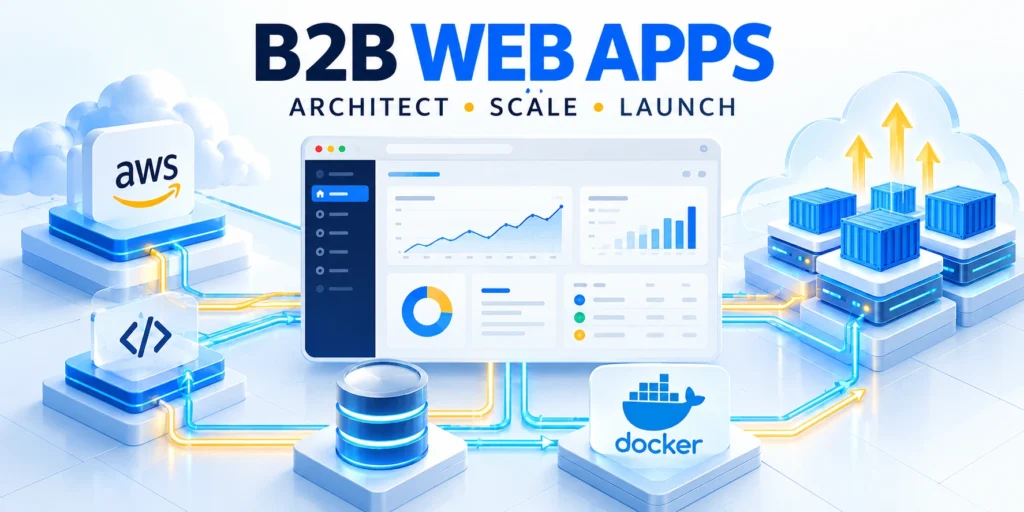
For product architecture and launch planning context, see our guide to B2B web app development.
Architecture determines which capabilities must remain continuous. Match hiring to current boundaries, operational risks, integration ownership, and the next measurable release.
Evaluate Skills with a Relevant, Fair Process
Evaluate the people who will actually join the team. A sales presentation by senior leaders does not establish the skills of engineers assigned later.
Use the same role expectations and scoring rubric for each candidate. Structured questions make comparisons clearer and reduce decisions based on confidence or familiarity.
Run a focused interview sequence
Follow this sequence to run a focused interview sequence:
- Share the role, product context, and interview stages in advance.
- Ask the candidate to explain a relevant system they helped deliver.
- Explore a real tradeoff involving reliability, security, cost, or maintainability.
- Use a short work sample resembling the actual job, with a clear time limit.
- Let the candidate ask questions about decisions and collaboration.
- Score evidence independently before discussing the panel’s impressions.
For a backend role, a useful exercise might ask candidates to review a small API design and identify failure cases. Avoid unpaid assignments that resemble deliverable client work.
Use the same prompt, time limit, support, and scoring dimensions for comparable candidates. Document accommodations and avoid irrelevant pressure tests.
Use a simple scorecard
Choose dimensions directly connected to the role and first outcome. Define observable evidence before interviews begin.
Keep the scale small and anchored. Reviewers should explain the observed behavior supporting each score and unresolved concern.
| Dimension | Evidence to record | Concern to investigate |
|---|---|---|
| Technical judgment | Explains options, constraints, and consequences. | Uses patterns without linking them to the problem. |
| Delivery practice | Breaks work into reviewable increments. | Cannot describe testing or release safeguards. |
| Communication | States assumptions and asks clarifying questions. | Hides uncertainty or gives vague status. |
| Team contribution | Shares credit and handles feedback constructively. | Blames others without examining personal choices. |
Make scoring actionable
Use these actions to make scoring actionable:
- Write down the evidence supporting each score before panel discussion.
- Separate a skill gap from an unfamiliar communication style.
- Ask the candidate to explain assumptions and revise an answer after feedback.
- Use the same exercise conditions and time limits for comparable candidates.
- Record unresolved concerns and decide who will verify them.
Agree on what “strong” means before interviews. For example, a senior engineer should explain why a simpler design is safer when the product has no need for distributed complexity.
Resolve conflicting scores by returning to recorded evidence. Do not average away a material security, ownership, communication, or delivery concern.
Check references without outsourcing judgment
Ask references about the person’s responsibilities, collaboration, reliability, and response to feedback. Confirm permission before contacting anyone and follow applicable hiring rules.
GitLab’s public candidate handbook shows how a company can explain hiring stages and expectations. Treat it as an example, not a universal hiring template.
Make Remote Collaboration Part of the Operating Model
Remote delivery depends on explicit handoffs and written decisions. Do not assume that daily video calls will compensate for unclear ownership or missing context.
Agree on a small set of working agreements before the first sprint. Revisit them after the team has enough experience to identify friction.
Set communication expectations
Use these actions to set communication expectations:
- Use one backlog as the source of truth for work and acceptance criteria.
- Record decisions with context, owner, and date in a shared space.
- Set response expectations by channel; urgent incidents need a separate route.
- Agree on overlap hours for collaboration that truly benefits from live discussion.
- Share a concise written update covering progress, next work, risks, and decisions needed.
For example, a developer finishing the day can post the current branch, test status, open question, and next action. A teammate elsewhere can continue without repeating discovery.
Review whether channels produce timely decisions or duplicate status. Remove ceremonies that add reporting effort without improving coordination, evidence, or ownership.
Design meetings around decisions
Keep live meetings for planning, difficult design choices, pairing, and relationship building. Send status asynchronously when participants only need information.
Every recurring meeting should have an owner, an expected outcome, and a short agenda. Cancel it when no decision or collaboration is needed.
Measure outcomes and delivery flow
Track customer outcomes, quality signals, and delivery flow. DORA’s guide to empowering delivery teams emphasizes improving the system around the team.
Interpret lead time, deployment stability, defects, support, and decision delay together. Segment changes before attributing results to the remote team.
Build a useful operating cadence
Follow this sequence to build a useful operating cadence:
- Plan a small set of outcomes for the next delivery period.
- Review working software with users or stakeholders.
- Discuss blocked work and assign a decision owner.
- Inspect production issues, quality, and customer feedback.
- Choose one improvement to test in the next cycle.
Keep the cadence stable enough to reveal patterns while allowing urgent risk decisions. Each meeting needs a purpose, owner, inputs, and recorded outcome.
Review the cadence after the team understands the product. Remove redundant status exchanges and preserve forums that improve decisions or working evidence.
Document handoffs that cross time zones
Use these actions to document handoffs that cross time zones:
- State the task and current status in the shared work item.
- Link the branch, test output, decision record, and relevant environment.
- Name the question that blocks progress and the person who can answer.
- Write the next safe action so another engineer can continue.
- Summarize customer impact before escalating an incident.
Measure whether coordination is improving. If engineers wait days for answers, clarify decision rights or increase useful overlap rather than adding more status meetings.
Audit handoffs after incidents and blocked work. Improve missing context, ownership, environment details, and recovery steps in the shared workflow.
Protect Access, Ownership, and Onboarding

Prepare access and ownership before onboarding. Shared personal accounts, undocumented production credentials, and unclear repository ownership create security and continuity risks.
Have your security and legal owners review the arrangement for your jurisdiction and data. The checklist below is an operational starting point, not legal advice.
Use an access checklist
Follow this sequence to use an access checklist:
- Create named accounts with the minimum permissions required for each role.
- Use your identity provider and multifactor authentication where available.
- Keep secrets in an approved secrets manager, not tickets or chat.
- Separate development, test, and production access.
- Record who approves elevated access and how it is reviewed.
- Define how access is removed when someone leaves the engagement.
For example, a new engineer may need repository and test-environment access on day one, but production access only after training and a documented approval.
Review access after role changes and milestones. Remove permissions that no longer support current work and preserve evidence of privileged approvals.
Make ownership explicit
Decide which organization controls source repositories, cloud accounts, domains, analytics, design files, and deployment credentials. Avoid placing critical assets solely in a contractor’s personal account.
Document code review, dependency updates, backups, incident escalation, and handover responsibilities. Ask the provider to explain how its team will keep these practices current.
Use these actions to make ownership explicit:
- Repository and cloud ownership are assigned to the client organization.
- Changes are reviewed and merged through agreed controls.
- Documentation is updated as part of delivery, not postponed until exit.
- Exit planning includes knowledge transfer and access revocation.
Prepare a first-week onboarding path
Give the team a product walkthrough, architecture overview, glossary, development setup, test instructions, and a small first contribution. Assign one client contact for questions.
Ask the new team to explain back the product goal and release process. Their questions often reveal missing documentation before that gap becomes a delivery delay.
Plan the First 90 Days Before the Team Starts
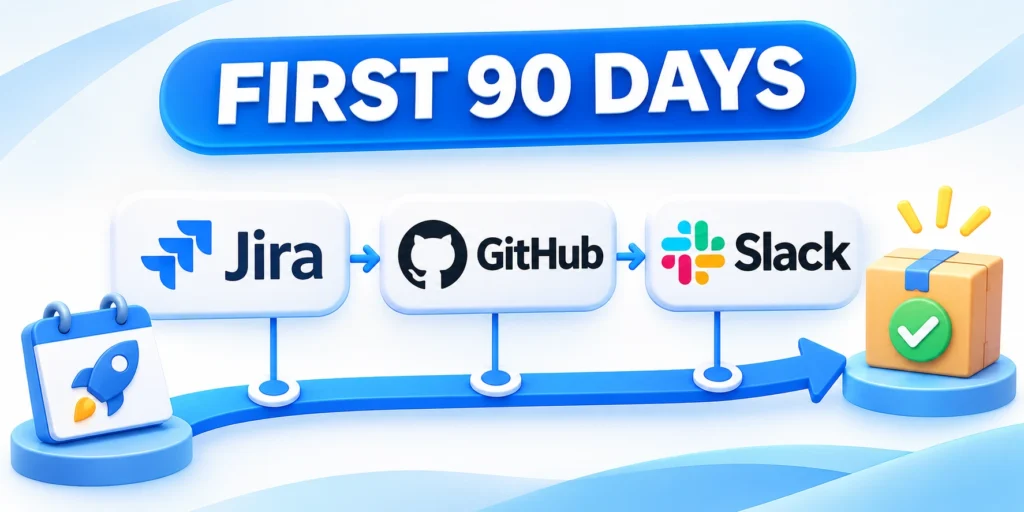
A 90-day plan gives both sides a shared way to test the relationship. Keep milestones focused on learning and usable outcomes, not arbitrary volume of tickets.
Set a baseline before work begins: current release process, known defects, product measures, and outstanding decisions. This makes later progress easier to interpret.
| Period | Practical focus | Evidence to review |
|---|---|---|
| Days 1–30 | Onboard, map the system, ship one small change. | Environment works and first release is observable. |
| Days 31–60 | Ship one workflow and reduce the largest blocker. | Users can test it; risks and defects are visible. |
| Days 61–90 | Improve delivery and agree on the next outcomes. | Product evidence, friction, and forward plan. |
Prepare the first review agenda
Use these actions to prepare the first review agenda:
- Demo the workflow and show what is available in a test environment.
- Review open risks, decisions, and dependencies with named owners.
- Compare planned work with completed outcomes and explain material changes.
- Collect user feedback and decide what to validate next.
- Confirm whether staffing and collaboration agreements still fit the work.
Send evidence before the review so participants can inspect results. Reserve meeting time for decisions, tradeoffs, risks, and changes to the operating model.
Record each decision with an owner and deadline. Distinguish accepted risk from work that remains blocked or requires further validation.
Agree on a review point before the start
Schedule a review near the end of the first month and another near the third month. Ask both sides what is working, what is blocked, and what should change.
Key considerations for agree on a review point include:
- Are product decisions arriving quickly enough?
- Can stakeholders see and test working software?
- Are code review and release responsibilities clear?
- Do actual capabilities match the team presented during hiring?
- Are risks being raised early, with an owner and next action?
If the team misses an outcome, diagnose the system before blaming individuals. Check scope changes, access delays, unclear acceptance, dependencies, and decision turnaround.
Decide whether to continue, adjust, or transition
Continue when collaboration is healthy and outcomes are becoming clearer. Adjust team composition or working agreements when evidence points to a specific capability or process gap.
Prepare a transition when the engagement no longer fits. Maintain documentation and client-owned assets so another team can take over without rebuilding essential knowledge.
Define the Product Leadership Interface

Name the person who sets outcomes, resolves priority conflicts, accepts work, and represents customer and business evidence to the remote team throughout delivery.
Without timely product decisions, additional engineers increase waiting, rework, and coordination rather than delivery capacity, reliable learning, or customer value.
Protect Client Ownership and Continuity
Keep repositories, cloud accounts, domains, documentation, credentials, data, build pipelines, and critical vendor relationships under approved client control.
Use named access, backups, offboarding, export rights, transition assistance, and regular recovery tests so one provider cannot become an uncontrolled dependency.
Set Decision and Acceptance Service Levels
Define who answers product questions, resolves conflicts, accepts work, and supplies customer evidence. Set response expectations that match delivery risk and urgency.
Track decision delay separately from engineering time. Repeated waiting can make a capable team appear slow while unfinished work accumulates.
Use these controls for timely product decisions:
- Name one accountable product decision-maker.
- Publish acceptance criteria before implementation.
- Record priority changes with business context.
- Escalate blocked decisions through a named route.
- Review decision delay during delivery reviews.
Protect Product Context During Turnover
Store outcomes, assumptions, decisions, user evidence, and acceptance history with the client. Avoid critical reasoning that exists only in meetings or individual messages.
When people rotate, review current priorities, unresolved risks, and customer evidence before assigning work. Context transfer protects continuity better than code access alone.
Establish Engineering Quality Controls
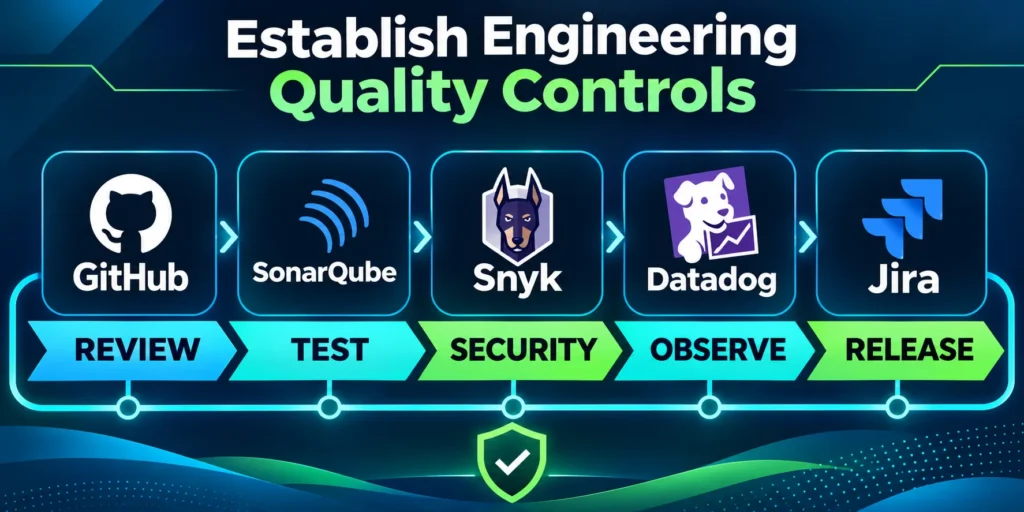
Agree on code review, testing, security, architecture decisions, observability, release approval, incident response, documentation, and definition of done.
Evaluate controls through working evidence from representative tasks instead of relying on process descriptions or certifications alone.
Verify Controls Through Delivery Evidence
Ask the team to demonstrate review, tests, security checks, deployment approval, monitoring, and rollback using one representative change.
Evidence should identify the change, owner, result, exception, and follow-up. Screenshots without traceable context provide weak assurance.
Review these engineering controls before scaling:
- Peer review for material code changes.
- Automated tests tied to acceptance behavior.
- Security checks with owned remediation.
- Observable releases and tested rollback.
- Incident learning connected to backlog changes.
Plan Communication Across Time Zones
Define overlap for decisions, pairing, incidents, and customer obligations, then use written context, ownership, and deadlines for asynchronous work.
Escalation routes must cover urgent production issues without requiring every contributor to remain continuously available.
Measure Outcomes and Team Health
Review usable delivery, change lead time, defects, recovery, predictability, support, rework, decision delay, knowledge continuity, and stakeholder outcomes.
Interpret indicators together; faster output is not success when quality, security, ownership, sustainability, or customer value deteriorates.
Review Quality Signals Together
Compare delivery speed with defects, recovery, support effort, rework, security findings, and decision delay. No single metric represents team effectiveness.
Use trends to ask better questions, not rank individuals. Investigate system constraints before changing headcount, process, or commercial terms.
Run a Paid Trial Before Scaling the Team
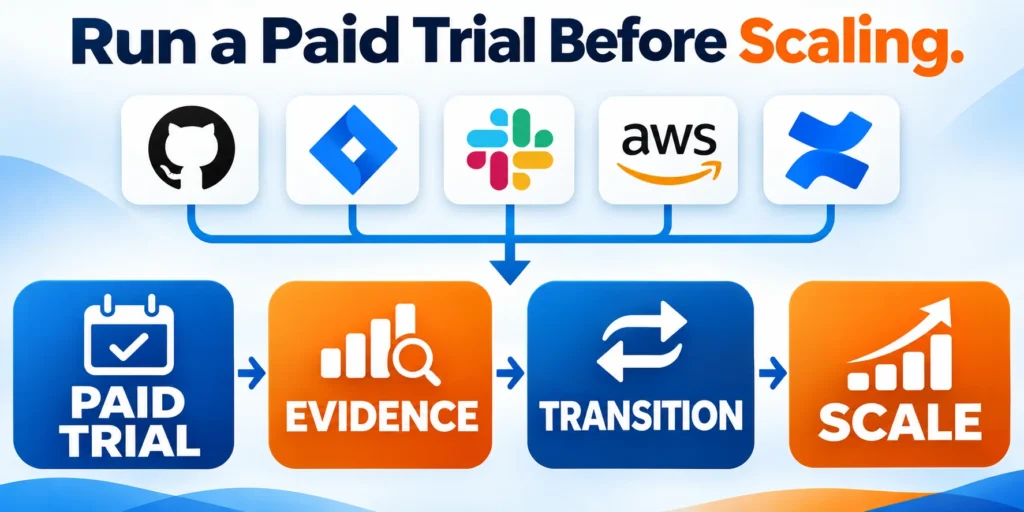
Use a representative paid assignment to evaluate discovery, communication, code quality, testing, documentation, review discipline, estimation, and responses under normal working conditions.
Define acceptance criteria, access boundaries, and responsible exit conditions beforehand, then compare observed collaboration against the operating model promised during selection.
Prepare a Responsible Transition Plan
Document repositories, environments, dependencies, decisions, owners, credentials, release procedures, support duties, data exports, and unresolved risks throughout the engagement.
A transition should preserve product continuity and customer knowledge when individuals rotate, the commercial model changes, or the relationship ends unexpectedly.
Design a Representative Paid Trial
Choose a realistic assignment covering discovery, delivery, review, testing, documentation, and communication. Avoid puzzles unrelated to the role.
Limit access and data according to risk. Pay for the assignment, define ownership, and explain how evidence will influence the final hiring decision.
Capture these decision signals during the paid trial:
- Questions that clarify outcomes and constraints.
- Technical decisions with explicit tradeoffs.
- Review response and correction quality.
- Testing, documentation, and release discipline.
- Transparent handling of uncertainty and delays.
Decide Whether to Scale or Transition
Scale when evidence supports capability, collaboration, ownership, security, sustainable economics, and dependable customer outcomes. Record remaining risks and required controls during expansion.
Transition when material gaps remain unresolved or trust deteriorates. Preserve repositories, environments, decisions, credentials, documentation, customer communication, service continuity, and a prioritized handoff plan.
FAQ
These answers clarify common questions about dedicated remote teams, provider evaluation, ownership, time zones, security, turnover, and responsible transitions.
How is a dedicated team different from staff augmentation?
A dedicated team usually brings a coordinated group for continuing product work. Staff augmentation adds individual specialists to a delivery system your organization already manages.
How many developers should I hire?
Start from the responsibilities and first release, not a standard headcount. Choose the smallest mix that can deliver safely while covering product decisions, engineering, testing, and operations.
Should the remote team work in my time zone?
Full overlap is not always needed. Agree on dependable overlap for decisions and pairing, then use written handoffs for work that can proceed asynchronously.
How can I evaluate a provider’s engineers?
Meet the proposed team, use consistent role-based questions, review relevant work, and try a short job-related exercise. Record evidence rather than relying on sales claims.
Who should own the source code and cloud accounts?
Usually the client organization should control critical repositories, cloud accounts, and deployment credentials. Confirm ownership and access terms with your legal and security reviewers.
Should a remote team use the client’s tools?
Use approved systems that preserve client ownership, security, auditability, collaboration, access control, export, and transition needs.
How should provider turnover be handled?
Require notice, access changes, knowledge transfer, replacement review, continuity plans, and protection of delivery and customer obligations.
Can a dedicated team work across several products?
Yes, when priorities, ownership, capacity, dependencies, and outcomes remain explicit enough to prevent constant interruption and hidden queues.
How are remote-team security practices verified?
Review access, devices, identity, repositories, environments, data handling, logs, incidents, offboarding, and representative evidence.
When should the engagement be ended?
End or transition when outcomes, trust, capability, economics, security, ownership, or collaboration no longer support a recoverable improvement plan.
Conclusion

Hiring succeeds when the client defines outcomes, supplies product leadership, verifies capability, protects ownership, and evaluates the operating relationship through evidence over time.
Use a paid trial and controlled start with representative people, tools, and decision-makers before expanding headcount, commitments, or access.
Complete these actions before final selection:
- Define the first outcome and acceptance evidence.
- Name product and technical decision owners.
- Verify proposed people through relevant work.
- Protect repositories, accounts, data, and credentials.
- Agree on reviews, escalation, and transition duties.
Choose the Smallest Complete Team
Cover product decisions, implementation, testing, release, operations, and support load without adding roles that the first outcome does not require.
Expand only when evidence shows a stable constraint that another capability can resolve. More developers cannot replace delayed decisions or unclear acceptance.
Review the Operating Relationship
Assess outcomes, quality, predictability, security, ownership, support, decision speed, team health, and economics together at agreed review points.
Address specific gaps with owners, deadlines, evidence, and review points. If the relationship no longer fits, use the documented transition process before continuity deteriorates.
Preserve Evidence for the Next Decision
Keep trial results, decisions, exceptions, risks, access reviews, release evidence, and transition records under client control for future commercial and staffing decisions.
For related integration planning, use the Custom API Development and Third-Party Integrations Playbook to define boundaries, ownership, and failure handling.



Leave a Reply