

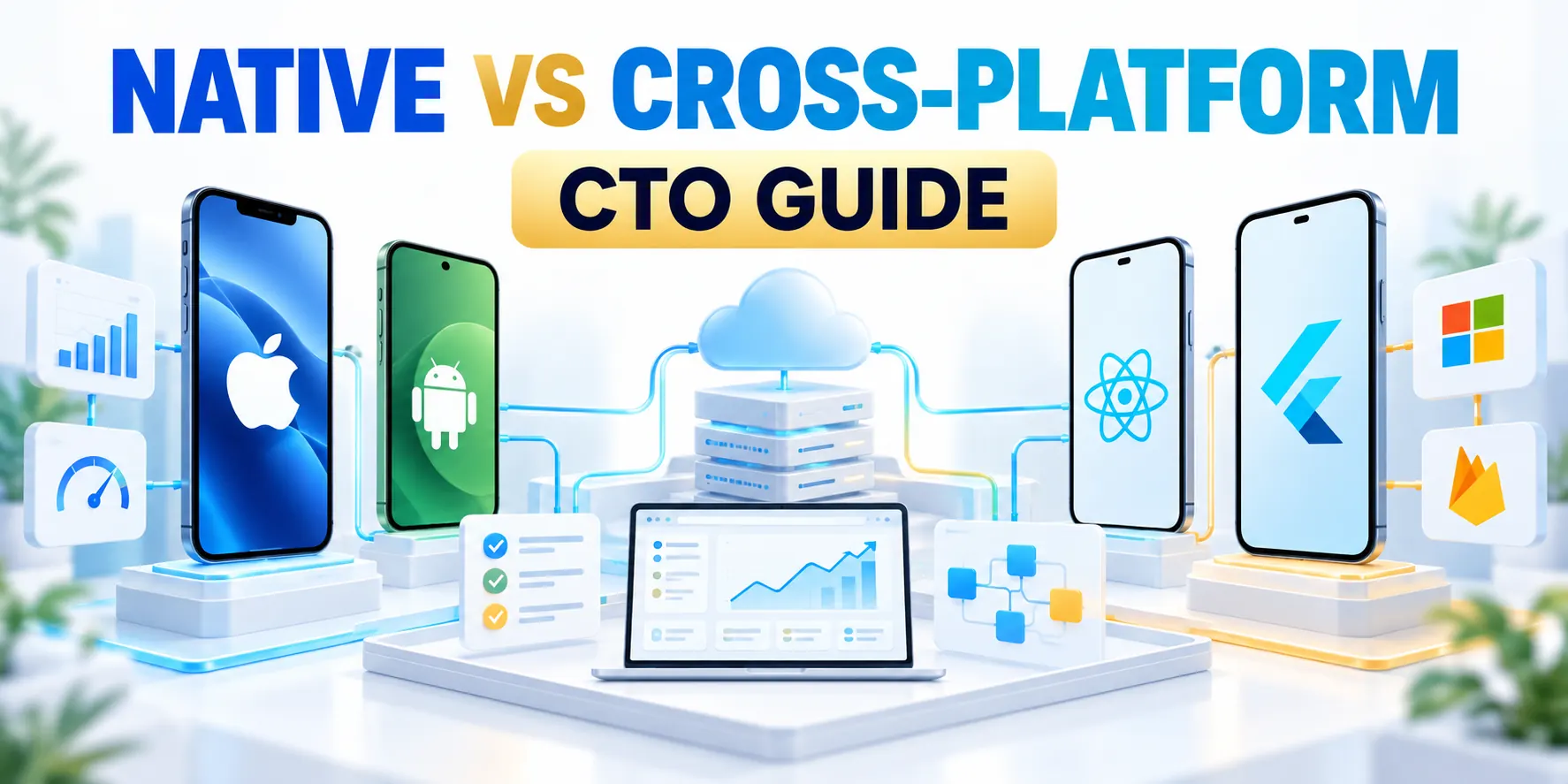
Frame the mobile architecture decision around product constraints
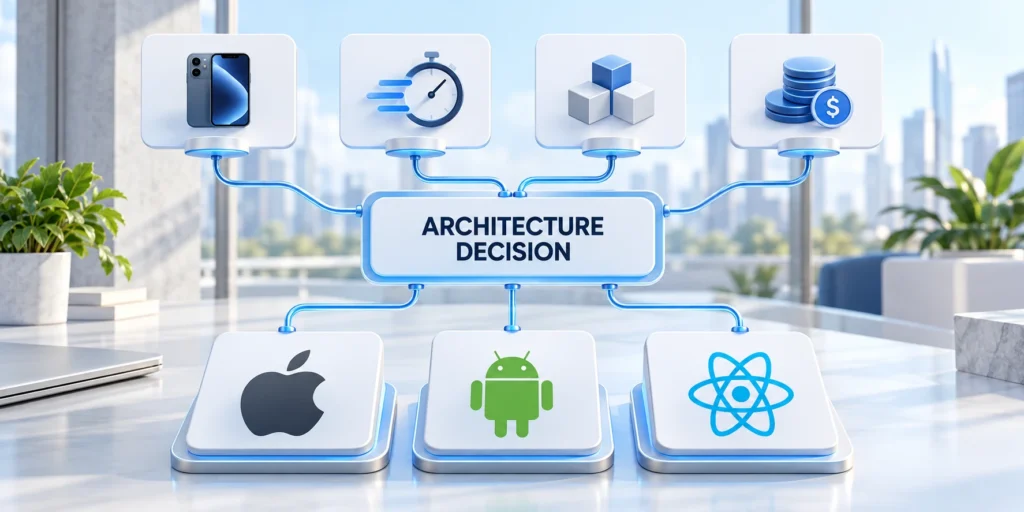
Native vs cross-platform development should be decided through product constraints, not framework popularity. Business goals, device capabilities, service levels, regulations, and release expectations define viable options.
A CTO needs evidence about the product’s hardest workflows. A generic feature list cannot reveal where platform integration, performance, accessibility, security, or team capacity will create durable risk.
Define the decision horizon
Decide whether the architecture must support a short market experiment, a regulated operational system, or a long-lived customer platform. Each horizon changes acceptable technical debt.
A six-month validation product may favor delivery speed. A five-year field application may prioritize predictable upgrades, offline resilience, hardware access, and platform-specific operational control.
Use this operational checklist for the decision:
- Expected product lifetime and investment horizon.
- Number of supported operating systems, form factors, and regions.
- Release frequency and acceptable store-review dependency.
- Availability, recovery, privacy, and regulatory obligations.
- Required integrations with cameras, sensors, payments, identity, or background services.
- Expected user volume, data volume, and peak interaction patterns.
Map critical user journeys
Identify journeys where delays, crashes, inconsistent controls, or unavailable device features would damage revenue, safety, trust, or adoption. Treat these journeys as architectural tests.
For a sales application, offline account access may be critical. For a consumer marketplace, startup time, payment reliability, deep links, notifications, and accessible navigation may dominate.
| Constraint | Question | Architectural consequence |
|---|---|---|
| Offline work | Review evidence before release | Review evidence before release |
| Device integration | Review evidence before release | Review evidence before release |
| Experience | Which interactions must feel platform-specific? | Review evidence before release |
| Compliance | Which controls require evidence? | Review evidence before release |
| Delivery | How often must both platforms ship? | Review evidence before release |
Separate assumptions from constraints
Teams often call preferences constraints. A familiar language, existing vendor relationship, or popular framework may influence delivery, but it should not replace product evidence.
Record each claim with an owner, confidence level, evidence source, and validation method. Unknowns become proof-of-concept questions rather than hidden reasons for a permanent commitment.
Use this operational checklist for the decision:
- List the journeys that create the most business or operational risk.
- Describe the required experience and measurable acceptance criteria.
- Identify operating-system services used by each journey.
- Estimate product lifetime, supported devices, and release cadence.
- Mark assumptions that need prototypes, benchmarks, or vendor confirmation.
- Define which findings would eliminate an option.
Use a weighted decision scorecard
Weight criteria according to business impact before scoring any approach. This prevents stakeholders from increasing a criterion’s importance after seeing which option it favors.
Keep the scorecard small enough to discuss. Pair every score with evidence and uncertainty, then conduct sensitivity analysis on criteria that could reverse the decision.
| Criterion | Example weight | Evidence |
|---|---|---|
| Critical journey performance | 25% | Prototype measurements on representative devices |
| Device and operating-system access | 20% | Integration spike and platform documentation |
| Delivery capacity | 20% | Team skills, hiring market, and release simulation |
| Lifecycle risk | 20% | Upgrade exercise and dependency inventory |
| Total ownership cost | 15% | Three-year operating model with ranges |
Compare native and cross-platform architecture boundaries

Native development builds each application with the platform’s primary toolchain and interfaces. Cross-platform development shares selected presentation, business, data, or integration code across operating systems.
The meaningful question is not whether code is shared. It is where the architecture places shared logic, platform adapters, native user interfaces, build pipelines, tests, and operational ownership.
Understand the native operating model
A native architecture gives each platform direct access to its interface frameworks, lifecycle events, security services, accessibility APIs, performance tools, and newly released capabilities.
It also creates separate implementation paths. Teams must coordinate product behavior, analytics, design semantics, backend contracts, quality gates, and release timing without assuming identical platform code.
Use this operational checklist for the decision:
- Direct adoption of new operating-system capabilities.
- Platform-specific interface behavior and accessibility semantics.
- Independent optimization, diagnostics, and release control.
- Separate code ownership and duplicated presentation work.
- Greater coordination demand across product and platform teams.
Understand cross-platform boundaries
Cross-platform frameworks can share interface and application logic while calling native capabilities through maintained packages or custom modules. The practical sharing percentage varies by product.
A framework does not remove platform differences. Permissions, background execution, notifications, payments, accessibility, app-store policies, signing, and device behavior still require platform-aware engineering and testing.
| Layer | Native approach | Cross-platform approach |
|---|---|---|
| User interface | Separate platform components | Review evidence before release |
| Business rules | Duplicated or shared service contracts | Usually shared application logic |
| Device services | Direct platform APIs | Review evidence before release |
| Build and release | Independent toolchains | Review evidence before release |
| Testing | Platform-focused suites | Shared tests plus mandatory platform coverage |
Consider selective code sharing
The choice is not always binary. Kotlin Multiplatform, shared C++ libraries, web views, design tokens, generated API clients, and shared test specifications support narrower reuse.
Android’s Kotlin Multiplatform guidance describes sharing business logic while retaining native interfaces when appropriate. This boundary can preserve platform experience without duplicating every rule.
Use this operational checklist for the decision:
- Share domain models, validation, networking, and persistence selectively.
- Keep platform interfaces native when interaction quality demands it.
- Generate clients from stable service contracts.
- Share design tokens and behavior specifications across implementations.
- Avoid forcing platform-specific workflows into an unsuitable abstraction.
Evaluate dependency ownership
List every framework, plugin, native bridge, build tool, analytics library, and critical maintainer. Determine who fixes compatibility failures after operating-system or store changes.
A package with many downloads can still create lifecycle risk. Review update cadence, issue response, platform coverage, license, security process, migration history, and replacement options.
Use this operational checklist for the decision:
- Inventory dependencies used by critical journeys.
- Identify maintainers and commercial support where available.
- Review compatibility with current and upcoming platform releases.
- Prototype replacing one critical package with a native module.
- Estimate the cost of a framework major-version migration.
- Document an exit path for abandoned dependencies.
Evaluate user experience, performance, and device integration

Performance decisions need workload-specific measurements. Startup, animation, memory, energy use, network behavior, local queries, background tasks, and failure recovery affect different products differently.
Measure on representative low, middle, and high-tier devices. Development machines and flagship phones conceal delays, memory pressure, thermal throttling, poor connectivity, and accessibility failures.
Create an experience budget
Define measurable budgets for the critical journeys before implementation. Include cold startup, warm startup, interaction response, animation stability, screen transition, network feedback, and recovery time.
Pair technical measurements with user outcomes. A fast render does not help if focus order is broken, permission requests are confusing, or state disappears after interruption.
| Experience area | Example measure | Test condition |
|---|---|---|
| Startup | Time to useful interaction | Cold launch on supported low-tier device |
| Responsiveness | Input-to-feedback latency | Representative data and background load |
| Rendering | Slow or dropped frames | Complex navigation and scrolling |
| Reliability | Crash-free and successful sessions | Production-like services and failure injection |
| Accessibility | Keyboard, screen-reader, and scaling completion | Real platform assistive technologies |
Test platform behavior, not only shared logic
Shared unit tests can verify business rules, but they cannot prove camera permissions, notification delivery, deep linking, biometric prompts, background work, or accessible navigation.
Flutter’s testing guidance separates unit, widget, and integration tests. A production plan should also include real-device coverage, store builds, backend failures, and platform-specific acceptance tests.
Use this operational checklist for the decision:
- Run critical journeys on physical devices from the support matrix.
- Test denied, revoked, and limited permissions.
- Interrupt workflows with calls, lock screens, restarts, and low memory.
- Exercise slow, intermittent, and unavailable networks.
- Verify text scaling, screen readers, contrast, and focus navigation.
- Measure release builds rather than development builds.
Validate native module escape routes
React Native documentation explains that native modules and components can expose platform capabilities unavailable through the shared layer. The team still owns integration, lifecycle, testing, and upgrades.
Prototype the hardest device integration early. Confirm data transfer, threading, error propagation, permission changes, background behavior, and compatibility with the framework’s current architecture.
Use this operational checklist for the decision:
- Choose the highest-risk platform capability.
- Implement the smallest complete vertical journey.
- Instrument latency, memory, failures, and recovery.
- Test both platforms with the same acceptance criteria.
- Upgrade the framework or toolchain during the prototype.
- Record custom native code that production teams must own.
Assess interface consistency intentionally
Shared interfaces improve consistency and delivery efficiency, but identical controls can conflict with platform expectations. Decide where brand consistency matters and where native conventions reduce learning effort.
Create a platform adaptation matrix for navigation, gestures, dialogs, typography, keyboard behavior, sharing, settings, payments, and accessibility. Review exceptions with design and engineering together.
| Element | Shared by default | Platform adaptation trigger |
|---|---|---|
| Brand tokens | Color, spacing, and core typography | Accessibility or system contrast requirements |
| Navigation | Information architecture | Platform back behavior and tab conventions |
| Forms | Validation and business rules | Keyboard, autofill, date, and selection controls |
| Permissions | User explanation | Operating-system sequence and settings path |
| Payments | Commercial rules | Store policies and platform purchase APIs |
Model team capacity, delivery cost, and lifecycle risk

Initial feature velocity is only one cost component. Include architecture, design adaptation, automation, testing, observability, store operations, dependency upgrades, incident response, hiring, and eventual migration.
Model ranges rather than a single promised saving. Shared code may reduce repeated implementation while increasing framework specialization, native integration work, and coordinated upgrade risk.
Map skills and ownership
Inventory current skills by platform, language, framework, backend, quality engineering, security, accessibility, and release operations. Identify responsibilities that have only one qualified owner.
A cross-platform team still needs people who understand both operating systems. A native model still benefits from shared product architecture, service contracts, design systems, and coordinated quality practices.
Use this operational checklist for the decision:
- Named owners for each platform and shared layer.
- Coverage for build signing, store submission, and release recovery.
- Capacity for native modules and framework upgrades.
- Quality engineering across real devices and accessibility tools.
- On-call ownership for mobile-specific production failures.
- Succession plan for specialized knowledge.
Build a three-year cost model
Estimate acquisition and operating costs across releases. Include engineering, quality assurance, devices, cloud builds, monitoring, security reviews, support, training, recruitment, and vendor services.
Use optimistic, expected, and adverse scenarios. The adverse case should include a major framework migration, abandoned dependency, urgent platform-policy change, or difficult native integration.
| Cost area | Native model | Cross-platform model |
|---|---|---|
| Feature implementation | Separate interface work | Shared work with platform adaptations |
| Specialist capacity | Platform specialists | Framework specialists plus native expertise |
| Testing | Separate suites and coordination | Shared suites plus both platform matrices |
| Upgrades | Independent platform upgrades | Framework, packages, and platform upgrades |
| Exit cost | Rewrite selected platform areas | Replace framework or expand native layers |
Model delivery flow
Measure lead time from approved requirement to production on both platforms. Identify queues for shared components, native modules, design review, device testing, store approvals, and release coordination.
A single repository does not guarantee faster flow. Bottlenecks may move into a shared team, package owner, release engineer, or platform expert who reviews every exception.
Use this operational checklist for the decision:
- Map the current delivery value stream for both platforms.
- Record waiting time separately from active engineering time.
- Simulate one shared feature and one platform-specific feature.
- Identify approvals and specialists on the critical path.
- Estimate parallel work and coordination overhead.
- Use the findings in staffing and release planning.
Plan upgrades and reversibility
Define supported versions, upgrade cadence, dependency review, deprecation handling, security response, and ownership for beta operating-system testing. Budget this work as product maintenance.
Preserve exit options through modular boundaries, stable backend contracts, portable domain rules, isolated device adapters, documented decisions, and tests that describe behavior independently from the framework.
Use this operational checklist for the decision:
- Test new operating-system betas before public release.
- Schedule framework and dependency upgrades before emergency deadlines.
- Keep critical native modules small and documented.
- Separate business rules from interface framework details.
- Maintain behavioral tests that survive implementation changes.
- Review replacement options for critical dependencies annually.
Run a proof of concept and record the architecture decision

A useful proof of concept answers a decision question with production-like evidence. It should test the hardest journey, uncertain integration, representative devices, release tooling, and operational diagnostics.
Do not compare polished native code with an inexperienced framework prototype. Use comparable acceptance criteria, qualified engineers, measured results, documented assumptions, and the same backend conditions.
Design a fair proof of concept
Select one vertical journey that crosses interface, state, network, storage, device integration, analytics, accessibility, and recovery. Avoid a demonstration that exercises only simple screens.
Time-box the experiment, but include setup, debugging, testing, build automation, store packaging, and one dependency upgrade. These tasks reveal delivery friction hidden by feature coding alone.
Use this operational checklist for the decision:
- State the architecture question and elimination criteria.
- Choose a representative critical journey.
- Define shared functional and nonfunctional acceptance tests.
- Use realistic data, devices, network conditions, and security controls.
- Instrument performance, stability, accessibility, and developer effort.
- Exercise build, signing, distribution, monitoring, and recovery.
- Review results with product, design, security, and operations.
Capture evidence consistently
Record device models, operating-system versions, framework versions, build type, datasets, network conditions, test scripts, measurements, defects, workarounds, and engineer experience level.
Distinguish observed facts from forecasts. A successful prototype proves feasibility under tested conditions, not guaranteed scale, maintainability, staffing availability, or future framework support.
| Evidence | What to record | Decision use |
|---|---|---|
| Performance | Median, tail, device, build, and workload | Validate experience budgets |
| Integration | Native code, packages, failures, and recovery | Estimate platform ownership |
| Delivery | Active effort, waiting, debugging, and setup | Model team capacity |
| Quality | Tests, defects, accessibility, and observability | Assess production readiness |
| Lifecycle | Upgrade steps, warnings, and replacements | Estimate maintenance risk |
Write an architecture decision record
Document the context, constraints, considered options, evidence, decision, consequences, risks, assumptions, owners, and review triggers. Link measurements and prototypes rather than copying every detail.
The record should explain tradeoffs honestly. Name capabilities the selected approach improves, costs it introduces, conditions that could invalidate it, and mitigations funded by the roadmap.
Use this operational checklist for the decision:
- Decision title, date, status, and accountable owner.
- Business context and critical user journeys.
- Options considered and explicit rejection reasons.
- Measurements, uncertainty, and confidence level.
- Operational, security, staffing, and lifecycle consequences.
- Review triggers tied to product or platform change.
Choose an implementation strategy
Adopt the selected approach incrementally where possible. Establish platform boundaries, coding standards, test matrices, observability, dependency governance, release ownership, and escalation paths before feature volume accelerates.
Connect the decision with the broader B2B web application architecture strategy so mobile and backend boundaries evolve through compatible contracts and operational evidence.
Use this operational checklist for the decision:
- Create the initial repository and module boundaries.
- Implement one production vertical journey end to end.
- Automate builds, tests, signing, and distribution.
- Establish real-device and accessibility coverage.
- Instrument critical journeys and failure recovery.
- Schedule the first architecture review after production evidence.
Connect the decision to enterprise mobile delivery
Place the selected framework within a governed product, release, support, and lifecycle model before expanding it across additional mobile initiatives.
For the broader delivery model, read our enterprise mobile app cross-platform strategy.
Validate offline and recovery behavior

Offline recovery validation gives product leaders a defined decision boundary before committing to a mobile implementation. Identify the critical journey, accountable owner, and expected operating effect.
Use a representative scope for offline recovery validation. A controlled decision creates useful evidence about user experience, delivery capacity, and lifecycle ownership.
Define offline recovery validation criteria
Name the architecture constraint, required evidence, test condition, decision owner, and reversal trigger for offline recovery validation. These details make the decision explainable.
Keep both the current assumption and the observed result visible during offline recovery validation. This prevents a framework preference from replacing product evidence.
Use these offline recovery validation criteria before approval:
- Defined offline journey
- Conflict resolution rule
- Recovery test condition
- Named support owner
- Measured user outcome
Review offline recovery validation outcomes
Compare offline recovery validation results with the critical user journey and operating model, not a generic framework claim. Include quality, cost, risk, and team evidence.
Record what offline recovery validation confirmed, what remains uncertain, and the next action. This gives future teams a practical architecture record.
Align offline recovery validation with delivery
Use the evidence to set a delivery scope, ownership boundary, and review date for offline recovery validation. The team can make changes without losing the decision context for release planning.
Revisit offline recovery validation when a critical journey, platform dependency, or operating constraint changes. A scheduled review makes the architecture adaptable rather than fragile.
Assess accessibility across both platforms

Accessibility evidence gives product leaders a defined decision boundary before committing to a mobile implementation. Identify the critical journey, accountable owner, and expected operating effect.
Use a representative scope for accessibility evidence. A controlled decision creates useful evidence about user experience, delivery capacity, and lifecycle ownership.
Define accessibility evidence criteria
Name the architecture constraint, required evidence, test condition, decision owner, and reversal trigger for accessibility evidence. These details make the decision explainable.
Keep both the current assumption and the observed result visible during accessibility evidence. This prevents a framework preference from replacing product evidence.
Use these accessibility evidence criteria before approval:
- Screen-reader interaction behavior test
- Text-scaling behavior test
- Keyboard navigation evidence
- Contrast validation evidence
- Assistive-device compatibility usability review inclusive
Review accessibility evidence outcomes
Compare accessibility evidence results with the critical user journey and operating model, not a generic framework claim. Include quality, cost, risk, and team evidence.
Record what accessibility evidence confirmed, what remains uncertain, and the next action. This gives future teams a practical architecture record.
Align accessibility evidence with delivery
Use the evidence to set a delivery scope, ownership boundary, and review date for accessibility evidence. The team can make changes without losing the decision context for release planning.
Revisit accessibility evidence when a critical journey, platform dependency, or operating constraint changes. A scheduled review makes the architecture adaptable rather than fragile.
Define release and observability ownership
Release observability ownership gives product leaders a defined decision boundary before committing to a mobile implementation. Identify the critical journey, accountable owner, and expected operating effect.
Use a representative scope for release observability ownership. A controlled decision creates useful evidence about user experience, delivery capacity, and lifecycle ownership.
Define release observability ownership criteria
Name the architecture constraint, required evidence, test condition, decision owner, and reversal trigger for release observability ownership. These details make the decision explainable.
Keep both the current assumption and the observed result visible during release observability ownership. This prevents a framework preference from replacing product evidence.
Use these release observability ownership criteria before approval:
- Build owner
- Store-release process
- Production telemetry
- Incident escalation
- Rollback decision
Review release observability ownership outcomes
Compare release observability ownership results with the critical user journey and operating model, not a generic framework claim. Include quality, cost, risk, and team evidence.
Record what release observability ownership confirmed, what remains uncertain, and the next action. This gives future teams a practical architecture record.
Align release observability ownership with delivery
Use the evidence to set a delivery scope, ownership boundary, and review date for release observability ownership. The team can make changes without losing the decision context for release planning.
Revisit release observability ownership when a critical journey, platform dependency, or operating constraint changes. A scheduled review makes the architecture adaptable rather than fragile.
Plan framework exit and migration options

Migration option planning gives product leaders a defined decision boundary before committing to a mobile implementation. Identify the critical journey, accountable owner, and expected operating effect.
Use a representative scope for migration option planning. A controlled decision creates useful evidence about user experience, delivery capacity, and lifecycle ownership.
Define migration option planning criteria
Name the architecture constraint, required evidence, test condition, decision owner, and reversal trigger for migration option planning. These details make the decision explainable.
Keep both the current assumption and the observed result visible during migration option planning. This prevents a framework preference from replacing product evidence.
Use these migration option planning criteria before approval:
- Module boundaries
- Portable business rules
- Dependency inventory
- Migration trigger
- Estimated exit cost
Review migration option planning outcomes
Compare migration option planning results with the critical user journey and operating model, not a generic framework claim. Include quality, cost, risk, and team evidence.
Record what migration option planning confirmed, what remains uncertain, and the next action. This gives future teams a practical architecture record.
Align migration option planning with delivery
Use the evidence to set a delivery scope, ownership boundary, and review date for migration option planning. The team can make changes without losing the decision context for release planning.
Revisit migration option planning when a critical journey, platform dependency, or operating constraint changes. A scheduled review makes the architecture adaptable rather than fragile.
FAQ
These answers clarify architecture constraints, user experience, team capacity, proof-of-concept evidence, and lifecycle decisions for enterprise mobile products.
Is native development always faster?
No. Native development can provide direct platform control, but delivery speed depends on product scope, team structure, duplicated work, automation, testing, and coordination across platforms.
Does cross-platform development eliminate native code?
Usually not. Device capabilities, operating-system lifecycle events, permissions, background work, store requirements, and framework gaps may require platform-specific configuration or native modules.
Which approach gives the best user experience?
Either can deliver a strong experience when the architecture, design adaptation, accessibility, performance budgets, device testing, and platform integrations satisfy the product’s critical journeys.
How much code should be shared?
Share code where behavior is genuinely common and maintainable. Keep platform-specific implementation where native conventions, hardware access, reliability, or independent optimization create greater value.
When should a CTO require a proof of concept?
Require one when critical performance, device integration, offline behavior, accessibility, framework maturity, upgrade risk, or team capability remains uncertain enough to change the decision.
Can a product change its mobile architecture later?
Yes, but migration cost depends on module boundaries, data contracts, automated tests, platform integrations, release coordination, and whether business logic remains portable.
How should accessibility affect the decision?
Test assistive technologies, focus behavior, text scaling, contrast, semantics, keyboard support, and platform conventions in the actual framework and target devices.
Should the same framework be used for every mobile product?
No. Reuse a standard when constraints align, but allow evidence-based exceptions for device integration, performance, accessibility, security, lifecycle, or team ownership.
What belongs in the architecture decision record?
Record the context, constraints, alternatives, evidence, chosen option, tradeoffs, ownership, review triggers, migration implications, and conditions that could reverse the decision.
How should framework upgrade risk be tested?
Upgrade a representative branch, rebuild native dependencies, run automated and device tests, measure effort, and verify rollback before committing the product roadmap.
Conclusion

Native and cross-platform development should be chosen through product constraints, critical journeys, operating capacity, and verified lifecycle evidence rather than framework preference.
A focused proof of concept gives teams the evidence to share what should be shared, keep what must remain native, and plan the ownership model before scale.
Maintain the architecture decision record
Review the selected approach after material changes to product scope, operating-system capabilities, team capacity, dependencies, or production evidence. The original choice should remain testable.
Keep constraints, measurements, ownership, tradeoffs, and reversal triggers together. A clear record helps product teams make future changes without reconstructing the original decision.
Keep these architecture practices visible:
- Test critical journeys
- Measure real devices
- Record ownership
- Plan dependency changes
- Review reversal triggers
Protect the operating model
Assign accountable owners for releases, incidents, upgrades, and platform-specific gaps before feature volume grows. Shared code does not remove platform responsibility.
Revise the architecture when evidence shows the product constraints have changed. A disciplined review is more valuable than defending an outdated initial choice.
Use evidence for the next decision
Share the proof-of-concept results with product, engineering, design, and operations before expanding the implementation. The result should state the supported scope and unresolved risks.
Set the next review around measured behavior, support demand, and platform change instead of an assumed framework advantage. This keeps the architecture decision connected to outcomes.



Leave a Reply