


Assess the Application Before Accepting Support

A legacy application support takeover begins with evidence, not a calendar date. The incoming team needs enough visibility to understand what it will own.
The assessment should connect business criticality, architecture, operational history, dependencies, access, deployment practices, and known constraints into one decision-ready view.
Build evidence before accepting accountability
Start with the application’s business purpose, critical journeys, user groups, operating hours, and financial or customer consequences when those journeys fail.
Then trace the technical path behind each journey, including interfaces, scheduled jobs, databases, identity services, infrastructure, vendors, and manual recovery steps.
Use these actions to build evidence before accepting accountability:
- Business-critical journeys and owners
- Architecture and dependency maps
- Source, build, and release access
- Incident and defect history
- Support contracts and vendor contacts
- Recovery evidence and known limitations
Review recent tickets and changes to identify recurring failures, fragile components, undocumented workarounds, and areas where only one person understands the behavior.
Compare written procedures with actual operations. A polished document is weak evidence when it does not match production access, current dependencies, or responder habits.
Turn uncertainty into explicit transition conditions
Record unknowns as transition risks with owners and due dates. Do not silently convert missing evidence into assumptions that the incoming team inherits.
Define acceptance conditions for critical gaps, such as unavailable repositories, untested backups, missing credentials, unsupported runtimes, or absent vendor escalation paths.
Key considerations for turn uncertainty into explicit transition include:
- Accept with verified evidence
- Accept with a dated remediation
- Keep responsibility with the incumbent
- Escalate a business risk decision
The assessment is not a modernization proposal. Its immediate purpose is to make support responsibility safe, measurable, and understandable before ownership changes.
A precise starting point also protects both teams from later disputes about inherited defects, missing controls, and obligations that were never included in scope.
Plan Knowledge Transfer Around Real Work
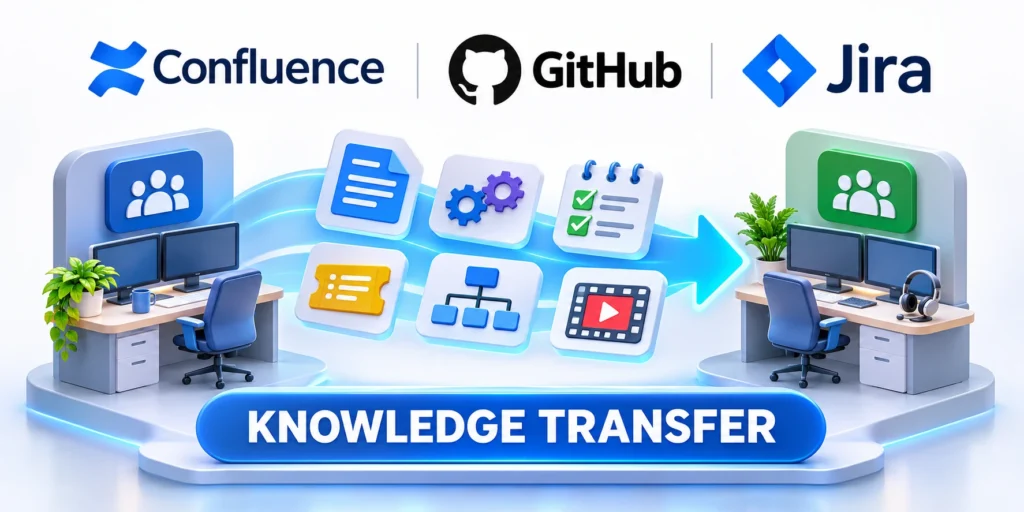
Test knowledge transfer against actual support tasks. If a nearshore development team is taking over, rehearse incident diagnosis and releases before handing over responsibility.
Prioritize frequent incidents, high-impact failures, releases, data corrections, certificate renewals, batch operations, vendor interactions, and recovery activities that determine service continuity.
Use production scenarios as the curriculum
Ask the incumbent team to demonstrate each scenario using current tools and environments. Capture decisions, prerequisites, checkpoints, failure signs, and escalation conditions.
Pair written runbooks with tickets, dashboards, logs, code paths, and deployment evidence so the receiving team understands both procedure and underlying system behavior.
Apply these criteria to production scenarios as the curriculum:
- Incident diagnosis and restoration
- Routine releases and rollback
- Data repair and reconciliation
- Access and certificate renewal
- Vendor escalation and follow-up
- Backup and recovery validation
Use shadow support first: the incoming team observes while the incumbent explains decisions. Then reverse the roles and require the receiver to lead.
Keep sessions short enough to produce usable artifacts. A recording without an indexed runbook, owner, and review date becomes difficult to find during an incident.
Prove that knowledge can be used independently
Test knowledge through realistic exercises. Give the receiving team an unfamiliar ticket, a degraded dependency, or a failed release and observe its investigation path.
Document gaps immediately and repeat the scenario after correction. Completion should depend on demonstrated capability, not the number of meetings held.
Key considerations for prove that knowledge can be include:
- Receiver explains the diagnosis
- Receiver performs the procedure
- Evidence is captured and searchable
- Escalation paths are understood
- Gaps have owners and deadlines
Assign every artifact an owner and review cadence. Runbooks should evolve when the team resolves incidents, changes architecture, or learns that a step is unreliable.
The result is an operational knowledge system that supports independent action, rather than a one-time archive created only to satisfy the transition schedule.
Secure Environments, Access, and Credentials
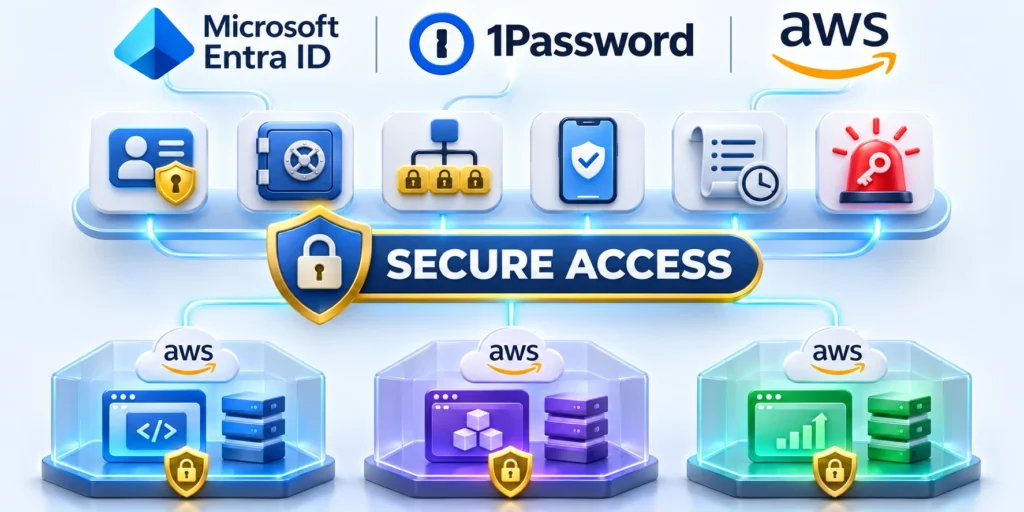
The receiving team cannot support an application safely without verified access. It also should not inherit shared credentials, dormant accounts, or undocumented administrator privileges.
Create an environment-by-environment access inventory covering source control, cloud consoles, servers, databases, monitoring, ticketing, secrets, vendors, and business administration interfaces.
Establish controlled access before operational responsibility
Map access to named roles and duties. Separate routine support, deployment, database administration, security response, and emergency recovery instead of granting broad access by default.
Use individual identities, multifactor authentication, approved credential vaults, and auditable elevation wherever the existing platforms allow those controls.
Key considerations for establish controlled access before operational include:
- Named accounts for every responder
- Least-privilege support roles
- Vaulted service credentials
- Audited emergency access
- Environment-specific approval paths
- Vendor portal ownership
Validate access through controlled tasks before the takeover date. A successful login is insufficient when the user cannot retrieve logs, restart services, or deploy safely.
Confirm that monitoring and ticket alerts reach the correct rotation. Misrouted notifications can leave the new team accountable for incidents it never receives.
Remove inherited access without creating an outage
Plan removal of incumbent access in stages aligned with the responsibility waves. Keep only the access required for agreed shadowing and fallback periods.
Rotate shared secrets after ownership changes, but sequence rotations with dependency testing. An undocumented integration may still depend on an older credential.
Key considerations for remove inherited access without creating include:
- Inventory current identities
- Approve replacement roles
- Test operational permissions
- Rotate secrets by dependency
- Remove access with evidence
Retain an emergency path with explicit authorization, expiration, and logging. Emergency access should solve exceptional failures without becoming a shortcut for daily support.
A secure takeover leaves the application supportable while reducing anonymous privileges, unclear ownership, and credentials that cannot be traced to accountable people or systems.
Triage Incidents, Defects, and Technical Debt

Legacy support queues often mix outages, defects, requests, recurring workarounds, and modernization ideas. Treating them as one backlog hides urgency and distorts capacity.
Define distinct work types with entry criteria, ownership, service targets, and closure evidence. The same symptom may require immediate restoration and a separate corrective item.
Separate urgent restoration from durable improvement
Incidents focus on restoring a service or critical journey. Defects describe incorrect product behavior. Technical debt captures maintainability constraints that create measurable future risk.
Requests and routine operations need their own path because they compete for the same people but do not represent service failure.
Use these actions to separate urgent restoration from durable improvement:
- Incidents restore affected service
- Defects correct product behavior
- Requests fulfill approved needs
- Technical debt reduces future risk
- Problems address recurring causes
Use a temporary transition queue for unclassified work. Review it frequently and move each item into the correct workflow rather than allowing it to become permanent.
Use business impact, urgency, recurrence, workaround quality, data risk, and cost of delay to prioritize. Age alone should not determine which item is next.
Prevent the inherited backlog from controlling the transition
Baseline the inherited backlog before adding new commitments. Identify duplicates, obsolete requests, abandoned changes, and tickets that lack enough evidence to act.
Agree which items transfer, which stay with the incumbent, and which require a business decision. Do not silently accept an unlimited historical backlog.
Key considerations for prevent the inherited backlog from include:
- Confirm scope and ownership
- Remove duplicates and obsolete work
- Identify missing reproduction evidence
- Separate restoration from correction
- Escalate unresolved business priorities
Track reopened work and repeated workarounds because they reveal weak diagnosis or insufficient closure criteria. These signals guide the first stabilization priorities.
Clear triage protects response capacity while giving stakeholders an honest view of inherited risk, ongoing demand, and the work required to improve supportability.
Create an Operational Baseline
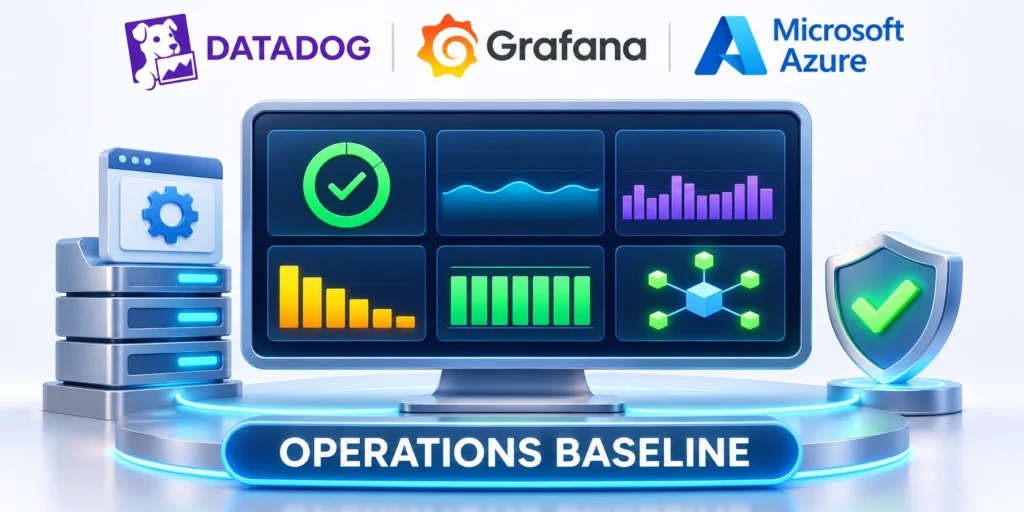
A transition needs an operational baseline so both parties can distinguish inherited behavior from changes introduced during the takeover. Start before responsibilities move.
Measure service outcomes, workload, backlog, changes, recovery performance, and dependency health using definitions that the incoming and incumbent teams both understand.
Measure the service before changing ownership
Choose metrics tied to customer journeys and support decisions. Averages alone can conceal regional failures, long-tail latency, recurring incidents, and vulnerable customer segments.
Record measurement windows, exclusions, data sources, and known blind spots. Precision about limitations is more useful than a polished dashboard with unexplained numbers.
Use these actions to measure the service before changing ownership:
- Critical journey availability
- Incident volume and recurrence
- Response and restoration time
- Backlog age and reopen rate
- Failed changes and rollback frequency
- Dependency and job health
Include qualitative evidence such as fragile manual steps, noisy alerts, single-person dependencies, and vendor delays. These conditions affect reliability before they appear in service metrics.
Keep the baseline period long enough to capture normal operating cycles. Month-end processing or scheduled customer events may expose risks that a quiet week misses.
Use the baseline to detect transition harm
Compare the baseline after each responsibility wave. Investigate meaningful deterioration in response, restoration, backlog, alert coverage, or release outcomes before expanding scope.
Avoid using the transition itself to reset targets quietly. Any target change should have an explicit business rationale and documented approval.
Apply these criteria to the baseline to detect transition harm:
- Keep definitions unchanged
- Compare equivalent operating periods
- Explain missing or unreliable data
- Investigate material movement
- Assign corrective actions
| Signal | Starting measure | Transition use |
|---|---|---|
| Availability | Critical journey result | Detect service decline |
| Restoration | Time to restore | Test response readiness |
| Backlog | Age and reopen rate | Reveal support pressure |
| Changes | Failure and rollback | Control release risk |
A baseline is not a performance guarantee. It is a shared reference for recognizing risk, validating stabilization, and deciding whether the next transition gate is safe.
Once ownership stabilizes, evolve the measures into ongoing service objectives without losing the historical context that explains the application’s inherited operating profile.
Move Responsibilities in Controlled Waves
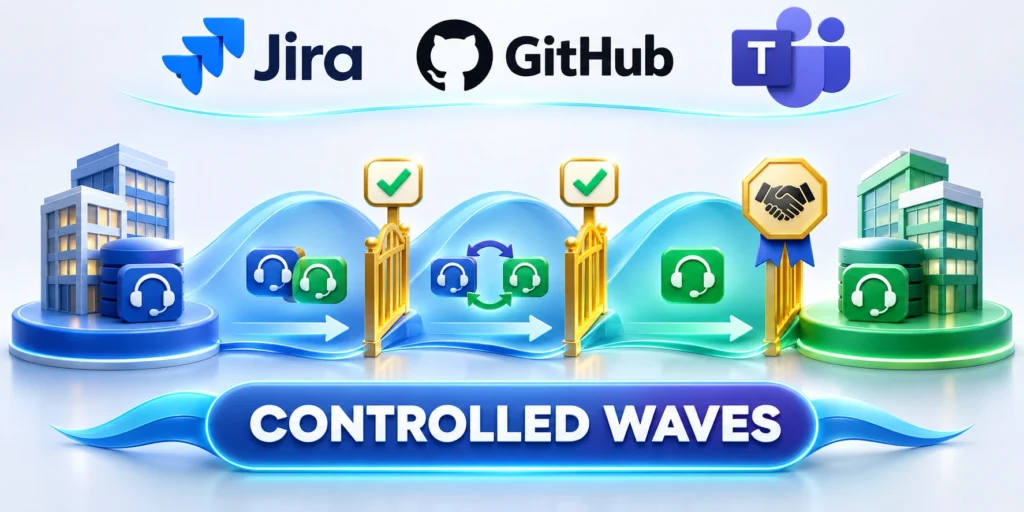
A single cutover concentrates knowledge, access, and service risk into one date. Controlled waves let the receiving team prove capability while fallback remains available.
Design waves around coherent responsibilities, such as monitoring, ticket triage, routine operations, releases, data support, and major incident coordination.
Use gates instead of one irreversible handoff
Begin with shadowing, where the incumbent leads and explains decisions. Continue with reverse shadowing, where the incoming team leads under observation.
Transfer independent ownership only after the receiver meets agreed evidence criteria. Attendance, confidence, or elapsed time should not substitute for demonstrated performance.
Apply these criteria to gates instead of one irreversible handoff:
- Observe current operations
- Lead with incumbent oversight
- Own a bounded responsibility
- Review evidence and gaps
- Expand only after approval
Keep wave scope small enough to diagnose problems. If monitoring, releases, data operations, and incident command move together, the cause of deterioration becomes unclear.
Align each wave with staffing coverage, access readiness, documentation, vendor availability, and business calendars. Avoid critical releases or seasonal peaks when possible.
Define exit criteria for every wave
Define measurable exit criteria before the wave starts. Include completed scenarios, correct escalation, ticket quality, access validation, and stable service results.
Specify the fallback owner and decision authority when criteria fail. Fallback should restore safe operations without creating ambiguity about who is currently accountable.
Use these actions to define exit criteria for every wave:
- Required scenarios completed
- Access and alerts verified
- Runbooks corrected after use
- Service metrics remain stable
- Fallback authority is available
Hold a short review after every wave and update the remaining plan. New evidence may justify changing sequence, adding practice, or narrowing the next scope.
Controlled waves make progress visible while preventing schedule pressure from turning unresolved knowledge or access gaps into production failures.
Prepare Rollback and Continuity Options

A support takeover changes people, permissions, procedures, and communication paths. Each change can introduce failure even when the application code remains untouched.
Prepare continuity options for operational mistakes, lost access, failed changes, unavailable vendors, incomplete knowledge, and unexpected dependency behavior during the transition.
Protect service while responsibility changes
Document how to restore the last known good state for configurations, deployments, credentials, data operations, integrations, and monitoring rules affected by transition work.
Clarify which actions are reversible, how long reversal remains safe, and who has authority to activate the fallback path.
Use these actions to protect service while responsibility changes:
- Configuration and deployment rollback
- Credential recovery procedures
- Verified backups and restore points
- Alternative communication channels
- Incumbent fallback coverage
- Vendor emergency contacts
Keep continuity independent from a single person or system. Store essential contacts, procedures, and recovery access where responders can reach them during a platform outage.
Avoid broad changes immediately before ownership transfer. Smaller reversible changes make it easier to isolate failures and return to a known state.
Test recovery instead of trusting documentation
Run recovery exercises for the most critical journeys and failure modes. Verify that backups can be restored and that the restored service actually supports required business operations.
Measure recovery time, missing prerequisites, unclear decisions, and manual dependencies. Correct the evidence before declaring continuity ready.
Use these actions to test recovery instead of trusting documentation:
- Trigger a realistic failure
- Activate the documented path
- Restore required business journeys
- Record elapsed time and gaps
- Repeat after correcting failures
Retire temporary fallback arrangements after the receiving team proves stable ownership. Extended dual control can create conflicting changes and unclear accountability.
Continuity planning is successful when it reduces transition risk without becoming a permanent substitute for complete knowledge, secure access, and capable support operations.
Communicate Ownership and Escalation Changes

A technically sound takeover can still fail when users, service desks, vendors, and leaders do not know where responsibility moved or how to escalate.
Publish one authoritative application support model covering intake channels, operating hours, severity rules, ownership, communication cadence, and decision authority.
Make the new operating model visible
Tailor communication to each audience. End users need the correct intake path, while responders need technical contacts, escalation thresholds, and status update expectations.
Vendors need named authorization and contract references. Business owners need clear decisions for risk acceptance, priority conflicts, and customer communication.
Use these actions to make the new operating model visible:
- Service desk and intake channels
- Application and business owners
- Technical escalation leads
- Vendor and platform contacts
- Executive decision authority
- Customer communication owner
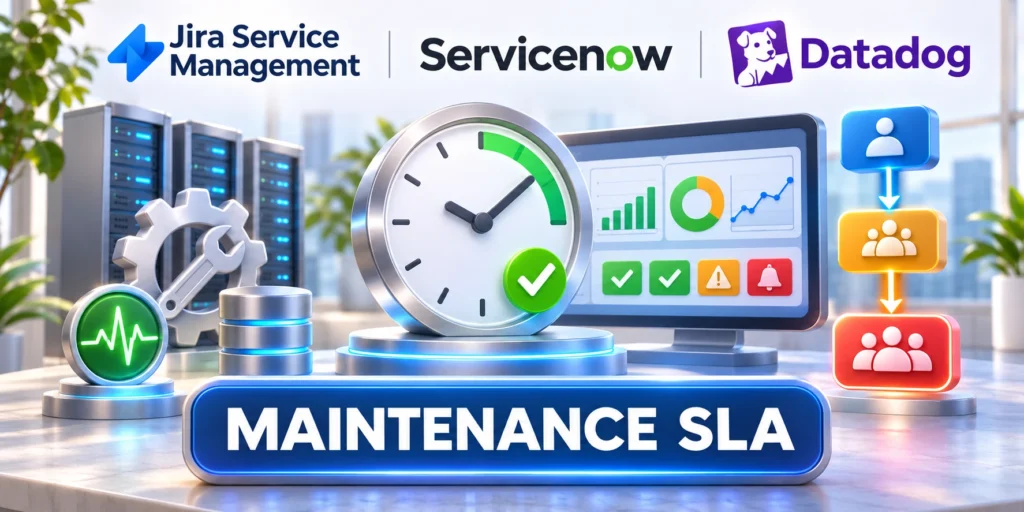
Align the transition with the documented software maintenance SLA so response, restoration, and escalation expectations remain consistent.
Update ticket routing, on-call schedules, distribution lists, vendor portals, status templates, and internal directories before the ownership date.
Keep escalation paths current after cutover
Test the communication path with a simulated high-severity incident. Confirm that each audience receives the right message and that decision makers can be reached.
Remove obsolete contacts quickly. Leaving the incumbent listed as owner causes delays, hidden forwarding, and uncertainty about who can approve risky actions.
Use these actions to keep escalation paths current after cutover:
- Announce the effective date
- Name current accountable owners
- Publish severity and escalation rules
- Test contact and routing paths
- Retire obsolete directories
Review contact data during the stabilization period and after staffing or vendor changes. Escalation documentation loses value quickly when it is not maintained.
Clear communication turns the operating model into usable behavior, reducing delays and preventing stakeholders from relying on personal relationships that no longer reflect ownership.
Stabilize Before Starting Modernization
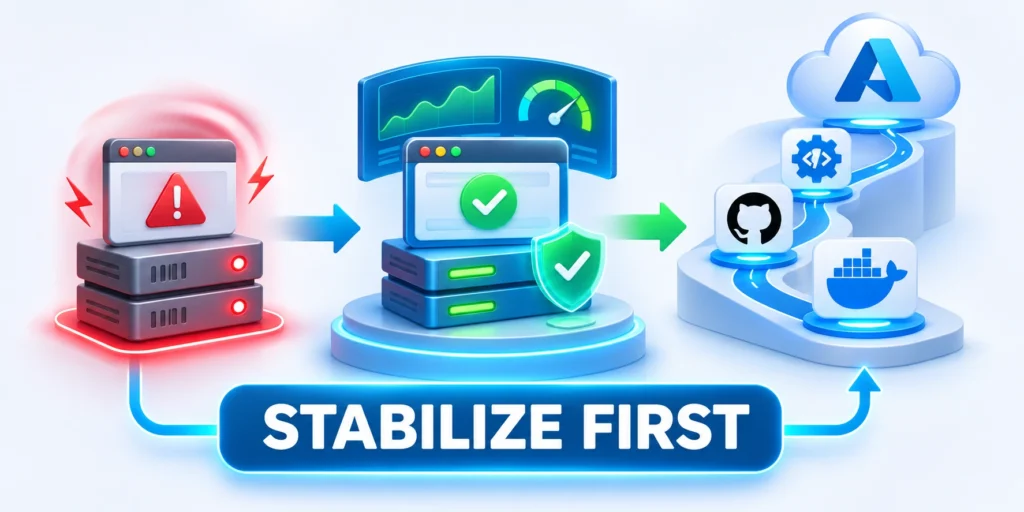
Modernization may be valuable, but combining it immediately with a support takeover makes failures harder to diagnose and accountability harder to establish.
First stabilize service ownership, access, monitoring, release control, backlog triage, recovery, and communication. Then use the new evidence to plan appropriate improvements.
Separate transition risk from transformation risk
Define a stabilization window with explicit outcomes rather than an arbitrary delay. The incoming team should handle normal operations and representative incidents without hidden incumbent intervention.
Service measures should remain within agreed ranges, and critical runbooks, contacts, backups, and access paths should be tested through real work.
Use these actions to separate transition risk from transformation risk:
- Ownership operates without hidden support
- Critical journeys remain stable
- Monitoring covers important failures
- Changes use tested rollback paths
- Backlog priorities are transparent
- Recovery procedures have evidence
Use stabilization findings to distinguish urgent remediation from broader modernization. Unsupported components or unmanageable operational effort may justify earlier targeted change.
Other improvements can wait until business value, cost of delay, feasibility, and transition capacity are understood.
Build modernization from reliable evidence
Choose the least disruptive modernization approach that achieves the required outcome. Replatforming, refactoring, rearchitecting, replacing, or continuing all have different risk profiles.
Preserve the operational knowledge gained during takeover. Modernization teams need dependency maps, failure evidence, recovery requirements, and business journey priorities.
Use these actions to build modernization from reliable evidence:
- Target unsupported technology
- Reduce recurring operational work
- Improve reliability bottlenecks
- Simplify fragile integrations
- Sequence change by business value
A stable support model does not mean the legacy application is healthy forever. It creates the control and evidence required to change it deliberately.
This sequence prevents modernization ambition from masking transition gaps and helps the organization invest where improvement will produce measurable operational or business value.
Conclusion
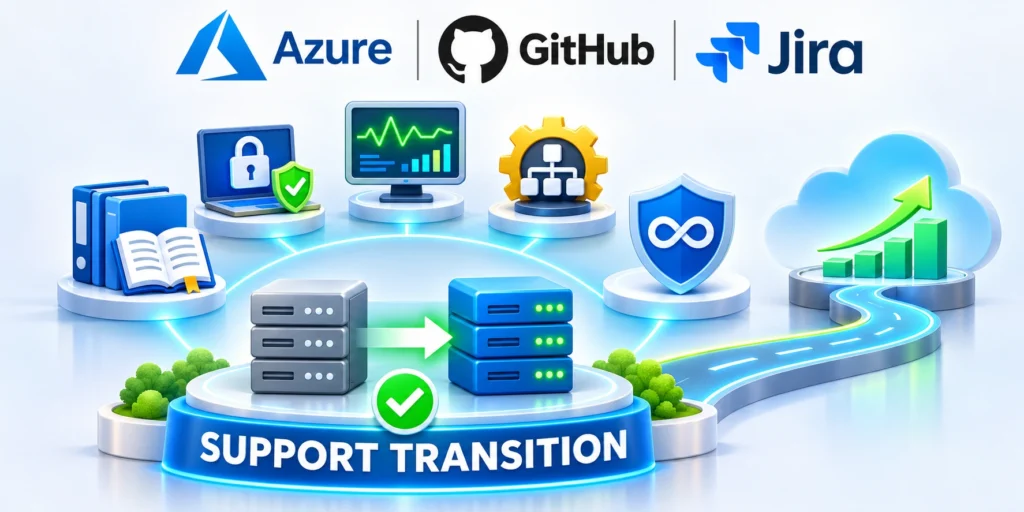
A legacy application support takeover transfers accountability for a living service, not merely tickets and documents. The transition must prove that support can continue safely.
Assessment, knowledge, secure access, triage, baselines, staged ownership, continuity, and communication work together to reduce uncertainty without hiding inherited risk.
Treat takeover as an operational change program
Use real operational scenarios to test the receiving team. Demonstrated diagnosis, recovery, release, and escalation capability is stronger evidence than meeting attendance.
Keep gaps visible with owners and dates. Schedule pressure should not silently convert missing access, unreliable backups, or undocumented dependencies into accepted conditions.
Use these actions to treat takeover as an operational change:
- Verify support scope and dependencies
- Transfer knowledge through real work
- Control access and credentials
- Move ownership through gated waves
- Test continuity and escalation
Measure the transition against the pre-takeover baseline. Pause expansion when service outcomes, backlog health, or response quality deteriorate materially.
Once ownership is stable, use the evidence to prioritize maintenance and modernization by business value, risk reduction, feasibility, and cost of delay.
Complete the transition with evidence
The final acceptance decision should name current owners, remaining risks, temporary controls, fallback retirement dates, and the next review cadence.
Store that decision with the operational record so later teams can understand why conditions were accepted and what remediation remains due.
Key considerations for complete the transition with evidence include:
- Current owners are published
- Critical scenarios are demonstrated
- Remaining risks are accepted explicitly
- Fallback arrangements have end dates
- Improvement work has priorities
A successful takeover makes the application easier to operate today and easier to improve tomorrow, without pretending that inherited constraints disappeared during the handoff.
That disciplined outcome protects users, gives leaders a truthful risk view, and provides the new team with a credible foundation for long-term service ownership.
FAQ
These answers cover assessment, timing, knowledge transfer, access, backlog, baselines, transition waves, modernization, and evidence for completing a legacy support takeover.
What is a legacy application support takeover?
It is the controlled transfer of operational responsibility, knowledge, access, ticket handling, recovery, communication, and accountability from one support arrangement to another.
How long should a support takeover take?
Duration depends on application complexity, evidence quality, criticality, access readiness, team capacity, and operational cycles. Use capability gates instead of a fixed universal timeline.
What should be assessed before accepting support?
Assess business journeys, architecture, dependencies, code, releases, environments, access, incidents, backlog, monitoring, recovery, vendors, documentation, staffing, and known operational constraints.
How should knowledge transfer be validated?
Require the receiving team to diagnose incidents, perform operations, explain decisions, use escalation paths, and correct runbooks during realistic shadow and reverse-shadow scenarios.
Should the incumbent team retain access after takeover?
Keep only the minimum access needed for an agreed fallback period. Remove obsolete access and rotate shared credentials in a dependency-aware sequence.
How should inherited backlog be handled?
Baseline and classify it before transfer. Remove duplicates, identify missing evidence, assign ownership, and obtain explicit decisions for disputed or out-of-scope work.
What is the purpose of an operational baseline?
It establishes pre-transition service behavior, workload, backlog, and recovery performance so teams can detect deterioration and distinguish inherited conditions from transition effects.
Why transfer support in waves?
Waves limit risk, create measurable learning, preserve fallback, and make it easier to identify which responsibility caused a service or process problem.
When can modernization begin?
Begin after support ownership is stable enough to separate transition failures from transformation risk, unless an urgent unsupported component requires immediate targeted remediation.
What proves the takeover is complete?
Completion requires demonstrated capability, verified access, stable service outcomes, tested continuity, current ownership, accepted remaining risks, and documented retirement of temporary fallback arrangements.




Leave a Reply