

Map B2B Buyer Needs Before Building the Cluster

A B2B content strategy connects a business goal to the distinct questions, risks, and decisions that buyers need help resolving.
Start with the buying situation and the audience, then decide which pages can answer those needs with evidence and useful next steps.
Translate business goals into audience problems
Begin with a goal the organization can observe, such as improving qualified demo conversations, supporting expansion, or reducing friction during technical evaluation.
A goal is not yet a content plan. Identify which people face the problem, what they must decide, and what information could help them act.
Apply the map to a real buying group
For example, a company selling inventory software may want more qualified enterprise evaluations. The audience could include operations leaders, finance reviewers, and technical owners.
Those roles do not necessarily need separate pages for every job title. First record the shared business problem and the decision criteria that differ by role.
Map the buying group without assuming a linear journey
B2B decisions often involve several participants, but their questions can overlap, recur, or change as a deal develops.
Map buyer roles through these distinct needs:
- Economic reviewer: needs costs, trade-offs, procurement implications, and a credible business case.
- Operational owner: needs workflow fit, adoption requirements, process changes, and implementation responsibilities.
- Technical reviewer: needs integration details, architecture boundaries, security evidence, and maintenance expectations.
- Executive sponsor: needs strategic fit, measurable outcomes, and a clear view of organizational risk.
Use a simple discovery session with sales, customer success, product, and subject-matter experts. Ask what prospects misunderstand, compare, verify, and delay on.
These are prompts for research, not a template to impose on every market. Validate them against actual customer conversations and product context.
Build a question inventory from real evidence

Collect questions from call notes, support requests, sales objections, onboarding sessions, product documentation, and first-party search data.
Capture buyer questions through these evidence fields:
- Record the question, source, date, customer type, and decision it supports.
- Group questions that need the same answer, while keeping distinct risks separate.
- Ask a subject-matter expert what evidence would make the answer trustworthy.
- Mark unanswered questions and assign research instead of inventing a confident response.
Preserve the wording and context. “Can it connect to our warehouse system?” is more actionable than a generic label such as “integrations.”
A useful question inventory is not a keyword dump. It is a traceable set of audience needs that can inform pages, sales enablement, and product education.
Connect architecture to enterprise SEO
For program-level priorities, use the enterprise B2B SEO strategy guide; this article focuses on page roles, clusters, architecture, and content operations.
Use the enterprise guide for program governance, investment, and operating-model decisions while this page retains responsibility for the content architecture itself.
Interview the people who hear buyer questions
Interview these customer-facing evidence sources first:
- Start with sales, support, implementation and customer success.
- Ask each team for recent questions, objections and handoff gaps.
- Collect the exact situation behind each question.
- “Integration” could mean technical feasibility, migration effort, security review or commercial ownership.
- Compare those observations with search data and existing site behavior.
- Search volume alone cannot tell you whether a page resolves a buying decision.
- Write each need as a question, audience, context, likely next action and evidence source.
- Mark assumptions so the content team does not treat anecdotes as universal demand.
- If no expert can verify a complex answer, postpone or narrow the page.
Customer-facing teams reveal recurring questions, misunderstood terms, proof requirements, and handoff problems that search exports cannot explain alone.
Record the original wording and decision context before translating the evidence into page roles or research themes.
Separate role, stage and task
Separate audience intent through these planning dimensions:
- A technical evaluator and procurement lead may visit the same topic cluster with different needs.
- Their roles do not guarantee a fixed journey order.
- Define each page task: explain, compare, guide implementation, or prepare approval.
- For every proposed article, record the primary reader and the decision it helps.
- Secondary readers can benefit, but the page needs a coherent main purpose.
- Test the map with real customer questions.
- Combine or distinguish proposed pages answering the same question at equal depth.
The same subject can support different decisions for a technical evaluator, operational owner, financial reviewer, procurement lead, or executive sponsor.
Label role, stage, and task independently so one broad persona does not hide distinct evidence or page requirements.
Choose the Topic Portfolio and Central Theme

A topic portfolio describes the subjects where the business can provide sustained, distinctive help to its intended market.
Choose a central theme by balancing audience importance, business relevance, available expertise, and the ability to maintain accurate content.
Select a theme with a real business boundary
A theme should be broad enough to support related questions, yet specific enough that its pages form a coherent resource.
“Business software” is usually too broad for one useful cluster. “Inventory visibility for multi-location distributors” gives a clearer audience, context, and decision space.
Write a scope statement and name exclusions
Write a one-sentence boundary before drafting: “This cluster helps operations and technology leaders evaluate, implement, and improve inventory visibility across distribution locations.”
Then list adjacent subjects that belong elsewhere, such as warehouse staffing, corporate finance systems, or general software procurement, unless they directly support this theme.
Evaluate whether the organization can serve the topic well
Review whether the team can contribute first-hand expertise, practical examples, credible evidence, and review capacity for the proposed subject.
Interest alone is not enough. A topic that depends on claims the business cannot verify may produce weak or risky material.
| Decision factor | Useful question | Evidence to collect |
|---|---|---|
| Audience relevance | Does this audience face the target problem? | Interviews, support questions, account notes |
| Business fit | Can content support a product or market priority? | Positioning, product scope, sales feedback |
| Expertise | Can specialists explain the subject accurately? | Reviewers, documentation, implementation knowledge |
| Distinctiveness | Can we add insight beyond common summaries? | Examples, process knowledge, approved evidence |
| Maintenance | Can the team keep important pages current? | Owners, review triggers, update capacity |
Scorecards can help teams compare candidate themes, but avoid pretending a numeric total makes uncertain evidence precise.
Confirm portfolio readiness
A theme is ready only when audience evidence, business relevance, expertise, existing coverage, and long-term maintenance can support a credible central resource.
Confirm portfolio readiness through these decisions:
- Name the audience problem and owner.
- Document expertise and evidence sources.
- Compare existing and planned coverage.
- Reserve capacity for review and maintenance.
Revisit readiness when products, expertise, evidence, ownership, market priorities, or maintenance capacity change materially.
Prioritize a portfolio instead of publishing every idea

Choose a small number of themes that the team can serve well. A focused portfolio is easier to govern than a calendar built around every phrase in a keyword export.
Classify candidate themes through these portfolio states:
- Active: strong audience need, clear business fit, and enough expertise to deliver useful pages.
- Exploratory: promising need, but a research gap or unclear audience boundary remains.
- Deferred: low strategic fit, unsupported claims, or insufficient editorial capacity for responsible coverage.
Separate themes into active, exploratory, and deferred groups. This makes the reason for prioritization visible without implying that deferred topics lack value forever.
Revisit the portfolio when products, customer segments, market conditions, or available expertise materially change.
Score themes with evidence
Score themes through these evidence-based portfolio factors:
- Create a portfolio table covering relevance, demand, expertise, coverage, and maintenance burden.
- Use descriptive ratings with reasons.
- Do not let search volume outweigh weak product fit or insufficient credible expertise.
- A central theme should support several distinct questions and a useful overview.
- If it can be answered in one focused page, it may not need a cluster.
- Check published posts, drafts, product pages and planned campaigns before committing to a new pillar.
- Record the canonical destination for overlapping questions.
- Prioritize themes validated by sales and support that remain maintainable as practices change.
A useful scorecard makes the reason for prioritization visible without pretending uncertain inputs produce an objective truth.
Keep qualitative evidence beside every rating so reviewers can challenge assumptions and update the decision when conditions change.
Define boundaries for the pillar
Define pillar boundaries through these explicit decisions:
- Write what the central page will explain and what a satellite will handle in depth.
- The pillar should orient readers and link to distinct next questions.
- For example, a software architecture pillar may cover the decision framework.
- Separate pages can examine authentication, observability or migration where depth is warranted.
- Do not create satellites solely to fill a diagram.
- Each one needs its own intent, evidence and useful answer.
- Keep a brief decision log for rejected themes.
- That prevents a later team from reopening the same overlap without new evidence.
The pillar should resolve the central decision and orient the reader without absorbing every implementation procedure, comparison, or troubleshooting case.
Name exclusions and intended supporting pages before drafting so later contributors do not expand the page into neighboring jobs.
Design Intent-Led Topic Clusters

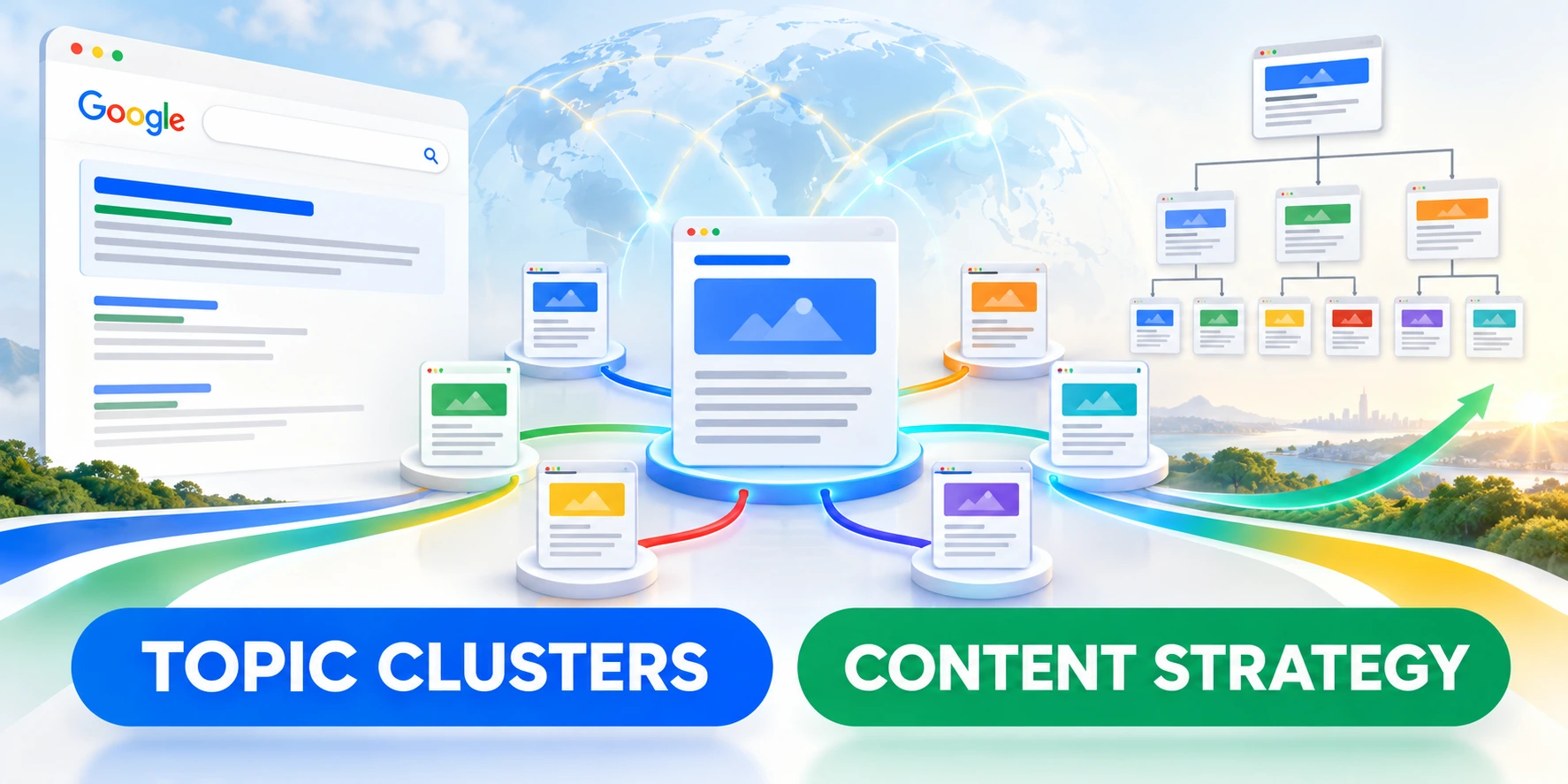
A topic cluster is a set of pages with clear relationships and distinct jobs, organized around a broader audience need.
The central resource provides orientation; supporting pages address narrower decisions or tasks that deserve their own complete answers.
Give the central page a useful, bounded role
A central page should explain the subject’s main concepts, choices, and relationships, then direct readers to deeper answers where more detail is useful.
It should not attempt to contain every procedure, comparison, troubleshooting case, and product detail in one long page.
Test the central page with a specific use case
For the inventory visibility example, the central page could describe the operating problem, data needed, common system patterns, decision criteria, and implementation phases.
A separate implementation guide could explain system integration steps, while a comparison page could help teams evaluate architecture options.
Create supporting pages only for distinct needs
Write each candidate page’s purpose in one sentence. If two candidates produce essentially the same answer and next step, combine or differentiate them before publication.
Classify supporting pages through these distinct reader tasks:
- Learn: define a concept and explain why it matters.
- Compare: make meaningful trade-offs visible for a specific decision.
- Implement: show prerequisites, steps, expected results, and recovery options.
- Troubleshoot: diagnose a symptom and guide the reader through safe checks.
- Evaluate: help a buying group assess fit, evidence, cost drivers, and risk.
Examples of distinct supporting intents include choosing an integration pattern, planning an inventory data migration, or troubleshooting mismatched stock counts.
These labels are planning aids rather than rigid page templates. A page may answer more than one related question if the reader benefits from a complete response.
Validate intent boundaries with evidence
Compare proposed page roles against actual buyer questions, published coverage, commercial destinations, documentation, and the evidence the team can maintain.
Revise the architecture when two pages promise the same decision or when one page combines audiences that require materially different answers.
Assign each page an intent owner and a scope boundary

For each page, document its primary audience, question, promise, evidence needs, and the questions it intentionally leaves to another page.
A boundary prevents briefs from expanding into neighboring topics simply because they share vocabulary.
| Page role | Reader need | Boundary and next step |
|---|---|---|
| Central guide | Understand the solution landscape | Exclude deep comparisons; link focused guides |
| Migration guide | Plan mapping, validation, and cutover | Exclude market review; link readiness steps |
| Pattern comparison | Choose an architecture approach | Avoid universal claims; link fit assessment |
Use the table as a living map, not a publishing quota. A cluster can be complete with only the pages that answer distinct needs well.
Check overlap before approving a new page
Compare published posts, drafts, commercial pages, and sales resources by promise, audience, answer, and next step. Shared terms alone do not prove duplicate intent.
When overlap appears, decide whether to narrow the new page, improve the existing page, combine redundant sections, or defer the proposal.
Build a page contract for every node
Build every page contract through these fields:
- For each page, record title, reader question, scope, exclusions, evidence, and next destination.
- Assign a content owner and a reviewer with the right expertise.
- Technical or regulatory claims may require a specialist before publication.
- Compare the contract with the current search results and site inventory.
- A result page can contain mixed intents; choose the intent the organization can answer well.
- Define the unique contribution: examples, decision frameworks, steps, or firsthand organizational knowledge.
- If two contracts still overlap, revise their boundaries or merge them before writing.
A page contract defines the job of one URL before drafting begins and gives reviewers a stable basis for evaluating overlap.
Update the contract when scope, audience, evidence, destination, ownership, or lifecycle status changes after publication.
Plan links as reading paths
Design reading paths through these contextual link choices:
- Link from the pillar where the reader naturally needs detail.
- Link back from a satellite when the broader framework helps interpret the detail.
- Also connect related satellites when the relationship is clear.
- A reader comparing deployment choices may benefit from a security checklist, for example.
- Use descriptive anchor text that explains the destination.
- Avoid a fixed link count or repetitive exact-match phrase.
- After publication, test that links resolve and that the destination still answers the promised question.
Links should connect the current decision to the next useful explanation, proof, comparison, implementation step, or commercial destination.
Test the path as a reader journey instead of assuming reciprocal links automatically improve the cluster.
Build Information Architecture for People and Teams
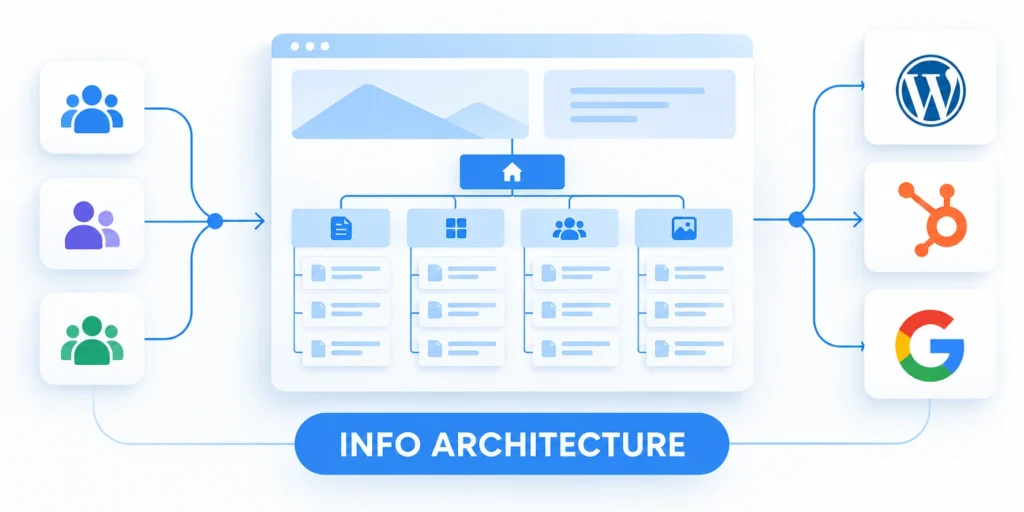
Information architecture describes how content is named, grouped, connected, and reached across the site.
For B2B teams, good architecture helps a prospect find the next relevant answer and helps editors understand where a new page belongs.
Choose labels that match audience language
Use labels that a real customer can understand without knowing your internal department names or product taxonomy.
Test a proposed category with people outside the content team. Ask where they would look for a specific question and what they expect the label to contain.
Keep navigation categories meaningful
Do not create separate navigation categories for every keyword variation. Group pages by a meaningful subject, task, audience, or product relationship.
Remove categories that merely repeat internal terminology, divide one audience task arbitrarily, or lack enough maintained destinations to justify a visible choice.
Use a hierarchy that supports discovery without excessive nesting
Organize broad themes and narrower subtopics only when the hierarchy helps people predict where information lives.
A possible structure might move from Resources to Operations, then Inventory Visibility, with implementation and integration guides nested only when they form a coherent group.
Keep URLs, categories, and links distinct
Separate architecture layers through these distinct functions:
- Navigation helps visitors choose a path through the site.
- Categories group related resources for browsing and governance.
- Internal links explain relationships in the context of an article.
- URLs provide stable addresses and should remain understandable and maintainable.
Do not confuse URL folders, navigation labels, and topic relationships. They can support one another, but each solves a different organizational problem.
Google’s guidance on crawlable links and anchor text is a technical baseline, not a ranking promise.
Plan links around the reader’s next decision
Link when a page adds needed context, evidence, a procedure, or a decision aid. Make the anchor explain what the reader will get.
For example, a broad architecture guide can link to a detailed migration checklist where the reader begins planning a move.
Cross-link only when broader context helps

A supporting page can link back to the central resource when the reader needs the wider topic map, but avoid mechanical reciprocal links.
Use the technical SEO architecture guide for crawlability, rendering, URLs, and release checks; this article covers business content topics and page roles.
Record a map that survives team changes
Keep one maintained inventory with each page’s owner, status, canonical URL, audience, intent, parent theme, links, reviewer, and next review trigger.
Use an existing planning tool; define ambiguous labels and page boundaries so an editor outside the planning meeting can maintain the map.
Model navigation around tasks
Model navigation through these audience-centered principles:
- Start with understandable categories independent of the organization’s internal structure.
- Use stable labels for related pages.
- Mixing product names, departments, and slogans inconsistently makes clusters difficult to scan.
- Sketch paths from broad questions to detailed answers and relevant decision pages.
- Test the route with someone outside the content team.
- Keep commercial pages distinct when their main task is contacting or buying.
- Editorial pages can explain decisions and point to a commercial page when appropriate.
- Use breadcrumbs, menus, and contextual links consistently without forcing articles into primary navigation.
Navigation labels should match language readers recognize and expose meaningful choices without mirroring internal departments or campaign names.
Test representative journeys from broad orientation to focused action before approving a deeper hierarchy.
Maintain an architecture register
Maintain the architecture register through these fields:
- Record each URL, type, intent, owner, cluster, canonical, links, and review date.
- This register helps teams spot an orphan page or a changed URL before links break.
- It also makes future consolidation decisions reviewable.
- When a product changes, identify which editorial pages depend on it.
- Assign updates across the cluster instead of correcting only the most visible pillar.
- Separate redirects and canonical decisions from copy edits, especially for established published URLs.
The register keeps page roles, ownership, relationships, review triggers, and lifecycle decisions visible beyond one editorial project.
Reconcile it with published URLs after releases, migrations, consolidations, redirects, and organizational changes.
Turn the Architecture into Useful Content
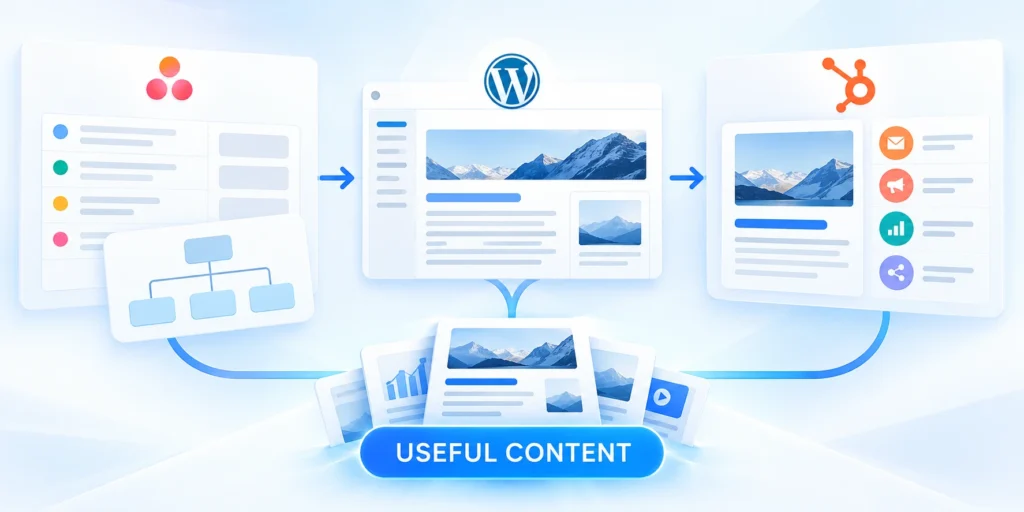
A content brief turns a page’s role into a clear assignment that writers, reviewers, and subject-matter experts can execute.
It should specify the reader’s need, the answer the page owes them, and the evidence required to support that answer.
Write a concise page promise and practical outline
Begin with a one-sentence promise that explains what the intended reader will understand or be able to do.
Build each content brief through these inputs:
- Reader and relevant business context
- Primary question and page role
- Answer or action the page should deliver
- Scope boundaries and related pages
- Evidence, examples, data, or expert review needed
- Internal links and a useful next step
- Owner, reviewer, and update triggers
Then outline the decisions or steps needed to fulfill that promise. Headings should organize the answer, not simply repeat related phrases.
For an implementation guide, the brief should name prerequisites, safe step order, where settings or code belong, observable outcomes, and recovery guidance when applicable.
Use subject-matter expertise to add concrete value
Give reviewers specific questions instead of asking them to “check the article.”
Ask an engineer to verify an integration sequence, a service lead to explain implementation dependencies, or a customer-success specialist to clarify a common adoption obstacle.
Protect evidence and describe uncertainty
Do not invent first-hand tests, customer outcomes, quotations, or credentials. If a useful example is hypothetical, label it as an example.
When the team cannot verify a claim, either research it from a suitable source, narrow the statement, or omit it.
Coordinate pages without turning the brief into a quota
The cluster map tells a writer which page owns a question and where deeper explanations live.
It does not require every article to mention every sibling page. Include a link when it helps the reader move to a relevant answer.
Decide when a supporting page is justified

When a section grows into a separate procedure, comparison, or audience need, check whether a supporting page would provide a clearer and more complete experience.
When a supporting page would repeat the central resource, keep the useful detail in one place instead of splitting it for the sake of a larger cluster.
Align calls to action with the reader’s stage
A relevant next step may be a deeper guide, a checklist, a product explanation, a consultation, or no call to action at all.
Match the invitation to the page’s promise and the reader’s likely decision. Avoid forcing a sales request into an informational answer when it does not help.
Keep calls to action proportional
A useful call to action reflects the evidence and commitment appropriate to the reader’s current decision rather than forcing every page toward immediate contact.
Review the destination, promise, commitment level, and evidence after campaign or service changes so the next step remains credible.
Check that the next step helps the reader
Review the page from the reader’s perspective: is the next action clear, proportionate, and supported by the content they just read?
Verify the destination continues the current task, matches the anchor promise, and remains accurate after product, campaign, or architecture changes.
Draft from questions and evidence
Draft useful pages through these evidence steps:
- Open with the reader’s situation and explain the decision the page will help them make.
- Define necessary terms before advanced detail.
- For technical sections, show prerequisites, steps, expected results, and brief failure diagnostics.
- Use examples that fit the intended audience.
- Mark a hypothetical example clearly and avoid invented customer outcomes or unattributed performance claims.
- Where a comparison matters, state the criteria and tradeoffs.
- Avoid naming a universal winner when the right choice depends on constraints.
- Answer each section’s question before linking to deeper material that adds value.
The draft should begin with a documented reader question and use verified evidence to explain the decision, action, limitation, or trade-off.
Writers should surface missing facts before publication instead of replacing uncertainty with generic claims.
Edit the cluster as a system
Edit the cluster through these system-level checks:
- Review the pillar and satellites together for duplicate definitions, conflicting advice and gaps between stages.
- Keep repeated essentials short.
- Check heading hierarchy, accessible labels, link meaning and mobile readability in the normal editorial workflow.
- Verify facts with current primary sources and an internal expert when appropriate.
- Record which assertions need future review.
- Treat the published URL and owner as authoritative; planning documents can become stale.
System editing compares definitions, claims, examples, links, next steps, and page boundaries across the connected set.
Resolve contradictions and gaps at their source rather than patching one page while related guidance remains inconsistent.
Govern Production, Links, and Maintenance

A content architecture is an operating system for decisions, not a one-time diagram that stays accurate automatically.
Clear ownership and review triggers keep page roles, links, and evidence aligned as products and customer needs change.
Assign responsibilities at the page level
Name who owns the audience problem, who drafts, who verifies claims, who approves publication, and who maintains the page after launch.
One person can hold several roles on a small team. The important part is that responsibility is explicit and handoffs are clear.
Give reviewers a bounded responsibility
Subject-matter reviewers should see the claims they are responsible for, not an unspecified request to approve a large document.
Assign factual, editorial, legal, technical, or commercial review explicitly so each reviewer knows which evidence and risks require attention.
Use workflow states that describe real work
Choose a short set of statuses that make the next action obvious, such as proposed, researched, brief approved, drafting, review, published, and maintenance.
Govern each page through these approval checks:
- Confirm audience need, page role, and existing-page overlap.
- Assign evidence tasks, writer, reviewer, and target decision date.
- Draft from the approved brief and document unresolved questions.
- Review factual claims, scope, links, and next steps before publication.
- Record the live URL, owner, and triggers for future review.
A status without an owner or next step does not help a team move work forward.
Adjust the workflow to the team’s actual capacity. Extra approval steps that do not reduce meaningful risk can delay useful work.
Maintain relationships when content changes
When a product changes, identify which pages make claims about that feature, workflow, integration, or support model.
When consolidating pages, preserve useful information, map links, and decide what should happen to the old URL before the change.
Keep central resources current as pages change

Keep the central resource accurate about the pages it recommends. Remove or update links that no longer serve the reader.
Use event-based review triggers, such as a product release, regulatory change, rebrand, or persistent customer confusion, rather than refreshing every page on an arbitrary schedule.
Make governance light enough to sustain
Keep required fields limited to what decisions depend on. If the map becomes hard to maintain, remove duplicated fields or clarify who updates them.
Review a small sample of active pages during planning meetings. Check whether ownership, promises, evidence, and links remain accurate.
Remove approval without losing control
Remove approvals that do not change accuracy, risk, ownership, or reader value, while preserving controls for consequential claims and structural changes.
Keep a lightweight record of the decision, responsible owner, exception, and review trigger whenever governance is simplified.
Keep governance focused on useful action
Governance should surface unresolved risks and stale dependencies, without turning into reporting detached from publication work.
Close each review with an owner, decision, evidence requirement, next action, and trigger for reopening the issue.
Give every update a trigger
Trigger content reviews through these operational events:
- Create a review calendar with triggers for releases, policies, integrations, sources, and recurring objections.
- Assign one owner to determine whether changes affect one page or the cluster.
- Record the decision and links checked.
- For time-sensitive claims, show the date of the underlying source where useful.
- Remove statements that cannot be verified.
- Retire an outdated page only after reviewing its traffic, links, purpose and replacement.
- Preserve the published URL until a separate migration decision is made.
Triggers connect maintenance to observable events such as releases, policy changes, source updates, recurring objections, or declining evidence quality.
Assign an owner and review action to every trigger so monitoring produces work instead of unattended alerts.
Make handoffs explicit
Make editorial handoffs explicit through these fields:
- An editorial brief should include intent, audience, scope, evidence, internal links, reviewer and acceptance criteria.
- The writer can then request missing product facts early.
- The reviewer can focus on accuracy instead of rewriting the article’s purpose.
- After publication, capture the final URL and update the cluster map.
- Confirm that reciprocal links are actually live where they help readers.
- Document unresolved questions instead of treating mechanical approval as editorial approval.
A handoff should state what is complete, what remains uncertain, which evidence supports the draft, and who owns the next decision.
Explicit acceptance criteria prevent reviewers from reopening page strategy during a late copyedit or technical release check.
Measure Content Outcomes Beyond Traffic

Measure whether the architecture helps people find and use useful content, then connect those signals to the business goal when evidence permits.
Traffic alone cannot show whether the right audience arrived, found the answer, or took an appropriate next step.
Start with questions the team can act on
Choose a small set of questions: Are priority pages discoverable? Do relevant visitors continue to useful pages? Do sales teams use the resource?
Then choose indicators that relate to those questions. A metric is valuable when a team understands what action it could inform.
| Question | Possible evidence | Possible response |
|---|---|---|
| Can people find the page? | Search terms, entries, crawl data, feedback | Improve labels, links, or navigation |
| Does the page answer the need? | Task feedback, next-page visits, support questions | Clarify the answer or fill an evidence gap |
| Does it support a business outcome? | Conversions, assisted journeys, sales references | Improve the relevant page or handoff |
| Is the architecture maintainable? | Duplicate reviews, stale pages, unclear ownership | Consolidate, reassign, or simplify the map |
These are diagnostic signals, not proof that one article caused a deal. B2B decisions involve multiple interactions and business factors.
Use analytics with attribution limits in view
Record how a conversion was defined, which systems contribute data, what attribution model is used, and where tracking gaps remain.
Compare cohort or journey patterns carefully. Do not treat a last-click report as a complete account of content’s role in a buying process.
Connect signals to decisions
A useful measurement plan states which team can act, which evidence changes the decision, and which limitations prevent a stronger conclusion.
Connect measurement through these evidence layers:
- Discovery shows whether intended pages appear.
- Engagement reveals progress through useful tasks.
- Progression records qualified next actions.
- Business evidence supports cautious contribution claims.
Report a signal only when the responsible team understands its limitations and the action that different outcomes could justify.
Interpret search signals separately

For search data, separate impressions, clicks, queries, and destination pages. These signals describe visibility and behavior; they do not independently prove commercial impact.
Content Marketing Institute’s B2B research can inform team planning, but its survey findings should be treated as respondent evidence rather than a universal forecast.
Build a review loop instead of a scorecard contest
At a regular planning review, inspect what changed, what the team learned, and which pages or decisions need attention next.
Ask whether a page still has a clear job, whether the intended audience finds it, and whether the content resolves the expected question.
Use findings to change the system
Use results to improve the system. Do not publish more pages automatically because one metric moved or because a cluster appears incomplete.
Translate recurring findings into clearer contracts, better templates, ownership changes, review triggers, or architecture decisions instead of repeating isolated fixes.
Use a measurement ladder
Measure outcomes through these evidence layers:
- Track discovery and engagement diagnostically; then examine inquiries and supported sales conversations.
- Define each event before reporting it.
- A download, meeting request and accepted opportunity should not be counted as equivalent outcomes.
- Segment by page task and cohort age.
- Educational articles may need longer than decision pages to influence later actions.
- Compare similar periods and note campaigns, site changes and sales capacity.
- A traffic increase alone does not establish causal impact.
- Ask sales and support whether the content resolves questions they previously had to explain repeatedly.
Keep each evidence layer tied to a decision the responsible team can actually make.
Compare layers over time without presenting discovery or engagement as proof of revenue contribution.
Diagnose underperformance
Diagnose underperformance through these signal patterns:
- If impressions rise without clicks, review title relevance and query fit.
- Avoid changing the title for curiosity alone.
- If visitors stall, verify answer completeness and whether the next action makes sense.
- If qualified inquiries fall, verify tracking, forms and routing before assuming the content failed.
- Follow the record through the handoff.
- Keep a written hypothesis, change and expected signal for each revision.
- This makes a later decision more credible.
Document which evidence would confirm or reject the suspected cause before rewriting the page.
Confirm the suspected cause with representative pages and cohorts before changing scope, links, content, or measurement.
Model Content Decay and Refresh Priorities

Content decay appears when facts, product scope, examples, links, audience assumptions, search behavior, ownership, or page relationships no longer match the current operating reality.
A refresh model helps teams distinguish routine maintenance from structural revision, consolidation, retirement, or evidence collection before an inaccurate page weakens the cluster.
Define observable decay signals
Use signals that reveal a specific maintenance problem instead of treating every traffic decline as proof that the page is obsolete.
Monitor refresh priorities through these evidence signals:
- Claims conflict with current product behavior.
- Examples no longer match buyer decisions.
- Links lead to retired or changed resources.
- Search queries reveal a different audience task.
- Ownership or review dates are missing.
Combine search, analytics, sales, support, product, and editorial evidence before deciding whether the problem belongs to one paragraph, one page, or the wider architecture.
Choose the smallest durable intervention
Correct isolated facts locally, revise sections when the page promise still holds, consolidate overlapping pages, and retire content only when no useful purpose remains.
Record the evidence, action, owner, dependent pages, verification method, and next review trigger so the same uncertainty does not return during the next audit.
Recheck cluster relationships
After a refresh, verify navigation, internal links, page contracts, canonical destinations, briefs, and measurement definitions that depend on the changed page.
A local correction is incomplete when surrounding pages still repeat the old claim, link to a retired destination, or assign the same intent elsewhere.
Prioritize by consequence and dependency
Prioritize inaccurate claims, broken journeys, unsupported commercial promises, and pages that propagate outdated guidance across dependent content or customer-facing teams.
Schedule lower-risk wording and example updates behind corrections that affect decisions, implementation, compliance, product expectations, or the integrity of the wider cluster.
Expand, Consolidate, or Retire Pages with Evidence

A cluster should grow when a distinct audience need remains unanswered and the team can provide a complete, accurate response.
It should change when pages overlap, products evolve, or evidence shows that the current structure no longer helps readers.
Decide whether a gap deserves a new page
Evaluate new-page gaps through these evidence checks:
- Compare the proposed need with existing pages, support documentation, product pages, and sales materials.
- Ensure any new page answers a distinct question with sufficient depth, evidence, and next step.
- Otherwise, improve the relevant page or add a concise section without splitting the topic.
A gap deserves a new URL only when the audience task is distinct, useful, supportable, and not already resolved elsewhere.
Compare existing pages and planned work before committing maintenance capacity to another destination.
Use a practical consolidation decision
Consolidation is useful when pages make the same promise, rely on the same evidence, and leave readers with the same decision.
Preserve unique material, verify the preferred destination, update internal links, and plan redirects only when the old URL should no longer stand alone.
Preserve distinct audience needs
Do not merge pages solely because they share a phrase. Distinct audiences or tasks may justify separate answers.
Document the audience, task, evidence, and next step that remain unique before deciding that separate pages should continue.
Retire material responsibly
Before retiring a page, check links, business use, replacement fit, subject relevance, and whether its claims or audience need still exist.
Record the reason and replacement URL, then verify redirects, navigation, sitemaps, analytics, dependent briefs, and internal links so teams do not recreate the gap.
Verify retirement after launch
Monitor crawl errors, redirected traffic, bookmarked journeys, campaign links, and user feedback after retirement so hidden dependencies surface quickly.
Revise the decision when evidence shows lost demand, broken workflows, or an unsuitable replacement rather than defending the original plan.
Scale only when the system can sustain it

Additional pages increase review, linking, measurement, and maintenance work. Plan that operating cost alongside the content opportunity.
When entering a new segment, validate its terminology and workflows; size the cluster to distinct needs and team capacity, not a page-count target.
Choose the smallest effective change
Choose lifecycle actions through these evidence rules:
- Expand pages when distinct reader questions need depth the current page cannot provide.
- Consolidate pages serving the same intent when separation confuses navigation or maintenance.
- Review links and URLs before acting.
- Retire when the underlying service or guidance is gone and no useful replacement exists.
- Treat redirects as a separate decision based on relevance.
- For each option, compare reader value, evidence quality, maintenance cost, traffic and dependencies.
- Record who approved the choice.
- Do not change live URLs merely because proposed taxonomies look cleaner.
Verify the selected change resolves the original audience or maintenance problem before closing the decision.
Record why the intervention preserves reader value and how the team will verify the result after publication in production.
Audit the whole cluster after changes
Audit cluster changes through these relationship checks:
- Revisit the central page, relevant satellites, navigation and internal links.
- Confirm that descriptions and examples remain consistent.
- Check whether the revised page now overlaps another planned or published page.
- Update the inventory and future briefs accordingly.
- Observe outcomes over a suitable period and avoid drawing strong conclusions from a small sample.
- If the update fails, revisit interviews and the page contract instead of adding generic text.
A local change can alter links, promises, definitions, page roles, canonical destinations, reporting, and maintenance responsibilities elsewhere.
Review connected pages after the change persists so the architecture reflects the final production state.
FAQ
Use these questions during planning and review meetings. Each answer should be tested against the current inventory, published URLs, organizational expertise, and measurable audience needs.
What is a B2B topic cluster?
It is a group of related pages organized around a broader business audience need, with each page serving a distinct question or decision.
Define the cluster boundary explicitly: audience, problem, decisions, excluded subjects, and owner. This prevents a broad label from absorbing every related keyword or internal initiative.
Does every cluster need one pillar page?
Often a central guide helps orient readers, but the format should follow the topic and audience rather than a mandatory template.
A distributed cluster can use several coordinating guides when audiences or decisions differ. Choose the structure readers can navigate and the team can maintain accurately.
How many pages should a topic cluster contain?
There is no fixed count. Include only pages that answer genuinely distinct needs and can be maintained with accurate, useful information.
Use the inventory to count distinct page jobs, not keywords. Add pages only when evidence supports a separate need, sufficient depth, and long-term ownership.
How do I choose a cluster topic?
Start with an audience problem connected to business priorities, then confirm that the team has expertise, evidence, and capacity to serve it.
Score candidate themes against customer evidence, strategic fit, available expertise, existing coverage, and maintenance cost. Search demand informs the choice but should not make it alone.
Are topic clusters the same as keyword groups?
No. Keyword groups can inform research, while a cluster organizes pages around audience needs, page roles, and useful relationships.
Keywords describe language and demand; architecture assigns responsibilities to pages. Several keyword groups may support one page, while one broad term may require distinct audience paths.
How can a team reduce overlapping articles?
Compare page promises, audiences, answers, evidence, and next steps. Narrow, combine, improve, or defer pages when their jobs are not distinct.
Maintain one page contract for each live URL, including audience, question, scope, evidence, owner, and review trigger. Compare proposed briefs against those contracts before drafting.
Should every page link to the central guide?
Link when broader context helps the reader. Avoid reciprocal links added only to satisfy a mechanical cluster rule.
Link to the page that best resolves the next question, even when it is not the pillar. Relevance and clear anchor context matter more than symmetric linking.
What should a B2B content brief include?
Include the intended reader, question, page role, scope, evidence, practical examples, related pages, reviewers, and a relevant next action.
The brief should also state exclusions and unresolved questions. Reviewers can then protect scope, request missing evidence early, and distinguish editorial judgment from mechanical completion.
How should content performance be measured?
Use indicators tied to audience tasks and business goals, while documenting attribution limits and avoiding claims that one page caused a complex sale.
Review discovery, engagement, progression, and business outcomes separately. Segment results by page role and cohort age, then combine analytics with sales and support evidence.
When should an outdated page be removed?
Retire it when it no longer serves a need and cannot be maintained. Check links and replacement intent before redirecting or removing it.
Preserve a live URL when it still has a valid purpose. Redirect only when the destination serves equivalent intent; otherwise document removal and monitor resulting errors.
Conclusion

A practical B2B content strategy begins with buyer needs, assigns each page a distinct role, and connects related answers through understandable architecture.
Use evidence, clear ownership, and a sustainable review loop to keep the system useful as customer needs and products change.
A short planning sequence
Plan the cluster through these ordered decisions:
- Choose a business-relevant audience problem the team can explain credibly.
- Map real buyer questions and assign each distinct intent to a page.
- Design categories, links, and URLs that help people predict where answers live.
- Brief pages with scope, evidence, reviewers, and useful next steps.
- Measure useful audience and business signals, then improve the map with evidence.
Do not expand a cluster merely to fill a calendar. Add a page when it answers a distinct need better than the current system.
The planning sequence should move from audience evidence to page roles, relationships, production, measurement, maintenance, and lifecycle decisions.
Preserve the planning record
Each step produces an explicit artifact that the next owner can review without reconstructing the earlier reasoning.
Store page contracts, evidence, owners, exclusions, relationships, and review triggers where future contributors can find and update them.
Keep decisions visible
Keep architecture decisions visible through these controls:
- A useful cluster gives each page a distinct question and connects related decisions.
- Assign ownership to the architecture, not only individual drafts.
- Products, buyers and evidence change after publication.
- Use the inventory and review triggers to keep guidance accurate.
- Measure whether readers and internal teams can act on it.
Visible decisions help future contributors understand why pages exist, which needs remain excluded, and what evidence would justify a change.
Store the decision with the architecture register and review it when ownership, products, audiences, or evidence change.
Validate the architecture with real journeys
Choose representative journeys from problem discovery through evaluation, implementation, and support. Confirm the expected pages, links, and next actions remain understandable without internal company knowledge.
Ask sales, support, subject experts, and an external reader to follow the same journey. Differences reveal missing context, unclear labels, duplicate promises, or weak handoffs.
Plan maintenance capacity before expansion
Estimate the review effort created by each new page, including source checks, product changes, link maintenance, and expert availability. Growth without ownership converts coverage into future debt.
Set a sustainable publishing pace and reserve time for updates, consolidation, and removals. A smaller maintained cluster is more useful than a large map of stale pages.
Reconcile the cluster after organizational change
When products, audiences, ownership, or terminology change, review the cluster as a system. Update page roles and links before launching replacement briefs or parallel campaigns.
Record which decisions changed, which URLs remain authoritative, and which gaps are intentional. This prevents separate teams from recreating retired pages or competing definitions.









Leave a Reply