

Start with the Buyer’s Job, Not a Clever Line
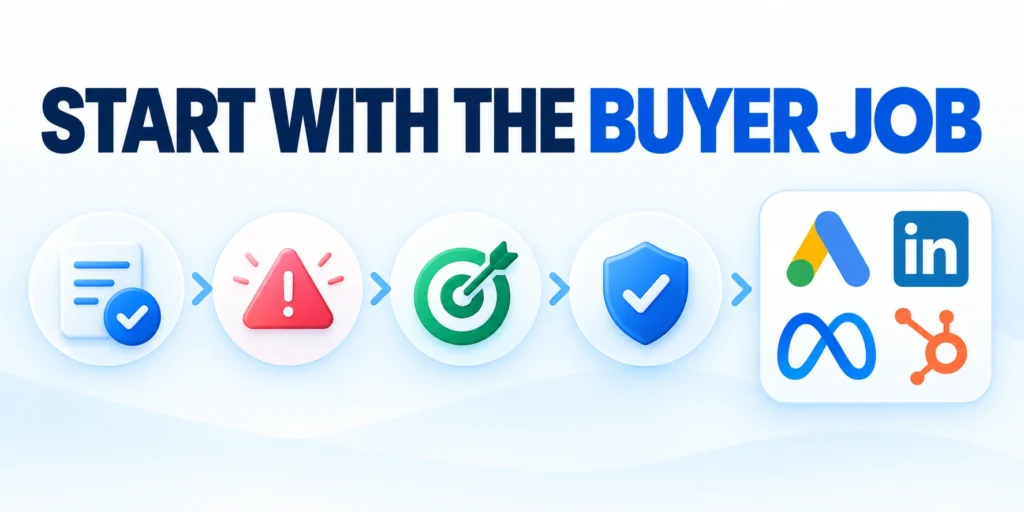
A useful ad does more than earn attention: it helps the right buyer recognize a relevant problem and choose a sensible next step.
Strong B2B ad copywriting formulas start with the buyer’s situation, then connect a specific outcome to credible evidence and an appropriate offer.
Define the moment your buyer is in
Before drafting headlines, identify what the prospect is trying to do, what is slowing them down, and what would make progress feel safer.
A finance leader comparing CRM platforms has a different job from a sales manager trying to repair inconsistent lead follow-up.
Ground the draft in real buyer language
Use customer interviews, sales-call notes, support conversations, and search queries as evidence. Do not invent customer language because it sounds persuasive.
Compare repeated wording across several conversations before treating one memorable phrase as a reliable campaign insight.
Ground each draft in these buyer signals:
- Situation: What changed or triggered the search?
- Problem: What is difficult, slow, risky, or expensive today?
- Desired progress: What practical improvement matters to this buyer?
- Proof: What can your organization substantiate?
- Next step: What low-friction action fits the buyer’s readiness?
Separate the offer from the outcome
“Book a demo” is an offer, not the customer outcome. The copy should explain why that meeting is useful to this particular audience.
For example, a CRM implementation firm could offer a workflow review that identifies one handoff delay and the data needed to diagnose it.
Make the audience and promise specific
That promise is clearer than “transform your sales operation” because it names a tangible activity without claiming a guaranteed business result.
Keep the audience narrow enough that a reader can recognize themselves. “B2B teams” is broad; “sales operations leaders consolidating regional pipelines” is more specific.
Align the claim with the destination
Use specificity only when it matches the campaign’s actual targeting and landing page. A precise headline cannot compensate for a mismatched offer.
Review targeting, headline, destination, and follow-up together so every stage serves the same buyer and promised next step.
Build a claim you can support
Before writing a benefit, ask what evidence supports it: product capability, a documented process, a customer-approved case study, or a transparent calculation.
Replace unsupported claims such as “double revenue instantly” with a verifiable description of what the service changes or helps the team measure.
Keep proof specific and consistent
When a result depends on customer context, say so. Clarify the conditions, timeframe, sample, and limitations behind any performance figure.
This discipline protects trust and gives the sales team language it can repeat without adding qualifications after the click.
Connect the promise to the campaign path
For a broader planning framework, see the B2B demand generation guide and connect the ad promise to the campaign’s qualification path.
The sales team should recognize that promise and understand which evidence, questions, and follow-up actions continue it after conversion.
Five B2B Ad Copy Formulas You Can Adapt
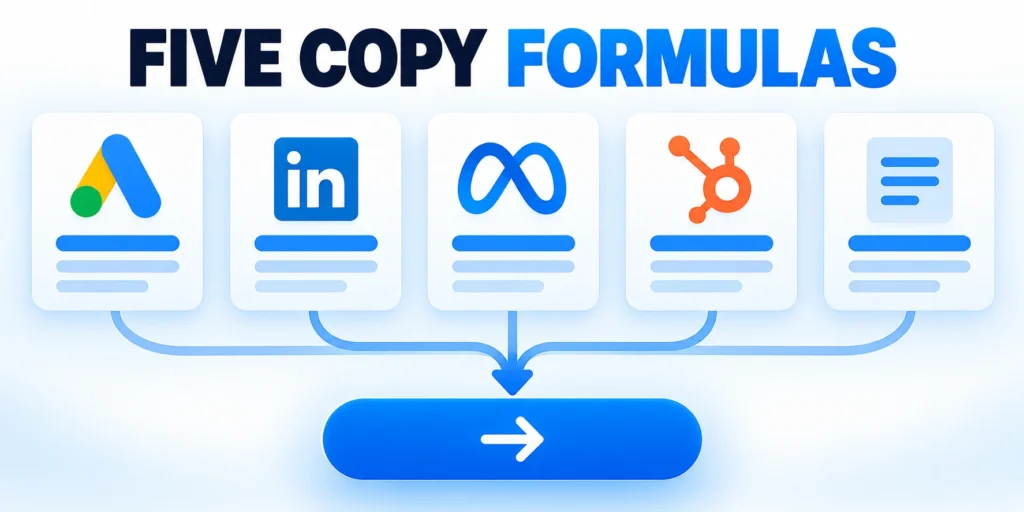
Formulas are drafting prompts, not templates that guarantee clicks. Use them to make the message easier to evaluate, then adapt the details to evidence.
Each structure below can produce search headlines, social introductions, or landing-page variations, but the available field lengths differ by platform.
Problem → impact → useful next step
Structure: Name a recognizable problem, explain its business consequence, and offer a relevant action that helps the buyer investigate.
Example: “Campaign leads reach sales without source context? Map the handoff and review a practical CRM tracking plan.”
Use it when the pain is already visible
This works when prospects already feel the pain but need help defining the next move. Keep the consequence factual rather than dramatic.
Use operational effects that buyers can recognize, such as delayed routing, missing attribution, or inconsistent pipeline definitions.
Match the action to the problem
Use it for an audit, checklist, or consultation when the offer genuinely helps diagnose the named issue. Do not promise a complete fix in one meeting.
State what the buyer receives from that action so the call to action feels concrete instead of merely lower commitment.
Outcome → mechanism → proof
Structure: State the improvement the buyer wants, describe how the product or service contributes, and add proof that is specific and approved.
Example: “See which campaigns create qualified pipeline. Connect CRM milestones to ad reporting, then review the documented setup.”
Explain how the offer contributes
The mechanism matters because buyers need to understand how the offer relates to the outcome. A slogan alone leaves that connection unexplained.
Name the capability, workflow, or service step that creates progress without implying that one feature controls the entire result.
Show evidence that supports the mechanism
Proof might be a named capability, a relevant customer result with context, a transparent methodology, or a clear product demonstration.
Match the strength of the evidence to the strength of the claim and retain the qualifications needed for an honest comparison.
Do not imply evidence you do not have
If no customer evidence is available, do not fabricate a testimonial or imply independent validation. Demonstrate the workflow or explain the method instead.
A transparent demonstration can be more credible than a vague success claim because the buyer can inspect how the work happens.
Before → after → bridge
Structure: Contrast the current workflow with a more useful future state, then identify the product, process, or service that bridges them.
Example: “From scattered regional reports to one reviewed pipeline view. Start by aligning stage definitions and ownership.”
Use a contrast the buyer can verify
Use a contrast the audience can verify. “Before” should describe a real operating condition, not ridicule the prospect or exaggerate the status quo.
Explain the bridge honestly. If the change requires integration work, training, or data cleanup, avoid suggesting that a purchase alone completes it.
Objection → answer → lower-risk action
Structure: Acknowledge a common concern, answer it with a concrete detail, and offer a next step that reduces uncertainty.
Example: “Concerned about migrating active workflows? Review a phased cutover plan before deciding which records to move first.”
Use objections heard from real buyers
Use objections heard repeatedly in sales or support, not imagined objections inserted to make the copy sound consultative.
Group similar concerns by buyer role and buying stage before selecting one that the campaign can answer accurately.
Answer with the actual scope
The answer should be accurate for the offer. If migration support varies by package, state the scope on the landing page and in the sales process.
Avoid compressing a conditional service into an absolute promise that sales must later narrow or withdraw.
Offer a useful next step
A lower-risk action could be a sample, checklist, technical review, or comparison call. Choose one the team can actually deliver.
Describe the output, preparation, and expected follow-up so prospects can judge whether the action fits their current decision.
Trigger → change → call to action
Structure: Start with a timely business trigger, explain the decision it creates, and invite the reader to take the next useful step.
Example: “Adding a new sales region? Check whether territories, lifecycle stages, and reporting owners are ready before launch.”
Use only a real buyer trigger
This approach fits events such as a new market, system replacement, team restructure, or revised compliance requirement when the campaign targets that context.
Confirm that targeting can identify the affected audience without assuming every company in the segment faces the same trigger.
Keep urgency factual
Avoid manufactured urgency. If a deadline is real, explain what changes when it passes and link to details that substantiate the timing.
Remove countdown language when the offer remains available, because false scarcity can damage trust and attract poorly qualified clicks.
Turn a formula into a usable draft
Use this short worksheet before producing variants. Fill each field with customer evidence, then remove any phrase that cannot be defended.
Turn each formula into a usable draft:
- Audience and situation: who is facing what change?
- Problem: what task or risk is blocking progress?
- Outcome: what specific improvement does the offer support?
- Mechanism: how does the product or service help?
- Proof: what evidence can the campaign show?
- Offer and CTA: what is the next step, and what will happen after it?
Draft several distinct angles, not near-identical versions that swap adjectives. One can focus on the problem, another on the mechanism, and another on proof.
Keep a record of the underlying audience, offer, and claim for each variant. That makes reviews faster and prevents inconsistent promises across ads.
Write Search Ads Around Active Intent
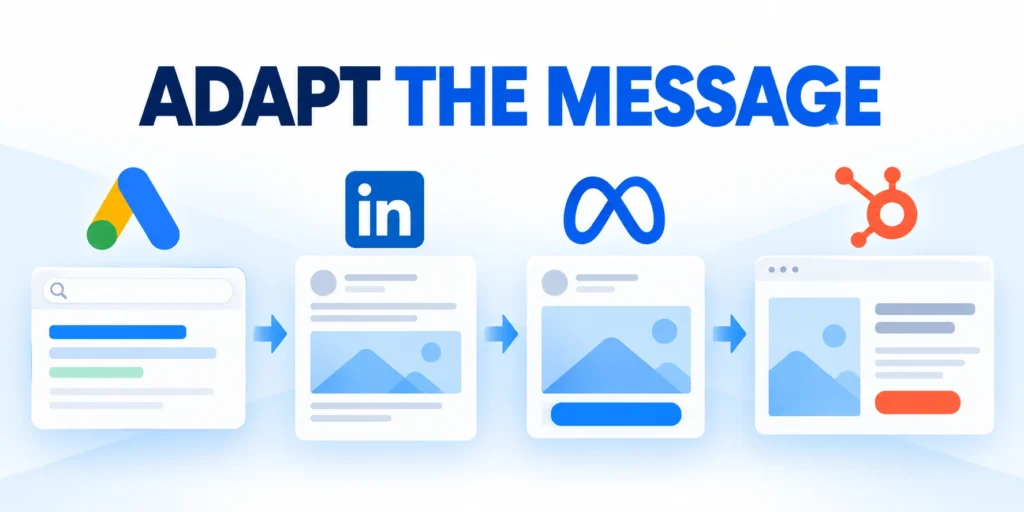
Search copy should answer the job implied by the query while clarifying the audience, offer, and practical next step without repeating every keyword.
A prospect searching for CRM migration planning needs different evidence from someone comparing attribution tools or troubleshooting paid lead quality.
Use these elements to build useful search assets:
- Name the relevant service category clearly.
- Match language to the searcher’s likely task.
- Add one supportable outcome or process detail.
- Use proof appropriate to the claim.
- Direct the click to the matching destination.
Create distinct headlines around audience, outcome, process, proof, and action. Variety helps only when every asset remains accurate in possible combinations.
Do not force the full keyword into every field. Repetition consumes limited space and can make the ad less informative for qualified readers.
Evaluate search copy with these outcome checks:
- Treat Ad Strength as guidance, not performance proof.
- Compare search terms with downstream lead qualification.
- Exclude misleading queries and revise ambiguous promises.
- Check asset combinations for missing context.
- Keep claims consistent across possible pairings.
- Archive variants that attract irrelevant intent.
- Preserve query evidence for future reviews.
Assess asset combinations before launch because responsive formats may pair headlines and descriptions in ways that change meaning or remove necessary context.
Keep approved variants distinct enough to answer different hypotheses while preserving the same offer, audience, destination, and qualification definition.
Earn LinkedIn Attention With Relevance

LinkedIn users are not always actively searching, so the opening must establish role-specific relevance before asking them to consider an offer or resource.
A strong feed message connects a recognizable business situation to one useful observation, then presents a next step proportionate to the buyer’s readiness.
Build LinkedIn copy around these relevance signals:
- Address a specific role or operating context.
- Lead with one recognizable problem or change.
- Explain one useful outcome without exaggeration.
- Support the claim with credible evidence.
- Choose a call to action matching commitment.
Put the most important context near the beginning. The visual and headline should reinforce the same idea instead of repeating identical wording.
Use concise introductory text when possible because placements can truncate longer copy. Confirm current field limits and specifications before every launch.
Use these controls before launching LinkedIn ads:
- Match calls to action with buyer commitment.
- Confirm current specifications in LinkedIn’s official guide.
- Evaluate qualified responses instead of reactions alone.
- Compare engagement across relevant job functions.
- Review disqualification reasons with sales regularly.
- Retire creative that attracts unsupported expectations.
- Preserve role-level response patterns for planning.
Coordinate organic and paid messages when the same audience sees both, but preserve campaign-specific tracking and a clearly defined conversion path.
Use comments and sales conversations as qualitative evidence, then validate recurring themes against lead quality before changing the campaign promise.
Preserve Message Continuity After the Click

An effective ad begins an expectation that the landing page, form, confirmation, and sales follow-up must continue without changing the audience or promise.
When the destination introduces a different offer or broader claim, buyers must reinterpret the message and may question whether the click was worthwhile.
Check these stages before activating a campaign:
- Ad names the intended audience and problem.
- Landing page repeats the same core promise.
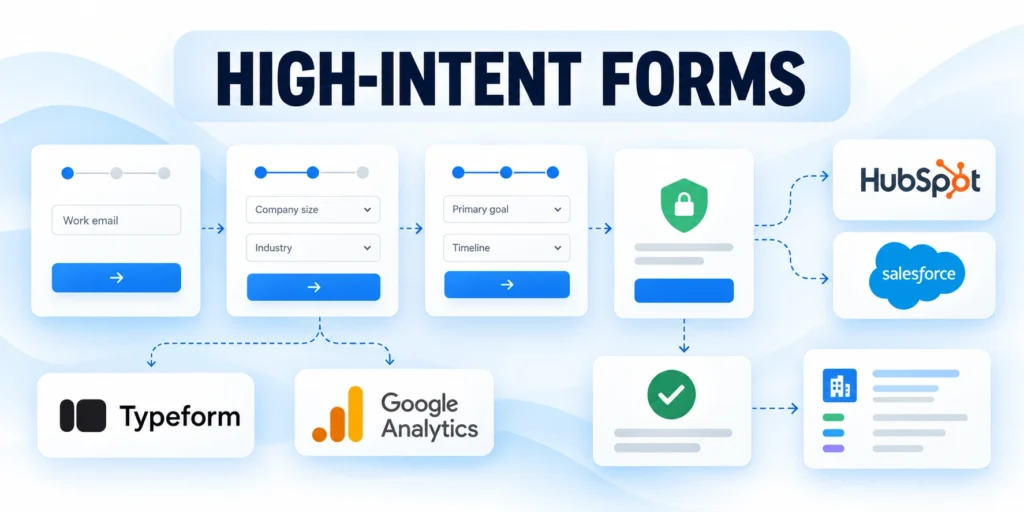
- Form requests information proportional to value.
- Confirmation explains the immediate next step.
- Sales follow-up continues the advertised context.
If an ad promises a template, make the resource easy to find. If it offers a review, explain its scope, preparation, output, and follow-up.
Review privacy language, consent, routing, and response timing before launch. Operational gaps after submission can invalidate conclusions about copy quality.
Protect continuity with these campaign controls:
- Separate journeys requiring materially different destinations.
- Use consistent analytics and CRM naming.
- Record destination changes as journey tests.
- Test routing with representative records before launch.
- Share original ad context with sales.
- Monitor response timing after every campaign change.
- Verify confirmation messages match advertised expectations.
Test forms and routing with representative records before launch so missing fields, ownership errors, or delayed notifications do not distort campaign conclusions.
Give sales the original ad context inside the CRM, enabling follow-up that acknowledges the exact problem, evidence, and offer the buyer selected.
Build a Practical B2B Message Matrix

A small message matrix helps teams connect buyer context, campaign angle, and offer without producing dozens of nearly identical ads or disconnected landing pages.
The matrix should expose meaningful choices, not become a quota that forces every audience, problem, and channel into a separate campaign.
Use these inputs to define each matrix row:
- Buyer context or active business trigger.
- Problem the audience can recognize now.
- Message angle supported by available evidence.
- Offer appropriate to decision readiness.
- Destination capable of fulfilling the promise.
| Buyer context | Message angle | Offer and next step |
|---|---|---|
| Known-solution search | Show category and process | Comparison or scoped demo |
| Problem-aware buyer | Explain problem and first step | Checklist or diagnostic |
| Implementation-risk buyer | Show migration approach | Technical review or sample plan |
| Provider comparison | Clarify fit and boundaries | Case study or consultation |
Apply the matrix with these safeguards:
- Combine rows only when the journey matches.
- Review claims with sales before production.
- Narrow wording when qualification evidence conflicts.
- Archive rows that no longer match current offers.
- Assign one measurable question to each active row.
- Use one destination for genuinely equivalent buyer needs.
- Separate contexts requiring different proof or follow-up.
- Revisit the matrix after material product changes.
Keep the active matrix small enough for the available budget and conversion volume. Too many simultaneous rows weaken learning and operational follow-through.
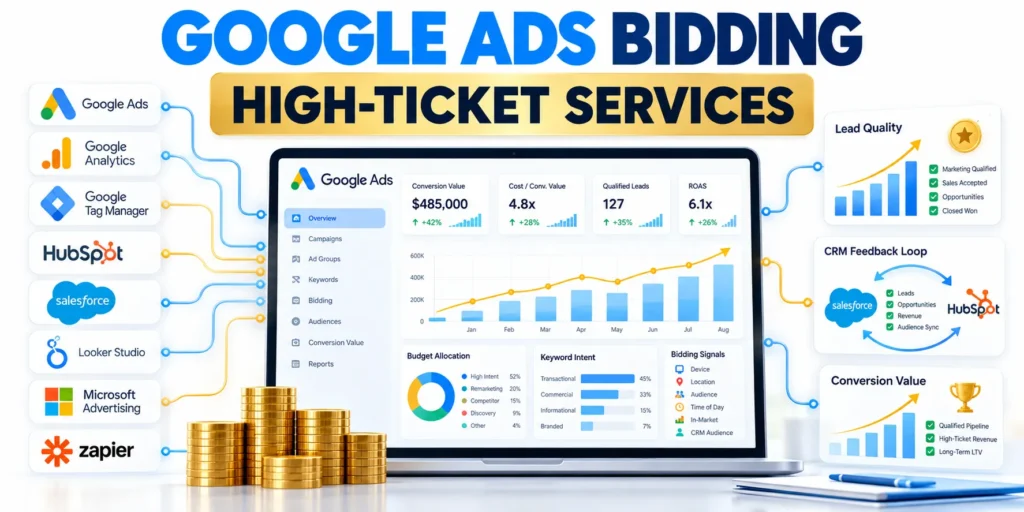
For bidding decisions after message alignment, use the Google Ads bidding guide for high-ticket services as a related reference.
Test Copy Without Guessing
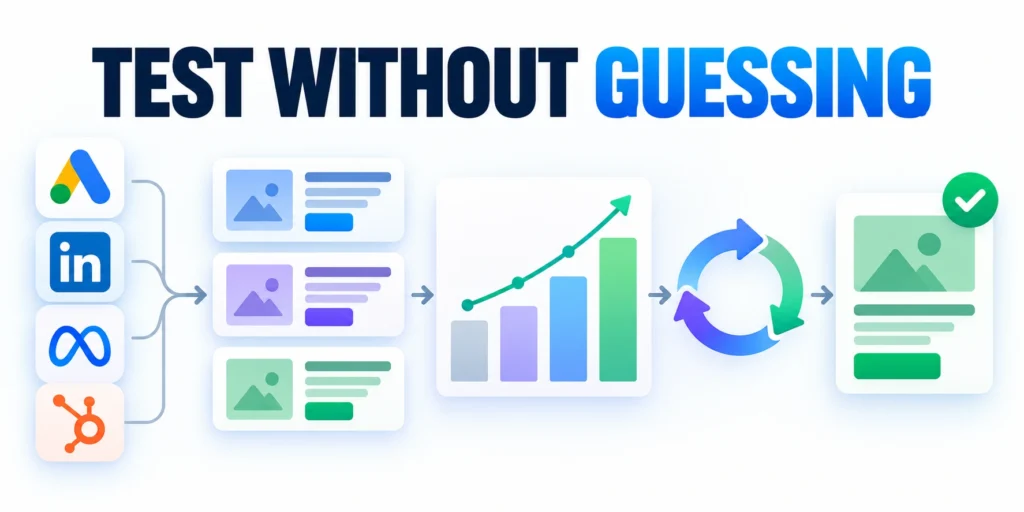
Testing turns copywriting from a preference debate into a measured learning process, provided the team changes one meaningful variable at a time.
Choose the outcome before launching. A click, form submission, sales-accepted lead, and qualified opportunity answer different business questions.
Write a test question, not just two ads
A useful test states an audience, a variable, and a predicted response. For example: does a workflow-risk angle produce more qualified consultations than a time-saving angle?
Keep targeting, bid strategy, offer, landing page, and measurement consistent when comparing message angles, unless one of those is the test variable.
Define qualification before launch
Define what counts as qualified before reading results. Write the criteria in the CRM so sales and marketing interpret the same event consistently.
Include disqualifying conditions and ownership rules so rejected leads still teach the team which messages attract the wrong audience.
Define qualification with this controlled test sequence:
- Choose one audience segment and a real buyer problem.
- Select one variable: angle, proof, offer, or call to action.
- Keep the destination and conversion definition stable.
- Set a review date based on expected volume and the sales cycle.
- Record qualified outcomes and disqualifying reasons, not only click metrics.
- Decide in advance what evidence would justify keeping or revising the variant.
Read metrics in context
Click-through rate can indicate whether an ad earns interaction, but it cannot show whether the resulting contacts fit the ideal customer profile.
Compare cost per qualified lead, opportunity creation, sales acceptance, and revenue when those measures are available and sufficiently mature.
Avoid premature conclusions
Check denominators and timing. A handful of conversions, a long sales cycle, or uneven delivery can make short-term differences unstable.
Do not call a variant a winner because it had a higher CTR in one short interval. Confirm the sample, audience, and downstream quality.
Turn each result into the next hypothesis
If one message attracts more qualified opportunities, investigate why. The audience may recognize the problem more clearly, or the offer may set better expectations.
If clicks rise but lead quality falls, check targeting, claim clarity, form friction, and whether the landing page changed the promise.
Record what changed and what comes next
Document what was tested, what changed, the period, the result, and the next decision. This prevents teams from rerunning the same inconclusive experiment.
Change one major element at a time when volume is limited. If multiple changes are necessary, label the result as a combined test rather than attributing impact to one line.
Maintain a Living Message Library
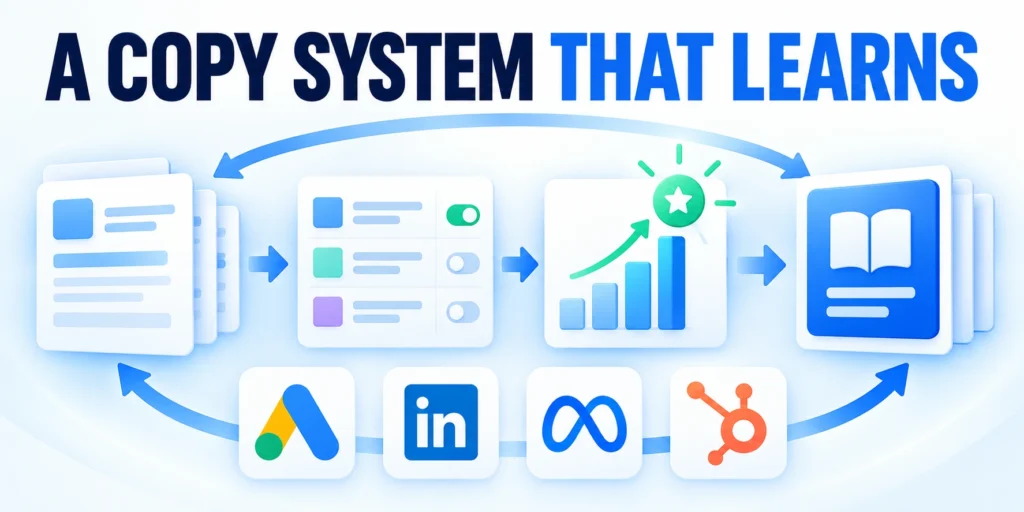
Repeatable ad copy comes from shared evidence about the buyer, offer, and results rather than a spreadsheet of clever headlines detached from campaign context.
A living message library gives marketing, sales, product, and reviewers one place to understand what was tested and which claims remain approved.
Record these fields for each active message concept:
- Audience and relevant buying situation.
- Problem, outcome, and message angle.
- Approved proof and necessary qualifications.
- Offer, channel, and destination.
- Test dates, results, and next decision.
Use consistent labels so teams can compare concepts across campaigns without mistaking minor wording variations for genuinely different hypotheses.
Review the library when positioning, product capability, customer evidence, or commercial scope changes. Retire claims that no longer reflect the current offer.
Keep the library useful with these controls:
- Assign each claim an owner and review date.
- Preserve failed tests with their original context.
- Store reusable learning instead of every draft.
- Separate measured evidence from reviewer interpretation.
- Record material changes to the underlying offer.
- Restrict sensitive customer evidence appropriately.
- Document approval dates for every active proof point.
- Remove duplicate concepts before quarterly reviews.
Separate verified evidence from interpretation so future teams can understand whether a conclusion came from campaign data, sales feedback, or reviewer judgment.
Use permissions and change history appropriate to the organization, especially when the library contains customer results, pricing, or regulated claims.
Choose the Next Experiment From Evidence

The next experiment should answer a decision created by current evidence, not simply rotate new language because a campaign has been running for several weeks.
Use qualified pipeline, buyer feedback, search terms, and delivery data to decide which uncertainty deserves budget and controlled comparison.
Prioritize experiments using these decision criteria:
- Material impact on buyer qualification.
- Evidence of a specific message mismatch.
- Enough volume for a useful comparison.
- One controllable variable with clear ownership.
- A defined action for each possible result.
If clicks rise while qualification falls, investigate audience targeting, claim clarity, offer expectations, and the destination before testing cosmetic headline changes.
Confirm every outcome, comparison, number, testimonial, and urgency statement has current evidence and the required internal approval before scaling exposure.
Scale experiments with these evidence controls:
- Maintain one promise across the full journey.
- Document variables, limitations, and next decisions.
- Broaden tests only after answering the hypothesis.
- Set review dates from expected conversion maturity.
- Pause tests when tracking becomes unreliable.
- Narrow questions when results remain inconclusive.
- Compare qualified outcomes across equivalent evaluation windows.
- Retain control variants until decisions are documented.
Set a decision date based on expected volume and sales-cycle maturity rather than an arbitrary weekly reporting rhythm that encourages premature conclusions.
When evidence remains inconclusive, improve measurement or narrow the question before spending more budget on additional creative variations.
FAQ
These answers address common decisions about B2B ad formulas, evidence, testing, channels, pricing, urgency, and approval.
What is a B2B ad copy formula?
It is a repeatable message structure that helps connect a buyer’s situation to an outcome, evidence, offer, and next step.
Do copywriting formulas guarantee a higher click-through rate?
No. They organize a draft; audience fit, offer relevance, delivery, landing-page quality, and measurement all affect results.
How many ad variants should I test?
Test only as many distinct variants as your budget and conversion volume can evaluate meaningfully. Avoid near-duplicates that differ only in adjectives.
Should I optimize for CTR or qualified leads?
Use CTR to diagnose engagement, then evaluate qualified leads and pipeline when your tracking and volume support those comparisons.
Can one formula work on Google Ads and LinkedIn?
The message logic can transfer, but adapt the wording, field limits, format, buyer intent, and destination to each placement.
Should ad copy mention pricing?
Mention pricing when it is accurate, current, material to qualification, and consistent with the destination and commercial terms.
How should proof appear in short ads?
Use concise, supportable evidence tied to the claim, then provide fuller context and limitations on the destination.
Can urgency improve B2B ad performance?
Only use genuine deadlines or constraints. Artificial urgency can mislead buyers and weaken trust, qualification, and compliance.
When should a copy test stop?
Stop after material policy risk, tracking failure, exhausted budget, invalid comparison, or enough evidence for the planned decision.
Who should approve B2B ad claims?
Use accountable product, marketing, legal, compliance, sales, or technical reviewers according to the claim and market.
Conclusion

B2B ad copy formulas are useful when they organize buyer evidence, supportable claims, relevant offers, and measurable next steps instead of replacing strategic judgment.
The strongest copy system connects search or feed context to a consistent destination, qualified follow-up, and a documented learning process.
Use these principles when reviewing the final campaign:
- Start with a real buyer situation.
- Make claims proportionate to available proof.
- Match the offer to decision readiness.
- Preserve continuity after every click.
- Choose new tests from qualified outcomes.
Review each material claim when the product, service, evidence, audience, or regulatory context changes. Retire language that the organization can no longer defend.
For a broader channel framework, read Advanced B2B Retargeting Strategy and connect each message to the appropriate follow-up path.
Use this final review before approving distribution:
- Confirm targeting reflects the stated buyer context.
- Verify every numerical claim against current evidence.
- Test destination forms and follow-up routing.
- Record ownership for future claim reviews.
- Define the decision each campaign result supports.
- Confirm channel specifications before final production.
- Review disqualification reasons with sales.
- Preserve the original test hypothesis.
- Document every material destination change.
- Retire claims that exceed available proof.
When these controls stay connected, formulas accelerate drafting without replacing evidence, judgment, or the operational discipline needed to turn attention into qualified business conversations across channels and buying stages globally.






Leave a Reply