


Why commercial intent deserves its own topic cluster

A commercial-intent topic cluster organizes pages around buyers evaluating solutions, vendors, implementation approaches, costs, and operational risk.
The goal is useful coverage of related decisions, not a larger number of URLs or a promise of higher rankings.
Start with the decision, not the keyword count
A search phrase can sound commercial without revealing the reader’s actual task. “CRM software” might mean discovery, while “CRM for distributed service teams” can signal evaluation.
Intent is a working interpretation. Validate it against the query’s wording, the audience, the search results, and what your sales team hears.
Turn the cluster into a decision path
A practical cluster helps a buyer move from a defined problem toward a defensible next step. Each page should answer one recognizable question.
That path may include learning, comparison, technical evaluation, and procurement. Buyers can enter at different points and revisit earlier questions.
Build the decision path through these stages:
- Problem clarification: help the reader name a costly or recurring business issue.
- Solution evaluation: explain approaches, trade-offs, and when each approach fits.
- Vendor comparison: give buyers criteria for comparing providers or products.
- Implementation planning: show prerequisites, risks, sequence, and ownership.
- Decision support: help a buying group build a shortlist or internal business case.
- Risk validation: surface delivery and adoption constraints.
- Stakeholder alignment: connect evidence to shared approval criteria.
- Post-purchase fit: confirm operational ownership.
Collect buyer and search evidence before clustering

Build the first query set from evidence that reflects buyer language and real decisions, rather than starting with a spreadsheet of loosely related keywords.
Search data reveals phrasing and page visibility; sales conversations reveal context, constraints, and objections that query reports cannot explain by themselves.
Use a small set of complementary inputs
Start with Search Console queries and landing pages for your existing visibility. Compare those phrases with customer-facing records and search result pages.
Apply these criteria to a small set of complementary inputs:
- Collect repeated questions from discovery calls, support cases, implementation reviews, and lost-deal notes.
- Review Search Console queries and pages for phrases tied to impressions, clicks, and existing pages.
- Inspect sample search results to understand which page types currently answer the queries.
- Ask sales and customer success which evaluation criteria repeatedly delay or change a purchase.
Search Console’s Performance report can compare queries, pages, clicks, impressions, and other search metrics over selected periods.
Do not treat one ranking snapshot as a verdict. Search results vary by time, location, device, and query formulation.
Keep the evidence tied to a business audience
Record the target organization, role, problem, current alternative, and decision stage beside each promising query or question.
For example, a procurement lead comparing enterprise identity tools needs different evidence than an engineer researching single sign-on architecture.
Record why two phrases belong together
Combine near-duplicate phrases only when they point to the same audience task and a page can answer them naturally.
Write down the shared question and note any differences in audience or expected evidence. This makes future edits easier to explain.
Use these actions to record why two phrases belong together:
- Keep phrases together when the same page can satisfy both without confusing its focus.
- Separate them when one asks for evaluation and another requires a technical procedure.
- Revisit the decision when query data or sales feedback reveals a different buyer task.
Classify intent by the job the searcher needs done

Classify queries by the decision or task they express. Modifiers such as “best,” “pricing,” or “enterprise” are clues, not definitive intent labels.
Use a consistent worksheet so marketing, product, and sales teams can challenge assumptions and update the cluster when evidence changes.
| Buyer task | Possible query shape | Useful page response |
|---|---|---|
| Understand a problem | Why does customer onboarding stall? | Causes, indicators, and ways to diagnose the issue |
| Compare approaches | Workflow automation vs. CRM automation | Differences, constraints, and fit by use case |
| Evaluate solutions | Enterprise CRM implementation services | Scope, requirements, proof, and criteria |
| Plan a purchase | CRM migration cost for a 500-person company | Cost drivers, assumptions, and planning questions |
Use language as a hypothesis, then verify the page need
“How to” often suggests learning, but a detailed implementation guide can support a buyer evaluating delivery risk.
“Pricing” can mean a request for a quote, a budgeting question, or a comparison of pricing models.
Use result-page patterns to test your classification
Check whether the same query group returns similar page types and whether those pages solve the same job.
If the evidence is mixed, record the uncertainty. Test one focused page before building several pages around a weak assumption.
Apply these criteria to result-page patterns to test your classification:
- Review a small, representative sample rather than interpreting one result page as a permanent rule.
- Note whether results emphasize guides, comparisons, vendor pages, or product documentation.
- Compare your proposed answer with the task readers appear to be pursuing.
Map query groups to distinct page roles

A query group should map to a page role before it maps to a URL. The role clarifies what the page must explain and prove.
Map one primary buyer task to each planned page. A single URL can serve several close variants when they need the same answer.
Choose the lightest page that fully serves the task
A comparison guide fits readers weighing alternatives. Service pages fit readers evaluating a provider’s scope and delivery approach.
An implementation guide fits teams planning technical work, ownership, and change management. A cost guide fits readers building a budget.
| Query group | Likely page role | Evidence to include |
|---|---|---|
| Approach A versus approach B | Comparison guide | Criteria, limits, and scenario fit |
| Provider for a defined need | Service or vendor page | Scope, proof, prerequisites, and next step |
| Migration or rollout planning | Implementation guide | Sequence, risks, roles, and validation |
| Budgeting a purchase | Cost guide | Cost drivers, assumptions, ranges, and exclusions |
Consider a hypothetical B2B cloud migration firm. “Cloud migration providers” may need a vendor comparison, while “cloud migration checklist” needs an actionable planning resource.
Both pages can link to each other when their explanations help readers move between evaluation and preparation.
Document the mapping before writing
A one-page map can list the query group, audience, page role, existing URL, evidence needed, and the next useful internal destination.
Mark uncertain decisions separately from confirmed ones. This prevents a brainstormed phrase from becoming a production commitment by accident.
Capture these fields before approving each page:
- Primary buyer task and audience.
- Distinct page role and scope.
- Required evidence and examples.
- Next contextual internal destination.
Design a cluster around connected buyer decisions

A useful cluster has a clear center and supporting pages with distinct purposes. It should reflect the buyer’s connected decisions, not a forced hub-and-spoke diagram.
Some topics need only a few strong pages. Add a page when it fills a real information gap and can offer meaningfully different evidence.
Plan the cluster before assigning production dates
Sequence production from buyer dependency and business value rather than isolated keyword volume. Confirm that each planned page has evidence and a distinct role.
Resolve overlaps before assigning writers or dates. A clear map prevents parallel drafts from answering the same question with slightly different wording.
Follow this sequence to plan the cluster before assigning production:
- Write the target buyer, organization type, problem, and commercial decision in one sentence.
- Group queries by the task they express, then label the evidence supporting each group.
- Assign a page role and one primary question to every group worth serving.
- Identify what proof, examples, comparisons, or technical detail each page must provide.
- Draw only the internal links that help a reader reach a relevant next decision.
- Remove a planned page when another page can answer its task without becoming unfocused.
Build links from useful next questions
For a broader foundation, see our guide to B2B topic clusters and information architecture.
This article narrows that foundation to commercial queries, buying tasks, page selection, and qualified business outcomes.
Use context to explain each relationship
Internal links should help explain relationships. Google recommends crawlable links with descriptive anchor text that sets a clear expectation.
For sitewide organic planning, connect this work with the broader enterprise B2B SEO strategy.
Make the link destination relevant to the paragraph
Link a comparison page to an implementation guide when readers need to understand rollout effort before selecting an approach.
Link a service page to a planning resource when that resource helps buyers assess prerequisites before requesting a proposal.
Use these actions to make the link destination relevant to:
- Use descriptive anchor text that names the destination’s subject.
- Place links near the explanation that makes the next resource useful.
- Review links when pages change, merge, or move to a different role.
Keep every page distinct and useful

Several URLs can target different tasks within one buying journey, but small wording changes do not create a meaningful new page purpose.
Before drafting, compare the proposed page with existing posts, service pages, and resources. Look at audience, task, evidence, and next action.
Use a four-part page differentiation test
Apply these criteria to a four-part page differentiation test:
- Audience: who needs this answer, and what role do they play in the purchase?
- Task: what decision or action should become easier after reading?
- Evidence: which examples, data, process details, or trade-offs make this page specific?
- Next step: what relevant action can readers take without being pushed into an unrelated offer?
If two pages have the same audience, task, evidence, and next step, combine their coverage or choose one stronger URL.
If the pages differ only because one targets “enterprise” and another targets “B2B,” check whether the content genuinely changes.
Separate pages only when their answer changes
When a product or industry changes the requirements, make those differences explicit with suitable examples and qualifications.
Do not invent benchmarks, customer outcomes, certifications, or first-hand testing to make pages appear unique.
Use these actions to separate pages only when their answer:
- Reuse accurate explanations when the requirement is genuinely shared.
- Explain meaningful differences with concrete scope, risks, or technical constraints.
- Consolidate thin pages when they cannot provide distinct evidence or useful guidance.
Measure whether the cluster supports qualified demand

Search visibility is one input, not the final measure of commercial value. Track whether relevant readers engage and progress toward qualified conversations.
Choose measures that match each page’s role. A planning guide and a service page should not be judged by identical conversion expectations.
Connect search, page, and business signals
Search Console can show queries and pages alongside clicks and impressions. Use filters and comparable periods to investigate patterns.
Analytics may add engagement and conversion events. A CRM can connect inquiries to qualification, opportunities, and eventual revenue.
| Signal | Question it helps answer | Useful comparison |
|---|---|---|
| Query impressions | Is the page appearing for relevant searches? | Query group and period |
| Clicks and click-through rate | Does the result attract the intended audience? | Query and landing page |
| Qualified inquiries | Do responses match the target buyer and need? | Page role and lead source |
| Opportunities and revenue | Does the cluster assist meaningful pipeline? | Account, campaign, and time period |
Review evidence without overclaiming attribution
Organic journeys often involve several searches, pages, devices, and conversations. Last-click reporting may miss earlier research.
Compare trends, annotate major site changes, and review representative leads with sales before attributing pipeline to one page.
Choose a next action from the evidence
Investigate mismatches between queries and page content. Update the page when evidence shows a gap, not merely because a metric changed.
Choose one change that addresses the diagnosed cause and preserves a comparable baseline. Record the expected effect before measuring the next review period.
Choose the next action through this sequence:
- Choose a review interval that matches traffic volume and the length of the buying cycle.
- Check search queries, landing pages, qualified inquiries, and sales feedback together.
- Decide whether to improve the page, revise internal links, consolidate overlap, or gather more evidence.
- Record the change and compare a similar period before drawing a conclusion.
Distinguish a content problem from a measurement problem
Low impressions can reflect limited demand, indexing issues, competition, or a page that does not match the query group.
Many impressions with weak engagement may justify checking the result snippet and page promise before rewriting the entire cluster.
Investigate conversion quality before changing copy
Qualified visits without sales progression may point to offer fit, follow-up, qualification rules, or a mismatch with the target account.
Review representative opportunities with sales before rewriting pages. The content may be accurate while qualification, routing, or follow-up creates the observed drop.
Prevent Cannibalization With Explicit Page Briefs
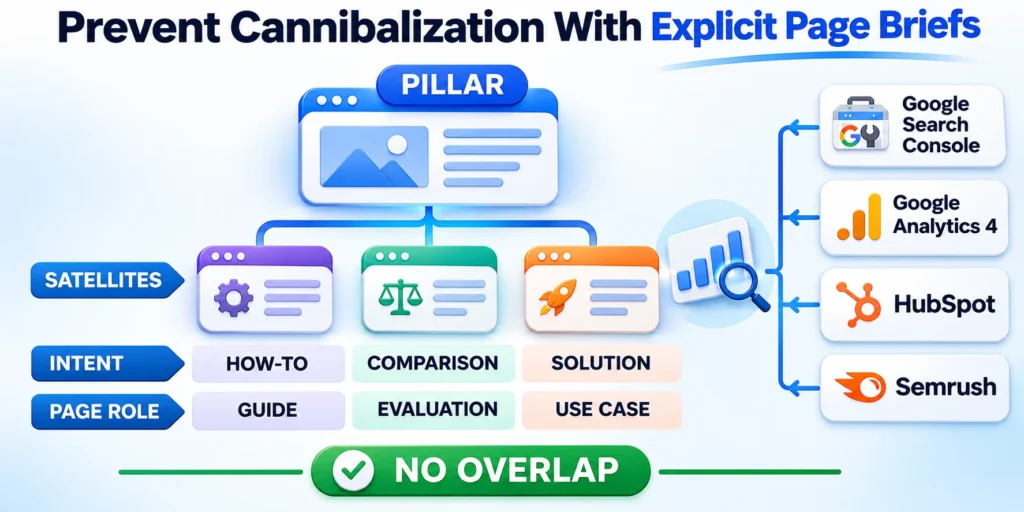
Give every planned URL one primary reader, intent, decision, scope, and conversion role. Compare the brief with existing content before drafting or changing slugs.
Map overlapping queries to the page that best satisfies the need. Related pages can share vocabulary without duplicating purpose or competing calls to action.
Choose Distinct Page Roles
A pillar can explain the complete decision landscape, while satellites answer narrower problems. Commercial pages should describe the actual service and buyer fit.
Do not create a new page for every keyword modifier. Expand an existing page when the reader, intent, and required answer are substantially the same.
Define distinct page roles through these fields:
- Record the primary intent and audience.
- List included and excluded subtopics.
- Name the intended internal-link relationships.
- Define the next useful reader action and measurable success signal.
Review Existing Search Signals
Compare queries, landing pages, links, conversions, and business purpose. Two URLs ranking for similar terms do not always serve the same task.
Investigate whether overlap causes unstable rankings, unclear navigation, duplicate answers, or divided authority before consolidating anything.
Resolve Overlap Conservatively
Clarify page scope, headings, examples, and internal links first. Consolidate only when one page can preserve the useful intent and evidence of both.
Protect published URLs and redirect only after a separate evidence-based decision. Monitor queries, engagement, conversions, and crawl behavior after changes.
Maintain a Governed Cluster Inventory

Keep one record for every cluster URL with its owner, role, intent, audience, key question, related pages, status, and last meaningful review.
Use the inventory before commissioning content. It helps teams update a useful page instead of creating another article with slightly different wording.
Review Changes Across the Cluster
When the pillar changes, identify satellites whose definitions, examples, links, or calls to action may become inconsistent. Review only affected dependencies.
Record redirects, retired topics, and intentional overlap. Future editors need the rationale, not only the current set of URLs.
Govern cluster changes through these records:
- Assign an accountable owner to each page.
- Record intent and content boundaries for editors.
- Track meaningful update dates and supporting evidence.
- Document consolidation and redirect decisions with owners.
Use Evidence to Schedule Refreshes
Prioritize stale claims, changed products, broken steps, new buyer objections, declining qualified outcomes, and meaningful search shifts. Avoid arbitrary freshness rewrites.
After updating, check internal relationships and business outcomes. A stronger satellite should improve the reader journey without weakening another page’s role.
Define decision rights for cluster changes
Name who can approve a new URL, change a page role, consolidate overlap, or retire content. Record the evidence required for each decision.
Separate editorial ownership from final redirect approval when possible. This review protects useful URLs while allowing teams to correct genuine duplication.
FAQ
These answers address ranking expectations, page counts, comparisons, service pages, redirects, review cadence, gaps, and cannibalization signals.
Does a topic cluster guarantee higher rankings?
No. A cluster is an editorial planning method. Search engines do not promise rankings because pages use a hub, shared keywords, or a specific URL count.
How many pages should a commercial-intent cluster contain?
Use as few pages as necessary to answer distinct buyer tasks well. The right number depends on evidence, audience needs, and existing coverage.
Should every query variation get a separate page?
No. Group close variations when they share the same audience task and answer. Separate pages only when the underlying need or evidence differs materially.
Should commercial-intent pages always include a sales call to action?
No. Match the next step to the reader’s readiness. A useful comparison may offer a worksheet, while an evaluation page may invite a conversation.
How often should a cluster be reviewed?
Review it when evidence or products change and on a schedule that fits the buying cycle. Avoid frequent edits based on short-lived ranking movement.
How should a cluster handle comparison queries?
Create a comparison page when buyers need a distinct evaluation. Use transparent criteria and link to deeper product, service, and implementation guidance.
Can service pages belong to a topic cluster?
Yes, when contextual links help readers move from education to a relevant service. Do not force every article to link commercially.
Should old posts be redirected into the pillar?
Only when intent and useful content can be preserved. Update distinct pages when they continue serving a separate reader need.
How are cluster gaps prioritized?
Use buyer questions, sales evidence, search demand, existing coverage, business relevance, and production effort. Avoid filling a template quota.
What indicates cluster cannibalization?
Look for unstable landing pages, duplicated intent, conflicting internal links, unclear page roles, and divided conversions. Confirm the cause before consolidating.
Conclusion

A commercial-intent cluster starts with buyer evidence, maps related searches to clear page roles, and gives every useful URL a distinct job.
Publish pages that add decision value, connect them contextually, and measure search and business signals without claiming guaranteed rankings or simple attribution.
Keep every URL accountable to a buyer task
Document the audience, intent, scope, evidence, conversion role, and internal relationships before production. Compare that brief with the existing inventory.
When two pages answer the same task, clarify their roles first. Consolidate only when one URL can preserve the useful intent and evidence.
Use this final cluster review sequence:
- Confirm each page serves a distinct decision.
- Check contextual links and destination relevance.
- Review queries beside qualified business outcomes.
- Correct overlap without changing URLs casually.
- Record owners, changes, and reassessment dates.
Use evidence to guide the next improvement
Search Console, analytics, CRM evidence, sales feedback, and crawl data answer different questions. Review them together before diagnosing content performance.
Improve a page when evidence reveals a missing answer, weak promise, or outdated claim. Fix measurement when tracking prevents a defensible conclusion.
Preserve governance as the cluster grows
Maintain one inventory for published, planned, redirected, and retired URLs. Future editors need the rationale behind boundaries, dependencies, and consolidation choices.
A governed cluster can expand with buyer needs while resisting duplicate pages, forced internal links, arbitrary freshness edits, and keyword-driven fragmentation.









Leave a Reply