


What Marketing Attribution Models Can Answer

B2B marketing attribution models assign reporting credit to touchpoints that appear before a defined conversion or milestone.
The selected model determines how that credit is divided; it does not prove that a touchpoint caused the outcome.
Define the question before selecting a model
Attribution is useful when a team needs a consistent way to describe how marketing interactions appear across customer journeys.
It can help compare channel roles, understand common paths, or allocate reported conversion credit under stated assumptions.
Use these actions to define the question before selecting a:
- Which touchpoint first introduced the account to the company?
- Which interactions appeared before a lead became an opportunity?
- What campaigns often appear in paths that later convert?
- How does reported credit change when the attribution rule changes?
These questions need different definitions of a touchpoint, a conversion, an account, and a reporting window.
Choose the unit that matches the sale
Many B2B purchases involve multiple people, repeated sessions, and sales activity that does not occur on the website.
A contact-level report may count a journey differently from an account-level or opportunity-level report.
Use these actions to choose the unit that matches the:
- Contact-level reporting asks which interactions an identified person had.
- Account-level reporting joins activity across known people at one company.
- Opportunity-level reporting connects eligible activity to a sales record.
Separate reported credit from causal impact
A channel can receive attribution credit because it appeared in a path, even if the conversion would have happened without it.
Attribution is a descriptive allocation rule. Incrementality asks whether an intervention changed outcomes compared with a credible counterfactual.
Use each method for the right question
Attribution describes recorded paths, while experiments estimate whether an exposure changed outcomes under controlled conditions.
Use attribution to inspect paths and organize reporting; use experiments when the decision depends on causal lift.
First-Touch Models and Their Trade-Offs

First-touch attribution assigns all modeled conversion credit to the first eligible touchpoint in the measurement window.
It is easy to explain and can highlight channels associated with discovery, but it ignores later interactions.
Calculate a first-touch example
Suppose an account first arrives through a partner article, later attends a webinar, clicks a paid search ad, and requests a demo.
Under first-touch rules, the partner article receives 100% of that modeled conversion credit, if it is tracked and eligible.
Check eligibility before interpreting the first touch
The rule does not say the article generated the whole sale. It only applies the chosen first-interaction rule to the recorded path.
If the earliest visit occurred outside the lookback window, the next eligible interaction may become the first touch.
Use these actions to check eligibility before interpreting the first:
- Confirm whether anonymous sessions can be connected to known contacts.
- Record how direct visits, referrals, and offline touches are handled.
- Check how missing campaign parameters affect channel classification.
Use first-touch for a focused discovery question
First-touch reporting can support a narrow review of where known contacts first entered a measurable journey.
Apply these criteria to first-touch for a focused discovery question:
- Keep the lookback window long enough for the defined B2B buying cycle.
- State whether the unit is a person, account, opportunity, or conversion.
- Check how direct visits and untracked interactions are treated.
- Compare first-touch results with pipeline quality, not only lead volume.
Do not use first-touch alone to decide that later campaigns, sales activity, or product education had no role.
Multi-Touch Models and Credit Allocation

Multi-touch models distribute modeled credit across more than one eligible interaction in a recorded path.
They can represent several campaign roles, but their weights remain assumptions about how reporting credit should be allocated.
| Model | Credit rule | Main limitation |
|---|---|---|
| Last-touch | Final eligible interaction | Hides earlier discovery |
| Linear | Equal eligible shares | Assumes equal influence |
| Time-decay | Favors recent touches | Assumes recency matters |
| Data-driven | Platform-estimated shares | Depends on tool scope |
Choose a rule that stakeholders can interpret
Use these actions to choose a rule that stakeholders can:
- Google Analytics and Google Ads currently support data-driven and last-click attribution options.
- Google retired four legacy models in November 2023; use them only for conceptual comparisons.
- Document the selected model and its unresolved attribution limitations.
Use the simplest model that matches the decision and can be explained with actual examples from the organization’s paths.
If stakeholders cannot describe the inputs or allocation, they may treat a reporting number as more precise than it is.
Use these actions to choose a rule that stakeholders can:
- Show the touchpoints included and excluded.
- Display the conversion definition and lookback window beside the report.
- Explain whether credit is whole-conversion or fractional.
- Identify the platform or data pipeline that calculated the result.
State the allocation rule in every report
Name the model, eligible events, lookback window, conversion, and reporting unit beside every attributed result.
Without those definitions, stakeholders cannot reproduce the view or explain why channel shares changed.
Compare One Path Under Different Attribution Rules

Take a path with four recorded interactions: partner content, a webinar, paid search, and a demo request.
Use these actions to compare the same path under different:
- First-touch assigns the full share to partner content.
- Last-touch assigns the full share to the demo-request interaction if eligible.
- Linear divides credit equally across the four eligible touches.
- Time-decay assigns larger shares to more recent touches according to its configured rule.
The total credited conversions may stay constant while the reported channel shares change substantially.
Google Analytics attribution settings and Google Ads attribution models document the currently supported choices and their product-specific scope.
Read algorithmic attribution with platform boundaries
A data-driven model uses observed data and a platform’s method to allocate credit; the result is specific to its measured scope.
It cannot automatically account for every offline conversation, dark social interaction, account relationship, or untracked exposure.
Explain why attribution shares change
Credit shifts when eligibility, identity stitching, path length, lookback windows, milestones, or weighting rules change.
Show those assumptions beside the result so stakeholders do not mistake a reporting change for a real underlying performance change in the market.
Audit scope before comparing platforms
Compare eligible channels, identities, conversion events, lookback windows, and offline imports before comparing reported shares.
Before comparing tools, record which channels, identities, conversions, and lookback windows each report includes.
How W-Shaped Attribution Works

W-shaped attribution is a rule-based multi-touch approach that emphasizes selected milestones in a lead-to-opportunity journey.
A typical implementation gives added weight to first touch, lead creation, and opportunity creation, then shares remaining credit among other touches.
Work through an illustrative allocation
Assume a team chooses 30% for first touch, 30% for lead creation, 30% for opportunity creation, and 10% for other eligible touches.
These weights are illustrative, not a universal W-shaped standard or recommended default; W-shaped is a custom allocation, not a standard Google Analytics or Google Ads setting.
Key considerations for work through an illustrative allocation include:
- First touch: a target account member reads a partner article.
- Lead creation: a contact registers for a product webinar.
- Opportunity creation: a sales-accepted opportunity is recorded later.
- Other touches: an email, event, or paid search visit occurs in the journey.
The team applies its declared weights to the event records and checks that all credited shares reconcile to the conversion total.
Check shorter paths and missing milestones
Some journeys contain no recorded lead-creation event, and others create an opportunity before marketing captures a known contact.
Define how the model handles those cases before launch; otherwise teams may compare conversions calculated under different rules.
Handle incomplete journeys through these declared rules:
- Specify whether missing milestones redistribute their weight or leave it unassigned.
- Document how one-touch and two-touch journeys are handled.
- Test that each conversion’s credited shares sum to the intended total.
Use W-shaped reporting only when milestone data is reliable
W-shaped models depend on consistent definitions and timestamps for lead creation and opportunity creation.
If lifecycle stages are entered late or inconsistently, the model can assign credit to misleading milestones.
Apply these criteria to w-shaped reporting only when milestone data:
- Agree on the event that formally creates a lead.
- Define opportunity creation and stage ownership.
- Resolve duplicate contacts and account matching before reporting.
- Check whether the analytics platform supports custom weights or requires a separate data model.
W-shaped credit may fit a team focused on lifecycle milestones, but it should not replace a separate test of channel impact.
Set Up Attribution Data and Reporting

Reliable model comparison starts with shared event definitions and a documented measurement window.
Before changing a report, confirm which business outcome it is meant to explain.
Create a measurement specification
Write one shared specification before configuring dashboards so marketing, sales, analytics, and finance use the same attribution definitions.
Version the document because lifecycle stages, platforms, identity rules, and eligible campaigns change over time.
A measurement specification records these operating choices:
- Name the conversion or milestone and its source system.
- Choose the reporting unit: contact, account, opportunity, or revenue event.
- Define eligible interactions and a lookback window suitable for the cycle.
- Document identity stitching, duplicate handling, and offline imports.
- Choose a model and record the exact weighting rule.
- Set an owner, reporting cadence, and review date.
Reconcile records across marketing and sales systems
Attribution paths can break when marketing automation and CRM systems use different contact, account, or opportunity identifiers.
Sample several completed journeys manually and compare their source events with the report’s joined records.
Key considerations for reconcile records across marketing and include:
- Confirm date and time-zone consistency across event sources.
- Check whether merged contacts retain their earlier activity.
- Review opportunity reopenings, duplicates, and stage corrections.
For example, a SaaS team might report opportunity creation separately from closed-won revenue to avoid mixing two different decisions.
In GA4, open Admin → Data display → Attribution settings to review the reporting model, eligible channels, and lookback window; options differ by channel group.
Check the event path before interpreting shares
Use these actions to check the event path before interpreting:
- Confirm campaign parameters are present and consistently named.
- Review whether CRM stages map to analytics events as intended.
- Check missing, duplicated, or out-of-order timestamps.
- Compare reported conversion totals with the source-of-truth system.
- Document channels the report cannot observe.
Attribution reports may use different conversion scopes. Google Ads, for example, describes attribution reports as reflecting interactions captured within that account.
For a broader business measurement example, see the site’s guide to measuring SEO ROI in long B2B sales cycles.
Compare Models for a Real Decision

Model comparison is valuable when it answers a decision, not when it produces more dashboards without an owner.
Use one conversion definition, one reporting window, and one channel scope while comparing allocation rules.
Build a comparison table for stakeholders
Hold the conversion, time window, channel scope, and eligible path constant while changing only the allocation rule.
That comparison reveals how model assumptions redistribute credit without implying that any view proves causation.
| Question | First-touch view | Multi-touch view |
|---|---|---|
| Discovery credit | Entry source is visible | Credit spans later touches |
| Long paths | Later touches are hidden | Several touches appear |
| Next action | May favor entry channels | Depends on weights |
Do not average model outputs into a new score unless the weights and purpose are explicit.
Use scenarios, not an unsupported winner
No allocation rule is universally best because each emphasizes a different part of the recorded journey.
Choose the view that answers the current decision and disclose what the rule leaves unseen.
Apply these criteria to scenarios not an unsupported winner:
- Use first-touch when supported to identify which tracked source introduced new contacts.
- Use last-touch to inspect the final recorded interaction under the platform’s eligibility rules.
- Supported linear attribution provides a simple, equal-share view of observed paths.
- Use W-shaped rules when lifecycle milestone data is trustworthy and the weighting is declared.
- Review data-driven platform models within the tool’s documented scope.
Treat model disagreement as a diagnostic signal
If first-touch and last-touch favor different channels, inspect how those channels enter the journey rather than averaging their results.
Large differences can reveal tracking gaps, long consideration periods, or channel roles that deserve a targeted test.
Use these actions to treat model disagreement as a diagnostic:
- Identify which campaign types shift most between models.
- Review sample paths for those campaigns.
- Ask whether the proposed budget action has independent evidence.
Adobe Analytics documents configurable first-touch, last-touch, linear, time-decay, and U-shaped models; these examples show that names and weights vary by product.
Its available models illustrate why implementation details matter: labels and weight distributions can differ across analytics products.
Make Attribution Model Changes Reversible

Keep the previous report available, note the effective date, and tell stakeholders when a model definition changes.
Recalculate a limited historical period to understand the change, but do not rewrite prior performance without preserving the earlier view.
Make attribution changes reversible through these records:
- Record the former and new model rules.
- Keep conversion definitions and source filters alongside the report.
- Explain any expected shift in channel shares.
- Review the decision after enough new data accumulates.
Preserve comparable reporting views
Keep a dated prior view and a recalculated comparison period so stakeholders can separate historical performance from a new allocation method.
Document data backfills, mapping corrections, and platform migrations that could change results independently of the model.
Communicate the reporting break
Mark the effective date in dashboards, exports, decision records, and recurring stakeholder reports.
Explain expected channel shifts before teams alter budgets, targets, or compensation based on the revised view.
Replay the decision before adopting the change
Apply the former and proposed models to the same mature period, then identify which actual budget or campaign decisions would differ.
Review those cases with channel owners before replacing a familiar report or changing operational targets.
Separate reporting changes from strategy changes
A new allocation method can move credit without improving or weakening the underlying customer journey.
Require independent evidence before changing investment solely because a revised model redistributed historical shares.
When to Test Incrementality Instead
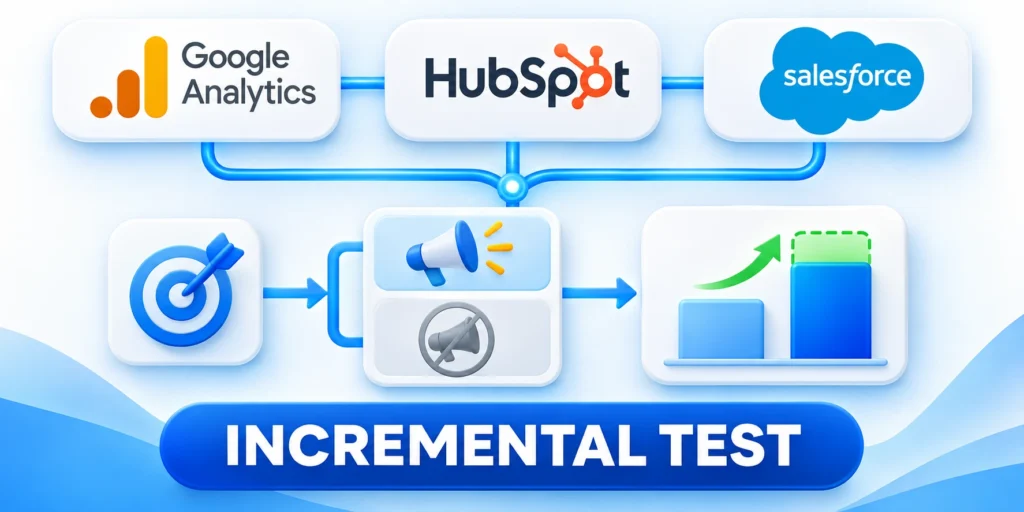
When budget allocation depends on whether a channel caused additional outcomes, attribution alone may not answer the question.
Controlled holdouts or carefully designed experiments can estimate what happened without the tested intervention.
Pick an experiment the team can actually run
In B2B, randomizing individuals may cause spillover when several people at one account share campaign information.
When possible, assign treatment at the account or another unit that reduces cross-group exposure.
Key considerations for pick an experiment the team include:
- Estimate whether the available account count can detect a meaningful difference.
- Choose an outcome that can mature within the test period.
- Keep the sales response process consistent across groups.
- Document contamination when holdout accounts encounter the campaign anyway.
Set up a practical holdout
Set up the holdout through this controlled sequence:
- Choose an eligible population, such as comparable target accounts.
- Randomly assign an exposed group and a holdout when the design allows.
- Define the outcome and observation window before the campaign runs.
- Keep other major conditions consistent between groups.
- Compare outcome rates and uncertainty, not just attributed conversions.
- Document exclusions, spillover, and implementation issues.
In B2B, small samples and long cycles can make experiments difficult; plan the test period and analysis before launch.
A holdout may be inappropriate when withholding a service would harm customers; choose a safe, ethical design.
Interpret results with the right limits
A randomized test can strengthen causal interpretation for its population and conditions, but results may not generalize to every segment or season.
Use attribution and experiments together: one describes modeled path credit, while the other tests whether an intervention changed outcomes.
Avoid common experiment interpretation errors
Report uncertainty, exclusions, contamination, and implementation failures alongside the observed difference between groups.
Keep the conclusion proportional to the design. Do not call a channel “incremental” from a simple correlation or model share.
FAQ
These answers clarify attribution rules, reporting units, model changes, offline activity, and incrementality testing.
What does first-touch attribution measure?
It assigns modeled conversion credit to the first recorded interaction in the defined path. It does not prove that the interaction caused the outcome.
When is last-touch attribution useful?
This model describes the final recorded interaction before conversion. Use it for a consistent reporting view, while recognizing that earlier demand-building activity disappears.
How does linear attribution distribute credit?
A linear model generally divides credit equally among included touchpoints. Confirm the platform’s scope, identity rules, conversion window, and handling of repeated interactions.
What makes a W-shaped model different?
It emphasizes selected milestones, commonly the first interaction, lead creation, and opportunity creation. Exact weights and milestone definitions depend on the implementation.
Is data-driven attribution automatically more accurate?
No. Its usefulness depends on data quality, eligible volume, identity resolution, platform assumptions, and whether the modeled outcome matches the business question.
Should sales activities appear in marketing attribution?
Include them when the reporting question and data model require them. Define ownership carefully so a sales milestone is not misreported as a marketing touch.
How should offline conversions be handled?
Import only outcomes with reliable identifiers, documented consent and governance, stable definitions, and reconciliation controls. Track unmatched records instead of silently discarding them.
Can attribution models compare channels fairly?
They compare recorded interactions under chosen rules. Channels with incomplete tracking, longer influence, or different identity coverage may still appear weaker or stronger than reality.
When should a team change attribution models?
Change when the business question, journey, data coverage, or decision process changes. Preserve the previous definition and explain the expected reporting shift.
Does attribution replace incrementality testing?
No. Attribution allocates observed credit, while a suitable experiment estimates whether an intervention changed outcomes. Use each method for the question it can support.
Conclusion

Marketing attribution assigns reported credit according to a declared rule; it does not automatically prove which interaction caused a business outcome.
Choose the model after defining the reporting question, unit, milestone, eligible touchpoints, lookback window, and decision the report supports.
Use each model for a bounded question
First-touch can describe recorded discovery, while multi-touch rules expose more of an observed path under explicit assumptions.
W-shaped reporting requires reliable lead and opportunity milestones; platform models remain limited to their eligible data and methods.
A defensible attribution report documents these essential choices:
- Conversion definition and reporting unit.
- Eligible touchpoints and lookback window.
- Identity stitching and duplicate handling.
- Exact model rule and platform scope.
- Owner, cadence, and review date.
Treat disagreement as evidence to investigate
When models shift channel shares, inspect sample paths, missing activity, milestone quality, and the proposed business action.
Keep model changes reversible and preserve former definitions so stakeholders can explain reporting discontinuities.
Test incrementality when causation matters
Use a feasible experiment or holdout when the decision requires evidence that exposure changed outcomes rather than merely preceding them.
For wider measurement context, read the guide to measuring ROI in long B2B sales cycles.
Keep reporting decisions reviewable
Record who approved the model, what question it answers, and which operational decisions may use it.
Schedule review when platforms, lifecycle definitions, campaign mix, or business priorities materially change.







Leave a Reply