


Why Target CPA Needs a Service-Business Context
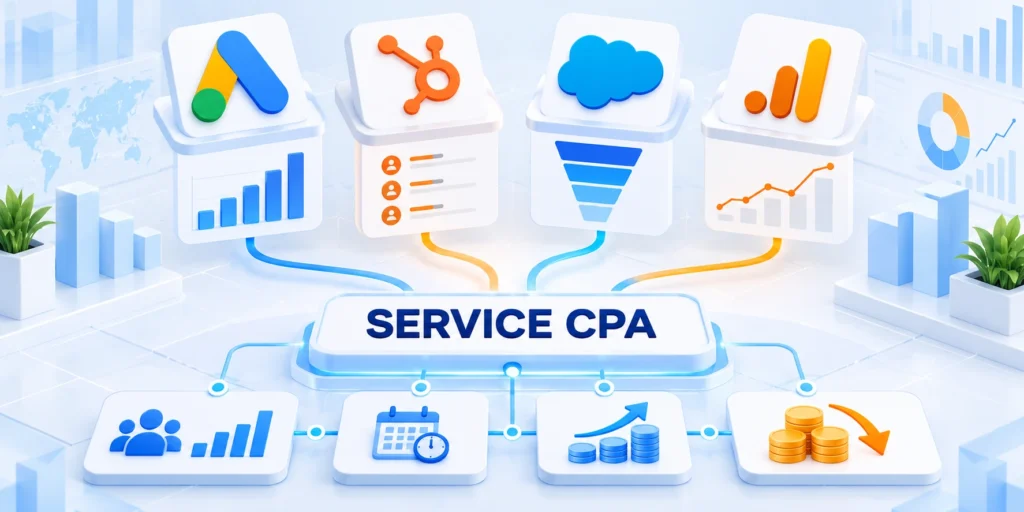
Target CPA for consulting services is an average bidding goal, not a promise that every lead will cost the same amount.
For consulting and technology firms, a useful target begins with qualified pipeline and delivery economics, not form submissions alone; see Google’s Target CPA definition.
What the bid strategy is optimizing
Google Ads defines Target CPA as automated bidding that seeks more selected conversions near your average cost per action. Individual conversions may cost more or less.
The algorithm uses conversion tracking and auction context. It cannot judge client profitability unless your setup marks a meaningful business event.
Why service sales need more than a cheap lead
A software consultancy may close one project from 20 qualified opportunities, while a managed-services firm may need a larger set of smaller contracts to reach the same margin.
A low-cost inquiry can still waste sales time when it lacks budget, authority, a credible need, or a delivery fit.
These economics define a commercially useful conversion:
- Count the outcome: choose sales-accepted opportunities, not page views or unqualified forms.
- Protect the economics: derive an acquisition ceiling from gross profit and the marketing allocation.
- Evaluate cohorts: compare lead cohorts after enough time for sales qualification and conversion lag.
This framing prevents a bidding system from efficiently producing the wrong kind of demand for the sales team.
Build an Economically Viable Target CPA

Start with the conversion you can afford to acquire, then work backward through the sales funnel.
Separate the allowable cost per customer from the allowable cost per lead; the second depends on your real close rate.
Step 1: Estimate the customer-level acquisition ceiling
For a simple project, estimate expected gross profit rather than using contract revenue alone. Subtract direct labor, subcontractors, implementation costs, and other variable delivery expenses.
Suppose a technology services engagement produces $60,000 in revenue and $36,000 in direct delivery costs. Its estimated gross profit is $24,000.
Calculate the customer ceiling with these inputs:
- Gross profit: $60,000 − $36,000 = $24,000.
- Acquisition ceiling: $24,000 × 20% = $4,800.
- Risk reserve: retain funds for delivery and optimization.
The 20% allocation is a planning assumption, not a universal benchmark. Adjust it for overhead, sales labor, payback requirements, retention, and required margin.
Step 2: Convert the ceiling into a qualified-lead target
Use the proportion of qualified opportunities that become customers. If 12% of accepted opportunities close, a $4,800 customer ceiling implies a maximum of $576 per accepted opportunity.
Translate the ceiling through these funnel assumptions:
- Formula: allowable customer acquisition cost × qualified-opportunity close rate = allowable opportunity CPA.
- Example: $4,800 × 12% = $576 per accepted opportunity.
- If half of captured leads become accepted opportunities, the lead ceiling is $576 × 50% = $288.
Use a mature cohort. A short reporting window can understate the close rate when the sales cycle is long.
Use a range when the funnel is uncertain
Do not present a single forecast as precise when the CRM has few wins or inconsistent qualification. Calculate a cautious, expected, and optimistic case instead.
| Scenario | Close rate | Opportunity CPA |
|---|---|---|
| Cautious | 8% | $320 |
| Expected | 12% | $576 |
| Upside | 16% | $896 |
The table shows the economics of one hypothetical service offer; it is not a market-price recommendation.
Set the initial target within the range that current campaign data can support, then compare acquired pipeline and signed work with the allowable ceiling.
Model Target CPA Across Service Contract Scenarios

A single target rarely fits project work, recurring services, and capacity-constrained delivery. Each contract structure converts revenue into contribution margin differently.
Build cautious, expected, and upside scenarios from documented ranges. The purpose is decision resilience, not an appearance of mathematical precision.
Adapt the economics to the contract
For a one-time implementation, use expected gross profit from the initial engagement. Exclude future expansion unless mature cohorts show a repeatable pattern.
For recurring services, use contribution within an approved payback window. Include onboarding, support load, churn, collection risk, and service-level commitments.
Apply these assumptions to each contract model:
- Project work: use project margin and accepted-opportunity close rate.
- Recurring service: include onboarding, churn, support, and payback limits.
- Capacity-constrained work: reduce volume before delivery quality declines.
Use ranges to expose fragile assumptions
Change one input at a time: gross profit, acquisition share, qualification rate, or close rate. Observe which assumption changes the allowable CPA most.
If viability depends only on the upside case, improve pricing, qualification, conversion, or delivery margin before setting an aggressive bidding target.
Keep the model operational with these reviews:
- Recalculate after pricing or delivery-cost changes.
- Use mature cohorts with wins and losses.
- Record the owner and review date.
- Preserve prior assumptions for comparison.
A range supports a starting decision while acknowledging uncertainty. It also gives finance, sales, and marketing a shared language for revising the target.
Choose a Conversion Signal That Matches the Sale
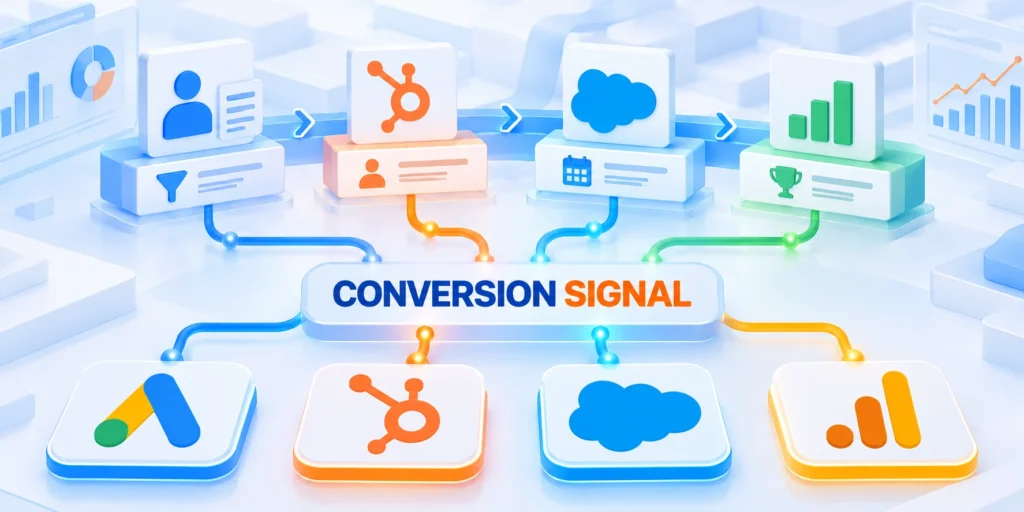
The conversion action tells Smart Bidding what counts as success.
For a long sales cycle, the best event is usually a reliable milestone with enough volume to inform bidding.
Map the event to a real CRM milestone
Define qualification with sales. A sales-accepted opportunity might require a target organization, confirmed need, identified contact, and assigned owner.
Choose one primary milestone for the bidding goal. Keep early actions such as content downloads or low-intent inquiries separate unless they represent the outcome the campaign should optimize.
Confirm which conversion actions guide bidding
Google explains how Target CPA uses conversion data; check the campaign’s selected goal before changing it.
Confirm secondary actions remain observational unless the team intentionally wants them included in the campaign bidding objective.
Choose the earliest reliable event, not the earliest available event
A signed contract is commercially meaningful but may happen too rarely or too late to guide a small campaign promptly.
A qualified opportunity may provide earlier feedback if qualification is consistent and the event is sent back accurately.
Evaluate candidate conversion events in this order:
- List candidate events from inquiry through closed-won.
- For each event, measure monthly volume, delay, CRM completeness, and relationship to eventual revenue.
- Select the earliest event that is dependable and sufficiently tied to business value.
- Keep a later reporting milestone to confirm earlier signals become real pipeline.
Do not optimize to a proxy just because it produces more conversion rows. Validate the proxy against accepted opportunities and won business.
Prepare Google Ads and CRM Data

Before choosing a target, confirm that the campaign records the action you intend to optimize.
For consulting and technology services, a useful setup joins advertising interactions to CRM outcomes without inflating counts.
Use these controls before changing production measurement:
- Assign advertising and CRM system owners.
- Preserve the source record and test evidence.
- Define rollback conditions before enabling imports.
Assign one owner to advertising configuration and another to CRM acceptance. Shared accountability helps teams distinguish bidding changes from broken measurement.
Preserve the source record and test evidence before changing production settings. That baseline supports rollback when an import or qualification rule behaves unexpectedly.
Audit the conversion action
Audit the selected conversion through these checks:
- Open Goals → Conversions → Summary in Google Ads; labels may vary as Google updates.
- Check the primary action matches the sales milestone and relevant campaign goal.
- Review settings; remove duplicate events representing the same business outcome.
- Submit a test lead through the CRM; verify source, identifiers, timestamp, consent, and milestone.
- Compare imported records with the CRM source; resolve mismatches before relying on metrics.
Have the privacy owner review data use, consent, retention, and any customer-data terms before enabling imports.
Reconcile test records against the CRM source before trusting campaign reports. Investigate missing, duplicated, delayed, or misclassified outcomes before bidding uses them safely and reliably for ongoing daily optimization decisions.
Define a Compact Target CPA Data Contract

A data contract defines the event, required fields, ownership, timing, and failure response across advertising and CRM systems.
Keep it compact enough for operators to use during testing. A long architecture document cannot replace a precise operational agreement.
Specify fields and ownership
Record each system owner and failure owner. Required fields may include lead ID, event time, matching identifiers, value, currency, consent, and upload status.
Use one stable event name per milestone. When a CRM status changes, update the mapping deliberately instead of creating an accidental duplicate.
Document these minimum contract elements:
- Business event and qualification definition.
- Required identifiers, value, and timestamp.
- Source owner and destination owner.
- Import cadence and acceptable delay.
- Rejection handling and remediation owner.
Log every import run
Record the import date, source, accepted rows, rejected rows, and remediation owner. This turns unexpected movement into a diagnosable event.
Retain rejection reasons and corrected counts. A successful request can still contain incomplete matching or stale business events.
Test complete and excluded records
Follow one known lead from the advertising interaction through qualification and import. Confirm its timestamp and value map to the intended outcome.
Then test a record that should not qualify. It should remain outside the primary bidding signal while staying available for internal analysis.
Verify these outcomes before enabling the schedule:
- Qualified records appear once with correct timestamps.
- Excluded records remain outside primary bidding.
- Rejected rows identify an actionable reason.
A working data contract makes measurement changes reviewable, repeatable, and reversible before they affect automated bidding decisions.
Set and Test the Target CPA
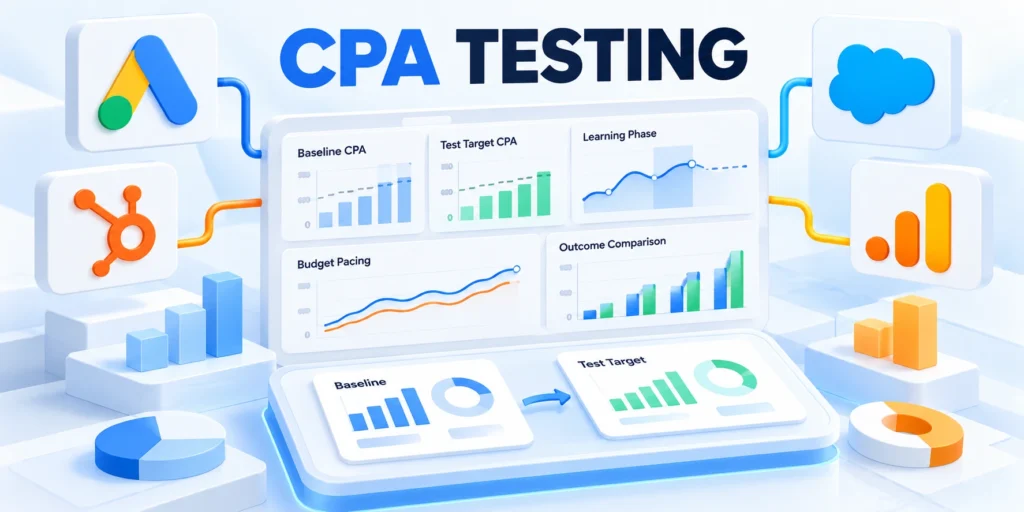
Use recent, relevant campaign outcomes as a starting point, but anchor the target to the allowable economics.
Change one major control at a time so the team can interpret delivery and pipeline effects.
Choose a starting point from evidence
Review actual cost per selected conversion, conversion delay, qualified-opportunity rate, and the economic ceiling for the offer.
Use a period with stable tracking and a mature conversion window. Exclude anomalies that the team can document and explain.
Compare the strategy with your campaign structure
For a broader campaign setup, see our guide to Google Ads bidding for high-ticket services.
Google may show a recommended Target CPA based on recent performance adjusted for conversion delay. Treat that as an input, not permission to ignore your margin model.
Check delivery before adopting a lower target
If the recommended target is well below recent performance, inspect the simulator first. Google warns that a target set too low can reduce eligible traffic and conversions.
Compare forecast volume with sales capacity and campaign budget. A lower theoretical CPA is unhelpful when it prevents sufficient qualified demand.
Run a controlled test
Run the target test through these controls:
- Record the current bid strategy, target, budget, conversion goal, and date range.
- Confirm target conversions fire and CRM outcomes import without duplication.
- Use the Target CPA simulator, when available, to compare targets with estimated conversion volume.
- Change only target or one major variable; avoid restructuring budget, goals, pages, and segmentation.
- Wait through the business’s typical conversion cycle, then compare cost, qualified pipeline, and signed work.
- Keep, reverse, or iterate the change based on evidence and the allowable acquisition ceiling.
Do not treat a few days of incomplete conversion data as a final result. Google’s conversion-lag reporting explains why recent CPA can look inflated before delayed actions arrive.
See Google’s conversion-lag reporting guide and annotate the evaluation window with the campaign’s observed sales cycle.
Run a Controlled Target CPA Test
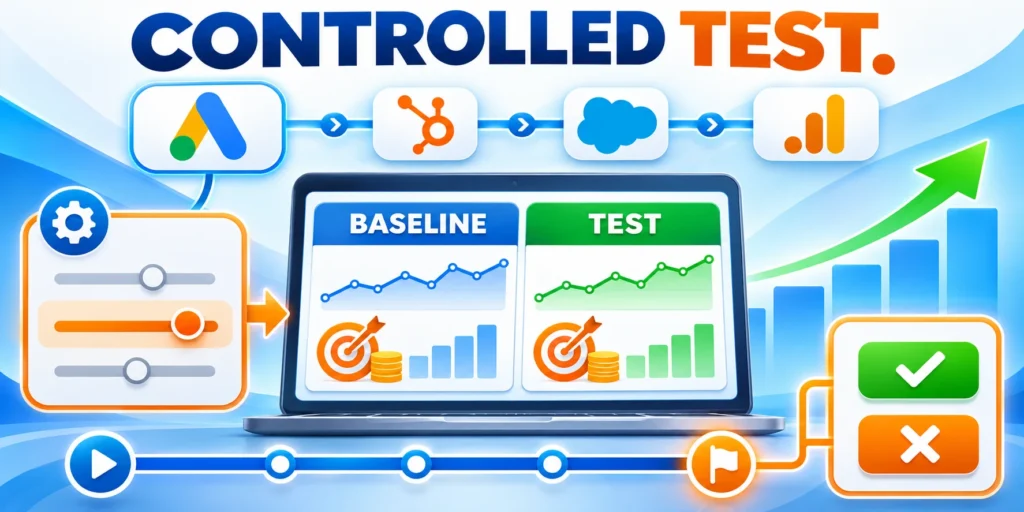
A controlled test isolates the target change from simultaneous budget, audience, landing-page, and conversion-goal changes.
Define the baseline, maturation window, decision metric, and rollback condition before editing the campaign. Those controls protect interpretation when results fluctuate.
Keep a decision log
Record the old target, new target, date, reason, and expected effect. Add the campaign’s normal qualification and closing delays.
For example, a team might expect more accepted opportunities without exceeding the $576 opportunity ceiling in its approved model.
Capture these fields for every test:
- Baseline target, budget, and conversion goal.
- Single variable changed during the test.
- Expected effect and mature evaluation date.
- Qualified-pipeline and profitability guardrails.
- Keep, iterate, or rollback decision.
Review a mature and comparable cohort
Compare periods with similar conversion delay, seasonality, offer, and market conditions. Recent incomplete cohorts should remain clearly labeled.
Judge both platform delivery and downstream evidence. A lower reported CPA can conceal weaker qualification, smaller opportunities, or higher delivery costs.
Use these outcomes to close the experiment:
- Keep the target when qualified economics improve.
- Iterate when evidence is mixed but reliable.
- Rollback when measurement or quality deteriorates.
A documented test gives future operators the context to understand why the target changed and what evidence would justify another revision.
Retain the baseline report so future reviews consistently compare the same definitions, windows, and qualified outcomes.
Diagnose Common Target CPA Outcomes

When performance changes, compare delivery, conversion measurement, lead quality, and sales outcomes.
Do not respond to every fluctuation by changing the target; first identify which part of the funnel moved.
Spend is low and volume drops
Check whether the target is materially below the campaign’s recent actual CPA, whether the budget limits reach, and whether the conversion goal became narrower.
Compare eligible traffic and impression share with the simulator. A target that is too restrictive may filter out auctions that could have produced useful leads.
Lead count rises but sales quality falls
Inspect whether the campaign is optimizing for an early or duplicated event. Review search terms, form qualification, CRM acceptance, and the source of each record.
If quality is the issue, correct conversion definitions and exclusions before lowering the target simply to reduce the reported cost per inquiry.
Reported CPA jumps unexpectedly
Investigate an unexpected CPA jump through these checks:
- Check the date range and conversion delay before comparing recent results.
- Verify the import schedule, rejected rows, event timestamps, and CRM-to-ad matching.
- Check whether a form, tag, consent setting, or conversion action changed.
- Compare campaign costs to CRM-qualified opportunities, not just the Ads conversion column.
Record the date and scope of every measurement change. Otherwise, the team may mistake a tracking discontinuity for a bidding failure.
Compare the same business milestone across both periods. Mixing inquiries with accepted opportunities can manufacture a change that did not occur.
Evaluate the pipeline, not just the platform metric
Maintain a small scorecard with spend, selected conversions, sales-accepted opportunities, cost per accepted opportunity, pipeline value, wins, and estimated gross profit.
For a long sales cycle, report early indicators weekly and mature outcomes by cohort. Keep the definitions consistent so different campaign periods remain comparable.
Run a sensitivity range before choosing the target
A single close rate or project margin can hide substantial uncertainty. Calculate conservative, expected, and stronger cases from documented historical ranges instead of one optimistic forecast.
For each case, multiply expected gross profit per client by the acquisition share the business can spend. Then multiply by the qualified-lead-to-client close rate.
| Case | Rate · profit · share | Lead ceiling |
|---|---|---|
| Conservative | 10% · $12,000 · 15% | $180 |
| Expected | 18% · $15,000 · 20% | $540 |
| Stronger | 25% · $18,000 · 20% | $900 |
The examples illustrate sensitivity, not a market benchmark. Replace every assumption with the firm’s own cohort data and use mature periods that include losses, refunds, and delivery costs.
If the campaign requires the strongest case to remain viable, the target is fragile. Improve qualification, conversion, pricing, margin, or audience focus before relying on aggressive bidding.
Separate the economic ceiling from the bidding target
The economic ceiling is the maximum average cost the business can support for the selected outcome. A bidding target is an operating instruction inside the advertising platform.
Do not automatically set both numbers equal. Leave room for measurement error, sales-cycle variation, service capacity, channel costs outside advertising, and changes in delivery margin.
Separate both numbers with these operating controls:
- Document the ceiling and its assumptions.
- Choose the initial target from recent campaign evidence.
- Keep budget and capacity constraints visible.
- Review lead quality by source and cohort.
- Define pause and rollback conditions.
When the observed CPA exceeds the target, inspect conversion delay and mix before reacting. A recent cohort may look expensive because qualified outcomes have not matured.
When the target is met, continue checking accepted opportunities, wins, and gross profit. Efficient form submissions do not prove that the business acquired suitable, profitable clients.
Account for sales and delivery capacity
A financially acceptable CPA can still create poor results when sales cannot respond promptly or delivery teams cannot absorb the acquired work.
Set volume guardrails beside the cost target. Review response time, proposal capacity, project start dates, utilization, and the margin effect of contractors or overtime.
Protect delivery capacity with these volume guardrails:
- Estimate accepted opportunities the team can handle.
- Define response targets by lead priority.
- Monitor backlog and delayed project starts.
- Adjust budgets before service quality declines.
When capacity is constrained, narrow the audience or prioritize higher-value services rather than using a lower Target CPA as the only control.
FAQ
These answers address common Target CPA planning and measurement decisions for consulting and technology service campaigns.
Should a consulting firm use Target CPA for every campaign?
No. Use it when the campaign tracks a reliable event and seeks more of that action near an average cost. Choose another strategy when goals or value measurement require it.
Should the target equal the maximum cost per lead?
Only if the lead itself is the business outcome. For most services, calculate the allowable cost per lead from qualified-opportunity and close rates, delivery margin, and the acquisition budget.
Can I start without much conversion history?
Google allows Target CPA without conversion history, but the forecast is less certain. Start with reliable measurement and monitor qualified pipeline against a defensible target.
How long should I wait before judging a target change?
Use the observed time from ad interaction to the selected conversion, plus the downstream sales cycle when judging client economics. Exclude incomplete recent periods from mature comparisons.
What if the target is met but clients are unprofitable?
Recheck the goal and economics. Meeting a Target CPA does not prove profitability; use a meaningful milestone and evaluate gross profit by cohort.
Which conversion should a service business optimize?
Use the deepest reliable event with sufficient volume, such as an accepted opportunity. Keep earlier forms visible for diagnosis without treating every submission as equal value.
How should long sales cycles affect the calculation?
Use mature cohorts and separate recent incomplete periods. Account for the delay between click, lead, accepted opportunity, win, and realized gross profit.
Should different services use one Target CPA?
Usually not when margins, close rates, qualification rules, or sales cycles differ materially. Calculate separate economics and structure campaigns only where measurement supports the distinction.
How often should the assumptions be updated?
Review them after a mature sales cycle and whenever pricing, margin, qualification, territory, offer, or delivery capacity changes. Preserve prior versions for comparison.
What should trigger a rollback?
Rollback when data quality breaks, qualified outcomes deteriorate, spend exceeds the economic guardrail, or service capacity cannot support the acquired work.
Conclusion

A workable Target CPA begins with a meaningful sales milestone and a cost ceiling the service business can support.
The target should guide bidding while finance, sales, and delivery evidence determine whether acquired demand creates profitable work.
Connect the target to operating evidence
Use clean CRM outcomes, mature cohorts, and documented conversion delay. A platform metric alone cannot validate lead quality, delivery fit, or gross profit.
Review the model whenever pricing, qualification, close rate, capacity, or delivery cost changes. Preserve prior assumptions so teams can explain movement.
Keep these controls beside every target decision:
- One defined primary conversion outcome.
- Documented acquisition ceiling and assumptions.
- Tested CRM import and rejection log.
- Mature cohort evaluation window.
- Qualified-pipeline and profitability guardrails.
Extend learning across related campaigns
Use the same economic definitions when comparing search with other acquisition or retargeting channels. Shared definitions prevent channel reports from counting incompatible outcomes.
For a broader framework, read Advanced B2B Retargeting: Maximizing Conversion Rates Across Channels and align its cohort measures with this model.
Define the final decision standard
The practical objective is not the lowest visible CPA. It is a repeatable acquisition system that produces suitable opportunities within defensible economic and operational limits.
Approve a target only when measurement integrity, qualified demand, delivery capacity, and expected gross profit support the same documented conclusion across every campaign.






Leave a Reply