


Establish a Useful Conversion Baseline

B2B conversion rate optimization (CRO) helps more suitable prospects take a useful next step. For a service business, that might be a qualified assessment request or discovery call.
The B2B conversion optimization guides cover research, experiment design, and demo requests in more detail. The objective is to improve qualified opportunities while protecting customer trust and delivery capacity.
Choose the outcome
A consultancy may prefer fewer, better-fit conversations over many generic inquiries. Define the target customer, service, fit evidence, and next action before editing a page.
Connect the chosen outcome to a decision that marketing, sales, and delivery teams can verify consistently.
Establish baseline controls
Use a primary outcome such as sales-accepted opportunity. Record the current page version, audience, source, form fields, period, and campaign changes.
Agree with sales on what counts as qualified. Keep this definition stable during measurement, and record exceptions instead of changing the rule silently.
Calculate a baseline that sales can trust
Use the same denominator for each comparison. For a service page, divide accepted inquiries by eligible visits during a defined period, then report the numerator and denominator together.
Apply these establish useful conversion criteria consistently:
- Exclude internal and test traffic using a documented rule.
- Break out major services and acquisition sources.
- Review small samples as counts and patterns.
For example, eight accepted inquiries from 400 eligible visits yield a 2% accepted-inquiry rate. That figure says little without service mix, source, and follow-up context.
Check the complete handoff
Submit one controlled inquiry and follow it through the confirmation screen, inbox, CRM, assignment, and first response. Record who owns each step and how long it takes.
A conversion rate measured only at form submission misses broken routing and slow follow-up. Fix those failures before declaring a page change successful.
Reconcile the denominator before setting a target
Document eligibility, exclusions, source, service, period, and follow-up rules so every comparison uses the same population.
Review these establish useful conversion checks carefully:
- Write down what counts as an eligible visit.
- Match form submissions to CRM records for a sample period.
- Separate contact volume from accepted sales conversations.
- Use a baseline table with page.
- Read a sample of real inquiries with appropriate privacy controls.
Recheck the denominator whenever targeting, consent, traffic filtering, form eligibility, or routing logic changes.
Measure the cost of a lost handoff
Connect each failed handoff to response delay, sales effort, buyer experience, and the opportunity value placed at risk.
Confirm these establish useful conversion conditions first:
- Map the time between submission, assignment, first response, and accepted next step.
- Choose a safe test submission and follow it through the form.
- If a transfer fails, keep the request in a recoverable queue and alert an owner.
- Use the handoff audit to prioritize fixes.
Use the estimated consequence to prioritize repair work, monitoring, ownership, and response commitments across affected teams.
Segment the baseline by buyer intent
Group pages by the question they answer. A broad educational article, a comparison guide, and a service proposal page draw different visitors. One blended conversion rate hides these differences.
Separate audiences and offers before interpreting differences as evidence of stronger or weaker page performance.
Compare conversion segments
Compare sources only when audiences and offers make the comparison meaningful.
Record seasonality, campaign changes, and sales coverage alongside the baseline. If a team changes its qualification policy during the period, note the date and recalculate a comparable measure where possible.
Interpret low-volume segments
Inspect low-volume segments carefully. Choose the segment where a clear problem and a useful intervention coincide.
Report sample size and statistical uncertainty in B2B A/B tests so small changes are not mistaken for reliable trends.
Map the B2B Buyer Journey
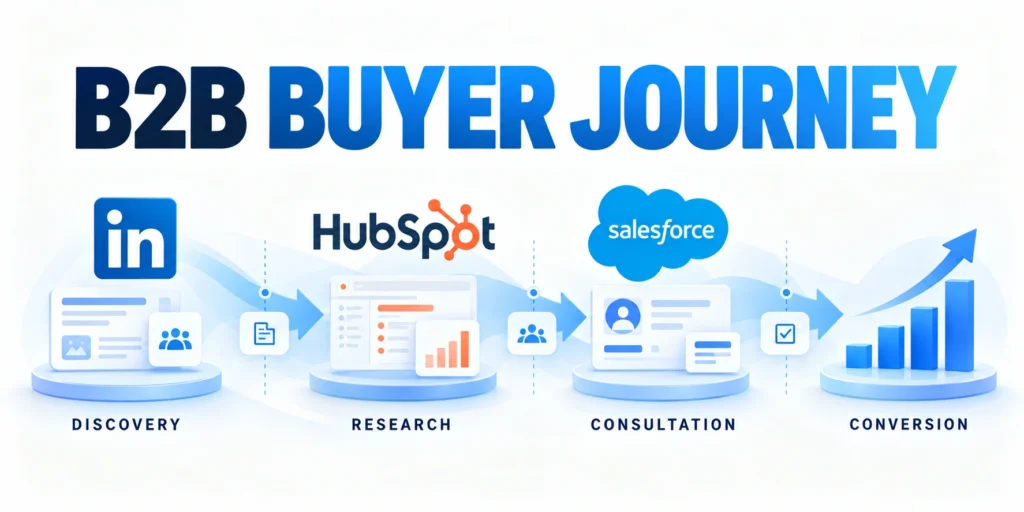
Service buyers compare providers, seek internal agreement, validate expertise, and assess delivery risks before requesting a conversation.
Map buyer questions and useful evidence at each stage. Do not assume every visitor follows one sequence or that the website controls a complex purchase.
Map decisions and proof
List the question, evidence that answers it, and appropriate next action. A finance leader may need migration safeguards before requesting a B2B demo.
Match each proof point to the specific uncertainty preventing a buyer from advancing responsibly.
Map buyer decisions
Problem recognition: explain the issue in buyer language. Check that campaign promises match landing pages.
Use customer conversations to identify decisions. Page views cannot explain motivation; our B2B demand generation guide connects this evidence to lead capture.
Use a buyer-question inventory
Ask sales which objections appear before a discovery call and which details prospects need to share internally. Compare those answers with support tickets and recent customer interviews.
Review these map b b checks carefully:
- Problem stage: explain the consequence of leaving the problem unresolved, without manufacturing urgency.
- Evaluation stage: show service scope, dependencies, relevant proof, and what the provider does not cover.
- Decision stage: explain attendees, helpful information, and the likely next decision.
For each service, place the highest-stakes questions beside the evidence that answers them. A security review may require delivery controls; an integration project may require system boundaries.
Use this inventory to choose page changes. A buyer asking about implementation risk needs credible process evidence, not a brighter button.
Identify the decision behind each visit
Use search context, navigation, page behavior, and buyer research to distinguish evaluation needs from premature conversion pressure.
Confirm these map b b conditions first:
- For each important page, ask what the buyer is trying to decide now.
- Map the likely next question and the evidence that answers it.
- Ask sales and customer success for recent objections, but check them against actual conversations.
- Use a buyer-question inventory with columns for question, stage, role, evidence, page section, and owner.
- Review the journey across devices and entry points.
Validate the inferred decision with interviews, search evidence, sales conversations, and observed behavior before redesigning the path.
Respect multiple people in the buying group
Map the concerns, proof, authority, and handoffs that influence technical, financial, operational, and executive participants.
Use these map b b controls together:
- An operational lead may care about delivery workflow,.
- Use navigation and contextual links to connect these needs.
- Check the call to action against readiness.
- Record where prospects ask for information the site does not provide.
Give participants shareable evidence and consistent next steps without forcing every role through the same sequence or form.
Audit the path after the first conversion
This checklist makes the operating decision explicit and reviewable.
Apply these map b b criteria consistently:
- Follow a submitted request into the response the buyer receives.
- Read the first sales reply against the page.
- Identify delays caused by unclear ownership.
- Collect a small set of buyer and sales comments after the meeting.
Measure the complete path to an accepted next step. Optimizing only the initial click can shift work downstream without improving customer outcomes.
Qualify Leads Before Optimizing

Lead quality is part of conversion performance. More submissions can make a business less efficient when sales receives a larger share of irrelevant requests.
Define qualification with the people handling inquiries. Keep criteria clear, fair, and limited to details needed for a responsible next step.
Separate fit, intent, and readiness
A company may match the target profile but have no current project. Another may have urgent need yet fall outside supported service scope.
Evaluate these dimensions separately so one positive signal does not conceal a genuine delivery mismatch.
Define qualification criteria
Fit may include region, organization type, environment, and project scope. Specify the inquiry owner and response process.
Use distinct criteria for organization fit, expressed need, and readiness. Avoid treating one field as a complete qualification decision.
Design a fair qualification handoff
Write a short, shared definition of an accepted inquiry. Include service match, contactability, stated need, and any genuine delivery constraint.
Use these qualify leads optimizing controls together:
- Route requests by service and region only where those details change the responsible team.
- Define an owner and target response time for each route, including weekends or absences when .
- Use a clear fallback queue for incomplete or uncertain requests instead of silently discarding them.
- Review rejected inquiries monthly for false negatives and new patterns of demand.
Do not infer readiness from job title or company size alone. A small organization can have an urgent, suitable project; a large one can be researching without budget.
Compare accepted-inquiry rate alongside submission rate. A shorter form may help completion yet create more work if sales cannot identify the right next step.
Design a qualification rule that can be audited
Keep inputs, thresholds, exceptions, owners, and outcomes visible enough to review errors and revise the rule fairly.
Apply these qualify leads optimizing criteria consistently:
- Define fit, need, timing, and ownership as separate dimensions.
- For each dimension, state the evidence and acceptable unknown state.
- Use a simple decision table.
- Record rejection reasons in categories that lead to action.
- Review the rule monthly.
Sample accepted and rejected inquiries regularly so teams can identify drift, unfair exclusions, and changing service capacity.
Improve Landing Pages and Forms

A landing page should clarify the service, intended buyer, evidence, and next step. It does not need to answer every possible question above the fold.
Treat form optimization as part of the offer. Fields, errors, privacy explanation, and confirmation should match what the page promises.
Make the offer and form clear
Replace broad claims with a concrete description of the work and audience. Explain what the first meeting covers without promising a guaranteed diagnosis.
Align the form request with the value and commitment represented by the proposed next step.
Clarify forms and offers
Keep labels visible, mark optional fields, and explain unusual requests. Test a valid inquiry on desktop and mobile.
For each field, ask whether it changes qualification, preparation, routing, or compliance. Remove fields that do not affect the next useful action.
Audit the page as a buyer would
Read the opening screen against the campaign promise. Confirm that the service, intended audience, likely outcome, and next action are clear before asking for contact details.
Apply these improve landing pages criteria consistently:
- Use an action label that names the next step, such as “Request a scope call.”
- Explain what happens after submission and when a response is normally expected.
- Keep contact details available for buyers who are ready to talk without a form.
- Test navigation and the form with keyboard input, at narrow widths, and with field errors.
Then check proof near the claim it supports. A case study should describe the context and work performed; a generic testimonial cannot establish every promised capability.
For a focused page-design walkthrough, see our B2B service landing page guide.
Make form errors recoverable
Associate each visible field label with its control and explain required formats before submission. When validation fails, identify the affected field and preserve entered values.
The W3C form guidance supports clear labels, instructions, and feedback. Verify the actual experience rather than assuming a short form is automatically usable.
Make the first screen answer a real question
Lead with the buyer problem, relevant service, credible evidence, and an appropriate next step before adding supporting detail.
Review these improve landing pages checks carefully:
- Check whether the page identifies the service.
- Place the main evidence close to the claim it supports.
- Review the offer and destination together.
- Test the page with a person unfamiliar with the project.
Test comprehension with representative buyers before interpreting clicks, scroll depth, or form starts as meaningful progress.
Reduce form friction without losing necessary context
This measurement checklist connects conversion changes to qualified pipeline and revenue.
Remove unnecessary requests while retaining information required for responsible routing, preparation, and qualification.
Reduce form friction
For each field, ask who uses it and at what stage.
Use labels that describe the information expected. Show format guidance before an error. Preserve entered values after validation failure, and make the error specific enough to correct without guessing.
Explain post-submission steps
Explain what happens after submission.
Check keyboard operation, field order, contrast, and error announcements with the tools and users available to the team. A visually clean form can still prevent someone from submitting it.
Verify form changes
Run a safe test on mobile and desktop after every form change.
Confirm validation, routing, notifications, and entered-value retention before treating the updated path as complete.
Run Disciplined CRO Experiments

Experiments help distinguish between explanations for a problem. Untracked design changes may improve a page but rarely show why.
Use controlled tests when traffic and implementation support fair comparison. With smaller audiences, interviews and task observation may teach more.
Write a testable hypothesis
Name observed friction, proposed change, expected behavior, and a measure that could support the explanation.
State what result would weaken the hypothesis so the team can interpret evidence without moving the goalposts.
Define CRO experiments
Record audience, allocation, primary metric, guardrails, review point, owner, and stop conditions before results appear. Check event collection first.
For example, prospects may hesitate because the first call is unclear; a short agenda could increase qualified requests without increasing disqualification.
Choose a method that matches the available evidence
A randomized A/B test needs enough relevant exposure and a stable measurement path. If accepted inquiries are rare, a short test may produce mostly uncertainty.
Use these run disciplined cro controls together:
- Protect a control experience when testing a material change and split comparable traffic fairly.
- Keep the primary outcome and guardrails fixed until the planned review point.
- Check that both variants load, track, and route inquiries before exposing all visitors.
- Document simultaneous campaigns or sales changes that could affect interpretation.
For lower traffic, observe task completion, interview suitable buyers, inspect form errors, or release a focused change in stages. Label the resulting evidence accurately.
Use our A/B testing guide for paid lead generation when the question is specifically about experimental design for campaign pages.
Review downstream quality
Measure CRO beyond conversion rate. If clicks rise but sales acceptance falls, discuss the result with sales before rollout.
Compare acceptance, workload, and customer outcomes before treating a local metric increase as progress.
Choose a test method that fits traffic and risk
This review checklist keeps test execution consistent across traffic segments and devices.
Verify assignment, instrumentation, performance, and release timing before attributing observed differences to the intended change.
Apply these run disciplined cro criteria consistently:
- Start with a hypothesis tied to a buyer problem.
- Fix broken forms, tracking, and misleading claims directly.
- For an A/B test.
- Do not stop the test after the first favorable day.
Watch for harmful side effects: more low-fit inquiries, increased form errors, slower pages, or confusion among existing customers. Record the trade-off rather than celebrating only a higher submission rate.
Preserve learning from inconclusive tests
Document what the result ruled out, what remains uncertain, and which evidence would justify another decision.
Review these run disciplined cro checks carefully:
- An inconclusive result can still reveal implementation defects or a weak hypothesis.
- Keep a test ledger with date, page, audience, change, metric, guardrail, result, and next action.
- Share the result with sales and delivery teams.
Keep the record searchable so later research can confirm, refine, or reject the original mechanism without repeating hidden work.
Check experiment implementation before interpretation
This experiment checklist defines the decision, evidence, and stopping rule before launch.
Verify assignment, instrumentation, performance, and release timing before attributing observed differences to the intended change.
Validate experiment implementation
Verify that assignment works and a visitor is not unexpectedly switched between versions.
Inspect page speed and layout differences that were not part of the hypothesis. A variant that loads more slowly may depress submissions for a reason unrelated to its message.
Record experiment releases
Keep a release note with the exact change and deployment time.
Check the sample by device and source for obvious imbalance. Do not slice a small test into many post-hoc “winning” groups. Use segment differences as hypotheses for later work.
Close completed experiments
After the decision, remove the losing variant and unused tracking code.
Preserve the hypothesis, result, limitations, and implementation details needed to evaluate related decisions later.
Measure CRO’s Revenue Impact

Measure the path from relevant visits to business outcomes rather than treating every click equally. Connect source, page, inquiry quality, sales acceptance, and revenue where available.
Conversion tracking for B2B funnels needs a clear event design and regular validation. A dashboard cannot repair an ambiguous conversion definition or missing CRM outcomes.
Build and validate event measurement
Name each action, trigger, destination system, and owner. Distinguish a button click from a submission that sales accepts.
Test every event across the complete handoff before using it to support revenue or pipeline conclusions.
Validate revenue measurement
inspect realtime or debug reporting. Attribution can be incomplete for buying groups using many channels.
Google Analytics calls important business actions key events. Mark only meaningful actions and verify collection before relying on reports.
Use an event plan that survives a handoff
Create a small event dictionary before building a dashboard. For each event, record the trigger, page or form, destination, owner, and expected count.
Use these measure cro s controls together:
- Compare a controlled submission with analytics and CRM records using a test marker.
- Investigate duplicate events, blocked scripts, missed consent, and missing CRM identifiers.
- Define how updates and rejected inquiries change downstream reports.
- Restrict access to lead data and avoid placing personal information in analytics event names.
Separate form start, valid submission, accepted inquiry, opportunity, and closed revenue. Each step answers a different question and may live in a different system.
Report both counts and rates by service and meaningful traffic segment. Show the period, data freshness, and definition beside each chart.
Interpret sparse outcomes
When the outcome volume is low, review individual opportunities with sales. A qualitative explanation can be more useful than a fragile percentage.
Use record-level evidence to explain the mechanism and preserve uncertainty when aggregate rates remain unstable.
Interpret revenue with care
Deals can span people, channels, and months. Revenue reporting should state its attribution rule and known gaps; a single tracked visit rarely proves causal impact.
For a detailed comparison of attribution models, see our marketing attribution guide.
Connect the form event to a business record
This landing-page checklist connects each change to a measurable buyer action.
Apply these measure cro s criteria consistently:
- Store durable event and CRM IDs to reconcile handoff outcomes.
- Define how an opportunity links back to the inquiry.
- Check the chain with a sample of accepted and rejected inquiries.
- Use staged measures: valid submission, accepted conversation, opportunity, and customer.
Estimate value conservatively. Separate observed revenue from modeled opportunity value, and document assumptions. A higher meeting count does not prove a proportional revenue increase.
Prioritize CRO Opportunities

The guide to prioritizing CRO tests by business impact shows how to compare friction, effort, and risk. A transparent decision is more useful than a score that implies false precision.
Compare customer impact, evidence, effort, and potential harm. Revisit priorities when sales, support, or analytics changes what the team knows.
Make a practical decision record
Capture problem, audience, evidence, proposed response, owner, effort, dependencies, and success measure in one place.
Keep assumptions and unresolved questions visible so prioritization remains explainable when evidence or constraints change.
Prioritize CRO opportunities
Fix a verified broken form promptly. Start broad changes on one representative service page and preserve a rollback path.
Scores can help compare options only when definitions are clear. They are decision aids, not objective truth.
Separate repairs, research, and experiments
Treat a broken form, incorrect routing rule, or inaccessible control as a repair. Confirm the fault, fix it, and verify the entire path without waiting for a test.
Review these prioritize cro opportunities checks carefully:
- Repair: restore a known expected behavior and verify it with a controlled inquiry.
- Research: identify a plausible customer obstacle and the evidence still missing.
- Experiment: compare a specific change against a defined outcome and guardrails.
- Scale: apply a supported improvement to related pages, then check for local differences.
Use research when the obstacle is unclear. Sales calls, task observation, support notes, and form errors can narrow the problem before anyone redesigns a page.
Assign each idea a named owner and next review date. Close rejected ideas with the reason, so the same suggestion does not return without new evidence.
Rank problems by evidence and consequence
Create a backlog with the observed problem, affected page or segment, supporting evidence, estimated consequence, proposed action, owner, and verification method. Keep uncertain ideas marked as hypotheses.
Confirm these prioritize cro opportunities conditions first:
- Separate three queues.
- Review the backlog with sales, marketing, and the people who operate the site.
- After each change, compare actual outcomes with the baseline and check guardrails.
Prioritize a broken handoff or misleading offer above cosmetic changes. Weigh the number of affected buyers, the importance of the decision, implementation effort, and risk of harm.
Run a monthly decision meeting
Bring a short packet: baseline, current funnel counts, accepted and rejected lead reasons, form defects, experiment results, and two or three buyer examples. Keep the underlying records available for questions.
Use the meeting to choose accountable work, not to review dashboards without a decision or owner.
Run the monthly decision
Start with changes in the measurement itself. Choose one repair, one research question, or one experiment for the next cycle.
Review the previous meeting’s action. Did the fix persist? Did the intended buyer experience improve? If the evidence is incomplete, extend observation or repair tracking rather than declaring success.
Share the decision record
Share a concise decision record with sales and delivery teams. Revisit the backlog every quarter.
Record changed evidence, dependencies, ownership, and the reason each item moved in priority.
Protect lead quality from local optimization
A page can produce more submissions while creating less useful sales work. CRO decisions should preserve qualification, expectation setting, and service fit.
Review these prioritize cro opportunities checks carefully:
- Track accepted inquiries by source.
- Review rejection reasons with sales.
- Monitor response time after changes.
- Check promised scope against delivery.
- Separate spam from genuine demand.
- Retain the original campaign context.
Define the downstream signals before changing the form or offer. Use accepted opportunities, suitable accounts, response time, and delivery fit where available.
If volume rises but acceptance falls, inspect audience mix, form wording, and routing before declaring success. The page metric alone is insufficient.
Document local trade-offs
Record unintended consequences alongside the primary result. A useful CRO report explains gains, losses, uncertainty, and the action each team will take.
Assign owners to investigate adverse effects before the same change reaches other pages, services, or audiences.
Set evidence thresholds before testing
Choose the decision rule before viewing results. State the primary outcome, minimum useful improvement, guardrails, audience, duration, and stopping conditions.
Confirm these prioritize cro opportunities conditions first:
- Name one primary outcome.
- Define a meaningful business change.
- Set quality and trust guardrails.
- Document the eligible audience.
- Choose a realistic review window.
- State reasons to stop early.
For low-volume services, an A/B test may take too long to support a decision. Use moderated research or sequential operational changes instead.
Avoid repeatedly checking a small sample and stopping when the desired pattern appears. This increases the risk of treating random variation as evidence.
Choose a reversible response
When evidence remains inconclusive, keep the existing experience or make a reversible repair supported by research. Do not manufacture certainty from weak data.
State what remains unknown and the evidence required before another experiment or broader change becomes justified.
Close the experiment and preserve learning
Every completed change needs a decision record. Include the tested hypothesis, implementation, dates, audience, data quality, outcome, limitations, and follow-up owner.
Use these prioritize cro opportunities controls together:
- Reconcile analytics with CRM records.
- Review qualified outcomes with sales.
- Confirm the production variant.
- Remove obsolete experiment code.
- Document limitations and dependencies.
- Assign the next review date.
Confirm the chosen version in production and remove abandoned variants. Verify analytics, CRM routing, accessibility, and page performance after the final deployment.
Share negative and neutral findings with the same care as positive results. They prevent teams from repeating weak ideas or misreading past decisions.
Revalidate changed conditions
Revalidate an old result after major changes to audience, service scope, pricing, page structure, tracking, or sales process. Context determines whether evidence remains reusable.
Record which dependency changed and whether the original mechanism, audience, implementation, and outcome still match production.
Audit the complete inquiry response path
A conversion is incomplete until the inquiry reaches the correct owner and receives an appropriate response. Test the path beyond the confirmation page.
Apply these prioritize cro opportunities criteria consistently:
- Submit a representative inquiry.
- Confirm the analytics event.
- Locate the CRM record.
- Verify routing and ownership.
- Check the customer confirmation.
- Record sales acceptance or rejection.
- Reconcile the final outcome.
Submit controlled examples for qualified, disqualified, duplicate, and incomplete inquiries. Preserve the original source and verify every expected status change.
Repeat the audit after changing forms, integrations, consent rules, routing logic, CRM fields, or notification systems. Each dependency can break silently.
Resolve path discrepancies
Assign a named owner to investigate discrepancies. Keep test records identifiable and remove them according to the organization’s data-handling procedure.
Correct both the affected record and the shared cause before relying on the journey for future optimization decisions.
Define CRO as a Business Decision System
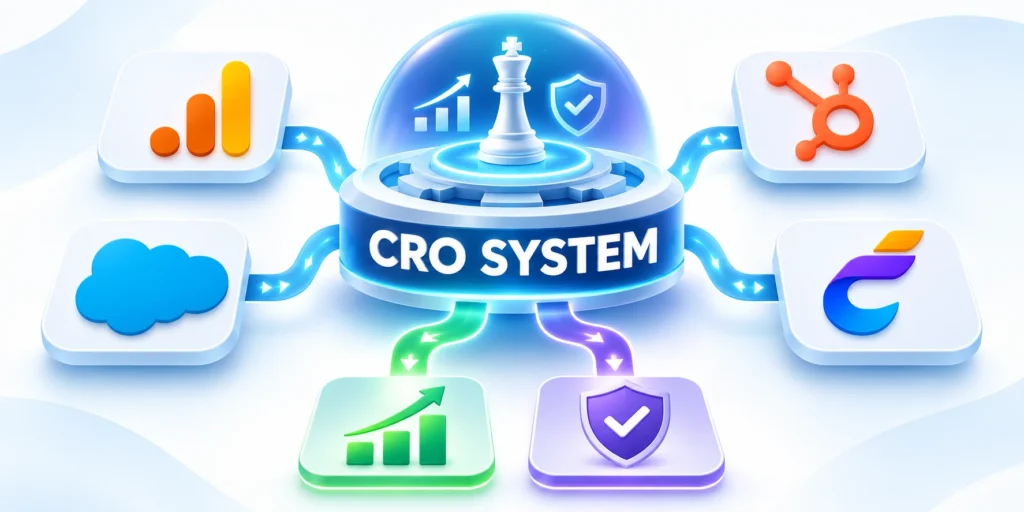
Conversion optimization should improve qualified demand and customer progress without overwhelming sales, weakening trust, or promising work the service team cannot deliver.
Treat CRO as a decision system with explicit outcomes, guardrails, owners, evidence, and review windows rather than a sequence of isolated page edits.
Connect optimization to business outcomes
Connect optimization to qualified demand, accepted opportunities, sales capacity, service fit, delivery constraints, margin, customer outcomes, and a credible measurement window.
A higher form-completion rate is not progress when it increases unsuitable inquiries, delays response, or creates promises the service team cannot fulfill.
Set Outcome and Guardrail Metrics
Choose one primary outcome and guardrails for lead quality, sales effort, accessibility, performance, privacy, support, and customer experience before changing the journey.
Document definitions, sources, owners, latency, and known limitations so teams do not reinterpret the result after seeing the data.
Map the Complete Conversion Journey
Trace advertisement, search result, referral, landing page, navigation, proof, form, scheduling, confirmation, CRM routing, sales response, qualification, and later opportunity progression.
Record handoffs and failure states because a page can perform correctly while routing, availability, or follow-up prevents the intended business outcome.
Separate Visitor and Operational Friction
A UX friction audit can reveal unclear value, accessibility barriers, or unnecessary effort. Operational friction includes ownership gaps, slow response, broken integrations, and capacity limits.
Fix the constraint supported by evidence instead of redesigning the interface whenever a downstream process fails.
Complete the business-decision check
Verify that the optimization decision connects page behavior to qualified outcomes and operational constraints.
Apply these define cro business criteria consistently:
- Name one primary business outcome.
- Set customer and operational guardrails.
- Assign evidence and decision owners.
Review the decision with sales and delivery leaders before changing the public journey or its qualification rules.
Record rejected alternatives so later teams understand the trade-offs instead of repeating the same debate.
Create a Research Repository

A shared research repository preserves interviews, analytics, experiments, objections, support evidence, and decisions with enough context for later teams to evaluate them.
Consistent labels and provenance help teams distinguish durable patterns from isolated comments while protecting consent, retention, and appropriate access.
Organize evidence for reuse
Store interview notes, recordings, surveys, search queries, support themes, sales objections, usability findings, analytics, experiments, and decision records with dates and provenance.
Use consistent labels for audience, journey, evidence strength, issue, hypothesis, and affected outcome so teams can find patterns without losing source context.
Protect Research Quality
Recruit representative participants, distinguish stated preference from observed behavior, avoid leading prompts, and record disagreement or uncertainty rather than forcing one conclusion.
Remove unnecessary personal data and control access according to consent, purpose, retention, and organizational policy.
Prioritize Evidence Before Ideas
Rank problems by user impact, business impact, frequency, confidence, reach, implementation risk, reversibility, and the cost of remaining uncertain.
Do not reward the most visually dramatic idea when the strongest evidence concerns eligibility, response time, proof, accessibility, or form reliability.
Write Testable Hypotheses
State the audience, observed problem, proposed mechanism, expected behavior, business outcome, guardrails, and evidence that would reject the hypothesis.
A useful hypothesis explains why a change should work and which measurement would distinguish that mechanism from random variation.
Complete the research-quality check
Confirm that stored evidence remains traceable, representative, appropriately protected, and useful for future decisions.
Apply these create research repository criteria consistently:
- Record source and collection date.
- Label audience and journey stage.
- Preserve uncertainty and disagreement.
Review repository themes on a cadence and retire evidence whose audience, offer, tooling, or operating conditions have changed.
Preserve contradictory findings because disagreement often reveals segmentation, timing, or process issues that averages conceal.
Audit Message Continuity
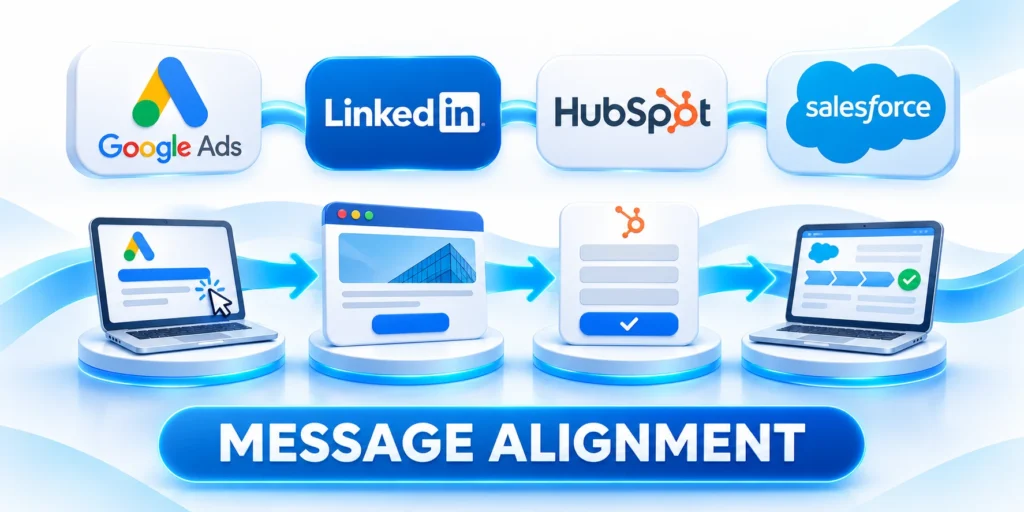
Conversion journeys lose trust when acquisition messages, page claims, form expectations, confirmations, and sales outreach describe materially different offers or commitments.
Audit continuity across every step so buyers encounter stable terminology, scope, proof, eligibility, timing, and next actions.
Compare every promise across the journey
Compare the promise, audience, terminology, proof, scope, and action across advertisements, search snippets, landing pages, forms, confirmations, and sales outreach.
A visitor should not discover after submission that the offer, commitment, region, price, or eligibility differs materially from the acquisition message.
Make Service Boundaries Explicit
Explain who the service helps, relevant prerequisites, included work, exclusions, collaboration model, likely next step, and factors that change timing or cost.
Clear boundaries may reduce raw inquiries while improving trust and the proportion that sales can serve responsibly.
Design Proof for the Decision Stage
Match testimonials, case studies, credentials, demonstrations, security evidence, process detail, and quantitative claims to the risk the buyer is evaluating.
Identify source, scope, date, conditions, and limitations for claims instead of presenting isolated results as universal expectations.
Govern Proof Maintenance
Assign owners and review dates to statistics, customer references, partner badges, awards, screenshots, product capabilities, and regulatory or certification language.
Remove or qualify proof when consent expires, conditions change, or the current service can no longer support the original claim.
Complete the message-continuity check
Compare the offer and expectations across acquisition, page, form, confirmation, and sales follow-up before testing copy.
Apply these audit message continuity criteria consistently:
- Keep audience and scope consistent.
- Align proof with buyer risk.
- Preserve timing and eligibility terms.
Correct material promise gaps before testing design variations because clearer presentation cannot repair an inconsistent offer.
Assign an owner to recheck claims and proof whenever service scope, pricing, availability, or delivery changes.
Reduce Form Friction Deliberately

A service form should collect only information needed for eligibility, routing, preparation, consent, or another defined operating decision.
Progressive collection, accessible recovery, and clear alternatives can reduce effort without depriving sales of necessary context.
Collect only decision-changing information
Ask for information only when it changes eligibility, routing, preparation, consent, service, or another defined decision, and explain unusual requests clearly.
Use progressive collection when later context is valuable but unnecessary for the first safe handoff.
Validate Form Recovery
Test keyboard use, screen readers, autofill, mobile input, error messaging, retained values, duplicate submission, slow connections, blocked scripts, and provider outages.
A failed submission should preserve safe input, explain the problem, offer another path, and avoid creating multiple CRM records.
Align Scheduling With Real Capacity
Expose appointment types, durations, time zones, buffers, ownership, availability, qualification, cancellation, rescheduling, and fallback contact methods consistent with team operations.
Do not display immediate availability when specialists, regions, languages, or service lines cannot meet the implied commitment.
Measure Attendance and Progression
Track scheduled, confirmed, attended, rescheduled, canceled, no-show, qualified, and opportunity outcomes by comparable cohort and acquisition context.
Interpret booking increases alongside sales workload and meeting quality rather than treating every calendar event as equal value.
Complete the form-friction check
Evaluate each requested field, validation rule, recovery path, and alternative channel against a documented operating need.
Apply these reduce form friction criteria consistently:
- Remove fields without decision value.
- Preserve safe input after errors.
- Offer an accessible fallback path.
Observe representative users completing the form on mobile, keyboard, autofill, slow networks, and recovery paths before accepting any design.
Treat unexplained abandonment as a research question instead of assuming every additional field creates the same friction across every buyer and service.
Instrument the Journey Reliably

Reliable CRO measurement requires consistent events, identifiers, consent behavior, timestamps, ownership, and reconciliation across acquisition, forms, scheduling, CRM, and revenue systems.
Test representative journeys before interpreting results so missing or duplicated signals do not become confident but unsupported conclusions.
Connect events to operational records
Define events, parameters, identifiers, consent behavior, deduplication, timestamps, environments, and ownership for each important interaction before relying on optimization reports.
Test representative journeys from acquisition through CRM and revenue systems, including retries, delayed events, offline outcomes, and cross-domain transitions.
Reconcile Analytics With Operations
Compare forms, scheduling, CRM, advertising, analytics, and sales records on a schedule to identify missing, duplicated, late, or misclassified outcomes.
Do not compensate for unresolved tracking gaps by creating a new metric whose meaning changes across systems.
Choose an Appropriate Evaluation Method
Use randomized tests when traffic, implementation, ethics, and stable exposure permit; use usability research, staged rollout, cohort analysis, or operational pilots when they do not.
The method should match the uncertainty and decision, not a universal preference for experimentation or a pressure to declare statistical certainty.
Plan Sample and Duration Before Launch
Estimate eligible traffic, baseline rate, meaningful effect, conversion delay, seasonality, interference, and stopping rules before reviewing results.
Low-volume service businesses may need larger changes, longer observation, or stronger qualitative evidence rather than many simultaneous page tests.
Complete the instrumentation check
Reconcile analytics with operational records before using reported conversion changes to prioritize investment or declare success.
Apply these instrument journey reliably criteria consistently:
- Define events and authoritative systems.
- Test retries and delayed outcomes.
- Reconcile CRM and analytics records.
Keep an evidence map that connects each metric to its event, record, owner, delay, and known limitation.
When systems disagree, investigate the mismatch before replacing the definition or selecting the most favorable count.
Protect Experiment Integrity
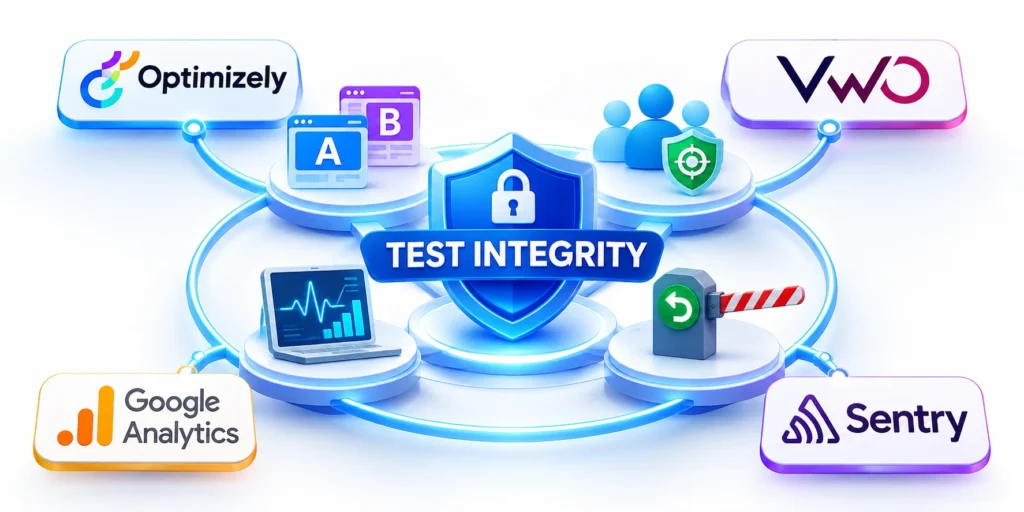
Experiments need stable assignments, documented audiences, preserved definitions, monitored exposure, and records of campaigns, releases, outages, and market changes.
Limit overlapping tests and unplanned edits so the result reflects a credible mechanism rather than interference or changing implementation.
Control exposure and interference
Assign variants consistently, exclude internal and test traffic, preserve event definitions, monitor exposure, and record campaigns, releases, outages, and market changes.
Avoid editing variants or audiences during the test unless a documented safety or correctness issue requires intervention.
Prevent Cross-Test Interference
Inventory active tests across pages, forms, offers, audiences, routing, pricing, and sales processes before launching another experiment on the same journey.
When interaction is unavoidable, design the analysis explicitly or run a smaller number of sequential tests.
Interpret Results With Uncertainty
Report the observed difference, interval or uncertainty, sample, exclusions, duration, guardrails, segment behavior, data quality, and plausible alternative explanations.
A nondecisive result can still reject an assumption, reveal instrumentation defects, or justify collecting different evidence.
Avoid Segment Fishing
Inspect segments chosen before launch or supported by a strong mechanism, and treat unexpected subgroup patterns as hypotheses requiring confirmation.
Do not promote a losing overall change because one small post-hoc slice appears favorable by chance.
Complete the experiment-integrity check
Document assignment, exposure, duration, exclusions, concurrent changes, and stopping rules before reviewing the observed result.
Apply these protect experiment integrity criteria consistently:
- Keep variants and audiences stable.
- Record incidents and campaign changes.
- Prevent overlapping test interference.
Document deviations during the test and explain whether they affect validity, safety, implementation, or only interpretation of the primary and guardrail outcomes.
A stopped experiment still needs a decision record, cleanup, production verification, and a clear follow-up owner before another related test begins.
Connect CRO to Sales Quality

A conversion improvement matters only when the resulting inquiries remain suitable, actionable, and valuable across qualification, opportunity progression, delivery, and customer outcomes.
Marketing and sales should share definitions and structured feedback before comparing variants or scaling a winning experience.
Review qualification and downstream effort
Review fit, need, authority, urgency, budget context, service eligibility, disqualification, response time, opportunity progression, sales effort, and eventual customer outcomes.
Marketing and sales should agree on definitions before comparing variants so quality is not retrofitted to support a preferred design.
Close the Feedback Loop
Give representatives structured disposition options and space for evidence, then sample conversations to distinguish acquisition defects from follow-up or capacity problems.
Use feedback to revise the journey, routing, offer, or qualification rules without turning one anecdote into a universal requirement.
Operationalize Winning Changes
Confirm code quality, accessibility, performance, analytics, content ownership, legal review, CRM routing, support, rollback, and documentation before making a variant permanent.
Remove obsolete variants, scripts, flags, audiences, and event definitions so temporary experiment infrastructure does not become hidden production debt.
Verify After Rollout
Compare the permanent implementation with the tested experience and monitor the primary outcome, guardrails, errors, and segment behavior after full exposure.
A winner can regress when recreated in another component, combined with later changes, or shown to a broader audience.
Complete the sales-quality check
Review downstream fit and sales effort alongside page metrics so local gains do not create costly or unsuitable demand.
Apply these connect cro sales criteria consistently:
- Track acceptance and disqualification reasons.
- Measure response and progression time.
- Sample conversations for context.
Separate acquisition quality from sales execution by reviewing sampled records and conversations with the responsible teams.
Use consistent dispositions so feedback improves targeting, qualification, routing, and service design instead of becoming anecdotal noise.
Build a Sustainable CRO Cadence

A sustainable CRO experimentation roadmap coordinates research, prioritization, implementation, quality assurance, launch, analysis, rollout, and retrospective within the team’s capacity.
A decision log and limited work in progress preserve learning while preventing unfinished experiments and obsolete infrastructure from becoming production debt.
Operate a repeatable optimization cycle
Plan research, prioritization, design, implementation, quality assurance, launch, monitoring, analysis, decision, rollout, and retrospective according to available capacity.
Limit concurrent work so teams can maintain instrumentation, review evidence, and support active journeys instead of accumulating unfinished experiments.
Maintain a Decision Log
Record hypothesis, evidence, owner, dates, variants, audience, metrics, changes, incidents, result, decision, limitations, and follow-up outside the live page.
The log prevents repeated failed ideas and preserves knowledge when tools, vendors, or team members change.
Govern Ethics and Customer Trust
Review whether a change manipulates urgency, hides material information, creates asymmetric effort, exploits vulnerability, or makes refusal and cancellation harder than acceptance.
Short-term conversion gains do not justify misleading claims, inaccessible choices, unwanted contact, or collection beyond the stated purpose.
Set Nonnegotiable Constraints
Define prohibited patterns, claim standards, consent requirements, accessibility expectations, privacy rules, review owners, and escalation before experimentation begins.
Pause any test whose implementation or emerging effect threatens customer safety, legal obligations, data integrity, or brand trust.
Complete the operating-cadence check
Close every cycle with a recorded decision, verified production state, assigned follow-up, and removal of obsolete experiment assets.
Apply these build sustainable cro criteria consistently:
- Limit concurrent optimization work.
- Maintain a reusable decision log.
- Schedule post-rollout verification.
Balance the cadence with engineering, analytics, design, sales, accessibility, legal, and operational review capacity.
Sustainable learning depends on completing fewer cycles well rather than launching many changes without trustworthy closure across releases and organizational changes.
Plan for Low-Traffic Services
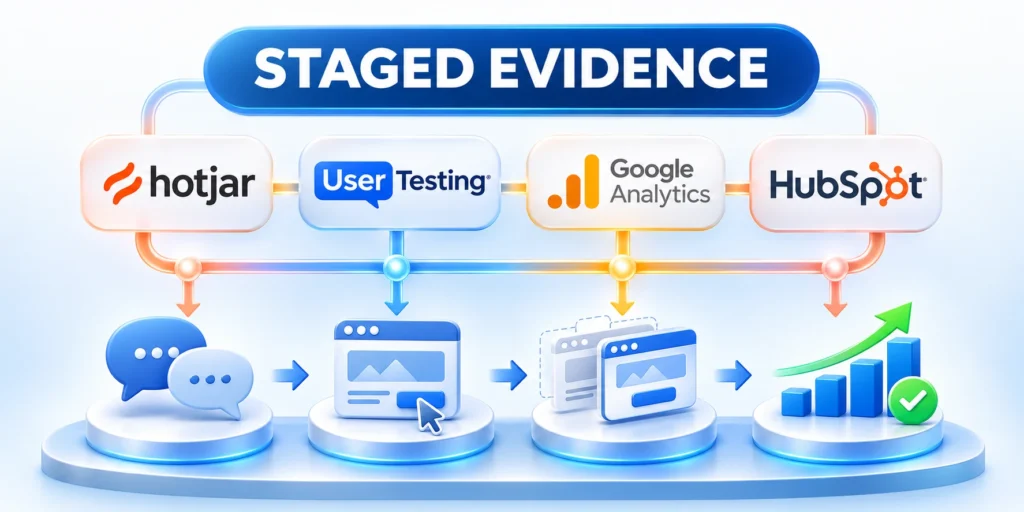
For low-volume services, conversion research methods such as interviews, usability tests, sales evidence, and staged pilots can be more informative than underpowered page tests.
Use larger mechanism-based changes and state remaining uncertainty clearly rather than presenting weak observations as randomized causal proof.
Combine staged evidence responsibly
Combine interviews, session review, usability testing, sales evidence, form diagnostics, operational pilots, and carefully chosen quantitative comparisons when conversion volume is limited.
Prioritize large, mechanism-based improvements and avoid small cosmetic tests that cannot produce credible learning within a useful decision window.
Use Staged Evidence
Begin with problem validation, then prototype observation, bounded rollout, and outcome monitoring, increasing exposure as uncertainty and implementation risk decrease.
State which evidence supports each decision and what remains unknown instead of presenting a staged pilot as a randomized causal result.
Design Qualification Without Interrogation
Collect the minimum context needed to determine service fit, ownership, urgency, region, constraints, and an appropriate next step without demanding a complete procurement brief.
Offer explanatory choices and an alternative path when visitors cannot answer internal terminology, budget, timeline, or technical questions confidently.
Separate Eligibility From Sales Priority
An eligible inquiry may not require immediate sales attention, while an urgent request may still be unsuitable for the available service.
Store these decisions separately so routing, reporting, and experimentation do not collapse different business judgments into one opaque score.
Complete the staged-evidence check
Increase confidence gradually through problem validation, prototype observation, bounded rollout, and outcome monitoring appropriate to available volume.
Apply these plan low traffic criteria consistently:
- Validate the problem qualitatively.
- Observe representative prototype use.
- Monitor a bounded operational rollout.
Use repeated evidence across methods to decide whether to repair, research, pilot, or leave the current experience unchanged.
Low volume increases the importance of mechanism, consequence, reversibility, and transparent limits on what the evidence proves.
Optimize Mobile Journeys as Distinct Contexts

Mobile visitors face different input, connectivity, interruption, sharing, and follow-up constraints that responsive layouts alone do not resolve.
Optimization should also cover performance, accessibility, confirmation, response, scheduling, and promise fulfillment after the initial form or booking event.
Treat mobile as a distinct operating context
Evaluate navigation, reading, proof, forms, scheduling, keyboards, errors, calls, document access, and interrupted sessions on representative devices and networks.
Do not assume responsive layout preserves intent when mobile visitors have different time, input, connectivity, and follow-up constraints.
Preserve Cross-Device Continuity
Let qualified visitors resume research, share evidence, save progress, or choose another contact channel without exposing personal data or duplicating submissions.
Measure device transitions carefully because analytics may split one buying journey into apparently unrelated sessions.
Treat Performance and Accessibility as CRO Inputs
Measure loading, responsiveness, stability, keyboard access, focus, contrast, labels, errors, zoom, and assistive-technology behavior on the actual conversion journey.
Barriers affect comprehension and completion before an experiment can test the intended message or offer mechanism reliably.
Use Guardrails During Experimentation
Reject variants that improve a primary metric by increasing layout shifts, blocking input, hiding focus, degrading contrast, or delaying essential information.
Retest the permanent implementation because experiment scripts and production components can create different accessibility and performance behavior.
Optimize the Post-Conversion Experience
Confirm receipt, state realistic timing, explain the next step, preserve submitted context, offer corrections, and provide support when the expected response does not arrive.
Align confirmation pages, email, scheduling, CRM tasks, ownership, and sales messaging so the visitor receives one coherent commitment.
Measure Promise Fulfillment
Track response time, successful contact, resolved questions, attendance, qualification, opportunity progression, complaints, and abandonment after the initial conversion event.
A page-level gain is unsustainable when the organization cannot deliver the experience that persuaded visitors to submit.
Complete the journey-quality check
Test the complete mobile and post-conversion experience, including interruptions, accessibility, confirmation, ownership, response, and recovery.
Apply these optimize mobile journeys criteria consistently:
- Test representative mobile conditions.
- Verify accessible form recovery.
- Measure response and promise fulfillment.
Verify the transition from mobile research to confirmation, CRM ownership, sales response, and eventual customer outcome.
A complete journey should preserve context and provide recovery when a device, connection, integration, or handoff fails.
Compare CRO evidence before action
Use the strongest available evidence for the uncertainty and consequence of each proposed change.
This comparison keeps method selection practical:
| Decision | Evidence | Action |
|---|---|---|
| Broken journey | Path audit | Repair first |
| Unclear behavior | Usability study | Research |
| Traffic supports testing | Randomized test | Experiment |
| Low traffic | Staged evidence | Pilot |
Conclusion

Effective CRO connects buyer needs with clear offers, measured actions, qualified follow-up, and honest learning. It improves a business process, not only a page statistic.
Start with one service and one evidence-backed friction point. Validate data, make a focused change, observe customer outcomes, and keep only useful improvements.
Use a repeatable operating rhythm
Review qualified inquiries and feedback with marketing, sales, and delivery. Select a specific customer problem supported by evidence.
Assign an owner and review date before implementing a change or beginning new research.
Sustain a CRO operating rhythm
Record what happened, including limitations and inconclusive findings. Reuse a result only while the page, audience, measurement, and sales process remain comparable.
Choose a change small enough to explain and test. Verify the complete submission path and monitor quality, trust, and operational guardrails.
A practical first-month CRO review
In the first week, agree on one service, a qualified inquiry definition, and an owner for the complete response path. Confirm the current page and form before making changes.
Use these conclusion controls together:
- Review a sample of recent accepted and rejected inquiries with sales.
- Identify one evidence-backed point of friction on the service page.
- Choose a focused change and define customer and operational guardrails.
- Schedule a review that reflects the sales cycle and available outcome volume.
Next, submit controlled inquiries and compare analytics events with CRM records. Fix broken tracking or routing before interpreting a conversion trend.
Know when the page is not the main problem
If suitable visitors understand the offer but decline to proceed, investigate scope, timing, price fit, service availability, or trust concerns before rewriting the page.
Apply these conclusion criteria consistently:
- Compare response time and acceptance rates by inquiry type.
- Ask recent prospects what information was still missing.
- Check whether delivery capacity or service boundaries changed.
Ask sales what qualified prospects mention after leaving the site. Check whether slow responses, unclear ownership, or mismatched expectations explain the loss.
FAQ
These answers clarify common decisions for service-business CRO programs.
What is CRO for a B2B service business?
It is a structured effort to help more suitable prospects take a useful next step while protecting lead quality, trust, and delivery capacity.
Which conversion should we optimize?
Start with an outcome the business can validate, such as a qualified inquiry. Use clicks and form starts as diagnostic measures.
Should every service page use the same form?
Keep a consistent core, then ask only the additional questions needed for qualification, routing, or preparation.
How many fields should a lead form include?
There is no universal ideal. Include the minimum information needed to respond and route the request.
Is a higher form completion rate always better?
No. Less-qualified submissions can increase processing costs and reduce sales efficiency even when completion rises.
When should a company use an A/B test?
Use one when audience, implementation, and outcome volume support a fair comparison. Otherwise use qualitative or staged methods.
Can heatmaps explain why prospects do not convert?
They show interaction patterns, not motivation. Combine them with page context, interviews, form data, and sales feedback.
What should CRO measurement track?
Track meaningful steps from relevant visits through submissions, qualification, sales acceptance, and downstream outcomes when available.
How long should an experiment run?
Set its review point based on method, traffic, sales cycle, and risk. Avoid deciding from a brief early lead.
What should a service business do first?
Choose one service page, define a qualified outcome with sales, validate tracking, and investigate one evidence-backed friction point.






Leave a Reply