

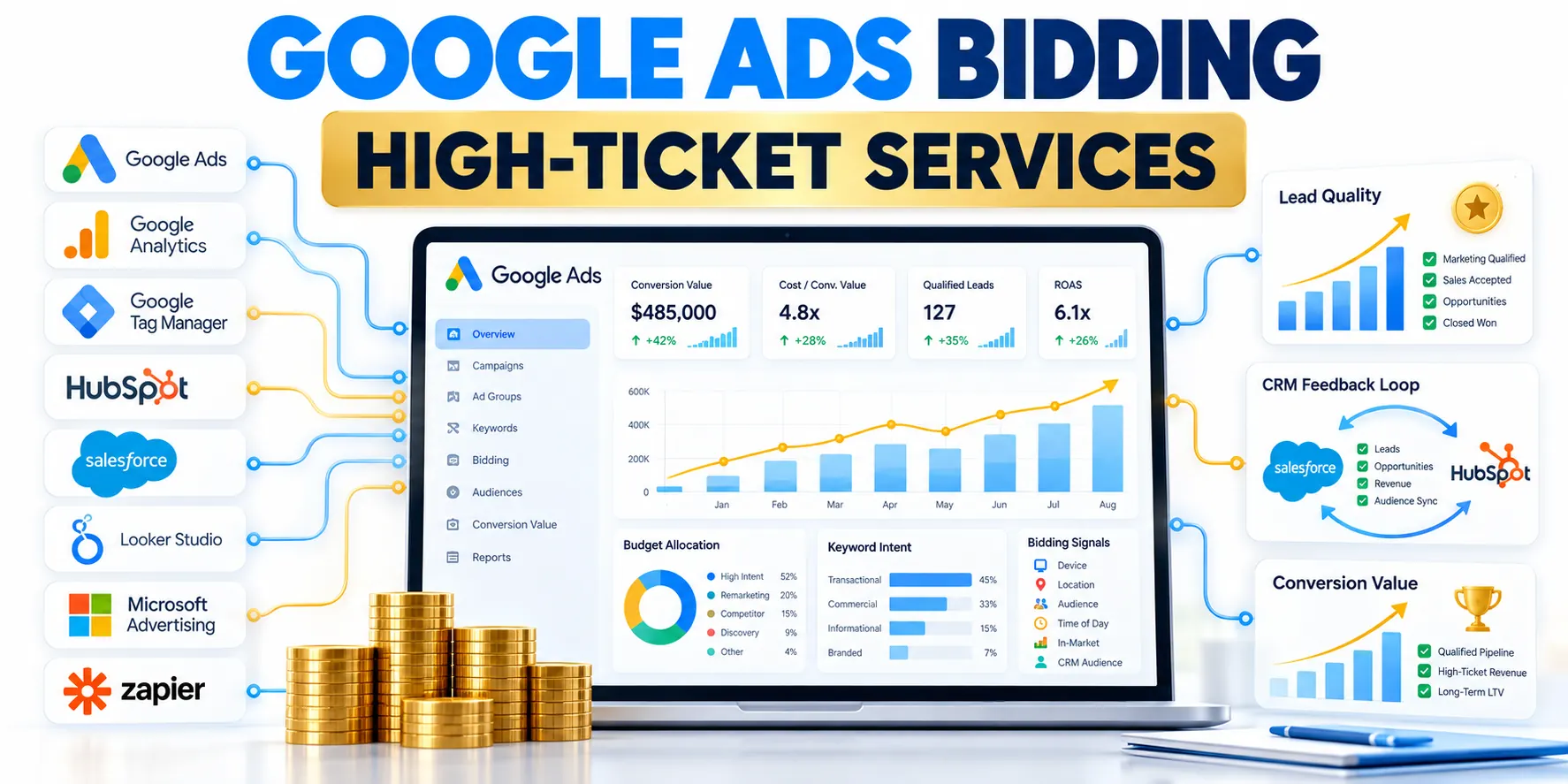
Define Value Before Choosing a Bid Strategy

Choosing a Google Ads bidding strategy for high-ticket services requires a trustworthy signal; conversions are few, sales cycles are long, and deal values can vary widely.
Start by defining the business outcome, the sales stage that predicts it, and the amount you can afford to spend to create that outcome.
Define bidding value through these business signals:
- Sales acceptance based on documented qualification.
- Opportunity creation with accountable ownership.
- Expected value grounded in mature cohorts.
- Closed revenue and delivery margin evidence.
Map the revenue path before setting bids
Write down the path from paid click to signed contract: inquiry, sales acceptance, qualified opportunity, proposal, and closed deal.
For each stage, name its owner, entry criteria, timestamp, and exit condition. Use evidence such as a confirmed need, service fit, authority, and a scheduled next step.
Separate raw inquiries from accepted leads
A form submission is a useful diagnostic, but it is not automatically a qualified lead. Spam, students, vendors, and out-of-area requests can make its cost misleading.
In the CRM, define the event that means sales accepted the lead. Require the representative to record a reason when rejecting or disqualifying it.
Align marketing and sales stage definitions
Keep stages mutually understandable. If marketing calls a form qualified while sales requires budget-confirmed buyers, reports will disagree.
Publish the entry and exit criteria for each stage. Train reviewers to apply the same evidence and record why a lead advances, stalls, or closes.
Set an economic ceiling using a worked example
Assume a service contract is worth $60,000 in first-year revenue and has a 70% gross margin. That leaves $42,000 before acquisition costs and overhead.
If leadership permits up to 20% of first-year gross profit for acquisition, the maximum target customer acquisition cost is $8,400.
Translate close rates into a lead target
Suppose 2% of qualified leads eventually become customers. A simple planning ceiling is $168 per qualified lead: $8,400 multiplied by 0.02.
This is a starting model, not a promised result. Replace assumptions with cohort data and distinguish gross margin, sales expense, delivery capacity, and contract renewals.
Account for delayed sales outcomes
Use a longer window for contracts that take months to close. Short reporting windows can make a healthy campaign appear unprofitable before opportunities mature.
Compare cohorts by click and opportunity dates, then label incomplete periods. Preserve the original campaign context while deals progress through the CRM.
Send Qualified Conversion Signals to Google Ads
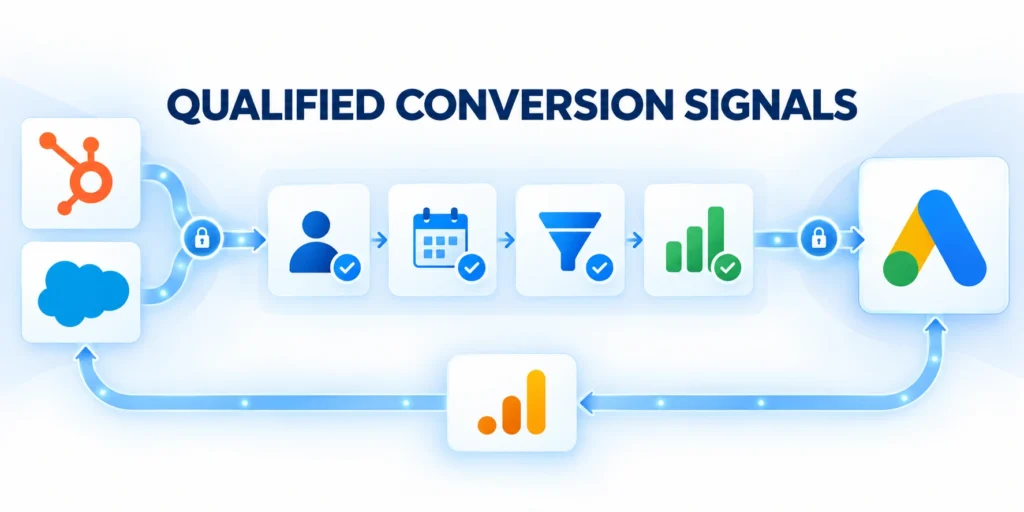
Automated bidding learns from the conversion actions selected in the account. If those actions represent low-quality forms, the system may pursue more low-quality forms.
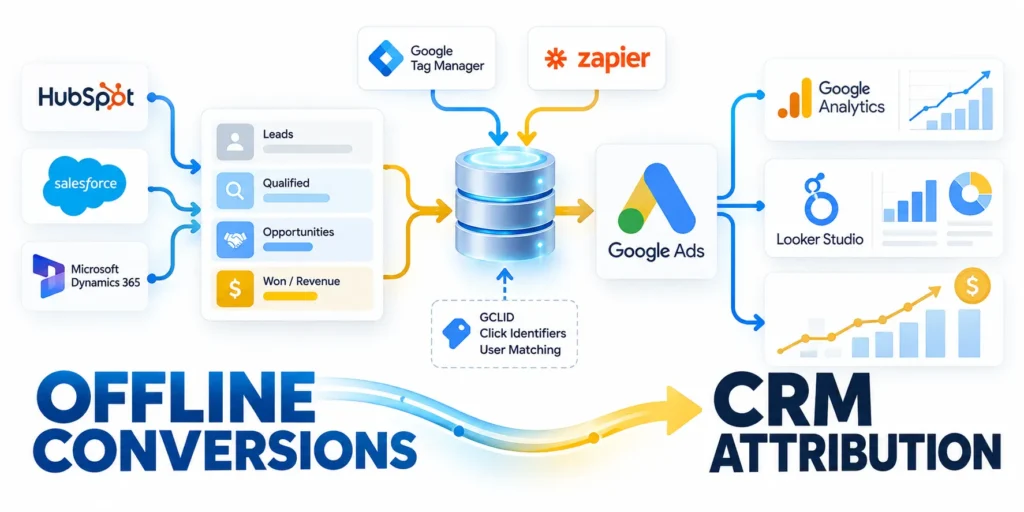
For a long sales cycle, connect ad interactions to CRM outcomes where feasible. Keep a basic form event for diagnostics, but separate it from sales-qualified actions.
Choose primary and secondary events deliberately
A primary conversion is eligible for use in the account’s conversion goals and bidding. A secondary action can remain visible for analysis without steering the strategy.
Use these actions to choose primary and secondary events deliberately:
- Primary candidate: sales accepted lead or qualified opportunity, when volume and implementation support it.
- Secondary diagnostic: form submission, call connection, meeting request, or content interaction.
- Value event: credible expected value for a qualified opportunity, updated when actual outcomes become available.
Do not mark every tracked event as primary. Otherwise one prospect can be counted repeatedly at several points in the same journey.
Validate signal ownership before upload
Assign an owner for the CRM definition, technical mapping, consent controls, upload monitoring, and business approval. Record the system of record for every field.
Test representative records before changing optimization. Confirm that timestamps, identifiers, stage conditions, values, and corrections survive the complete path without creating duplicate events.
Verify ownership through these operating checks:
- Assign one accountable owner for each conversion definition.
- Monitor one path for imports and corrections.
- Require documented approval before bidding activation.
Implement a Practical Measurement Sequence

A practical sequence connects the ad interaction to a governed CRM milestone without allowing duplicate, unsupported, or poorly defined events to guide bidding.
Design the data path, ownership, consent, identifiers, timing, and verification method before activating the imported action as a primary conversion goal.
Follow this sequence to implement a practical measurement sequence:
- In Google Ads, review Goals → Conversions → Summary and list the actions currently counted as primary.
- Define a stable CRM event for sales acceptance and qualified opportunity; document exact conditions.
- Capture permitted click IDs and campaign context, mapping them to the matching CRM record.
- Configure the supported offline or enhanced lead-conversion method, then test one record end to end.
- Compare uploaded events, CRM stages, and Google Ads diagnostics before making them bidding goals.
Google’s current Enhanced Conversions for Leads upgrade guide describes supported approaches and data requirements.
Protect customer data, obtain required consent, limit access, and follow applicable platform terms. Hashing data does not remove the need for a lawful and secure process.
Plan for delayed outcomes and duplicate events
Record the click date, conversion name, CRM stage, and conversion time consistently. Assign each event once and use an idempotent upload process where supported.
Compare conversion delays with upload windows in the current Google Ads guidance. Recent changes may not appear immediately in campaign reports.
Troubleshoot imported conversion events
Review duplicate, unmatched, and rejected event diagnostics. Fix mapping and consent issues before interpreting bidding performance as a strategy failure.
For Salesforce users, opportunity stages can represent milestones such as proposal, negotiation, and contract signing; adapt stage names to your actual sales process.
Choose a Strategy That Matches Your Sales Data

Choose the bidding goal after validating conversion tracking and deciding what outcome matters. A sophisticated strategy cannot repair an inaccurate conversion definition.
Google’s bid strategy guide distinguishes conversion volume, conversion value, traffic, and visibility goals.
Compare bidding choices through these operating requirements:
- Reliable primary conversion with sufficient business meaning.
- Targets derived from mature and comparable cohorts.
- Budget ceilings approved for expected volatility.
- Values grounded in observable opportunity economics.
Compare strategy requirements before activation
Use this comparison to match the business objective, available signal, and primary operational risk before selecting an automated strategy.
| Goal | Suitable signal | Primary risk |
|---|---|---|
| Conversion volume | Reliable qualified action | Low-quality volume |
| Average acquisition cost | Comparable conversions | Restrictive target |
| Conversion value | Valid opportunity values | Fabricated values |
| Visibility or traffic | Bounded awareness need | Weak pipeline signal |
Treat the table as a decision aid, not a guarantee. Confirm current platform options, conversion volume, budget, and sales-cycle evidence before activation.
Use Maximize Conversions for a volume objective
Maximize Conversions aims to generate as many selected conversions as possible within the campaign budget. It is suitable only when the chosen conversion represents a meaningful action.
For a high-ticket firm, optimize to a qualified stage when data supports that event. If only raw leads are tracked, monitor quality separately and avoid calling volume a business outcome.
Control budget pressure
Check the budget before switching. This strategy can spend toward the average daily budget, so use an approved ceiling and monitor actual spend.
Record who may change the ceiling and which evidence justifies an increase. Compare cumulative spend with qualified outcomes before expanding coverage.
Use Target CPA when conversion value is similar
Target CPA pursues conversions around an average cost goal. Before switching, estimate a target CPA for your service using comparable conversions and actual unit economics.
Set the target from recent mature cohorts, not an aspirational number. A target far below observed performance can constrain delivery and reduce the evidence available for assessment.
Measure downstream sales outcomes
Use cost per accepted lead or qualified opportunity when those actions are reliable. Track signed contracts and gross profit separately to confirm downstream economics.
Reconcile the campaign cohort after enough deals mature. A lower qualified-lead cost can still underperform when opportunity progression or delivery margin deteriorates.
Use Value-Based Bidding When Deal Values Differ

Maximize Conversion Value or Target ROAS can account for different conversion values. They require values that reflect business importance rather than arbitrary numbers.
For example, assign expected values from validated opportunity bands only when historical close rates support them. Update values as deal outcomes mature and assumptions change.
Build value logic from these governed inputs:
- Validated opportunity bands and close rates.
- Expected contract value and delivery margin.
- Stage-specific probabilities from mature cohorts.
- Corrections when actual revenue becomes available.
Avoid fabricated conversion values
Do not assign every opportunity a large value simply to make the strategy appear successful. That teaches bidding to prefer a fabricated score.
Audit assigned values against actual progression and revenue. Remove unsupported multipliers, document assumptions, and require an owner to approve changes to the value model.
Keep visibility and click goals in their proper role
Target Impression Share focuses on placement visibility, while Maximize Clicks pursues traffic. Neither directly optimizes for qualified contracts or revenue.
Use visibility bidding for a bounded brand-protection or awareness objective, with a maximum CPC and budget. Evaluate it on its stated goal, not on pipeline alone.
Keep visibility goals separate
Google notes that automated bid strategies use different business goals. Recheck current naming because labels can change during product transitions.
Keep visibility campaigns in separate reporting and budget decisions. Their success criteria should not dilute conversion or value goals used for qualified pipeline acquisition.
Organize Campaigns Around Intent and Economics

Campaign structure should make budgets, conversion goals, and search intent understandable. Separate campaigns only when the difference changes a real operating decision.
Too many small campaigns divide limited conversion data and make it harder to see which business hypothesis is being tested.
Organize campaign structure through these decision boundaries:
- Service economics and delivery capacity.
- Search intent and landing-page promise.
- Conversion goal and value logic.
- Geography, ownership, and approved budget.
Group queries by the decision they signal
Build keyword themes around service category, urgent problem, implementation need, location, and brand. Keep terms with different landing pages or sales paths apart.
For a cybersecurity consultancy, “incident response retainer” signals a different request from “what is an incident response plan.” Separate immediate service demand from research intent.
Filter search terms against service fit
Review actual search terms and exclude irrelevant queries. Add negative keywords only after checking whether a term might represent a valid service or buyer need.
Brand campaigns can protect navigational searches, but report them separately from new-demand campaigns. Otherwise branded demand may make prospecting look more productive than it is.
Match the ad group to a useful landing page
Each high-intent theme should lead to a page that explains the service, eligibility, process, and next step promised by the ad.
Do not send every query to the homepage if the visitor needs a specific audit, migration, consultation, or implementation engagement.
Match ads to landing-page evidence
Keep a clear message match: query problem, ad promise, landing-page proof, and conversion action should describe one coherent service decision.
Test the page with the intended query theme and conversion path. Remove unsupported claims, ambiguous calls to action, and proof that belongs to another service.
Related paid acquisition resources
For a broader paid acquisition framework, see our B2B Google Ads playbook.
Coordinate paid acquisition with lead qualification, sales follow-up, and the delivery capacity available for each service.
Connect bidding with demand generation
For broader demand-generation planning, see our high-intent B2B demand generation guide.
Use that framework to align paid demand with qualification, content, sales response, and delivery capacity. Bidding should support the system rather than define it alone.
Keep account structure maintainable
Keep acquisition decisions connected to qualification, follow-up, and the service capacity available to deliver the work.
Use a small set of campaigns with distinct budget or goal needs. Use ad groups for tightly related keyword and ad themes that share a relevant destination.
Standardize campaign naming and conversion goals
Name campaigns consistently with service, geography, intent, and brand status. A clear naming convention helps CRM reports reconcile spend with opportunities.
Document which conversion actions each campaign uses. Review campaign goals after changing global defaults, tracking, or the service offer.
Set Targets and Budgets Without Choking Delivery

A target is a control based on evidence, not a promise that every conversion will land at exactly that cost.
Build a range from mature CRM cohorts, then decide what variation the business can tolerate while the campaign gathers more evidence.
Approve a target range before launch
Define an acceptable range rather than one aspirational number. Use mature cohorts, contract economics, capacity, conversion delay, and the expected number of observable outcomes.
Assign an owner to approve the range and the evidence required for revision. Avoid changing the target merely because daily results fluctuate.
Approve the target through these evidence checks:
- Mature cohorts with consistent stage definitions.
- Contract value, margin, and delivery capacity.
- Expected volume within the test window.
Calculate a qualified-opportunity target transparently
Continue the example: the maximum acquisition cost is $8,400 per won contract. If 10% of accepted opportunities close, the planning ceiling is $840 per accepted opportunity.
If 20% of sales-accepted leads become qualified opportunities, the implied ceiling is $168 per accepted lead: $840 multiplied by 0.20.
Validate targets with mature cohorts
These numbers depend on stable stage definitions and representative cohorts. Use separate calculations for distinct services, regions, or contract types when economics materially differ.
Include sales capacity and delivery margin in approval. A campaign can meet its acquisition target and still create poor outcomes if the business cannot serve the work.
Protect Budget While Preserving a Fair Test

A fair test protects the approved investment while giving the campaign enough stable time and eligible demand to produce interpretable evidence.
Define spend limits, stop conditions, review cadence, decision ownership, and protected variables before launch. Record every change that could alter delivery or qualification.
Protect the test through these budget controls:
- Choose a maximum daily and total test spend that the business can afford.
- Estimate how many qualified actions the test can reasonably observe at that budget.
- Pause for broken tracking, clear audience mismatch, or spending beyond the approved ceiling.
- Keep a log of target, budget, and conversion-goal changes with dates and owners.
Do not make repeated target changes in response to a single day. High-ticket lead volume is often sparse and influenced by sales timing, seasonality, and competition.
Google’s bidding learning guidance recommends using conversion data, accounting for delays, and avoiding targets disconnected from historical performance.
Avoid combining campaigns without a reason
Portfolio bidding can pool campaigns when they share a compatible goal and conversion definition. Do not combine campaigns just to increase a reported conversion count.
Keep separate budgets where services have different margins, capacity, geography, or sales ownership. Shared bidding should support a real decision, not hide underperformance.
Keep portfolio goals aligned
Before pooling, confirm that each campaign can use the same primary actions and value logic. Document why the shared strategy is appropriate.
Review the portfolio whenever services, margins, regions, or ownership change. Remove campaigns whose goals no longer match the shared optimization logic.
Launch a Controlled Test and Read Results
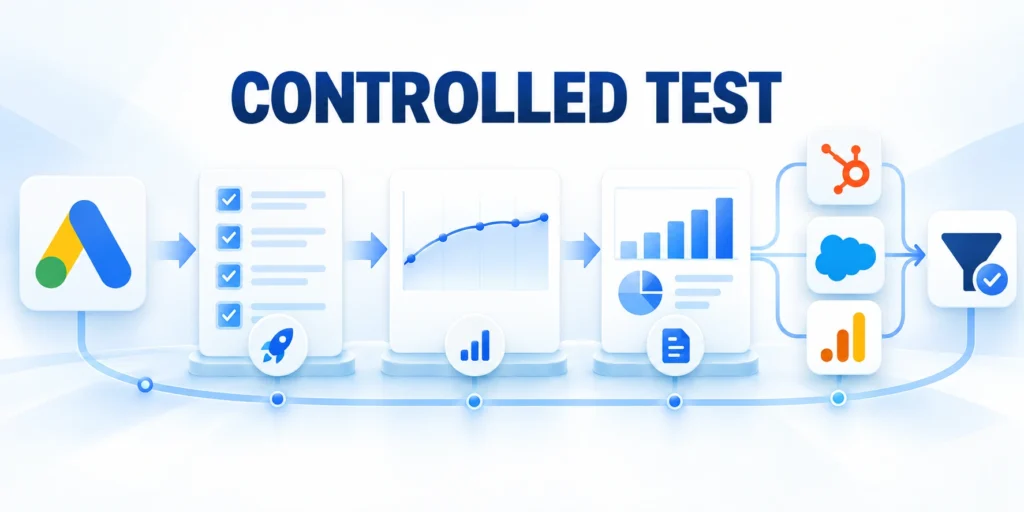
A controlled launch lets the team learn which assumption is wrong without changing every part of the account at once.
Set a baseline, hold the major variables steady, and define what evidence would justify continuing, revising, or pausing the campaign.
Use a four-week operating plan
Follow this sequence to use a four-week operating plan:
- Week 1 — verify: test forms, calls, CRM capture, conversion actions, consent behavior, and lead routing.
- Week 2 — launch: activate limited high-intent themes with approved daily and total budgets.
- During week 3, qualify: review search terms, sales acceptance, disqualification reasons, and response time.
- Week 4 — decide: compare mature indicators with baseline and record each campaign’s next action.
Four weeks may be too short to judge closed revenue for a long sales cycle. Continue cohort tracking until the normal conversion delay has elapsed.
Change one meaningful variable at a time when feasible. If you alter targets, budgets, landing pages, and keywords together, the result will be difficult to explain.
Use a diagnostic order when results disappoint
Apply these criteria to a diagnostic order when results disappoint:
- No delivery: inspect eligibility, budget limits, target settings, and keyword coverage.
- Clicks without useful inquiries: review search terms, ad promise, location, and landing-page fit.
- Inquiries without sales acceptance: inspect qualification rules, form friction, response time, and source quality.
- Accepted leads without opportunities: compare service fit, discovery, and the accepted-lead definition.
- Opportunities without revenue: inspect deal maturity, pricing, proposal follow-up, and the close-rate assumption.
Use Google Ads bid strategy reports and CRM cohorts together. Platform conversion totals explain bidding inputs; CRM stages explain whether those inputs create business value.
Document the date range, conversion delay, goal, and changes whenever sharing a result. This makes comparisons more useful to marketing, sales, finance, and leadership.
Conclusion
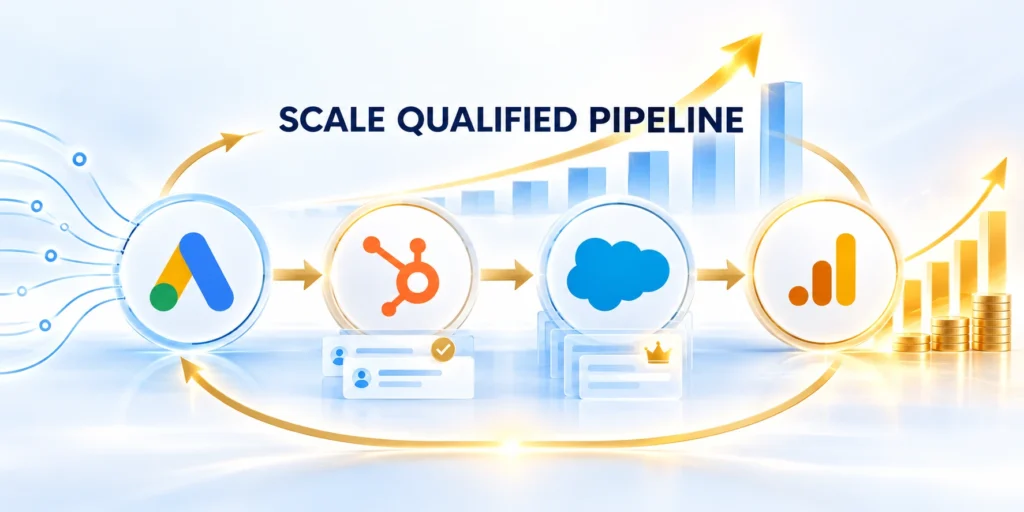
High-ticket Google Ads bidding starts with economics and measurement, then applies a strategy that matches the signal and sales process for every major decision.
Validate outcomes, set a controlled budget, and judge progress at the right stage. Scale only when qualified pipeline and delivery capacity support it and remain operationally trustworthy.
Coordinate Bidding With Sales Capacity
Increase demand only when qualified inquiries can receive timely discovery, accurate routing, appropriate expertise, and consistent follow-up during sustained demand.
When capacity tightens, adjust budgets and coverage deliberately instead of allowing response quality to deteriorate invisibly during the same review.
Coordinate scaling through these operating controls:
- Qualified pipeline supported by stable conversion evidence.
- Sales capacity for timely and informed follow-up.
- Delivery margin protected after acquisition costs.
- Named owners for budgets and target changes.
Preserve Experiment History
Record targets, budgets, conversion definitions, attribution settings, learning periods, changes, external events, and responsible owners for every material test.
This history helps teams distinguish a strategy effect from tracking changes, seasonality, auction movement, or delayed sales outcomes.
Scale from governed evidence
Use CRM cohorts to confirm that accepted leads become opportunities and signed work at sustainable economics. Label incomplete cohorts before comparing periods.
Increase investment in controlled steps and monitor response quality, capacity, margin, and conversion integrity. Pause when any safeguard fails or definitions become unreliable over time.
FAQ
These answers clarify common high-ticket bidding decisions.
Which bidding strategy works best for high-ticket services?
There is no universal best choice. Use the strategy that matches reliable conversion data, deal-value differences, budget, and the business goal you can measure.
Should I optimize for form submissions or qualified opportunities?
Use form submissions as diagnostics, then optimize to a qualified CRM action when tracking quality and volume support it. Do not promote an unverified event to primary.
Can Target CPA work with a long sales cycle?
It can when the selected conversion is timely, reliable, and economically meaningful. Import or model later sales outcomes where supported, and account for reporting delay.
How much should I spend on a bidding test?
Set an approved spend ceiling and estimate how many qualified actions it could produce. The needed budget depends on auction costs, conversion rates, and the evidence required.
When should I change a bidding target?
Change it when mature performance, conversion delays, or business economics justify an adjustment. Avoid reacting to a small number of recent conversions or one poor day.
Should high-ticket campaigns use broad match?
Use it only with reliable conversion signals, exclusions, budgets, search-term review, and evidence that broader reach remains relevant.
How should offline conversions be valued?
Use consistent CRM stages and documented values, avoid duplicates, account for delays, and audit representative records.
Can campaigns share one portfolio strategy?
Yes, when goals, conversion values, economics, audiences, and constraints are compatible enough for shared optimization.
When should seasonality adjustments be considered?
Use them only for predictable, short conversion-rate changes supported by platform guidance and a documented event window.
How are low-volume campaigns evaluated?
Use longer windows, stable definitions, search-term quality, qualified cohorts, and business judgment while stating uncertainty explicitly.






Leave a Reply