


Map the Risks by Use Case and Audience

AI-generated content risks depend on the audience, source material, and purpose. A brainstorming draft differs from a public product claim.
Treat a customer proposal, public claim, and internal outline differently. Map each use case instead of labeling every AI output equally risky.
Classify the content before choosing controls
Classify each use case through these levels:
- Low impact: labeled internal drafts without confidential or personal information.
- Medium impact: routine website or sales content using approved product facts and pre-use review.
- High impact: legal, financial, health, employment, security, regulated, or comparative claims affecting decisions or rights.
List the channel, audience, content owner, source materials, and business consequence if a statement is wrong. A public comparison page carries different exposure than an internal outline.
These categories are a practical triage method, not legal classifications. A single paragraph can move into a higher-risk category if it names a customer, competitor, individual, or regulated outcome.
Separate ethical concerns from legal duties
Ethical expectations can exceed the legal minimum. Readers may reasonably expect accurate attribution, candid disclosure, respectful treatment, and a human contact who can correct mistakes.
Legal duties vary by country, industry, audience, and use. Treat this article as an operational overview, then route jurisdiction-specific questions to qualified counsel before high-impact publication.
Prioritize review by exposure
Increase review when the content reaches a broad audience, makes a factual promise, uses third-party material, or could affect a customer’s rights or spending decision.
Set a clear escalation path for high-risk items. A writer should know which claims need product, privacy, security, or legal review before a campaign deadline.
Connect governance with content operations
Test connect governance with content operations with representative customers, workflows, exceptions, and operating conditions before expanding the decision.
For broader content operations, connect this review to the existing guide on generative AI in B2B content production workflows.
Copyright, Source Rights, and Human Authorship

Copyright risk has two separate questions: whether inputs were used with appropriate rights, and whether the final work contains protectable human authorship.
Do not assume that a vendor’s permission to use its tool clears every source, output, or downstream commercial use. Review the provider’s current terms and your own contracts.
Keep a record of source materials
Apply these source rights and review controls:
- Use company-owned or licensed materials for source documents, images, customer examples, and campaign references.
- Do not submit paywalled, confidential, or third-party creative material without organizational approval.
- Retain prompts, models, dates, sources, and reviewer notes for valuable or higher-risk assets.
For each high-value asset, record the sources supplied to the model, who supplied them, and the permission or business basis for using them.
A record does not make an unauthorized use lawful, but it helps a team explain how it made the content and identify issues before publication.
Add human contribution deliberately
In its 2025 report, the U.S. Copyright Office said AI outputs may be copyrightable where a human determines sufficient expressive elements; prompting alone is not enough.
That conclusion concerns U.S. copyrightability, not whether a company may use every output or whether another party’s rights were infringed. Preserve meaningful human selection, editing, arrangement, and original contributions.
Review output similarity and attribution
Check unusual phrases, close paraphrases, named quotations, and distinctive creative material against the cited sources. An AI-generated citation is not evidence that a quotation or attribution is real.
If a passage appears unusually close to a source, pause publication, verify the source, and rewrite from independently established facts with appropriate attribution or permission.
Read provider terms as one part of clearance
Check whether provider terms address commercial use, user inputs, output rights, indemnity, restrictions, and termination. Terms can change, so save the version applicable to the workflow.
A provider warranty may cover only specific claims or conditions. It does not replace a company’s review of its sources, campaign statements, privacy duties, or customer agreement.
Confidentiality, Privacy, and Personal Data

Content teams sometimes paste customer emails, meeting transcripts, sales notes, employee details, or unpublished product plans into a generative AI tool.
Those materials may be confidential or personal data even when they seem ordinary. Remove or protect them before prompting, and use only approved services and workspaces.
Create an approved-input rule
Handle information through these classification rules:
- Public: approved public product facts may be used in a company-approved tool.
- Internal: use only approved services, settings, retention terms, accounts, and access controls.
- Restricted: exclude customer identifiers, credentials, sensitive details, and confidential deal data without explicit approval.
Give employees a simple rule they can apply before copying information: identify the data, confirm the tool, and verify the permitted purpose.
Do not treat masking as a magic fix. A unique role, location, deal detail, or combination of fields can still identify a person or customer.
Check vendors and data flows
Before using an AI service with nonpublic data, confirm who can access prompts and outputs, whether they are retained or used for training, and how deletion works.
Also review subprocessors, storage locations, breach notification terms, and data-processing commitments. Ask procurement, security, or privacy staff when contract language is unclear.
Test the process with a safe dataset
Test test the process with a safe dataset with representative customers, workflows, exceptions, and operating conditions before expanding the decision.
For a safer pilot, create a small approved dataset with synthetic or properly de-identified examples. Confirm that the team can complete the task without copying live customer records.
Prepare for an accidental disclosure
If sensitive information enters an unapproved tool, follow the company incident process promptly. Record what was shared, which service received it, and when.
Ask the service owner about deletion and retention, involve privacy or security staff, and notify affected parties only through the approved response process.
Accuracy, Bias, and Unsupported Claims
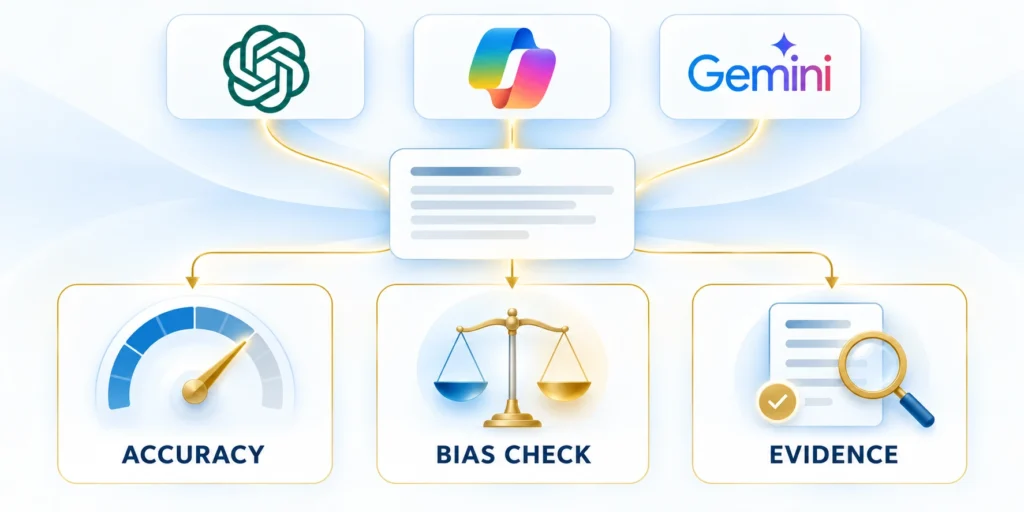
Fluent output can still contain invented figures, outdated terms, unsupported comparisons, or discriminatory assumptions. Treat every material factual statement as a claim that needs evidence.
The Federal Trade Commission has stated that existing consumer-protection laws still apply when companies use AI. Its enforcement examples underscore that an AI label does not excuse deceptive claims.
Build a claim-evidence table
Review consequential claims through these fields:
- Claim: write the statement as it will appear to the reader.
- Evidence: link to an approved source, test result, contract, or current product record.
- Owner: name the person responsible for confirming the evidence and its date.
- Decision: approve, revise, qualify, or remove the claim.
Before approving a product page, comparison, case study, or campaign, list the claims readers might rely on and attach the evidence that supports each one.
Reject unsupported superlatives, market-share statements, performance guarantees, and competitor comparisons. If the evidence is conditional, place the qualification near the claim.
Test for bias and misleading framing
Review examples and recommendations for stereotypes, exclusionary wording, invented customer outcomes, or assumptions about a person based on protected or sensitive characteristics.
Ask reviewers from affected functions to inspect customer-facing automation. Add a second reviewer when output could affect hiring, credit, health, or service access.
Keep evidence tied to approval
Test keep evidence tied to approval with representative customers, workflows, exceptions, and operating conditions before expanding the decision.
Save the evidence, decision, and correction path. If a claim is later challenged, the team should be able to identify who approved it and what information supported it.
Check what a reasonable reader will infer
Review the headline, chart, footnote, and surrounding copy together. A precise sentence can still mislead when the design implies certainty or a stronger comparison.
Ask reviewers to explain the claim in their own words. If their interpretation exceeds the evidence, qualify the statement or remove it.
Transparency, Contracts, and Customer Expectations

Whether disclosure is legally required depends on the jurisdiction and context. Even where a general disclosure rule does not apply, clear communication can prevent a misleading customer experience.
The EU AI Act has targeted transparency duties for certain AI-generated media and public-interest text. Scope and exceptions depend on context; the rules do not cover every B2B draft.
Use disclosure when it changes the reader’s understanding
Test use disclosure when it changes the reader’s understanding with representative customers, workflows, exceptions, and operating conditions before expanding the decision.
Apply these disclosure and correction practices:
- Describe AI’s role plainly; never imply human checks occurred when they did not.
- Keep required notices close to the relevant content, not hidden in a distant policy page.
- Give customers a contact for corrections and explain how they can challenge inaccurate information.
Consider disclosure when synthetic media depicts a real person or event, a customer expects a human-authored deliverable, or AI materially shaped a high-stakes recommendation.
Align contracts with actual practice
Review client agreements, agency terms, supplier commitments, and content licenses for rules about automation, confidentiality, attribution, approval, and ownership.
Do not promise exclusive ownership or unrestricted rights unless counsel and the provider terms support that promise. Define which party approves claims, supplies evidence, and handles takedown requests.
Assess jurisdiction-specific disclosure duties
Test assess jurisdiction-specific disclosure duties with representative customers, workflows, exceptions, and operating conditions before expanding the decision.
For EU-facing content, ask legal staff to assess Article 50 against the content, publication purpose, and any exception before adopting a general disclosure rule.
Make the disclosure specific and useful
When a notice is needed, explain whether AI drafted, transformed, or generated synthetic media. Avoid broad claims such as “fully human-made” when automated steps shaped the result.
Keep disclosure factual and proportional. The goal is to help the audience understand what happened and who stands behind the published material.
Build a Practical Human Review Workflow
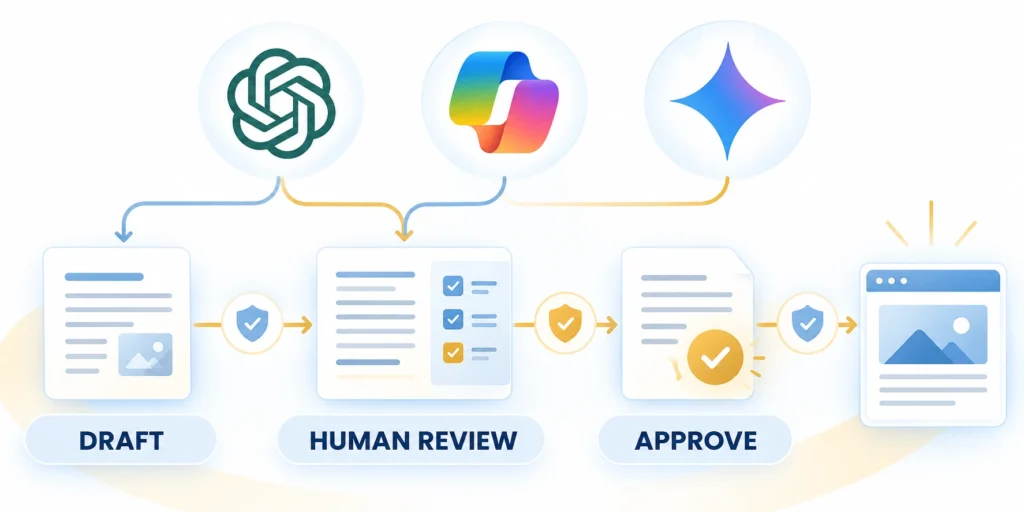
A workable policy connects safeguards to the content lifecycle. It should tell a writer what to do before prompting, what to verify in a draft, and who can approve publication.
Keep the workflow proportional. A routine internal summary does not need a legal review, while a public claim about regulated performance may need evidence and specialist approval.
Run a repeatable six-step check
Follow this accountable publication review sequence:
- Define purpose: state the audience, channel, decision, owner, and consequence of an error.
- Choose approved inputs: use permitted sources and remove unnecessary confidential or personal data.
- Generate a draft: label it as AI-assisted internally and retain relevant source links.
- Verify claims: check names, numbers, dates, citations, comparisons, and promises against current evidence.
- Review rights and context: assess copyright, attribution, bias, privacy, contract terms, and required disclosures.
- Approve and monitor: record the approver, publish, and provide a route for correction or escalation.
Test run a repeatable six-step check with representative customers, workflows, exceptions, and operating conditions before expanding the decision.
For example, a team drafting a comparison page can reject unsupported competitor claims, link each accepted statement to evidence, and obtain product-owner approval before release.
Keep a lightweight audit trail
Store only what is useful: the content version, sources, tool and date, reviewer, approval outcome, and unresolved limitations. Avoid retaining sensitive prompts unnecessarily.
Assign a process owner to review incidents, vendor changes, and new legal requirements. Update approved-tool lists when data retention, model terms, or capabilities change.
Measure and update the controls
Test measure and update the controls with representative customers, workflows, exceptions, and operating conditions before expanding the decision.
Start with one team and one content type. Track correction rates, review time, unsupported-claim findings, and user complaints, then adjust controls based on observed issues.
Assign owners for each decision
Writers own source notes and draft labels; subject-matter reviewers verify claims; privacy and security teams assess sensitive data; legal staff interpret jurisdiction-specific obligations.
A designated publisher makes the final release decision and ensures a correction route exists. Clear ownership prevents “the model said it” from replacing accountability.
Govern AI Vendors, Models, and Connected Data
Organizations remain accountable for how AI vendors, models, connectors, and datasets affect published content. A vendor contract does not replace use-case review or human responsibility.
Inventory each model, provider, region, connected repository, retention setting, training option, privileged credential, and downstream publication path. Approve scope before employees send sensitive material.
| Control | Evidence | Owner |
|---|---|---|
| Data use | Approved scope | Privacy |
| Model change | Evaluation result | AI owner |
| Publication | Reviewed version | Publisher |
| Incident | Correction record | Response lead |
Evaluate vendor and model boundaries
Review data use, security, deletion, subcontractors, geographic processing, model changes, availability, and incident communication according to the information and decision risk.
Require these vendor governance records:
- Approved use case
- Connected data
- Model version
- Retention setting
- Accountable owner
Test revocation and deletion rather than relying on configuration screenshots. Remove obsolete connectors, credentials, and access when projects, vendors, or staff change.
Control changes before production use
Evaluate material model, prompt, retrieval, safety, or connector changes with representative content. Preserve the prior configuration and rollback path when publication risk justifies it.
Communicate changed limitations to authors and reviewers. A previously acceptable workflow may require new evidence when model behavior, data processing, or contractual terms change.
Separate procurement from publication approval
Procurement may approve a service while editorial, legal, privacy, security, or domain owners restrict particular content uses. Record both decisions and their scope.
Authors should know which system, data, and audience are approved. A general enterprise license does not authorize every confidential input or public claim.
Plan vendor exit and evidence portability
Document how approved content, review records, source references, configurations, and deletion evidence remain accessible if the provider changes or the service ends.
Test export and credential revocation before dependency becomes urgent. A commercial exit should not erase the organization’s publication history or leave connected repositories exposed.
Respond to AI Content Incidents and Corrections

AI content incidents can involve false claims, confidential data, discrimination, unauthorized material, harmful instructions, broken citations, or contract violations. Define response ownership before publication.
Give customers, employees, and reviewers a clear way to report problems. Triage potential harm, affected audiences, ongoing exposure, evidence preservation, and the need for immediate removal.
Contain harm and preserve evidence
Pause distribution, automation, or connected access when continued exposure creates material risk. Preserve the published version, prompts, sources, model configuration, approvals, and timestamps.
Capture these incident response decisions:
- Affected content
- Potential harm
- Containment action
- Correction owner
- Notification scope
Do not retain unnecessary sensitive content solely for diagnosis. Coordinate evidence access and retention with legal, privacy, security, and records requirements.
Correct the record transparently
Fix or remove affected content, invalidate caches and syndication, notify impacted stakeholders when appropriate, and link corrections to the accountable publication record.
Review why generation, sourcing, human review, access, or release controls failed. Improve the workflow and test the correction without blaming the model as the sole actor.
Rehearse high-impact scenarios
Exercise confidential disclosure, fabricated evidence, discriminatory output, unsafe guidance, and unauthorized publication. Confirm escalation and communication remain usable outside normal business hours.
Record decision thresholds for removal, correction, customer notice, regulator consultation, and vendor escalation. Qualified owners should resolve ambiguity rather than improvising under pressure.
Coordinate accurate external communication
Name who approves customer, partner, employee, public, and regulatory messages. Early communication should distinguish confirmed facts, current containment, uncertainty, and the next update.
Avoid repeating harmful content unnecessarily. Give affected audiences a usable correction or support path and preserve consistency across every channel carrying the original claim.
Preserve Review, Consent, and Publication Records

Records should explain what was generated, which evidence supported it, who reviewed it, what changed, and why the final version was approved for its audience.
Define retention from legal, contractual, privacy, security, and operational needs. Keeping every prompt forever can create unnecessary exposure without improving accountability.
Bind evidence to the published version
Store source identifiers, model and configuration, reviewer names, decision scope, exceptions, consent where applicable, and the exact version released or distributed.
Preserve these publication record elements:
- Content version
- Source evidence
- Review decision
- Approved exception
- Correction history
Separate raw sensitive inputs from the minimum audit record. Restrict access to prompts, customer data, credentials, and privileged advice according to their actual classification.
Make records usable during review
Test whether a qualified person can reconstruct a consequential decision without relying on the original author’s memory. Missing scope or evidence weakens later correction and accountability.
Use consistent identifiers across drafts, approvals, publications, corrections, and removals. This prevents a generic approval from being attributed to a materially changed version.
Dispose of records deliberately
Apply approved deletion or archival schedules to prompts, outputs, logs, embeddings, review artifacts, and vendor data. Confirm downstream copies and caches follow the decision.
Preserve holds and required evidence when incidents or disputes arise. Resume normal disposal only after authorized owners close the exception and document the outcome for every affected system and vendor.
FAQ
These answers clarify copyright, privacy, accuracy, bias, disclosure, vendor governance, incident response, records, and human accountability for AI-generated content.
Can a company use AI-generated marketing copy commercially?
Often, but the answer depends on the tool terms, input rights, output, contract, and jurisdiction. Review all of them before treating generated copy as cleared for commercial use.
Does a prompt give a company copyright in the output?
Not automatically under the U.S. Copyright Office’s 2025 analysis. Human authorship must determine sufficient expressive elements; prompts alone are not necessarily enough.
Must every AI-assisted article disclose AI use?
No universal answer applies across countries and contexts. Check specific laws, platform rules, contracts, and customer expectations for the content being published.
Can employees paste customer data into an AI tool?
Only when the company has approved the tool, data use, retention terms, and purpose. Sensitive or identifying information should remain out unless specifically authorized and protected.
Who is responsible if AI-generated copy makes a false claim?
The business publishing or using the claim should not assume the model provider takes responsibility. Assign a human reviewer to verify evidence and approve material statements.
For the broader framework, read B2B Conversion Rate Optimization (CRO) for Service Businesses.
Can AI-generated content contain confidential information?
It can expose submitted or memorized information depending on the system and use. Apply approved data rules and verify outputs.
How should factual claims be verified?
Use current primary evidence, a qualified reviewer, and context checks. Do not treat citations produced by a model as verified.
Should AI content keep an audit trail?
Keep proportionate records of purpose, source material, review, evidence, approval, and corrections when risk or policy requires them.
What if an AI output resembles existing content?
Stop publication, investigate the source and similarity, obtain appropriate review, and replace or license material when necessary.
When should AI-assisted content be removed?
Remove or correct it when it creates material legal, safety, privacy, accuracy, or customer harm that cannot remain published safely.
Conclusion

AI-generated content can support research and drafting, but publication responsibility remains human. Every consequential claim needs appropriate sources, permissions, review, and a correction path.
Apply controls according to use case, audience, data, jurisdiction, contract, and potential harm. A low-risk internal draft and regulated public advice require different evidence.
Keep source and decision boundaries visible
Confirm rights to inputs and outputs, protect confidential and personal data, verify factual claims, test for harmful bias, and disclose AI involvement when context or obligations require it.
Use these final publication controls:
- Approved source use
- Qualified human review
- Supported claim
- Audience-appropriate disclosure
- Correction route
Separate observation, generated language, reviewer judgment, and final approval. Records should show which version was reviewed and which exceptions remained at release.
Prepare for change and failure
Monitor vendor terms, model behavior, connected data, legal requirements, customer expectations, and incident patterns. Reevaluate workflows when any dependency materially changes.
Provide removal, correction, notification, escalation, and evidence-preservation procedures. Rehearse high-impact scenarios before an urgent response depends on unfamiliar owners or inaccessible records.
Use AI only within accountable operations
Automation may reduce drafting or review effort, but it should not hide authorship, evidence, access, or approval. Human owners must be able to stop publication.
The strongest program enables useful experimentation while preserving rights, safety, trust, and remedy. It treats governance as part of content operations rather than a final disclaimer.







Leave a Reply