


Define Business Outcomes and Data Foundations

A data-driven marketing stack is a set of tools, data agreements, and operating routines that help a business make better customer and investment decisions.
For a B2B company, the stack works when teams can follow a useful signal from a campaign interaction to a qualified opportunity and a business outcome.
Define outcomes and event terms
Agree on a compact vocabulary for lead, qualified inquiry, accepted opportunity, pipeline, and closed revenue. Record definitions where marketing and sales can use them.
Apply these define business outcomes controls consistently:
- Choose an owner for every metric definition
- Document source systems and refresh timing
- Separate observed fields from calculated scores
- Define a process for correcting bad or duplicated records
A form submission is an event, not automatically a qualified opportunity. Distinguish the action from the commercial judgment and preserve the reason for status changes.
Translate a business decision into a data requirement
Test the requirement with the people who make and execute the decision before configuring fields, reports, or automation.
Review these define business outcomes checks before proceeding:
- Choose one recurring decision before selecting another tool.
- define the evidence that would change that decision.
- Trace each required value to a system and field.
- Include uncertainty in the definition.
- Test the definition with five actual records, chosen to include exceptions.
An effective decision specification contains:
Confirm these define business outcomes conditions before launch:
- The question the team will answer and how often.
- The action available after an answer.
- Specify the population and measurement window.
- The required fields, systems, owners, and quality checks.
- The situations that require a human review.
Keep this specification beside the report so reviewers compare results with the same population, timing, evidence, and decision criteria.
Establish a measurable starting point
Record current definitions, systems, exclusions, timing, owners, and known data gaps before comparing future performance.
Apply these define business outcomes controls consistently:
- Capture a baseline before changing integrations or scoring.
- Sample the records behind each headline metric.
- Measure latency as well as completeness.
- Make a small correction log.
- Recalculate the baseline after correcting a major measurement defect.
Preserve representative records so later reviewers can distinguish real improvement from a changed population or measurement rule.
Design a MarTech Stack Around Workflows

A stack should support real customer and employee workflows. Buying overlapping platforms adds subscription, training, and integration work without guaranteeing better decisions.
Map end-to-end workflows such as campaign response, lead qualification, sales handoff, customer onboarding, and measurement.
Design the handoff as a tested contract
A connection is more than an installed connector. Teams need field ownership, allowed values, update direction, error handling, and a support owner.
Use these design martech stack criteria for review:
- Specify required fields and values
- Define which system may create or update each field
- Test create, update, duplicate, and failure cases
- Alert an owner when records stop synchronizing
For example, marketing may write campaign-source fields while sales owns opportunity stage. Avoid automatic overwrites of fields controlled by another team.
Keep the first architecture small
Use the simplest design that meets current needs and can be extended without rewriting every workflow. Add a warehouse only when reporting or reuse needs justify it.
Apply these design martech stack controls consistently:
- Pilot one service, campaign, or region
- Do not synchronize every historical field by default
- Add tools only for a named capability gap
- Review real use before broad rollout
A demand-generation workflow can start with campaign source, CRM record, agreed qualification, and sales follow-up before adding advanced attribution.
Draw the path a customer record follows
Mark every transformation, ownership change, delay, and failure condition so the architecture reflects the journey that teams actually operate.
Review these design martech stack checks before proceeding:
- Sketch one concrete journey from first interaction to customer handoff.
- At each boundary, identify a trigger and expected result.
- Specify an integration contract for the boundary.
- Use a sample payload with invented values in the design document.
- Keep processing order visible.
Before launch, test at least these paths:
Confirm these design martech stack conditions before launch:
- A new prospect with complete information.
- A returning contact who uses a different form.
- Records lacking reliable account matches require review.
- A withdrawn permission or suppression request.
- A duplicate event or temporary API failure.
Compare each observed CRM state and message eligibility with its expected result, then investigate every mismatch before approving the workflow.
Compare tools through a bounded pilot
Use representative data and workflows instead of a vendor demonstration designed around ideal configuration and clean records.
Apply these design martech stack controls consistently:
- Begin with the workflow requirements, not a vendor feature list.
- Ask each candidate to complete the same representative task.
- Consider the whole operating cost.
- Check how the tool handles permissions, audit history, data export, and failure recovery.
- Decide who can maintain the configuration after launch.
Score usability, integration behavior, export rights, support, accessibility, security, and recovery using the same acceptance criteria.
Integrate and Govern Customer Data
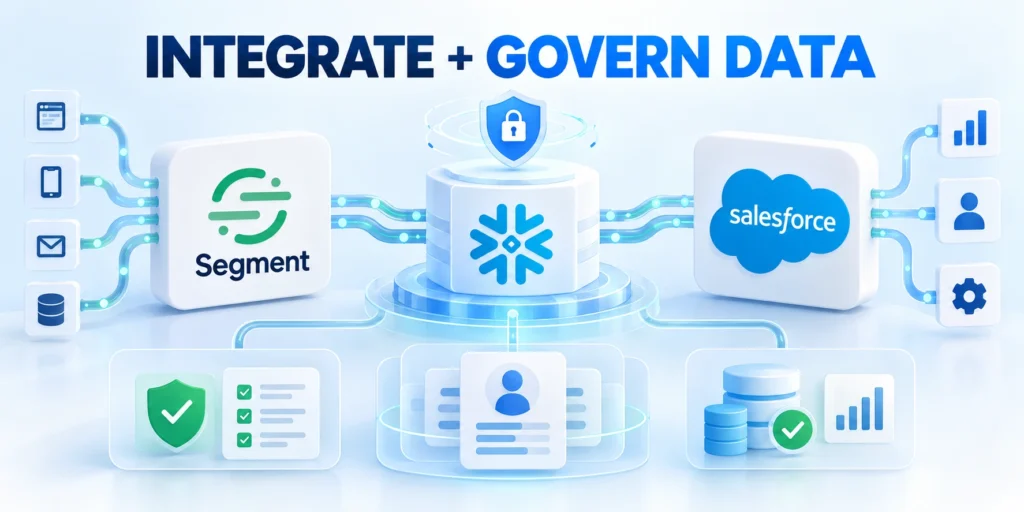
Useful measurement depends on consistent records, clear ownership, and responsible access. Integration alone can distribute errors faster when definitions and data quality are weak.
Treat governance as everyday practice: know what data is collected, why it is needed, who can access it, and how changes are corrected.
Prevent duplicate and stale records
Set a duplicate review process before enabling automatic merges. Keep evidence needed to resolve conflicts rather than deleting whichever record looks older.
Use these integrate govern customer criteria for review:
- Test duplicate rules using real examples
- Choose which record wins for conflicting fields
- Keep a recovery path for accidental merges
- Review duplicate and invalid-record trends
Track when a field was verified if staleness affects action. An old role or region can route a good inquiry to the wrong team.
Set identity rules that people can explain
Document why records match, remain separate, or enter review so teams can correct identity decisions without hidden vendor logic.
Apply these integrate govern customer controls consistently:
- Define what identifies a person and what identifies an account.
- Use a stable internal identifier for each record and keep the source identifier when importing.
- Decide which fields survive a merge.
- Create a review queue for uncertain matches rather than forcing an automatic merge.
- Test identity rules against a sample with different office locations.
Test shared addresses, changed employers, subsidiaries, aliases, acquisitions, and incomplete data before automating high-consequence merges.
Audit authoritative data boundaries
List the system that owns every consequential customer, account, opportunity, consent, campaign, and revenue attribute.
Document permitted overrides, synchronization direction, freshness expectations, conflict handling, and the evidence needed to correct an authoritative value.
Verify governance through representative records
Test new, duplicate, merged, corrected, suppressed, reassigned, and deleted records across every destination before trusting automated governance.
Use reconciliation results to improve shared rules, not merely repair isolated records after reporting or customer communication has already failed.
Measure Campaign Performance and Revenue

A campaign dashboard should help the team decide what to continue, change, or stop. Impressions and clicks describe activity, but do not show whether suitable customers moved forward.
Connect channel and campaign information to CRM status and outcomes while stating where attribution is incomplete or delayed.
Use consistent campaign conventions
Agree on readable values for source, medium, campaign, and content. Publish examples so new campaigns do not invent a different naming scheme.
Apply these measure campaign performance controls consistently:
- Choose names before launch
- Test values through forms, analytics, and CRM
- Keep internal campaign IDs when useful
- Record legacy naming exceptions
Use controlled lists or validation where practical. Free-text variations can split one campaign across several report rows.
Turn reports into operating reviews
Review findings with people who can act: marketing, sales, and delivery. Pair numbers with examples of accepted and rejected inquiries.
Review these measure campaign performance checks before proceeding:
- What changed since the previous review?
- Which qualified segment improved or worsened?
- Is the bottleneck marketing, sales, or delivery?
- What safe action comes next, and how will it be measured?
A useful meeting ends with an owner, a decision, and a review date. Avoid creating a dashboard nobody uses.
Connect the stack to webinar demand generation
A webinar campaign depends on the same identity, consent, CRM ownership, event tracking, and opportunity-feedback contracts defined in this architecture.
For a focused implementation example, read the webinar marketing strategy for high-ticket consulting services.
Test the event pipeline before campaign launch
Prepare test records for ordinary, incomplete, duplicate, and restricted cases. Follow each record from registration through analytics, automation, CRM ownership, and reporting.
Confirm these measure campaign performance conditions before launch:
- A valid prospect enters the intended follow-up route.
- An existing customer reaches the correct account owner.
- An unsupported region enters a visible review queue.
- A duplicate event does not create duplicate tasks.
- A withdrawn permission stops ineligible communication.
- Integration failures raise actionable alerts.
Compare the destination values with the source event. Confirm timestamps, timezones, campaign identifiers, consent fields, account association, and the reason for every suppressed action.
Reconcile counts at every boundary. Registrations minus rejected tests should equal accepted transfers, with every exclusion explained by a controlled reason.
Investigate event discrepancies
Record the affected records, time window, expected behavior, observed difference, and responsible owner before applying a correction.
If counts differ, inspect filters, identity matching, retry behavior, timezone boundaries, and delayed events before changing campaign conclusions.
Connect engagement to pipeline without overstating causality
Attendance and engagement can support follow-up prioritization, but they do not prove that the event caused an opportunity or revenue outcome.
Use these measure campaign performance criteria for review:
- Report registration, attendance, and qualified follow-up separately.
- Distinguish new opportunities from previously open opportunities.
- Show unmatched records and unresolved account associations.
- Preserve the attribution model beside every credited result.
- Use experiments when a causal decision requires stronger evidence.
Define the reporting population, comparison window, opportunity association rule, and treatment of existing pipeline before presenting influenced results.
Ask sales to record a controlled disposition after meaningful follow-up. Those reasons help marketing improve targeting, content, event format, and handoff criteria.
Review outcomes with stack health
Compare campaign results with transfer completeness, routing ownership, response time, and unresolved synchronization errors.
Review buyer and pipeline outcomes with operational health. A campaign should not scale while synchronization failures or unowned records hide part of the audience.
Create a recovery path for live-event failures
Name the operator who monitors registration, streaming, automation, and CRM delivery. Provide a manual queue for records that cannot complete the normal path.
Apply these measure campaign performance controls consistently:
- Preserve the original event and payload.
- Prevent repeated retries from duplicating downstream actions.
- Route unresolved records to a named owner.
- Reconcile recovered records before closing the incident.
- Update the test set with the observed failure.
The runbook should identify warning signals, affected integrations, retry limits, reconciliation reports, customer communication owners, and the decision maker authorized to pause automation.
After recovery, document the cause, customer impact, correction, and prevention step. Verify the fix with representative records before restoring automatic execution.
Build a Phased MarTech Roadmap

A high-performance MarTech stack is not the largest collection of tools. It is a maintained system that helps people act on consistent evidence and improve customer experience.
Start with outcomes, define data ownership, connect only what a workflow needs, and review whether the stack helps teams deliver.
Use a phased implementation plan
A staged rollout reveals missing fields, adoption problems, and integration failures while the affected workflow is manageable.
Review these build phased martech checks before proceeding:
- Phase 1: baseline definitions and tracking
- Phase 2: pilot one workflow with named owners
- During phase 3, connect CRM, automation, and reporting
- Phase 4: expand after reviewing quality and adoption
Keep a manual operating path for important handoffs until the new process is proven.
A 30-Day MarTech Improvement Sequence
A month-long pilot can reveal whether a stack change improves an actual workflow. Adapt the timing to procurement, access, and the service’s sales cycle.
Confirm these build phased martech conditions before launch:
- Week 1: choose a decision, map workflow, outcomes, systems, and owners.
- Week 2: confirm definitions, permissions, tracking, alerts, and reporting data.
- test records across normal, duplicate, incomplete, and error cases, record mismatches and assign fixes.
- Week 4: review adoption, routing, outcomes, support, and customer impact.
- expand only if the workflow is understood.
Keep a named owner for decisions and a manual fallback for critical handoffs. Use the review points to decide whether to expand, revise, or stop.
Worked Example: Campaign-to-Sales Handoff
A service firm launches a webinar campaign for a CRM migration offer. Marketing wants to measure registrations and attendance; sales needs relevant follow-up and enough context to prepare.
Use these build phased martech criteria for review:
- Create and test the registration event and required campaign values before launch.
- Send one test record through the form, CRM, routing rule, and confirmation message.
- Verify that the source remains available after an account or contact match.
- Have sales record acceptance or disqualification with a defined reason.
- Compare registrations with accepted opportunities and review any broken or delayed handoffs.
The stack should preserve the campaign source, connect the inquiry to the right contact and account, and let sales update qualification without overwriting the original campaign record.
Use a risk register for the entire stack
Connect each risk to a business workflow, warning signal, accountable owner, recovery target, and review date.
Apply these build phased martech controls consistently:
- its business owner, technical owner, likely failure, warning signal, and recovery path.
- Rank risks by consequence and detectability, not by how modern a tool appears.
- For each high-priority risk, run one controlled failure exercise.
- Set a review date for the register and update it after incidents or architectural changes.
- Treat the review as a decision meeting.
Update the register after incidents, vendor changes, new integrations, and material shifts in customer or campaign volume.
Compare roadmap evidence and action
Use the evidence type that matches the decision and operational consequence.
This comparison keeps implementation choices bounded:
| Decision | Evidence | Action |
|---|---|---|
| Fix workflow | Path audit | Repair |
| Select tool | Pilot evidence | Compare |
| Scale campaign | Revenue signals | Stage |
| Retire system | Usage records | Migrate |
Start With Decisions, Not Tools

List the recurring marketing and revenue decisions the stack must support, including audience eligibility, campaign investment, routing, service capacity, measurement, and customer communication.
For each decision, identify the user, timing, required evidence, acceptable uncertainty, owner, and action that follows.
Map Current Work Before Architecture
Trace how data, approvals, files, audiences, leads, opportunities, and reports move through real processes, including spreadsheets and manual corrections.
A documented application list misses the workarounds that often carry important context or compensate for broken integrations.
Set Architecture Principles
Define preferences for authoritative data, reuse, portability, security, observability, accessibility, automation, and vendor dependence before evaluating products.
Use the principles to reject attractive features that increase fragmentation or lack an accountable operating model.
Start with decisions teams need to make
Begin by listing recurring decisions, not by shopping for platforms. A sales leader may need to prioritize follow-up, while marketing needs to reallocate campaign effort.
Confirm these start decisions not conditions before launch:
- Which accounts or inquiries deserve attention first?
- Which campaigns contribute qualified pipeline rather than traffic alone?
- Where do prospects stall before sales acceptance?
- Which service lines can delivery support this quarter?
For each decision, state who acts, what evidence is needed, how often it changes, and what a harmful mistake would look like.
Measure stack health as well as marketing results
Operational health includes sync delays, failed jobs, duplicate records, field completeness, tool use, and unresolved support incidents.
Use these start decisions not criteria for review:
- Assign an owner to each critical integration
- Review access, renewal, and export capability
- Retire overlapping tools after mapping dependencies
- Document limitations and review date
Marketing health includes qualified pipeline and movement between agreed lifecycle stages. Interpret both in context.
Use these decision design checks:
Apply these start decisions not controls consistently:
- Name the recurring business decision.
- Identify the accountable decision owner.
- Define evidence and acceptable uncertainty.
Create a Capability Map

Group needs into content, CRM, campaigns, advertising, customer data, analytics, experimentation, consent, enrichment, integration, workflow, and reporting capabilities.
Describe the outcome and boundary of each capability without assuming that one product or feature owns it permanently.
Identify Overlap and Gaps
Compare tools against the map to find duplicated email, forms, audiences, scoring, attribution, identity, reporting, or automation and unsupported critical work.
Retire overlap only after verifying data, workflow, integration, permissions, reporting, contracts, and replacement readiness.
Assign Capability Owners
Name a business and technical owner for every critical capability, even when a vendor operates the underlying service.
Owners decide standards, approve changes, review incidents, maintain documentation, and plan replacement or retirement.
Define layers without assuming one vendor
A practical architecture may include a website and consent layer, analytics, tag management, CRM, automation, reporting, and connectors.
Confirm these create capability map conditions before launch:
- Capture: forms, calls, campaign visits, and service interactions
- Coordinate: identity, CRM records, routing, and lifecycle status
- Activate: email, audiences, sales tasks, and follow-up
- Analyze: operational reports, cohorts, pipeline, and outcomes
Some businesses can run these capabilities in one platform. Others need specialists. Choose based on workflow fit, data access, reliability, skills, and total ownership cost.
For a practical lead-capture workflow that connects campaigns and sales handoffs, see our B2B demand generation guide.
Choose systems by fit and maintainability
Create requirements before comparing products. Include integrations, export rights, administrative controls, accessibility, support, learning curve, and exit options.
Use these create capability map criteria for review:
- Must-have workflow and user roles
- Existing systems that must stay connected
- Data export, recovery, and access options
- Setup, support, training, and renewal costs
Ask vendors to demonstrate your actual workflow using representative data. A polished feature tour does not prove that the team’s process will work.
Review these capability mapping checks:
Apply these create capability map controls consistently:
- Define every capability by outcome.
- Identify overlap before adding tools.
- Assign business and technical owners.
Design the Customer Data Model

Define people, accounts, households, subsidiaries, partners, prospects, customers, products, contracts, opportunities, activities, consent, and relationships according to business decisions.
Use stable identifiers and preserve source lineage instead of matching every record through mutable names or email addresses.
Assign Attribute Authority
Specify which system owns each important fact, how updates propagate, which overrides are permitted, and how conflicts are resolved.
A single source of truth is an operating agreement at attribute level, not a claim that one database contains everything.
Handle Identity Uncertainty
Use confidence, review queues, merge and split rules, effective dates, and reversible decisions for ambiguous person and account matches.
Incorrect consolidation can corrupt attribution, suppress valid outreach, expose information, or assign revenue to the wrong organization.
Map current data and owners
Inventory forms, analytics, CRM, ad accounts, automation, support, billing, and spreadsheets that contain useful customer information.
Confirm these design customer data conditions before launch:
- Identify the source of truth for each key object
- List manual exports and fragile integrations
- Mark fields that sales or delivery actually uses
- Record known access and retention constraints
For every flow, note what enters, where it goes, who owns it, whether updates return, and what happens when a transfer fails.
Create a field and identity map
List important fields with a definition, source, owner, allowed values, and systems that consume them. Start with fields used for routing and reporting.
Use these design customer data criteria for review:
- Define account and contact matching rules
- Keep original source and later updates distinguishable
- Use consistent campaign and lifecycle values
- Document unknown and not-applicable states
Do not assume email is a permanent customer identity. People change roles, use aliases, or represent more than one account.
Apply these customer data controls:
Apply these design customer data controls consistently:
- Use stable identifiers and lineage.
- Assign authority at attribute level.
- Keep uncertain matches reversible.
Build a Governed Event Taxonomy

Define events, properties, timestamps, actors, objects, source, environment, consent, deduplication, and version for each meaningful customer or system action.
Name events by business meaning rather than interface labels that change when a website or tool is redesigned.
Validate Collection End to End
Test browser, server, mobile, CRM, advertising, offline, and integration events through ingestion, transformation, storage, reporting, and activation.
Confirm retries, late arrival, blocked scripts, duplicate calls, identity changes, and consent states using representative journeys.
Manage Event Evolution
Version changed definitions, preserve compatibility, notify consumers, update documentation, and reconcile reports when an event’s meaning or properties change.
Do not reuse an old event name for a different behavior because historical comparisons will appear valid while measuring another action.
Build a trustworthy baseline
Pick a time period that reflects the service’s buying cycle. Compare similar audiences and campaigns fairly.
Confirm these build governed event conditions before launch:
- Compare website events with CRM records
- Check lead acceptance and disqualification reasons
- Segment by service, source, and customer fit
- Record campaign or process changes during the period
Report missing or delayed data beside the metric. A partial dashboard should not be presented as a complete view of revenue contribution.
Keep the operating model human-readable
Teams need clear instructions for common exceptions, not just architecture diagrams. Explain who handles errors and how to keep customers informed during delays.
Use these build governed event criteria for review:
- Maintain a short inventory of systems and owners
- Train teams with realistic workflow examples
- Keep a change log for definitions and routing
- Review the stack with people who do the work
Revisit the design when strategy, products, or obligations change. Reuse checks that remain valid and repeat only those affected by a change.
Use these event governance checks:
Apply these build governed event controls consistently:
- Name events by business meaning.
- Version definitions and properties.
- Test collection across destinations.
Engineer Integrations as Products
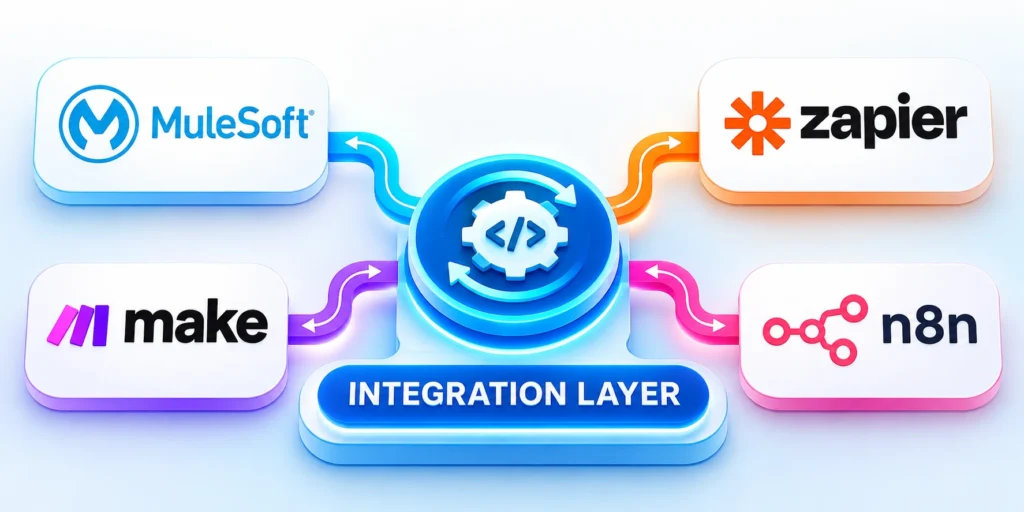
Document purpose, owner, source, destination, schema, authentication, frequency, latency, volume, transformation, retry, idempotency, monitoring, support, and retirement for every integration.
Treat point-to-point connections as maintained software, not one-time configuration completed when the first test record transfers.
Design Failure and Reconciliation
Define queues, backoff, dead letters, partial success, ordering, replay, duplicate prevention, alerting, and record-level comparison before production activation.
A green connector status does not prove that accounts, consent, lifecycle, value, and ownership remained correct.
Control Integration Changes
Test upstream and downstream dependencies whenever fields, APIs, credentials, permissions, limits, vendors, or business rules change.
Preserve rollback and a known-good mapping until affected records and workflows pass reconciliation.
Plan for integration failures
Retries can create duplicate events or records unless a connection recognizes repeated requests. Define how systems identify a repeated operation.
Review these engineer integrations products checks before proceeding:
- Alert a named owner after repeated failures
- Record time, record ID, and failure category
- Set a safe retry and replay process
- Reconcile counts after recovery
Keep an error log with enough context to troubleshoot, while avoiding unnecessary copies of sensitive values.
Reconcile integrations every day
Prioritize differences that can alter consent, ownership, lifecycle, customer communication, measurement, or revenue reporting.
Confirm these engineer integrations products conditions before launch:
- Count events at each step: submissions, accepted messages, created or updated contacts, assignments, and failures.
- Use durable event IDs to prevent duplicate records or tasks during retries.
- Set an alert threshold based on business impact.
- Include a manual continuity path.
Track unresolved discrepancies until both the affected records and the shared integration cause have been corrected and verified.
Limit the first release
Choose one bounded workflow whose outcome, dependencies, failure behavior, and rollback can be observed without disrupting unrelated operations.
Use these engineer integrations products criteria for review:
- Choose one audience, one journey, and one measurable handoff.
- Keep the previous workflow available during the pilot.
- Do not migrate historical data merely because a platform permits it.
Expand only after the first release produces reconciled records, stable ownership, useful monitoring, and a documented operating routine.
Review these integration product controls:
Apply these engineer integrations products controls consistently:
- Document ownership and dependencies.
- Design retries and reconciliation.
- Preserve rollback for mapping changes.
Govern Consent Across the Stack

Model purpose, channel, scope, jurisdiction, source, status, timestamp, evidence, expiry, and withdrawal consistently across collection and activation systems.
Keep service communication, sales outreach, advertising, analytics, and marketing permissions distinct when their authority or user expectation differs.
Propagate Restrictions Reliably
Test preference changes through CRM, email, advertising, forms, data platforms, exports, enrichment, and account relationships before relying on automated suppression.
Use deterministic enforcement and alert when a downstream destination cannot represent or honor the required state.
Minimize Data and Retention
Collect, copy, and retain only information needed for a documented purpose, with access, deletion, export, correction, and vendor responsibilities defined.
Review backups, logs, warehouses, audiences, files, and retired tools because visible application deletion may leave operational copies elsewhere.
Make consent and access operational
Collect information for a defined purpose and make access appropriate to job responsibilities. Consult qualified privacy counsel for jurisdiction-specific requirements.
Confirm these govern consent across conditions before launch:
- Assign access by role and review it
- Document purpose and retention expectations
- Test preference propagation across tools
- Keep sensitive details out of campaign fields unless justified
Build preference and suppression changes into connected systems so an old list or delayed sync does not re-add someone.
Make consent enforceable in every destination
Document each permission state, its source, time, and intended use. A person may agree to receive a requested resource while declining a broad newsletter. The workflow must preserve that distinction.
Use these govern consent across criteria for review:
- Map the permission state to each channel and system that can send a message.
- Avoid using a blank field as an implicit opt-in.
- Give operators a way to find and correct a failed synchronization.
- Review access by role.
Apply these consent governance checks:
Apply these govern consent across controls consistently:
- Separate purpose and channel permissions.
- Propagate restrictions deterministically.
- Verify deletion across stored copies.
Design Activation With Eligibility Rules

Define the data quality, consent, customer status, account ownership, audience purpose, freshness, exclusions, and minimum cohort conditions required before activation.
Prevent incomplete or conflicting records from entering campaigns simply because an integration can synchronize them.
Version Audiences and Decisions
Record source data, rules, exclusions, refresh, owner, campaign use, and effective dates for every material audience or scoring definition.
Later analysis needs to know which accounts were eligible when the campaign actually ran, not only the current list state.
Protect Sales Coordination
Reconcile campaign audiences with customers, open opportunities, territories, account plans, and suppression choices before launch.
Give sales useful context without implying surveillance or exposing sensitive attributes that do not support the outreach decision.
Map webinar events to accountable systems
A webinar creates registrations, attendance events, engagement signals, sales conversations, and later opportunity outcomes. Assign an authoritative system and owner to each event.
Use these design activation eligibility criteria for review:
- Registration: form timestamp, consent state, and acquisition source.
- Attendance: joined status, duration, and event identifier.
- Engagement: approved poll, question, or resource interaction.
- Handoff: qualification state, owner, and response timestamp.
- Outcome: opportunity, revenue, disqualification, or nurture decision.
The registration platform may capture submission details, while the CRM owns account association, lifecycle state, sales ownership, and opportunity history.
Preserve stable event and contact identifiers through each transfer. Email alone may be insufficient when aliases, shared addresses, or account changes occur.
Handle identity and consent exceptions
Document how the stack handles a repeated registration, corrected email, unknown company, existing customer, and attendee who withdraws marketing permission.
Apply these design activation eligibility controls consistently:
- Require sufficient data quality.
- Enforce consent and customer exclusions.
- Version audiences and effective dates.
Use these activation eligibility controls:
Build Measurement From Business Outcomes

Define qualified engagement, accepted leads, opportunities, value, retention, sales effort, service capacity, and customer outcomes consistently before configuring dashboards or attribution.
Keep operational, diagnostic, and executive metrics separate so each report answers a clear decision instead of combining incompatible purposes.
Reconcile Sources Regularly
Compare advertising, analytics, forms, CRM, billing, product, and warehouse records with documented timing, attribution, currency, identity, and exclusion rules.
Investigate material gaps instead of normalizing whichever platform reports the most favorable result.
Report Uncertainty Honestly
Explain missing data, conversion delay, model assumptions, selection effects, offline activity, market changes, and alternative explanations alongside estimates.
A precise dashboard is not reliable when its definitions or dependencies remain unresolved.
Design a useful measurement chain
Define the event at each stage and the system that records it. Keep website behavior, marketing response, sales judgment, and revenue accounting distinguishable.
Review these build measurement business checks before proceeding:
- Website action and campaign source
- Inquiry received and routing completed
- Qualification and sales acceptance
- Opportunity, closed work, and revenue when available
Google Analytics describes key events as actions important to business outcomes. Verify each event in Google Analytics reporting before relying on it.
Build a common measurement dictionary
Require every shared metric to state its population, grain, source, refresh, exclusions, owner, and intended decision.
Confirm these build measurement business conditions before launch:
- Write one definition for each key event.
- Separate a person, account, and opportunity in reports.
- Include costs beyond media when they affect the decision.
- Check the join between campaign and revenue systems with sampled records.
- Set a reporting delay that matches the buying cycle.
Review definitions after workflow, source, attribution, currency, or lifecycle changes so historical comparisons remain understandable and appropriately qualified.
Turn dashboards into decisions
Design each view around an owner and a question. A campaign manager needs spend, audience response, and landing-page defects. A revenue leader needs accepted opportunities, pipeline quality, and capacity constraints.
Use these build measurement business criteria for review:
- Show both the metric and the number of records behind it.
- Use a regular review agenda.
- Retire charts that no one uses.
Review these outcome measurement checks:
Apply these build measurement business controls consistently:
- Define operational and executive metrics.
- Reconcile analytics with revenue systems.
- Report limitations beside estimates.
Choose Attribution for the Decision

Use attribution to support a specific budget, journey, or learning decision, recognizing that different models answer different questions.
Do not present allocated credit as proof that one touch caused a complex B2B purchase involving prior relationships and unobserved interactions.
Combine Experiments and Observational Evidence
Use randomized or staged tests when feasible, then supplement them with cohort, journey, sales, and market evidence for questions the design cannot isolate.
Preserve predeclared outcomes, guardrails, duration, exclusions, and limitations to reduce interpretation after seeing results.
Connect Media to Capacity
Increase demand only when sales and delivery teams can respond, qualify, fulfill, and learn from the additional volume responsibly.
Measure delayed response, rejection, backlog, and support burden as possible consequences of a successful acquisition campaign.
Separate attribution from contribution
B2B buyers may use multiple channels and people before purchasing. A reporting model assigns credit by its rules; it does not reveal the full causal story.
Confirm these choose attribution decision conditions before launch:
- Name the model in reports
- State known data gaps and delays
- Compare similar cohorts and service lines
- Avoid counting the same opportunity twice
Use attribution alongside customer research, sales conversations, and experiments. Compare models without claiming that one is a perfect account of influence.
Use experiments for decisions that attribution cannot answer
Select a design whose assignment, exposure, outcomes, guardrails, duration, and limitations match the decision at stake.
Use these choose attribution decision criteria for review:
- Attribution shows how a reporting rule assigns credit.
- Choose a unit that the team can keep reasonably separate.
- Define a practical stop rule before starting.
- Where a clean experiment is impractical, present evidence with limits.
Apply these attribution decision checks:
Apply these choose attribution decision controls consistently:
- Match the model to the decision.
- Separate allocation from causal proof.
- Combine tests with operational evidence.
Operate the Stack With Service Ownership

Define availability, latency, data freshness, recovery, support hours, escalation, vendor contacts, security, and business continuity expectations for critical capabilities.
Prioritize services by customer and business impact rather than applying the same monitoring and recovery target to every tool.
Monitor Business Transactions
Trace representative journeys across forms, consent, identity, enrichment, CRM, routing, campaigns, analytics, and reporting with correlated timestamps and identifiers.
Component health can remain green while the complete marketing process loses or misroutes a customer request.
Prepare Incident Response
Assign detection, command, containment, evidence, recovery, reconciliation, communication, legal review, and post-incident improvement for plausible data and campaign failures.
Exercise expired credentials, duplicate sends, failed suppression, incorrect audience, corrupted mapping, delayed events, and unavailable vendors.
Define gates for each phase
A gate should require observable evidence, a responsible approver, documented exceptions, and a recovery option before expansion.
Confirm these operate stack service conditions before launch:
- Operational readiness is the third gate.
- Write evidence for each gate before work starts.
- Plan a rollback for every change that writes to live records or changes message eligibility.
- Budget time for cleanup and documentation.
Start with an inventory and one business decision. The first gate is agreement on field definitions, owners, and a baseline. The second is a working integration tested with representative records.
Create an operator runbook
Keep a concise runbook for each critical flow. Include the trigger, systems involved, expected daily volume, destination, alert location, retry rule, manual fallback, and escalation contact.
Use these operate stack service criteria for review:
- Show a worked example using a test record.
- Review the runbook after a real incident or major platform change.
- Keep an ownership register for fields, reports, segments, automations, and vendor connections.
Use these service ownership controls:
Apply these operate stack service controls consistently:
- Set availability and recovery expectations.
- Monitor complete business transactions.
- Rehearse plausible incident scenarios.
Manage the MarTech Portfolio

Maintain an inventory of tools, owners, capabilities, users, data, integrations, contracts, cost, security, compliance, support, adoption, incidents, and renewal dates.
Review portfolio evidence before procurement so teams do not add another tool to compensate for unclear process or unused existing capability.
Evaluate Total Cost
Include licenses, usage, implementation, integration, data movement, monitoring, training, support, review, correction, vendor management, and exit costs.
A low initial price can create expensive dependence when data, workflow, and reporting become difficult to migrate.
Plan Renewal and Retirement
Start renewal review early enough to compare outcomes, alternatives, contractual changes, data export, transition effort, and operating risk.
Retire triggers, credentials, audiences, webhooks, files, users, data copies, billing, and reports only after replacement and reconciliation are verified.
Review the stack as a portfolio
Compare capability value, adoption, reliability, risk, operating effort, contract timing, and replacement readiness across the complete stack.
Confirm these manage martech portfolio conditions before launch:
- Do not remove a tool solely because another vendor advertises the same feature.
- For each proposed change, state the expected improvement and the cost of making it.
- The roadmap should remain a sequence of decisions, not a permanent shopping list.
Once a quarter, list every tool, its purpose, owner, cost, active users, connected data, and critical workflows. Mark overlapping capabilities and exports that exist only to bridge a missing integration.
Decide when to replace an existing tool
Replace a platform only when a verified alternative improves the required capability enough to justify migration and transition risk.
Use these manage martech portfolio criteria for review:
- Begin with a documented failure.
- List the workflows the current tool actually supports.
- Run a small proof with the same sample records used to evaluate the current system.
- Write a migration map for records, identifiers, automations, segments, reports, and integrations.
- Plan the cutover with a freeze window, reconciliation counts, named decision maker, and rollback conditions.
- Communicate the operational change to the people who use the data.
Review these portfolio management checks:
Apply these manage martech portfolio controls consistently:
- Track capability, cost, and adoption.
- Plan renewals before contractual deadlines.
- Retire credentials and integrations safely.
Create a Stack Change Process

Require purpose, owner, affected capabilities, data, security, privacy, integrations, reporting, migration, tests, rollout, monitoring, communication, and rollback for material changes.
Use proportionate review so low-risk configuration moves quickly while expanded data or automation receives stronger evidence and approval.
Maintain Architecture Records
Document current diagrams, contracts, definitions, decisions, exceptions, dependencies, incidents, and planned retirement outside vendor interfaces.
Revise records during acceptance rather than relying on future teams to reconstruct the architecture using credentials and billing statements.
Review Strategy Periodically
Reassess the stack after changes in markets, products, teams, regulations, customer journeys, sales capacity, vendors, or business strategy.
Preserve stable foundations while changing components whose value, risk, or operating fit no longer justifies their cost.
Define the Warehouse and Semantic Layer
Specify which raw, cleaned, modeled, and aggregated datasets belong in the warehouse and which operational decisions remain in source systems.
Separate ingestion history from business-ready models so corrections preserve the evidence needed to reconcile prior reports.
Govern Shared Metrics
Maintain definitions, filters, grain, currency, attribution, owners, refresh, validation, and examples in a governed semantic layer or catalog.
Prevent dashboards from redefining qualified pipeline, revenue, customer, campaign, or retention independently.
Control Analytical Access
Apply least privilege, row and field restrictions, approved exports, audit history, retention, and safe development data for analysts and automation.
Review derived datasets because aggregation or joins can reveal sensitive relationships absent from individual source tables.
Build Experimentation as a Shared Capability
Define assignment, exposure, outcomes, guardrails, sample rules, identity, interference, duration, analysis, and decision records consistently across channels.
Do not let each campaign tool create incompatible experiment populations and conversion definitions.
Preserve Exposure Evidence
Record which account or person saw each variant, when, under which eligibility rule, and whether downstream systems changed the experience.
Exposure evidence distinguishes a failed idea from an experiment that never delivered its intended treatment reliably.
Coordinate Concurrent Tests
Inventory active changes across advertisements, landing pages, forms, routing, offers, lifecycle rules, sales processes, and products before launch.
Reduce overlap or design the analysis explicitly when tests can affect the same outcome.
Secure Marketing Operations
Map privileged users, service accounts, API keys, audience exports, advertising access, domains, tags, forms, webhooks, files, and vendor administration.
Apply named access, strong authentication, least privilege, approval, rotation, offboarding, logging, and emergency procedures according to impact.
Control Tracking and Tag Changes
Review scripts, permissions, destinations, collected data, consent behavior, performance, and rollback before changing production tracking or containers.
Monitor unexpected outbound requests and configuration changes that can expose data or corrupt measurement silently.
Rehearse Account Recovery
Test recovery contacts, ownership evidence, backup administrators, credential rotation, domain control, and vendor escalation for critical platforms.
Keep recovery information outside the account whose compromise or lockout would make it inaccessible.
Plan Adoption and Decommissioning Together
Define user roles, training, support, migration, parallel operation, acceptance, usage evidence, and retirement conditions before announcing implementation.
Adoption succeeds when intended work becomes more reliable, not merely when users authenticate or complete vendor training.
Remove Legacy Paths Deliberately
Identify remaining users, data, integrations, reports, campaigns, contracts, credentials, exports, and customer obligations before disabling an older system.
Preserve necessary history while preventing teams from creating records in two competing sources.
Measure Operational Adoption
Track completion, exceptions, correction effort, support, data quality, cycle time, user outcomes, and business results by role and workflow.
Use evidence to improve process and training rather than treating low usage as resistance automatically.
Apply these create stack change controls consistently:
- Document purpose and affected systems.
- Test migration, rollout, and rollback.
- Update architecture records during acceptance.
Apply these stack change controls:
FAQ
These answers clarify common MarTech architecture and operating decisions.
What is a MarTech stack?
It is the set of marketing, customer, analytics, and integration systems a business uses to run and measure customer workflows.
Where should a B2B company start?
Start with one decision or workflow, such as routing qualified inquiries, and map the current data and owners before selecting tools.
Does every business need a customer data platform?
No. Add one only when a defined identity, activation, or reporting need exceeds what current systems can reliably support.
Which system should be the source of truth?
Choose per object and field. For example, the CRM may own opportunity stage while analytics records website events.
How should teams select MarTech tools?
Compare real workflows, integrations, security, accessibility, export rights, training, support, and total ownership cost.
How can marketing and sales align their data?
Agree on lifecycle definitions, field ownership, handoff timing, disqualification reasons, and how changes are recorded.
How can teams reduce duplicate records?
Define identity and matching rules, test them on representative records, review merge conflicts, and preserve a recovery path.
What should marketing analytics measure?
Connect relevant interactions to inquiries, qualification, sales acceptance, opportunities, and outcomes when reliable data is available.
Does attribution prove a campaign caused revenue?
No. Attribution distributes credit under a model. Combine it with customer research, sales feedback, and controlled analysis.
How often should a MarTech stack be reviewed?
Review after material workflow or system changes and on a cadence that fits business cycles, renewals, and operational risk.
Conclusion

A high-performance MarTech stack begins with accountable business decisions, reliable customer data, governed integrations, and evidence that teams can explain.
Architecture becomes durable when every capability has clear ownership, measurable service expectations, recovery paths, and a practical plan for change.
Keep the operating model reviewable
Review the stack as a connected operating system rather than a catalog of subscriptions, dashboards, and automation features.
Apply these conclusion controls consistently:
- Resolve the highest-consequence workflow gap.
- Reconcile data before expanding automation.
- Retire overlap only after verified migration.
Use these priorities for the next review:
Connect architecture to daily decisions
Every platform, field, event, audience, and report should support a named decision with an accountable owner and observable consequence.
Remove or redesign components that create duplicated work, ambiguous authority, unreliable handoffs, or evidence nobody can use confidently.
Preserve trustworthy customer context
Keep identity, consent, lifecycle, ownership, and interaction history consistent enough for teams to coordinate without exposing inappropriate detail.
Reconcile important records across systems before campaigns, reports, and automation turn a local discrepancy into a customer-facing problem.
Operate integrations with recovery
Monitor complete business transactions, not only individual connector status, because healthy components can still lose or misroute valuable records.
Assign detection, containment, replay, communication, correction, and retrospective responsibilities before predictable failures occur during a critical campaign.
Improve the stack through bounded change
Use pilots, acceptance criteria, staged rollout, rollback, and post-release reconciliation to reduce uncertainty without freezing useful improvement.
A durable stack evolves through documented evidence, verified migration, controlled retirement, and regular review of value, risk, adoption, and operating cost.
Make the next decision explicit
End each review with one prioritized action, a named owner, required evidence, a safe boundary, and a specific decision date.
That discipline keeps MarTech improvement connected to customer outcomes instead of accumulating disconnected tools, reports, and unfinished automation.








Leave a Reply