


Match each case study to one search intent

A case study performs better when it answers one recognizable search need. Mixed intent weakens relevance, page structure, and the reader’s next decision.
Start with the query problem, then connect the story to the broader enterprise B2B SEO strategy.
Map the query to the buyer’s decision
Informational searches need methods, definitions, and lessons. Comparison searches need alternatives, constraints, and evidence that explains why one approach won.
Commercial searches need proof that resembles the reader’s organization. Transactional searches need a clear path to assessment, consultation, or a relevant product page.
| Search intent | Reader question | Proof and next action |
|---|---|---|
| Informational | How does the approach work? | Methods; read a practical guide |
| Comparison | Which option fits our situation? | Tradeoffs; compare solutions |
| Commercial | Can this work for our company? | Outcomes; review capabilities |
| Transactional | What should we do next? | Readiness; request an assessment |
Choose one dominant intent
One page may support related questions, but one dominant intent should control the title, opening, evidence order, and primary conversion path.
When two intents require different evidence or actions, create separate pages and connect them with contextual internal links.
Use these actions to choose one dominant intent:
- Review actual search queries, sales questions, and customer interviews.
- Define the reader’s role, industry, scale, and decision stage.
- Select one primary problem the story can answer completely.
- State the expected decision after reading the page.
- Remove sections that serve a different search journey.
- Record secondary questions for related pages or FAQ content.
Build a search-focused case study brief

The brief aligns search, customer evidence, editorial scope, and conversion goals before interviews begin. It prevents the story from becoming a promotional testimonial.
Write the brief with marketing, sales, customer success, and the subject expert who understands the implementation.
Define the minimum inputs
Document the target query, dominant intent, audience, case selection criteria, evidence requirements, approval owner, and primary next action.
Add boundaries early. Note confidential details, restricted claims, unavailable metrics, regional limits, and customer terminology that cannot appear publicly.
Use these actions to define the minimum inputs:
- Primary query and closely related questions
- Audience role, business model, and decision stage
- Customer situation before the project
- Implementation scope, timeline, and stakeholders
- Approved measures and calculation definitions
- Search title, slug, excerpt, and conversion objective
- Customer and legal approval responsibilities
- Publication, review, and refresh dates
Set evidence requirements before interviews
Evidence should support the search promise. A page about cost reduction needs verified cost logic, not only a favorable quote.
A page about migration needs architecture, sequencing, risk controls, and measurable operational change. Ask for source records before drafting conclusions.
Use these actions to set evidence requirements before interviews:
- Define each metric’s numerator, denominator, period, and source.
- Separate measured outcomes from estimates or customer perceptions.
- Capture the baseline used for comparison.
- Confirm whether other initiatives influenced the result.
- Request implementation artifacts that can support explanation.
- Record limitations that readers need for interpretation.
Turn customer evidence into a clear narrative

A credible narrative explains what changed, how the team worked, and why the result matters. It does not hide complexity behind a success claim.
The customer remains the decision maker. The provider contributes expertise, technology, or execution without becoming the hero of every sentence.
Use a decision-centered structure
Open with the customer’s context and the decision pressure. Readers should understand the stakes before they encounter the solution.
Then explain the selected approach, meaningful alternatives, implementation choices, measurable outcomes, and practical lessons for a similar organization.
Follow this sequence to use a decision-centered structure:
- Describe the operating context and relevant constraints.
- Define the business problem with observable evidence.
- Explain the criteria used to evaluate options.
- Show the implementation sequence and ownership.
- Report outcomes with a clear comparison period.
- Close with lessons, limitations, and the next decision.
Write claims that survive scrutiny
Use exact language for measured results. Replace vague improvement claims with the approved metric, period, baseline, and business meaning.
When evidence is qualitative, identify it as customer feedback or observed behavior. Do not present sentiment as a quantified operational result.
Use these actions to write claims that survive scrutiny:
- Attribute opinions to the customer or named expert.
- Explain how calculations were produced.
- Keep necessary qualifiers near the related claim.
- Use quotations that add experience or decision context.
- Avoid implying causation from a simple timing relationship.
- Preserve customer terminology when it improves accuracy.
Optimize headings, links, and supporting assets

On-page optimization should help readers locate evidence quickly. Search terms belong where they describe the content naturally, not where repetition creates noise.
Google recommends people-first content that provides original information, substantial value, clear sourcing, and enough depth to satisfy the visitor’s purpose.
Create a useful heading hierarchy
The title should summarize the case and its value without exaggeration. H2 headings should represent the major questions a qualified reader expects answered.
Use H3 headings for methods, criteria, implementation details, and lessons. Do not create headings merely to insert another keyword variation.
Use these actions to create a useful heading hierarchy:
- Use the page title for the main search promise.
- Keep one H1 in the WordPress title field.
- Write descriptive H2 headings for major evidence sections.
- Use H3 headings only when the information needs subdivision.
- Keep anchor links aligned with actual headings.
- Place the most decision-relevant evidence early.
Connect proof with supporting assets
Images, diagrams, tables, and quotations should explain the case. Decorative assets increase page weight without improving understanding or trust.
Use descriptive alt text for informative images. Link to relevant internal guides where readers need deeper methods, definitions, or implementation detail.
Use these actions to connect proof with supporting assets:
- Add tables for comparable before-and-after measures.
- Use diagrams when process order affects the outcome.
- Provide captions when an image needs context.
- Link internal resources with descriptive anchor text.
- Keep external evidence close to the supported statement.
- Test that every link leads to a useful destination.
Design conversion paths around reader readiness

A case study can support several buyer stages, but its primary action should match the dominant intent. Premature sales pressure reduces trust and qualified engagement.
Offer a logical next step after the reader understands the evidence. The action should continue the same problem-solving journey.
Match the action to readiness
An early-stage reader may need a related guide or checklist. A comparison-stage reader may need criteria, architecture, or implementation detail.
Validation-stage readers may need a relevant capability page. Decision-ready readers may benefit from an assessment or consultation.
| Reader stage | Evidence need | Appropriate action |
|---|---|---|
| Learning | Method and terminology | Read a practical guide |
| Comparing | Criteria and tradeoffs | Review a comparison |
| Validating | Comparable proof and scope | Explore relevant capabilities |
| Acting | Requirements and next steps | Request an assessment |
Reduce friction without weakening qualification
Ask only for information needed to provide the promised next step. Long forms can suppress useful conversations and encourage inaccurate entries.
Explain what happens after submission, who will respond, and which information helps the team prepare a relevant conversation.
Use these actions to reduce friction without weakening qualification:
- Use one primary action and limited secondary choices.
- Keep button language specific to the outcome.
- Place the action after supporting evidence.
- Avoid popups that interrupt the case narrative.
- Preserve campaign attribution across the next page.
- Confirm that mobile forms remain easy to complete.
Review the complete journey after launch. A clear button cannot compensate for an irrelevant destination, broken attribution, or a follow-up process that ignores the case context.
Measure organic discovery and conversion quality

Measurement should connect discovery with useful business behavior. Rankings alone cannot show whether the case study attracts relevant readers or supports decisions.
Define the measurement plan before publication. Preserve a baseline and distinguish direct conversions from assisted influence across longer B2B journeys.
Track a practical event sequence
Start with impressions and qualified search visits. Then measure evidence engagement, internal navigation, primary actions, and downstream opportunity signals.
Use events that represent meaningful behavior. A scroll or click matters only when it helps explain whether the reader understood or advanced.
Use these actions to track a practical event sequence:
- Search impressions for relevant queries
- Organic visits from priority regions and roles
- Engagement with evidence sections or tables
- Clicks to related internal resources
- Primary and secondary conversion actions
- Qualified leads and assisted opportunities
- Sales feedback about case relevance
- Updates to branded and nonbranded demand
Interpret results with context
Compare performance by intent, audience, industry, device, and acquisition path. A high conversion rate from tiny traffic may not justify expansion.
Review the page with sales and customer teams. Their feedback can reveal mismatched promises, missing proof, or stronger questions for future optimization.
Key considerations for interpret results with context include:
- Use the same definitions across reporting periods.
- Separate new discovery from branded navigation.
- Compare qualified actions, not only total sessions.
- Account for paid promotion and email distribution.
- Document major page changes beside performance data.
- Prioritize fixes supported by several evidence sources.
Govern updates, approvals, and reuse

Case studies contain customer facts, quotations, metrics, and brand references. Governance protects accuracy while allowing useful content to remain current.
Assign clear owners for approval, publication, measurement, updates, correction requests, and retirement. Do not rely on informal memory after launch.
Build an approval record
Record exactly what the customer approved, including quotations, metrics, logo use, screenshots, publication channels, and permitted reuse.
Legal and privacy review should address personal data, confidential information, regulated claims, intellectual property, and contractual restrictions.
Use these actions to build an approval record:
- Name the customer approval owner.
- Store the approved draft and supporting evidence.
- Record approval dates and permitted channels.
- Track restrictions on logos and identities.
- Define a correction and withdrawal process.
- Keep internal claims aligned with public wording.
Refresh evidence without resetting history
Review the page when products, metrics, customer relationships, or search behavior change. Update facts when new evidence materially improves the story.
Preserve the original publication context. Do not change dates merely to suggest freshness, and do not replace limitations with broader claims.
Key considerations for refresh evidence without resetting history include:
- Schedule evidence and link checks.
- Confirm that quoted people and roles remain accurate.
- Review conversion actions after product changes.
- Update screenshots when interfaces materially change.
- Retire unsupported claims instead of rewriting history.
- Reuse approved evidence within recorded permissions.
Build a reusable evidence library
High-performing case studies become easier to maintain when teams capture evidence as the work happens. Waiting until publication creates avoidable gaps in context, permissions, baseline metrics, and customer approval.
Create one structured record for every approved story. Include the business problem, relevant audience, scope, implementation choices, measured outcome, customer quote status, and permitted assets.
Use these actions to build a reusable evidence library:
- Record the initial situation and the success measure before execution.
- Keep source links, dashboards, and approved screenshots together.
- Label details that require customer confirmation before publication.
- Note related service pages and articles for contextual internal linking.
Refresh proof without rewriting the whole story
Case studies lose search and conversion value when results, screenshots, or customer context become outdated. Schedule a concise review after meaningful milestones rather than replacing useful narrative every quarter.
Review the original claim against current evidence. If a result has changed, explain the period and conditions clearly instead of presenting an old performance figure as a permanent outcome.
Follow this sequence to refresh proof without rewriting the whole:
- Verify customer name, approval scope, and current positioning.
- Check whether the original challenge still matches the target audience.
- Update metrics with their date range and measurement method.
- Replace obsolete product references, links, and screenshots.
- Confirm the next conversion path supports the reader’s intent.
Connect evidence to the next decision
Readers rarely need another generic success claim. They need evidence that helps them judge fit, risk, and the next practical step for their own organization.
Place the relevant service link or consultation path after the result is clear. This keeps the conversion prompt useful instead of interrupting the reader before the proof is established.
Use these actions to connect evidence to the next decision:
- Create a sales summary with context, validated outcomes, evidence limits, and a useful follow-up question.
- Require evidence links for claims that influence customer decisions.
- Record approval status before reusing the summary externally.
Segment performance by query and buyer context
A case study can attract several audiences, yet each visitor arrives with a different decision in mind. Segment reporting before deciding whether the page succeeds.
Compare search themes, landing-page engagement, and qualified actions together. This reveals whether visibility comes from relevant demand or broad informational traffic.
Key considerations for segment performance by query and include:
- Group queries by problem, solution, industry, and comparison intent.
- Separate branded discovery from non-branded search demand.
- Review engagement by audience and acquisition source.
- Compare calls to action by buyer readiness.
- Connect qualified submissions with CRM opportunity records.
- Note sample size before interpreting conversion differences.
Distribute proof without duplicating the entire page
The published case study should remain the authoritative evidence source. Other channels can reuse selected proof while linking readers back to the complete context.
Prepare approved excerpts for sales, email, social, proposals, and relevant service pages. Keep the result, attribution, and customer limitations attached to every excerpt.
Key considerations for distribute proof without duplicating the include:
- Create one short summary for early-stage readers.
- Prepare a technical excerpt for evaluation teams.
- Give sales representatives approved language and source links.
- Link related service pages to the most relevant evidence.
- Avoid copying the full narrative across multiple URLs.
- Update reused excerpts when the primary evidence changes.
Test conversion changes one variable at a time
Conversion improvements are difficult to interpret when the headline, proof, layout, and offer change together. Use controlled iterations with a clear hypothesis.
Choose a meaningful outcome, such as qualified contact, consultation request, or assisted opportunity. Avoid declaring success from clicks that never reach a commercial next step.
Use these actions to test conversion changes one variable at:
- Record the original page state and measurement period.
- Change one high-impact element whenever practical.
- Keep audience and traffic conditions comparable.
- Measure qualified actions rather than button clicks alone.
- Check CRM acceptance before scaling the winning version.
- Retain the result and rationale in the update record.
Protect credibility when evidence has limits
Strong case studies explain what changed without implying universal results. State the starting conditions, scope, period, and dependencies that shaped the outcome.
If a customer cannot approve exact figures, use a transparent range or qualitative result. Never replace unavailable evidence with unsupported precision.
Use these actions to protect credibility when evidence has limits:
- Distinguish measured outcomes from customer observations.
- Identify the period covered by every material claim.
- Describe important implementation or market conditions.
- Keep confidential information out of public examples.
- Remove claims the customer no longer approves.
- Preserve an internal record of approved wording.
Protect case-study discovery with technical foundations
Useful evidence still needs dependable crawling, canonicalization, structured navigation, and stable rendering. Validate these foundations before interpreting weak discovery as a content problem.
For complex sites, use the controls in our technical SEO architecture guide for large web applications.
Connect each case study to a topical cluster

A case study gains context when it supports a broader topic rather than standing as an isolated proof page. The cluster should help readers understand the problem, method, and decision.
Connect the story to service pages, practical guides, comparisons, and implementation resources that share its intent. Every link should advance the same buyer journey.
Define the role of every connected page
Use the case study for verified context and outcomes. Let guides explain methods, service pages define capabilities, and comparison pages clarify alternatives without duplicating the story.
Map links before publication so navigation reflects the reader’s next question. Avoid sending every visitor directly to a sales form regardless of readiness.
Connect these assets around the customer story:
- Primary service page matching the demonstrated capability
- Practical guide explaining the implementation method
- Comparison page addressing relevant alternatives
- Related case study with a different constraint
- Conversion page matching the reader’s readiness
Keep anchor text descriptive and place each link near the evidence it extends. Separate linked paragraphs with substantive unlinked explanation so the page remains useful, not promotional.
Review the cluster when services, customer approvals, or search demand changes. Remove destinations that no longer answer the promised question or preserve current evidence.
Measure the cluster as one decision path
Track entrances, internal navigation, evidence engagement, qualified actions, and assisted opportunities. Evaluate whether the connected pages help readers progress instead of only increasing page views.
Compare query and conversion patterns by case context. Different industries, roles, and constraints may require distinct supporting paths even when the underlying service is similar.
Distribute the case study without duplicating the page

Distribution should extend verified evidence without cloning the entire page across channels. Adapt the approved story to each audience while preserving meaning, limitations, and attribution.
Prepare reusable excerpts, charts, sales notes, and social assets using one governed record. Link each derivative to the canonical case study when readers need full context.
Build a controlled reuse workflow
Record approved claims, restricted details, expiration dates, and channel permissions. Teams should know which evidence can be shortened, translated, visualized, or used in direct sales conversations.
Keep reusable assets aligned with the current page. When customer approval or evidence changes, revise every active derivative using the same inventory.
Prepare these reusable assets after approval:
- Short evidence summary for sales conversations
- LinkedIn post focused on one verified lesson
- Email excerpt matched to buyer readiness
- Presentation slide preserving essential context
- CRM note describing relevant customer fit
Avoid copying long sections into multiple URLs. Duplicate pages divide maintenance, weaken canonical signals, and make withdrawn claims harder to remove across the publishing system.
Use campaign parameters and CRM context consistently. The measurement record should distinguish channel distribution from the original organic discovery that introduced the case study.
Protect credibility across every channel
Preserve the measurement period, customer conditions, and important limitations whenever a claim appears outside the full page. Shorter formats cannot justify a stronger conclusion.
Review derivatives during the same governance cycle as the canonical story. Remove outdated assets promptly and retain an internal record of the change and responsible owner.
FAQ
These answers address common decisions about search intent, evidence, optimization, and conversion design for enterprise case studies.
Should one case study target several keywords?
It can address related phrases when they share one intent. Separate pages work better when the queries require different evidence, audiences, or actions.
Where should the main keyword appear?
Use it naturally in the title, relevant headings, opening evidence, excerpt, and metadata. Avoid repetition that does not help the reader.
Do case studies need numerical results?
Numbers strengthen specific claims, but verified qualitative evidence can still explain decisions, implementation, adoption, and customer experience.
Which conversion action works best?
The best action matches reader readiness and page intent. Early-stage visitors need education, while decision-ready visitors may need an assessment.
How often should a case study be updated?
Review it when evidence, customer approval, offerings, links, interfaces, or search behavior changes. Update only when the revision adds real value.
Should a case study hide weak or mixed outcomes?
No. Explain limitations, tradeoffs, and conditions honestly. Credible constraints help qualified readers judge fit and protect the company from exaggerated claims.
How many internal links should a case study contain?
Use only links that help the reader continue the same decision journey. Keep references contextual and separate them with substantive unlinked explanation.
Can anonymized case studies rank in search?
Yes, when they provide specific context, methods, evidence, and limitations without exposing restricted information. Anonymization should not turn the story into vague promotion.
What should happen when customer approval is withdrawn?
Follow the recorded agreement, remove restricted claims or assets promptly, preserve an internal audit trail, and review links or campaigns that reuse the affected evidence.
How should case-study conversions be attributed?
Track direct and assisted actions with consistent definitions, campaign context, and CRM progression. Avoid claiming causation when the available evidence shows only correlation.
Conclusion
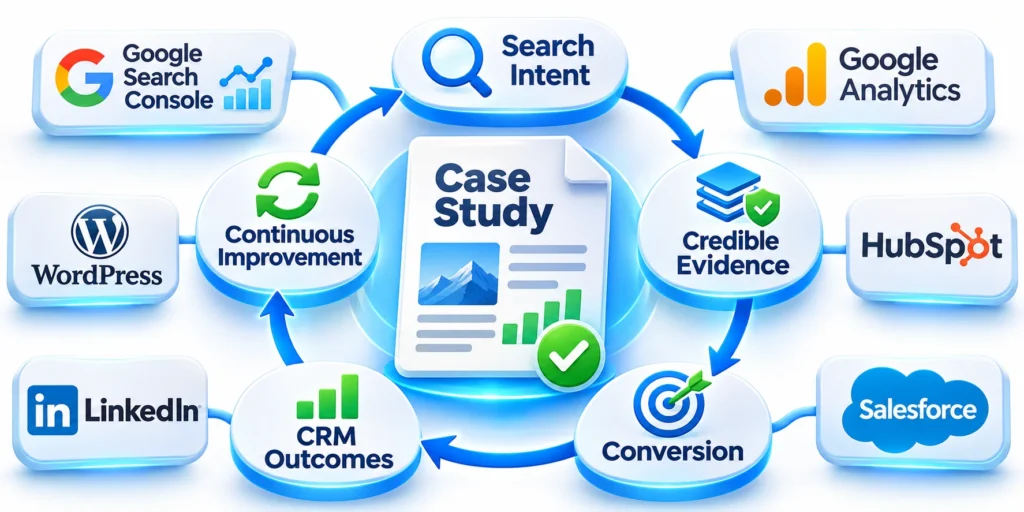
An effective case study connects one search intent with credible evidence, a clear narrative, and a conversion path suited to the reader’s actual decision stage.
The page should remain useful even when a visitor is not ready to contact sales. Practical context and transparent limitations strengthen both qualification and long-term trust.
Manage the case study as evidence
Begin with a search-focused brief and define approval boundaries before interviews. Organize the story around the problem, decision, implementation, outcome, and transferable lessons.
Use specific claims that survive scrutiny. Distinguish measured outcomes from observations, preserve the relevant period, and avoid implying that one customer result guarantees another.
Confirm these elements before publishing the page:
- One dominant intent and defined reader decision
- Approved evidence with necessary limitations
- Logical links to supporting cluster pages
- Conversion action matched to buyer readiness
- Named owner and scheduled evidence review
Measure discovery, evidence engagement, internal navigation, qualified actions, and CRM progression with stable definitions. Treat rankings and traffic as early signals, not final commercial proof.
When results disappoint, diagnose intent alignment, evidence clarity, page experience, destination relevance, and follow-up quality separately. Each failure requires a different correction.
Improve the system without fragmenting the story
Add structure only when it helps readers understand a distinct decision. Do not create shallow headings, isolated bullets, or repetitive paragraphs merely to satisfy a mechanical rule.
Reuse approved evidence through governed assets instead of duplicating the full page. Keep every derivative synchronized with customer permissions, current facts, and the canonical story.
Use these decisions during every scheduled review:
- Retain evidence that remains accurate and useful
- Revise claims affected by new conditions
- Remove assets that lost customer approval
- Improve links that interrupt the decision path
- Assign the next measurable optimization test
A well-governed case study becomes more than a testimonial. It supports organic discovery, buyer education, sales conversations, and learning from one reliable evidence record.
The strongest program improves that record over time without hiding uncertainty or multiplying near-duplicate pages. Search relevance and conversion quality then reinforce the same customer decision.




Leave a Reply