


Programmatic SEO Starts with a Repeated User Need
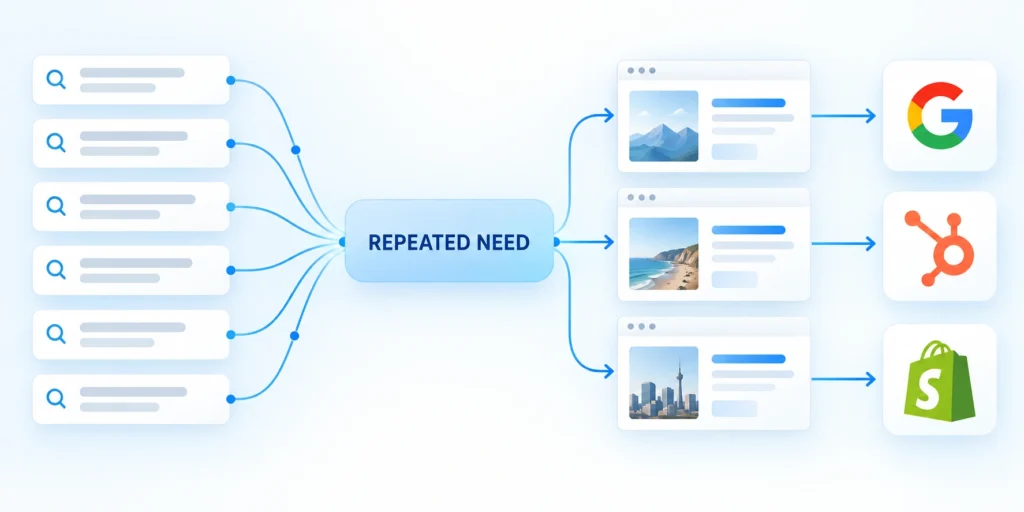
Programmatic SEO for SaaS and enterprise marketplaces uses structured data and reusable page patterns to serve recurring search needs across distinct cases.
It works when each page can answer a specific question with reliable details, not merely repeat a template with swapped labels.
Separate the method from mass page production
A template is a production tool, not proof that a page deserves to exist. Every URL needs a distinct purpose and useful evidence.
A page assembled from a city name and service label adds little when availability, pricing, and details are identical everywhere.
What a marketplace page can prove
A marketplace page can help when it compares real providers, service areas, qualifications, current availability, and meaningful constraints.
The proof should match the visitor’s decision and remain traceable to current records, owners, and review dates.
Start with a repeatable decision
Ask what users repeatedly compare, locate, calculate, or configure. Then test whether structured pages can make that task easier.
A SaaS buyer may compare tools by integration, company size, workflow, or industry-specific requirements.
Test whether the data supports a distinction
Compare page families through these distinct purposes:
- Directory: helps users locate relevant providers, products, or services.
- Comparison: clarifies differences using defensible attributes.
- Use case: explains support for a distinct workflow or constraint.
- Integration: shows how a real connection works, including prerequisites and limitations.
These dimensions matter only when the underlying data supports honest distinctions and readers benefit from separate answers.
Choose the page type that resolves the user’s task. Do not create a URL for every data field.
Define the page promise for one real visitor
Define each page promise through these steps:
- Write a sentence that begins.
- List the evidence the visitor needs.
- Then compare two proposed page variants.
- Test the promise with people who answer customer questions.
Approve generation only after these criteria pass:
- The page answers a distinct question.
- The essential facts have identifiable sources and owners.
- Missing data produces an honest state, not invented copy.
- A visitor can reach a useful next step.
- The page is linked from a relevant parent or category.
Create acceptance criteria before generating anything:
Keep the actor, decision, constraints, required evidence, and acceptable next action visible when translating the task into a page family.
Apply the page contract
Use this contract to reject weak variants early.
A narrow promise makes required evidence, exclusions, next actions, and rejection criteria easier to review before generation begins.
Find Page Opportunities Worth Building
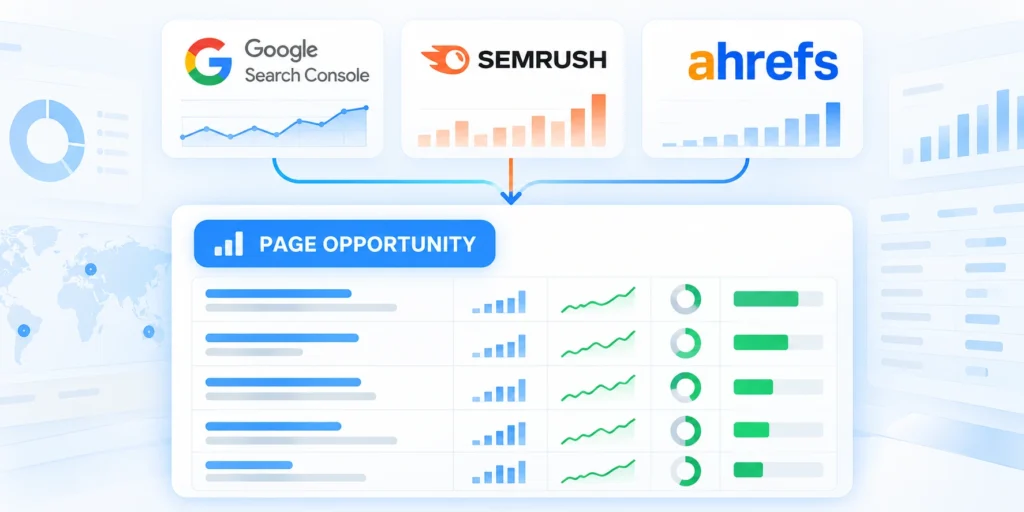
Good opportunities combine recurring demand, meaningful variation, trustworthy data, and an action the page can support.
Validate those conditions before estimating how many URLs a template could generate.
Describe the user task in plain language
Write the task as a sentence: “Compare inventory platforms that connect to our accounting system and support multiple warehouses.”
This is more useful than a list of modifiers because it explains what information the page must provide.
Validate the task with customer-facing teams
Ask sales, support, product, and customers what they repeatedly compare, which constraints matter, and what evidence would help someone choose.
Capture the words, constraints, objections, and decision context behind each recurring request instead of recording only the topic label.
Check whether variation changes the answer
Compare candidate pages side by side. Ask whether products, steps, risks, requirements, or recommendations actually differ.
If changing a location or industry leaves the entire answer unchanged, that variation may not justify its own indexed page.
Use evidence to assess product variants
A CRM marketplace page for an accounting integration should identify verified behavior, setup needs, supported plans, and known constraints.
Swapping “accounting” for “billing” while showing identical products and copy does not serve a new decision.
Inventory sources and ownership
Document source ownership across these operational systems:
- Product catalog and integration registry
- Customer-approved use cases and implementation notes
- Partner directories and verified service regions
- Pricing, plan, compatibility, and availability records
- Support findings and product documentation
List each data source, its owner, update method, rights, freshness, and known gaps. Do not assume a spreadsheet is authoritative.
Mark values as verified, inferred, stale, or unavailable. Never present an unknown attribute as a confirmed feature.
Estimate demand without treating volume as a mandate
Use search queries, internal search, customer questions, and sales feedback to estimate whether a task recurs.
Search volume does not show whether your business can answer the task better or maintain accurate data.
Compare candidate page families
Estimate viable page families through these evidence checks:
- For each family, estimate how many variants have enough distinct evidence.
- Inspect existing articles, category pages, product pages, and drafts before approving a new family.
- Run a sample of three to five variants through the complete template.
- Prioritize the family where data is reliable and the next action is clear.
Group ideas by the kind of decision they support: product comparisons, integration compatibility, industry use cases, locations with genuinely different service conditions, or feature-specific implementation guidance.
Compare demand, evidence, operational ownership, useful variation, maintenance cost, and overlap before approving any family for a pilot.
Use a page decision record
Record every page family through these governance fields:
- Record each page family’s audience, task, data, owner, URL, canonical, and indexation.
- Keep the record with the template specification.
- Review the record after a pilot.
The record preserves why the family exists, which variants qualify, and which evidence would pause, revise, or retire it.
Review the record whenever source data, buyer needs, product coverage, or indexation policy changes.
Prove that the underlying inventory is strong enough
Validate inventory strength through these coverage checks:
- Count records that can support the complete page promise.
- Sample the records before building the template.
- Estimate how often the facts change.
- Separate records that qualify for publication from those that need research.
- Run a pilot with the weakest eligible records.
A strong inventory supports ordinary, sparse, changed, and disputed records without forcing the template to invent a confident answer.
Test representative records before estimating the sustainable number of pages.
Design a Reliable Data Model and Page Pattern
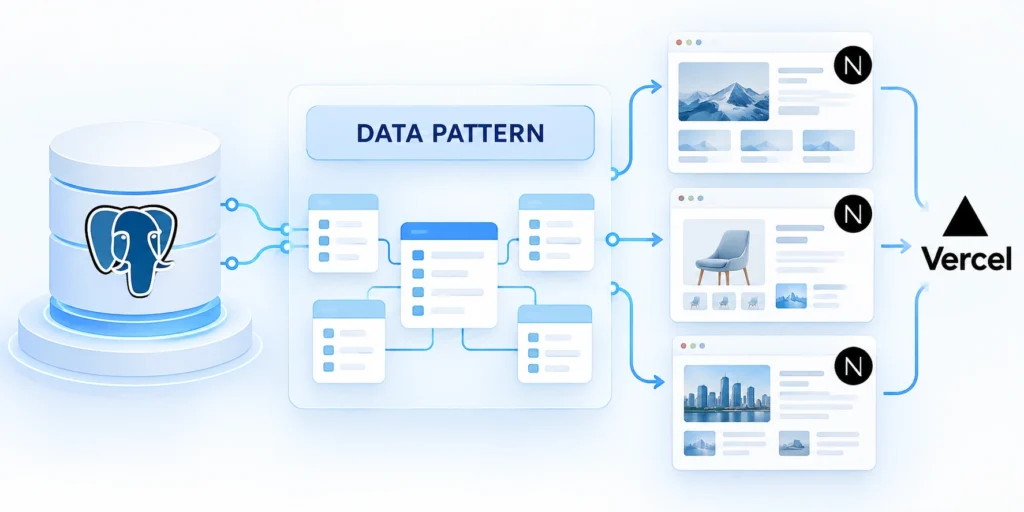
A page pattern should make data requirements visible before writers or developers scale production.
Model the entities, relationships, evidence, and failure states that each page needs to represent.
Define entities and relationships
A SaaS marketplace might model products, vendors, integrations, industries, workflows, plans, and customer evidence separately.
Then record relationships: a product supports an integration, a plan enables a capability, and an example applies to a workflow.
| Field | Example | Evidence, owner, use |
|---|---|---|
| Product | Inventory platform A | Vendor docs; editor; profile |
| Integration | Accounting connector B | Verified record; team; directory |
| Capability | Scheduled stock sync | Plan docs; owner; comparison |
| Workflow | Multi-warehouse reconciliation | Reviewed case; expert; use-case |
| Review date | Last confirmed date | Reviewer; operations; freshness |
Set data rules and missing-value behavior
Define allowed values, units, naming conventions, validation rules, and evidence required to mark an attribute as confirmed.
Decide what happens when data is missing: hide an unsupported comparison, explain the gap, or send the page for review.
Avoid unsupported placeholder copy
Define data fields through these validation rules:
- Define the field and accepted values.
- Name the responsible system or person.
- Record verification and review timing.
- Specify behavior for missing or conflicting data.
- Sample output against source records before release.
Do not fill blank fields with generic claims such as “flexible,” “easy,” or “enterprise-ready.” Those phrases do not resolve a decision.
An honest missing state protects trust and shows the team which source or workflow must improve before the page can qualify.
Make templates answer the task
A comparison page may need eligibility, verified differences, plan limits, setup complexity, and a path to deeper documentation.
A local provider page may need service boundaries, credentials, availability, response expectations, and how users can confirm a match.
Render only supported sections
Use conditional sections only when the evidence supports them. Empty headings and repeated filler make templates look unfinished.
Conditional modules should disappear cleanly without leaving broken headings, empty containers, misleading transitions, or duplicated fallback text.
Validate the data before rendering
Validate template inputs through these contract rules:
- Define required, optional, and prohibited values for each field.
- Set rules for stale data.
- Build a prepublication sample report that shows missing fields.
- Render a preview for a complete record, a sparse record, and an invalid record.
- When the source changes, regenerate only affected pages and keep a change log.
Validation should identify the record, rule, owner, affected pages, and safe disposition before the publishing pipeline continues.
Keep rejected records available for correction and controlled replay.
Keep templates flexible without hiding thin content
Assemble useful pages through these evidence modules:
- Use a short human-written introduction to explain the decision the page supports.
- Do not compensate for missing evidence with broad advice.
- Test headings, tables, and links with the shortest and longest valid records.
Design modules around actual evidence: verified specifications, practical examples, compatibility notes, limitations, and relevant alternatives. Make each module conditional on reliable data, not on the desire to fill a page.
Flexibility should support legitimate data variation while maintaining the same minimum evidence, usefulness, and decision clarity across every eligible page.
Build a correction path for readers and owners
Give each page an owner and a way to report an incorrect fact.
Complete approved corrections through these dependent actions:
- When a correction is approved, update the source record first and regenerate the affected page.
- Keep a short history of consequential corrections.
- Verify dependent pages and links after regeneration.
Triage errors by harm. A wrong compatibility or availability claim may affect a buying decision and need a prompt correction. A minor formatting issue can follow the ordinary editorial queue.
If a claim cannot be verified quickly, remove or qualify it instead of leaving a confident statement in place. A transparent unknown state is more useful than a fabricated answer.
Make Every Generated Page Useful on Its Own

Each page should fulfill its promise without requiring another URL for the basic answer.
Related pages can extend the task, but should not carry information needed to make the current page complete.
Add evidence specific to the page
Show how facts were confirmed, what they mean, and which circumstances could change the recommendation.
An integration page should identify supported data flows, prerequisites, setup responsibility, plan requirements, limitations, and where to check availability.
Make marketplace comparisons verifiable
A marketplace page should explain why listed options match the task, what the comparison excludes, and how to validate claims.
Name the basis, date, coverage, and limitations of each comparison so users can distinguish evidence from editorial interpretation.
Use examples that demonstrate real distinctions
Consider a hypothetical distributor evaluating two inventory tools. Label the scenario hypothetical unless it comes from an approved customer account.
Option A supports the required accounting integration but needs a higher plan. Option B supports the lower plan but requires an export-and-import workflow.
Show the buyer how to test the trade-off
A useful page would show evidence for those differences and explain how a buyer can test each workflow.
It would not declare one option “best” without defining the buyer’s requirements and relevant trade-offs.
Avoid formulaic uniqueness
Swapping a city, industry, or integration name in otherwise identical paragraphs does not make a page genuinely distinct.
Use the template to organize facts, then write only the explanation needed for the specific case.
Consolidate overlap instead of duplicating pages
When pages cannot provide distinct evidence or guidance, combine them into a stronger resource or leave them uncreated.
Preserve the strongest evidence and reader path in the surviving destination, then update links, sitemaps, canonicals, and monitoring deliberately.
Add a review that tests the visitor’s decision
Review generated pages through these decision tests:
- Ask whether reviewers can make the stated decision using the page.
- Have one reviewer inspect factual accuracy and another inspect task completion on a sample.
- Include negative information where it matters.
- Offer a next step appropriate to the uncertainty.
- Record what changes when a page is updated.
Reviewers should attempt the stated task with the rendered page and record missing facts, ambiguity, unsupported claims, and unusable next steps.
A passing template does not excuse a failing page instance.
Build Internal Architecture for Discovery
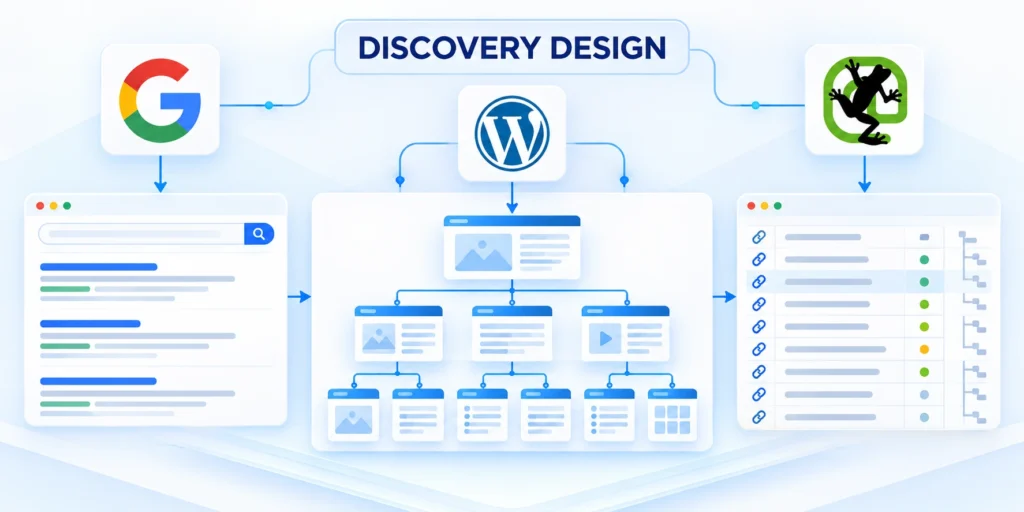
Internal architecture helps users and crawlers discover useful pages without exposing every possible filter combination.
Organize pages around stable categories, meaningful tasks, and relationships that users can understand.
Connect the page to its topic cluster
For a broader topic-cluster approach, see our guide to B2B content strategy and information architecture.
The parent should explain the family, while supporting pages resolve narrower decisions without repeating the same promise or definitions unnecessarily.
Create clear parent and child paths
A SaaS directory might group products by workflow, then offer focused comparisons for supported company sizes or integrations.
Keep navigation labels descriptive. Avoid exposing internal database terms that do not help visitors choose a path.
Make the hierarchy easy to retrace
Use breadcrumbs when they clarify hierarchy and provide a dependable way back to broader choices.
Breadcrumbs, parent links, categories, and contextual paths should return visitors to a meaningful choice rather than an arbitrary archive.
Link related pages in context
Link from a category to its strongest useful child pages, and from those pages back to the category.
Place links near explanations that help a reader decide whether to explore another comparison or workflow.
Keep link paths selective
Avoid linking every generated URL across the site. Too many generic links obscure the useful routes.
Prioritize relationships that explain hierarchy, compatibility, alternatives, or a useful next action; exhaustive cross-linking obscures those signals.
Keep URL patterns stable
Choose readable, consistent URL patterns before launch and avoid encoding temporary campaign labels or changing data values.
When multiple URLs represent substantially the same page, select a preferred canonical URL and consolidate duplicates appropriately.
Create navigable groups before publishing volume
Build navigable page families through these architecture steps:
- Build a parent page that explains the family and helps visitors choose a path.
- Link child pages to their parent and a few contextually related pages.
- Test navigation with a visitor who starts at an unexpected child URL.
- Keep links current when a page is removed or consolidated.
- Define which filters change the core answer and which only rearrange a list.
A family should expose useful choices through stable categories and parent pages before automation expands the number of eligible destinations.
Test entry points from search, navigation, and related pages.
Maintain a route registry
Protect route ownership through these registry controls:
- Check the registry for collisions before creating a new URL.
- Use the registry to build sitemaps from approved, live pages.
- Reserve retired routes before creating replacements.
Store the entity ID, public URL, canonical target, indexation state, parent, and status in one registry. This makes redirects and retirement decisions traceable when data changes.
The registry separates approved, staged, retired, redirected, and reserved routes so automation cannot recreate obsolete or conflicting destinations.
Control Crawling, Indexing, and Duplication

Publishing a page does not guarantee that a search engine will crawl, index, or show it.
Set clear technical signals and make sure each indexable URL offers a distinct purpose and complete experience.
Separate discovery from indexation
Internal links and XML sitemaps help discovery. They do not require search engines to index every submitted URL.
Include canonical, indexable pages in sitemaps and keep excluded filter states out unless they serve a distinct search need.
Diagnose indexing signals together
Review robots directives, status codes, canonical tags, and rendered content when diagnosing an unexpected indexation result.
Review status, canonical, robots, sitemap, internal links, rendering, and content equivalence together before assigning one isolated cause.
Control faceted navigation
Filters can generate a huge number of URL combinations. Decide which combinations deserve stable landing pages before exposing them to crawling.
For other combinations, use a consistent crawl and canonical strategy that avoids duplicate or low-value pages.
Test filter combinations
Test important routes with realistic filter selections and verify that navigation remains usable without creating endless crawl paths.
Test approved, duplicate, empty, sparse, removed, and extreme combinations to verify routing, content, canonicals, and indexation behavior.
Confirm page rendering
Check that primary content is available in the rendered page, including data loaded through scripts or application components.
Confirm that each URL returns the intended status, canonical, title, and useful visible content.
Separate filtering from indexable destinations
Separate filters from destinations through these criteria:
- A filter helps a visitor narrow choices.
- For unapproved combinations, choose a consistent crawl and canonical policy that fits the site’s implementation.
- Be cautious with parameter combinations that can multiply indefinitely.
- Inspect server logs and Search Console coverage for unexpected URL patterns.
- Test a representative approved page, duplicate variant, empty result, and removed entity.
An indexable destination needs independent demand, stable evidence, a complete answer, and a maintained path beyond the temporary filter state.
Treat unapproved combinations consistently across links, sitemaps, canonicals, and responses.
Monitor the chosen canonical
Declare the preferred URL consistently in links, sitemap, redirects, and page metadata. A canonical tag is a signal, not a command that can repair a confusing site architecture by itself.
Compare declared and selected canonicals; investigate differences through content, redirects, and links.
Choose an equivalent destination
When consolidating pages, choose a destination that substantially serves the old intent. Update internal links and sitemap entries. Preserve a redirect only when it helps visitors reach the equivalent answer.
Verify the destination resolves the same audience task before preserving a redirect or transferring internal discovery signals.
Test the full URL lifecycle
Test the URL lifecycle through these transitions:
- Confirm that publishing creates one intended public URL.
- Check redirects and canonicals after renaming an entity.
- Test a URL with punctuation, accented characters, and a long name.
Take a test record through approved inventory, live URL, internal link, sitemap entry, and search diagnostics. Then update it, remove it, and observe each transition.
Record the result of these lifecycle tests with the template version. Repeat them after routing, caching, or sitemap changes, because a later technical release can reintroduce duplicate or missing URLs.
Govern Quality Before Pages Scale
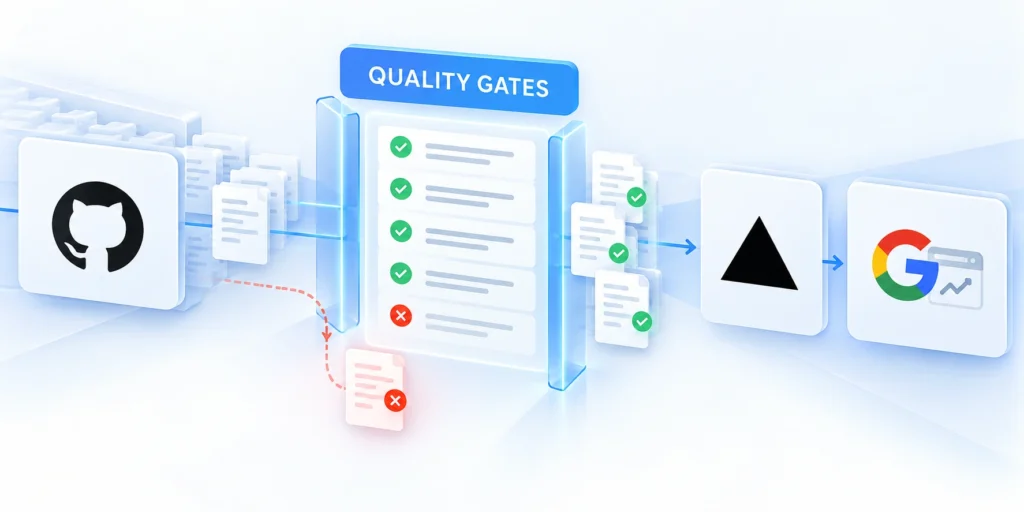
Quality checks should examine real page outputs, not just whether a template rendered without errors.
Review representative cases before launch and monitor edge cases as the dataset changes.
Use a practical release sequence
Release page families through these controlled stages:
- Choose a small, representative set of page types and data cases.
- Verify source data, page purpose, unique details, links, and user actions.
- Test mobile layouts, empty fields, errors, and unsupported combinations.
- Publish a limited group and monitor technical and user signals.
- Expand only after the first group meets the quality bar.
Assign an owner to review data freshness, broken destinations, and user feedback on a regular schedule.
Move from records to rendered samples, controlled cohorts, monitoring, correction, and expansion only after each gate produces reviewable evidence.
Handle missing or uncertain data honestly
Do not fill missing values with guesses or generic claims. Explain the gap or omit the unsupported page feature.
Label estimates and hypothetical examples clearly, and distinguish them from verified product or marketplace facts.
Prevent thin pages at scale
Pages generated at scale still need original value and user benefit. Thin variations can create search quality and trust problems.
Eligibility rules should stop pages whose data, evidence, inventory, or useful distinctions cannot support the full promise of the template.
Document ownership and changes
Record the data owner, update cadence, field definitions, validation rules, and the person responsible for correcting defects.
When a data source or page pattern changes, review affected page types and their canonical and internal link behavior.
Use gates that stop an unsafe batch
Expand the pilot through these quality gates:
- Only then test the automated checks on a larger sample.
- Set a maximum error rate and a stop condition before publication.
- Stop the batch when critical failures appear.
Define a pilot size small enough for full editorial review. Check data accuracy, distinct intent, rendered HTML, mobile readability, links, images, metadata, and the next action on every pilot page.
Record the approved sample, reviewer, failures, exceptions, and expansion decision before the next cohort enters the release pipeline.
Schedule post-launch revalidation
Keep the source record, template version, reviewer decision, and publication time for each page. If a source becomes unreliable, this ledger identifies what to suspend or update.
Schedule revalidation.
Score a representative sample without hiding failures
Score representative samples through these independent dimensions:
- Evaluate task completion, factual support, distinct value, navigation, technical response, and accessibility separately.
- Write the reason for each failed mark and assign a correction owner.
- Record confidence and unresolved evidence gaps.
Review pages across the full range of the inventory, not only the strongest examples. Include common records, sparse records, old records, disputed facts, and pages with unusual formatting.
Estimate sustainable maintenance through these operating inputs:
- Use the sample to estimate the cost of maintaining the family.
- Retest after a template or source change.
- Reduce scope when upkeep exceeds demonstrated value.
Compare reviewers on a small overlapping sample. Disagreement may reveal an unclear rule rather than careless work. Update the rubric with examples so the next batch receives consistent treatment.
Measure, Improve, and Retire Pages

Measurement should connect page performance with the task the page was designed to help complete.
Use several signals together. A ranking or traffic change alone rarely explains whether a page is useful.
Match signals to the page task
| Page type | User task | Signals and action |
|---|---|---|
| Integration | Assess compatibility | Setup use; clarify prerequisites |
| Comparison | Choose options | Engagement; explain trade-offs |
| Category | Find a provider | Searches; improve coverage |
| Use case | Check workflow fit | Feature use; remove weak claims |
Interpret signals in context. A low click-through rate may reflect a title mismatch, while low engagement can indicate a weak page task.
Review feedback and support questions alongside analytics to uncover missing details or confusing claims.
Improve the smallest useful unit
When a page underperforms, inspect its specific data, explanation, links, and conversion path before changing the entire template.
Test a focused correction, such as clarifying a plan limitation or adding a verified workflow example.
Document what changed
Keep a record of the change and its expected result so the team can learn from the outcome.
Record the source, template, rule, cohort, affected URLs, verifier, and result so later analysis can separate one change from another.
Consolidate or retire pages responsibly
Combine pages when their purposes overlap and one stronger resource can satisfy the same user need.
Before retiring a URL, inspect links, traffic, conversions, and relevant alternatives. Redirect only when a genuine replacement exists.
Update paths after a retirement
Remove or noindex unsupported pages according to their purpose, and update internal links and sitemaps consistently.
Remove the retired destination from generation, navigation, sitemaps, internal links, structured data, monitoring, and future planning records.
Measure whether the page solves the task
Measure page families through these outcome signals:
- Group results by page family and useful outcome.
- Observe whether visitors continue to product details.
- Review a sample of actual pages behind aggregate metrics.
- A family can look healthy.
- Use search impressions and indexing data as diagnostic signals, not proof of quality.
- A page can be indexed and still fail its visitor.
- A useful page may need better internal paths before it is discovered reliably.
- Change one meaningful component at a time.
- Retire pages when the entity disappears.
- Remove retired URLs from sitemaps and generated lists, then verify links and responses.
Define the visitor action, diagnostic signals, qualified outcome, observation window, and owner before interpreting aggregate traffic as success.
Compare page families and cohorts instead of mixing unrelated intent and maturity.
Maintain a page-family registry
Record each page family’s purpose, audience, source data, eligibility rules, template owner, URL pattern, indexation policy, and review cadence.
Govern each page family through these ownership fields:
- Name the accountable family owner.
- Describe the supported visitor decision.
- List required source fields.
- Document URL and indexation rules.
- Set the next review date.
The registry should distinguish proposed, piloting, active, paused, and retired families. It prevents separate teams from creating competing templates for the same visitor task.
Monitor source freshness
Assign freshness expectations by field because pricing, availability, compatibility, location, and legal information change at different rates.
Monitor source freshness through these operational controls:
- Store source and verification dates.
- Flag values beyond their review interval.
- Identify all dependent pages.
- Pause unsupported claims promptly.
- Record correction evidence.
When a source disappears or fails validation, mark affected pages for review. Do not retain a confident claim merely because regeneration still succeeds.
Test the correction workflow
Submit representative factual corrections through the public or internal reporting path. Measure routing, evidence review, source update, regeneration, publication, and confirmation.
Process factual corrections through these traceable steps:
- Capture the page and disputed claim.
- Request supporting evidence.
- Assign the source-data owner.
- Regenerate every affected page.
- Verify the public result.
A correction should update the source of truth before generated output. Manual page edits create divergence and disappear during later regeneration.
Quantify maintenance cost
Measure verification time, source corrections, template work, support requests, crawl monitoring, and retirement effort for each family.
Quantify maintenance burden through these recurring measures:
- Track review time per page sample.
- Count recurring source defects.
- Measure correction turnaround.
- Estimate family-level operating cost.
- Review value before expansion.
Compare that cost with useful outcomes and editorial risk. Reduce scope when reliable maintenance exceeds the family’s demonstrated value.
Govern redirects and retirement
Retire pages when entities disappear, evidence becomes insufficient, or another page serves the same intent better. Choose the response from visitor need.
Retire weak pages through these controlled actions:
- Record the retirement reason.
- Select an evidence-based response.
- Update every discovery path.
- Verify status and canonical behavior.
- Prevent automatic recreation.
After retirement, update sitemaps, parent pages, internal links, generated indexes, and monitoring. Preserve the decision so automation does not recreate the weak URL.
Review privacy exposure
Classify fields before publishing them at scale. A source system may contain personal, contractual, confidential, or inferred values unsuitable for public templates.
Prevent privacy exposure through these publishing controls:
- Publish only approved field allowlists.
- Exclude private source attributes.
- Test unusual record combinations.
- Review exports and embedded data.
- Stop batches after disclosure risk.
Test sparse, unusual, and adversarial records for accidental disclosure. Apply allowlists so new source fields never become public automatically.
Audit representative family samples
Review ordinary, sparse, high-value, recently changed, and previously failed records for each family instead of relying only on aggregate health metrics.
Audit representative records through these quality checks:
- Select records across quality conditions.
- Verify claims against current sources.
- Test navigation from unexpected entry points.
- Record defects by shared cause.
- Retest corrected regression cases.
Compare public HTML with source evidence, template rules, navigation, and intended task. Keep failed cases in the regression sample after correction.
Reconcile the crawl inventory
Compare approved pages, template routes, sitemaps, internal links, response codes, robots directives, and declared canonicals after every material release.
Reconcile crawl inventory through these release checks:
- Export the approved live inventory.
- Compare sitemap and route outputs.
- Sample status and canonical responses.
- Locate unintended linking sources.
- Record and verify corrective changes.
Investigate URLs appearing outside the approved inventory. Fix generation and linking rules at their source rather than patching each unexpected path.
Validate Search Demand and Page Eligibility

Demand evidence should connect a recurring customer job to eligible entities, dependable data, a maintained destination, and an accountable business owner.
Eligibility rules convert that evidence into explicit decisions before any combination receives a public route or indexation signal.
Build a Search-Demand Inventory
Map query families to customer jobs, eligible entities, available evidence, commercial relevance, and an existing destination before proposing a scalable page type.
Separate repeated modifiers from genuinely different intent so the system does not manufacture pages whose only distinction is a substituted keyword.
Validate Demand With Representative SERPs
Review current results, page formats, primary sources, local differences, freshness, and query ambiguity for representative combinations before committing engineering and editorial resources.
A template should serve a stable intent pattern; exceptions that require a different answer deserve another design or explicit exclusion.
Define Page Eligibility Rules
Write the minimum data, uniqueness, demand, utility, inventory, evidence, and operational support required before any entity or combination receives an indexable URL.
Keep ineligible states discoverable internally when useful, but prevent them from entering sitemaps, navigation, canonicals, or other indexation signals accidentally.
Distinguish Empty, Sparse, and Unavailable States
An empty result, a temporarily unavailable offer, and a thin but valid market page represent different user needs and lifecycle decisions.
Specify the message, alternatives, status, indexation, structured data, internal links, monitoring, and retirement behavior for each state.
Approve page families through these demand gates:
- Name the recurring customer decision.
- Verify meaningful entity variation.
- Confirm evidence and ownership.
- Exclude unsupported combinations.
Record demand assumptions
Store the query evidence, customer job, eligible entity rules, exclusions, owner, and review trigger beside the page-family decision.
Revisit those assumptions when products, markets, search results, source coverage, or customer language changes materially.
Create Data Contracts and Decision-Led Templates

A source contract defines what each field means, who owns it, how it changes, and when its uncertainty must stop publication.
A decision-led template then uses only supported evidence to answer the visitor’s task without filling empty space with generic claims.
Create a Source Data Contract
Document field meaning, type, format, ownership, authority, refresh, validation, allowed values, sensitivity, lineage, and fallback behavior for every template dependency.
Reject or quarantine records that violate the contract instead of silently inserting blanks, stale values, or generic claims into thousands of pages.
Handle Conflicts and Late Data
Define which source wins, how delayed updates are reconciled, and when a page pauses because evidence is incomplete or contradictory.
Preserve effective dates and prior values when historical comparisons or customer expectations depend on knowing what was true at publication time.
Design Templates Around Decisions
Start with the questions a qualified visitor must answer, then connect each component to available evidence, a useful action, or a relevant alternative.
Avoid mandatory modules whose only purpose is word count; omit a section when the underlying data cannot support a truthful, specific answer.
Specify Component Fallbacks
For every table, comparison, summary, recommendation, image, link, and call to action, define behavior when data is missing, invalid, restricted, or stale.
Fallbacks should preserve comprehension and honesty rather than replacing absent evidence with broad marketing language that appears unique only structurally.
Connect data and templates through these controls:
- Define authoritative fields and owners.
- Validate records before rendering.
- Specify honest component fallbacks.
- Reject unsupported template states.
Version the contract and template
Version source rules and template behavior together so a later release can identify which records, components, and pages changed.
Keep migration and rollback instructions with the version whenever a new contract changes eligibility, public output, or fallback behavior.
Generate Distinct Value and Relationship-Based Links
Distinct value comes from verified differences that change a decision, not from rearranged sentences, substituted modifiers, or decorative template variation.
Relationship-based links expose hierarchy, compatibility, alternatives, workflows, and useful next actions without turning every entity into an exhaustive cross-link network.
Generate Unique Value From Evidence
Use verified attributes, calculations, relationships, local context, inventory, constraints, and expert interpretation to produce differences that matter to the intended reader.
Do not treat shuffled sentences, synonyms, or repeated introductions as uniqueness; they increase crawl volume without improving the decision the page supports.
Separate Facts From Recommendations
Label measured facts, provider data, derived calculations, editorial judgment, and sponsored placement so readers and reviewers can understand the basis of each claim.
Recommendations should explain eligibility and limitations instead of presenting an opaque ranking generated from whatever records happen to be available.
Build Internal Links From Relationships
Connect pages through real hierarchy, compatibility, alternatives, parent-child relationships, workflows, locations, categories, and user journeys rather than exhaustive keyword cross-linking.
Use stable anchor language and bounded link rules so one new entity does not create a dense network that overwhelms navigation or dilutes context.
Protect Important Pages From Link Churn
Prioritize durable hubs and high-value destinations while allowing temporary or low-confidence pages to remain less prominent until evidence justifies stronger exposure.
Monitor orphaning, excessive fan-out, broken targets, redirects, and changes in click depth whenever inventory or taxonomy updates.
Build useful differentiation through these evidence rules:
- Show decision-changing facts.
- Label interpretation and sponsorship.
- Link through real relationships.
- Monitor orphaning and link churn.
Review differentiation after data changes
Recompare representative pages after source or taxonomy changes because distinctions and relationships can disappear even when every page still renders.
Consolidate destinations whose evidence no longer supports an independent decision, then reconcile navigation and internal links.
Control URLs, Canonicals, and Indexation Signals

Approved entity keys and relationships should map deterministically to stable public URLs, including rules for normalization, collisions, renames, merges, and retirement.
Canonical, robots, status, sitemap, internal-link, hreflang, and structured-data signals must support the same approved indexation decision.
Control URL Generation
Define a deterministic mapping from approved entity keys and relationships to readable, stable URLs, including normalization, collision handling, reserved terms, and international variants.
Never expose indexable routes from arbitrary filters, user input, session state, tracking parameters, or every possible attribute combination.
Preserve URL Ownership Through Change
Store the canonical entity-to-URL history so renames, merges, splits, deletions, and taxonomy revisions produce intentional redirects or retirement decisions.
Avoid redirect chains and unrelated consolidations; the destination must preserve the original intent and provide a credible replacement for users.
Align Canonical and Indexation Signals
Coordinate status codes, canonical tags, robots directives, sitemaps, internal links, hreflang, structured data, and navigation around one approved indexation decision.
Conflicting signals make diagnosis difficult and may leave low-value variants discoverable even when a page declares another URL canonical.
Treat Canonicals as Consolidation Evidence
Use a canonical when pages are meaningfully duplicate or equivalent, not as a substitute for preventing unnecessary URL creation or fixing weak content.
Verify the declared destination is indexable, internally supported, and appropriate for the same audience, language, region, and search intent.
Align route ownership through these technical controls:
- Generate only approved routes.
- Preserve entity-to-URL history.
- Coordinate indexation signals.
- Verify equivalent canonical targets.
Reconcile route and signal changes
After renames, merges, or retirements, compare the approved registry with public routes, redirects, canonicals, sitemaps, links, and response codes.
Resolve inconsistencies at the generator or routing source before search engines and visitors discover conflicting destinations. Record the verified production state for future releases and audits.
Budget Crawl and Stage Indexation Deliberately

Crawl planning begins with eligible inventory, change frequency, discovery paths, response cost, and the operational capacity to correct failures quickly.
Staged indexation lets teams verify representative cohorts before exposing the entire generated inventory through links, sitemaps, and search signals.
Budget Crawl Around Useful Inventory
Estimate eligible pages, update frequency, discovery paths, response cost, and change volume before exposing a large set to crawlers.
Prioritize stable sitemaps and internal links over limitless parameter spaces, calendars, sorting routes, searches, or faceted combinations without independent demand.
Monitor Crawl Waste at the Source
Review server logs, Search Console patterns, generated URL counts, response codes, and bot traffic to identify routes consuming resources without useful outcomes.
Correct templates, links, parameters, and routing rules that produce the waste rather than blocking each discovered URL individually.
Stage Indexation Deliberately
Launch a representative sample, verify quality and technical signals, then expand by approved cohorts instead of submitting the entire generated inventory immediately.
Hold back new classes when monitoring, support, correction, or editorial review cannot keep pace with the volume the generator can produce.
Define Promotion and Demotion Rules
Prioritize pages with complete, current data and demonstrated demand. Use digital PR when original research or a useful resource gives relevant publications a reason to cite it.
Demotion should reduce signals or retire the page through an explicit lifecycle process, not leave abandoned URLs competing with maintained destinations.
Control discovery through these release decisions:
- Estimate eligible inventory first.
- Remove unintended crawl paths.
- Launch representative cohorts.
- Define promotion and demotion rules.
Review cohort expansion evidence
Approve another cohort only after the current sample passes quality, usefulness, source freshness, crawl, indexation, correction, and maintenance checks.
Pause expansion when operational burden rises faster than qualified outcomes or when unresolved defects share a systemic cause.
Automate Mechanical Quality and Validate Structured Data

Mechanical checks should block deterministic defects while reporting the affected record, rule, URL, owner, and safe remediation path.
Structured data requires separate validation because technically valid markup can still conflict with visible content, eligibility, identity, price, availability, or evidence.
Automate Mechanical Quality Checks
Validate required fields, encoding, markup, headings, links, status, canonical, robots, structured data, image metadata, uniqueness, and template invariants before deployment.
Block generation on deterministic failures and report the source record, rule, affected URL, and remediation owner instead of publishing known defects.
Sample Semantic Quality Separately
Review representative pages across templates, entities, languages, edge cases, and data conditions for usefulness, accuracy, coherence, and intent satisfaction.
Automated checks cannot decide whether a page genuinely helps a buyer compare options or merely formats available records attractively.
Test Structured Data Against Visible Content
Generate schema only for supported page types and include properties that match visible, current, eligible content rather than hidden or inferred marketing claims.
Validate syntax, identity, URLs, prices, availability, ratings, and relationships whenever a source or template changes the structured output.
Manage Eligibility and Removal
Track when a page stops meeting the requirements for a schema type and remove or revise markup with the same discipline applied to content.
Do not preserve rich-result markup after the underlying offer, review, event, product, or evidence has expired or become unavailable.
Protect releases through these validation layers:
- Block deterministic template failures.
- Sample semantic usefulness separately.
- Match schema to visible content.
- Remove markup after eligibility ends.
Keep failed cases in regression coverage
Every corrected deterministic failure should become a repeatable test tied to the record, template, route, or schema rule that caused it.
Retain semantic failures in human review samples because automated checks cannot prove that a page resolves the intended decision.
Measure Cohorts and Govern Commercial Placement

Cohort metadata separates differences in template, entity class, eligibility, completeness, maturity, and market before teams compare outcomes.
Commercial placement needs eligibility, disclosure, ranking, review, expiration, and customer-protection controls that cannot be bypassed by revenue pressure.
Connect Analytics to Page Cohorts
Record template, entity class, eligibility version, data completeness, launch date, market, and other dimensions needed to compare similar pages responsibly.
Measure qualified engagement, useful actions, conversions, support burden, crawl, indexation, and customer outcomes rather than traffic growth alone.
Account for Selection and Maturity
New pages often represent different entities or markets from established pages, so raw comparisons can confuse inventory quality with age or demand.
Use cohorts and comparable observation windows, then explain uncertainty when seasonality, product changes, or market events affect the result.
Govern Commercial and Sponsored Content
Define eligibility, disclosure, ranking, evidence, review, expiration, conflicts, and customer-protection rules for paid placement within scalable page systems.
Revenue should not allow an ineligible entity to bypass data quality, safety, availability, or intent requirements applied to organic inventory.
Keep Editorial and Commercial Decisions Traceable
Record who approved the placement, which rule applied, what evidence supported it, when it expires, and how it affects sorting or recommendations.
This separation supports review and prevents monetization changes from silently altering the informational promise of thousands of pages.
Keep measurement and monetization accountable through these records:
- Store cohort and eligibility versions.
- Compare equivalent observation windows.
- Disclose paid placement clearly.
- Record approvals and expiration.
Separate outcomes from placement revenue
Measure whether visitors complete useful tasks independently from the revenue produced by paid visibility or lead distribution.
Review conflicts when commercial performance improves while eligibility, satisfaction, correction, support, or customer-protection signals deteriorate. Escalate the conflict to accountable editorial and commercial owners.
Safeguard Marketplace Supply and Page Lifecycles

Marketplace pages depend on legitimate, current supply, understandable boundaries, availability, pricing context, and a usable path for customers.
A page lifecycle converts changes in supply, data, usefulness, and risk into consistent states with explicit entry, exit, and verification criteria.
Design Marketplace Supply Safeguards
Confirm active supply, provider legitimacy, location, availability, pricing context, service boundaries, and customer support before exposing a destination for transactional or lead-generation demand.
Suppress or qualify pages when supply becomes unreliable instead of maintaining search visibility with stale inventory and an unusable conversion path.
Handle Provider Changes Consistently
Define how onboarding, suspension, correction, merger, duplicate providers, ownership transfer, and removal update URLs, listings, reviews, links, and historical records.
Protect users from abrupt reassignment that makes prior evidence, reputation, or contractual context appear to belong to a different entity.
Operate a Page Lifecycle
Assign states for proposed, eligible, staged, indexable, limited, stale, deprecated, redirected, removed, and archived pages with clear entry and exit criteria.
State changes should update every dependent signal and preserve the evidence needed to understand why the page moved through the lifecycle.
Review Stale Pages by Risk
Set refresh expectations from data volatility, user impact, commercial importance, regulatory exposure, and the cost of presenting an outdated answer.
Prioritize critical facts such as availability, price, eligibility, location, and safety before cosmetic changes or generic copy refreshes.
Protect marketplace users through these lifecycle controls:
- Verify active and legitimate supply.
- Qualify unreliable availability.
- Assign explicit page states.
- Prioritize stale pages by consequence.
Reconcile supply and lifecycle states
A provider, offer, or location change should update eligibility, public content, links, schema, indexation, conversion paths, and customer communications together.
Verify that retired or suspended inventory cannot return through stale exports, cached feeds, duplicate records, or automatic regeneration.
Prepare Programmatic SEO Incident Recovery
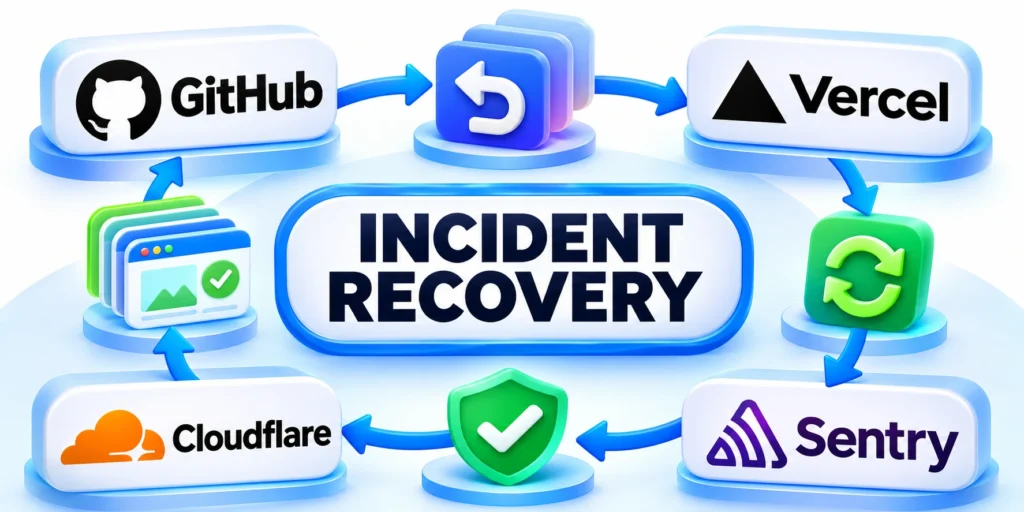
Programmatic systems can spread one source, template, routing, canonical, privacy, or commercial error across a large cohort quickly.
Recovery procedures must pause propagation, preserve evidence, restore a safe state, reconcile dependent signals, and verify that corrected generation cannot recreate the failure.
Prepare Incident and Rollback Procedures
Define how teams pause generation, remove affected cohorts, restore prior templates or data, preserve evidence, communicate impact, and reconcile corrections after an incident.
Exercise failures involving bad source data, broken canonicals, route explosions, incorrect redirects, schema errors, privacy exposure, and invalid commercial listings.
Reconcile After Recovery
Compare generated inventory, sitemaps, internal links, status codes, metadata, analytics, and source versions after rollback or replay to find residual inconsistency.
Close the incident only after preventive controls, ownership, and monitoring have been updated, not merely when the most visible pages render again.
Exercise recovery through these representative failure scenarios:
- Inject invalid source records.
- Test canonical and routing failures.
- Reconcile every discovery signal.
- Retest preventive controls.
Test recovery readiness before an incident
Run controlled exercises with representative records and cohorts so owners can practice pausing, restoring, replaying, communicating, and validating without improvising under pressure.
Record elapsed time, missing access, unclear ownership, unsafe assumptions, residual URLs, and monitoring gaps, then update the runbook before expanding the page system.
Verify recovery closure
Closure requires consistent source versions, generated inventory, routes, responses, canonicals, links, sitemaps, schema, analytics, and monitoring across the affected cohort.
Confirm that preventive controls now detect the original failure before production and identify any dependent pages still carrying stale output. Record the final evidence with the incident and release history.
Close recovery only after these checks pass:
- Reconcile approved inventory.
- Retest the original failure.
- Verify dependent public signals.
- Assign the next control review.
Conclusion

Programmatic SEO creates durable value when repeated user needs, verified evidence, controlled routes, and maintainable page lifecycles work as one accountable system.
Scale should follow demonstrated usefulness and operating capacity, not the theoretical number of combinations a template or database can produce.
Make eligibility the primary growth control
Eligibility rules should combine distinct intent, adequate evidence, dependable supply, ownership, useful next actions, and the capacity to correct or retire the page.
When one requirement fails, pause that record or family instead of compensating with generic copy, conflicting signals, or unsupported indexation.
Keep final expansion decisions tied to these controls:
- Approve useful page families.
- Release representative cohorts first.
- Measure qualified outcomes and burden.
- Retire weak inventory deliberately.
Treat generated pages as maintained products
Each family needs source owners, template owners, review triggers, incident procedures, correction paths, monitoring, and documented lifecycle decisions after launch.
The generator is only one component; lasting quality depends on evidence, operations, navigation, customer protection, and accountable editorial judgment.
Expand only after verification
Confirm public output, internal links, sitemaps, canonicals, indexation states, structured data, analytics, and source reconciliation before approving the next cohort.
Preserve failed records in regression samples so a corrected defect becomes a durable control rather than a one-time manual repair.
Use the smallest sustainable page system
A smaller maintained inventory can outperform a larger weak set by concentrating evidence, navigation, authority, conversion paths, review capacity, and user trust.
Continue expanding only while new pages resolve distinct decisions and the organization can keep their facts, relationships, and lifecycle states current.
Stop when quality cannot be sustained
Pause growth when corrections, stale evidence, route drift, support burden, weak supply, or review queues exceed the team’s verified operating capacity.
Resolve the shared cause, revalidate representative pages, and expand again only after the control works reliably across the affected family.
FAQ
These answers clarify common decisions before teams scale programmatic SEO page families.
What is programmatic SEO?
It is a way to create useful pages for recurring search needs using structured data and reusable publishing patterns.
Is programmatic SEO the same as automatically publishing pages?
No. Automation can assemble pages, but each page still needs a distinct purpose, accurate evidence, and a useful experience.
How should a team choose page variations?
Choose variations that reflect real differences in user tasks, data, availability, requirements, or decisions.
Can a small SaaS company use programmatic SEO?
Yes. A small, well-supported set of integration, comparison, or use case pages can be more useful than a large weak set.
How many programmatic pages should launch first?
There is no universal number. Start with a representative group the team can review and maintain well.
Should every generated page be indexed?
No. Index pages only when they serve a distinct need and offer enough reliable information to stand on their own.
What data is needed for a page template?
Use dependable fields that support the page purpose, such as verified capabilities, requirements, locations, or current availability.
What should a team do when information is missing?
Do not guess. Explain the limitation, omit unsupported claims, or avoid creating the page until evidence is available.
When should similar pages be consolidated?
Consolidate them when they address essentially the same task and one stronger page can preserve the useful information.
How can a team reduce the risk of a large launch?
Release a small representative group, review real outputs, fix defects, and expand gradually with clear ownership.
For a focused companion topic, read The Impact of Core Web Vitals on Enterprise Software Marketing.








Leave a Reply