


Define scope, audience, and search competitors
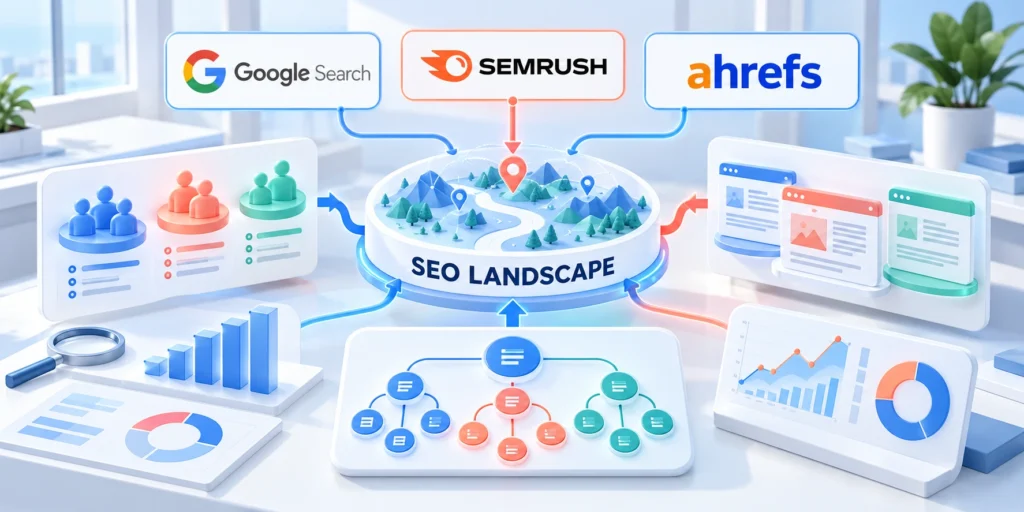
A useful SEO content gap analysis starts with a business question. It identifies missing coverage that helps a defined audience decide, act, or solve a valuable problem.
Do not begin by exporting every keyword from a competitor tool. Define the market, audience, offer, geography, language, funnel stage, and decision the analysis should support.
Separate business competitors from search competitors
Business competitors sell a similar solution. Search competitors may include publishers, marketplaces, communities, documentation sites, review platforms, and adjacent providers answering the same query.
Create a search competitor set for each topic cluster. A domain may compete strongly for one subject and remain irrelevant for another.
| Competitor type | Why it appears | How to use it |
|---|---|---|
| Direct provider | Competes for buyers and queries | Compare offers, proof, and decision support |
| Publisher | Covers broad informational demand | Study topic depth and formats |
| Marketplace | Aggregates product choices | Analyze comparison intent |
| Community | Answers practical questions | Identify language and unresolved problems |
| Documentation site | Ranks for implementation needs | Study technical completeness |
Define the audience and jobs to be done
List the roles involved, their goals, constraints, questions, objections, and evidence requirements. Convert those needs into topic families before collecting competitor URLs.
Include existing customers and sales conversations. Search tools reveal visible demand, while first-party conversations expose high-value questions with limited public volume.
Use these criteria to define the research scope:
- Decision maker and economic outcome
- Technical evaluator and implementation risk
- Operator and workflow impact
- Procurement and commercial requirements
- Security or legal reviewer and evidence needs
- Existing customer and expansion use cases
Set inclusion and exclusion rules
Document which languages, countries, devices, result types, dates, brands, product lines, and query classes belong in the study. Apply the same rules to every competitor.
Exclude irrelevant traffic, duplicate URLs, navigational queries, unsupported markets, and topics outside the site’s purpose. This prevents a large spreadsheet from creating a false opportunity.
Build the baseline with these first-party data points:
- Write the analysis objective.
- Select the topic cluster.
- Name the intended audience.
- Choose comparable competitors.
- Define the observation period.
- Record exclusions and assumptions.
- Assign an owner and review date.
Build a first-party SEO performance baseline

Competitor data shows what others cover. Your own Search Console, analytics, conversions, content inventory, and sales evidence show what the site already earns and supports.
Check existing pages before proposing new ones. Use the technical SEO architecture guide to distinguish a genuine content gap from crawl, canonical, or indexing issues.
Export queries and pages from Search Console
Use consistent date ranges and filters. Export queries, pages, clicks, impressions, click-through rate, position, country, device, and search appearance where relevant.
Google recommends examining query and page trends rather than treating average position as a precise rank. Privacy filtering and aggregation can limit visible rows.
Review these inventory signals before adding content:
- Choose a representative date range.
- Compare with a relevant prior period.
- Export query and page dimensions.
- Preserve country and device context.
- Mark branded and non-branded demand.
- Join queries with landing pages.
- Record extraction date and property.
Create a complete content inventory
Combine published URLs, status, canonical, indexability, topic, intent, format, author, update date, internal links, conversions, and business owner in one inventory.
Include pages receiving no organic traffic. A page can remain strategically necessary for sales, support, onboarding, compliance, or product documentation.
| Inventory field | Purpose | Common problem |
|---|---|---|
| Canonical URL | Identifies the preferred asset | Duplicate or redirected records |
| Primary intent | Explains the page's job | Mixed or undefined intent |
| Topic cluster | Supports coverage mapping | Inconsistent naming |
| Performance | Shows observed demand | Short or seasonal window |
| Conversion role | Connects content to value | Only last-click data |
| Internal links | Shows discoverability | Isolated pages |
Diagnose existing coverage before creating more
Group queries by intent and map them to ranking URLs. Multiple pages appearing for the same query family may signal overlap, but rotation alone does not prove cannibalization.
Inspect pages with impressions but weak clicks, declining demand, mismatched queries, or no conversions. Choose whether to improve, consolidate, redirect, reposition, or leave unchanged.
Compare these dimensions across relevant search competitors:
- Strong page with missing subtopic
- Relevant page with weak title or snippet
- Two pages serving the same intent
- Useful page with poor internal discovery
- Outdated page with retained demand
- Strategic page with low search volume
Compare competitor topics, formats, and search intent

A gap is more than a keyword absent from the site. It can involve intent, depth, format, evidence, audience stage, geography, media, or a missing connection between existing pages.
Review result pages and competitor assets manually enough to understand why they satisfy the query. Tool exports alone cannot identify usefulness, trust, or differentiation.
Build topic and intent clusters
Normalize close queries into a topic family, then separate distinct intents such as learning, comparing, selecting, implementing, troubleshooting, and validating a purchase.
Keep ambiguous queries marked for review. Forcing one intent can produce the wrong page type and create overlap with an existing asset.
| Intent | Typical need | Possible format |
|---|---|---|
| Learn | Understand a concept | Guide or explainer |
| Compare | Evaluate alternatives | Comparison or decision matrix |
| Select | Choose a provider or approach | Buyer guide or checklist |
| Implement | Complete a task | Procedure or technical tutorial |
| Troubleshoot | Resolve a failure | Diagnostic guide |
| Validate | Reduce purchase risk | Case study or evidence page |
Compare coverage at the section level
Record each competitor page’s main question, headings, evidence, examples, tools, media, update signals, authorship, and call to action. Avoid copying its structure or language.
Look for unanswered questions, missing constraints, weak examples, and unsupported claims. The opportunity is usually better decision support, not a longer version of the same article.
Group these inputs before deciding what coverage lacks:
- Unique questions answered
- Evidence and primary sources
- Practical procedures or examples
- Tables, calculators, or templates
- Audience-specific constraints
- Implementation and failure guidance
- Author and review transparency
Check demand outside one keyword tool
Use Search Console for observed queries, sales and support records for business questions, and Google Trends for relative changes and related searches.
Trends data is normalized rather than absolute volume. Compare like-for-like terms, locations, categories, and periods before using it to influence priority.
Use a repeatable competitor sample
Capture the result pages for representative queries across the cluster. Record date, location, device, language, result features, and the URLs reviewed.
Sample multiple query formulations and buying stages. One result page can overrepresent a brand, format, news event, or localization that does not define the whole opportunity.
Use these signals to prioritize a meaningful gap:
- Select representative query families.
- Record the observation context.
- Capture the leading relevant URLs.
- Classify result types and intent.
- Remove duplicates and irrelevant pages.
- Review page sections and evidence.
- Store the sample with the analysis date.
Score and prioritize SEO content gaps

Prioritization converts a research list into an investment decision. Score opportunities with consistent evidence while preserving space for expert judgment and strategic commitments.
Do not rank by estimated search volume alone. Include audience value, commercial relevance, authority, intent fit, differentiation, effort, risk, and overlap with existing assets.
Use an evidence-based scoring model
Define every score before applying it. A five-point business-value score needs observable criteria, not a different interpretation from each reviewer.
Keep the raw evidence beside the score. Teams should be able to understand and challenge the assumptions without recreating the analysis.
| Factor | High score means | Evidence |
|---|---|---|
| Audience need | Important unresolved problem | Queries and interviews |
| Business value | Supports qualified demand or retention | CRM and product strategy |
| Intent fit | Site can satisfy the task | SERP and content review |
| Authority | Organization can provide credible depth | Experts and first-party evidence |
| Differentiation | Clear added value exists | Competitor section comparison |
| Effort | Feasible research and production | Resource estimate |
Choose the right action for each gap
Use programmatic SEO when many distinct buyer questions share a repeatable structure and reliable data. Address isolated gaps with a targeted page or section.
Prefer improving an existing page when it already serves the same primary intent. Create a new URL when the audience task and required experience are meaningfully distinct.
Choose one of these actions for each finding:
- Confirm the intended audience and task.
- Search the complete site inventory.
- Identify the strongest existing asset.
- Compare its intent with the gap.
- Choose update, consolidate, create, or decline.
- Record the reason and expected outcome.
Protect against cannibalization
Assign one primary URL to each core intent and document supporting pages. Use contextual internal links to show the relationship without repeating the same promise everywhere.
Connect the roadmap to the broader enterprise B2B SEO strategy so topic coverage, architecture, authority, and conversion goals remain aligned.
Execute, measure, and refresh the content gap roadmap

A gap analysis creates value only when teams turn approved opportunities into differentiated briefs, useful assets, internal links, measurement, and scheduled learning.
Manage the roadmap as a portfolio. Balance quick improvements, foundational pages, commercial support, technical dependencies, and evidence-heavy work requiring subject-matter experts.
Write briefs around user outcomes
Each brief should define the audience, task, intent, existing assets, differentiation, required evidence, sources, examples, internal links, conversion role, and success measures.
Specify what the article must help the reader decide or accomplish. Avoid prescribing headings copied from competitors or arbitrary word counts.
Protect the portfolio with these cannibalization controls:
- Primary audience and decision
- Search intent and task completion
- Existing page relationship
- Original contribution and evidence
- Required expert input
- Internal link destinations
- Conversion role and measurement
- Update owner and review date
Publish in coherent clusters
Sequence foundational pages before narrow supporting topics when dependencies matter. Add reciprocal internal links only when they help readers move naturally between related decisions.
Update navigation, category pages, sitemaps, and structured data where appropriate. Confirm canonical and indexability settings before expecting search performance.
Measure outcomes by hypothesis
Record the baseline, change date, affected URLs, target query families, expected behavior, and business outcome. Compare similar periods and account for seasonality or market events.
Review impressions, clicks, landing pages, engagement, conversions, assisted outcomes, qualified pipeline, and customer questions. Avoid declaring success from ranking movement alone.
| Review window | Primary question | Possible action |
|---|---|---|
| After publication | Is the page discoverable and indexable? | Fix technical or linking issues |
| Early observation | Are relevant impressions emerging? | Refine intent or internal links |
| Established period | Are clicks and useful actions improving? | Improve snippet, page, or offer |
| Portfolio review | Did the cluster support business outcomes? | Scale, refresh, merge, or retire |
Refresh the analysis without chasing every competitor
Repeat high-value clusters on a defined cadence and after major product, market, or search changes. Preserve prior snapshots so movement remains explainable.
Google recommends people-first, original, useful content rather than pages created mainly to capture rankings. Decline gaps the organization cannot satisfy credibly.
Govern the roadmap across teams
Assign one owner for every approved action and one subject-matter reviewer where specialized claims are involved. Define research, draft, review, publication, and measurement states.
Keep rejected ideas with their reasons. This prevents the same weak opportunity from returning whenever a new tool export or competitor page appears.
Build briefs around these reader and business outcomes:
- Content owner and due date
- Subject-matter reviewer
- Required primary evidence
- Design or development dependency
- Internal linking changes
- Measurement owner
- Refresh trigger
- Decision history
- Approval criteria for commercial and technical claims
- Archive location for briefs, exports, and prior snapshots
Run a monthly content gap decision review
Bring SEO, sales, product, customer success, and subject experts together for a short review. Each team contributes evidence that keyword exports cannot provide alone.
Decide one action for every priority item and record the owner, dependency, confidence, due date, and measurement plan before the meeting closes.
Use these checks before publishing a new asset:
- Review changes in customer questions, demand, product priorities, and competitor coverage since the last meeting.
- Confirm whether each opportunity already has a suitable URL, draft, commercial page, documentation, or campaign.
- Challenge scores based on old, estimated, incomplete, or audience-disconnected evidence.
- Approve opportunities with a clear reader task, credible expertise, distinct value, and practical distribution.
- Assign research, writing, expert review, design, linking, publication, and measurement responsibilities with realistic delivery dates.
- Archive rejected opportunities and rationale so future reviews reuse evidence instead of repeating debates.
Validate a gap before committing production resources
For an expensive opportunity, test the assumption before commissioning a full asset. Interview customers, review sales conversations, examine internal search, or publish a smaller useful improvement.
State what evidence would change the decision. A gap should not remain high priority merely because a competitor ranks for it or a tool estimates traffic.
Track these measures against the original opportunity hypothesis:
- Confirm a relevant audience task.
- Identify the existing coverage and weakness.
- Define the distinct contribution.
- Name the evidence and reviewer.
Use the validation result to choose a new page, an update, a new format, or no action. Preserve the decision so later reviews can reuse the evidence.
When the evidence remains uncertain, lower confidence in the score and schedule more research. Do not disguise uncertainty with artificial numerical precision.
Measure whether the new coverage changes the portfolio
Evaluate the asset within its cluster, not only as an isolated URL. Check whether it strengthens navigation, answers a missing task, and supports relevant next steps.
Compare the observed audience, queries, engagement, conversions, assisted outcomes, and sales feedback with the hypothesis recorded before publication.
Refresh the analysis using these stable decision signals:
- Record the baseline and review window.
- Track the intended audience and task.
- Check internal and external discoverability.
- Document the next portfolio action.
If another page loses relevant visibility, inspect intent overlap and linking before celebrating aggregate traffic. Portfolio growth should not conceal avoidable cannibalization.
Use the result to refresh the scoring model. Repeated misses may reveal that estimated volume, competitor visibility, or business value received too much weight.
Preserve the evidence behind each roadmap decision
Store the query export, competitor sample, inventory snapshot, scoring version, reviewer notes, and approval date with the roadmap item.
Evidence provenance matters when demand, rankings, product scope, or competitor pages change. Teams can then distinguish a changed market from an earlier analytical mistake.
Maintain these governance records for content roadmap decisions:
- Record source and collection date.
- Keep the scoring assumptions.
- Name the reviewer and decision owner.
- Link the published or updated asset.
At refresh time, compare the current evidence with the preserved snapshot. Update only the assumptions that changed instead of rebuilding the analysis without continuity.
This record also supports responsible rejection. Stakeholders can see why a visible competitor topic was excluded and what new evidence could justify reconsideration.
Connect gap analysis to the content architecture
For cluster design and navigation, read our B2B topic-cluster and information architecture guide.
Use the architecture to define parent pages, supporting resources, internal routes, and scope boundaries before approving another asset in the cluster.
Map search intent before expanding coverage
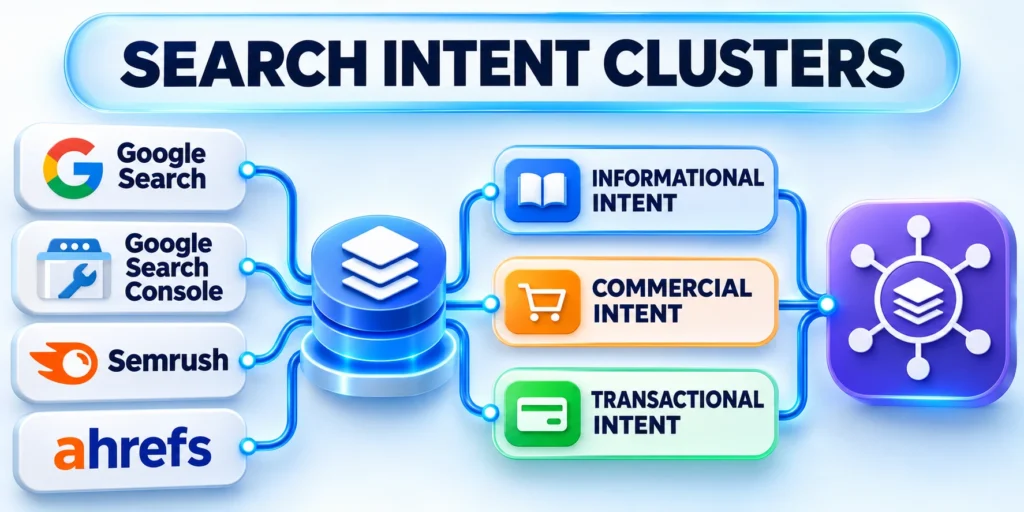
A content gap is not simply a missing keyword. It is a missing answer, format, comparison, decision aid, or path that a defined audience needs at a particular search moment.
Intent mapping prevents a team from treating informational, evaluative, and purchase-oriented queries as interchangeable opportunities with the same proof, format, and conversion path.
Separate query wording from the underlying job
Queries with different words may represent the same decision. Conversely, similar phrases can signal distinct tasks when the reader needs a definition, comparison, implementation plan, or vendor evaluation.
Review live search results and the surrounding reader journey before assigning one page to a cluster. The result page reveals the format and evidence that searchers currently expect.
Cluster these intent signals before drafting content:
- Reader question and desired outcome
- Search result format and page type
- Decision stage and risk level
- Existing internal coverage and links
- Evidence needed for a useful answer
Use formats that match the decision
A guide, template, calculator, migration plan, comparison, or service page can each solve a different reader need. Do not force every cluster into another long article.
Choose the smallest useful format that gives the reader a clearer decision or next action. More pages do not improve coverage when they repeat the same answer.
Validate clusters with first-party evidence
Use Search Console queries, conversion paths, sales questions, customer research, and internal search data to test whether a cluster represents a durable audience need.
Third-party tools help discover candidates, but owned evidence clarifies whether the opportunity serves the business and whether the organization can add credible information.
Document the cluster decision
Record the audience, intent, format, existing asset, evidence, proposed action, owner, and measurement plan. That record makes later refresh decisions easier and reduces duplicate work.
A documented rationale also helps collaborators distinguish a deliberate exclusion from a gap that simply has not yet been assessed.
Compare content coverage beyond keyword counts
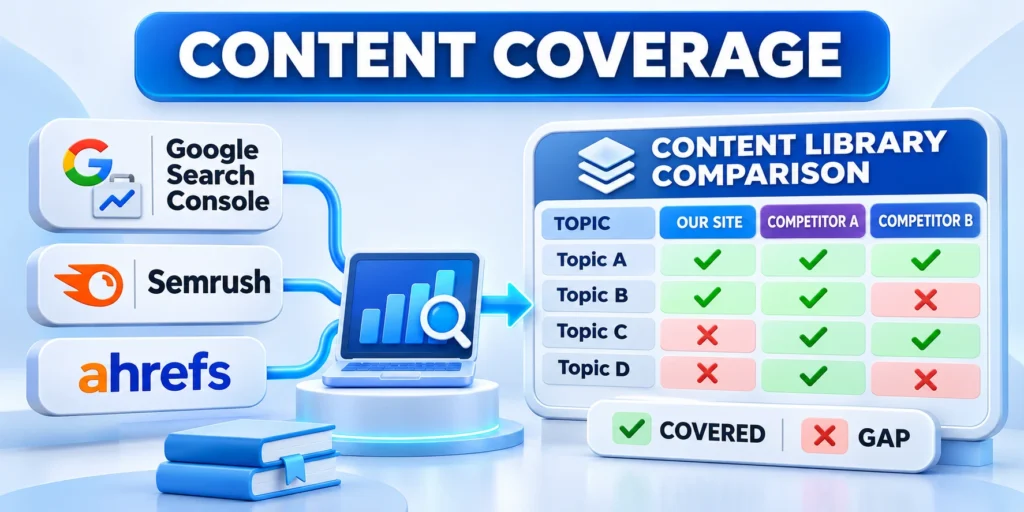
Coverage comparison should evaluate the reader outcome, evidence depth, page architecture, discoverability, and freshness of an asset rather than just its rank for a single phrase.
A competitor may appear to cover a topic while leaving important implementation questions unanswered. That creates a chance to build a more useful, better connected resource.
Evaluate whether pages solve the intended task
Read the candidate page from the audience perspective. Identify the decision it supports, the proof it offers, the practical detail it omits, and the next step it makes possible.
Score the page against the real search intent, not against its word count. A concise configuration guide can outperform a broad overview when the task is narrowly operational.
Compare these elements across competing coverage:
- Audience task and decision stage
- Evidence quality and specificity
- Content format and information depth
- Internal links and navigation path
- Freshness and implementation accuracy
Find gaps in the supporting architecture
A strong flagship page can still fail when related definitions, examples, comparisons, and implementation guidance are difficult to find or disconnected from the main decision path.
Review how pages link into a cluster. The useful opportunity may be a supporting asset or navigation improvement rather than a competing new pillar.
Treat competitor pages as directional evidence
Competitor content reveals possible expectations and language, but it does not determine what your organization should publish. Their page may target another market, product, or revenue model.
Use direct review to separate useful patterns from superficial similarity. Copying a competitor outline rarely creates a distinctive or reliable resource.
Capture the evidence behind every comparison
Save representative URLs, observed intent, format, gaps, strengths, and the date reviewed. Search results and competitor pages change, so decisions need a recoverable evidence trail.
That record lets the team revisit a conclusion without repeating every discovery step or mistaking an old observation for current evidence.
Prioritize gaps with business and evidence criteria
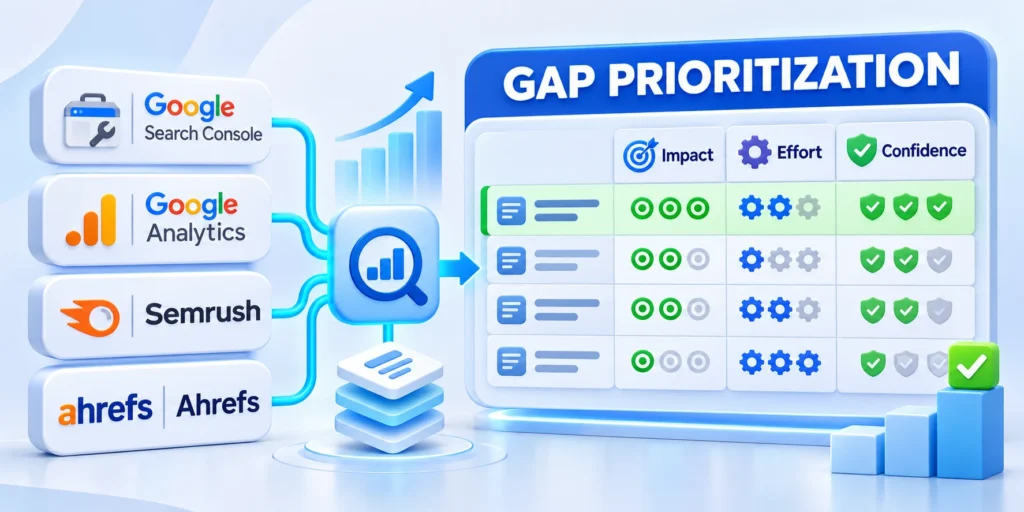
Prioritization turns a long list of possible topics into an accountable roadmap. The best opportunity is not always the highest-volume phrase or the competitor page with the most estimated traffic.
Use impact, confidence, effort, audience fit, existing coverage, and distribution capacity together so the decision reflects both search demand and the organization’s ability to deliver value.
Estimate impact without inventing precision
Use ranges and explicit assumptions when traffic, conversion, or revenue outcomes are uncertain. A ranking estimate is evidence to test, not a forecast that can justify any level of investment.
Connect expected impact to an audience task and a measurable outcome such as qualified visits, assisted pipeline, reduced support friction, or product adoption.
Score each opportunity using these decision factors:
- Audience relevance and urgency
- Evidence of search demand
- Distinct value from existing assets
- Effort and subject-matter access
- Expected business or customer outcome
Make confidence visible in the roadmap
Confidence should reflect evidence quality, not optimism. First-party queries, customer research, and direct result review provide stronger support than a single third-party keyword estimate.
Mark unknowns clearly and schedule the validation needed to reduce them. A transparent uncertainty label is better than a falsely precise priority score.
Balance quick wins with durable coverage
Balance quick fixes with larger gaps that require research and distribution. Use the gap analysis to brief a digital marketing strategy consultant when priorities span several channels.
Avoid filling the calendar with easy topics that do not strengthen the portfolio. Allocate capacity to the work that materially improves a high-value audience journey.
Assign an owner and a decision date
Every accepted gap needs an accountable owner, next milestone, evidence link, and review date. Otherwise, a prioritization list becomes a passive archive instead of an operating plan.
Every rejected or deferred gap should retain its rationale, ensuring the team does not rediscover and debate the same low-value opportunity every quarter.
Build briefs that close a specific audience gap
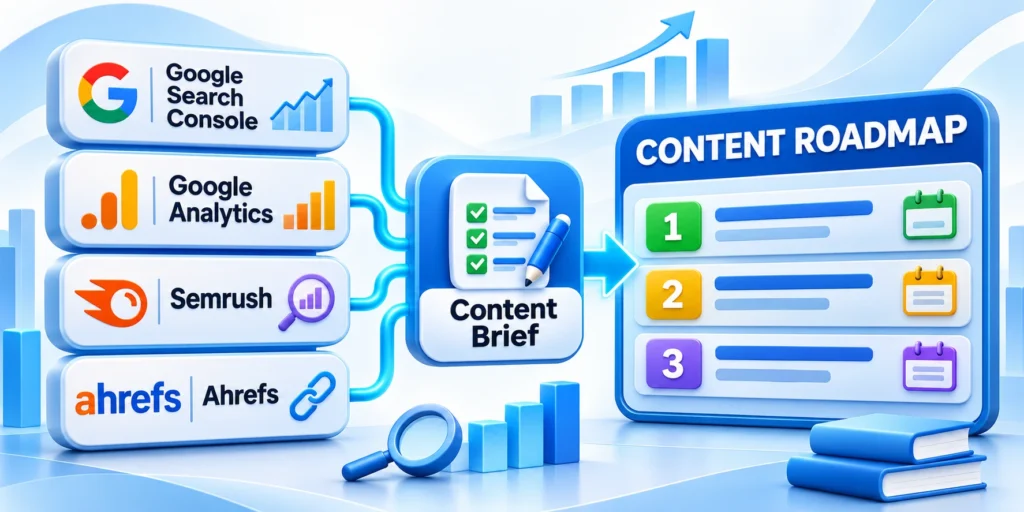
A content brief should translate a validated opportunity into a useful reader outcome, not merely list target keywords, heading quotas, or a competitor’s section order.
The brief connects audience need, intent, evidence, structure, internal links, subject expertise, conversion path, and measurement so production starts with a coherent decision.
State the reader problem and outcome
Define what the reader is trying to decide, build, compare, diagnose, or avoid. The outcome gives writers and reviewers a test for whether the final asset actually closes the gap.
Specify the context that makes the need distinctive: company size, role, technical environment, buying stage, risk, and constraints. Broad language creates broad, unfocused coverage.
Include these elements in every content gap brief:
- Audience task and search intent
- Specific promise and scope boundary
- Evidence and subject-matter sources
- Format, structure, and internal links
- Success measure and review date
Plan differentiation before drafting
Identify the helpful contribution that existing results do not provide, such as a clearer decision framework, a tested implementation sequence, original data, or better navigation to related work.
Differentiation is not a decorative angle. It should change what the reader can understand or do after engaging with the asset.
Connect the asset to the wider cluster
Plan relevant internal links that help a reader continue the journey without forcing unrelated cross-links. The relationship should be obvious from the surrounding explanation.
This improves discovery and clarifies page purpose across the portfolio. It also reduces the risk that two assets silently target the same job.
Define a review trigger
Set a refresh trigger: ranking shift, new capability, recurring customer question, updated guidance, or evidence that the page no longer matches intent.
Review triggers make maintenance intentional. They avoid both neglecting valuable assets and wasting effort refreshing content that still serves the audience well.
Maintain a repeatable content gap operating cycle
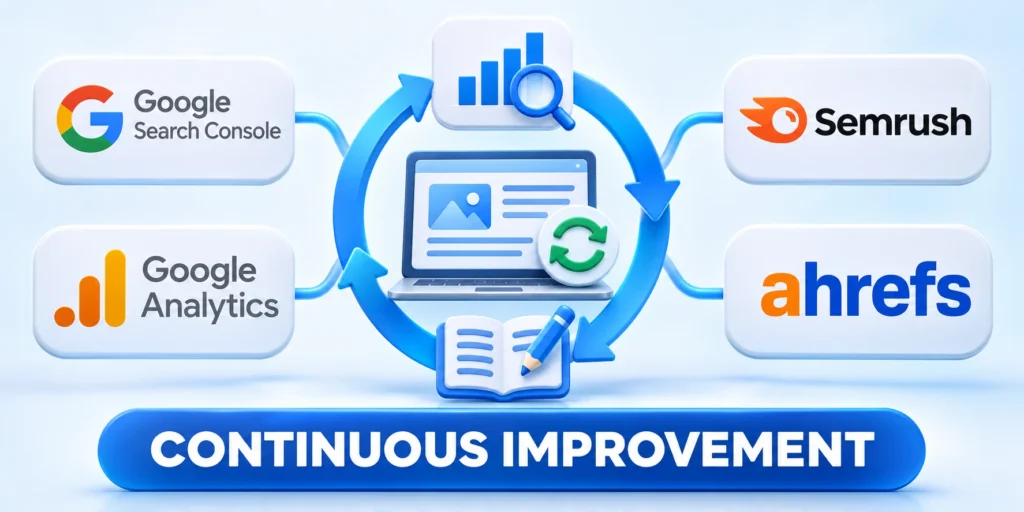
Content gap analysis creates value when it becomes a repeatable operating cycle: observe demand, assess coverage, choose an action, publish or improve, measure outcomes, and learn.
A periodic cycle keeps the team responsive without chasing every temporary competitor movement, search fluctuation, or tool alert as though it demands a new page.
Review the portfolio at a useful cadence
Review high-value clusters more often than stable, low-risk topics. Combine planned reviews with event-driven checks after product changes, market shifts, customer questions, or search result changes.
Use a lightweight review format that preserves prior decisions. Repeating the same discovery process without a record consumes time but does not produce stronger strategy.
Use these inputs for each scheduled portfolio review:
- Current first-party search performance
- Customer and sales feedback
- Competitor and search result changes
- Published asset outcomes
- Open decisions and deferred opportunities
Measure outcomes against the original hypothesis
Compare the observed effect with the purpose defined in the brief. Rankings alone may not show whether the new coverage improved qualified visits, understanding, adoption, or pipeline support.
Keep the measurement proportional to the decision. A small support article does not need the same reporting burden as a major commercial cluster investment.
Turn findings into a next action
Decide whether to expand, refresh, consolidate, improve navigation, gather more evidence, or leave the asset unchanged. Each action should follow from the observed result and reader need.
Avoid treating every performance dip as a reason to rewrite content. Investigate intent, technical visibility, competition, seasonality, and audience change before editing.
Preserve learning across teams
Maintain a concise record of evidence, decisions, outcomes, and unresolved questions. It helps content, product, sales, and subject experts collaborate without recreating context.
The record also makes strategy resilient when team members change. Good decisions remain understandable because their evidence and assumptions are visible.
Conclusion
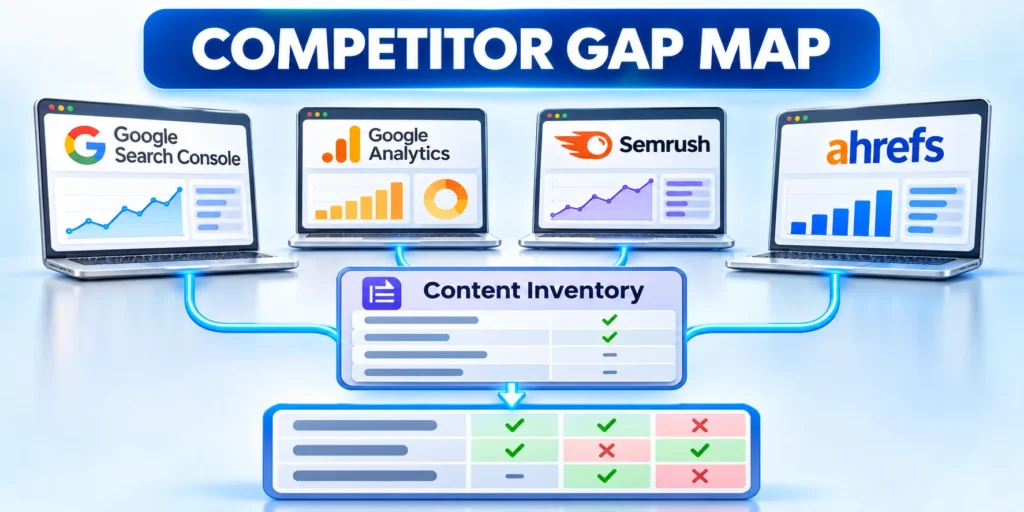
SEO content gap analysis works when it produces a useful decision: improve an existing asset, create a distinct resource, repair discovery, or deliberately decline an opportunity.
Use audience intent, owned evidence, competitive context, and accountable measurement to maintain a portfolio that solves meaningful problems without creating duplicate coverage.
Keep the evidence cycle practical
Review the portfolio on a cadence that fits the topic’s value and volatility. Preserve the evidence and rationale so each new decision begins with context rather than repetition.
A disciplined cycle turns competitor observation into better reader outcomes, clearer internal priorities, and content investments that can be evaluated honestly after publication.
Turn evidence into a durable portfolio decision
Choose the action that best improves the reader journey: expand, refresh, consolidate, repair internal discovery, collect more evidence, or keep the existing coverage unchanged.
Recording that choice prevents duplicate projects and makes later performance reviews more useful. The portfolio should become clearer with each cycle, not merely larger.
Use measurement to improve the next decision
Compare observed results with the intended audience outcome and the evidence used to approve the work. Learn whether the chosen format, scope, and distribution path actually helped.
Keep the next change proportionate to what the evidence shows. A durable SEO program favors useful, verified improvements over constant production for its own sake.
Keep these review principles visible in every cycle:
- Start with audience tasks, not keyword counts
- Use first-party evidence to validate demand
- Compare formats and evidence, not just rankings
- Assign an owner and measurement plan
- Record what the team decided and why
FAQ
These answers clarify common SEO content gap decisions using first-party evidence, direct search review, a complete inventory, and documented audience priorities.
What is an SEO content gap?
It is a missing or weak ability to satisfy a relevant audience task through content, format, evidence, architecture, or discoverability compared with demand and alternatives.
How many competitors should be analyzed?
Use enough competitors to represent each important topic cluster and result type. A small relevant set is more useful than many unrelated domains.
Does every competitor keyword require a new article?
No. Improve an existing asset, add a section, build another format, fix discoverability, or decline the opportunity when a separate page lacks value.
How often should the analysis be repeated?
Review priority clusters on a planned cadence and after meaningful product, market, competitor, or search changes. Avoid constant reanalysis without execution.
Which metric proves a gap was closed?
Use the metric tied to the hypothesis, such as relevant impressions, qualified visits, task completion, conversions, pipeline support, or fewer unresolved customer questions.
How should competitor estimates be treated?
Use them as directional evidence. Validate important opportunities with owned performance data, direct result review, customer research, and the organization’s ability to contribute something useful.
What should happen when two existing pages target the same intent?
Compare their purpose, evidence, links, and performance. Improve differentiation or propose consolidation separately; do not create another competing page.
How can content gaps support commercial pages?
Create useful supporting explanations for related reader tasks, then link contextually when the commercial page is the appropriate next step. Avoid disguised promotional duplication.
Who should approve a high-priority gap?
Ask the content owner and subject expert to validate the gap. If it spans search, content, and distribution, explore the related capabilities at Fase Network.
When should an opportunity be rejected?
Reject it when the audience is irrelevant, intent already has adequate coverage, evidence is weak, expertise is unavailable, or the content would add no distinct value.








Leave a Reply