


Set a performance role for video

B2B video performance advertising works when video has a defined job in the revenue system. Awareness and conversion assets require different messages, placements, and measurement.
Start with a commercial question. Decide whether the campaign should create informed demand, support account engagement, generate qualified conversations, or move identified buyers toward a next step.
Clarify the conversion decision
Assign one commercial job before launch: qualified conversations, evaluation, or account engagement. That focus makes creative and measurement choices easier to defend.
Define the buyer stage and the evidence that indicates progress. That evidence can include meaningful form quality, meetings, opportunity movement, or a documented sales response.
Define the campaign job before choosing a video
For a broader demand-generation framework, use the B2B demand generation guide to connect video campaigns to buyer intent and pipeline actions.
Assign campaign, sales, and reporting owners. If a nearshore B2B marketing agency runs video campaigns, share the audience, conversion event, and evaluation window.
Use this operational checklist for the decision:
- Name one business outcome.
- Specify the intended audience stage.
- Choose a conversion definition.
- Assign a revenue owner.
A concise brief connects creative decisions to the operating model. It also prevents a polished video from becoming an isolated brand activity with no accountable performance decision.
Write the expected decision before launch. Teams can then compare the result with the original purpose instead of redefining success after delivery begins.
Choose video formats by buying stage
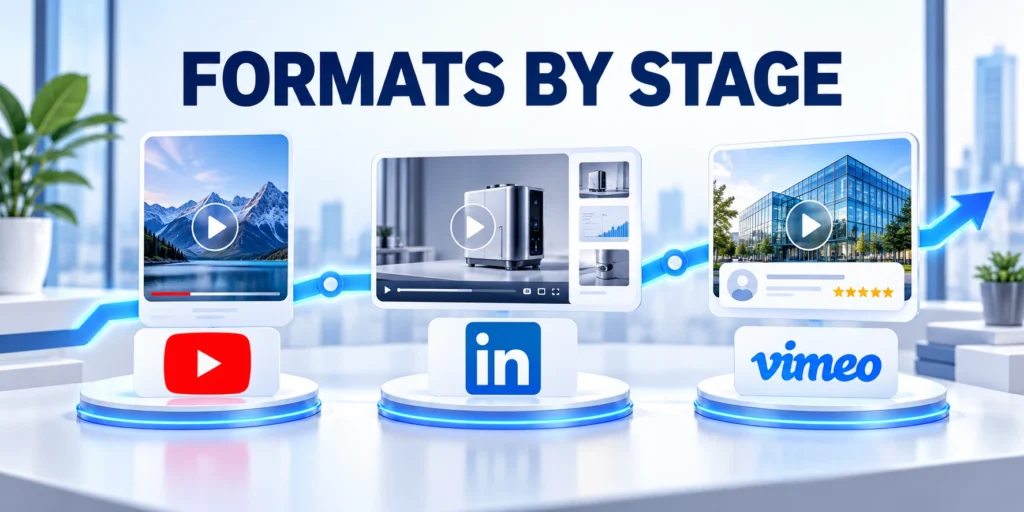
B2B buyers need different evidence at different moments. Short narrative clips can introduce a problem, while demonstrations and customer proof can reduce uncertainty later.
Choose the format based on the next question a buyer must answer. Do not force the same video into every placement merely because production consumed significant time.
Match format to the buyer moment
Choose video length, proof type, and call to action for the information a buyer needs now. An introductory problem statement and a late-stage demonstration should not carry the same burden.
Keep the destination aligned with the asset. A useful video can lose value when the landing page, form, or follow-up path asks for an unrelated decision.
Match video formats to how buyers evaluate risk
Map each format to a buyer question and a distribution context. That map prevents awareness clips from carrying product proof that belongs in later evaluation.
Use this operational checklist for the decision:
- Use short clips for initial attention.
- Choose explainers for complex categories.
- Add product demonstrations for evaluation.
- Use proof for risk reduction.
Keep the promise consistent across formats. A viewer who moves from a short video to a landing page should recognize the same problem, audience, and practical outcome.
Match video to discovery audiences. If the same campaign also targets buyers actively searching for a provider, use the B2B Google Ads playbook to plan that search campaign.
Build a video asset system for testing

A video program becomes more useful when it produces deliberate variants. Create distinct hooks, proof points, calls to action, and aspect ratios before campaign launch.
Each variant should test one meaningful choice. Changing every element at once makes it difficult to learn whether the audience, message, opening, or offer influenced performance.
Create reusable proof components
Organize customer evidence, product demonstrations, subject-matter explanations, and objection responses as components. This helps teams test a specific proof element without rebuilding every asset from the beginning.
Record the intended buyer question beside each component. A recognizable library enables faster testing while reducing the temptation to repeat generic claims.
Turn one production into a testable asset system
Create a naming system before production begins. Include the target audience, message angle, opening hook, offer, version, and intended placement in every asset record.
Use this operational checklist for the decision:
- Create two opening hooks.
- Vary one proof point.
- Keep a consistent call to action.
- Prepare channel-specific aspect ratios.
Maintain a simple asset register with the message, audience, format, version, and intended test. This gives campaign and creative teams a common reference during optimization.
Reuse a strong concept only after confirming why it worked. A high view count alone does not prove that the message improved qualified demand.
Keep the asset decision traceable
Record the audience, message, offer, format, and destination beside each production version. This trace makes performance differences easier to interpret.
A traceable asset record also prevents a team from attributing a later result to the wrong creative change or distribution condition.
Launch with controlled performance signals

Campaign setup should make the first learning period interpretable. Select an objective, conversion event, budget, and audience approach that match the job assigned to the video.
Google describes Demand Gen as a campaign type that combines video and image assets across discovery-oriented surfaces. It requires working conversion tracking and appropriate asset preparation.
Protect the first learning cycle
Limit early variables across audience, creative, bid, and destination. A controlled launch produces clearer evidence than simultaneous changes made in response to daily platform noise.
Set the review date before delivery begins. This avoids premature judgment while giving the campaign owner a defined point to inspect qualified outcomes.
Launch video campaigns with stable learning signals
Document the campaign baseline before launch. Capture audience definitions, exclusion logic, conversion setup, budget, placements, creative versions, and the decision owner.
Use this operational checklist for the decision:
- Verify the conversion tag.
- Set a realistic learning window.
- Keep initial audience logic stable.
- Document exclusions and budget.
Avoid frequent changes during the first observation period. Large shifts in bids, targeting, or creative can make it impossible to identify which intervention changed the outcome.
Record the initial configuration before launch. This is the baseline needed for a controlled iteration, a rollback, or a credible decision to expand investment.
Set a shared review question
Ask what business change the video should help produce before looking at the dashboard. That question keeps media reporting connected to a commercial decision.
Bring sales feedback into the review at a defined point. The feedback can reveal whether an apparently strong response becomes a credible buyer conversation.
Measure contribution beyond video views

Views and completion rates can diagnose creative attention, but they cannot independently prove business value. Connect performance reporting to qualified leads, meetings, opportunities, and revenue signals.
Use a comparison point such as an existing campaign, historical baseline, or controlled audience. Without one, seasonal demand and sales follow-up may be mistaken for video effectiveness.
Reconcile attention with revenue evidence
Use consistent campaign identifiers across the marketing technology stack to connect video response events, CRM records, and sales qualification.
Review disagreements between media reports and CRM data before optimizing. The gap may reveal attribution assumptions, delayed follow-up, or a problem with the campaign handoff.
Measure video contribution through pipeline quality
Agree on lead-quality signals with sales before reporting starts. A completed form has limited value when the contacted accounts do not fit the commercial motion.
Use this operational checklist for the decision:
- Track response quality.
- Review meeting progression.
- Capture opportunity creation.
- Compare cost against pipeline.
LinkedIn’s B2B research identifies awareness, trust, and conversions as common video goals. The metric set should therefore follow the role selected for the specific campaign.
Review results with both marketing and sales. Disqualification reasons can reveal whether the offer, targeting, landing experience, or follow-up process needs adjustment.
Separate learning from scale
Protect a baseline while creative and audience conditions are being tested. Scaling before a meaningful comparison exists can convert uncertainty into needless media spend.
Use one documented decision after each test cycle. A clear decision makes the next video iteration easier to explain to marketing, sales, and finance.
Scale what improves qualified demand

Scaling is a business decision rather than a reward for inexpensive delivery. Increase investment when the campaign produces a repeatable improvement in the qualified outcome selected in the brief.
Keep a reversal path while expanding. Preserving the prior configuration and documenting the change makes it possible to pause, narrow, or restore the campaign if quality declines.
Scale only after qualified demand improves
Set a review cadence before increasing spend. Marketing, sales, and operations should compare volume, quality, progression, and delivery constraints using the same period.
Use this operational checklist for the decision:
- Expand one variable at a time.
- Preserve the original control.
- Review downstream conversion rates.
- Record the expansion decision.
Use the learning loop to improve future creative. A winning message can inform another format, account segment, or sales enablement asset when the buyer problem remains comparable.
Video marketing becomes performance marketing when creative, media, measurement, and revenue operations share evidence. That connection protects budget and makes scale more defensible.
Create an evaluation brief buyers can act on
List the buyer question, proof required, next action, and destination for each asset. This turns production into a sequence of decisions rather than a collection of isolated videos.
For example, an operations leader may need a short explanation of a workflow problem before accepting a demonstration. A procurement stakeholder may need customer proof before approving a meeting.
Use this operational checklist for the decision:
- State the buyer question.
- Choose one proof source.
- Define the next action.
- Assign the landing destination.
Review the brief with sales before filming. Sales conversations reveal objections that can become the opening hook, demonstration sequence, or follow-up asset.
Plan the production handoff and follow-up
Performance media cannot repair a weak handoff. Connect the campaign response to a named owner, a service-level expectation, and a follow-up sequence before budget begins spending.
Use the same audience language in the video, form, routing rule, and sales playbook. Consistent language makes later analysis more reliable and reduces avoidable qualification friction.
Use this operational checklist for the decision:
- Route responses to the correct team.
- Set a follow-up expectation.
- Record the campaign source.
- Capture rejection reasons.
When a campaign produces engagement but limited meetings, inspect the destination and follow-up process before replacing the creative. The constraint may exist after the view.
Use a decision log for controlled iteration
Maintain a short log for each material change. Record what changed, why it changed, the expected effect, the owner, and the earliest review date.
This practice limits reactive optimization. It also allows a team to distinguish an evidence-based adjustment from a coincidental improvement caused by demand, timing, or sales activity.
Use this operational checklist for the decision:
- Preserve the previous setting.
- Change one material variable.
- Set the review period.
- Document the decision outcome.
A useful decision log becomes an operating asset. It helps new team members understand the campaign history without relying on memory or scattered reporting comments.
Set thresholds before reading the dashboard
Set a small number of decision thresholds before results arrive. Define the acceptable cost, response quality, meeting rate, and opportunity rate for the campaign’s assigned role.
Thresholds must reflect the audience and sales cycle. A targeted enterprise program can justify fewer responses when those responses create credible buying conversations with relevant accounts.
Use this operational checklist for the decision:
- Set a qualified-response threshold.
- Set an acceptable cost range.
- Schedule the review date.
- Define the escalation owner.
Write these thresholds in the campaign brief. They give the team a consistent basis for maintaining, adjusting, pausing, or scaling the program.
Connect creative feedback to sales evidence
Ask sales representatives which claims prompt useful follow-up questions and which claims create confusion. Those observations can improve the next version of the opening, proof, or call to action.
Separate anecdotal feedback from patterns. A single memorable conversation should not overrule a recurring signal across qualified meetings, pipeline progression, and recorded objections.
Use this operational checklist for the decision:
- Collect recurring objections.
- Match objections to assets.
- Review meeting notes monthly.
- Prioritize repeated evidence.
Creative feedback becomes useful when it names the buyer stage and the commercial consequence. That makes it actionable for production and performance teams.
Separate platform signals from business signals
Platform metrics explain delivery and attention. Business metrics explain whether the program created a meaningful commercial change. Both matter, but neither should substitute for the other.
For example, weak completion may indicate a poor opening, while strong completion with weak qualification may reveal an audience, offer, landing page, or follow-up problem.
Use this operational checklist for the decision:
- Review reach and frequency.
- Review attention quality.
- Examine qualified responses.
- Review pipeline movement.
Use a shared report that shows both layers. It prevents optimization toward inexpensive attention when the actual goal is qualified demand.
Protect learning when budgets change
Increase spending gradually and compare downstream quality. If video competes with search or nurture for budget, digital marketing strategy consulting can help assess the channel trade-offs.
Keep the original control configuration available. If qualification declines, the team can identify the change and restore the previous setting without reconstructing the campaign from memory.
Use this operational checklist for the decision:
- Increase one budget variable.
- Preserve the control audience.
- Review lead quality.
- Record the rollback option.
This approach does not eliminate uncertainty. It creates a disciplined record that makes uncertainty manageable and decisions easier to explain.
Build a reusable video learning library
Store approved videos with their campaign brief, targeting context, creative hypothesis, result, and next decision. A library helps teams reuse evidence rather than merely reusing files.
Tag entries by buyer role, problem, industry, funnel stage, and message angle. These fields make a past result findable when a comparable campaign is planned.
Use this operational checklist for the decision:
- Keep the asset URL.
- Keep the campaign context.
- Preserve the result period.
- Keep the next lesson.
A reusable learning library reduces repeated production decisions. It also helps teams distinguish a durable pattern from a one-time campaign outcome.
Review the full buying journey each quarter
Quarterly reviews should compare the campaign brief, creative record, response quality, meeting progression, and opportunity data. This connects individual optimizations to the wider commercial system.
Use the review to retire weak assumptions and preserve proven messages. The outcome should be a short list of decisions for the next production and media cycle.
Use this operational checklist for the decision:
- Review the original hypothesis.
- Compare downstream results.
- Retire weak assumptions.
- Assign the next test.
- Share decisions with revenue leaders monthly.
That discipline keeps video marketing connected to revenue operations instead of treating it as a separate content activity.
It also clarifies who owns the next experiment and when to revisit the decision during the next operating cycle.
Retarget video engagement with a defined next step
Video engagement can inform a later audience only when the viewing signal represents meaningful attention. Define the watched percentage, recency window, exclusions, and next offer before activation.
Use different follow-up messages for viewers who sampled an introduction and those who completed a detailed demonstration. For cross-channel sequencing, apply our advanced B2B retargeting strategy.
Define operating criteria before execution
For B2B video marketing for performance advertising, define audience, buying stage, video promise, and conversion destination before changing campaigns, code, content, or workflow.
That shared context gives every contributor a practical boundary for action.
Use this operational checklist for the decision:
- Write the decision, owner, assumptions, and known constraints.
- Identify dependencies that could change the expected result.
- Set a reversible first step when uncertainty remains.
- Keep the decision record accessible to contributors.
- State what evidence is sufficient to proceed.
- Note which decisions cannot be reversed cheaply.
- Define the time frame for the decision.
- Record the intended business benefit.
- Confirm the available capacity and budget.
Test the workflow under realistic conditions
Evaluate B2B video marketing for performance advertising across the real briefing, production, distribution, conversion, and sales follow-up sequence.
A narrow test can hide handoff issues, exceptions, integration failures, or user behavior.
Use this operational checklist for the decision:
- Choose a representative task or audience segment.
- Run the workflow from its first input to the final outcome.
- Capture exceptions, delays, and manual work.
- Compare results with the agreed baseline.
- Decide whether to improve, repeat, or scale.
- Document the limits of the test.
- Confirm that owners can support the next step.
- Review assumptions with people doing the work.
- Capture feedback from affected customers or users.
Measure outcomes and tradeoffs together
Track qualified attention, completion quality, lead fit, and opportunity influence together rather than optimizing a single favorable metric.
Costs, risk, quality, and effort can otherwise distort the apparent value.
Use this operational checklist for the decision:
- Use business and technical indicators in the same review.
- Record data gaps before interpreting a result.
- Explain material changes with evidence, not timing alone.
- Preserve the baseline and reporting period.
- Share findings with the teams responsible for follow-up.
- Check whether the outcome can be reproduced.
- State the confidence level behind each conclusion.
- Compare actual effort against the original estimate.
- Assign responsibility for the next reporting cycle.
Keep the practice current
Review the approach when audience feedback, creative performance, offer, or channel changes.
Past decisions may still help, but their assumptions require current evidence.
Use this operational checklist for the decision:
- Schedule ownership and review dates with the operating team.
- Retire outdated instructions, definitions, and unsupported claims.
- Record the next action and accountable owner.
- Link related internal guidance when it helps execution.
- Decide whether to improve, replace, or stop the practice.
- Share changed instructions with affected contributors.
- Keep the latest decision record easy to find.
- Confirm whether the documented standard remains usable.
- Escalate material risks before the next release.
Define the buyer question before production

Buyer-question alignment gives B2B video teams a practical boundary before changing targeting, creative, budget, or follow-up. Name the decision owner and explicit commercial outcome clearly first.
Use a controlled scope for buyer-question alignment. A documented constraint creates more reliable learning than broad changes that obscure which condition improved demand.
Define the buyer-question alignment decision
Write the buyer-question alignment hypothesis, target audience, expected effect, review date, and reversal condition. This keeps production and media choices tied to the same business purpose.
Keep evidence for buyer-question alignment with the campaign record. Sales, marketing, and operations need the same context when results or delivery conditions change.
Use these buyer-question alignment controls before launch:
- Named buyer role
- Specific business problem
- Proof required to continue
- Clear next action
- Owner for review
Review buyer-question alignment evidence
Compare buyer-question alignment results with the stated decision rule, not a favorable isolated metric. Include delivery, response quality, and downstream sales evidence.
Record what buyer-question alignment confirmed, what remains uncertain, and the next action. This preserves learning when a future team revisits the campaign.
Make the production brief usable
Give producers the buyer problem, approved audience boundaries, evidence requirement, and desired next action. A usable brief reduces disconnected creative decisions.
Review the brief before launch with the person responsible for sales follow-up. That review catches a mismatch between video promise and the receiving workflow.
Connect video targeting to consented audience data

Consented audience targeting gives B2B video teams a practical boundary before changing targeting, creative, budget, or follow-up. Name the decision owner and explicit commercial outcome clearly first.
Use a controlled scope for consented audience targeting. A documented constraint creates more reliable learning than broad changes that obscure which condition improved demand.
Define the consented audience targeting decision
Write the consented audience targeting hypothesis, target audience, expected effect, review date, and reversal condition. This keeps production and media choices tied to the same business purpose.
Keep evidence for consented audience targeting with the campaign record. Sales, marketing, and operations need the same context when results or delivery conditions change.
Use these consented audience targeting controls before launch:
- Approved CRM audience
- Current consent status
- Relevant exclusions
- Defined recency window
- Documented activation owner
Review consented audience targeting evidence
Compare consented audience targeting results with the stated decision rule, not a favorable isolated metric. Include delivery, response quality, and downstream sales evidence.
Record what consented audience targeting confirmed, what remains uncertain, and the next action. This preserves learning when a future team revisits the campaign.
Preserve the meaningful comparison
Keep the original audience, budget range, and campaign window visible while testing a creative condition. Comparable conditions make the lesson more credible.
When a result changes, review the operating record before deciding that a particular video element caused the improvement or decline.
Use controlled creative tests before scaling
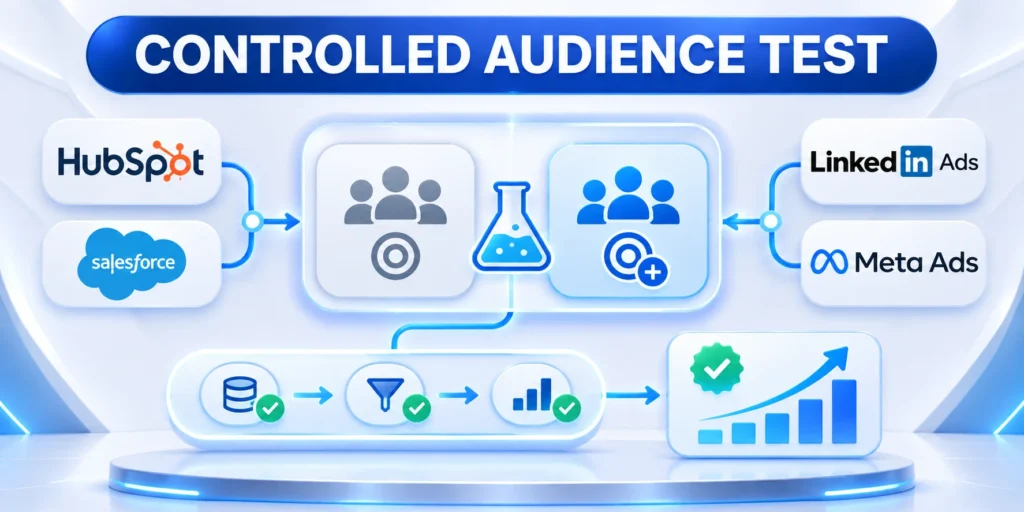
Controlled creative testing gives B2B video teams a practical boundary before changing targeting, creative, budget, or follow-up. Name the decision owner and explicit commercial outcome clearly first.
Use a controlled scope for controlled creative testing. A documented constraint creates more reliable learning than broad changes that obscure which condition improved demand.
Define the controlled creative testing decision
Write the controlled creative testing hypothesis, target audience, expected effect, review date, and reversal condition. This keeps production and media choices tied to the same business purpose.
Keep evidence for controlled creative testing with the campaign record. Sales, marketing, and operations need the same context when results or delivery conditions change.
Use these controlled creative testing controls before launch:
- One meaningful variable
- Stable comparison group
- Bounded media budget
- Defined review window
- Recorded rollback choice
Review controlled creative testing evidence
Compare controlled creative testing results with the stated decision rule, not a favorable isolated metric. Include delivery, response quality, and downstream sales evidence.
Record what controlled creative testing confirmed, what remains uncertain, and the next action. This preserves learning when a future team revisits the campaign.
Use evidence to guide production
Share qualified-response patterns with the people who choose stories, demonstrations, and calls to action. Sales evidence can improve the next asset without overreacting to one conversation.
Document whether the result supports another test, a targeted expansion, or a pause. This keeps video production aligned with the available evidence.
Connect video response to qualified pipeline

Qualified pipeline measurement gives B2B video teams a practical boundary before changing targeting, creative, budget, or follow-up. Name the decision owner and explicit commercial outcome clearly first.
Use a controlled scope for qualified pipeline measurement. A documented constraint creates more reliable learning than broad changes that obscure which condition improved demand.
Define the qualified pipeline measurement decision
Write the qualified pipeline measurement hypothesis, target audience, expected effect, review date, and reversal condition. This keeps production and media choices tied to the same business purpose.
Keep evidence for qualified pipeline measurement with the campaign record. Sales, marketing, and operations need the same context when results or delivery conditions change.
Use these qualified pipeline measurement controls before launch:
- Campaign identifier
- Response-quality rule
- Sales follow-up status
- Opportunity progression
- Decision record
Review qualified pipeline measurement evidence
Compare qualified pipeline measurement results with the stated decision rule, not a favorable isolated metric. Include delivery, response quality, and downstream sales evidence.
Record what qualified pipeline measurement confirmed, what remains uncertain, and the next action. This preserves learning when a future team revisits the campaign.
Interpret performance signals together
Use a small shared view of attention and commercial signals. This prevents a high platform metric from being mistaken for a qualified-demand result.
Choose an action only after the evidence is compared with the campaign role, audience definition, and sales follow-up conditions.
| Signal | Meaning | Next action |
|---|---|---|
| High completion | Message holds attention | Check lead quality |
| Weak response | Offer lacks relevance | Test the buyer problem |
| Low-quality leads | Audience is too broad | Refine exclusions |
| Strong meetings | Proof reaches buyers | Document the pattern |
Conclusion

B2B video performance improves when teams treat buyer questions, audience controls, creative testing, and CRM evidence as one accountable operating system.
Keep scale reversible and evidence-based. A smaller video program with credible sales learning is more valuable than a broad program optimized only for inexpensive attention.
Maintain an evidence-led operating rhythm
Review the buyer question, campaign conditions, response quality, and sales outcomes together. Use that review to improve one material condition instead of making unrelated changes at once.
A documented operating rhythm protects media investment and gives future teams the context to repeat, revise, or stop a video program responsibly.
Keep these practices visible in each review:
- Name the commercial job
- Document audience constraints
- Test one meaningful variable
- Review qualified pipeline
- Record the next decision
Keep the learning record current
Store the campaign brief, approved assets, test conditions, and outcome in one accessible record. This makes successful patterns reusable without stripping away their original context.
Retire unsupported assumptions when buyer behavior, offers, channels, or sales feedback change. Current evidence should guide the next production and media cycle.
Keep accountability with the operating team
Name the owner who will review performance, preserve the evidence, and approve the next change. Clear ownership turns reporting into an operating decision rather than a passive summary.
When the campaign no longer supports its assigned commercial job, pause it and document the lesson. Reallocation is often better than continuing a weak pattern.
FAQ
These answers clarify how B2B teams assign, test, measure, and improve video advertising without treating attention metrics as commercial proof.
What does video performance mean in B2B?
It means evaluating video against the business job assigned to it, such as qualified conversations, account engagement, meetings, opportunities, or pipeline progression.
Should every B2B campaign use video?
No. Use video when it helps explain value, earn attention, reduce uncertainty, or move a defined audience toward a useful next action.
Which video metric matters most?
The useful metric depends on the campaign role. Pair attention metrics with downstream quality measures that connect to the selected commercial outcome.
How many variants should a team test?
Start with a manageable set of deliberate variants. Test one meaningful difference at a time so the team can interpret the result.
When should a team scale a video campaign?
Scale when qualified demand improves repeatedly against an appropriate comparison and the campaign configuration can be explained and monitored.
How should video viewers be segmented for retargeting?
Segment by meaningful viewing depth, recency, buyer context, and the next evidence required. Exclude customers and ineligible contacts when prospecting is the goal.
Can one video serve every buying stage?
Usually not. Introductory, evaluation, proof, and conversion moments require different information, pacing, calls to action, and destinations.
How long should a video campaign run before evaluation?
Run long enough to gather stable delivery and observe the downstream qualification cycle. Set the review window before launch and avoid reacting to isolated daily changes.
What should a video test change first?
Change one meaningful variable, such as the opening hook, proof point, offer, or audience. Keep the remaining conditions stable enough to interpret the result.
How can sales feedback improve video advertising?
Structured objections, qualification reasons, and meeting outcomes reveal which claims attract suitable buyers and which parts of the message create confusion.





Leave a Reply