


When Google Ads Is the Right B2B Growth Lever

A B2B Google Ads pipeline can help a company reach buyers who are actively researching a problem, service, or solution. It cannot create reliable pipeline by itself.
In practice, results depend on the offer, market demand, campaign structure, landing experience, measurement, qualification, and sales follow-up working together.
Distinguish demand capture from demand creation
Search ads work best when buyers can describe a problem or solution. A query for an enterprise CRM migration partner signals different intent from a general marketing video.
Even so, the query does not prove budget, authority, timing, or fit. Search intent is evidence to investigate, not a guarantee that the searcher will become a customer.
Search intent captures existing demand
Demand capture means responding to existing interest. A company can do this with service pages, comparison pages, migration guides, consultations, or other offers that match the buyer’s stage.
By contrast, demand creation educates people before they search. Search may support adjacent research, but it cannot replace a broader awareness strategy.
Set expectations for narrow markets
For an account-based or category-creation program, search volume may be limited even when the business opportunity is meaningful. The campaign must then be judged alongside other channels and sales activity.
Use opportunity value, buyer fit, and service capacity alongside volume because a narrow market can still support a commercially useful test.
Check the commercial conditions before launch
Before a high-ticket campaign, confirm the business can serve its target buyers. More leads hurt when delivery cannot meet the promise or sales cannot respond.
Use this campaign readiness checklist before launch:
- The offer solves a specific business problem with a credible path to value.
- Target geographies and industries are supportable by the company.
- Sales can identify the person or account that owns each inquiry.
- A landing page explains the service, relevant proof, constraints, and next step.
- CRM records can preserve campaign and conversion context through the buying journey.
- Teams can distinguish a valid inquiry from a qualified opportunity.
If several conditions are missing, fix the most important operational gap before increasing media spend. Buying traffic does not repair a weak offer or unclear handoff.
Estimate whether the market can support a test

The market needs enough relevant searches to create a useful learning opportunity. Keyword tools can estimate demand, but their volumes are directional and do not promise impressions, clicks, or contracts.
Next, look for the words buyers use for the problem, desired outcome, implementation, and alternatives. Ask sales and customer-success teams which phrases appear in calls and proposals.
Balance search demand with service capacity
Then compare projected traffic with service capacity. Niche searches may have high contract value; broad searches may attract students, vendors, or poor-fit organizations.
Do not label a campaign unviable solely because a keyword tool reports low volume. Check close variants, regional language, adjacent problem queries, and the actual search-term data once campaigns run.
Choose a bounded test over a forecast
The appropriate decision is a bounded test with a measurable hypothesis, not a promise that a particular budget will produce a fixed number of leads.
State the budget, audience, offer, observation window, primary outcome, review owner, and stopping rule before activating traffic.
Example: a specialized cloud migration firm
Suppose a consultancy migrates regulated B2B workloads to cloud infrastructure. A broad term such as cloud services may attract research, careers, support, hosting, and consumer intent.
By contrast, specific queries about regulated-cloud migration, data residency, or replacing a legacy hosting environment may reflect closer alignment, but each needs review against the actual service scope.
Turn the query into a scoped offer
State the buyer problem, service regions, and initial evaluation in the campaign. Avoid advertising every cloud service under one generic promise.
For measurement, use qualified consultations and sales-accepted opportunities as the meaningful outcomes. A click or form submission remains an early event, not proof that the media program generated revenue.
Define the minimum useful test
A useful test needs enough relevant demand, operational capacity, and measurement quality to support a business decision rather than a decorative traffic report.
Bound the test through these operating decisions:
- Choose one supported service and buyer problem.
- Set geography from actual delivery capacity.
- Define qualified outcomes before estimating volume.
- Record a budget, review date, and stop rule.
Record assumptions separately from observed evidence, then replace estimates with actual query, qualification, opportunity, and cost data as the campaign matures.
Define the Pipeline Outcome Before Buying Clicks

High-ticket B2B performance spans beyond form submissions. Agree on outcomes and trace progress from ad interaction to sales result.
First, define terms with marketing, sales, finance, and delivery before setting a bidding goal. Teams often use the same label for different events, which makes campaign reports difficult to interpret.
Separate the funnel events
Use clear definitions for the main steps:
- Inquiry: a person submits a form, calls, or requests information.
- Valid inquiry: usable contact data, genuine intent, and no spam or test submission.
- Qualified lead: the available facts indicate fit and a plausible business need.
- Sales-accepted lead: sales has reviewed the inquiry and accepted the follow-up responsibility.
- Opportunity: a real buying process is underway and recorded in the CRM.
- Closed revenue: a signed agreement or recorded transaction meets the business’s revenue definition.
These are operating definitions, not universal industry standards. A company may need additional stages for technical validation, procurement, security review, or an implementation assessment.
Write the trigger for each transition. For example, a sales-accepted lead might require an owner, documented next action, and an explicit acceptance status in the CRM.
Qualify bookings before calling them opportunities
Do not count a calendar booking as a qualified opportunity unless the business has evidence that the buyer and use case meet its agreed criteria.
Require an agreed business need, suitable account, responsible buyer, and documented next action before promoting the record to an opportunity stage.
Choose one primary bidding outcome carefully
Google Ads can use primary conversion actions for bidding when the campaign optimizes toward their associated goals. Secondary actions generally inform reporting instead.
Optimizing only for raw form submissions can reward leads that sales rejects. Optimizing only for closed revenue may leave a new campaign too little timely data.
Select a useful and measurable bidding signal
Choose an observable stage that is both valuable and frequent enough for the account's actual data. Review the definition whenever sales processes or CRM fields change.
Google’s primary and secondary conversion actions guidance explains how they affect reporting and bidding. Check account settings before changing a goal.
Build an economic model from your own data
To ground estimates, use historical CRM data to see how inquiries move through the funnel. Segment by offer, geography, company size, and sales motion when the sample supports it.
A simple model can start with the following relationships:
- Qualified leads = valid inquiries × qualified-lead rate.
- Opportunities = qualified leads × opportunity-creation rate.
- Expected gross profit = won opportunities × gross profit per contract.
- Expected acquisition cost per opportunity = campaign spend ÷ opportunities.
Example assumptions should be labeled as assumptions, not benchmarks. If the model uses an inquiry-to-opportunity rate of 20%, state where the rate came from and which time period it represents.
If 50 valid inquiries historically produce 10 accepted opportunities, that cohort’s observed rate is 20%. The next campaign is not guaranteed to reproduce it.
Account for sales-cycle delay
Add sales-cycle delay. Campaigns launched last month may have many leads still being evaluated, so judging them as if every deal had matured can produce a false conclusion.
Separate recent inquiries from mature cohorts so short reporting windows do not classify open buying processes as campaign failures.
Create a stage-based scorecard
Keep both early and mature outcomes visible. Early metrics support operational diagnosis; late-stage metrics answer whether the program contributes to business value.
An actionable scorecard might include:
- Spend, impressions, clicks, and search-term categories.
- Valid inquiries, with spam and duplicate handling defined.
- Qualified leads and sales acceptance by campaign and offer.
- Opportunity creation, progression, and recorded loss reasons.
- Closed revenue or gross profit, with cohort and time-window context.
- Response time and unworked inquiries by owner or team.
For context, report denominators. “Eight qualified leads” is hard to interpret without the total valid inquiries, spend, time period, and qualification rule.
Use consistent attribution windows and explain their limits. A platform’s conversion reporting is useful for optimization, but it is not automatically the company’s accounting ledger.
Interpret attribution with business context
For a deeper operating model between marketing and sales, use the RevOps playbook as an internal reference. This guide focuses on paid-search pipeline decisions.
Compare attribution reports with CRM timing, sales notes, offline activity, and known measurement gaps before assigning budget credit.
Compare stage economics consistently
Compare pipeline economics through this compact stage model:
| Stage | Evidence | Decision |
|---|---|---|
| Click | Relevant query | Check offer fit |
| Inquiry | Real contact and need | Route to owner |
| Opportunity | Accepted scope | Track value and delay |
| Revenue | Signed agreement | Compare economics |
Use consistent cohort dates and stage definitions so later comparisons distinguish real economic change from reporting or maturity differences.
Map High-Intent Queries to Real Buying Jobs

Keyword research should organize buyer problems and decisions, not generate a large list of loosely related phrases. The intent behind a query determines which page and next step are appropriate.
Start with the sales conversation. Ask what the buyer was trying to change, what triggered the search, and what information helped them move forward.
Collect buyer language from first-party sources
Review call notes, discovery questions, proposal language, customer interviews, support requests, and lost-deal feedback. Remove personal data before sharing material with advertising platforms or external tools.
Then group phrases by buyer job, not exact wording. A migration partner, cloud modernization consultant, and regulated-workload move may express overlapping intent.
Build a query research sheet
Build a research sheet with these columns:
- Query theme and representative search phrases.
- Buyer problem and likely stage of research.
- Relevant service, use case, or customer segment.
- Evidence from sales conversations or existing demand.
- Best landing page and next action.
- Exclusions, risks, or assumptions requiring review.
Do not assume every phrase with “enterprise” is enterprise intent. Job seekers, students, software vendors, and existing customers may use the same words.
Record source, date, geography, intent, buyer problem, service fit, landing page, exclusions, and uncertainty for every theme reviewed.
Match the query to the offer
For instance, an implementation query may warrant a scoped assessment, while an educational query may need a checklist or guide. The offer should answer the buyer’s immediate question.
Use a query-to-page map before building ad groups:
- Write the buyer problem in plain language.
- Identify what evidence the buyer expects next.
- Select a page that answers that question directly.
- Choose a call to action with a commitment proportionate to the intent.
- Check that the sales team can fulfill the promised next step.
If the only landing page is a generic contact page, create or improve the service page before scaling the campaign.
Use an ungated technical explanation for researchers when it helps more than a demo form. A buyer requesting a migration estimate may need a direct inquiry path.
Use match types as controls, then inspect actual traffic

Google Ads keyword matching includes broad, phrase, and exact match. Matching can use meaning and context rather than only literal character overlap, and these types have different reach.
Google’s keyword matching guide explains match-type behavior. Check current account settings before restructuring.
Start with bounded themes and inspect search terms
Begin with a deliberately bounded set of themes that represent the target service. Avoid duplicating every keyword across every match type merely to create a longer list.
Broad match can discover related searches, but depends on accurate conversion goals, relevant pages, and query reviews. Without stable measurement, start with tighter controls.
Keep match types tied to qualification
Exact and phrase matching can offer different controls, but neither guarantees that every searcher is commercially qualified. Search terms must still be reviewed against the offer and qualification rules.
When testing long-tail enterprise keywords, compare actual query quality, valid inquiries, sales acceptance, and opportunity progression alongside click volume.
Create a negative-keyword review process
Negative keywords can reduce irrelevant traffic, but overly broad exclusions can suppress legitimate buyers. Classify a term before excluding it.
Classify query exclusions through these practical categories:
- Clearly irrelevant intent, such as free support when the firm only offers paid services.
- Wrong geography when the company cannot serve the region.
- Employment or training intent when those offers are unrelated.
- A valid adjacent research term that may deserve an educational page.
- An ambiguous term that needs more data before a decision.
Use a change log with the term, affected campaign, reason, owner, and review date. This makes it easier to reverse an exclusion when a legitimate query disappears.
Do not exclude a keyword solely for having no conversion when the sample is small or the sales cycle is long. Check spend, relevance, page fit, and delay.
Review changes against a stable baseline
Preserve the prior query mix, exclusions, conversion definition, bidding settings, and qualification evidence before changing match behavior.
Compare the next observation window with equivalent maturity and disclose simultaneous changes that limit interpretation.
Build Campaign Architecture Around Intent and Economics

Campaign architecture should make budget, geography, bidding goal, and reporting decisions understandable. It should not fragment data into many tiny groups that nobody can maintain.
Organize campaigns around meaningful differences in intent, service, region, or economics. Similar budgets, messages, pages, and goals may not need separate campaigns.
Choose a structure the team can operate
Start with the fewest campaign divisions that preserve real business controls. Each campaign needs an owner and a reason to exist.
A practical structure can separate:
- Core service queries from adjacent educational research.
- Regions with different service capacity or economics.
- Distinct products or services with different margins and sales motions.
- Branded demand from non-brand acquisition when reporting needs differ.
- Campaigns that optimize for genuinely different conversion goals.
Do not create one campaign per keyword. Too many subdivisions can make budgets, reporting, and learning harder to interpret.
Keep ad groups focused enough to share a coherent landing experience. Every group should have a clear reason for its query theme.
Use a campaign brief before building
Capture campaign decisions through these essential brief elements:
- Target account or buyer situation.
- Search themes and exclusions.
- Offer and landing page.
- Geographic and language boundaries.
- Primary conversion action used for bidding.
- Secondary observations used for diagnosis.
- Budget owner, operating constraints, and review cadence.
This brief catches mismatches before they become spending. For example, a campaign may be assigned a consultation goal even though the landing page only offers a newsletter.
Record assumptions rather than hiding them in ad copy. If a geography is selected because sales can serve it, the owner should know when capacity changes.
Set geography, language, schedules, and devices for the real service
Target settings should reflect where the company can sell and deliver, not where the website happens to receive traffic. Check location options and availability in the current interface.
For a B2B service provider, a region may be eligible but still uneconomic because local sales coverage, legal requirements, time zone, or delivery capacity differ.
Align targeting with service capacity
Use language targeting as a practical signal, not a substitute for a localized landing experience. Ensure ads, forms, follow-up, and sales conversations support the language promised.
Set ad schedules for buyer context and response capacity. Ads need not stop after office hours, but overnight inquiries need a handling plan.
Set schedules and devices deliberately
Avoid changing device bid modifiers without checking the chosen bidding strategy and campaign behavior. Automated bidding settings can change how manual adjustments apply.
Review performance by buyer availability and response capacity, then change settings only when the evidence supports a service-related constraint.
Control overlap and brand traffic
Brand searches can perform differently from non-brand acquisition because the user may already know the company. Report them separately when this distinction matters to the business question.
Review branded terms alongside organic results, partners, competitors, and support activity. An attributed brand click does not prove the ad created demand.
Avoid misleading brand and competitor claims
Use policy-compliant trademark practices. Avoid implying affiliation with a competitor or using claims that the company cannot substantiate.
If several campaigns can match the same search, review the account’s prioritization and actual query report. Clean structure helps, but it does not replace checking how the platform serves traffic.
Connect campaign architecture to CRM fields
Where consent and implementation allow, preserve campaign, keyword theme, landing page, offer, and click context. The CRM should show what preceded each inquiry.
Agree on fields with the CRM owner before launch. Common fields include first-touch source, most recent paid touch, campaign, landing page, lead status, acceptance reason, opportunity stage, and disqualification reason.
Keep CRM requirements maintainable
Do not create dozens of required CRM fields that sales cannot maintain. Prioritize the small set that supports routing, qualification, and outcome feedback.
Test a complete sample record from ad click to CRM and back. Confirm that the data is populated, formatted consistently, and not overwritten by a later form submission.
Approve targeting boundaries
Targeting should reflect where the company can sell, deliver, support, and respond rather than every location or audience the platform can technically reach.
Confirm targeting through these service constraints:
- Supported industries, regions, languages, and contract sizes.
- Available sales coverage and response windows.
- Delivery capacity for qualified opportunities.
- Explicit exclusions for unsupported demand.
Revisit boundaries when staffing, delivery regions, product scope, qualification criteria, or sales capacity changes materially.
Write Search Ads and Landing Pages That Qualify

An ad should make a clear, supportable promise that the landing page fulfills. Click-through rate is not a substitute for relevance or sales acceptance.
In B2B, several people may review the same offer. The page should help the champion explain the decision to technical, financial, operational, and procurement stakeholders.
Build a message from problem, proof, and next step
Write one message for a defined search theme. Start with the problem or outcome, explain what the service includes, and give a next action that matches buyer readiness.
Use a simple message worksheet:
- Buyer problem: what is costly, risky, slow, or blocked?
- Relevant outcome: what can the service change, and for whom?
- Evidence: what process, credentials, case example, or technical capability can be substantiated?
- Constraint: who is not a fit, or what must be true before an engagement begins?
- Next step: what will happen after the user clicks or submits?
Avoid claims such as guaranteed revenue, risk-free migration, or fastest implementation unless they are documented and legally reviewed. Specific promises create expectations the delivery team must meet.
Google Ads responsive search ads combine assets in different arrangements. Write headlines and descriptions that remain understandable independently and in multiple combinations.
Keep the promise consistent
The query, advertisement, landing page, form, confirmation, and sales response should describe the same service, audience, value, and next step.
Remove unsupported urgency, universal claims, and vague superlatives that attract curiosity without helping suitable buyers evaluate the offer.
Validate the complete message path
Test representative searches, ad combinations, page variants, devices, form outcomes, and follow-up messages before increasing campaign reach.
Record mismatches and correct the earliest promise that diverges from delivery or qualification expectations.
Use qualification evidence to revise claims
Compare accepted and rejected inquiries with the promise that attracted them, then identify wording that creates a repeatable mismatch.
Revise the narrowest unsupported claim first and preserve a record linking the change to observed buyer and sales evidence.
Write assets that work in different combinations
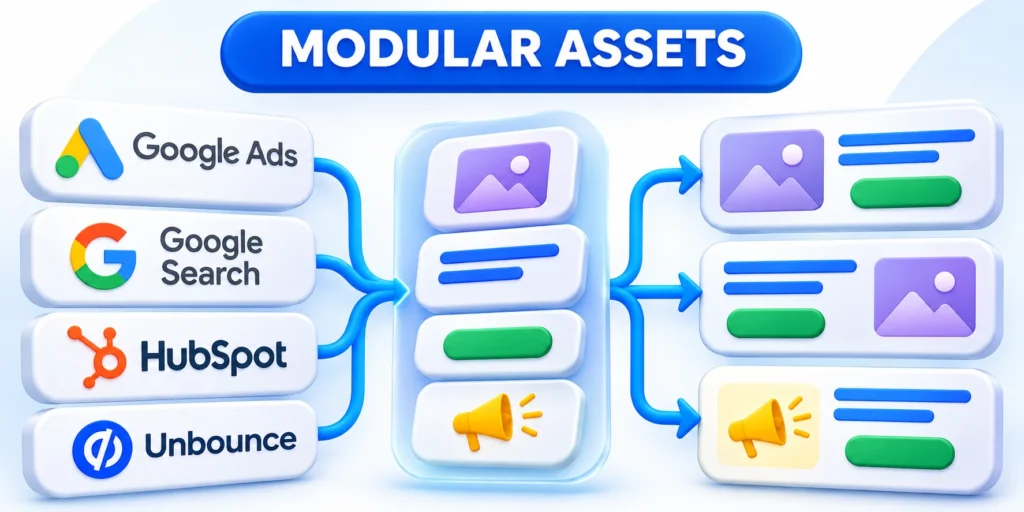
Modular assets should preserve one coherent promise while allowing headlines and descriptions to support different buyer questions without creating contradictory claims.
Include variation in messages, not synonyms. A useful asset set can cover the problem, service approach, proof, region, and next step without repeating the same phrase.
Create landing pages for the query and decision
The page should answer the searcher’s question above the fold without forcing a visitor to decode company jargon. A high-ticket buyer may need both a concise summary and deeper evidence.
Review the landing experience through these qualification elements:
- A headline that matches the search theme and offer.
- A clear explanation of what the service does and does not include.
- Evidence relevant to the buyer’s technical and commercial concerns.
- One specific next step, such as a scoped assessment or consultation.
- Form fields limited to information needed to route or prepare.
- Clear privacy information and accessible consent choices where applicable.
- An option for visitors who are not ready to speak with sales.
An enterprise cybersecurity assessment page should not lead with a generic “We innovate” slogan. It should tell the buyer what is assessed, what evidence they receive, and what prerequisites apply.
Do not hide limitations. If a project requires a supported platform, a minimum engagement, or access to a technical owner, state that before the form where appropriate.
Control message combinations
Group headlines and descriptions that remain accurate together, then review assembled combinations for clarity, repetition, unsupported promises, and conflicting next steps.
Use distinct assets for the buyer problem, relevant proof, service boundary, and requested action rather than repeating one claim across every field.
Review asset evidence regularly
Compare asset performance with query relevance, landing-page fit, valid inquiries, qualification, and opportunity evidence instead of click-through rate alone.
Pause misleading or weak combinations, document the reason, and preserve enough variation for the system to test meaningful alternatives.
Design forms for qualification without excessive friction
Ask for enough information to make a responsible next action possible. More fields can improve context but also reduce completion; the right tradeoff depends on the offer and sales process.
For a high-commitment consultation, useful fields may include organization, business email, role, service region, problem category, and desired timing. Do not collect sensitive personal data unnecessarily.
Reduce friction while preserving useful context
Use optional fields when an answer helps sales prepare but is not required to respond. Explain what happens after submission and provide a confirmation state that actually functions.
For Google-hosted lead forms, check eligibility, required privacy policy links, campaign support, and the current optimization choices. Do not assume every account or industry can use every form format.
Test the complete lead handoff
Test a form and confirm the CRM record, owner, notification, source, and follow-up task. A success message alone does not prove sales received the lead.
Verify confirmation, CRM creation, ownership, notifications, campaign fields, duplicate handling, consent, and the promised response before launch.
Match follow-up to the promise
The first response should reflect the specific offer and the buyer’s stated context. A generic automated email can undermine a strong ad if it ignores the actual request.
Define a service-level expectation internally. The appropriate response time depends on business hours, sales coverage, buyer urgency, and the complexity of the consultation.
Make follow-up relevant and permission-aware
When a request is not sales-ready, deliver the promised resource and offer a useful next step. A download does not grant permission for unrelated promotions.
Audit missed handoffs weekly during the initial test. If inquiries arrive but no owner acts, fix routing before adding spend or changing keywords.
Ask only decision-changing questions
Every required field should improve delivery, qualification, routing, security, scheduling, or preparation for the promised next step.
Audit form value through these practical questions:
- Does the answer change routing or preparation?
- Can approved enrichment provide the information?
- Is the field appropriate for this commitment?
- Will an owner review the response promptly?
Remove fields that nobody uses, repeat known information, or demand sensitive details before a secure process is available.
Measure Qualified Opportunities and Feed Outcomes Back

Measurement should preserve enough context to understand which campaigns create useful conversations. It must also respect consent, data governance, platform policies, and applicable law.
Before implementation, involve the people responsible for advertising, web analytics, CRM, privacy, and sales operations. A tracking change can affect reporting and bidding across an account.
Separate primary conversions from diagnostic events
A conversion setup might track forms, calls, consultations, accepted leads, opportunities, and sales. These events serve different purposes; they are not interchangeable bidding targets.
Choose the campaign goal explicitly. If a campaign optimizes for low-quality form completions, it may find more people likely to submit forms rather than buyers likely to progress.
Separate bidding goals from diagnostic signals
Keep useful diagnostic events, but distinguish them from bidding actions. Check each action’s primary or secondary setting and whether the campaign uses its goal.
Test each event and document the expected record. Do not treat clicks or thank-you views as valuable outcomes unless they represent the intended business event.
Preserve first-party and click context responsibly
With platform and consent permission, capture campaign parameters and click identifiers for later CRM stages. Define retention, access, and deletion rules.
Do not place personal information in URLs or UTM values. Use controlled values such as campaign, source, medium, and content identifiers, and avoid ad hoc naming that creates duplicates.
Check data continuity across the journey
Verify that redirects, schedulers, consent tools, and CRM integrations preserve campaign data. If the saved lead lacks a field visible in the browser, trace the handoff.
The person responsible for the data should verify the allowed transfer method, hashing requirements, notice, and consent configuration. Hashing is not a substitute for permission or a complete privacy program.
Reconcile advertising with CRM evidence
Marketing and sales should compare campaign records with accepted leads, opportunity stages, disqualification reasons, revenue timing, and unresolved data gaps.
Reconcile performance through these shared records:
- Campaign and query context stored with the inquiry.
- Qualification, acceptance, and disqualification evidence.
- Opportunity value, stage, owner, and creation date.
- Revenue outcome and material attribution limits.
Use discrepancies to repair definitions, integrations, ownership, or reporting before they influence bidding and budget decisions.
Return mature outcomes to the advertising system
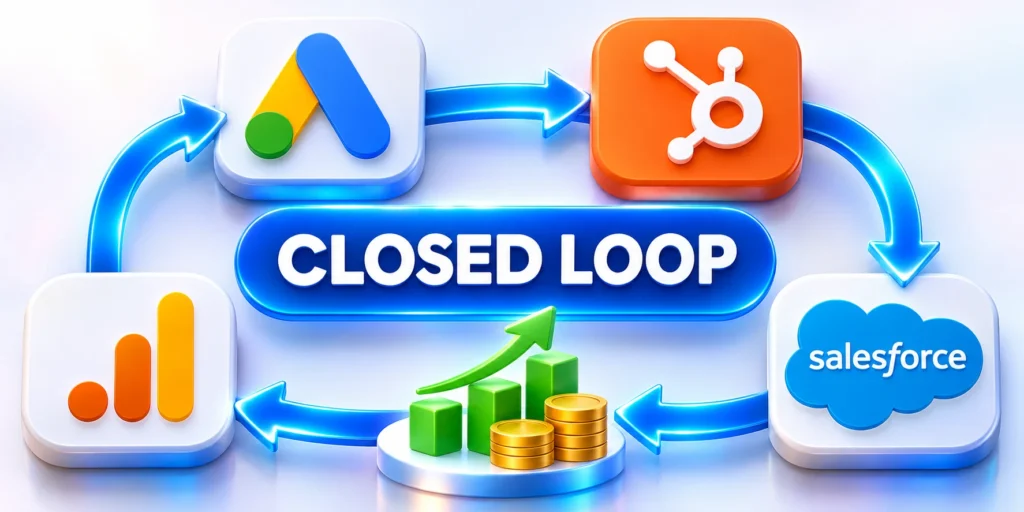
Offline outcomes can connect mature sales results to earlier clicks. The implementation must follow current Google Ads requirements.
Google’s lead conversion setup guide uses Data Manager for enhanced conversions and offline measurement. Older upload instructions may no longer apply.
Choose one meaningful offline outcome
Choose one meaningful stage for optimization rather than importing every status change as an independent conversion. Duplicate events, inaccurate timestamps, inconsistent identifiers, and retroactive edits can distort learning.
Create a reconciliation process between the CRM and ad platform. Compare counts by event name, date, campaign, and upload status, then investigate accepted, rejected, or duplicated records.
Use a simpler approach when imports are unreliable
If secure offline imports are impractical, use simpler valid measurement and analyze mature outcomes in the CRM. Avoid fragile integrations just to claim advanced attribution.
Keep offline results visible in reporting while repairing identifiers, timestamps, duplicates, permissions, and CRM stage definitions before automated optimization.
Keep a measurement change log
Record the conversion action, source system, owner, date, campaign impact, and validation method for every material tracking change. This reduces confusion when reporting shifts after a tag or goal update.
Before changing a live campaign goal, capture its configuration and affected campaigns. Change one logical area, then verify the data before proceeding.
Diagnose tracking failures before demand
If reported conversions suddenly disappear, check tag status, consent behavior, form changes, CRM mapping, upload errors, and date windows before assuming demand has collapsed.
The goal is not perfect multi-touch attribution. It is a transparent, repeatable view that helps the team decide what to improve without confusing modeled platform results with accounting revenue.
Protect the offline feedback loop
Send only supported outcomes with reliable identifiers, timestamps, stage definitions, permissions, and documented governance appropriate to the business process.
Validate the feedback loop through these controls:
- Use one documented event definition consistently.
- Reject duplicates and invalid timestamps before import.
- Compare upload results with CRM source records.
- Pause optimization when outcome quality becomes unreliable.
Monitor accepted, rejected, delayed, and unmatched records so missing feedback does not silently distort campaign learning.
Optimize Bids, Budgets, and Search Quality Without Chasing Noise

Optimization should follow a diagnosis, not a reaction to one day of data. In high-ticket B2B, conversion delays and small sample sizes make short-term fluctuations especially easy to misread.
Set a review cadence that matches the sales cycle. Inspect technical delivery and tracking frequently, but make strategic bid or budget changes only when evidence supports the decision.
Review search-term evidence in context
Inspect actual queries and search-category insights to learn buyer language. Intent summaries help, but do not replace reviewing available details.
Google’s Search terms insights guide describes current reports. Interface labels can change, so confirm them in the account.
Diagnose queries with stage and page evidence
Compare query relevance, spend, conversion stage, and landing-page fit. Use the guide to suspected click fraud when traffic anomalies warrant investigation.
Apply exclusions when the term clearly conflicts with the service, geography, audience, or offer. Keep a record so a later reviewer can understand and reverse the decision if needed.
Select bidding based on measurement readiness
Automated bidding depends on the goals and data sent to the system. Use conversion-focused strategies only when conversion tracking represents the business action the campaign should pursue.
Maximize conversions and maximize conversion value serve different goals. The former seeks more recorded conversions within budget; the latter considers assigned values. Neither makes inaccurate conversion values meaningful.
Match bidding strategy to data readiness
Start with a clear, observed outcome and review the current campaign’s eligibility and settings. Do not copy a target CPA or return-on-ad-spend number from another account without a business case.
If a campaign has limited data, test simpler structures and goals. Splitting a small amount of traffic across many campaigns can make decisions less reliable.
Prioritize the earliest meaningful constraint
Find the first stage where observed results diverge from the campaign hypothesis, then assign the issue to the team controlling that stage.
Choose optimization through these diagnostic priorities:
- Repair serving or tracking before judging demand.
- Correct query and offer mismatch before bidding.
- Fix routing delays before buying more inquiries.
- Protect delivery capacity before expanding qualified volume.
Change one interpretable variable when practical and preserve enough time for the relevant conversion stage to mature.
Budget from unit economics and sales capacity
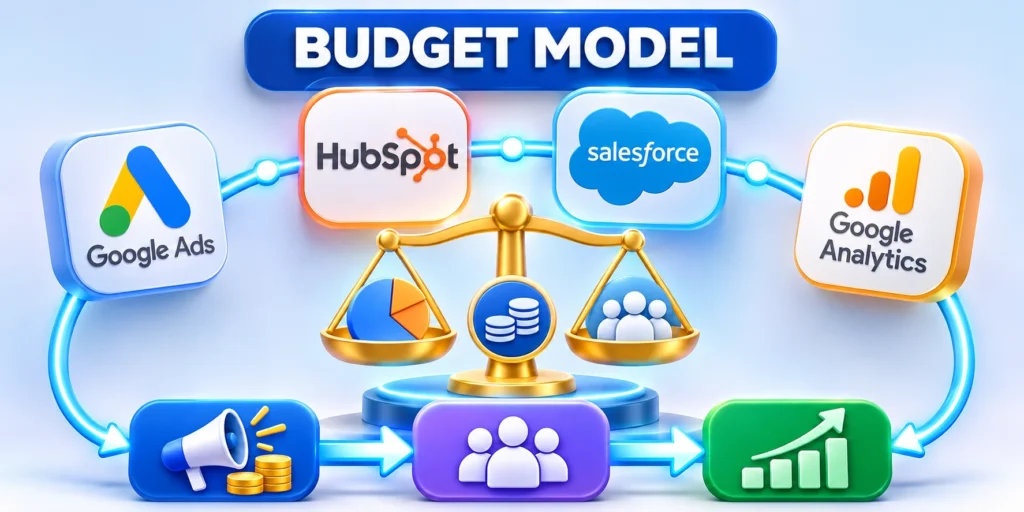
Set a test budget from your economics, demand, and response capacity. Treat B2B SaaS acquisition cost benchmarks as context for that decision.
A practical planning worksheet can include:
- The maximum spend the business can test without compromising delivery or cash needs.
- The observed or hypothesized cost per click range, labeled with its source.
- Expected valid inquiries and qualification rates, with confidence limits.
- Sales capacity for follow-up and delivery capacity for won work.
- The decision date and minimum evidence required to expand, revise, or stop.
Use scenarios rather than a single forecast. A base case can use historical rates; an adverse case can test what happens if clicks cost more or qualification falls.
Do not increase budget merely because the campaign is spending its current amount. Check marginal lead quality, opportunity creation, and sales capacity first.
Run controlled experiments
Write the hypothesis before changing a major variable. For example: “A service-specific landing page will improve qualified-opportunity rate for migration searches compared with the general services page.”
Identify what changes and what stays fixed. Avoid simultaneously changing keywords, bidding, landing page, form length, and qualification rules, because the result will not explain which change mattered.
Limit each test to an interpretable change
Set a review window that accounts for conversion delay and traffic volume. If the evidence remains inconclusive, report that outcome rather than declaring a winner.
Protect the original configuration in a reversible change log. Where platform experiments are available and appropriate, follow their current setup requirements instead of manually splitting traffic without a design.
Diagnose results by stage
Diagnose performance through these stage-specific signals:
- Few impressions: review eligible demand, targeting, budget constraints, approval status, and campaign settings.
- Clicks with weak engagement: compare query intent, ad promise, page relevance, and load experience.
- Forms without valid inquiries: inspect traffic quality, spam controls, offer clarity, and form behavior.
- Qualified inquiries without sales acceptance: review targeting, qualification definitions, routing, and service fit.
- Accepted leads without opportunities: inspect discovery quality, buyer timing, pricing, and follow-up.
- Opportunities without revenue: review pipeline progression, deal loss reasons, and sales-cycle maturity.
Do not ask advertising to solve a delivery or sales problem that occurs after the click. Put each issue with the team that controls the relevant stage.
Compare the diagnosed constraint with representative records before changing spend, because aggregate rates can conceal routing failures or unsuitable segments.
Launch a 90-Day High-Ticket Search Program
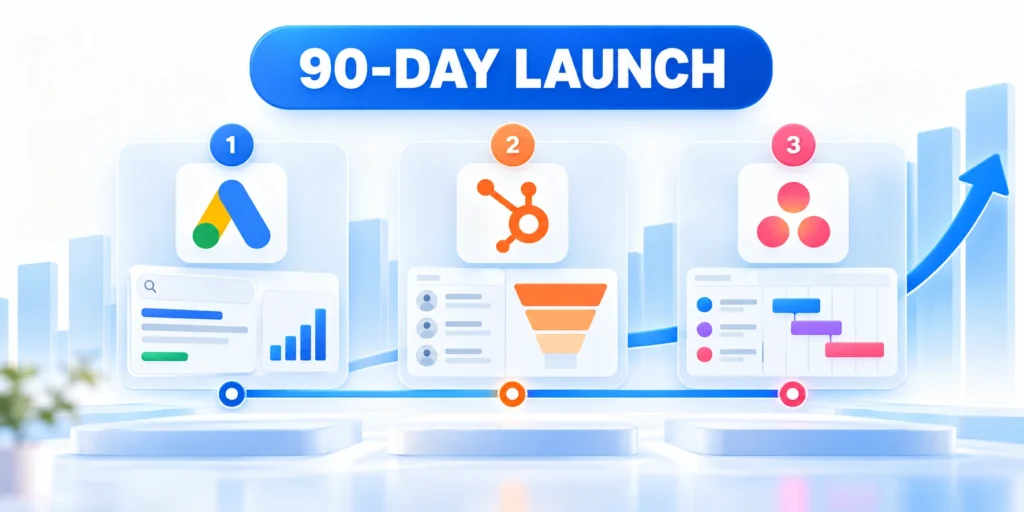
A 90-day plan sets a decision rhythm, not a promise that a long sales cycle will mature. Use it to measure, test intent, and choose the next investment.
Use the sequence below to assign work, review evidence, and decide whether to expand the program.
Days 1–30: establish the operating foundation
Document the customer profile, business problem, supported offer, regions, sales capacity, and exclusions. Confirm that marketing and sales agree on what counts as a valid inquiry, qualification, acceptance, and opportunity.
Review existing search demand, customer language, paid account history, and the current landing experience. Separate assumptions from observed evidence in the campaign brief.
Prepare campaigns and measurement before launch
Configure the smallest campaign structure that preserves necessary budget, geography, and goal controls. Prepare the landing page and follow-up route before activating traffic.
Test conversion events from the website to the CRM. Validate ownership, notification, campaign fields, consent behavior, deduplication, and reporting before using the event for bidding.
Set the initial decision criteria
Set a bounded initial budget and define what evidence would justify a change. This keeps the launch accountable even if the first traffic is sparse.
Document which evidence justifies holding, revising, expanding, or pausing the test so the first review does not invent success criteria afterward.
Days 31–60: test a focused hypothesis
Launch the most clearly supported search themes and review the actual traffic. Avoid adding broad adjacent topics merely to increase impressions.
Check ad approvals, query relevance, tracking, page performance, response routing, and lead validity. Fix broken operations promptly, but keep strategic changes limited enough to interpret.
Use one decision record across the program
The operating record should connect the hypothesis, campaign settings, responsible owners, observed evidence, changes, unresolved risks, and next review date.
Maintain the program through these decision records:
- Baseline settings and approved conversion definitions.
- Weekly evidence, decisions, owners, and deadlines.
- Experiment changes and preserved comparison conditions.
- Scale, revise, pause, or stop rationale.
This record prevents later reviewers from confusing platform activity with a deliberate business decision or repeating an inconclusive test.
Use sales feedback to refine qualification
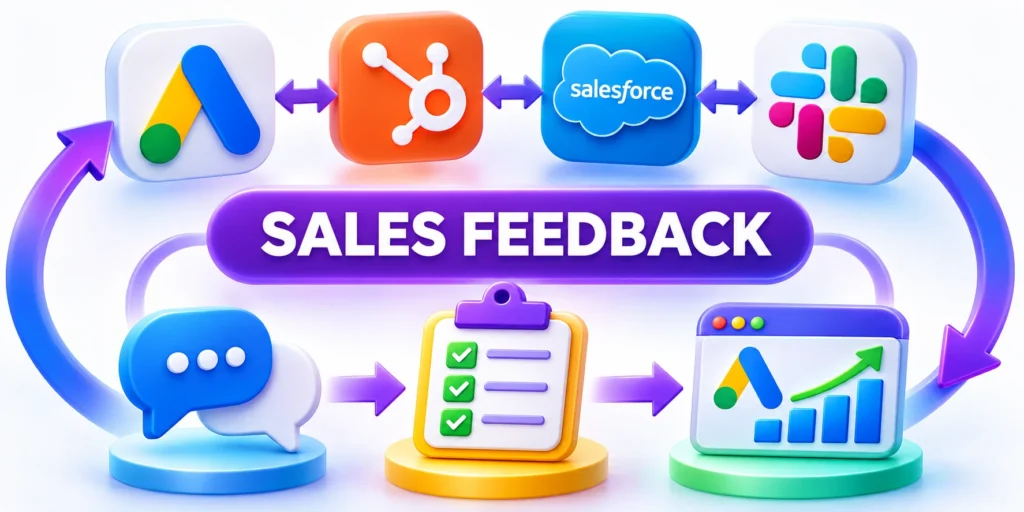
Ask sales to record acceptance and disqualification reasons consistently. Review a small set of records together so the team can spot problems in the definitions or handoff.
Add negative keywords only when evidence shows a clear mismatch. A relevant query without a mature conversion needs more evaluation before exclusion.
Days 61–90: choose a deliberate next investment
Compare the observed results with the campaign brief and base/adverse scenarios. Separate early indicators from mature opportunities, and label cohorts whose sales cycle is still open.
Decide among three actions: scale a proven segment within capacity, revise a specific weak stage, or pause a segment that consistently attracts unsuitable demand.
Scale, revise, or pause based on evidence
To scale, add budget gradually and preserve a baseline. For a revision, state the hypothesis and change one variable. When pausing, retain evidence for future decisions.
Document lessons, remaining uncertainty, and the next decision owner. A campaign report should support a business choice, not merely list platform metrics.
Sample weekly operating review
Run the weekly operating review through these steps:
- Confirm spend, serving status, policy approvals, and measurement health.
- Review query themes and obvious relevance or geography problems.
- Compare valid inquiries, qualification, acceptance, and opportunity movement.
- Check unworked leads and agree on owners for overdue next actions.
- Decide whether to hold, fix, test, or scale one part of the program.
- Record the decision, evidence, owner, and date for the next review.
Avoid turning every meeting into a bid adjustment session. Some weeks the correct outcome is to hold settings while enough evidence accumulates.
Carry unresolved decisions into the next review with an accountable owner, due date, and the evidence required for closure.
Turn feedback into a controlled change
Translate recurring sales evidence into one documented adjustment to targeting, exclusions, offer language, form questions, routing, or qualification criteria.
Recheck the resulting cohort before adopting the change broadly, because individual objections may not represent a repeatable market pattern.
Conclusion
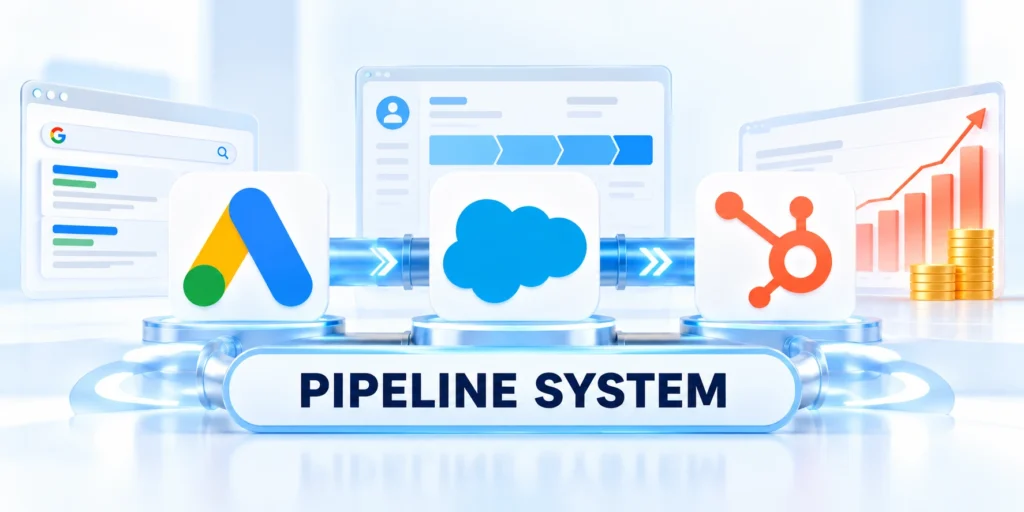
A high-ticket B2B Google Ads program works when buyer intent, service fit, campaign structure, qualification, measurement, sales response, and delivery capacity remain aligned.
Treat search as a pipeline system with explicit decisions, observable outcomes, reliable ownership, and controlled learning rather than a source of isolated clicks.
Operate one accountable pipeline
Marketing, sales, finance, and delivery should share definitions for valid inquiries, qualification, acceptance, opportunities, revenue, capacity, and campaign economics.
Keep the operating system reliable through these controls:
- Match campaigns to supported buyer problems and services.
- Preserve query, conversion, and CRM context.
- Route every inquiry to an accountable owner.
- Review qualification, opportunity, revenue, and capacity evidence.
- Document experiments, uncertainty, and stopping rules.
Review representative records beside aggregate reports so favorable averages do not hide unsuitable demand, broken handoffs, or unresolved opportunities.
Improve the earliest failed stage
When performance disappoints, locate the first stage that diverges from expectations and assign the correction to the team controlling that stage.
Do not ask bidding changes to repair an unsupported offer, unclear page, broken form, delayed response, weak discovery, or unavailable delivery capacity.
Scale only supported learning
Increase budget, reach, or campaign breadth gradually while qualified outcomes, response quality, economics, buyer experience, and delivery capacity remain acceptable.
Pause expansion when measurement gaps, inconsistent definitions, or operational limits prevent a responsible interpretation of additional volume.
Preserve the next decision
Finish each review with the evidence, limits, decision, accountable owner, next action, review date, and condition that would change the conclusion.
For a focused companion topic, read How to Structure Google Ads Bidding for High-Ticket Services.
Keep the system decision-ready
Retain the approved baseline, current definitions, unresolved risks, experiment history, and responsible owners where future reviewers can verify them.
That discipline lets the team improve one constraint without losing the evidence needed to explain earlier campaign and pipeline decisions.
FAQ
These answers clarify common Google Ads planning, qualification, measurement, budgeting, and operating questions for high-ticket B2B services.
Is Google Ads effective for high-ticket B2B services?
Search can work when buyers actively seek the problem and the company can serve them. Demand, economics, sales-cycle length, and follow-up capacity shape the test.
The platform does not guarantee qualified opportunities. Measure what sales accepts and what progresses, not only clicks or form fills.
How much should a B2B company spend on Google Ads?
There is no universal budget. Base a test on the company’s unit economics, available search demand, acceptable risk, and sales capacity.
Use scenarios and a review date. Treat projected leads as estimates, not guaranteed delivery.
Should a B2B campaign optimize for leads or opportunities?
Use the most valuable stage with accurate, timely data. Opportunities may be better than raw leads, but occur too rarely or too late for a new campaign.
Keep intermediate events visible and choose the bidding goal deliberately.
Are broad-match keywords appropriate for B2B?
They can discover relevant queries, but they need clear conversion goals and regular quality review. Broad matching is not a shortcut around keyword research or sales qualification.
Check actual query themes, account settings, and current platform guidance before expanding reach.
How many keywords should an enterprise campaign use?
There is no ideal fixed count. Organize around distinct buyer problems and keep each group coherent enough to match its ad and landing page.
A focused structure is easier to manage than a large list of near-duplicate phrases.
Should every paid-search visitor see a form?
No. A form is appropriate when the user needs to request a service, consultation, or other gated outcome. Early researchers may benefit more from a useful ungated explanation.
Match the commitment to the intent and explain what happens after submission.
How can marketing tell if Google Ads creates qualified pipeline?
Connect campaign context to CRM stages, define qualification and acceptance, and report opportunities with spend and cohort timing. Reconcile the stages with sales records.
Use platform attribution as an optimization aid, not as an unquestioned accounting source.
Can a company import offline sales outcomes to Google Ads?
Yes, when the company meets current platform, consent, data, and technical requirements. The supported workflow can change, so check the current Google Ads documentation before implementation.
Validate identifiers, timestamps, duplicates, upload errors, and data governance with the CRM and privacy owners.
How long should a B2B Google Ads test run?
The review period depends on traffic, conversion delay, and the sales cycle. A fixed number of days cannot guarantee enough evidence for every business.
Set the decision window before launch and label open opportunities as immature rather than failed.
What should a business do when clicks arrive but leads do not?
Compare search intent, ad promise, landing-page relevance, form usability, tracking, and consent behavior. Confirm that the event can actually be recorded before changing bids.
Fix the earliest broken stage and document the test; do not change every campaign setting at once.





Leave a Reply