


The Role of Webinars in High-Ticket Consulting Sales
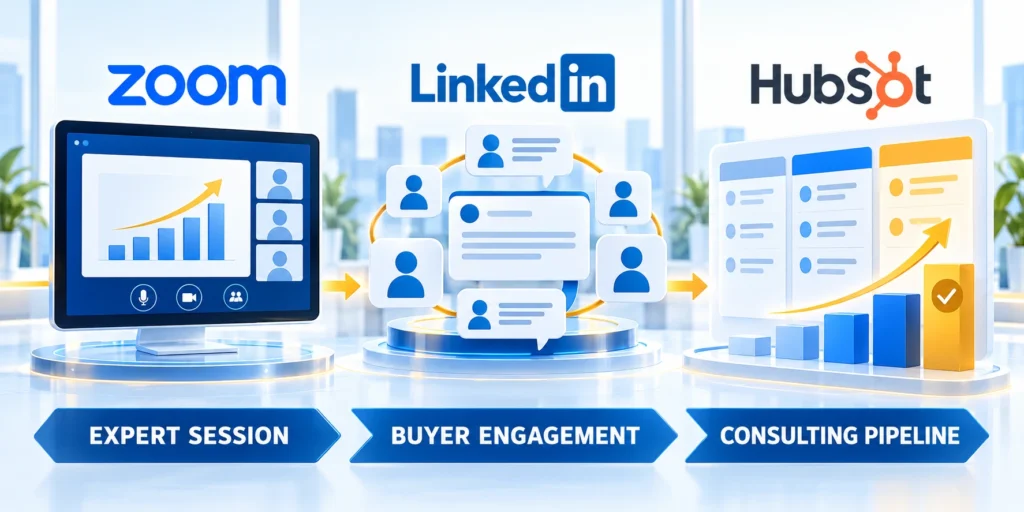
A webinar marketing strategy for high-ticket consulting can help firms demonstrate how they think before buyers commit to a costly engagement.
Its job is to make a costly business problem clearer and give the right participants a credible next step.
Use the event to reduce decision risk
Consulting buyers are not purchasing a standard box of features. They are evaluating judgment, expertise, delivery risk, internal effort, and the consequences of choosing poorly.
A well-designed session makes part of that evaluation observable. It shows the reasoning behind a recommendation, the assumptions that matter, and the questions a responsible team should ask.
Use webinars for these bounded decision-support jobs:
- Explain a costly buyer problem
- Compare credible operating choices
- Show evidence and practical limits
- Clarify an optional next step
A strong session helps buyers prepare for a serious conversation without pretending that one group presentation can replace discovery. Stakeholder alignment, or a tailored consulting recommendation.
Teach a method without replacing a tailored assessment
This does not mean giving away a complete engagement. Teach a useful diagnostic or decision method, then explain which evidence requires a tailored assessment.
Show enough of the decision framework to help attendees evaluate their situation, while reserving organization-specific diagnosis. Prioritization, and implementation choices for a relevant follow-up conversation.
Know when a webinar is the wrong format
A webinar is a poor choice when buyers need private advice. The topic depends on confidential facts, or the audience cannot spare time for a group session.
In those cases, a short diagnostic call, a private workshop. Or a written assessment may create more value with less friction.
Choose a group session only when it adds value
Use a webinar when one focused lesson can help several members of a buying group understand the same decision.
Use a group setting when participants benefit from a shared problem, comparable evidence. And visible questions rather than confidential details requiring an individual advisory session.
Choose a Webinar Offer Around One Costly Buyer Problem

Start with a decision the target buyer already needs to make, not with the consulting firm’s service list.
A narrow problem makes the invitation easier to understand and the session easier to deliver credibly.
Describe the decision in the buyer’s language
Interview recent clients, sales staff, and delivery consultants about the decisions that preceded successful projects.
Record the trigger, the cost of delay, the teams involved, the evidence buyers lacked, and the alternatives they considered.
Define the offer with these buyer-facing elements:
- Costly decision and affected role
- Current risk or operational friction
- Evidence participants will examine
- Practical takeaway and next step
Turn the decision into a participant takeaway
For example, “improve operations” is too broad. “Decide whether to standardize a fragmented revenue process before expanding into another region” names a concrete decision.
Then write one sentence describing the session’s practical outcome. A participant might leave with a risk checklist, a prioritization method, or a draft decision brief.
Set Buyer Decision Criteria Before Promotion
Specify the buyer decision, current risk, available evidence, participant role. Desired learning outcome, and practical limit before finalizing an offer or registration promise.
This keeps the session focused on a decision participants can evaluate rather than a broad topic that attracts curiosity without creating a useful basis for consulting follow-up.
Confirm these offer criteria before announcing the session:
- Named buyer role and costly decision
- Evidence participants will receive
- Practical outcome and teaching boundary
- Optional next step and owner
Design the Webinar Format and Teaching Boundary
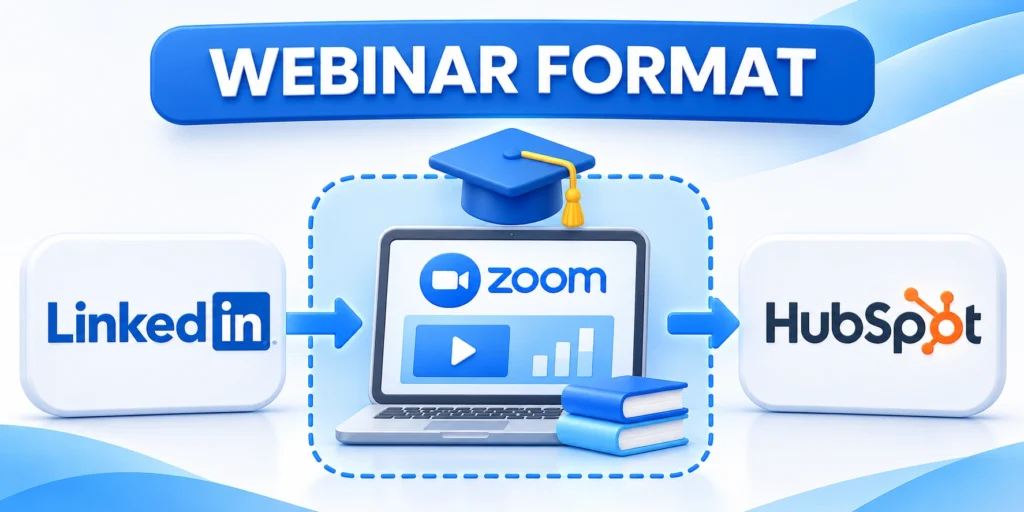
Format determines how much interaction, confidentiality, preparation, facilitation, follow-up, and buyer work the session can safely support.
Set the teaching boundary before promotion so the promise is useful, specific. And realistic for a group experience rather than an undeclared consulting engagement.
Match the format to the decision
Choose the delivery format according to the audience’s need for interaction. The sensitivity of the topic, and the available production capacity.
| Format | Best fit | Trade-off |
|---|---|---|
| Live briefing | Questions and current discussion | Speaker backup needed |
| Interactive workshop | Applying a framework | Facilitation and privacy controls |
| On-demand session | Flexible schedules | Less live discovery |
| Live plus recording | Interaction and later access | Separate follow-up paths |
Choose one primary format and one fallback. Do not add polls, breakout rooms, or a panel simply to make the event look more elaborate.
Choose format from the buyer task, time sensitivity, confidentiality, expected interaction. Speaker availability, and the practical work participants should complete during or after the session.
Set these format decisions before promotion:
- Buyer task and confidentiality level
- Interaction and facilitation requirement
- Speaker, moderator, and backup plan
- Recording and follow-up expectation
Set a useful boundary for the teaching
Teach a repeatable method that helps participants make progress without pretending that one presentation can diagnose every organization.
State the assumptions behind examples. Label hypothetical scenarios clearly, and do not present invented client outcomes as evidence.
Connect the invitation to the lesson
Keep the service invitation connected to the lesson. Offer a next-step assessment only when its scope, audience, and expected output are clear.
Describe the specific decision the session will clarify, the evidence participants will receive. And the optional next step without promising a generic transformation or sales pitch.
Build Registration and Promotion Around the Buying Group
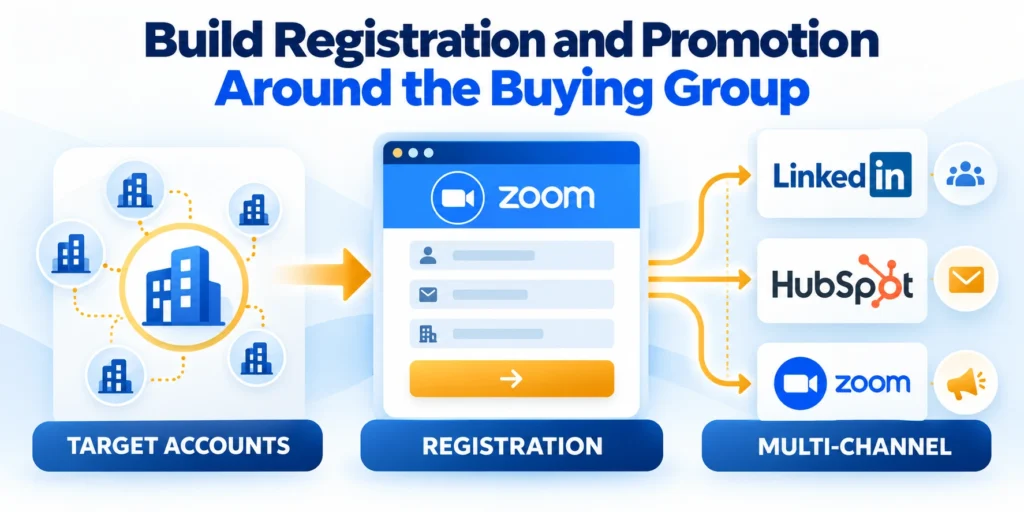
Registration should tell buyers exactly what they will learn and help the team understand who is attending.
Promotion should reach relevant roles with a consistent promise, rather than maximizing registrations from people unlikely to use the advice.
Write a specific registration promise
Use a title that names the decision or outcome. Avoid vague titles such as “The Future of Transformation” unless the session truly addresses a broad executive briefing.
The registration page should state who the event is for, what participants will be able to do. Who is presenting, and how the recording will be handled.
Keep registration fields decision-useful
Keep the form proportionate. Name and work email may be enough for an open briefing; add role, company. Or a single challenge question when the answers change follow-up.
Do not require a phone number or detailed budget just because the consulting team wants more fields. Every field should support the event or a transparent next step.
Coordinate channels without flooding the same audience
Use channels where the target buying group already pays attention: client newsletters. Expert posts, partner communities, account outreach, or paid promotion.
Choose a channel based on audience access, trust, cost, and the ability to identify qualified participation. Do not assume one channel will perform equally across roles.
Track promotion and set a clear schedule
Give each channel a distinct tracking value. Google Analytics campaign parameters distinguish sources. Media, and campaign names in acquisition reporting.
For example, use one campaign name across the event and separate source values for a client newsletter. LinkedIn post, and partner email.
Coordinate these promotion checkpoints before the event:
- Initial invitation and buyer relevance
- Reminder with useful session context
- Final attendance and access details
- Post-event resource and next step
Use a simple promotion sequence
Set a modest promotion calendar: announce the problem, share a useful preview. Send a final reminder, then stop routine invitations after registration closes.
Coordinate invitation, reminder, value preview, final notice. And post-event follow-up around the buyer schedule so the same audience receives useful context rather than repeated generic messages.
Coordinate Promotion, Partners, and Delivery

Promotion quality depends on delivery readiness, audience fit, partner alignment, consent. Routing, speaker availability, and a shared understanding of the lesson and next step.
Coordinate these elements before invitations go live so the program creates useful conversations instead of avoidable no-shows. Unclear expectations, or unsupported follow-up.
Align sales and delivery before the invitation goes out
Agree on the ideal account, relevant roles, disqualifying conditions, follow-up owner, and what counts as a qualified request.
Tell sales what the webinar covers and what it does not promise. Give the delivery team a way to flag technical questions requiring a private answer.
Confirm these delivery commitments before inviting buyers:
- Registration and consent ownership
- Speaker, moderator, and recording coverage
- Sales routing and response expectation
- Attendee and no-show follow-up
Choose partners for audience fit
A partner can add trust and reach when its audience overlaps with the intended buying group and its contribution improves the lesson.
Agree on audience ownership, registration fields, promotion dates, recording access. Brand review, and who answers questions before announcing a joint event.
Measure partner contribution by quality
Use a distinct campaign source for each partner. Afterward, compare qualified participation and requested next steps, not just the number of names delivered.
Use these actions to measure partner contribution by quality:
- Assign one owner for registration data and consent settings.
- Confirm speaker availability, moderator coverage, and recording permissions.
- Prepare an attendee reminder and a separate no-show follow-up.
- Test the registration, calendar, join, recording, and unsubscribe paths.
Compare partner-sourced registrations, attendance, buyer fit, questions, accepted meetings. And downstream outcomes before repeating a channel or treating raw reach as proof of contribution.
Run the Session and Make the Next Step Clear

A polished event is less important than a useful session that delivers the promise made on the registration page.
Prepare the speaker, moderator, technology, and follow-up action as one coordinated experience.
Use an agenda that protects the teaching time
For a 45-minute briefing, a practical agenda could allocate five minutes to context. Twenty-five to teaching, ten to questions, and five to the next step.
For a workshop, reserve more time for guided application and less for introductory slides. Tell participants what materials they need before joining.
Protect these agenda elements during the session:
- Buyer problem and decision context
- Method and supporting evidence
- Questions with stated boundaries
- Optional next step and resources
Assign moderation and test the fallback
Use a moderator to watch chat, group related questions, handle housekeeping, and help the presenter stay on time.
Run a rehearsal with the actual presentation, audio, links, polls, recording settings, and backup host. Keep a dial-in or alternate meeting route ready.
Use interaction to clarify buyer needs
Use a poll only when its answer changes the teaching or helps participants compare their situations.
For example, ask which constraint most slows a project: unclear ownership, fragmented data, implementation capacity, or executive alignment.
Interpret responses as feedback, not market research
Discuss the result without implying that a small live poll represents the entire market. Invite participants to explain context in the question period.
Treat polls, questions, and chat as directional evidence from a self-selected audience. Then compare patterns with sales conversations, pipeline evidence, and broader market research.
Protect Delivery Quality and Buyer Attention
Use moderation, accessibility, timing, technical fallback, question boundaries. And a clear agenda to protect the teaching experience and help attendees stay oriented throughout the session.
When delivery friction appears, resolve it quickly, preserve the promised resource path. And record the issue for the next event instead of filling the remaining agenda with unscripted promotion.
Review these delivery safeguards before every session:
- Moderator and speaker roles
- Platform, caption, and backup checks
- Question and privacy boundaries
- Attendee support and escalation route
Design the Optional Next Step

High-ticket buyers should be able to act on the lesson without accepting an unwanted sales interaction. While people with a live need need a clear route to relevant help.
Design the optional next step around the decision evidence presented. The attendee context, and the accountable follow-up capacity available after the event.
Make the call to action relevant and optional
Offer one primary next step that follows naturally from the lesson. Such as a scoped readiness review or a working session.
Explain who the next step serves, what the participant should prepare. What the firm will provide, and whether the conversation is commercial.
Offer these paths after a useful session:
- Download the promised resource
- Review a related decision guide
- Request a relevant assessment
- Subscribe to future educational sessions
Give participants a non-sales option
Give people a useful alternative if they are not ready to talk: a worksheet, recording, or follow-on resource they requested.
Do not imply that attendance proves purchase intent. A participant may be researching, learning, or sharing information with colleagues.
Support Self-Directed Buyer Progress
Offer a useful resource, decision guide, recording. Or future educational session for attendees who need time to apply the lesson before considering a direct consulting conversation.
This path respects buying-group timing while preserving a clear way to return when the buyer has stronger evidence. Stakeholder alignment, or a defined need for tailored help.
Provide these non-sales paths after the session:
- Replay with promised supporting resource
- Decision guide for internal discussion
- Related educational session invitation
- Relevant assessment when readiness increases
Turn Attendance into Qualified Consulting Conversations

Follow-up should reflect what people did and what they asked, while respecting the communication choices they made.
Use the session to improve the next conversation, not to label every registrant as a sales lead.
Separate follow-up by meaningful behavior
At minimum, distinguish attendees from registrants who did not attend. Also note requested follow-up, questions, resource downloads, and account fit when those signals are available.
Send the promised recording or materials to the full eligible audience. Keep the message useful, concise, and consistent with the stated communication preferences.
Distinguish follow-up using these observed signals:
- Explicit request for a conversation
- Relevant question or stated priority
- Attendance and promised resource request
- No-show requiring a useful replay path
Route requests with context and an owner
When a participant asks for a conversation. Route that request to an assigned owner with the question and relevant account context.
For engaged attendees without an explicit request, offer a relevant resource or a low-pressure invitation. Avoid treating attendance duration as proof of buying readiness.
Preserve Context Through the Handoff
Include the webinar topic, attendee question, stated priority, company context, consent status. Requested action, and expected response window when transferring a request to sales or delivery.
The receiving owner should know which lesson the attendee received and which claims or boundaries shaped the request. Avoiding a generic outreach that repeats the session or misreads intent.
Preserve these handoff details for every request:
- Topic, session, and attendance context
- Question, priority, and requested action
- Consent and communication preference
- Named owner and response deadline
Route Attendance Into Qualified Consulting Follow-Up
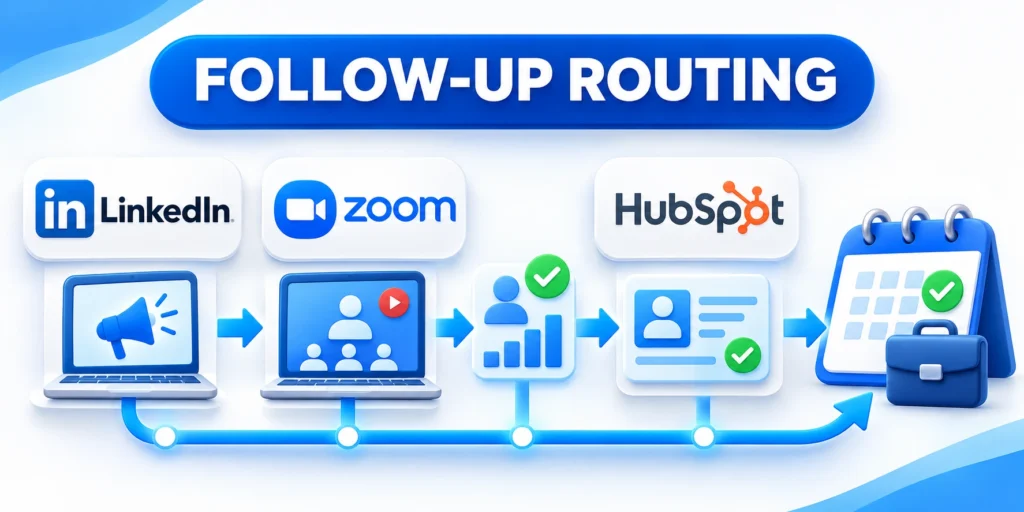
Attendance becomes useful when the team preserves context, differentiates meaningful behavior. Responds within an agreed window, and connects the request to a suitable consulting path.
Use a short workflow that protects consent and relevance while allowing sales, delivery. And marketing to learn from accepted meetings and downstream opportunity evidence.
Set up a short operational workflow
Before launch, document the workflow in the marketing automation or CRM system already used by the firm.
Follow this sequence to set up a short operational workflow:
- Capture registration source, campaign, company, role, and communication preferences.
- After the session, sync attendance and requested actions to the contact record.
- Route explicit consultation requests to the named owner with a response target.
- Send the recording and promised resources to eligible registrants.
- Review accepted meetings and qualified opportunities with sales after the agreed observation window.
Test the workflow with internal test contacts before the event. Confirm that opt-outs are respected and records are not duplicated.
Record these follow-up controls for each event:
- Source, company, role, and consent
- Attendance and requested action
- Named owner and response target
- Accepted meeting and opportunity outcome
Measure outcomes that connect to consulting revenue
Track operational measures, audience quality, and downstream commercial outcomes separately. This helps the team diagnose weak promotion without confusing activity with value.
| Question | Measure | Next action |
|---|---|---|
| Did delivery work? | Join success and attendance | Fix delivery friction |
| Did target buyers attend? | Account share and roles | Adjust offer or channel |
| Did it create a next step? | Reviews and accepted meetings | Improve lesson transition |
| Did it support outcomes? | Qualified opportunities | Compare sales-cycle cohorts |
Define the attribution approach before the event. A webinar can influence a buying process without being its only source or cause.
Review results by account, role, offer, and source when sample sizes permit. Small events often produce directional learning rather than statistically reliable comparisons.
Use the review to improve the next event
Compare the promise with the actual questions. Repeated questions may point to a missing explanation, a better follow-up asset, or a narrower next topic.
If registrations are relevant but attendance is weak, investigate scheduling, reminders, and access friction before changing the audience strategy.
Connect event learning to the broader program
If attendance is strong but no qualified next steps follow, review the problem choice. Teaching quality, qualification definition, and call to action.
For deeper campaign planning. Connect the event to a broader B2B demand generation system rather than evaluating it as an isolated tactic.
FAQ
These answers address length, format, forms, follow-up, attendance, topics, recordings, questions, sales readiness, and when to pause a webinar series.
How long should a webinar for consulting buyers be?
Use the shortest format that can deliver the promised outcome. A focused briefing may fit within 30 to 45 minutes, while a working session may need longer.
Should a consulting webinar be live or on demand?
Choose live delivery when questions and interaction matter. Offer on-demand access when scheduling flexibility matters, and explain how questions can be handled afterward.
How many registration fields should the form include?
Request only information needed to deliver the event, understand fit, or honor the next step. Remove fields that do not change an operational decision.
Should every attendee receive a sales call?
No. Prioritize explicit requests and agreed qualification signals. Send promised materials to everyone eligible, then offer relevant follow-up without assuming attendance equals purchase intent.
What if attendance is low?
Review audience fit, topic clarity, promotion reach, timing, and registration friction before changing the content. Interview registrants and target buyers for context.
For the broader framework, read AI in B2B Marketing: Automating Workflows and Analytics.
How should a webinar topic be selected?
Choose a narrow buyer decision supported by sales questions, delivery experience, search evidence, and useful examples. Avoid broad themes without an actionable outcome.
Should webinar recordings be gated?
Choose based on audience value, follow-up, consent, and measurement needs. Test whether gating improves qualified response without blocking useful access.
How should questions be handled after the event?
Answer safely during the session when possible, then route unresolved questions to a named expert. Preserve context and the promised response time.
What makes a webinar lead sales-ready?
Use account fit, role, stated problem, requested action, timing, and relevant engagement. Attendance alone does not prove buying intent.
When should a webinar series be paused?
Pause when quality, consent, production, follow-up, or business safeguards fail, or when repeated events do not support the approved hypothesis.
Conclusion

A high-ticket consulting webinar works when it addresses one costly buyer decision with useful evidence. Honest boundaries, reliable delivery, and an optional path to a relevant next conversation.
Treat the event as an operational service rather than a one-off promotion. That means coordinating the offer, invitation, registration, teaching, moderation, follow-up, measurement, and improvement cycle.
Run each webinar as an accountable service
Prepare the full journey from invitation through recording, questions, handoff. And review so buyers receive the lesson promised and internal teams can respond responsibly to real interest.
Use the evidence from attendance, questions, accepted meetings. And sales outcomes to improve the next session without treating a self-selected audience as a complete market sample.
Require these controls for every recurring event:
- Specific buyer decision and teaching boundary
- Named delivery and follow-up owners
- Consent-aware registration and routing
- Optional next step with response target
- Review evidence and improvement decision
Scale only what the operating system supports
Expand a webinar series when topics, speakers, promotion channels, delivery capacity. And follow-up quality remain useful for the target audience and commercially relevant for the consulting practice.
Pause or redesign a format when the lesson lacks evidence, audiences are mismatched. Requests cannot be served, consent or handoff controls fail, or results no longer justify ongoing effort.
Review these outcomes after each event cycle:
- Attendance quality and learning engagement
- Follow-up completion and response time
- Accepted meetings and consulting relevance
- Delivery effort and recurring friction
Connect the program to the broader B2B demand generation strategy guide so webinars support a coherent path from useful education to qualified opportunity.
This approach preserves buyer trust, creates usable learning for the team. And lets consulting webinars grow only where the teaching and follow-up experience remain genuinely valuable.




Leave a Reply