


Build the data foundations first

AI-driven B2B marketing cannot repair inconsistent records by itself. Before automating campaigns, agree on account, contact, lifecycle, consent, and source definitions across marketing and sales.
For example, decide whether a qualified lead means a person, a buying group, or an account meeting documented criteria. Record the owner and evidence for that decision.
Map sources and ownership
Start with a narrow data map. Identify the systems that create each field, the team responsible for corrections, and the rules that prevent stale or duplicated values.
Set an approved source for each important value. A CRM may own sales stage, while an analytics platform records website events and an email system tracks delivery.
Limit and protect model inputs
Do not send every available field to a model. Exclude sensitive information, define retention, and confirm that collection and use match your consent and privacy obligations.
Minimize context further when a field adds convenience but does not improve the approved decision, evidence trail, or recovery process.
Enforce purpose limitation
Use only the fields required for the approved task, and exclude sensitive details that do not change the marketing decision.
Record purpose, access, retention, transfer, and deletion rules before sending customer or prospect data to a model or connected service.
Create a small readiness checklist
Verify readiness through these initial operating checks:
- Choose one business outcome and the records needed to measure it.
- Document field definitions, owners, permitted uses, and update frequency.
- Remove test records and resolve obvious duplicates before using automation.
- Keep a sample of known-good records for later quality checks.
A practical first test is a weekly review of 20 recently created leads. Compare source, consent, account match, and routing against the documented rules.
Log each mismatch and its source system. Fix the upstream cause where possible; manually correcting downstream copies often recreates the same problem next week.
Use readiness as a gate
The checklist should reveal whether the workflow has enough ownership, evidence, permissions, and recovery capacity to justify a controlled pilot.
Record unresolved ownership, evidence, access, or recovery gaps and close them before automation receives broader data or authority.
Connect governance to the CRM
For a broader governance approach, connect this work to the existing CRM data governance guide.
Make state transitions explicit enough for operators to distinguish a model suggestion, human approval, executed action, correction, and closed exception.
Keep governance states visible
Store eligibility, review, override, and correction states where operators can see them without reconstructing decisions across disconnected tools.
Use governed fields and history rather than free-text notes when the value affects routing, suppression, consent, reporting, or customer treatment.
Set data-quality service levels
Define a tolerance for missing, delayed, or conflicting values before connecting systems. Routing may require a valid account and consent status.
Escalate data failures through these defined responses:
- Critical consent or suppression errors: stop the affected action.
- Missing enrichment: route for review instead of guessing.
- Late analytics events: mark reports provisional until data arrives.
A trend report may tolerate some incomplete fields. Assign a response owner and correction window, then check whether fixes reduce downstream exceptions.
Turn a data map into an operating contract
Convert the data map into these commitments:
- Begin with one workflow, such as routing requests from a product demo form.
- The contract should define account identifier.
- Test this contract with a small set of ordinary and difficult records.
- Do not let a model infer missing consent.
Measure workflow acceptance through these concrete conditions:
- Every new request has an event time, source, and accountable owner.
- The CRM and campaign system agree on the approved lifecycle definition.
- A rejected or delayed transfer appears in a monitored queue.
- A reviewer can explain why a record reached a particular person.
Useful acceptance criteria are concrete:
Measure the share of records that satisfy these conditions before adding AI.
Design access around the specific task
Restrict model access through these practical controls:
- Create a separate view of data for each use case.
- List the fields the model can read.
- provide a record ID and the approved attributes, then return a suggested route with reasons.
- Retain a small audit trail.
- Review one failed and one successful example together each week.
Access should match the minimum records, fields, actions, and observation period required for one approved workflow.
Separate reading, recommendation, approval, and execution permissions so a useful analysis tool cannot silently become an autonomous actor.
Automate workflows with clear guardrails

Choose a workflow with repeated decisions, clear inputs, and a measurable cost of delay. Lead enrichment, routing, and campaign follow-up are common starting points.
Map the current process before adding AI. Write down the trigger, required data, decision rules, owner, exception path, and expected outcome for every step.
Separate recommendations from decisions
Consider a demo request from a company that matches your target market. Validate consent and required fields, enrich only approved firmographic data, then assign an owner.
A model may summarize the request or suggest a priority. Keep the routing rule deterministic when it controls ownership, eligibility, or a commitment to the buyer.
A safe lead-routing rollout
Pilot lead routing through these controlled steps:
- Record the current routing rule and a sample of recent outcomes.
- Run the proposed workflow in a test environment or shadow mode.
- Compare suggested assignments with decisions from experienced staff.
- Send uncertain or incomplete cases to a human review queue.
- Enable a small segment, monitor errors, and keep a rollback switch.
In HubSpot, workflows can automate record-based actions. Review the official workflow setup documentation before configuring triggers and actions.
Test edge cases deliberately: missing company domain, duplicate contact, existing customer, consent withdrawal, and a failed enrichment response.
Contain failures and retries
Set limits for volume and retries. A loop or repeated API failure can create duplicate records, overwhelm sales queues, or consume service limits unexpectedly.
Review the HubSpot automation and lead-scoring guide when defining how qualification signals should influence follow-up.
Decide whether AI is needed
Use a fixed rule when the decision is stable and explainable. Consider a model when inputs are varied or unstructured, and the benefit of interpretation outweighs added uncertainty and review.
For example, a region-based owner assignment usually needs a clear rule. Summarizing free-text product questions for a sales representative may benefit from language processing.
Compare the full operating cost
Compare the simplest viable design with the AI-assisted option. Include licensing, integration effort, monitoring, staff review, and the cost of incorrect output.
Estimate operating effort through these baseline measures:
- Record baseline processing time and correction effort.
- Estimate human review per case at expected campaign volume.
- Include support, usage limits, and rollback costs.
- Revisit the estimate after a limited pilot.
Estimate recurring work, not just setup. Someone must maintain permissions, review exceptions, update documentation, and respond when a vendor or connected system changes.
Proceed only when the expected benefit justifies these operating costs and the team can sustain the required oversight.
Specify the handoff as a state machine
Model the handoff through these explicit states:
- Describe the workflow as states rather than a vague promise to automate qualification.
- For every transition, write the trigger, required evidence, timeout, and recovery path.
- Start with rules where the decision is deterministic.
Test routing behavior with these representative cases:
- A clear request from a known account.
- A request with conflicting company names.
- Student or vendor inquiries should not enter sales.
- A customer requesting support rather than a new purchase.
- An incomplete form with enough information for a respectful follow-up.
Create a test set with real but appropriately protected examples:
For each example, record the expected route and why.
Make transitions testable
Explicit states make ownership, deadlines, permitted transitions, exception paths, and recovery behavior testable before automation reaches live records.
They also prevent a model score from being confused with a completed qualification, accepted handoff, or customer-ready commitment.
Make failures visible and reversible
Expose failures through these operator-facing controls:
- An automation needs an operator, not just a creator.
- Use an idempotency key based on the source event and record ID.
- Set a safe default when the model or an external service is unavailable.
- Run a shadow period before granting write access.
- When granting write access, start with a narrow segment and a rollback switch.
- Track exceptions as product feedback.
Operators need clear alerts, affected-record identifiers, retry history, customer impact, and the authority to pause the workflow safely.
Recovery should correct both the immediate record and the shared cause before processing resumes for the affected population.
Apply AI across the campaign lifecycle

Use AI where it accelerates analysis or creates a useful first draft. Keep positioning, claims, audience choice, and final approval with people who understand the market.
During planning, summarize interviews and identify recurring buyer questions. Verify every theme against source notes rather than treating a generated summary as evidence.
Use AI for bounded campaign tasks
For content production, provide approved product facts, audience context, voice guidance, and prohibited claims. Ask for alternatives, then edit for accuracy and specificity.
For campaign operations, use automation to detect missing fields, prepare channel variations, or flag delivery anomalies. Review each output before it reaches a customer.
Keep campaign claims tied to evidence
Build a claims library with approved wording, supporting evidence, owner, and review date. Mark claims that require legal, security, or product approval.
Bound campaign generation through these permitted tasks:
- Use AI to draft subject-line options, not to invent customer results.
- Use AI to classify feedback, then sample-check the classifications.
- Summarize account research while preserving source links and dates.
- Use a person to approve claims, exclusions, and audience-sensitive language.
For example, do not let a generated email promise a specific implementation timeline unless delivery teams have approved that estimate for the relevant customer segment.
Give models bounded, testable instructions
For a support task, provide approved product facts, audience role, source material, allowed output format, and decisions the model must defer to a person.
Constrain model instructions through these evidence rules:
- Specify what source material the output may use.
- Require unsupported claims to be marked, not filled in.
- Review a varied sample before approving repeated use.
Ask it to cite evidence for claims and flag uncertainty when sources are incomplete. This makes review faster than requesting polished copy without a verification trail.
Keep version history for marketing operations prompts, templates, and campaign assets. When performance changes, teams need to distinguish a model change from a new offer or audience.
Complete the release review
Before launch, review deliverability, audience eligibility, consent, suppression lists, landing-page behavior, and the destination of every tracked link.
Record the approver, evidence, affected audience, and launch decision so later analysis can distinguish content quality from delivery or targeting failures.
Protect brand and buyer context
Use audience-specific examples that reflect real buying situations. Avoid generic personalization that inserts a company name without addressing the buyer’s role, evaluation stage, or business question.
Keep a reviewer accountable for tone and relevance. A technically valid message can still feel intrusive if it uses behavioral signals without a clear value to the recipient.
Build a reviewable campaign brief
Standardize campaign planning through these brief elements:
- Give the campaign team one brief that defines the buyer problem.
- Use AI to propose angles against this brief.
- a security campaign aimed at IT leaders could compare three approved angles.
- Separate ideation from publication.
- Create a claim ledger with the statement, supporting source, date checked, approved wording, and owner.
A shared brief keeps audience, offer, evidence, exclusions, channels, approvals, measurement, and stop conditions consistent across generated variations.
Reviewers can then evaluate each output against a visible contract instead of relying on personal preference or the fluency of generated copy.
Test messages without losing buyer context
Test campaign messages through these controlled variables:
- Choose one variable for each test.
- Check that each message describes the actual offer.
- read the message from the perspective of an customer.
Approve campaign content through these verification checks:
- The claim has a current source and an owner.
- The audience has a legitimate reason to receive the message.
- Destination pages must answer the question raised by the copy.
- Tracking and consent behavior match the approved design.
- A human can pause the campaign if complaints or errors appear.
Use a small approval checklist:
After launch, review the quality of conversations and opportunities, not just generated impressions or clicks.
Preserve buyer context
Preserve the buyer problem, product truth, segment constraints, and offer while changing one testable message variable at a time.
This discipline makes results interpretable and prevents personalization from drifting into unsupported assumptions about an individual or account.
Reuse learning across channels
Preserve campaign learning through these decision records:
- Keep a short decision log for every campaign.
- AI can summarize interview notes or campaign feedback.
- Turn repeated questions into useful content when they match the site’s editorial scope.
Share validated decisions across paid, organic, lifecycle, sales, and customer-success channels without copying unsupported assumptions or audience treatments.
Record which context can transfer, which channel constraints differ, and which outcome would justify reusing the experiment elsewhere.
Measure business outcomes, not activity

Define success before launch. A useful scorecard connects campaign activity to qualified opportunities, pipeline progression, revenue, retention, or another agreed business result.
Keep diagnostic metrics such as email opens or clicks, but do not treat them as proof of incremental revenue. They help explain performance; they do not replace outcomes.
Connect events to revenue definitions
In Google Analytics, identify meaningful events and mark them as key events when they represent important actions. The official documentation explains how key events support reporting.
For B2B programs, connect web activity to CRM stages carefully. Agree on the account identity, attribution window, opportunity source, and treatment of reopened or influenced deals.
Govern event meaning
Define which events represent attention, qualification, accepted handoff, opportunity progress, revenue, retention, or an operational failure.
Keep timestamps, identities, campaign context, and source systems consistent enough to trace a result without claiming unsupported attribution precision.
Use a practical experiment design
Structure experiments through these hypothesis components:
- Write a hypothesis and name the audience, offer, and expected behavior.
- Choose one primary outcome and a guardrail such as unsubscribe rate.
- Keep a comparable holdout when volume and business risk allow it.
- Set the analysis period before reviewing results.
- Record limits, confounders, and the decision the evidence supports.
If a small audience cannot support a reliable test, report that limitation. Use a directional pilot and combine it with sales feedback instead of claiming statistical certainty.
Compare cost and time saved with error rates, customer experience, and downstream workload. Automation that creates more cleanup for sales may reduce marketing effort while harming the whole process.
Interpret results with the revenue team
Review results with finance and sales. Use one agreed definition for pipeline and revenue so teams do not optimize different versions of the same metric.
Marketing signals need sales and customer-success context before leaders decide whether an AI-assisted workflow improved commercial outcomes or created hidden friction.
Separate attribution from incrementality
Attribution assigns credit under a chosen model; it does not by itself prove that a campaign caused the outcome. Use a holdout, phased rollout, or another suitable comparison when feasible.
Document what the comparison can and cannot show. Sales cycles, low account counts, concurrent campaigns, and market changes can limit causal conclusions.
Create a measurement chain before launch
Map measurement through these connected lifecycle events:
- Map the path from campaign exposure to site visit.
- Decide what a useful lead means before the pilot.
- Use both leading and delayed measures.
- Compare the new workflow with a credible baseline.
- Write the decision threshold before observing results.
Map the expected journey from eligible record through exposure, response, handoff, opportunity, outcome, and any correction or suppression event.
Name the owner and authoritative system for every transition so missing evidence becomes a visible measurement problem rather than an optimistic assumption.
Audit the measurement itself
Audit measurement integrity through these reconciliation checks:
- Sample records at each transition and compare analytics events with CRM history.
- Check attribution windows and time zones before combining systems.
- Document exclusions, such as employees, test submissions, and existing customers seeking support.
- Review a handful of wins and losses with the revenue team.
- If the pilot is too small for a confident causal conclusion, state that limit.
Compare sampled records across analytics, automation, CRM, and revenue systems to identify dropped events, duplicate identities, delayed updates, and inconsistent definitions.
Reconcile discrepancies before using the dashboard to scale a workflow, change targeting, or claim financial impact.
Decide what to scale
Scale proven components through these controlled decisions:
- Scale one working component at a time.
- Estimate operating cost as staff review time, integration maintenance, model use, monitoring, and incident handling.
- Keep an exit criterion.
Scale only the component whose value, quality, cost, review burden, and failure recovery remain acceptable across representative segments.
Keep the baseline and holdout logic stable enough to distinguish improvement from seasonality, audience mix, sales capacity, or unrelated campaign changes.
Keep people accountable for decisions

Assign an accountable owner to every production workflow. That person should understand its purpose, inputs, failure modes, escalation route, and way to pause it.
Keep human review for decisions with material impact, including customer eligibility, pricing, contractual claims, sensitive segmentation, and external communications.
Make recommendations traceable
Make generated recommendations traceable. Store the relevant input, output, model or rule version, approval, and resulting action according to your organization’s retention policy.
Give staff a clear way to flag incorrect output. Review those reports on a schedule and route systemic issues to the workflow owner, not only to individual users.
Set an operating review cadence
Review workflow health through these operating measures:
- Check volume, failure rate, and exception queues after each launch.
- Sample outputs for accuracy, relevance, privacy, and tone.
- Compare saved time with downstream correction and support effort.
- Pause the workflow when a material error or policy breach appears.
- Document each decision, owner, evidence, deadline, customer impact, and recovery obligation.
Keep a rollback procedure that a trained operator can execute. Test it before expanding the audience or connecting the workflow to additional systems.
Automation maturity grows through review, not through removing every human checkpoint. Expand only when the evidence shows that quality and customer outcomes remain acceptable.
Connect accountability to customer impact
Owners should understand how errors affect customers, sales capacity, consent, reporting, and downstream service teams rather than monitoring model quality in isolation.
Use customer corrections and operational incidents to improve the shared process, not merely to repair one record or regenerate one message.
Escalate accountability through these customer-impact signals:
- A customer receives an unsupported or mistimed claim.
- A qualified request reaches the wrong owner.
- Consent or suppression handling becomes inconsistent.
Document ownership before scaling
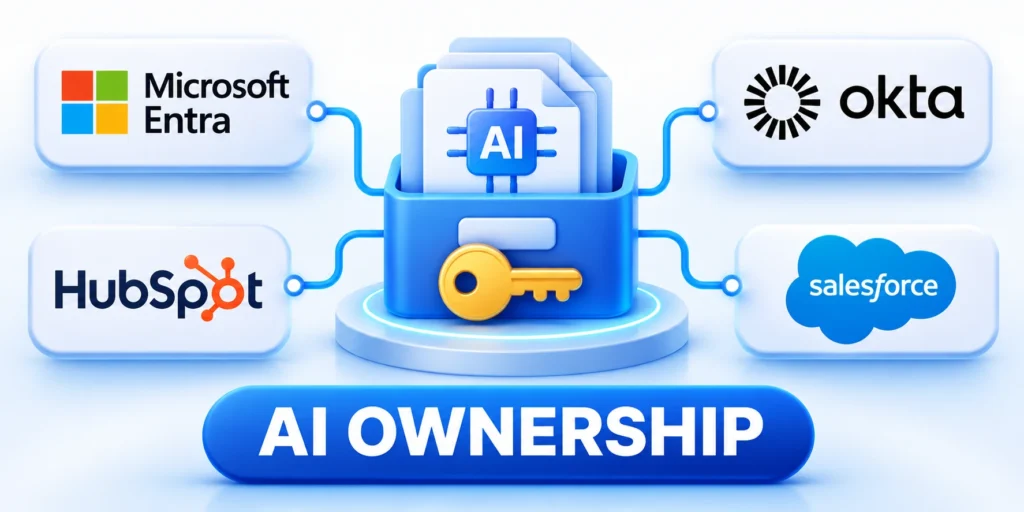
AI workflows need named owners for data, prompts, integrations, approvals, incidents, and customer corrections before their audience or authority expands.
Documenting ownership turns an experimental workflow into an accountable operating system that teams can review, pause, transfer, and improve safely.
Define change and access ownership
Write down who can change prompts, rules, permissions, and connected applications. Separate routine campaign edits from changes that affect data access or customer decisions.
Review access when roles change and remove unused integrations. Keep credentials in approved secret-management systems, never in prompts, spreadsheets, or campaign copy.
Evaluate a model before connecting it to live work
Evaluate models through these preproduction criteria:
- Define the task in one sentence and specify what a correct answer looks like.
- Build an evaluation set from cases.
- Ask two knowledgeable reviewers to label difficult cases independently.
- Measure errors by consequence.
- save the input case ID.
- Compare the model with a simple rule and the current human workflow.
- Repeat the same evaluation after a material change to the prompt.
Use representative, difficult, sparse, ambiguous, and adverse cases that reflect the real operating population and consequences of error.
Compare the model with existing rules and human work so added complexity must demonstrate a practical advantage.
Design a useful human review screen
Support reviewers through these decision-screen elements:
- Present the proposed decision beside the original evidence and the relevant rule.
- Explain confidence calibration and task meaning, or provide a clear categorical reason.
- Avoid forcing reviewers to copy information between tools.
- Measure review burden as well as model performance.
Use overrides as learning material. Group them by source-data defect, unclear policy, model interpretation, or changed business rule. Fix the underlying issue and rerun evaluation cases before widening automation.
A reviewer should understand the proposed action, supporting evidence, policy, uncertainty, and available correction without switching repeatedly between systems.
Set a practical rollout sequence

A controlled rollout should increase audience, permissions, and automation authority only after the prior stage produces reliable evidence and manageable review work.
Separate shadow evaluation, assisted recommendations, limited actions, and broader production access so failures remain visible, reversible, and owned.
Sequence access by evidence
Stage rollout through these weekly operating milestones:
- Week one can establish definitions, data owners, baseline measures, and ten to twenty representative cases.
- run the workflow in shadow mode with live arrivals.
- Document daily failures and reviewer effort during the pilot.
Then give a small segment controlled write access with a named operator and rollback path. Monitor daily for duplicates, missing records, misroutes, complaint signals, and unexpected changes in review load.
Expand only when the team can explain outcomes and recover from failure.
Expand authority deliberately
Start with observation and recommendation before granting write access, and limit each expansion to a defined cohort and reversible action.
Reviewers should be able to explain why the next stage is safer and more valuable than the current one.
Assign authority to each decision
Assign decision rights through these explicit roles:
- List the decisions in the workflow and name who may make each one.
- Separate a suggestion from an action in the interface.
- Define escalation for sensitive cases.
- Give reviewers enough context to work efficiently.
Define which decisions a model may recommend, which require human approval, and which remain exclusively with an accountable business or compliance owner.
The interface and permissions should reinforce those boundaries instead of presenting every output as equally approved.
Run a monthly control review
Review controls monthly through these evidence samples:
- Review a sample of outputs, failures, overrides, complaints, and abandoned cases.
- Check whether prompts, models, integrations, field definitions, or offers changed since the prior review.
- Invite marketing, sales, customer success, data, and security owners to the same short review.
- Archive superseded instructions and remove access that is no longer needed.
- Write a one-page runbook for the person on duty.
- Rehearse a failure with a test record.
- When a pilot ends, retain its decision record even if the result was negative.
Use the review to close open incidents, approve changes, remove obsolete access, and decide whether the workflow should continue, narrow, pause, or retire.
Keep the resulting decisions with owners and deadlines so the same unresolved risk does not return as a recurring agenda item.
Run a controlled 60-day AI workflow pilot

A sixty-day pilot creates enough time to establish a baseline, test difficult cases, operate a limited cohort, and evaluate downstream business effects.
Keep the pilot bounded to one decision or production task so results remain interpretable and recovery procedures can be exercised without broad exposure.
Write the pilot charter
A useful pilot tests one bounded marketing decision or production task. It does not connect an unproven model to every campaign, audience, and customer record.
Sequence the pilot through these timed phases:
- Days 1–10: define scope, risks, data, and baseline.
- Days 11–20: build prompts, rules, and review criteria.
- During days 21–35, test representative and adverse examples.
- Days 36–50: run a limited production cohort.
- Days 51–60: compare outcomes and decide the next step.
Write a pilot charter that identifies the business problem, eligible records, approved inputs, expected output, human reviewer, baseline, success threshold, and stop condition.
For content support, the task might be summarizing approved account research into a draft briefing. The reviewer confirms every claim and source before sales receives it.
Compare two representative tasks
For lead prioritization, the pilot might recommend a queue order while representatives retain final judgment and record a controlled reason when they disagree.
Different tasks may require different evidence, reviewers, thresholds, and stop conditions even when they use the same model or connected platform.
Build an evaluation set before production
Use historical examples that reflect ordinary work and important exceptions. Remove unnecessary sensitive information and preserve the approved labels or outcomes used for comparison.
Build evaluation coverage through these representative cases:
- Positive cases the workflow should advance.
- Negative cases it should reject or suppress.
- Ambiguous cases requiring human review.
- Incomplete records that should enter an exception path.
- Adversarial or misleading inputs that test safeguards.
The set should include different segments, regions, languages, account sizes, lifecycle stages, data completeness levels, and examples the current manual process handles poorly.
Record the expected action and the reason for every example. Accuracy alone is insufficient when a confident error could trigger an inappropriate customer message.
Preserve a stable comparison set
Retain a fixed validation subset so later prompt, model, or rule changes can be compared against the same evidence.
Version the cases, expected outcomes, reviewers, and accepted tolerances so a later improvement does not silently redefine the evaluation target.
Separate generation, approval, and execution
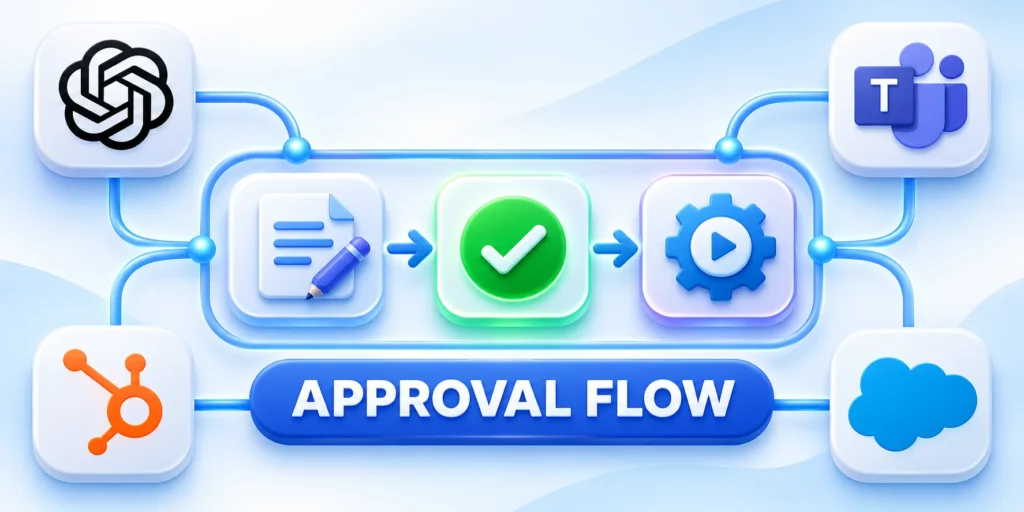
Generation, approval, and execution represent different authority levels and should remain visible as separate workflow states, records, permissions, and audit events.
This separation prevents draft output from appearing authoritative and lets teams measure where errors, delays, overrides, and operational costs actually occur.
Keep output states visible
Generation creates a recommendation or draft. Approval confirms that it meets policy and context. Execution changes a record, audience, campaign, or customer-facing message.
Separate output states through these approval records:
- Store the output status and reviewer.
- Preserve source links and retrieval dates.
- Log material edits before approval.
- Restrict execution permissions by role.
- Provide a manual route when automation is unavailable.
Keep those stages visible in the workflow. A model output should not look like an approved fact merely because both appear in the same CRM record.
For higher-impact actions, require a named reviewer before audience inclusion, pricing claims, account prioritization, suppression changes, or personalized outreach reaches production.
Adjust review only with evidence
For lower-risk drafts, sampling may be appropriate after evidence shows stable quality. The owner still monitors failures and can restore full review.
Document why sampling is safe, which cases remain fully reviewed, and which failure signal restores the prior approval requirement.
Monitor production quality and operational cost
Track useful outcomes with error, exception, latency, review, and correction measures. A faster workflow is not successful when it creates more customer or data risk.
Monitor production through these segmented operating measures:
- Acceptance rate after human review
- Unsupported claim or classification rate
- Exception and manual-correction volume
- Time from request to approved output
- Cost per approved result
- Downstream opportunity or customer outcome
Segment results by the populations that could experience different performance. Investigate material differences instead of hiding them inside one overall average.
Set an alert for missing sources, unusual output volume, repeated failures, integration delays, or a sudden change in the distribution of model decisions.
Close alerts through recovery
When an alert fires, pause the affected route, preserve evidence, correct any customer record or message, and compare the failure with the evaluation set.
Resume only after the shared cause is corrected, representative cases pass, affected records are reconciled, and the accountable owner approves the next stage.
Make an evidence-based scale decision
At day 60, compare the pilot with its baseline using the same eligible population and time logic. Report uncertainty, exclusions, and operational effort.
Authorize scale through these evidence-based outcomes:
- Scale when value and controls are repeatable.
- Revise when one correctable weakness limits the result.
- Hold when evidence is insufficient or unstable.
- Stop when risk or review cost exceeds the benefit.
Scale only when the workflow improves a meaningful outcome, remains reviewable, handles exceptions, and fits the team’s capacity to monitor and correct it.
Document the decision, owner, evidence, unresolved risks, and next review date. A negative pilot remains valuable when it prevents a larger unreliable deployment.
Frame the AI Use Case as a Decision

A useful AI use case starts with a decision, task, owner, eligible population, evidence requirement, and measurable outcome rather than a model capability.
This framing makes alternatives comparable and exposes whether rules, process repair, better data, or simpler automation could solve the problem more reliably.
Name the bounded business decision
Define the user, decision, input, output, frequency, latency, business outcome, acceptable error, prohibited action, and accountable owner before selecting a model.
Separate assistance from authority: drafting a summary and approving an offer, audience, price, or customer commitment require different controls and evidence.
Establish a Non-AI Baseline
Measure the current process, quality, delay, cost, exceptions, customer impact, and staff effort using representative cases before adding automation.
Compare the proposed workflow with a simpler rule, search, template, or process improvement that may solve the same problem more reliably.
Set Pilot Exit Criteria
State the minimum benefit, maximum error, review burden, cost, security condition, and customer guardrail required to continue after a bounded test.
Stop when evidence shows the use case, data, ownership, or operating capacity cannot support responsible deployment.
Build a Governed Input Contract
List every permitted field, document, event, derived feature, source, owner, refresh expectation, sensitivity, retention rule, and allowed purpose for the use case.
Reject or route incomplete, stale, conflicting, or unauthorized inputs instead of allowing the model to infer critical facts silently.
Protect Consent and Suppression
Keep consent, communication preferences, customer status, account ownership, legal restrictions, and suppression rules outside probabilistic interpretation whenever deterministic enforcement is possible.
Test merges, imports, replay, deletion, withdrawal, and regional differences to ensure protected records never reenter an automated marketing path unexpectedly.
Preserve Source Context
Attach stable identifiers, timestamps, provenance, and relevant evidence to model inputs and outputs so reviewers can trace important statements and decisions.
Do not treat generated citations or confident language as proof that the underlying source supports a claim.
Use these gates to approve a bounded use case:
- The decision has one accountable owner.
- Approved evidence supports the required output.
- A simpler alternative was compared.
Select Models and Vendors by Operational Fit

Model quality matters, but production fit also depends on security, latency, cost, retention, integration, observability, change control, and practical recovery options.
When evaluating AI tools for sales enablement, compare vendors against workflow requirements and representative cases before trusting benchmark scores or demos.
Compare operational requirements
Compare capability, data handling, regional availability, latency, limits, pricing, model changes, support, observability, portability, and contract terms against the approved use case.
A stronger benchmark score may matter less than predictable behavior, adequate controls, and sustainable integration for the team operating the workflow.
Test Representative Failure Modes
Evaluate unavailable services, timeouts, truncation, malformed output, prompt injection, unsupported language, ambiguous input, stale knowledge, and conflicting instructions before production use.
Define safe fallback and escalation for each failure rather than retrying indefinitely or accepting incomplete output as valid.
Plan Provider Exit
Preserve prompts, schemas, evaluations, source mappings, decision records, and exportable logs needed to replace a vendor without losing governance evidence.
Test deactivation, credential removal, data deletion, fallback operation, and migration before a commercial or security event forces immediate change.
| Criterion | Evidence | Decision |
|---|---|---|
| Task fit | Representative cases | Approve bounded use |
| Data exposure | Field allowlist | Restrict access |
| Operating cost | Review and model cost | Compare alternatives |
| Recovery | Rollback test | Stage deployment |
Design Prompt and Output Contracts
Specify task, context, approved sources, exclusions, format, uncertainty behavior, refusal conditions, tone, length, and decisions that always require human approval.
Use structured output and validation when downstream automation depends on specific fields instead of parsing persuasive prose optimistically.
Separate Instructions From Untrusted Content
Mark customer text, webpages, documents, and retrieved material as data rather than authority, and prevent embedded instructions from changing the approved task.
Restrict tools and retrieval according to the minimum access necessary for one workflow execution.
Version and Evaluate Changes
Track prompt, model, parameters, retrieval, schema, policy, and integration versions together so performance changes can be attributed and reversed.
Reevaluate representative cases after any dependency changes, even when the business-facing prompt appears unchanged.
Compare providers through these operating requirements:
- Data handling matches approved policy.
- Representative cases meet quality thresholds.
- Costs and recovery options remain visible.
Define Human Oversight as Work

Human oversight requires eligibility rules, evidence, interfaces, staffing, escalation, service levels, feedback handling, and authority to pause or reverse outcomes.
Treat review as measurable operational work so automation does not hide costs, overload specialists, or turn approvals into unexamined clicks.
Design accountable review work
Name who reviews which outputs, what evidence they receive, how much time is available, which mistakes they can detect, and how disagreements are resolved.
A nominal approval step provides little protection when reviewers lack context, authority, training, or capacity to challenge the model.
Design Review Interfaces
Present source evidence, uncertainty, changed fields, policy checks, prior state, and proposed action without encouraging one-click acceptance of lengthy generated content.
Record meaningful edits and rejection reasons to improve the process without monitoring employees invasively.
Protect High-Impact Decisions
Require qualified human judgment for eligibility, pricing, legal claims, sensitive segmentation, employment effects, account termination, or commitments with material customer consequences.
Use automation to organize evidence, not to obscure who accepted the decision and its residual risk.
Build a Representative Evaluation Set
Include common, rare, ambiguous, multilingual, adversarial, incomplete, duplicate, customer, competitor, consent-restricted, and out-of-scope cases drawn from authorized evidence.
Preserve a stable holdout while adding new incident and edge cases to a separate regression suite.
Measure Task-Specific Quality
Score factual support, completeness, relevance, classification, routing, policy compliance, usefulness, consistency, cost, latency, and reviewer effort according to the workflow.
Aggregate scores can hide severe failures, so inspect error categories and important segments separately.
Calibrate Acceptance Thresholds
Choose thresholds from business impact and review capacity rather than a convenient model score or one impressive demonstration.
Route uncertain cases safely and monitor whether humans consistently override outputs near the chosen boundary.
Staff review through these accountable operating controls:
- Reviewers see evidence and uncertainty.
- Escalations reach qualified decision owners.
- Workload stays within measured capacity.
Deploy Through Controlled Stages

Deployment should progress from offline evaluation to shadow mode, assisted recommendations, limited actions, and broader access only after explicit quality gates pass.
Every stage needs an owner, observation window, rollback path, approved population, stop condition, and evidence required for expansion.
Stage access and rollback
Move from offline evaluation to shadow mode, internal use, bounded customer exposure, and wider operation only after each stage meets documented acceptance criteria.
Keep a rollback switch, known-good prior process, named operator, support coverage, and monitoring active during expansion.
Limit Blast Radius
Restrict eligible records, channels, actions, spend, volume, regions, and permissions so an unexpected behavior cannot affect the entire customer base.
Increase one dimension at a time when practical to preserve evidence about what changed.
Reconcile Every Write
Use identifiers, idempotency, audit history, before-and-after values, and downstream confirmation for workflows that create or update CRM, campaign, or customer records.
Investigate partial success before retrying, because repeated execution can duplicate tasks, messages, audiences, or financial actions.
Monitor AI and Workflow Drift
Track input distributions, missing data, output patterns, evaluation quality, review edits, overrides, incidents, latency, cost, routing, and customer outcomes over time.
Distinguish model drift from changes in market, campaign, offer, data pipeline, sales behavior, or customer mix.
Set Operational Alerts
Alert on sudden volume, malformed output, unsafe content, service failure, repeated retries, missing evidence, suppression conflicts, and unusual write behavior with accountable runbooks.
Review alert precision so genuine risks remain visible instead of disappearing among expected variations.
Schedule Revalidation
Reevaluate after model, prompt, data, product, policy, audience, channel, integration, or vendor changes and when monitoring reveals material deviation.
Do not rely on a launch evaluation as permanent approval for a changing system.
Advance stages only after these gates pass:
- Evaluation results meet stated thresholds.
- Rollback succeeds with representative records.
- Operators can explain observed outcomes.
Secure the Complete AI Workflow

Security covers the entire workflow: source data, retrieval, prompts, models, tools, credentials, outputs, reviewers, logs, integrations, and downstream actions.
Threat modeling should follow information and authority across those boundaries, including failures caused by excessive permissions, poisoned context, or unsafe generated instructions.
Protect data and connected systems
Map users, service accounts, models, retrieval stores, files, APIs, tools, CRM permissions, logs, exports, and administrative controls across every environment.
Apply least privilege, strong authentication, secret rotation, network controls, validation, rate limits, and audit logging at each boundary that can read or change data.
Minimize Sensitive Data
Exclude personal, confidential, regulated, or commercially sensitive information unless necessary, authorized, protected, and covered by documented retention and vendor terms.
Use redaction or purpose-built representations when the task can succeed without raw source values.
Prepare AI Incident Response
Define containment, evidence, credential revocation, vendor escalation, customer correction, communication, rollback, and post-incident review for plausible model and integration failures.
Rehearse prompt injection, data exposure, incorrect mass action, unsafe claims, unavailable provider, and corrupted retrieval scenarios.
Measure Business Outcomes Without Attribution Theater
Connect AI-assisted campaigns to qualified engagement, accepted opportunities, sales effort, progression, revenue, retention, support, and customer experience using stable definitions.
Do not credit the model for every downstream outcome when audience, offer, budget, timing, sales behavior, or market conditions changed simultaneously.
Use Controlled Comparisons Where Feasible
Compare eligible cohorts, staged rollouts, shadow decisions, or repeated periods with documented assumptions and sufficient observation delay.
When causal isolation is impossible, report directional evidence and alternative explanations instead of manufacturing precision.
Include Total Operating Cost
Measure model usage, retrieval, integration, monitoring, evaluation, review, correction, incidents, vendor management, and specialist maintenance alongside time saved.
An automation that reduces production time may still lose value through error, review burden, or downstream rework.
Protect the workflow through these security boundaries:
- Inputs follow approved field allowlists.
- Tools receive minimum necessary permissions.
- Logs support investigation and recovery.
Govern the AI Portfolio

A portfolio view helps leaders compare value, risk, operating cost, maturity, ownership, evidence, and dependencies across every proposed or active AI workflow.
Shared governance prevents duplicated experiments, inconsistent controls, hidden vendor exposure, and indefinite pilots that continue without measurable outcomes.
Use a shared portfolio register
Maintain an inventory of use cases, owners, models, vendors, data, permissions, status, risk, evaluations, monitoring, incidents, costs, and retirement conditions.
Review overlapping pilots and shared dependencies so teams do not recreate the same capability with incompatible rules or uncontrolled access.
Use Change Control Proportionate to Risk
Require stronger evidence and approval when a change expands data, autonomy, audience, channels, financial exposure, customer impact, or difficulty of reversal.
Allow low-risk prompt and template improvements through a faster path only when versioning and regression checks remain intact.
Retire AI Safely
Stop triggers, complete or cancel queued work, remove credentials, reconcile records, preserve required evidence, delete retained data, and communicate the replacement process.
Confirm that no hidden integration, scheduled job, or downstream report continues to depend on the retired output.
Govern AI-Assisted Content Production
Define approved sources, claim boundaries, audience, voice, accessibility, originality, review, disclosure, localization, and publication ownership for each recurring content workflow.
Generated drafts should preserve source links and uncertainty so editors can verify substance rather than reverse-engineering confident prose.
Protect Brand and Product Accuracy
Use current product facts, service boundaries, pricing context, evidence, and prohibited promises from maintained internal sources rather than model memory.
Route security, legal, performance, customer, and comparative claims to qualified owners before publication.
Measure Editorial Value
Track correction effort, unsupported claims, time to approval, useful output, search intent, customer response, and content maintenance alongside production speed.
Stop workflows that increase volume while shifting verification, rework, or reputational risk onto editors and subject-matter experts.
Compare portfolio investments through these shared records:
- Each workflow has measurable value.
- Risks and dependencies remain current.
- Retirement criteria have named owners.
Apply AI at Account Level Carefully

Account-level AI can combine useful buying signals, but incomplete identity resolution and sparse activity can make confident conclusions misleading or unfair.
Limit inference to approved evidence, show uncertainty, preserve source context, and keep consequential targeting or routing decisions reviewable.
Limit account-level inference
Combine firmographic fit, relationship, ownership, opportunity, customer status, consent, and first-party evidence before using AI to summarize or prioritize an account.
Do not imply knowledge of an individual’s private research when the evidence exists only at company or campaign level.
Preserve Buying-Group Context
Represent contacts, roles, interactions, disagreements, open tasks, and account history separately instead of collapsing the organization into one generated intent label.
Give sales the evidence and limitations needed to decide whether outreach would add value.
Audit Prioritization Outcomes
Compare accepted conversations, disqualification, opportunity progression, effort, customer conflicts, and missed accounts across relevant segments and territories.
Review whether historical patterns disadvantage new markets, smaller accounts, uncommon buying journeys, or records with less observable data.
Experiment With AI Components Separately
Test retrieval, classification, generation, review interface, routing, and workflow changes independently when possible so teams can locate the source of improvement or failure.
Record model and prompt versions alongside audience, offer, campaign, and sales-process changes during evaluation.
Use Shadow Comparisons
Generate recommendations without acting on them, then compare results with experienced reviewers and actual outcomes across representative cases.
Shadow mode reveals disagreement and operating burden without exposing customers to unvalidated automated actions.
Avoid Optimizing Proxy Metrics
Do not reward engagement, scores, generated volume, or reviewer acceptance when these measures fail to predict qualified business and customer outcomes.
Inspect whether people approve outputs because they are useful or because review has become repetitive and rushed.
Limit account-level automation through these safeguards:
- Identity confidence remains visible.
- Sensitive inferences require explicit review.
- Outreach uses verified account evidence.
Prepare Teams for Changed Responsibilities
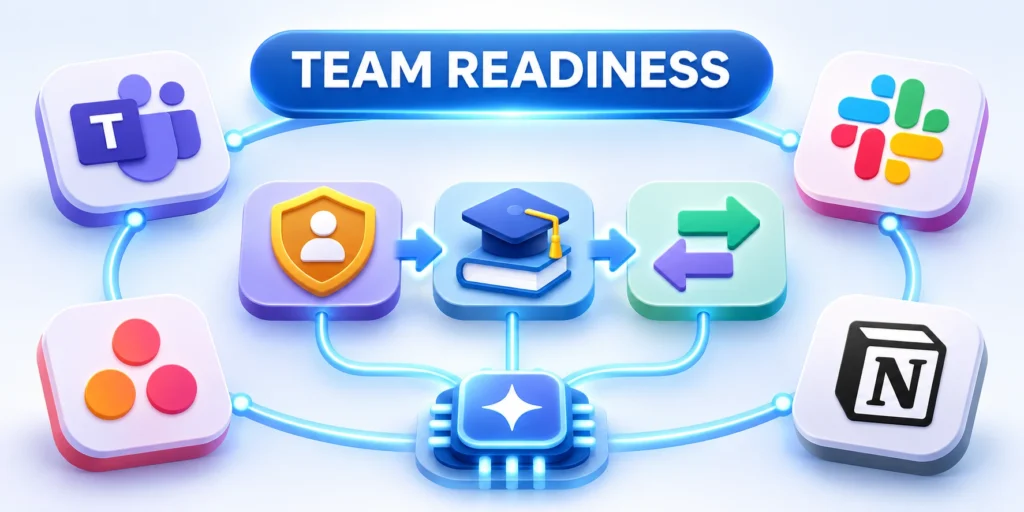
AI changes who prepares evidence, reviews exceptions, approves actions, monitors outcomes, maintains integrations, and explains decisions to customers or colleagues.
Training should cover the workflow, limits, escalation paths, recovery procedures, and professional judgment required when automation is uncertain or wrong.
Define the new operating roles
Explain which tasks change, which decisions remain human, how performance is evaluated, what monitoring occurs, and where employees can challenge unsafe automation.
Provide training on evidence review, uncertainty, data handling, escalation, incident response, and the limits of each approved tool.
Make ownership transferable
Assign primary and backup owners for evidence, prompt changes, vendor configuration, evaluation, daily operations, incidents, customer corrections, and retirement decisions.
Make role changes part of access review and knowledge transfer so the workflow remains governable when staff or vendors change.
Protect Sustainable Workloads
Estimate review queues, exception volume, monitoring, corrections, vendor changes, and support instead of counting only production time removed by AI.
Adjust eligibility or staffing when automation creates more decisions than accountable teams can inspect responsibly.
Use Feedback Without Surveillance
Collect workflow-level error and outcome evidence needed for improvement while minimizing unnecessary monitoring of individual employee behavior.
Separate coaching, process design, model evaluation, and employment decisions with appropriate transparency and qualified review.
Prepare role transitions through these operating commitments:
- Training covers tools and workflow limits.
- Backup owners can run recovery.
- Staff can report unsafe behavior.
- Rehearse ownership transfer before expanding the workflow further.
Make capability transfer measurable
Confirm that backup owners can explain the workflow, inspect evidence, change approved configuration, pause processing, and execute recovery without the original builder.
Record gaps found during the exercise and close them through documentation, access changes, training, or simpler workflow design before expanding scope.
Conclusion

AI improves B2B marketing when it strengthens a defined workflow with trustworthy evidence, accountable decisions, visible limits, and measurable customer or business outcomes.
Begin with one bounded use case, preserve human authority where consequences matter, and expand only after quality, cost, and recovery remain acceptable.
Keep value and control connected
Measure whether the workflow improves a real decision or production task, not whether the model generates more outputs or activity.
Review quality, exceptions, correction effort, customer impact, operating cost, and downstream outcomes together before changing scope or authority.
Close each review through these operating decisions:
- Continue when value and controls remain repeatable.
- Correct shared causes before expanding the cohort.
- Pause when review capacity or recovery becomes inadequate.
- Retire workflows that cannot justify their ongoing burden.
Close each review through these operating decisions:
Treat responsible automation as ongoing work
Data, models, offers, teams, regulations, vendors, and buyer behavior change after launch, so every production workflow requires scheduled revalidation and ownership.
Keep evaluation cases, decision records, change history, incident evidence, and rollback procedures current enough to support the next review.
Continue with personalization at scale
Apply the same evidence, review, and measurement discipline when expanding personalization across channels, accounts, lifecycle stages, and customer-facing messages.
For a focused companion topic, read How to Personalize B2B Marketing Campaigns at Scale.
Leave a clear next decision
End each review with one documented action: continue, correct, narrow, pause, retire, or expand through a defined cohort and observation window.
Assign the action, evidence, owner, deadline, and follow-up measure so responsible automation remains an operating discipline rather than a presentation principle.
Review the next boundary
Before granting new data, tools, audiences, or execution authority, repeat the relevant evaluation, security, workload, and recovery checks.
Expansion is justified only when teams can explain the added value, contain failure, preserve customer trust, and sustain the resulting review work.
FAQ
These answers clarify practical limits, starting points, controls, measurements, and recovery expectations for B2B teams adopting AI in marketing workflows.
What is AI in B2B marketing?
It is the use of machine-learning or generative systems to support research, content, campaign operations, analysis, and customer workflows. People remain responsible for strategy, claims, and consequential decisions.
Where should a B2B team start?
Start with one repetitive process, reliable inputs, a named owner, and an outcome you can measure. Test in a limited segment before connecting the workflow to broader systems.
Does AI replace marketing automation?
No. Traditional automation executes defined rules and triggers; AI can classify, summarize, predict, or generate. Many useful systems combine both, with explicit review for uncertain outputs.
Can AI qualify B2B leads automatically?
It can assist with prioritization using approved signals, but teams should validate data quality and monitor errors. Keep exceptions and high-impact decisions available for human review.
How should teams protect customer data?
Limit inputs to necessary, authorized fields; review vendor terms and retention; restrict access; and document permitted uses. Consult your privacy and security teams for applicable obligations.
Which metrics matter for AI campaigns?
Track qualified pipeline, opportunity progression, revenue, retention, and customer experience alongside operational measures such as errors and time saved. Choose metrics that match the business objective.
How can a team evaluate AI-generated content?
Check factual claims against approved sources, confirm audience fit and tone, remove unsupported promises, and review accessibility and compliance requirements before publication.
Should every campaign use generative AI?
No. Use it when it improves a defined task without adding unacceptable risk or review burden. A clear manual process can be better for rare or sensitive work.
How do you know if an AI workflow is working?
Compare the agreed outcome with a baseline, inspect error and exception rates, and ask affected teams whether the process improved. Report uncertainty when a test is too small.
What should happen when an automated decision is wrong?
Pause or route the affected workflow, correct the customer record or action, notify the owner, and document the cause. Update the rule or model only after testing the fix.









Leave a Reply