


Why Test Paid Lead-Generation Landing Pages

A/B testing for lead generation compares controlled page experiences using real paid traffic.
Use the B2B Google Ads playbook to align the search query, ad promise, and landing page before testing which version generates more qualified conversations.
Confirm these conditions before calling the comparison a test:
- One defined audience and offer.
- Stable assignment between control and variant.
- One primary qualified business outcome.
- Documented sample and stopping rules.
Separate the ad question from the page question
A landing-page test asks whether a change to the destination page affects a defined outcome while the audience and offer stay comparable.
If the ad, audience, offer, and page all change together, the result cannot identify which change caused the difference.
Keep the page aligned with the ad
Google recommends matching a landing page to its ad and keyword, sharing useful information, and clarifying the next step. Its landing-page evaluation guide explains how to review Google Ads traffic.
Keep the message, offer, and next step consistent when testing page layout. To isolate the message itself, run a separate B2B messaging A/B test.
Use a baseline and a testable hypothesis
The control is the current experience. A variant changes one planned element or one coherent page treatment.
Write the reason before launching: “For high-intent visitors, showing the project scope before the form should increase qualified submissions because buyers need to confirm fit.”
Review the hypothesis against the result
That statement names the audience, change, expected result, and explanation. It can be reviewed after the test instead of retrofitted to whichever version wins.
Record disconfirming evidence as carefully as supporting evidence. An inconclusive result still improves the next hypothesis when assumptions remain visible.
Choose a Hypothesis Worth Testing

Choose an uncertainty that affects visitor decisions and can be measured on the page.
Prioritize changes that could improve qualified demand. If the bottleneck spans targeting, messaging, and the page, digital marketing strategy consulting can help decide what to test first.
Start with visitor evidence
Review search terms, ad promises, sales-call objections, form abandonment, and CRM rejection reasons.
Look for a specific mismatch. For instance, ads may promise an implementation plan while the landing page leads with a broad company introduction.
Use these actions to start with visitor evidence:
- Message match: make the page’s headline and offer reflect the clicked ad.
- Proof: test a relevant case result, certification, or process explanation near the claim it supports.
- Form burden: test whether a shorter form improves completion without attracting unqualified inquiries.
- CTA: compare “Book project-fit review” with a generic request.
- Mobile clarity: inspect whether the offer, proof, and form remain understandable on a phone.
Do not test a claim that legal, compliance, or delivery teams have not approved.
Rank candidates by impact and feasibility
| Candidate | Evidence to inspect | Useful primary outcome |
|---|---|---|
| Headline and offer | Ad-to-page mismatch, low scroll depth | Qualified form submissions per eligible visit |
| Form length | Starts without completion, mobile abandonment | Accepted leads per eligible visit |
| Proof and case detail | Repeated trust objections in sales calls | Sales-accepted opportunities per visit |
| CTA wording or placement | Clicks without completed forms | Completed qualified requests per visit |
Use the CRO process in our B2B conversion-rate optimization guide for service businesses to organize discovery and prioritize page friction.
A click on the CTA is a diagnostic signal, not proof that the campaign generated a commercially useful lead.
Rank ideas using these decision criteria:
- Define the business outcome before ranking ideas, such as sales-accepted consultations instead of submissions.
- Compare changes by expected impact, problem confidence, implementation effort, and compliance or tracking risk.
- Reject ideas that cannot produce measurable decision evidence.
Build Variants Without Breaking Attribution

A clean experiment gives eligible visitors a fair, stable chance of seeing each experience.
Keep the offer, campaign targeting, and measurement plan consistent unless one of them is the specific test variable.
Assign visitors consistently
Use a testing tool that randomly assigns eligible visitors and keeps each visitor on the same version during the experiment.
Do not send the same person to A on one visit and B on the next if the change affects a multi-step form or later sales follow-up.
Keep assignments balanced
Keep device, geography, and audience eligibility balanced. If the B2B retargeting strategy uses multiple lookback windows, distribute each window consistently across page variants.
Investigate meaningful allocation differences before reviewing outcomes. Uneven assignment can expose routing, eligibility, caching, or consent behavior that invalidates the comparison.
Use these actions to keep assignments balanced:
- For low-volume campaigns, avoid many launch segments; stable assignment improves interpretability.
- Check sample-ratio mismatch; unexplained assignment imbalance may reveal routing or measurement problems.
- Preserve assignment identifiers across sessions and conversion events.
Keep campaign attribution intact
Preserve the final destination, consent handling, click identifiers, and UTM values through redirects and form submission.
Store the experiment and variant assignment with the lead record. A hidden form field can carry a stable control-versus-variant label.
Validate the full attribution path
Before launch, submit a test lead from each version and check that source, campaign, variant, and CRM status persist correctly.
Reconcile the received record with the browser assignment and analytics exposure event before paid traffic enters the experiment.
Select an implementation that fits the site
Nelio A/B Testing on WordPress.org is one option for page and element experiments. Before installing, review its features, traffic limits, data practices, and compatibility.
A hosted or server-side platform may fit teams that need deeper analytics integrations or tests across several systems, but adds cost and configuration.
Check how the tool records exposure
Whatever tool you choose, confirm that it tracks assignment and exposure separately. Counting a visitor as tested before the page actually renders can contaminate the result.
Inspect exposure timing, duplicate firing, consent behavior, and repeat sessions before accepting the tool’s default reporting.
Use these actions to check how the tool records exposure:
- Verify experiments in staging before paid traffic; test consent, caching, redirects, and personalization.
- Attach variant labels to leads without unnecessary analytics data; follow consent and privacy requirements.
- Confirm privacy controls before exposing any variant to users.
Plan Sample Size and Test Duration

Set the measurement plan before viewing results so random fluctuations do not choose the winner.
Low-volume B2B campaigns often need more time, a larger effect, or a different research method.
Define the baseline and minimum useful change
Use a recent, comparable baseline conversion rate for the same page, traffic source, device mix, and conversion definition.
Choose the smallest improvement that would matter commercially. A small statistical lift can be operationally irrelevant if it does not improve qualified pipeline.
Estimate the required sample
For example, a 5% baseline and a 6% variant would be a one-percentage-point lift, or a 20% relative increase. It is a hypothesis, not a forecast.
Enter baseline, minimum detectable effect, number of variants, and statistical settings into a recognized sample-size calculator before launch.
Use these actions to estimate the required sample:
- Use identical conversion definitions for baselines and experiments to preserve reliable comparisons.
- Record calculator inputs, outputs, and expected samples; recalculate only when documented assumptions change.
- Set a minimum runtime that covers normal demand variation.
Set a stop rule and cover a full business cycle
Document the minimum sample and planned duration. Include enough weekdays and weekends to cover the normal behavior of your buyers.
Use the same eligibility and outcome definitions throughout the planned window so the comparison remains interpretable.
Avoid stopping when results briefly look favorable
Do not stop because one version leads after a small number of conversions. Repeatedly checking ordinary fixed-sample results and stopping at a favorable moment increases false-positive risk.
Optimizely explains that sample size, effect size, random assignment, and a prespecified stop rule affect interpretation in its guide to statistical significance.
Protect the stop rule with these safeguards:
- Keep one primary outcome and limit variants to planned questions to reduce misleading winners.
- Combine interviews with controlled tests, but never treat underpowered results as statistical proof.
- Predefine stopping rules for harm, breakage, or tracking failure.
What if paid traffic cannot reach the required sample?
Do not split a small audience into many variants. Reduce the number of versions and test a change with a plausible business impact.
If the required sample is unrealistic, label the result inconclusive. Use interviews, usability sessions, or sales-call feedback to improve the next hypothesis.
Measure Qualified Leads, Not Only Form Fills

The primary metric should reflect the decision the experiment is meant to improve.
Track the form and follow the resulting contacts through qualification and sales acceptance.
Choose one primary metric and supporting guardrails
For many B2B service pages, qualified submissions per eligible visitor is more informative than raw form completion rate.
Use these metrics and qualification controls:
- Primary: accepted opportunities per eligible landing-page session.
- Diagnostics: form starts, completion rate, CTA clicks, and technical errors.
- Quality guardrails: spam rate, sales rejection reasons, meeting acceptance, and pipeline created.
- Cost guardrails: cost per qualified lead and cost per accepted opportunity.
Choose one primary outcome before the test. Treat secondary metrics as explanations, not alternate chances to declare a winner.
Use these metrics and qualification controls:
- Define qualified leads with sales before launch using fit, need, and valid contact criteria.
- Set a consistent CRM maturity window before judging accepted or rejected lead outcomes.
- Audit qualification consistency across reviewers before comparing variants.
Use a worked example without overclaiming
Imagine each version receives 600 eligible sessions. Control produces 30 form fills; the variant produces 36.
The observed rates are 5% and 6%, respectively. This difference alone does not establish a reliable winner or prove that the variant brings better prospects.
Reconcile the result with later sales data
Check the planned sample requirement, assignment balance, form integrity, and later sales acceptance before changing the page permanently.
If the variant generates more forms but fewer accepted opportunities, it may have improved curiosity while weakening fit.
Reconcile page results through these checks:
- Compare qualified outcome rates and counts; tiny samples may not justify permanent rollout.
- Segment results by source, account fit, and sales outcome.
- Review accepted and rejected leads after the maturity window.
Launch, Diagnose, and Roll Out the Result

A test needs technical checks before traffic and a documented decision after the planned sample.
Keep a snapshot of the control, variant, settings, and analytics events so the result can be reproduced.
Run a practical preflight
Verify both experiences before exposing paid visitors. The control and variant must complete the same journey without broken forms or inconsistent consent.
Use controlled submissions to reconcile browser assignment, analytics exposure, attribution fields, confirmation events, and CRM records.
Follow this sequence to run a practical preflight:
- Write the hypothesis, eligible audience, primary metric, guardrails, sample requirement, and stop date.
- Check both versions on mobile and desktop, including forms, links, validation, and confirmation states.
- Submit a lead on each version and verify analytics and CRM attribution end to end.
- Confirm balanced assignment and fire exposure events only after visitors see the variant.
- Launch traffic and monitor technical health; do not change the hypothesis during the planned test.
- At the stop rule, review outcomes and guardrails, then record win, loss, or inconclusive result.
Diagnose common failures
| Signal | Likely cause to investigate | Next check |
|---|---|---|
| Variant has fewer sessions | Assignment, redirect, cache, or eligibility issue | Compare exposures by browser, device, and campaign |
| More forms, lower acceptance | Weaker qualification or unclear offer | Review CRM rejection reasons and form fields |
| Clicks rise, submissions do not | Form errors, slow load, or broken continuation | Test each form path and confirmation event |
| Results differ by device | Mobile layout or traffic mix | Check page rendering and assignment balance |
Use these actions to diagnose common failures:
- Verify page rendering, variant persistence, and single-fire conversion events before interpreting unexpected results.
- Separate monitoring from outcome checks; stop on broken forms or tracking outages, and document interruptions.
- Archive the result, evidence, and implementation decision together.
Avoid declaring a universal winner based only on a segment discovered after results are available. Treat that segment as a new hypothesis and validate it separately.
Record the affected sessions and correction window when a failure occurs. Resume only after both variants pass the same recovery checks.
Estimate Whether the Test Can Answer the Decision

Start with the control’s baseline conversion rate, the smallest improvement worth implementing, the number of variants, and the planned statistical method.
Use the qualified outcome when possible. A page may generate enough forms quickly while requiring much longer to collect accepted leads or opportunities.
Use these actions to estimate whether the test can answer:
- Record the baseline period and traffic source.
- Define the minimum useful business effect.
- Estimate eligible sessions per week.
- Include the downstream conversion delay.
- Set the planned analysis and stopping rule.
If the required sample would take longer than the offer or campaign remains stable, choose a larger message change, a stronger early indicator, or another research method.
Do not reduce the sample target merely because the early dashboard looks favorable. Repeated unplanned checking increases the chance of acting on temporary noise.
Validate assignment and attribution before launch
Run an allocation check with internal and controlled external sessions. Confirm that eligible visitors enter one variant, remain assigned, and reach the correct confirmation path.
Campaign parameters, consent state, redirects, caching, cross-domain navigation, and browser restrictions can break attribution even when the page looks correct.
Use these actions to validate assignment and attribution before launch:
- Verify one exposure event per eligible session.
- Check assignment balance by device and campaign.
- Confirm forms preserve attribution fields.
- Test duplicate and repeat submissions.
- Inspect CRM records for both variants.
Exclude employees, agencies, automated monitors, and test leads through documented rules. Apply the same eligibility logic to both groups before reviewing performance.
Keep the destination, offer, audience, budget logic, and sales follow-up stable when the page experience is the intended variable.
Connect Page Results to CRM Cohort Quality
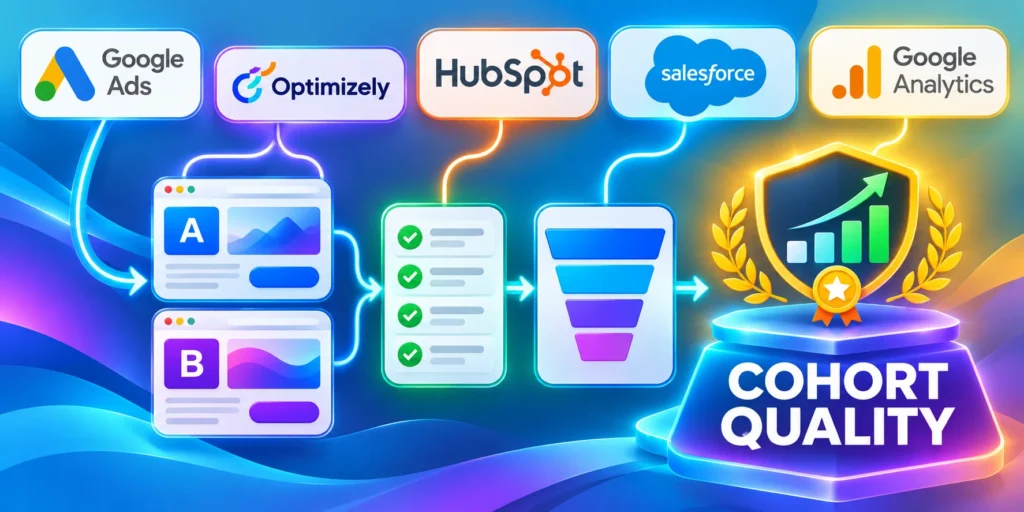
Join each submission to its assigned variant using a durable experiment field. Preserve that field when records merge, move between lifecycle stages, or enter another system.
Compare form completion, sales acceptance, opportunity creation, pipeline value, and wins by original cohort. Use mature windows so recent leads are not unfairly classified as failures.
Use these actions to connect page results to crm cohort:
- Define the acceptance rule before launch.
- Track rejection reasons by variant.
- Separate duplicates and existing customers.
- Report stage delay and cohort maturity.
- Review gross profit when data becomes available.
A higher submission rate with lower acceptance can indicate weak message qualification or an overly easy form. Treat that outcome as a failed business test despite improved page conversion.
Review cohort evidence consistently
Use the original assignment field when comparing acceptance, opportunity creation, pipeline, and wins. Do not regroup records after learning which version performed better.
Apply the same maturity window and rejection taxonomy to both variants. Differences in reviewer behavior can otherwise look like page performance.
Resolve evidence conflicts before deciding
When sales feedback conflicts with the numbers, review a blinded sample of records. Use the evidence to refine the next hypothesis rather than redefining success after the result.
Document whether disagreement came from qualification, delayed stages, inconsistent review, or a page effect. Apply the same resolution method to both cohorts.
Plan the Rollout and Post-Test Holdback

Record the owner, release date, expected effect, and monitoring window. If a nearshore B2B campaign team implements the change, make the previous version recoverable.
For a high-impact change, retain a small eligible holdback when the platform and business context allow it. This can reveal whether the effect persists after the campaign expands.
Use these actions to plan the rollout and post-test holdback:
- Confirm the production page matches the tested variant.
- Monitor forms, attribution, and page performance.
- Compare lead quality after rollout.
- Define the condition for restoring the control.
Do not combine rollout with unrelated pricing, offer, audience, or tracking changes. If another release is unavoidable, document the overlap and limit the causal claim.
Monitor the released experience
Compare production assignment, form integrity, page performance, qualified leads, and rejection reasons with the tested window. Investigate material drift before claiming durable improvement.
Keep the control recoverable until the monitoring window closes. Restore it when tracking, conversion quality, or delivery constraints cross the documented rollback threshold.
Close the rollout with these records:
- Released variant and implementation owner.
- Production monitoring window and guardrails.
- Qualified cohort comparison after maturity.
- Rollback decision and retained control.
Close the rollout with evidence
Archive the final production version, release date, monitoring evidence, and decision owner. Preserve the tested control until the review window closes.
Document whether the observed effect persisted, weakened, or reversed at broader traffic. Use that evidence to design the next experiment.
Conclusion

A useful landing-page experiment changes a defined visitor experience and measures an outcome that matters to sales.
Plan assignment, sample, maturity, and stopping rules before launch. Preserve attribution so page results remain connected to qualified CRM outcomes.
Make the decision from complete evidence
Review technical integrity, primary outcomes, guardrails, and cohort quality together. A higher form rate does not compensate for weaker acceptance or pipeline.
Label underpowered or unstable results inconclusive. That discipline protects future tests from decisions based on temporary noise or broken measurement.
Keep these controls in every experiment record:
- Hypothesis, audience, and eligible traffic.
- Primary metric and quality guardrails.
- Sample target and planned stop rule.
- Assignment and attribution verification.
- Rollout, monitoring, and rollback decision.
Connect experiments to acquisition strategy
Use consistent definitions when comparing landing-page learning across paid channels. Shared qualification standards make experiments useful beyond one campaign.
For the broader framework, read LinkedIn Ads Strategies for High-Value Enterprise Contracts and apply the same cohort discipline.
Define the final decision standard
The objective is a repeatable decision system that improves suitable demand without sacrificing measurement integrity, buyer clarity, or downstream commercial quality across changing paid acquisition conditions and buyer segments.
Approve permanent rollout only when technical integrity, qualified outcomes, and operational guardrails support the same documented conclusion through the full agreed monitoring window and downstream maturity period.
FAQ
These answers address common planning, measurement, assignment, and rollout decisions for paid landing-page experiments.
How many visitors do I need for a landing-page test?
There is no single safe number. Estimate it from your baseline rate, the smallest useful effect, number of variants, and statistical method before launching.
Should I test the headline or the form first?
Test the issue best supported by visitor and sales evidence. If visitors do not understand the offer, test message match; if they start but abandon the form, inspect form friction.
Can I change the page while the test is running?
A material change alters the experiment. Pause, document the change, and restart or treat the earlier and later periods as separate tests.
Should I use form submissions as the main conversion?
Only when a submission is a suitable business outcome. Otherwise, connect form records to qualification and compare accepted leads or opportunities.
What should I do when the result is inconclusive?
Keep the control or make a decision using other evidence, but do not claim a statistically supported winner. Use the uncertainty to design a sharper next test.
Should paid channels share one landing-page test?
Only when audiences, intent, offers, and attribution are comparable. Otherwise, separate the tests or predefine channel analysis without claiming an unsupported universal winner.
How should returning visitors be assigned?
Keep a visitor in the same variant when the design requires consistent exposure. Document identity limits across browsers, devices, and consent states.
Can a test use qualified leads as the primary metric?
Yes, when CRM matching is reliable and the test can run long enough. Use form completion as a diagnostic rather than a substitute for lead quality.
What should stop a test immediately?
Stop for broken forms, incorrect prices, privacy or security issues, severe performance failures, or corrupted assignment and tracking. Document the interruption before restarting.
When can the winning variant be rolled out?
Roll out after the planned analysis supports the decision, guardrails remain acceptable, and qualified outcomes justify the change. Continue monitoring after implementation.






Leave a Reply