


Define the Decision Before the Competitor List
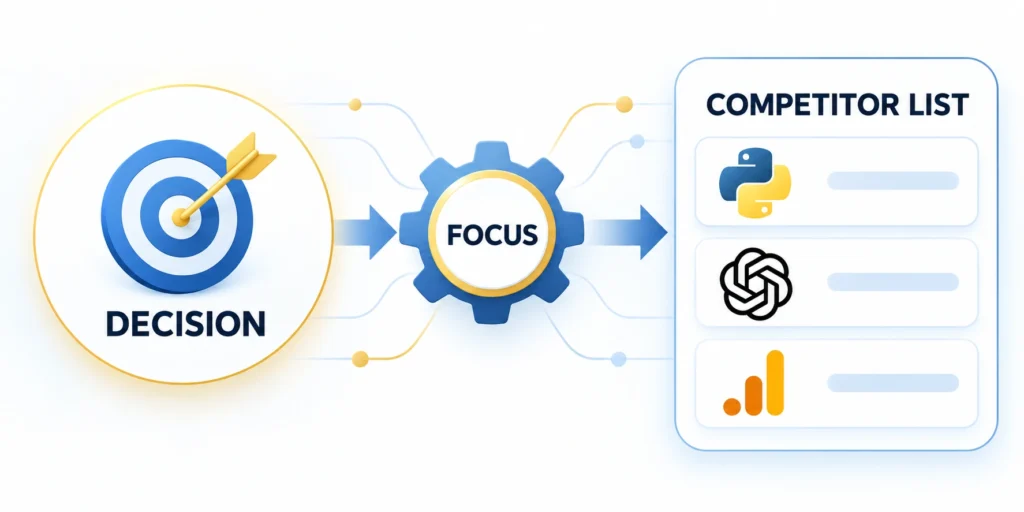
Competitor analysis automation is useful only when it informs a real decision. Start with the decision, the owner, and the evidence needed to act.
Define the analysis through these decision fields:
- Decision: select one audience segment for a landing-page test this quarter.
- Scope: compare five direct providers selling to the same company size and region.
- Evidence: dated product pages, public campaign examples, and approved win-loss summaries.
- Action threshold: investigate a pattern only when at least two independent sources support it.
For example, a demand-generation team may need to choose which audience segment deserves its next campaign test.
Turn the request into a decision
A broad request such as “track competitors” creates noise. A focused question makes collection, comparison, and review repeatable.
Write the question as a decision statement: “Which two competitor offers should we investigate before revising our enterprise landing page?”
Set the market boundary
Then define the market boundary. Identify the product category, customer segment, region, buying stage, and period being compared.
Separate direct competitors from substitutes and adjacent providers. A spreadsheet field should record why each company belongs in the comparison.
Select the comparison set
Choose a manageable initial set, such as five to ten organizations. Add more only when a decision requires a wider market view.
Set the observation window and collection cadence. A weekly capture may suit changing campaigns; quarterly reviews may suit stable positioning.
Choose a useful observation window
Define what would count as a useful finding before collecting data. Examples include an uncovered audience, repeated objection, or new pricing model.
Record the decision owner and the person responsible for checking each finding. Automation can organize evidence, but it cannot authorize a strategy change.
Assign review ownership
Test assign review ownership with representative customers, workflows, exceptions, and operating conditions before expanding the decision.
Teams already conducting SEO research can connect this workflow to their SEO competitor analysis process, while keeping search-specific questions separate.
Choose Repeatable Data Sources
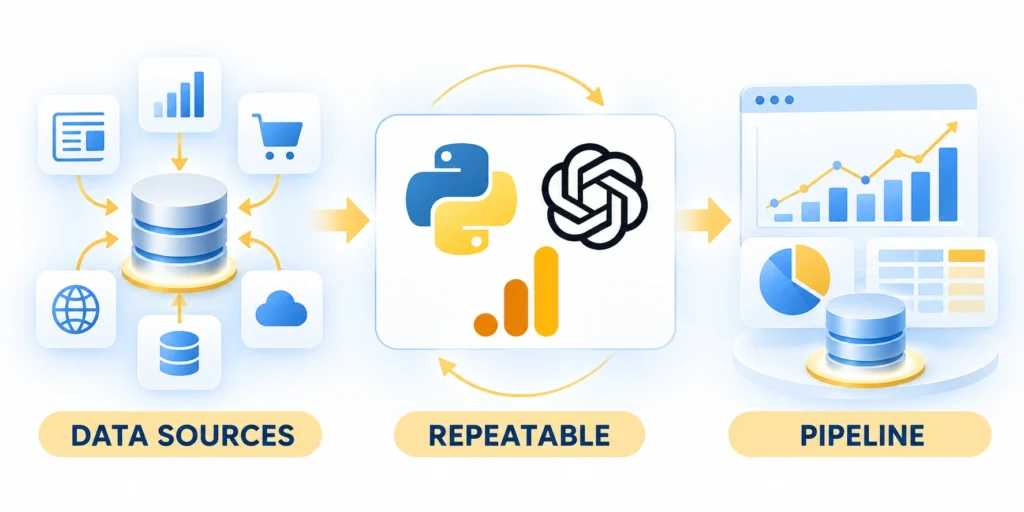
Reliable automation begins with sources the team may access consistently and retain appropriately. Prefer documented exports, approved APIs, and public company materials.
Record the source, retrieval date, collection method, and any license or access restrictions alongside every observation.
Match evidence to the decision
Useful sources depend on the decision. Public product pages can reveal positioning; campaign libraries can show creative themes; customer reviews can surface recurring concerns.
Internal CRM data can add context about win-loss patterns, but it must be aggregated and handled under company privacy and access rules.
Keep a source register
Use a source register with fields such as source name, URL, owner, permitted use, refresh interval, and expiration or review date.
When an API is available, read its terms, quotas, authentication requirements, and data-retention rules before building a recurring job.
Review access and API constraints
For keyword research, Google Ads API keyword-planning tools can return ideas and historical metrics. Access requires the relevant Google Ads account setup and API authorization.
Do not assume that an API result is exhaustive, current in real time, or comparable across every market. Store its date and geographic settings.
Select a maintainable collection method
Automated web collection should respect site terms, robots guidance, rate limits, and applicable law. Do not bypass logins, paywalls, or technical controls.
Preserve these source collection details:
- Store the source URL and capture date so a reviewer can revisit the evidence.
- Record region, currency, page type, and collection method for fair comparisons.
- Set an owner and review date for sources with quotas or changing terms.
- Keep raw captures access-controlled and delete them when the approved retention period ends.
Compare these collection methods and tradeoffs:
- Manual capture: low setup effort and strong context, but slower and difficult to scale.
- Approved exports: predictable columns and clear ownership, but may require cleanup and scheduled downloads.
- Official APIs: structured responses and repeatable retrieval, but access, quotas, cost, and coverage vary.
- Public-page monitoring: useful for visible changes, but requires careful terms review and robust change detection.
A source that changes structure frequently may be cheaper to review manually than to maintain with a fragile scraper.
Structure and Clean Competitor Data With Python

A consistent data model prevents every analyst from inventing new columns. Keep raw observations separate from interpretations and recommendations.
Use one row per observation, not one row per company. That preserves history when a page, offer, or message changes.
Define the row-level schema
A practical schema includes competitor, segment, observation type, value, source URL, collected date, analyst, confidence, and next review date.
Keep prices, currencies, regions, and units explicit. A price without its billing period or package scope is not a comparable value.
Validate inputs and preserve provenance
CSV files are convenient for lightweight workflows. Python’s standard csv module supports dictionary-based reading and writing.
The example below standardizes headers, trims empty values, and flags rows without a company or evidence URL.
import csv

from pathlib import Path

source = Path("observations.csv")

required = {"competitor", "observation", "source_url", "collected_at"}

clean_rows = []

issues = []

with source.open(newline="", encoding="utf-8-sig") as handle:

    reader = csv.DictReader(handle)

    headers = {name.strip().lower() for name in (reader.fieldnames or [])}

    missing = required - headers

    if missing:

        raise ValueError(f"Missing columns: {sorted(missing)}")

for line_number, row in enumerate(reader, start=2):

        item = {key.strip().lower(): (value or "").strip()

                for key, value in row.items() if key}

        if not item.get("competitor") or not item.get("source_url"):

            issues.append({"line": line_number, "reason": "missing identity or evidence"})

            continue

        clean_rows.append(item)

if not clean_rows:

    raise ValueError("No valid observations remain; inspect the input and rejected rows.")

with Path("observations_clean.csv").open("w", newline="", encoding="utf-8") as handle:

    writer = csv.DictWriter(handle, fieldnames=sorted(clean_rows[0].keys()))

    writer.writeheader()

    writer.writerows(clean_rows)

with Path("rejected_rows.csv").open("w", newline="", encoding="utf-8") as handle:

    writer = csv.DictWriter(handle, fieldnames=["line", "reason"])

    writer.writeheader()

    writer.writerows(issues)

print(f"Kept {len(clean_rows)} rows; flagged {len(issues)} rows")
Run the cleaning script
Save this as clean_observations.py beside the input file, then run it with Python 3 from that directory.
The expected result is a cleaned CSV and a rejected-row CSV with line numbers and reasons. Review exclusions before using the output in a report.
Add production controls
For production, also validate dates, normalize domains, deduplicate repeated captures, and retain the original file. Add automated tests for the fields that drive decisions.
Apply these reproducible data preparation controls:
- Preserve the original export unchanged and store a checksum or dated copy.
- Keep a rejection reason for each skipped row rather than silently dropping it.
- Report the input file, script version, accepted rows, and flagged rows with each run.
Do not overwrite raw evidence with normalized values. Store transformations in a reproducible script and record its version with each run.
Find Topic and Message Patterns With NLP

Natural-language processing can surface repeated vocabulary across collected pages. Treat the result as a map for review, not proof of market demand.
Validate these topic pattern signals together:
- Phrase frequency
- Document coverage
- Source date
- Business relevance
A simple baseline uses term frequency and inverse document frequency to compare page language while reducing the weight of ubiquitous terms.
Prepare like-for-like documents
Collect comparable text from the same page type, such as product pages against product pages. Mixing ads, blogs, and help documents can distort similarity.
Remove navigation, cookie notices, and repeated boilerplate where permitted. Preserve the source URL and original text for every document.
Build and run the baseline
Install the required packages in an isolated environment, then point the script at a CSV containing competitor and text columns. scikit-learn’s feature-extraction guide explains the vectorization approach.
import pandas as pd

from sklearn.feature_extraction.text import TfidfVectorizer

from sklearn.metrics.pairwise import cosine_similarity

data = pd.read_csv("page_captures.csv")

missing = {"competitor", "text"} - set(data.columns)

if missing:

    raise ValueError(f"Missing columns: {sorted(missing)}")

data = data.dropna(subset=["text"])

data["text"] = data["text"].astype(str).str.strip()

data = data[data["text"].str.len() >= 80].reset_index(drop=True)

if len(data) < 2:

    raise ValueError("Add at least two comparable page captures before comparing.")

vectorizer = TfidfVectorizer(

    stop_words="english", ngram_range=(1, 2), min_df=1, max_features=5000

)

matrix = vectorizer.fit_transform(data["text"])

similarity = cosine_similarity(matrix)

terms = vectorizer.get_feature_names_out()

for index, row in data.iterrows():

    top = matrix[index].toarray().ravel().argsort()[-8:][::-1]

    peers = [i for i in similarity[index].argsort()[::-1] if i != index][:3]

    print(row["competitor"], terms[top].tolist(), data.iloc[peers]["competitor"].tolist())
Create an isolated environment, activate the command for your operating system, and install the two packages before running the analysis.
python -m venv .venv

# macOS or Linux

source .venv/bin/activate

# Windows PowerShell

.venv\Scripts\Activate.ps1

python -m pip install pandas scikit-learn
Save and run the comparison
Test save and run the comparison with representative customers, workflows, exceptions, and operating conditions before expanding the decision.
Save the analysis as compare_pages.py beside page_captures.csv, then run it with the environment active.
python compare_pages.pyReview false matches
The output shows high-weight terms and the closest captured pages. It does not rank companies, measure demand, or establish that a topic is strategically important.
Inspect false matches caused by shared product vocabulary, templates, or boilerplate. Compare results against a small human-labeled sample before trusting a recurring report.
Choose a method that fits the corpus
Test choose a method that fits the corpus with representative customers, workflows, exceptions, and operating conditions before expanding the decision.
TF-IDF is transparent and inexpensive for a small corpus. Embeddings can capture broader semantic similarity, but introduce model choice, cost, privacy, and explainability tradeoffs.
Use AI to Summarize Evidence, Not Invent It
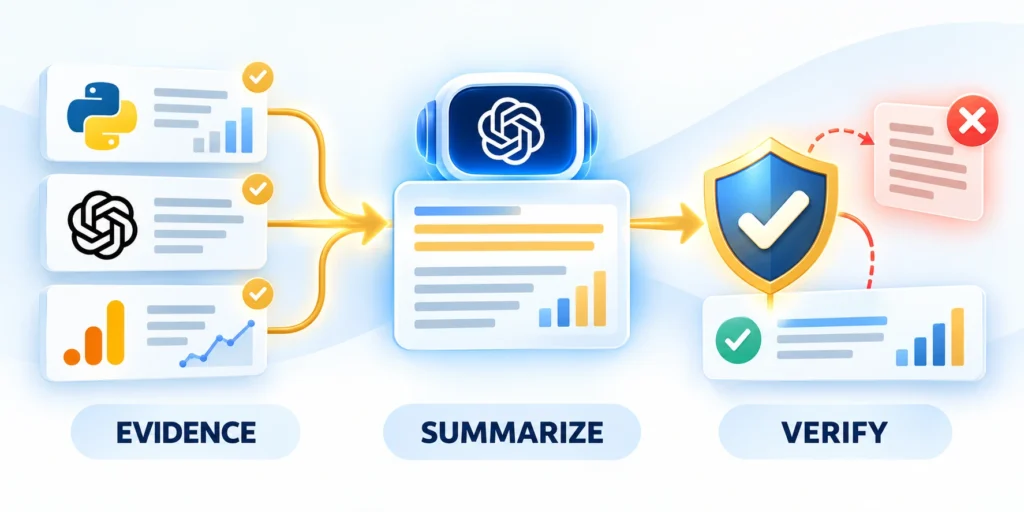
AI can cluster notes and draft summaries quickly, but every claim should remain traceable to a source capture that a person can inspect.
Require these evidence summary boundaries:
- Traceable source
- Observed pattern
- Uncertainty note
- Human review
Give the model only approved data, a defined question, and a strict output format that includes evidence references and uncertainty.
Separate observations from interpretations
Separate observation from inference. “The page lists three implementation tiers” is observable; “the company is targeting enterprise buyers” is an interpretation.
Ask the model to quote short evidence spans or cite row IDs. Reject summaries that omit the relevant source or combine incompatible time periods.
Use evidence-linked output
Do not send confidential customer records, credentials, unpublished strategy, or personal data to an unapproved model service.
Use a prompt contract that limits what the model may conclude:
Task: summarize the supplied competitor observations for the named decision.

Rules:

- Use only the supplied records; do not add outside facts.

- For each finding, list supporting record IDs and quote the evidence briefly.

- Label interpretation separately from direct observation.

- If evidence conflicts or is missing, say so explicitly.

- Return: finding, evidence_ids, confidence, open_question, suggested_test.
Protect sensitive information
Run the prompt on a small, reviewed batch first. Compare its claims with the cited records and note omissions, fabricated details, and overconfident language.
Require a human owner to approve any recommendation before it enters a campaign brief, roadmap, or sales playbook.
Review and retain model runs
Test review and retain model runs with representative customers, workflows, exceptions, and operating conditions before expanding the decision.
Keep the prompt version, model name, run date, input record IDs, and reviewer decision. This makes later changes explainable without treating a model output as ground truth.
Score Opportunities and Route Actions

A score can help teams sort findings, but it should reveal assumptions rather than disguise subjective judgment as precision.
Use a small rubric with plain-language anchors and require a source for every scored observation.
Make the rubric explicit
For example, rate decision relevance, evidence quality, and effort from one to three. Define what each score means before reviewers begin.
A simple weighted score might be relevance times evidence quality, divided by estimated effort. Keep the raw ratings visible beside the result.
Route accepted findings
Suppose a verified competitor pricing change is highly relevant, strongly evidenced, and inexpensive to investigate. It may outrank a weakly sourced feature rumor.
Do not compare the resulting numbers across teams until their scoring anchors and effort estimates are calibrated.
Measure follow-through
Route each accepted finding to an owner and a next action: test a message, update a sales objection guide, or request product discovery.
Record the expected outcome, deadline, and decision date. Close findings that no longer matter instead of allowing the backlog to grow indefinitely.
Calibrate the scoring method
Test calibrate the scoring method with representative customers, workflows, exceptions, and operating conditions before expanding the decision.
Route opportunities through these accountable functions:
- Marketing: validate a positioning or campaign hypothesis with a bounded test.
- Sales: review an objection pattern and update enablement only when evidence supports it.
- Product: route repeated unmet needs into discovery, not directly into a committed roadmap item.
- Operations: revise a source, schema, or review cadence when collection quality degrades.
Measure whether the workflow improves time to insight, evidence coverage, decision follow-through, or experiment quality. Avoid claiming revenue impact without a credible comparison.
Run the Pilot and Keep the Analysis Useful
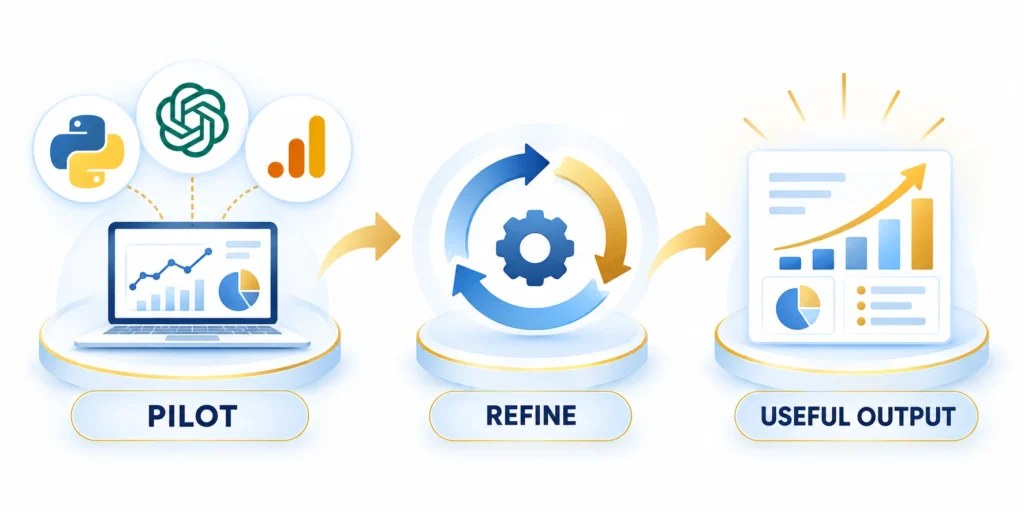
A small pilot exposes weak sources and unclear ownership before a team invests in a larger automation system.
Review these pilot outcomes before scaling:
- Decision usefulness
- Data freshness
- Analyst effort
- Reproducibility
Start with one decision, a limited competitor set, and a single reporting cycle that a person can review end to end.
Bound the pilot
First, select a business question and write down what action a useful answer could change. Name the decision owner.
Second, approve the sources and retention rules. Test that each record includes a date, URL, and permitted collection method.
Run a reviewed cycle
Third, collect a small baseline, run the cleaning script, and manually inspect several records and excluded rows.
Fourth, run one pattern analysis and one constrained AI summary. Have a reviewer compare every proposed finding to its evidence.
Monitor source and output quality
Fifth, route only accepted findings to owners. At the end of the cycle, review usefulness, effort, errors, and any access concerns.
Define a rollback: disable the scheduled job, revoke its credentials, and return to the last reviewed manual process if collection or output quality fails.
Define rollback and scale criteria
Monitor source failures, unusual row-volume changes, missing fields, stale captures, and model output without evidence references.
Assign an owner to review source permissions and the workflow whenever the data provider, model, market, or business decision changes.
Keep ownership current
Test keep ownership current with representative customers, workflows, exceptions, and operating conditions before expanding the decision.
Scale only when the pilot repeatedly produces decisions the team uses. If it mainly produces summaries no one acts on, narrow the question or stop the automation.
Validate Competitive Claims and Source Freshness
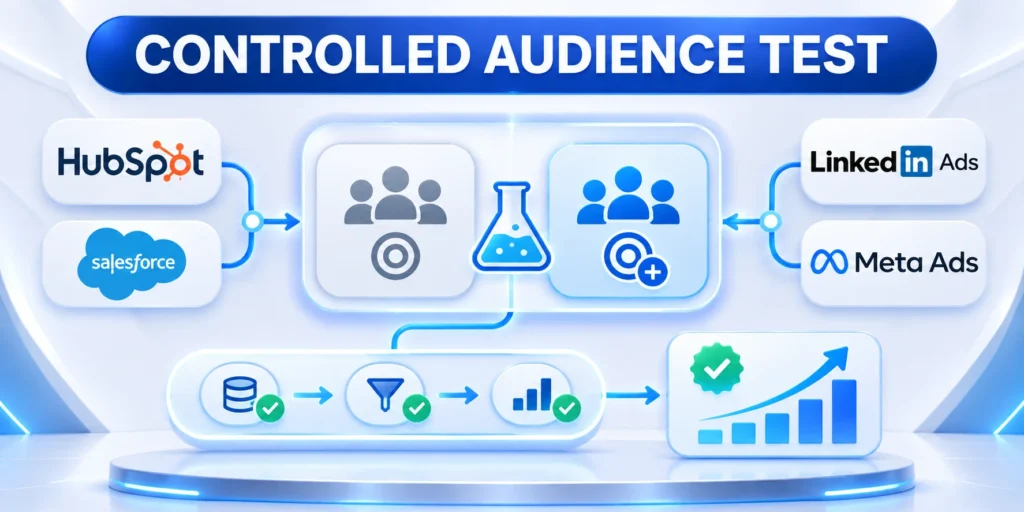
Competitive analysis becomes unreliable when a current page, archived offer, search snippet, and generated summary are treated as equivalent evidence. Preserve source context and collection time.
Define which claims matter to the decision, how current they must be, and which source types can support them. A competitor statement does not prove customer adoption or performance.
| Check | Evidence | Decision |
|---|---|---|
| Claim | Current source | Keep or correct |
| Pattern | Multiple documents | Investigate theme |
| Change | Comparable snapshots | Alert owner |
| Gap | Buyer need evidence | Prioritize research |
Separate observation from interpretation
Store the observed text, source URL, page title, collection time, region, and access condition before adding analyst interpretation or opportunity scoring.
Check these competitive evidence qualities:
- Source identity
- Collection date
- Claim scope
- Comparable context
- Analyst confidence
Use several relevant documents before calling a phrase a positioning pattern. Templates, navigation, syndicated content, and old pages can otherwise inflate apparent emphasis.
Recheck material claims before action
Refresh evidence before changing pricing, campaigns, product priorities, or sales guidance. Record what changed instead of overwriting the previous snapshot.
Escalate ambiguous or high-impact claims to a qualified owner. The system should expose uncertainty rather than converting incomplete evidence into a confident recommendation.
Control source access and retention
Collect only authorized public or licensed evidence and respect access restrictions. Preserve enough context for review without retaining unnecessary personal or confidential information.
Document retention and deletion expectations for raw pages, extracted text, screenshots, embeddings, and summaries. Analysts should know which artifact remains authoritative during a dispute.
Monitor Competitor Changes Without Creating Noise

Change monitoring should identify material differences in offers, positioning, proof, channels, or customer workflows. Page edits alone do not explain strategic importance.
Choose a review cadence based on decision value and source volatility. Excessive crawling creates noise and cost, while infrequent collection can miss the timing of a relevant shift.
Compare normalized snapshots
Remove unstable navigation, timestamps, tracking parameters, and unrelated layout changes before comparing content. Preserve raw evidence for verification when normalization hides context.
Route these material change signals:
- Offer change
- Message shift
- New proof
- Channel change
- Removed claim
Assign every alert a business owner, relevance threshold, and disposition. Unowned notifications become a backlog rather than a competitive intelligence capability.
Connect changes to accountable decisions
Link a material difference to the affected sales guidance, content brief, product assumption, campaign, or research question. Do not publish automated reactions without human review.
Track whether routed evidence changed a decision, confirmed an assumption, or required no action. This feedback improves thresholds and reduces repeated low-value alerts.
Review monitoring quality over time
Measure duplicate alerts, missed changes, review effort, stale sources, and decisions supported across each monitored source and owner. Tune collection and comparison from operational evidence rather than alert volume.
Retire sources that no longer represent the competitor or buyer journey. Add new evidence only when it improves a defined decision, not to inflate database coverage.
FAQ
These answers clarify competitive data collection, Python cleaning, NLP patterns, AI summaries, scoring, source validation, monitoring, and the evidence required for responsible decisions.
Can Python automate competitor analysis without paid tools?
Yes, Python can clean approved CSV exports and compare text with open-source libraries. Data access, staff time, hosting, and maintenance may still carry costs.
Should every competitor page be scraped automatically?
No. Check site terms and applicable rules first. Use approved exports or APIs when possible, and review manually when automation would be fragile or prohibited.
What data should a competitor-analysis dataset contain?
At minimum, record the company, observation, source URL, collection date, market context, owner, and confidence. Add fields needed for the specific decision.
Can an AI model choose the best competitor strategy?
It can organize evidence and suggest hypotheses, but strategy requires business context and accountable human judgment. Verify claims against sources before acting.
How often should automated competitor analysis run?
Match cadence to how quickly the decision context changes. Begin with one reviewed cycle, then increase frequency only when fresher data changes decisions.
For the broader framework, read AI in B2B Marketing: Automating Workflows and Analytics.
How should teams store competitor observations?
Store the observation, source URL, collection date, market context, owner, and confidence. Keep raw evidence separate from generated interpretations.
What should happen when sources conflict?
Preserve both observations, compare dates and scopes, and mark the discrepancy for human review. Do not let automation silently choose the preferred claim.
How can automation avoid duplicate findings?
Combine competitor, source, topic, and observation period consistently. Review materially changed evidence instead of repeatedly storing identical records.
Which competitor changes deserve alerts?
Alert on changes tied to an active decision, such as pricing, positioning, product availability, or campaign messaging. Ignore cosmetic changes without business impact.
How should AI-generated summaries be reviewed?
Compare each material claim with its recorded source. Label uncertainty, remove unsupported conclusions, and require an accountable owner before distributing recommendations.
Conclusion

AI can accelerate competitive analysis when the evidence remains traceable, comparable, and tied to a decision. It cannot turn incomplete observations into reliable market truth.
Start with the business question, repeatable sources, a documented schema, and clean snapshots. Use Python and NLP to organize evidence before asking a model to summarize.
Preserve evidence before interpretation
Store source identity, collection time, observed text, normalization steps, and access context. Separate facts, analyst interpretation, generated summaries, opportunity scores, and final decisions.
Use these final analysis controls:
- Defined decision
- Repeatable source
- Comparable snapshot
- Traceable summary
- Accountable owner
Validate material claims across relevant documents and refresh them before consequential action. A single competitor statement cannot prove adoption, customer value, or operational capability.
Use models to reduce review effort
Apply NLP for clustering, phrase coverage, similarity, and change detection. Use generative AI for bounded summaries that cite evidence, state uncertainty, and avoid unsupported recommendations.
Evaluate outputs against analyst-reviewed examples. Measure missed evidence, incorrect grouping, unsupported claims, duplicated alerts, and time saved rather than fluency alone.
Route insights into owned decisions
Connect validated changes and gaps to sales guidance, research, content, campaigns, product assumptions, or pricing reviews. Every routed action needs an owner and decision threshold.
The strongest program remains reproducible when sources, competitors, tools, or staff change. It helps teams learn faster without confusing automated pattern detection with strategic certainty.






Leave a Reply