Separate Application Support from Maintenance

An application support model restores service, answers user needs, and resolves production issues. Maintenance changes the application to preserve reliability, security, and compatibility.
The activities overlap, but combining them into one undefined queue hides urgency, ownership, capacity, and the true cost of keeping a business application dependable.
Define the work before choosing the provider
Support usually begins with an incident, request, alert, or user question. Its immediate objective is safe diagnosis, communication, restoration, and documented closure.
Maintenance includes upgrades, defect correction, dependency changes, performance work, preventive tasks, and controlled improvements that require planning, testing, and release governance.
Use these actions to define the work before choosing the:
- Incidents and service restoration
- User requests and access questions
- Problem investigation and workarounds
- Planned upgrades and dependency changes
- Defect correction and preventive work
Define which work enters the support queue and which becomes planned engineering. A restored incident may generate a separate defect, problem, or maintenance item.
Keep the records linked so teams retain the operational context without forcing responders to complete every permanent improvement during an active service interruption.
Create boundaries without creating silos
Assign service targets to support outcomes and delivery commitments to maintenance work. Mixing both under one response clock encourages shortcuts and misleading performance reports.
Reserve capacity for recurring support demand and planned change. Otherwise, urgent tickets consume every cycle while known reliability risks remain indefinitely postponed.
Use these actions to create boundaries without creating silos:
- Name the accountable queue owner
- Define transfer criteria between queues
- Link incidents to corrective work
- Reserve planned engineering capacity
- Report support and maintenance separately
The operating model should connect support, product, engineering, security, and vendors through explicit handoffs rather than treating each function as an isolated service.
Clear boundaries make later model comparisons meaningful because every option is evaluated against the same workload, outcomes, and responsibility assumptions.
Understand Tiered Support Models

Tiered support organizes work by the knowledge, access, and decision authority required. It should accelerate resolution, not add ceremonial transfers between disconnected teams.
A useful design begins with intake and self-service, then moves through functional support, technical specialists, engineering, vendors, and accountable business owners when necessary.
Route work by capability rather than status
Level-one teams handle intake, identity checks, known solutions, communication, and evidence collection. They need current knowledge and access to service health information.
Level-two specialists investigate application behavior, configuration, data, integrations, and recurring failures. Engineering addresses code, architecture, or release changes beyond operational authority.
Key considerations for route work by capability rather include:
- Self-service for approved known tasks
- Intake and evidence collection
- Application and configuration diagnosis
- Engineering and code correction
- Vendor and platform escalation
Define entry and exit criteria for every tier. A transfer should include impact, timeline, diagnostics, logs, attempted actions, current owner, and required decision.
Allow skilled responders to collaborate directly across tiers during major incidents. Sequential reassignment wastes time when several capabilities must investigate the same failure together.
Prevent escalation from becoming ticket forwarding
Measure resolution quality across the complete journey, not only each team’s handling time. Local speed can conceal repeated transfers and long customer waiting periods.
Review tickets that bounce, reopen, or reach engineering without useful evidence. Those patterns reveal missing knowledge, authority, tools, or routing rules.
Key considerations for prevent escalation from becoming ticket include:
- Track transfers per resolved ticket
- Measure customer waiting time
- Review reopen and bounce rates
- Improve knowledge after resolution
- Escalate with complete evidence
Tier names matter less than capability design. A small organization may combine roles while preserving clear ownership, escalation, and access boundaries.
The chosen support model must fund every required tier, including engineering and vendor coordination, instead of pricing only a visible service desk.
Evaluate an In-House Support Team

An in-house team offers direct access to product context, business priorities, internal systems, and decision makers. That proximity can shorten diagnosis and coordination.
It works best when the application is strategically distinctive, changes frequently, or depends on knowledge that is difficult to separate from core product engineering.
Use internal proximity where it creates value
Internal responders can build durable relationships with users, product owners, infrastructure teams, and executives. They can also influence design choices that reduce future support demand.
Control remains close to the organization, including access, prioritization, hiring, knowledge, and operational tradeoffs. That control carries full management responsibility.
Apply these criteria to internal proximity where it creates value:
- Direct business and product context
- Immediate internal decision access
- Strong knowledge retention potential
- Flexible priority and scope changes
- Closer influence on application design
Calculate the staffing needed for coverage, leave, turnover, training, specialist skills, leadership, tooling, and surge demand. One expert is not a resilient support model.
Small teams may struggle to maintain broad technical depth while supporting extended hours. Repeated interruptions can also reduce the engineering capacity available for product improvement.
Account for resilience and opportunity cost
Separate the value of control from the habit of ownership. Internal delivery is not automatically faster when queues, responsibilities, and service objectives remain undefined.
Assess recruitment time and local labor constraints for the technologies involved. Legacy platforms, specialized integrations, and uncommon environments may create concentrated staffing risk.
Key considerations for account for resilience and opportunity include:
- Model leave and turnover coverage
- Fund leadership and service management
- Protect planned engineering capacity
- Cross-train critical application knowledge
- Test after-hours escalation readiness
A hybrid design can keep product ownership and advanced engineering internal while using external capacity for intake, routine operations, or defined coverage windows.
Choose in-house support when its contextual advantage outweighs the cost and risk of building a complete, resilient operating capability rather than only named headcount.
Evaluate Managed Application Support
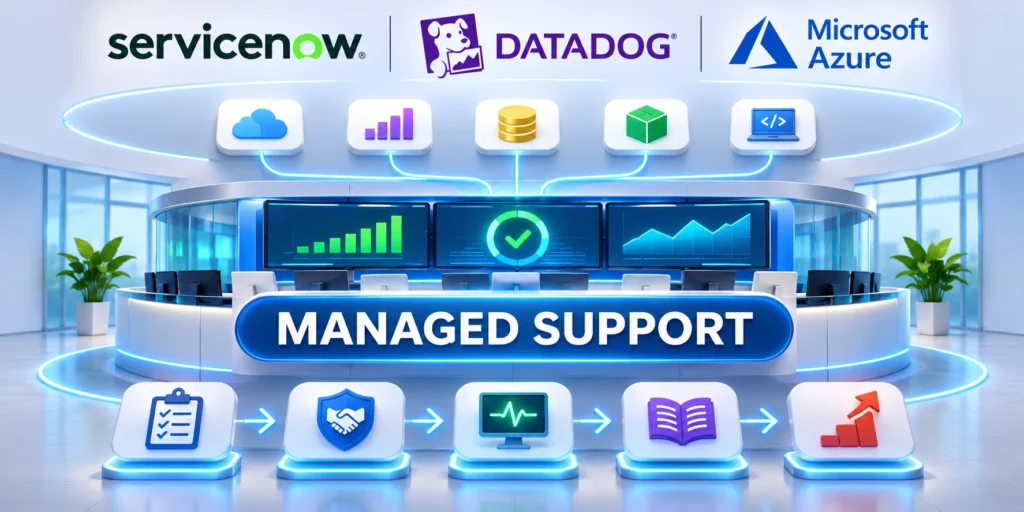
Managed application support assigns defined service outcomes to a provider that supplies people, processes, tools, governance, reporting, and continuity under an agreed scope.
The model can improve coverage and predictability, but only when the contract describes the real application workload and the governance can correct weak behavior.
Buy an operating capability, not generic capacity
Evaluate the provider’s capability across the complete support chain: intake, technical diagnosis, monitoring, releases, knowledge, vendors, reporting, security, and major incident coordination.
Ask who actually performs each activity, where those people work, which skills are dedicated, how replacements are trained, and when subcontractors are involved.
Key considerations for buy an operating capability not include:
- Named scope and service boundaries
- Coverage and escalation commitments
- Required technical competencies
- Knowledge ownership and portability
- Reporting and improvement cadence
- Exit and transition obligations
Service levels should reflect business impact and controllable outcomes. Response targets alone are weak when restoration, communication, recurrence, and customer experience remain unmeasured.
Define responsibilities for third-party platforms, cloud services, business approvals, engineering changes, and dependencies outside the provider’s direct control.
Make accountability enforceable through evidence
Managed service does not remove customer accountability. Internal owners still decide business priority, accept risk, approve material change, and govern access and architecture.
Require transparent ticket, staffing, knowledge, and performance evidence. A monthly presentation should not replace access to the operational records behind reported results.
Use these actions to make accountability enforceable through evidence:
- Inspect underlying service records
- Review repeated failures and reopens
- Track knowledge and staffing changes
- Test major incident coordination
- Exercise exit provisions periodically
Pricing must include transition, service management, tools, after-hours coverage, specialist escalation, and improvement obligations. Low unit rates can hide expensive exclusions.
Choose managed support when defined outcomes, broader resilience, and operational discipline justify reduced day-to-day control over staffing and delivery methods.
Evaluate a Nearshore Support Model

Nearshore support uses teams in nearby countries with overlapping workdays, practical travel, and cultural familiarity. For North American companies, Latin America is a common option.
Compare how nearshore delivery teams allocate responsibilities across staff augmentation, dedicated teams, and managed services. Verify who owns escalation and continuity.
Use geographic proximity to improve collaboration
Daytime overlap supports live diagnosis, joint releases, product discussions, knowledge transfer, and incident coordination without making every collaboration an after-hours event.
A broader talent market can provide application, cloud, integration, data, and quality skills while preserving more interaction than distant follow-the-sun arrangements.
Apply these criteria to geographic proximity to improve collaboration:
- Meaningful business-hour overlap
- Accessible technical talent pools
- Practical travel and workshops
- Real-time product collaboration
- Flexible dedicated-team scaling
Evaluate communication ability through real technical scenarios, not only sales meetings. Confirm how responders explain uncertainty, request evidence, document decisions, and escalate risk.
Review employment stability, leadership, security practices, infrastructure, continuity, legal terms, data access, and the provider’s experience with comparable application environments.
Validate the delivery model beyond location
Clarify whether named people are dedicated and who owns recruitment, retention, performance, replacement, and training. High turnover can erase the model’s collaboration advantage.
Align holidays, working hours, on-call expectations, language needs, and travel assumptions before pricing. Hidden availability gaps surface quickly during incidents and releases.
Use these actions to validate the delivery model beyond location:
- Interview the proposed delivery leaders
- Test collaboration with sample incidents
- Confirm staffing and replacement terms
- Review access and continuity controls
- Define onsite and travel expectations
Nearshore delivery can combine internal product ownership with an external team that operates as a close extension of engineering and support.
Select it for collaboration and capability, not simply labor arbitrage. Sustainable value depends on clear ownership, stable teams, and measurable operational outcomes.
Plan Coverage Across Time Zones

Coverage should reflect customer usage, revenue exposure, operational deadlines, recovery needs, and dependency availability. A universal twenty-four-hour promise may add cost without proportional value.
Map when critical journeys run, where users are located, when changes occur, and how long the business can tolerate reduced service before choosing shifts.
Design coverage from business risk
Distinguish staffed support, active monitoring, on-call response, vendor availability, and engineering escalation. These capabilities may follow different schedules and response expectations.
Document who can diagnose, communicate, approve risk, change production, access sensitive data, and engage third parties during every coverage window.
Use these actions to design coverage from business risk:
- Core staffed support hours
- Extended monitoring coverage
- After-hours on-call response
- Engineering escalation availability
- Vendor and business decision coverage
Use historical incidents and workload by hour to test the design. Include seasonal events, month-end processing, deployments, batch jobs, and geographically concentrated customer demand.
Measure alert-to-acknowledgment and alert-to-capable-responder time separately. An alert can be acknowledged quickly while the right expertise remains unavailable.
Make every handoff an accountable transfer
Handoffs should transfer open incidents, recent changes, degraded dependencies, customer commitments, risky work, and the named owner for every next action.
Use one shared operational record so incoming teams do not reconstruct the situation from private messages or incomplete meeting notes.
Use these actions to make every handoff an accountable transfer:
- Record active impact and timeline
- Name each current action owner
- List recent changes and risks
- Confirm next communication deadline
- Require receiver acknowledgment
Test the coverage model with realistic incidents outside core hours. Exercises reveal missing access, unclear authority, stale contacts, and escalation delays before production depends on them.
The best schedule is the least complex model that meets genuine business risk while protecting responder health, continuity, and access to necessary expertise.
Assign Ownership with a Support RACI

A support RACI clarifies who performs work, who is accountable, who contributes expertise, and who receives information. It should resolve ambiguity before incidents expose it.
Build the model around operational decisions rather than departments. Different people may own intake, restoration, releases, data correction, security, vendors, and customer communication.
Connect responsibility to decision authority
Assign one accountable owner for each decision. Multiple accountable parties often mean that nobody can approve risk, resolve priority conflicts, or accept a temporary workaround.
Responsible teams need the access, skills, capacity, and documented authority to perform their duties. A label without capability creates false assurance.
Use these actions to connect responsibility to decision authority:
- Incident command and restoration
- Business priority and risk acceptance
- Production change approval
- Security and data decisions
- Vendor and customer communication
- Knowledge and service improvement
Include the service desk, application team, product owner, engineering, infrastructure, security, data owners, vendors, and executive escalation where those roles affect outcomes.
Keep consulted groups limited to people whose input changes a decision. Overly broad consultation slows restoration while obscuring who must act.
Use the RACI during real operations
Walk through representative scenarios and require each participant to explain the sequence. Test outages, failed releases, data issues, vendor failures, and disputed priorities.
Update tickets, runbooks, on-call schedules, directories, and contracts to match the approved model. A spreadsheet alone does not change operational behavior.
Apply these criteria to the raci during real operations:
- Test common and severe scenarios
- Resolve duplicate accountability
- Confirm access for responsible roles
- Publish escalation decision rights
- Review after organizational changes
Review the RACI after major incidents and provider changes. If responders repeatedly bypass it, investigate whether the model or the behavior needs correction.
A practical RACI makes every support option governable because ownership remains visible even when delivery crosses internal, managed, nearshore, cloud, and vendor teams.
Compare Cost, Control, and Responsiveness

A fair comparison includes total cost, operational control, response capability, knowledge durability, scalability, continuity, transition effort, and the business consequences of failure.
Compare the same defined workload across options. One proposal may include monitoring and engineering while another prices only ticket handling, making headline rates misleading.
Compare complete operating systems
Total cost includes recruitment, leadership, tools, coverage, training, turnover, facilities, vendors, transition, governance, and retained internal roles required to make the model work.
Control includes priority, staffing, access, methods, architecture, knowledge, and the ability to change direction. More control also means more direct management obligation.
Use these actions to compare complete operating systems:
- Normalize scope and coverage
- Include governance and transition
- Price specialist escalation capacity
- Value knowledge and continuity risk
- Estimate failure business impact
Responsiveness depends on intake quality, capable staffing, access, collaboration, decision authority, and escalation paths. Location or employment status alone does not determine speed.
Use observed ticket demand, incident history, release patterns, and business calendars to model capacity instead of relying on generic industry ratios.
Use evidence instead of model stereotypes
Score each option against mandatory conditions before comparing preferences. A cheaper model that cannot meet security, continuity, or critical coverage requirements is not viable.
Run scenario workshops with the proposed teams. Ask how each model handles a severe outage, recurring defect, urgent change, key-person departure, and provider exit.
Apply these criteria to evidence instead of model stereotypes:
- Simulate severe incident coordination
- Verify recurring defect ownership
- Model surge and leave coverage
- Confirm knowledge portability
- Exercise provider exit readiness
| Model | Primary strength | Primary tradeoff |
|---|---|---|
| In-house | Context and direct control | Staffing and resilience |
| Managed | Defined operating capability | Less staffing control |
| Nearshore | Overlap and collaboration | Partner governance |
| Hybrid | Strengths by responsibility | Coordination complexity |
Document assumptions and sensitivity. Volume, coverage, turnover, vendor dependence, or application change can alter the preferred option after the initial decision.
A balanced choice optimizes business outcomes rather than maximizing one dimension. Many organizations use a hybrid when different responsibilities require different strengths.
Transition to the Chosen Model
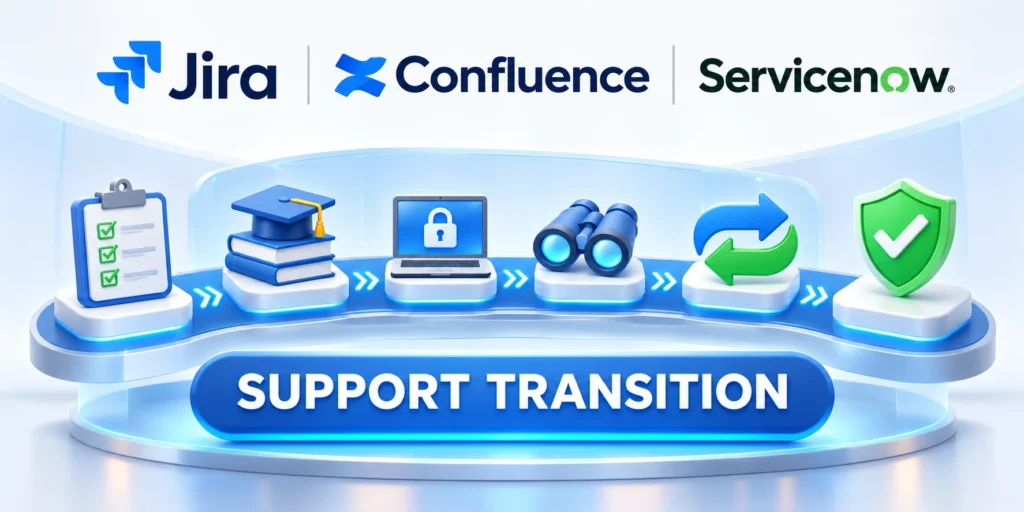
Changing the application support model transfers knowledge, access, workflows, relationships, tools, and accountability. Treat it as an operational change program rather than staffing administration.
Begin with a verified inventory of applications, dependencies, environments, queues, service commitments, vendors, credentials, runbooks, monitoring, releases, and current risks.
Transfer capability through controlled evidence
Define transition waves around coherent responsibilities. Shadowing lets the new team observe decisions, while reverse shadowing requires it to lead under controlled oversight.
Use capability gates before independent ownership. Attendance and elapsed time do not prove that responders can diagnose, restore, communicate, release, and escalate safely.
Key considerations for transfer capability through controlled evidence include:
- Inventory scope and operational evidence
- Prepare access and monitoring
- Shadow current support work
- Lead under incumbent oversight
- Accept ownership through gates
Protect continuity with rollback, incumbent fallback, verified backups, current contacts, and clear authority to pause a wave when service quality deteriorates.
The detailed application support takeover transition plan provides a practical framework for knowledge, access, waves, and stabilization.
Stabilize before expanding scope
Baseline response, restoration, backlog, recurrence, failed changes, and customer impact before ownership moves. Compare equivalent periods after every wave.
Keep temporary dual control time-bound. Prolonged ambiguity encourages conflicting actions and prevents the new model from becoming genuinely accountable.
Key considerations for stabilize before expanding scope include:
- Verify critical operating scenarios
- Compare service against baseline
- Correct knowledge and access gaps
- Retire temporary fallback deliberately
- Record accepted remaining risks
After stabilization, review whether the model delivers expected cost, control, coverage, responsiveness, knowledge, and improvement. Correct assumptions through governance rather than waiting for renewal.
A successful transition creates an observable support capability with clear ownership, usable knowledge, secure access, reliable escalation, and evidence that the service remains protected.
Conclusion

No application support model is universally superior. The right choice depends on business criticality, application change, coverage, skills, governance capacity, and acceptable risk.
In-house teams maximize proximity and direct control. Managed services can add operational discipline and resilience. Nearshore teams can combine external capacity with collaborative time-zone overlap.
Choose the model that fits the service
Define support, maintenance, tiers, coverage, ownership, and service outcomes before comparing options. Undefined work makes every cost and capability estimate unreliable.
Evaluate complete operating systems rather than labels. Include internal retained roles, engineering escalation, vendors, knowledge, tools, continuity, transition, and exit readiness.
Use these actions to choose the model that fits the:
- Start with business service risk
- Normalize scope before comparing cost
- Test teams with real scenarios
- Preserve knowledge and exit options
- Measure outcomes after transition
Hybrid designs are often appropriate when product ownership must stay internal while routine operations, extended coverage, or specialized capability comes from a partner.
Whichever model is selected, one accountable organization must govern priorities, access, risk decisions, architecture, customer obligations, and provider performance.
Keep the decision adaptable
Transition through evidence-based waves and keep fallback available until capability is proven. Stable service outcomes matter more than meeting an arbitrary handoff date.
Review the model when demand, architecture, business hours, vendors, staffing, or risk changes. A previously sound decision can become misaligned as the service evolves.
Use these actions to keep the decision adaptable:
- Publish current ownership and escalation
- Review service evidence regularly
- Correct recurring failure patterns
- Rebalance internal and external capacity
- Update coverage as demand changes
The goal is not to defend a sourcing label. It is to create dependable support that restores service, improves the application, and earns stakeholder confidence.
A disciplined selection and transition process turns cost, control, responsiveness, and collaboration into explicit choices that leaders can govern and improve.
FAQ
These answers summarize practical decisions about in-house, managed, nearshore, hybrid, tiered, coverage, ownership, cost, transition, and ongoing application support governance.
What is an application support model?
It defines how people, processes, tools, coverage, ownership, escalation, knowledge, and service commitments work together to operate and restore business applications.
When is an in-house support team appropriate?
It fits applications requiring deep business context, frequent product collaboration, direct control, and capabilities the organization can recruit, lead, cover, and retain reliably.
What is managed application support?
A provider accepts defined operational responsibilities and supplies staffing, process, governance, tools, reporting, continuity, and improvement under an agreed service scope.
How is nearshore support different?
Nearshore teams operate from nearby countries with greater workday overlap and practical travel, but the arrangement may be dedicated staffing or a managed service.
Can a company combine support models?
Yes. A hybrid can retain product ownership and advanced engineering internally while external teams handle intake, operations, specialist work, or extended coverage.
How many support tiers are necessary?
Use only the tiers required by distinct capabilities and authority. Small teams may combine roles while preserving clear escalation, ownership, access, and evidence.
What should an application support RACI include?
Include incident command, restoration, business priority, production changes, security, data, vendors, customer communication, knowledge ownership, and service improvement decisions.
How should support model costs be compared?
Normalize scope and include staffing, leadership, tools, coverage, turnover, training, transition, governance, retained internal roles, vendors, continuity, and exit costs.
What proves a support transition is complete?
Completion requires demonstrated operating capability, verified access, current knowledge, stable service outcomes, working escalation, accepted remaining risks, and retired temporary fallback.
How often should the support model be reviewed?
Review it at least during service governance and after material changes in demand, architecture, business hours, vendors, staffing, risk, or performance.