

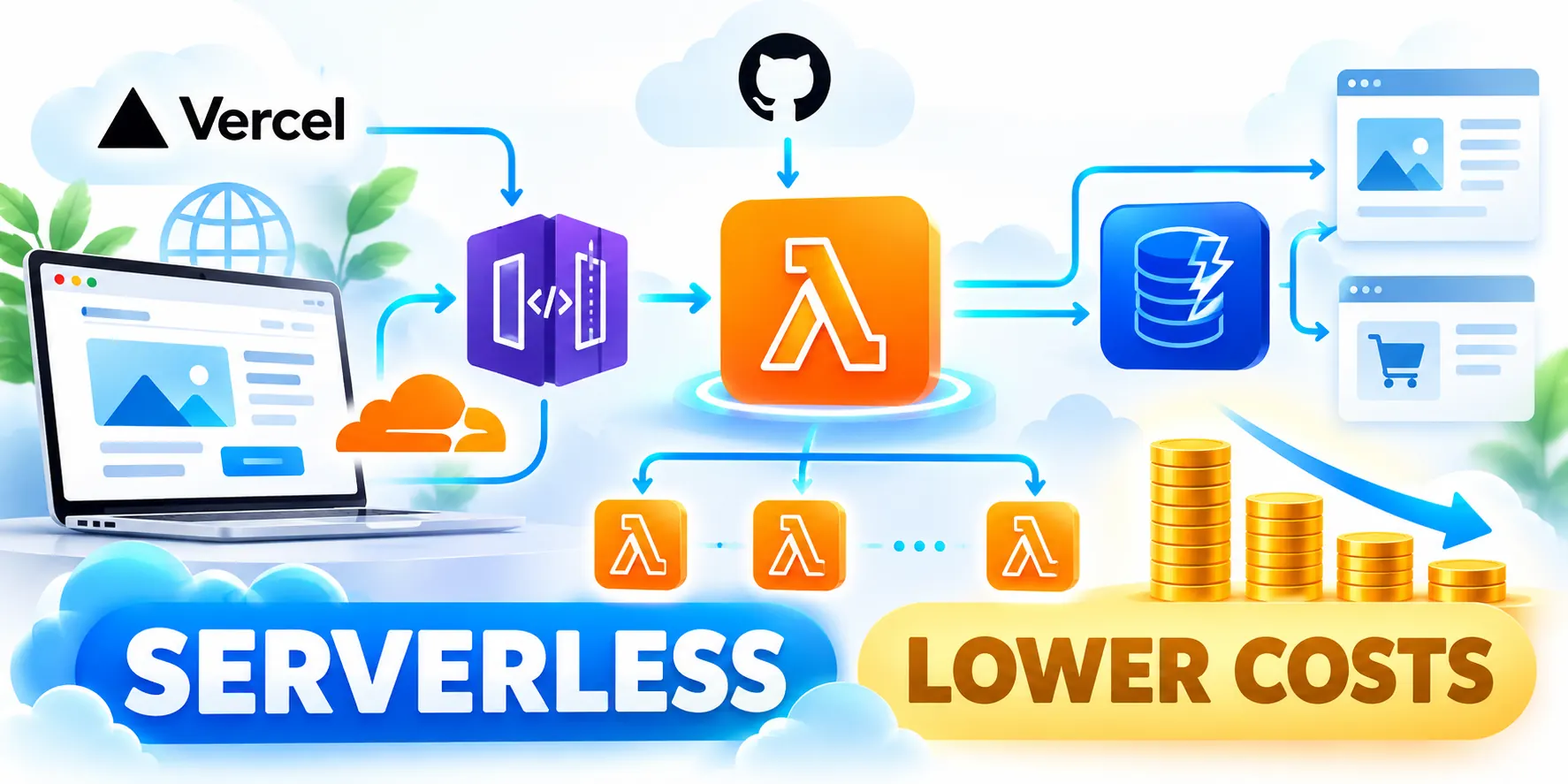
What Makes Serverless Cost-Effective for Web Apps?

Serverless AWS Lambda web apps can lower costs for bursty demand because teams pay for short execution instead of keeping application compute active at fixed capacity.
That does not remove infrastructure costs. B2B apps still pay for APIs, databases, storage, network traffic, logs, and engineering needed to operate distributed services.
Identify workloads that benefit from elasticity
Serverless is strongest when usage arrives in bursts, work runs briefly, and tasks can operate independently. A small team may also value managed scaling over server patching.
It is less compelling for steady high utilization, long-lived connections, or processes that exceed function limits. A right-sized container can be cheaper and easier to reason about in those cases.
Check whether the workload fits
Serverless works best when execution is bounded, demand varies, and each invocation can recover without depending on local persistent state.
Compare these workload signals before choosing:
- Traffic has quiet periods and measurable peaks.
- Tasks finish within the platform’s execution limits.
- Durable state remains outside the function runtime.
- Selected work can complete asynchronously.
- Teams benefit from reduced host management.
At each scaling milestone in the SaaS product development lifecycle, compare Lambda with a right-sized container if traffic becomes steady or connections remain open longer.
Separate infrastructure savings from engineering savings
Managed compute reduces some server duties but adds distributed-system work. The team still owns retries, cold starts, permissions, quotas, telemetry, and recovery procedures.
Compare serverless with a container or instance using the same traffic, availability, latency, and support assumptions. Include cloud services and engineering effort in both estimates.
Map a B2B Request Through AWS Lambda

A production request passes through an API layer, identity checks, authorization, application code, and a data service. A function is one stage in that path, not the whole architecture.
Draw each dependency before implementation. Include the API, authorizer, function, database or object store, queue for slow work, and monitoring destination.
Define the request boundary
Keep synchronous requests small enough to return before client and gateway timeouts. Validate input, authorize the action, perform bounded work, and return a stable response shape.
For slower work, record a durable job and return its identifier. A separate worker can process the event and update the job status without holding the browser connection open.
Trace the request path
Map every trust decision, synchronous dependency, durable write, event, and user-visible response before implementation begins.
Answer these questions for each request path:
- Where is the caller authenticated?
- Which component authorizes the requested object?
- Which function changes durable business data?
- What dependency can delay or fail?
- How does the caller receive delayed results?
Record timeouts, ownership, and failure responses beside the path. A diagram without those behaviors hides the operational decisions that determine customer reliability.
Make tenant identity trustworthy
Derive tenant identity from verified claims or a server-side authorization decision. A tenant ID in a query string or request body is data, not proof of access.
Pass only the fields the function needs, then test cross-tenant access explicitly. A user from one account must never retrieve another account’s record by changing an identifier.
Verify authorization boundaries
Authentication identifies a caller, while authorization decides whether that identity may perform a specific action on the requested tenant resource.
Apply these checks at every protected boundary:
- Authorize the object after authenticating the route.
- Scope database keys to the verified tenant.
- Grant functions only required resource access.
- Prevent cross-tenant details in denial responses.
- Test forged and stale identity claims.
Derive tenant context from verified claims or authoritative data, never from an untrusted request field. Log denials without exposing sensitive identifiers.
Protect databases from burst concurrency
Elastic function concurrency can exceed database connection capacity. Estimate simultaneous connections, query duration, and database limits before increasing a function’s concurrency.
Test a managed connection proxy when the database supports it.
Match the database to access patterns
A key-value database can fit when access patterns, partition keys, consistency needs, and item growth are known before schema design.
Keep relational storage when transactions, joins, reporting, or established operational knowledge provide greater value. Do not migrate data merely to follow an architectural trend.
Choose Synchronous or Event-Driven Execution

Synchronous invocation keeps the caller waiting for a response. It suits bounded actions such as validating a quote or loading a small account summary.
Asynchronous processing queues work for later. It absorbs bursts and isolates slow tasks, but the product must communicate pending status and handle duplicate delivery safely.
| Pattern | B2B example | Design concern |
|---|---|---|
| Synchronous API | Read an account summary | Latency, timeouts, downstream limits |
| Queue-backed job | Generate a large report | Idempotency, retries, job status |
| Scheduled event | Reconcile nightly records | Overlap protection, recovery |
Make asynchronous handlers idempotent
An event may be delivered again after a timeout or retry. Reprocessing must not duplicate invoices, accounts, inventory changes, or customer notifications.
Choose a stable idempotency key, persist the accepted result atomically, and return that result when the same business action appears again.
Make retries idempotent
For a report job, store the event ID with the result using a conditional write.
When the event appears again, return the existing result rather than starting the side effect again.
Process queue-backed jobs safely
A queue separates request latency from background work, but delivery retries and partial failures require explicit state transitions.
Use this sequence for each durable job:
- Create a stable job identifier.
- Record tenant, request type, and pending state.
- Validate the permitted state transition.
- Persist the result before completion.
- Return the stored result after retries.
- Route repeated failures for investigation.
Monitor queue age, failed transitions, and dead-letter growth. Name the operator authorized to inspect, correct, and redrive affected jobs.
Choose the experience the user needs
If the user needs a result immediately, a queue can make a simple screen confusing. Keep the synchronous endpoint narrow and return clear validation or dependency errors.
For longer work, expose a status that the client can poll or subscribe to. Explain whether a failed job retries, needs user action, or moves to operator review.
Estimate the Full Cost Before Committing

Lambda pricing depends on requests and execution duration, with memory affecting compute resources. The bill also includes services around the function, so invocation cost alone is incomplete.
Build a monthly estimate from observed or forecast traffic. Keep request volume, duration, memory, concurrency, API calls, storage, network transfer, and log retention as separate assumptions.
Build a comparable cost worksheet
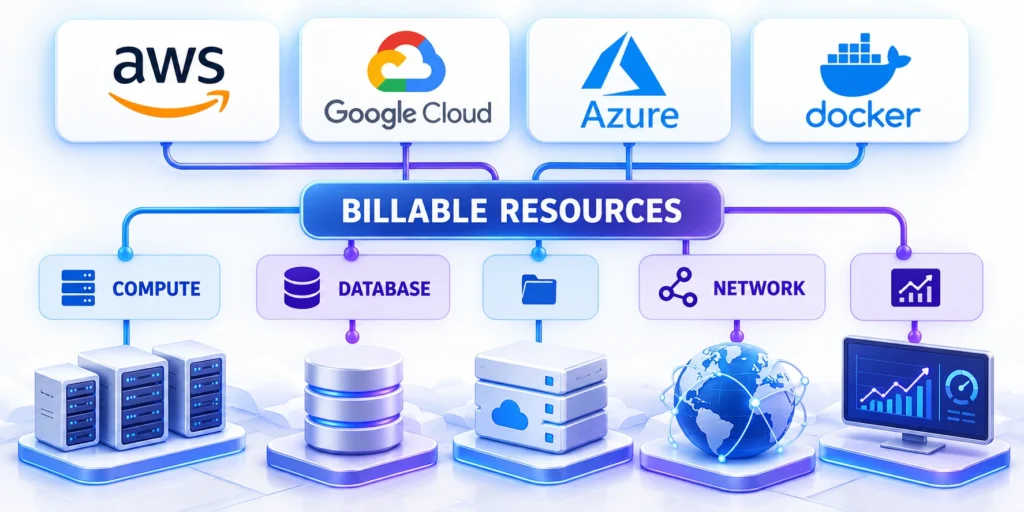
For a first estimate, calculate function compute from invocation count, average duration, and allocated memory. Add the API, queue, database, storage, network, monitoring, and support costs separately.
Use the same demand curve and service target for a container comparison. Keep units visible because one thousand requests per day differs sharply from one thousand requests per second.
| Cost line | Measure | Common blind spot |
|---|---|---|
| Function execution | Requests, memory, duration | Retries and initialization |
| API and events | Calls and payload volume | Gateway features or delivery |
| Data services | Storage, reads, writes, connections | Capacity held for peak load |
| Operations | Logs, traces, alerts, egress | Retention and cross-zone traffic |
The site’s server cost estimation guide can help build a comparable baseline for an always-on workload.
Include cold starts and predictable traffic
Cold starts affect latency and may require optimization or pre-initialized capacity. Provisioned concurrency can reduce startup variation, but it adds a standing charge.
Benchmark realistic endpoints with the runtime, package size, network placement, and downstream calls you intend to deploy. Compare percentile latency and total cost at low, average, and peak load.
Validate the estimate before launch
Run dated assumptions through the official AWS Pricing Calculator, then compare the model with representative staging load and measured dependency behavior.
Validate these inputs before approving the design:
- Requests, duration, memory, and concurrency.
- Gateway, queue, storage, and database usage.
- Logs, traces, transfer, and retention.
- Provisioned capacity and support coverage.
- Engineering effort for operations and incidents.
After launch, reconcile the forecast with billing and telemetry. Update the model when traffic shape, dependency pricing, retention, or architecture changes.
Handle State, Tenant Identity, and Connections
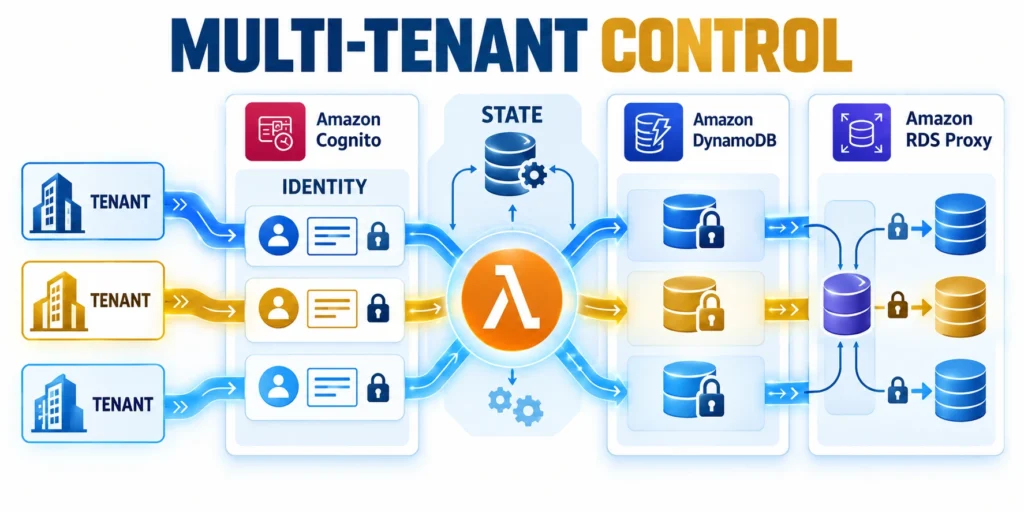
Treat each invocation as independent. Lambda may reuse an execution environment, but correctness must not depend on that reuse or on customer state stored only in process memory.
Persist business state in a system of record. Reuse safe immutable configuration or SDK clients while ensuring cached data cannot cross users or tenant boundaries.
Apply least privilege to each function
Separate functions when their data access or operational risks differ. A report generator may need read access to a dataset and write access to one output bucket, not account-wide administration.
Use separate deployment roles and environment settings for development, staging, and production. Store secrets in a managed service, grant access narrowly, and rotate credentials using a documented procedure.
Complete a security review before release
Review identity, permissions, configuration, secrets, logging, data handling, dependencies, and incident ownership before production traffic reaches the function.
Confirm these controls before every release:
- Roles grant only required actions.
- Secrets stay outside source and logs.
- Environments use distinct protected configuration.
- Dependencies pass approved security checks.
- Access reviews have owners and dates.
Retest authorization and sensitive logging after dependency or event-contract changes. Preserve evidence that connects each control to an accountable owner.
Check database behavior under concurrency
Create reusable clients outside the handler when supported, but expect connections to become stale. Apply bounded timeouts, connection limits, and retries that do not multiply load during outages.
Test a connection proxy and database pool at realistic concurrency. Record expected query latency, maximum connections, and what the function returns when the database is unavailable.
Keep idempotency records for business actions
Choose a stable key generated before enqueueing, such as a payment or provisioning request ID. Store its state and result with a conditional write and suitable expiration policy.
Do not generate a new key inside every retry. That makes one business action look like several unrelated requests and cannot prevent duplicate side effects.
Build a Deployable AWS SAM Vertical Slice

Start with one end-to-end capability instead of creating dozens of functions. A useful first slice accepts an authenticated request, validates it, stores a record, and exposes telemetry.
AWS SAM defines serverless infrastructure as code and builds on CloudFormation. Keep the template, source, and test event under version control so staging and production can be reproduced.
Declare a narrow function and HTTP event
This template defines a small HTTP-triggered function. Memory and timeout are starting assumptions; measure them with the actual request path before deciding they are adequate.
Transform: AWS::Serverless-2016-10-31

Resources:

  AccountSummaryFunction:

    Type: AWS::Serverless::Function

    Properties:

      CodeUri: src/

      Handler: app.handler

      Runtime: nodejs22.x

      MemorySize: 512

      Timeout: 10

      Events:

        AccountSummary:

          Type: HttpApi

          Properties:

            Path: /accounts/{accountId}/summary

            Method: GET
The sample does not define authentication or data permissions. Add an API authorizer and a least-privilege role before exposing an endpoint to customers.
Use a repeatable local-to-staging sequence
Follow this sequence to use a repeatable local-to-staging sequence:
- Confirm the AWS account and region are the intended development environment.
- Run
sam validate --lintto check the template structure. - Run
sam buildto package the function and dependencies. - Invoke the handler locally with a representative request event.
- Deploy a separate staging stack and exercise authorization, retries, and failures.
- Promote the same reviewed template and artifact through the production process.
Keep a sanitized event file under version control, then invoke the function locally:
sam local invoke AccountSummaryFunction --event events/account-summary.jsonDo not place customer data or credentials in the event file. Check the response, structured logs, downstream writes, and error behavior before a staging release.
Confirm behavior before production
In staging, verify a valid tenant can read its account, an unauthorized tenant is denied, and malformed input receives a controlled client error. Check latency under concurrent requests.
Test a dependency failure too. The request should return a documented error or enqueue a retryable job; it should not hang, repeat a side effect, or leak sensitive data.
Plan Reliability, Retries, and Observability

Scaling helps only while the API, function, database, and partner services can handle the load together. Set limits that protect dependencies and monitor throttling.
Before launch, identify the signals operators need: errors, duration percentiles, throttles, queue age, retries, database saturation, and successful business outcomes.
Make retries safe and bounded
Retries can recover transient faults or amplify an outage. Configure behavior separately for synchronous calls, asynchronous events, queues, and scheduled invocations.
Define these controls for every retry path:
- Maximum attempts and total retry window.
- Backoff, jitter, and timeout behavior.
- Idempotency key and result retention.
- Dead-letter or failure destination.
- Alert owner and redrive procedure.
- Dependency capacity during retry storms.
- Customer status during delayed completion.
- Retention for failed event evidence.
- Manual replay authorization and audit trail.
Test permanent failures and dependency recovery. Confirm that redrive restores intended work without repeating customer-visible side effects.
Connect logs, metrics, and traces
Use a correlation ID across the API, function, queue, and downstream calls. Exclude tokens, credentials, payment details, and unnecessary personal information from logs.
Measure dependency latency as well as function duration. The OpenTelemetry documentation describes how traces, metrics, and logs support diagnosis across service boundaries.
Correlate these signals for each business action:
- Request and event identifiers.
- Function errors and duration percentiles.
- Dependency latency and throttling.
- Queue age and retry counts.
- Successful customer or business outcome.
Protect Downstream Capacity and Control Concurrency
Function elasticity must stop before a database, partner API, queue consumer, or internal service exceeds its safe operating capacity.
Model dependency limits and recovery behavior before raising concurrency, because rapid scaling can transform a traffic spike into a wider platform incident.
Set dependency-aware concurrency budgets
Translate database connections, write throughput, partner quotas, latency targets, and recovery capacity into explicit concurrency or rate limits.
Record these limits for each dependency:
- Maximum safe concurrent requests.
- Sustained and burst throughput limits.
- Timeout and connection pool settings.
- Reserved capacity for critical workloads.
- Owner, alarm, and escalation threshold.
- External partner quota and reset behavior.
- Database write and connection ceilings.
- Recovery capacity after throttling.
- Traffic priority during constrained operation.
Use reserved concurrency when a function must remain within a downstream boundary. Allocate separate budgets when critical and noncritical workloads share dependencies.
Exercise overload and recovery behavior
Increase representative traffic gradually while observing throttles, queue age, connection saturation, dependency errors, customer outcomes, and recovery after demand declines.
Test these overload controls under realistic conditions:
- Queue buffering and consumer scaling.
- Backoff after dependency throttling.
- Load shedding for optional work.
- Alerts before sustained saturation.
- Recovery without duplicate side effects.
- Customer messaging during delayed processing.
Keep the lowest limit that protects service objectives and business outcomes. Capacity changes require another measured test rather than an assumption that elasticity remains safe.
Migrate One Capability at a Time

Do not rewrite a working B2B platform simply to adopt serverless. Choose a bounded capability whose load pattern has a measurable reason to change and whose failure can be contained.
A billing notification, document conversion, or scheduled reconciliation may be a better first candidate than a transaction tightly coupled across many tables. Keep the existing path available during the pilot.
Follow a controlled migration sequence
Move one bounded capability through evidence-based stages while the existing production path remains available for rollback.
Use these stages for the initial migration:
- Record cost, latency, errors, and support effort.
- Define contracts, authorization, and recovery.
- Build an isolated staging stack.
- Replay sanitized representative events.
- Route a small reversible traffic share.
- Expand after written criteria pass.
Record exceptions throughout the cloud modernization pilot. Stop expansion when correctness, cost, latency, security, or operational ownership falls outside the approved boundary.
Define rollback before enabling traffic
Rollback should be a concrete action, such as switching a route back, stopping a queue consumer, or disabling a scheduled trigger. Name the operator and the dashboards that confirm recovery.
Keep data compatible during the transition. Use a versioned schema or adapter when old and new implementations write different formats, then remove it only after rollback is no longer needed.
Compare results after the pilot
Compare the same workload and service target with the baseline. Include cloud cost, engineering effort, incident frequency, p95 or p99 latency, and manual recovery steps.
Keep serverless when it meets the business target with acceptable operating effort. Otherwise, preserve the useful event contract and use a container or service better suited to the runtime pattern.
Conclusion
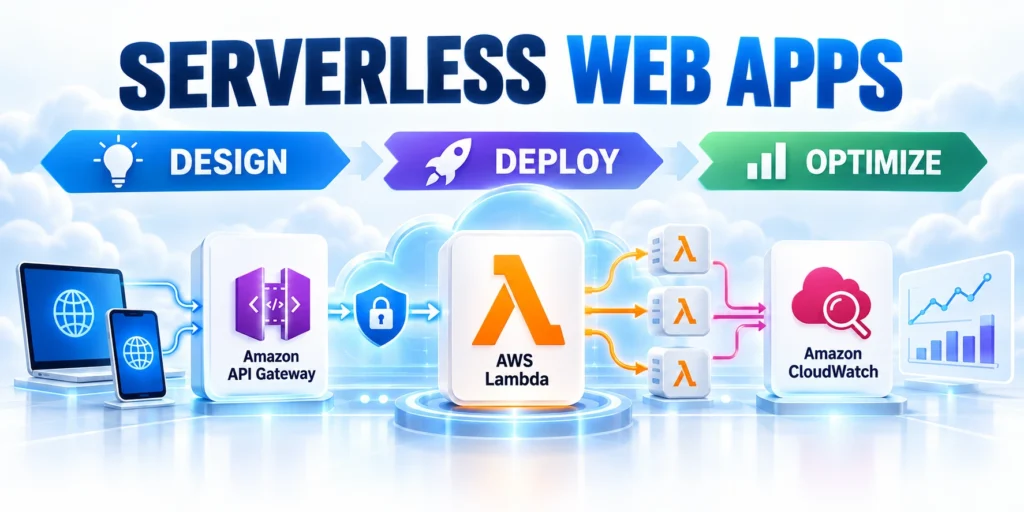
AWS Lambda can reduce operating effort and idle infrastructure when bounded execution, variable demand, and managed scaling fit the application’s real workload.
That value disappears when distributed dependencies, uncontrolled concurrency, weak ownership, or steady utilization create greater cost and reliability risk.
Connect serverless to platform governance
Assign ownership for every function, event source, dependency, alarm, budget, permission boundary, data contract, and rollback path before production adoption.
Preserve these controls with each deployed capability:
- Event contract and accountable owner.
- Concurrency and spending guardrails.
- Retry, idempotency, and failure handling.
- Permission and dependency review dates.
- Service objectives and rollback evidence.
- Operational runbook and escalation path.
Distributed services remain supportable when operational boundaries are as explicit as code boundaries. Review controls after material traffic, dependency, security, or product changes.
Expand only after production evidence
Begin with one measurable capability, protect tenant data, test failure behavior, and compare production outcomes against the prior implementation.
Review these outcomes before expanding serverless adoption:
- Total cost across every dependency.
- Latency, errors, throttles, and recovery.
- Engineering and on-call effort.
- Security and data isolation evidence.
- Customer outcomes from the migration.
- Support demand after production adoption.
Keep Lambda when the evidence supports the business case. Otherwise, preserve useful contracts and choose a container or service matching the runtime pattern.
For broader decisions, read B2B Web App Development: Architecture, Scalability and Launch.
FAQ
These answers clarify common serverless fit, cost, concurrency, security, reliability, migration, and operating decisions for B2B web applications.
Is AWS Lambda a good fit for every B2B web app?
No. Lambda fits short, stateless, event-driven work that benefits from managed scaling. Sustained compute, long-lived sessions, or tight local coupling may fit containers better.
Can a Lambda function run continuously?
Standard invocations have a finite maximum duration. Split longer workflows into steps or queued jobs, or choose a compute service designed for persistent processes.
Does serverless always cost less than containers?
No. Compare total monthly costs under the same traffic and service assumptions, including APIs, storage, networking, monitoring, and provisioned capacity.
How should a team prevent duplicate processing?
Use a stable business idempotency key and a conditional record of the completed action. Return the prior outcome when the same event arrives again.
What is a safe first Lambda migration?
Select a bounded capability with measurable traffic and limited side effects. Stage it, replay sanitized events, then route traffic gradually with a tested rollback.
How should Lambda concurrency be limited?
Set reserved or account-level concurrency according to downstream capacity. Protect databases, partner APIs, and queues from a sudden burst that exceeds their safe throughput.
Test throttling and retry behavior before release. Confirm that rejected work remains recoverable and does not create duplicate side effects.
What causes Lambda cold starts?
A cold start occurs when the platform prepares a new execution environment. Runtime, package size, initialization work, networking, and traffic patterns affect startup latency.
Measure the affected route before optimizing. Provisioned concurrency can reduce startup delay, but it adds cost and should follow a documented latency requirement.
How should secrets be managed in serverless applications?
Store secrets in an approved managed service, grant the function minimum read access, rotate values, and avoid embedding credentials in code or deployment packages.
Cache retrieved values only for an appropriate period. Log access failures without exposing secret content or sensitive environment variables.
How can serverless costs be monitored?
Track invocation count, duration, memory allocation, provisioned concurrency, data transfer, logs, API requests, storage, and dependent managed services together.
Use tags, budgets, and anomaly alerts. Review cost per business transaction so traffic growth is distinguishable from inefficient execution.
When should a team prefer containers over Lambda?
Containers may fit sustained workloads, long-running processes, specialized runtimes, predictable capacity, or applications needing tighter control over networking and execution environments.
Compare operational responsibility, scaling behavior, latency, deployment model, and total cost with the same workload evidence before choosing.





Leave a Reply