

Define Both Delivery Models
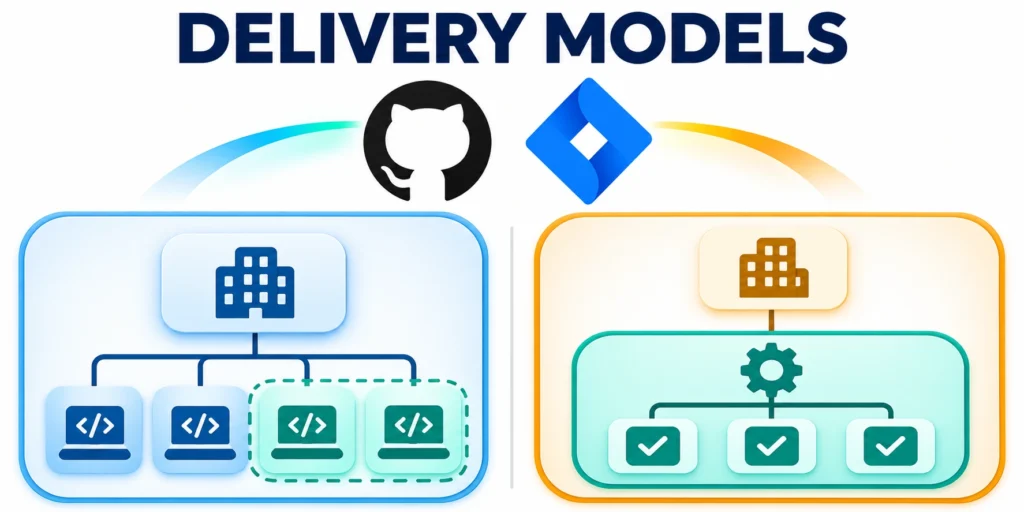
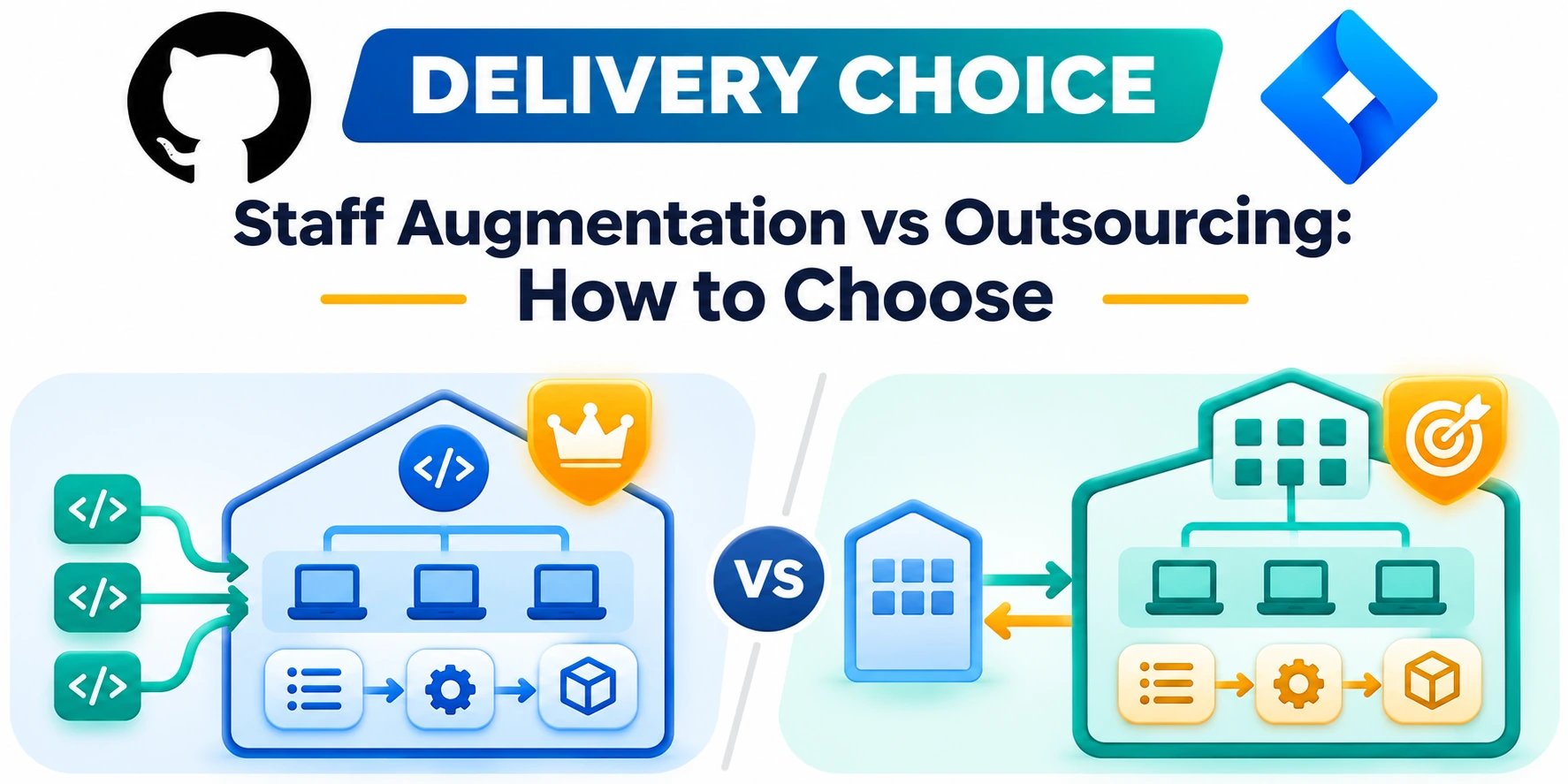
Staff augmentation vs outsourcing compares two ways to add external software capability. The core difference is who manages people, work, decisions, and delivery outcomes.
Staff augmentation adds specialists to a client-led team. Outsourcing assigns a defined service, project, or result to a provider-led delivery system.
Separate added capacity from delegated outcomes
Augmented professionals usually follow the client’s backlog, tools, architecture, practices, meetings, and leadership. The client retains day-to-day direction and integration responsibility.
An outsourcing provider typically plans staffing and execution within agreed boundaries. The client governs scope, business outcomes, risk, acceptance, and contractual performance.
Use these actions to separate added capacity from delegated outcomes:
- Product and backlog ownership
- Architecture and technical leadership
- Staffing and performance management
- Quality and release responsibility
- Operations and escalation authority
Neither label guarantees a specific commercial model. Augmentation may use hourly or monthly rates, while outsourcing may use projects, capacity, retainers, or managed services.
Before comparing nearshore development services, decide who owns the product, architecture, engineering, releases, operations, and security.
Describe the operating model in practical terms
A dedicated external team can resemble augmentation when the client directs every task. It resembles outsourcing when the provider owns delivery methods and outcomes.
Likewise, a project contract may still require substantial client management when requirements, acceptance, dependencies, or decision rights remain unresolved.
Key considerations for describe the operating model in include:
- Name the daily work director
- Define provider outcome ownership
- Identify retained client roles
- Document acceptance authority
- Clarify transition obligations
Use observable responsibilities instead of sales terminology. The model should explain who decides, acts, measures, corrects, escalates, and transfers knowledge.
A precise definition prevents mismatched expectations and allows cost, speed, risk, and governance to be compared across genuinely equivalent options.
Compare Ownership and Decision Rights

Ownership determines whether either model can work. A party cannot be accountable for results when it lacks authority, information, access, or timely decisions.
Staff augmentation keeps most delivery authority inside the client organization. Outsourcing moves selected execution responsibility to the provider while preserving essential business decisions internally.
Match authority to accountability
In augmentation, client leaders assign work, prioritize tradeoffs, review performance, coordinate dependencies, and resolve conflicts among internal and external contributors.
In outsourcing, providers may own staffing, workflow, technical coordination, quality practices, and delivery planning, subject to agreed standards and client governance.
Key considerations for match authority to accountability include:
- Product priority and acceptance
- Architecture and engineering standards
- Staff selection and performance
- Production release and recovery
- Security and data decisions
- Budget and scope authority
Clients should retain product priorities, business risk acceptance, customer commitments, data authority, consequential security decisions, and approval of material scope or budget changes.
Providers need enough authority to organize delivery, enforce engineering practices, manage assigned people, and correct performance without awaiting approval for every routine action.
Test decision rights with real scenarios
Create a decision map rather than one generic RACI. Product, architecture, release, access, incident, staffing, commercial, and vendor decisions may have different owners.
Assign one accountable owner for each decision. Multiple accountable parties often create delay, escalation loops, and disputes after problems occur.
Use these actions to test decision rights with real scenarios:
- Simulate a failed release
- Resolve a priority conflict
- Escalate a security concern
- Replace a critical specialist
- Approve an urgent scope change
Walk through a failed release, disputed requirement, security concern, key-person departure, and urgent priority change before approving the model.
The selected arrangement should let ordinary work proceed independently while ensuring consequential risk reaches the correct business authority early.
Evaluate Speed and Talent Access

Both models can accelerate access to software talent, but recruitment speed is only the first step. Productive capability also requires context, access, leadership, and integration.
Staff augmentation often fills a specific skill or capacity gap quickly when the client already has a functioning team, backlog, architecture, and onboarding process.
Measure time to productive capability
Outsourcing may mobilize a broader multidisciplinary capability, including delivery leadership, engineering, quality, design, cloud, and operations under one coordinated arrangement.
The provider’s talent inventory matters less than its ability to present suitable, available people for the required start date and sustain them afterward.
Use these actions to measure time to productive capability:
- Approved role and capability need
- Candidate availability and screening
- Contract and access readiness
- Domain and architecture onboarding
- First independent accepted outcome
Measure time from approved need to independently useful contribution. Include contracting, screening, access, environment setup, domain learning, and review cycles.
A fast start can create hidden rework when roles, acceptance criteria, technical constraints, or decision owners remain unclear during onboarding.
Protect speed from weak onboarding
Evaluate proposed people through practical discussions and representative work. Confirm technical depth, communication, product judgment, collaboration, and willingness to surface uncertainty.
Review provider recruitment, retention, replacement, training, and succession systems. Individual availability can disappear before a delayed contract is completed.
Use these actions to protect speed from weak onboarding:
- Verify proposed team availability
- Test practical technical judgment
- Prepare access before arrival
- Assign onboarding owners
- Measure productive contribution time
Plan staged onboarding with explicit evidence: environment access, successful build, first reviewed change, production observation, and ownership of a bounded outcome.
Choose augmentation for targeted integration speed and outsourcing for coordinated capability when the client cannot or should not assemble every role independently.
Compare Pricing and Total Cost

Augmentation pricing highlights individual rates, while outsourcing pricing may bundle leadership, process, tools, quality, continuity, and delivery risk. Headline numbers are therefore not directly comparable.
Build a total cost model covering provider fees, internal management, recruitment, onboarding, tools, coordination, quality, delay, turnover, transition, and downstream maintenance.
Normalize scope before comparing rates
For augmentation, include the client leaders who plan work, manage performance, coordinate dependencies, review output, maintain standards, and resolve delivery issues.
For outsourcing, identify responsibilities excluded from the fee, such as product ownership, security approval, cloud consumption, third-party software, travel, and specialist escalation.
Key considerations for normalize scope before comparing rates include:
- Provider fees and commitments
- Internal leadership and coordination
- Tools and third-party services
- Quality and operational consequences
- Transition and switching cost
Normalize seniority, allocation, coverage, holidays, leave, overtime, replacement, and expected productive capacity. One nominal full-time resource may not equal another.
Separate fixed commitments from variable demand. Minimum capacity can improve continuity but creates cost when priorities or access prevent productive work.
Include retained management and failure cost
Estimate rework, escaped defects, failed changes, support demand, and architectural debt. Delivery that appears inexpensive can create expensive operating consequences.
Include exit and switching costs, such as overlap, knowledge transfer, access migration, unfinished work, contract termination, and temporary productivity loss.
Use these actions to include retained management and failure cost:
- Compare equivalent seniority
- Estimate productive capacity
- Price internal management time
- Model quality and delay
- Test adverse scenarios
| Cost area | Augmentation | Outsourcing |
|---|---|---|
| Provider fee | Individual capacity | Bundled capability |
| Management | Mostly client | Shared or provider |
| Quality risk | Client controlled | Contract governed |
| Transition | Person handoff | Service handoff |
Use scenarios for normal demand, rapid scale, key-person departure, delayed decisions, and quality deterioration rather than relying on one optimistic forecast.
The appropriate model produces the strongest risk-adjusted business outcome, not merely the lowest rate or most comprehensive-looking proposal.
Plan Product Knowledge Retention
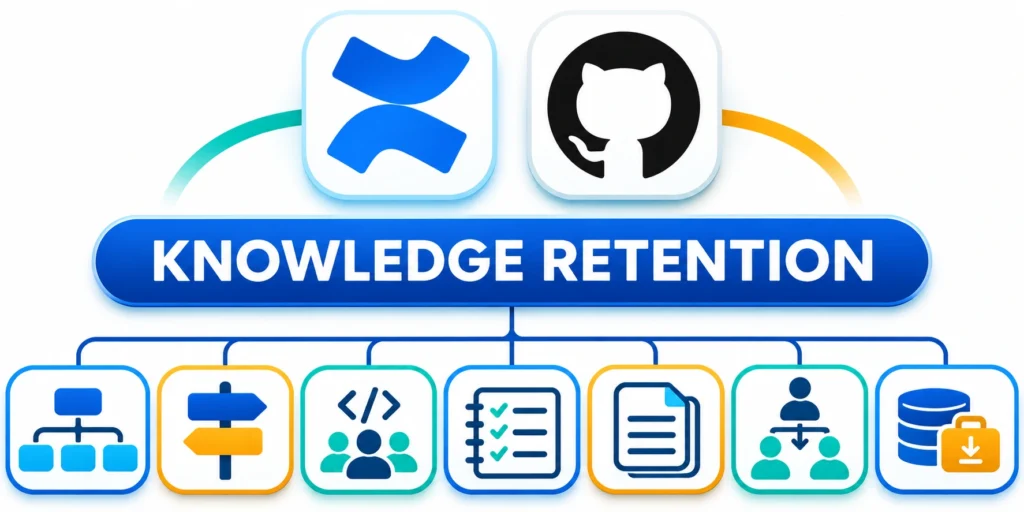
External delivery creates value only when the organization can understand, operate, improve, and transfer what was built. Knowledge must remain usable beyond individual contributors.
Augmented specialists work inside client systems, which can support retention. Outsourced teams may create stronger provider continuity but require deliberate client visibility and portability.
Treat knowledge as an operating asset
Store source code, architecture, decisions, tests, runbooks, environments, dependencies, release evidence, and known risks in shared systems accessible to authorized client owners.
Documentation should support real work rather than contract compliance. Teams need enough context to diagnose failures, change behavior, and explain why important decisions were made.
Use these actions to treat knowledge as an operating asset:
- Architecture and decision records
- Source and dependency ownership
- Build and release procedures
- Operational runbooks and monitoring
- Known risks and constraints
Assign owners and review dates to critical records. Unmaintained documentation can become more dangerous than an acknowledged knowledge gap.
Use code review, pairing, design review, demonstrations, incident analysis, and rotation to distribute understanding across internal and external team members.
Make knowledge portable across staffing changes
Identify concentrated knowledge through repository ownership, incident dependence, architecture decisions, and work that repeatedly waits for one person.
Create succession plans for critical components before departure. Replacement should include overlap, guided work, evidence review, and demonstrated independent capability.
Use these actions to make knowledge portable across staffing changes:
- Review critical ownership quarterly
- Pair across organizational boundaries
- Test onboarding from documentation
- Require replacement overlap
- Exercise transition procedures
Contracts should define access, intellectual property, background assets, third-party licenses, documentation, transition assistance, and deletion or return obligations.
The best arrangement leaves product knowledge stronger after delivery, regardless of whether individuals were augmented resources or part of an outsourced team.
Measure Internal Management Load

Staff augmentation and outsourcing consume different kinds of internal attention. Ignoring that management load can turn external capacity into delay, rework, and leadership exhaustion.
Augmentation generally requires the client to direct work, integrate contributors, review performance, maintain engineering standards, and coordinate the complete delivery system.
Estimate the leadership the model requires
Outsourcing can reduce daily task management when the provider owns planning and execution, but it still requires product direction, governance, acceptance, risk decisions, and commercial oversight.
Measure time spent on backlog preparation, meetings, technical review, access, staffing, escalation, contract administration, reporting, and correcting misunderstandings.
Use these actions to estimate the leadership the model requires:
- Backlog and requirement preparation
- Technical and quality review
- Access and environment coordination
- Staffing and performance management
- Commercial and risk governance
Separate valuable client involvement from avoidable coordination. Product discovery and risk decisions may require internal leaders, while repetitive status collection should not.
Evaluate whether current leaders have capacity and skill to manage augmented contributors. Adding people can reduce throughput when coordination exceeds the team’s operating maturity.
Do not outsource the wrong responsibilities
For outsourcing, confirm that provider leadership is included and empowered. A contract labeled managed delivery may still depend on the client to coordinate every specialist.
Define meeting cadences, evidence, decision deadlines, and escalation thresholds. Effective governance reduces management load by making routine behavior predictable.
Key considerations for do not outsource the wrong include:
- Measure internal management hours
- Track blocked decision time
- Review recurring clarification
- Remove redundant status meetings
- Fund required leadership explicitly
Track decision waiting time, management hours, blocked work, review queues, repeated clarification, and escalations caused by unclear authority.
Select the model whose management demands fit the organization’s actual capability, not the leadership capacity executives hope will appear after contracting.
Recognize Common Delivery Risks
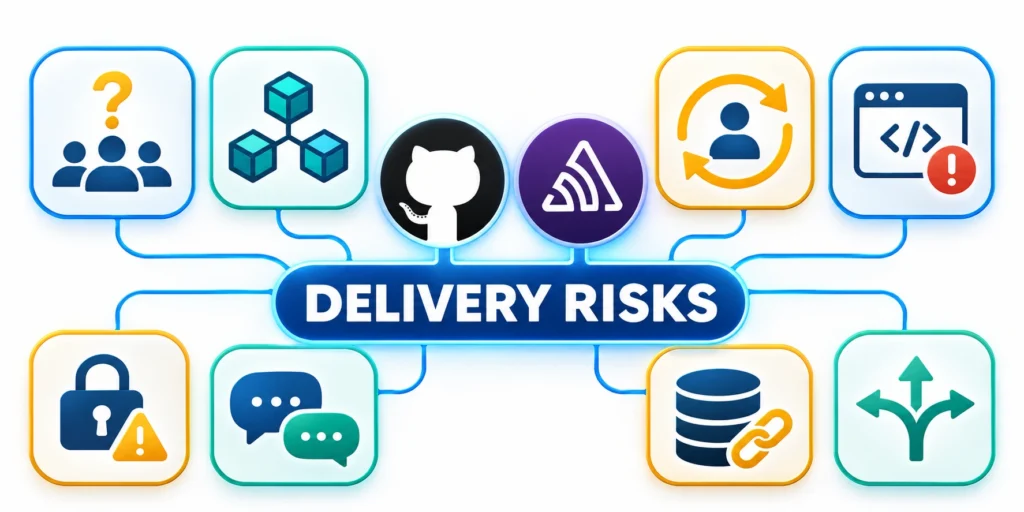
Every external delivery model introduces boundaries involving organizations, access, incentives, knowledge, communication, and contracts. Those boundaries need explicit controls rather than optimistic assumptions.
Augmentation can create fragmented accountability, unmanaged performance, excessive coordination, and dependency on individuals. Outsourcing can create opaque delivery, lock-in, and disputed scope or quality.
Identify risks created by each boundary
Unclear ownership is the most common risk. Define who acts and who decides during normal delivery, failed releases, security concerns, incidents, and commercial disputes.
Misaligned incentives can reward hours, ticket volume, scope protection, or apparent velocity while customer value, reliability, and maintainability deteriorate.
Use these actions to identify risks created by each boundary:
- Ambiguous delivery ownership
- Misaligned commercial incentives
- Access and credential exposure
- Knowledge concentration and lock-in
- Quality and recovery weakness
- Provider continuity failure
Access risk grows when external contributors receive broad production privileges or shared credentials. Use individual identities, least privilege, auditable elevation, and timely offboarding.
Knowledge risk appears when architecture, decisions, code, and operations remain with one person or provider. Require shared systems, review, and tested transition evidence.
Build controls that preserve recovery options
Quality risk increases when acceptance remains subjective or delayed. Define automated and manual evidence for behavior, security, performance, operability, and recovery.
Continuity risk includes provider failure, turnover, geopolitical disruption, infrastructure loss, unavailable stakeholders, and critical vendor dependency.
Use these actions to build controls that preserve recovery options:
- Publish responsibility boundaries
- Use measurable acceptance evidence
- Control and audit access
- Test recovery procedures
- Maintain practical exit readiness
Maintain rollback, backups, alternate contacts, repository access, documentation, and exit rights. Test representative recovery and transition scenarios before a real crisis.
Risk management should make dependencies visible and reversible, not eliminate collaboration or burden every routine action with unnecessary approval.
Combine Models Without Creating Confusion

Many organizations combine employees, augmented specialists, project vendors, and managed services. A hybrid model can use each strength without forcing one arrangement everywhere.
It also creates more interfaces where ownership, priorities, architecture, access, quality, and communication can fragment unless the complete system is governed deliberately.
Use coherent boundaries for hybrid delivery
Assign responsibilities along stable product, service, platform, or capability boundaries. Avoid dividing one tightly coupled workflow among providers solely to compare rates.
Keep product direction and consequential business decisions internally accountable, even when providers own substantial engineering or operational outcomes.
Apply these criteria to coherent boundaries for hybrid delivery:
- Stable product or service boundaries
- One accountable priority owner
- Shared engineering and quality standards
- Explicit dependency ownership
- Unified incident and escalation paths
Use shared engineering standards, repositories, issue tracking, quality evidence, architecture records, observability, and incident practices across every contributing team.
Define integration ownership for dependencies between teams. Each interface needs technical contracts, testing, monitoring, versioning, and a clear escalation path.
Govern the complete value stream
Avoid duplicate leadership where several parties assign the same work. One priority system should guide contributors regardless of employment or contract structure.
Commercial boundaries should not hide customer impact. Review delivery flow, reliability, and outcomes across teams instead of optimizing each provider’s isolated metrics.
Key considerations for govern the complete value stream include:
- Map every team interface
- Remove duplicate work direction
- Standardize delivery evidence
- Measure end-to-end outcomes
- Review provider interaction failures
The nearshore versus offshore software development comparison can help place hybrid capacity where collaboration, scale, and coverage needs differ.
A hybrid succeeds when organizational boundaries remain visible but do not prevent shared ownership of product quality, knowledge, and customer outcomes.
Use a Practical Selection Framework
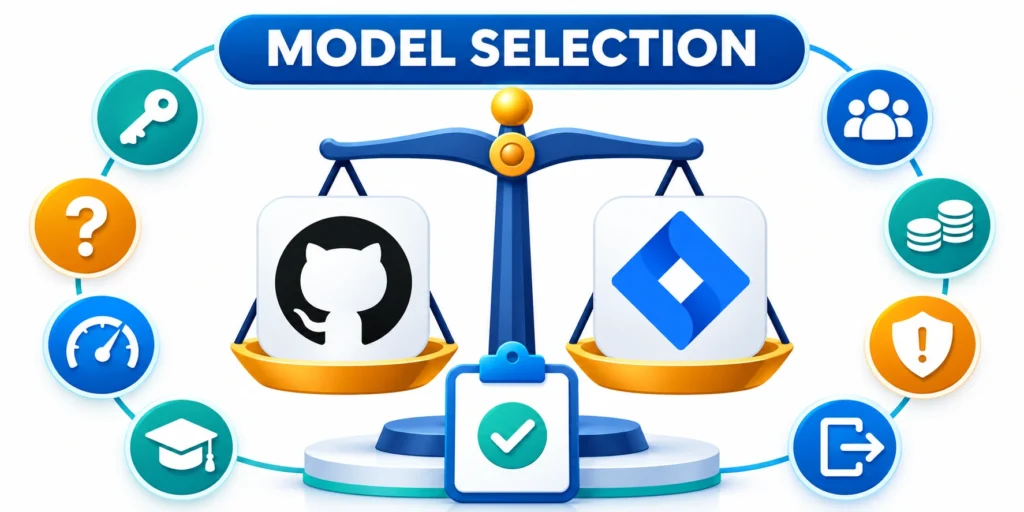
A useful selection framework begins with the problem, not a preferred vendor category. Define the capability gap, desired outcome, constraints, and decision horizon.
Assess ownership, uncertainty, internal leadership, skill needs, speed, duration, scale, security, quality, coverage, continuity, budget, and transition requirements together.
Choose from evidence and organizational fit
Staff augmentation fits a client with strong product and engineering leadership that needs targeted skills, flexible capacity, or temporary acceleration inside existing practices.
Outsourcing fits a client that can define outcomes and governance but wants a provider to organize a broader capability, service, or project delivery system.
Use these actions to choose from evidence and organizational fit:
- Work uncertainty and duration
- Client leadership and management
- Required skills and scale
- Quality and operational risk
- Security and legal constraints
- Knowledge and exit requirements
Use mandatory conditions before weighted preferences. A model that cannot meet security, legal, continuity, access, or critical coverage needs should not remain viable.
Compare representative proposals with equivalent scope, seniority, responsibility, quality evidence, governance, tooling, transition, and retained client roles.
Validate the model with a bounded pilot
Ask each provider to respond to realistic scenarios involving unclear requirements, failed releases, staffing changes, urgent defects, budget pressure, and exit.
Score both provider capability and client readiness. A strong partner cannot compensate indefinitely for missing product authority, delayed access, or unavailable decisions.
Use these actions to validate the model with a bounded:
- Define mandatory conditions
- Normalize proposal responsibilities
- Test realistic failure scenarios
- Measure pilot operating evidence
- Expand through explicit gates
Run a pilot that includes real complexity and stakeholders. Measure productive speed, quality, communication, management load, predictability, knowledge, and risk behavior.
Expand only after evidence validates the operating assumptions. Correct boundaries, access, leadership, staffing, or governance before adding more dependency.
Conclusion

Staff augmentation and outsourcing solve different operating problems. Augmentation adds people to client leadership, while outsourcing delegates defined delivery responsibility to a provider system.
Choose augmentation when internal product and engineering management is strong. Choose outsourcing when broader provider coordination and outcome ownership create genuine value.
Select the responsibility model that fits
Define decision rights, retained roles, acceptance, quality, access, coverage, knowledge, transition, and escalation before comparing speed or price.
Evaluate proposed people and leadership through real scenarios. Provider branding and contract labels are weaker evidence than observed technical and operating behavior.
Use these actions to select the responsibility model that fits:
- Match authority to accountability
- Compare complete operating cost
- Test teams with real work
- Preserve knowledge and portability
- Measure end-to-end outcomes
Compare total cost, including internal management, delay, rework, defects, turnover, tools, support, transition, and the business impact of failure.
Protect product knowledge in shared repositories, decisions, tests, runbooks, environments, and ownership records that remain usable after individuals or providers change.
Keep knowledge, quality, and exit visible
Hybrid delivery can combine the models when boundaries follow coherent products or capabilities. Avoid splitting tightly coupled work into competing contractual silos.
Govern the complete value stream through stable measures and clear escalation. Local provider efficiency should not obscure customer delay or system reliability.
Use these actions to keep knowledge quality and exit visible:
- Review ownership regularly
- Track management load
- Improve quality evidence
- Exercise transition readiness
- Reassess changing assumptions
Use a bounded pilot when uncertainty remains, and measure management effort alongside delivery output. External capacity is valuable only when the organization can absorb it.
The right model makes accountability clearer, delivery more dependable, knowledge more durable, and future change easier rather than creating hidden organizational debt.
FAQ
These answers summarize the differences between staff augmentation and outsourcing across control, speed, cost, knowledge, management, hybrid delivery, risk, and selection.
What is staff augmentation?
Staff augmentation adds external specialists to a client-led team. The client usually directs daily work, priorities, architecture, quality, coordination, and performance integration.
What is software outsourcing?
Software outsourcing assigns a defined project, service, or outcome to a provider that organizes staffing and delivery within agreed scope, standards, governance, and acceptance.
Which model gives the client more control?
Staff augmentation usually provides more direct control over individual work. Outsourcing provides control through outcomes, contracts, governance, evidence, acceptance, and escalation.
Is staff augmentation faster to start?
It can be faster for a specific skill when the client has ready leadership, backlog, access, architecture, and onboarding. Missing prerequisites can erase that advantage.
Is outsourcing less expensive?
Not automatically. Compare total cost across provider fees, internal management, tools, quality, delay, turnover, transition, support, and business impact using equivalent scope.
Who owns product knowledge?
Knowledge should remain accessible to authorized client owners through repositories, documentation, decisions, tests, environments, runbooks, dependencies, and contractual transition obligations.
Can a company combine both models?
Yes. A hybrid can work when responsibilities follow coherent product or capability boundaries with one priority system, shared standards, and explicit dependency ownership.
What is the biggest augmentation risk?
The client may add people without enough leadership, creating coordination overload, fragmented accountability, inconsistent quality, and dependence on individual contributors.
What is the biggest outsourcing risk?
The client may delegate work without maintaining visibility, product authority, knowledge portability, quality evidence, or practical options for correction and exit.
How should a company choose?
Define the capability gap, ownership, uncertainty, management capacity, skills, risk, cost, knowledge, and exit needs, then validate the preferred model through representative evidence.






Leave a Reply