

Define DevOps and SRE by Outcomes

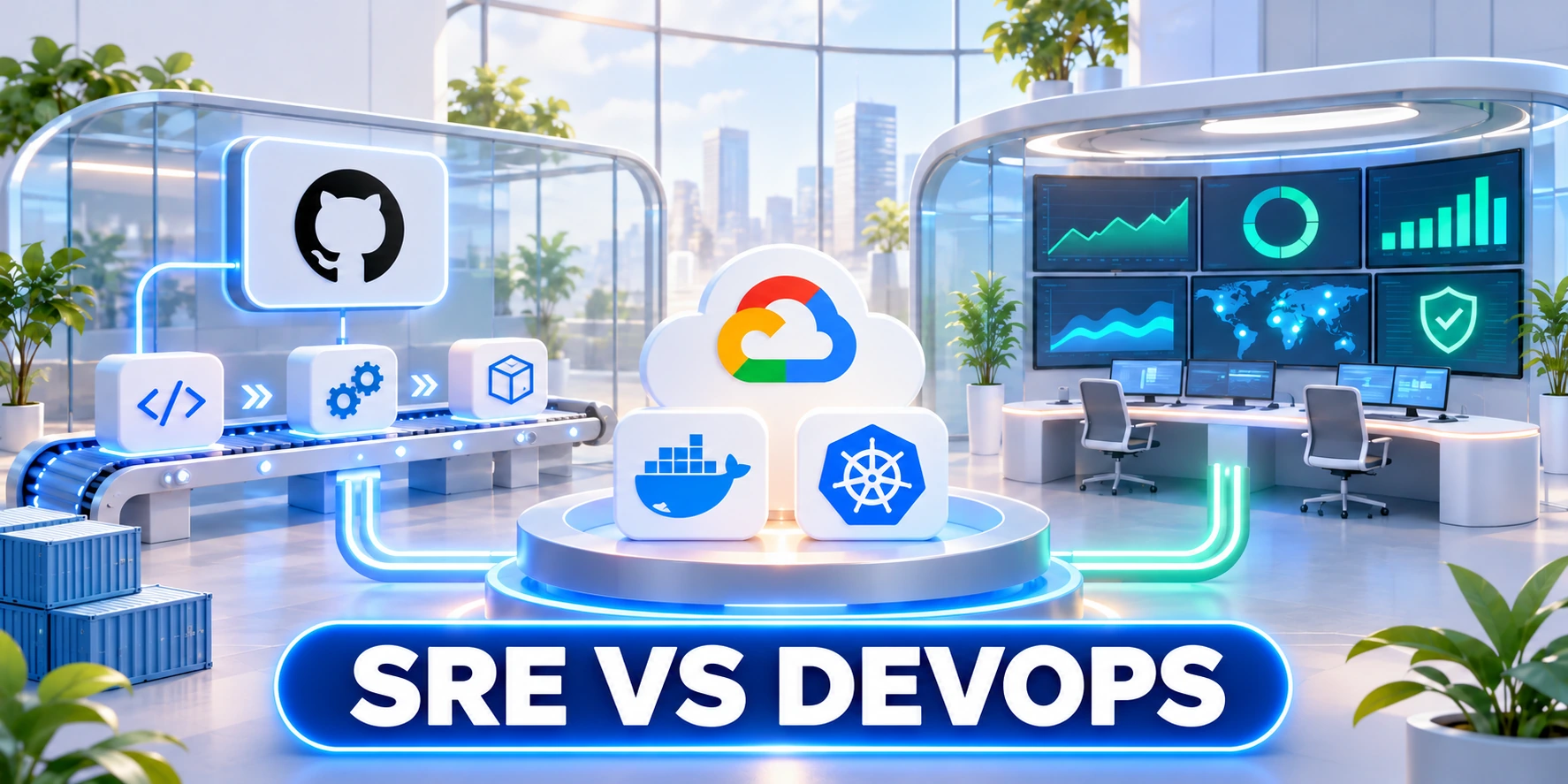
DevOps and site reliability engineering overlap, but they solve different operating problems. DevOps improves delivery flow, while SRE makes reliability measurable and governable.
The useful choice is therefore not a label. It is a defined set of outcomes, constraints, responsibilities, and feedback loops for the services your team operates.
Start with business and service outcomes
Identify the customer journeys and internal workflows that depend on dependable software delivery. Connect every operating practice to those outcomes before selecting tools or roles.
Delivery outcomes may include deployment frequency, lead time, recovery speed, and change quality. Reliability outcomes may include availability, latency, correctness, durability, and support load.
Use these actions to start with business and service outcomes:
- Name critical customer journeys.
- Define delivery and reliability outcomes.
- Assign a metric owner.
- Set a review cadence.
Choose a small metric set that teams can influence. A long dashboard without decision thresholds creates observation, not an effective operating model.
Document who consumes each metric, which decision it supports, and how often teams review it. Remove measurements that never change priorities or behavior.
Separate principles from implementation
DevOps is a collaboration and delivery philosophy rather than one team or product. SRE applies software engineering methods to operations and formal reliability management.
A team can practice DevOps without a formal SRE function. It can also use SRE methods without creating a separate organization or changing every job title.
Use these actions to separate principles from implementation:
- Define desired behaviors first.
- Choose structure after evidence.
- Avoid role-title substitution.
- Review the operating hypothesis.
Describe the behaviors you need before choosing structure. Shared ownership, automation, learning, and bounded risk matter more than copying another company’s organization chart.
Record the initial operating hypothesis and revisit it after measurable experience. The model should evolve when service evidence or organizational constraints change.
Create a decision statement
Write one sentence explaining why this operating model is needed now. Include the service problem, expected outcome, owner, and review date.
Use that statement to reject unrelated tooling projects. Every proposed practice should improve the named outcome or reduce a documented operating risk.
Compare Responsibilities and Team Boundaries
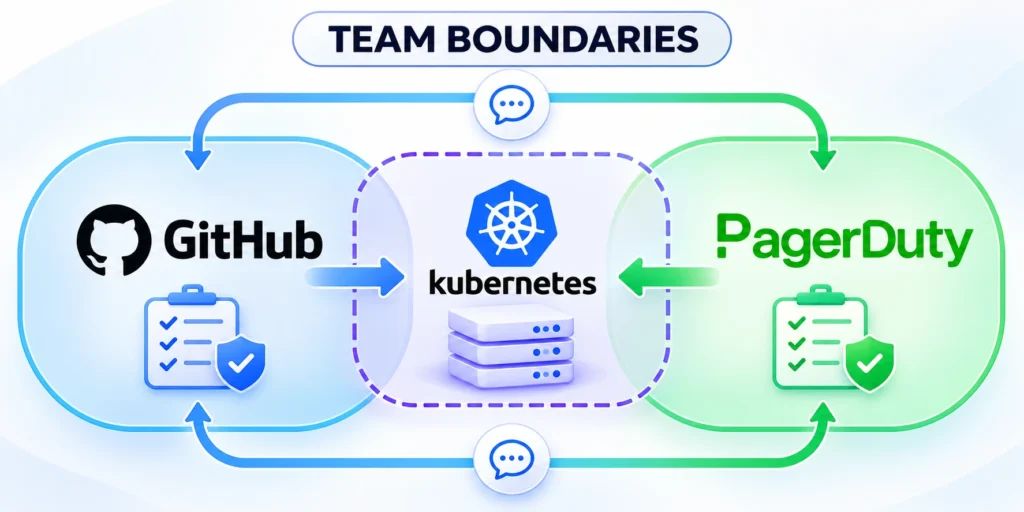
Ambiguous ownership causes slower incidents, duplicated automation, and neglected services. Define responsibilities around the service lifecycle instead of dividing work between development and operations queues.
A clear boundary explains who designs, builds, releases, observes, supports, and improves each service. It also identifies decisions requiring shared approval or escalation.
Map lifecycle responsibilities
Start with service design, capacity assumptions, deployment, configuration, observability, incident response, recovery, and retirement. Assign one accountable owner for each material decision.
Developers usually own code behavior and safe delivery. Platform teams provide reusable capabilities, while reliability specialists define controls, coaching, and deeper operational engineering.
Use these actions to map lifecycle responsibilities:
- Map the complete service lifecycle.
- Assign one accountable owner.
- Document shared decisions.
- Define escalation authority.
Give each responsibility a decision owner. If a nearshore delivery team shares operational work, agree who can approve changes and escalate incidents.
Publish boundaries beside service documentation and review them after reorganizations. Ownership information that lives only in memory becomes unreliable during urgent events.
Use service ownership records
Maintain a compact record for every production service. Include owner, repository, deployment path, dependencies, dashboards, on-call route, recovery objective, and retirement status.
Keep the record close to engineering workflows and update it through normal change processes. A disconnected spreadsheet quickly becomes a misleading inventory.
Apply these criteria to service ownership records:
- Record owners and repositories.
- Link dashboards and runbooks.
- Expose unknown ownership gaps.
- Update records through change workflows.
Review high-risk services first and mark unknown fields honestly. An explicit gap is safer than false ownership that delays response or approves unsafe changes.
Connect this responsibility model with a broader cloud and DevOps consulting framework when organizational redesign spans several platforms.
Test the boundaries
Run a tabletop scenario covering a failed release and degraded dependency. Observe where participants hesitate, duplicate work, or lack authority to decide.
Revise the responsibility map from those observations. Repeat the exercise after major architecture, staffing, vendor, or organizational changes.
Use SLIs, SLOs, and Error Budgets
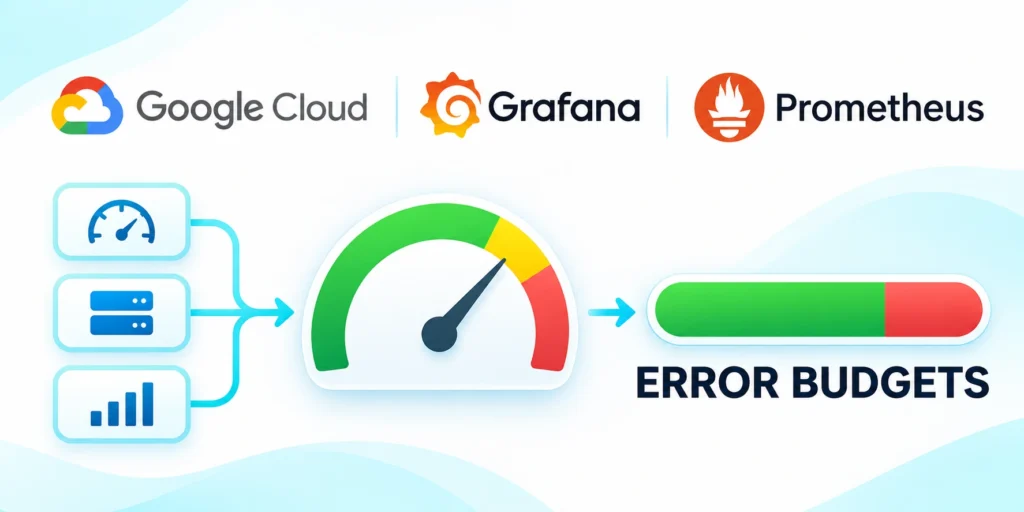
Service level indicators measure customer-relevant behavior. Service level objectives define acceptable performance, while error budgets translate the remaining tolerance into an operating decision boundary.
These controls help teams balance reliability and delivery without demanding perfection. They work only when measurements represent real user experience and trigger agreed actions.
Choose customer-centered indicators
Select indicators for successful requests, latency, freshness, durability, or workflow completion. Infrastructure utilization is supporting evidence, not a substitute for service behavior.
Define the event population, good events, exclusions, measurement source, and aggregation window. Small definition differences can create incompatible reports and misleading trends.
Use these actions to choose customer-centered indicators:
- Select customer-centered indicators.
- Define good and total events.
- Document exclusions clearly.
- Validate telemetry during failures.
Start with a few indicators for the most important journey. Add another only when it supports a distinct decision or exposes a material hidden failure mode.
Validate telemetry during normal traffic and controlled failures. An indicator that disappears during an outage cannot reliably govern availability or response.
Set objectives and budget policy
Choose an objective from business impact, user expectations, contractual commitments, architecture, and current capability. Do not copy a fashionable number without understanding its cost.
Define rolling windows and burn-rate thresholds that expose both rapid incidents and sustained degradation. Pair every threshold with a proportionate operational response.
Use these actions to set objectives and budget policy:
- Set evidence-based objectives.
- Use rolling measurement windows.
- Define burn-rate responses.
- Review targets after major changes.
When consumption is healthy, teams may continue planned delivery. Rapid budget loss should trigger investigation, stabilization, and temporary restrictions on risky changes.
Review objectives after material product or architecture changes. Raising a target should represent a deliberate investment rather than an unexplained dashboard edit.
Keep error budgets actionable
Discuss budget state in regular product and engineering reviews. Show the customer impact, current burn, likely causes, and decisions required from named owners.
Do not use error budgets to punish teams. Use them to align delivery risk, reliability work, and investment with a shared, measurable service standard.
Design On-Call and Incident Practices
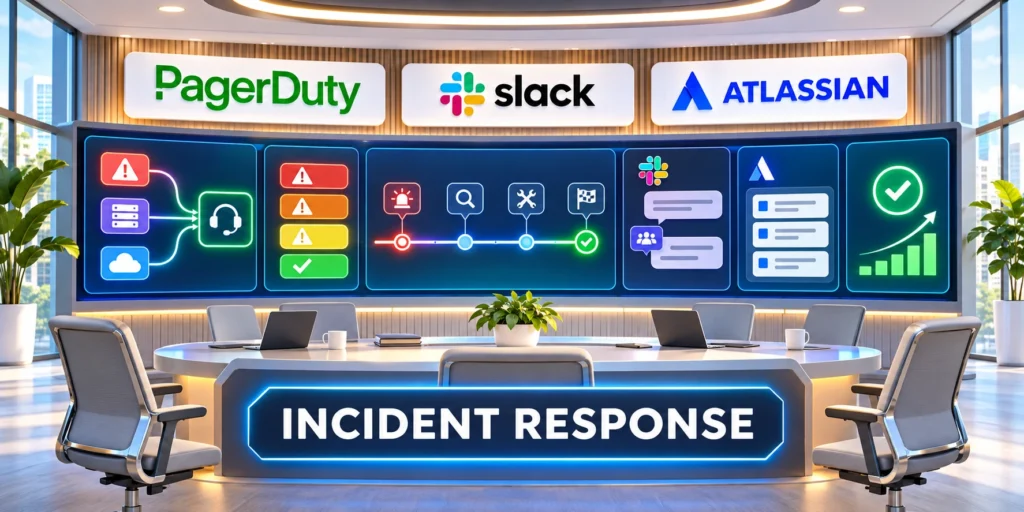
On-call exists to restore service and protect customers, not to absorb unlimited operational debt. Design rotations, alerts, authority, and escalation around sustainable response.
Incident management should create fast coordination during disruption and reliable learning afterward. Excessive ceremony during minor events can be as harmful as missing structure during major failures.
Build a sustainable on-call system
Route alerts to people who can diagnose or safely mitigate the affected service. Include current runbooks, dashboards, dependencies, severity, and escalation contacts in every actionable notification.
Set rotation size, handoff, coverage, compensation, and backup expectations explicitly. Repeated interruptions or single-person expertise require engineering investment, not permanent individual sacrifice.
Use these actions to build a sustainable on-call system:
- Route actionable alerts only.
- Maintain current response context.
- Provide backup and escalation.
- Measure responder load.
Measure page volume, actionable rate, acknowledgment time, after-hours disruption, and repeat causes. Use those trends to remove noise and improve service design.
Give responders authority to stop deployments, reduce features, fail over, or escalate vendors within defined safety boundaries. Responsibility without authority delays recovery.
Use a simple incident command model
Assign an incident lead, technical responders, and communications owner for material events. One coordination channel and one current timeline reduce fragmented decisions.
Declare severity from customer impact and operational risk. Update it as evidence changes rather than defending the initial classification.
Apply these criteria to a simple incident command model:
- Name an incident lead.
- Use one coordination channel.
- Update severity from evidence.
- Schedule proportionate learning reviews.
Communicate known impact, current action, uncertainty, and next update time. Avoid unsupported root-cause statements while diagnosis remains incomplete.
After restoration, preserve evidence and schedule a proportionate review. Focus on system conditions, decision quality, safeguards, and durable corrective work.
Close the learning loop
Assign corrective actions with owners, deadlines, and expected effects. Track them with normal engineering work instead of isolating them in forgotten incident documents.
Verify whether completed changes reduce recurrence or detection time. A closed ticket without observed improvement does not demonstrate operational learning.
Automate Repetitive Operational Work
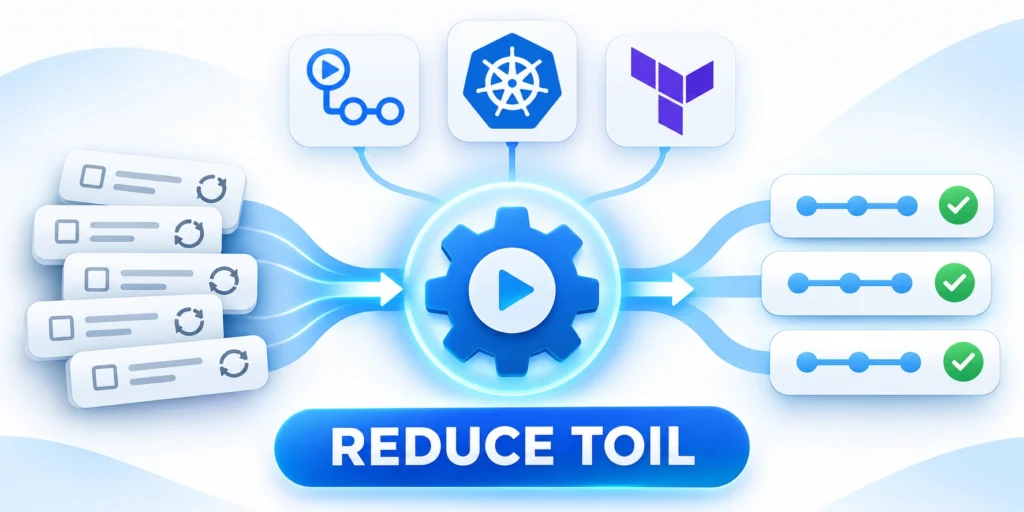
Toil is repetitive, manual, automatable work that scales with service growth and creates little enduring value. Reducing it protects engineering capacity and consistency.
Automation should remove a verified burden without hiding risk or creating an unowned system. Start with stable procedures whose inputs, outputs, and failure modes are understood.
Identify valuable automation candidates
Measure time, frequency, interruption cost, error rate, and growth for recurring work. Interview responders because ticket categories often hide repeated diagnostic and coordination effort.
Prioritize high-frequency tasks with clear rules and safe rollback. Avoid automating rare, ambiguous processes before teams understand why judgment is still required.
Use these actions to identify valuable automation candidates:
- Measure repetitive work first.
- Prioritize stable procedures.
- Define safe rollback behavior.
- Record the manual baseline.
Examples include environment provisioning, certificate renewal, routine access changes, deployment checks, capacity adjustments, log collection, and standardized recovery steps.
Record the manual baseline before implementation. The comparison should include time saved, failures prevented, maintenance burden, and new dependencies introduced.
Engineer automation as a product
Give automation an owner, repository, tests, telemetry, documentation, permissions model, and support path. A script without maintenance becomes another operational liability.
Design idempotent actions where practical and expose preview modes for risky changes. Validate inputs and stop safely when assumptions are not satisfied.
Key considerations for engineer automation as a product include:
- Assign an automation owner.
- Test success and failure paths.
- Use least-privilege credentials.
- Expand after a bounded pilot.
Protect credentials through managed secrets and least privilege. Log decisions and outcomes without exposing sensitive values or generating unusable event volume.
Pilot on bounded scope, compare results with the manual process, and expand only after failure handling proves understandable to operators.
Prevent automation sprawl
Maintain a catalog of operational automation and retire duplicated or obsolete tools. Prefer shared platform capabilities when they satisfy several teams without excessive coupling.
Review whether each tool still saves effort after maintenance, upgrades, and incidents. Replace automation that merely moves toil into a less visible queue.
Compare Centralized, Embedded, and Platform Models

Organization design determines how reliability knowledge spreads, how quickly teams receive help, and whether operational ownership stays close to software decisions.
Centralized, embedded, and platform models each work under different constraints. Many organizations need a hybrid that changes as services and teams mature.
Understand the three common models
A centralized reliability team concentrates expertise and standards. It can address shared risks efficiently, but may become a service queue or operational dumping ground.
Embedded specialists work closely with product teams and local context. This improves influence, yet scarce expertise may become inconsistent or isolated across groups.
Key considerations for understand the three common models include:
- Evaluate centralized expertise.
- Consider embedded context.
- Assess platform reuse.
- Match structure to maturity.
A platform model delivers reusable paved roads, observability, deployment, and recovery capabilities. Product teams retain service ownership while consuming supported internal products.
Choose from service criticality, engineering maturity, scale, architecture, talent, and coordination cost. Avoid selecting a model because another company made it famous.
Design a practical hybrid
Central experts can define standards, coach teams, and handle exceptional risk. Platform groups can productize common capabilities, while service teams own daily reliability outcomes.
Define engagement thresholds so specialist support targets meaningful risks. Time-box embedded work and transfer knowledge rather than creating permanent dependency.
Use these actions to design a practical hybrid:
- Productize common capabilities.
- Time-box specialist engagements.
- Transfer knowledge deliberately.
- Review organizational friction.
Measure adoption, service outcomes, queue time, platform satisfaction, and repeated exceptions. These signals reveal whether the organization removes friction or redistributes it.
Revisit boundaries as platforms mature or services become more critical. A successful model should make routine ownership clearer while preserving expert escalation.
Compare operating choices
Use the comparison table to begin a design discussion. Validate each choice against actual team capacity, service risk, and the current platform roadmap.
No model removes ownership. It changes where expertise, enabling products, standards, and final service decisions reside.
| Model | Best fit | Main risk |
|---|---|---|
| Centralized | Scarce expert capability | Becoming a service queue |
| Embedded | High local context | Inconsistent practices |
| Platform | Repeated shared needs | Low product adoption |
| Hybrid | Mixed service maturity | Unclear boundaries |
Assess Current Reliability Maturity
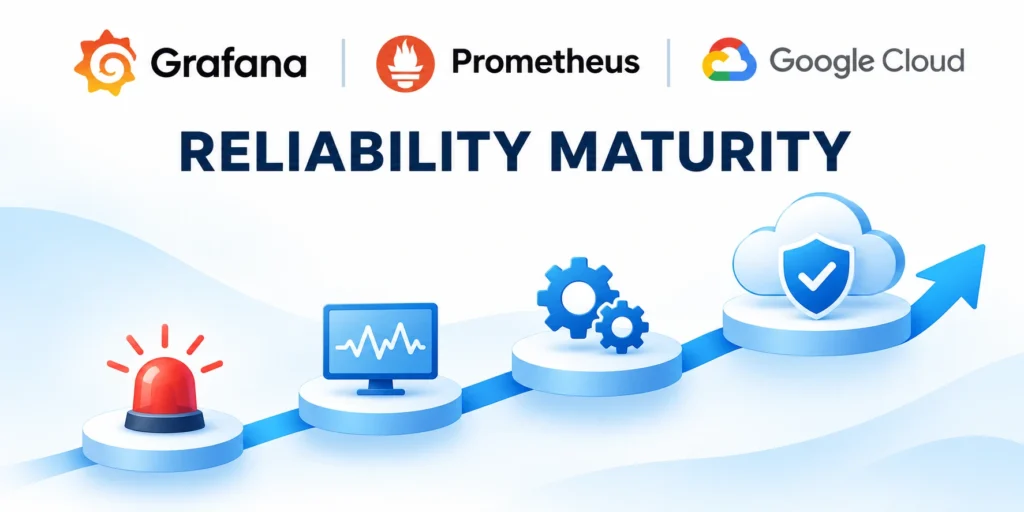
A maturity assessment should identify the next useful capability, not produce a flattering score. Evaluate practices through evidence from real services and recent operational events.
Assess several dimensions separately because strong deployment automation can coexist with weak ownership, noisy alerts, poor recovery, or unclear customer objectives.
Gather evidence from representative services
Select critical, typical, and problematic services rather than reviewing only the best team. Include different architectures, business impacts, ages, and support models.
Inspect ownership records, objectives, dashboards, alerts, deployment safeguards, incidents, recovery tests, automation, and unresolved operational work. Verify documents against observed practice.
Key considerations for gather evidence from representative services include:
- Sample representative services.
- Inspect operational evidence.
- Interview different roles.
- Trace recent real events.
Interview developers, responders, product leaders, and support teams separately. Differences between their explanations often reveal hidden handoffs or conflicting priorities.
Use recent incidents and releases as traceable cases. Abstract policies may appear mature until teams explain how decisions actually occurred under pressure.
Prioritize the next capability
Group findings by customer risk, operational burden, recurrence, dependency, and feasibility. Fix foundational ownership and telemetry gaps before advanced optimization.
Select a small number of improvements with measurable outcomes. Each action needs an owner, affected services, support, completion criteria, and review date.
Use these actions to prioritize the next capability:
- Rank customer and operational risk.
- Fix foundational gaps first.
- Set measurable improvement outcomes.
- Reassess after meaningful change.
Avoid universal maturity targets that ignore service importance. A low-risk internal tool may need fewer controls than a revenue-critical customer workflow.
Repeat the assessment after meaningful change rather than on a ceremonial calendar. Compare evidence and outcomes, not only questionnaire scores.
Keep the assessment honest
Document uncertainty and unavailable evidence instead of converting assumptions into ratings. Missing evidence is itself an operational finding that may deserve corrective work.
Share the assessment as a planning tool, not an individual performance score. Teams provide better evidence when the process supports learning rather than punishment.
Avoid Common Adoption Failures
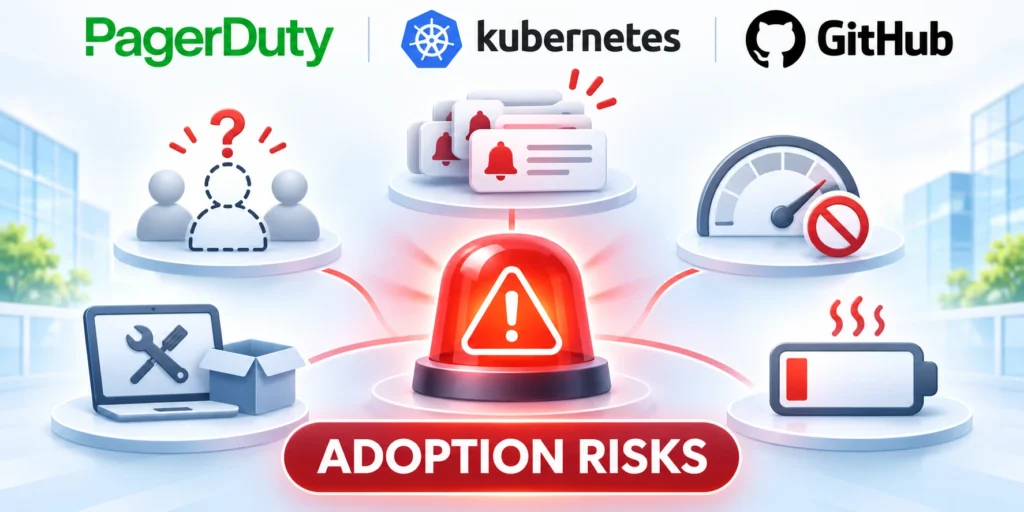
SRE and DevOps programs fail when organizations rename teams, purchase tools, or transfer operational burden without changing authority, incentives, engineering practices, and decision processes.
Successful adoption begins with a bounded problem and executive support for shared ownership. It grows through evidence, coaching, reusable capabilities, and visible outcomes.
Recognize structural failure patterns
Creating an SRE team as the new operations queue separates developers from consequences and overloads specialists. Reliability expertise should enable ownership, not absorb every service.
Mandating tools without workflow changes creates dashboards and automation that teams do not trust. Define the decision first, then select the minimum supporting technology.
Key considerations for recognize structural failure patterns include:
- Avoid the new operations queue.
- Choose tools after decisions.
- Adapt patterns to context.
- Reject instant perfection targets.
Copying objectives or organizational structures from larger companies ignores different architecture, staffing, regulation, customer expectations, and product maturity.
Demanding immediate perfect reliability encourages hidden risk and defensive reporting. Use explicit tradeoffs, prioritized services, and gradual capability development.
Align incentives and authority
Product plans must reserve capacity for reliability work when evidence supports it. Teams cannot own outcomes if every improvement loses against feature deadlines.
Leaders should review delivery and reliability together. Rewarding release volume while penalizing incidents creates contradictory behavior and unsafe local optimization.
Use these actions to align incentives and authority:
- Reserve reliability capacity.
- Review delivery and reliability together.
- Provide matching decision authority.
- Measure operating outcomes.
Give service owners authority over safeguards, risk acceptance, escalation, and bounded feature reduction. Define when higher leadership must approve exceptions.
Track whether adoption reduces customer impact, toil, recovery time, and coordination delay. Training attendance and tool installation are inputs, not outcomes.
Correct adoption drift
Pause expansion when the pilot creates queues, duplicated responsibilities, or unmaintained automation. Repair the operating design before adding more teams or tooling.
Collect specific feedback from participating teams and customers. Adjust boundaries, platform capabilities, objectives, and coaching while preserving the original outcome focus.
Build a 90-Day Operating Model Pilot
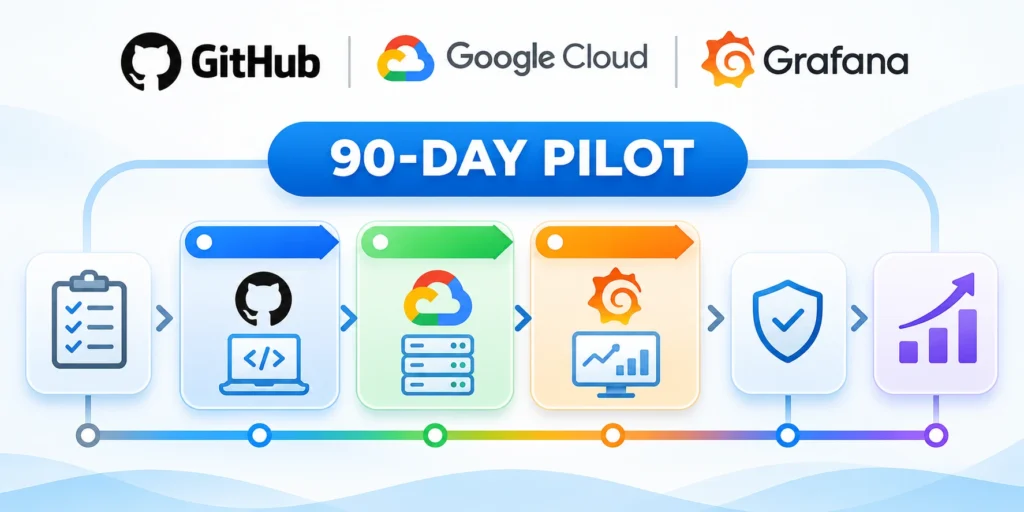
A 90-day pilot creates enough time to test roles, controls, and feedback without declaring a permanent reorganization before evidence exists.
Choose a representative service with meaningful business value, willing owners, measurable pain, and manageable risk. Avoid the easiest showcase or the most unstable emergency.
Plan the pilot in three phases
The first thirty days establish ownership, customer journeys, baseline indicators, incident history, toil, dependencies, and the operating problem to solve.
Days thirty-one through sixty introduce objectives, alert improvements, response practices, targeted automation, and a regular reliability review with product participation.
Use these actions to plan the pilot in three phases:
- Baseline the selected service.
- Introduce bounded operating changes.
- Observe measurable outcomes.
- Decide the next scope.
The final thirty days observe outcomes, test recovery, resolve gaps, document reusable patterns, and determine whether to expand, revise, or stop.
Protect a stable pilot scope. Record adjacent issues separately unless they block the experiment or create unacceptable customer risk.
Define success before starting
Select outcome measures such as actionable alert rate, recovery time, change failure, toil hours, objective compliance, or repeated incident reduction.
Add guardrails for customer impact, responder burden, delivery delay, and platform cost. Improvement in one metric should not hide transferred harm.
Use these actions to define success before starting:
- Choose outcome and guardrail metrics.
- Name every pilot owner.
- Schedule decision reviews.
- Preserve baseline evidence.
Assign an executive sponsor, service owner, technical facilitator, product representative, and review cadence. Clarify who can resolve priority conflicts during the pilot.
Schedule decision reviews at the beginning rather than waiting for the final week. Preserve baseline evidence so comparisons remain reproducible.
Scale only verified patterns
Document which practices helped, which failed, and which depended on unique service conditions. Convert only stable repeated needs into platform capabilities or standards.
Expand to another representative service before organization-wide rollout. The second application tests whether the model transfers without the original team’s hidden knowledge.
Conclusion

SRE and DevOps are complementary approaches when teams connect delivery speed, operational ownership, and measurable reliability instead of treating them as competing brands.
The right model depends on service risk, organizational maturity, platform capability, and current constraints. Begin with outcomes, then design responsibilities, controls, and enabling products.
Choose the next operating decision
Identify one service where unclear ownership, unreliable delivery, excessive toil, or repeated incidents create meaningful customer or business cost.
Define its critical journeys, owners, indicators, objectives, escalation, and improvement backlog. Keep the first control set small enough for teams to understand.
Use these actions to choose the next operating decision:
- Select one representative service.
- Clarify ownership and outcomes.
- Pilot a bounded model.
- Review shared evidence.
Use a bounded pilot to test whether the model improves decisions and outcomes. Preserve evidence from both successful and unsuccessful changes.
Review delivery and reliability in the same forum. Separate dashboards or leadership conversations allow local improvements to hide broader service harm.
Build durable operating capability
Invest in reusable observability, deployment, recovery, and automation where repeated service needs justify a maintained internal platform capability.
Keep service teams accountable for customer outcomes while providing expert coaching and escalation. Central specialists should multiply ownership rather than replace it.
Use these actions to build durable operating capability:
- Productize repeated capabilities.
- Preserve service-team ownership.
- Adapt controls as conditions change.
- Measure outcomes, not labels.
Revise objectives, boundaries, and controls when customer expectations, architecture, staffing, or risk materially change. Reliability governance is an ongoing operating practice.
Measure the model through customer impact, response quality, toil, delivery safety, and decision speed. Organization charts alone cannot demonstrate improvement.
Continue with evidence
The strongest model makes routine decisions clear and difficult events manageable. It also leaves teams able to explain why each tradeoff was accepted.
Continue only the practices that create observable value. Retire ceremony, tools, and reports that do not improve customer experience or operational judgment.
FAQ
These answers clarify common decisions teams face when comparing SRE and DevOps operating models, controls, responsibilities, and adoption paths.
Is SRE the same as DevOps?
No. DevOps is a broad collaboration and delivery philosophy, while SRE applies software engineering methods to measurable reliability and operational work.
Does every company need an SRE team?
No. Teams can use service objectives, error budgets, toil reduction, and incident learning without creating a separate SRE department.
Can developers own production reliability?
Yes, when they receive useful platform capabilities, observability, authority, sustainable on-call practices, and support for reliability work.
What should an SLO measure?
An SLO should measure customer-relevant service behavior through clearly defined good events, total events, exclusions, sources, and windows.
How many SLOs should a service have?
Start with a small set covering the most important customer journeys. Add another only when it supports a distinct operating decision.
What is an error budget?
An error budget is the tolerated unreliability remaining under an objective. Teams use its consumption to balance delivery and stabilization decisions.
How should on-call health be measured?
Track actionable alert rate, page volume, acknowledgment, after-hours interruption, repeat causes, escalation, and responder feedback.
Which team model works best?
The answer depends on service risk, scale, talent, platform maturity, architecture, and coordination cost. Many organizations benefit from a hybrid.
How long should an operating model pilot run?
Ninety days is practical for establishing evidence, introducing bounded changes, observing outcomes, and deciding whether the model should expand.
What proves SRE or DevOps adoption worked?
Evidence includes lower customer impact, safer delivery, less toil, faster recovery, clearer ownership, and better operating decisions.







Leave a Reply