


Establish a Cloud Cost Baseline

Cloud cost optimization begins with a reliable baseline for current spending and resource consumption. It must also define business demand and the comparison period.
A baseline should preserve seasonality, unusual events, growth. Contractual changes so teams do not celebrate savings created by lower demand or delayed work.
Define a measurable starting point
Select a representative window and reconcile provider invoices with billing exports. Include account structures, currencies, taxes, credits, refunds, and shared platform charges.
Record both cost and usage because a smaller invoice can hide increased unit prices. Higher spending may support substantially greater customer activity.
Use these actions to define a measurable starting point:
- Choose a representative evidence window.
- Reconcile invoices and detailed billing exports.
- Separate credits, taxes, and shared charges.
- Capture usage beside every cost total.
Make the baseline reproducible
Document filters, account scope, exchange rates, allocation rules. Excluded anomalies so another analyst can reproduce the same result without private spreadsheet knowledge.
Freeze a dated baseline snapshot and retain the underlying export because provider dashboards. Tags, credits, and billing dimensions can change after the review.
Use these actions to make the baseline reproducible:
- Store the original billing export.
- Version allocation and exclusion rules.
- Name the baseline owner.
- Schedule the next comparison.
Test baseline integrity
Reconcile a sample of resources back to their invoices and owners. Investigate unexplained differences before using the baseline for targets or executive reporting.
Repeat the calculation from the stored export. A second analyst should obtain the same totals, exclusions, and allocation results without undocumented adjustments.
Use these actions to test baseline integrity:
- Trace sampled charges to source records.
- Resolve unexplained reconciliation differences.
- Repeat calculations independently.
Map Spend to Products and Owners

Unallocated cloud spending cannot produce accountable decisions because engineers see resources. Finance sees invoices, and product leaders see outcomes without a shared mapping.
Connect each material charge to a product, environment, team, customer segment, or shared service. Assign an identified owner to every material allocation.
Build useful allocation dimensions
Start with accounts, subscriptions, projects, labels, and tags already governed by deployment pipelines rather than asking teams to repair every historical record manually.
Use fallback rules for shared platforms, observability, security, and networking, clearly distinguishing directly attributed spending from estimated allocation.
Use these actions to build useful allocation dimensions:
- Map production costs to products.
- Separate development and test environments.
- Identify shared platform services.
- Flag every unallocated charge.
Assign ownership without distorting incentives
An owner should explain demand, approve experiments, and coordinate changes. However, should not be blamed for costs controlled by another platform or procurement decision.
Publish allocation coverage and disputed charges beside totals so leaders understand which numbers are precise, estimated, shared, or awaiting correction.
Use these actions to assign ownership without distorting incentives:
- Name one accountable business owner.
- Name one technical resource owner.
- Record allocation confidence.
- Resolve disputes at a regular cadence.
Improve allocation coverage
Track the percentage of spending assigned through direct evidence, governed rules, estimates, and unresolved exceptions. This separates progress from apparent precision.
Prioritize material unallocated charges before low-value cleanup. Improve deployment metadata so future resources inherit useful ownership and product context automatically.
Key considerations for improve allocation coverage include:
- Measure direct allocation coverage.
- Prioritize material unknown charges.
- Automate governed resource metadata.
Separate Usage Waste from Rate Waste

Usage waste and rate waste require different remedies. Removing idle capacity changes architecture or operations, while improving rates changes purchasing, commitments, or pricing options.
Mixing both categories produces false confidence and duplicate recommendations. It can lock an oversized environment into a discounted but still wasteful footprint.
Find avoidable consumption first
Inspect idle compute, oversized instances, unattached storage, obsolete snapshots, and excessive retention. Find dormant environments and unnecessary data transfer paths.
Validate utilization, dependencies, recovery needs, and release schedules for every candidate. Consult service owners before changing production resources.
Key considerations for find avoidable consumption first include:
- Identify idle and orphaned resources.
- Compare capacity with observed utilization.
- Check retention and recovery requirements.
- Confirm ownership before changing service.
Improve rates after demand is credible
Clarify the expected footprint before comparing provider discounts and savings plans. Then evaluate reservations, spot capacity, storage classes, licensing, and negotiated agreements.
Apply rate improvements to stable demand, not to speculative growth or temporary peaks. Include exchange, support, and early-exit implications in the decision.
Key considerations for improve rates after demand is include:
- Forecast stable baseline demand.
- Compare effective rates, not headlines.
- Model expiry and underuse risk.
- Review commitments before renewal.
Sequence the remedies
Remove confirmed waste before estimating long-term commitments. Recalculate the stable footprint after operational changes reach production and complete an appropriate observation period.
Keep usage and rate savings in separate records. This prevents double counting when a discounted resource is later resized, scheduled, retired, or reassigned.
Key considerations for sequence the remedies include:
- Remove confirmed usage waste first.
- Observe the revised demand profile.
- Prevent savings from being double counted.
Build a FinOps Operating Cadence

FinOps connects engineering, finance, product, procurement, and leadership as an operating practice. It is not a quarterly report delivered after irreversible decisions.
A useful cadence turns fresh evidence into small decisions with owners and deadlines. It verifies cost changes without harming delivery or reliability.
Create connected review rhythms
Use weekly reviews for anomalies and quick corrections. Review product forecasts monthly, then assess commitments and architectural priorities quarterly.
Each meeting needs decision thresholds, current evidence, and named owners. Maintain a short action register instead of touring dashboards without decisions.
Use these actions to create connected review rhythms:
- Review anomalies every week.
- Reconcile forecasts every month.
- Evaluate commitments every quarter.
- Escalate unresolved ownership gaps.
Keep engineering and finance aligned
Finance contributes invoice accuracy, forecasts, and commercial terms, while engineering explains technical demand. Risk, reversibility, and the effort required to change resources.
Product leaders connect both views to customer value, capacity plans, launch schedules. Unit economics so optimization supports strategy instead of imposing arbitrary cuts.
Use these actions to keep engineering and finance aligned:
- Share one cost vocabulary.
- Preserve technical risk context.
- Connect spending to product demand.
- Verify completed actions with evidence.
Close every review loop
Connect this cadence with a broader cloud, DevOps, and software modernization consulting model. Shared governance prevents isolated finance exercises.
Close actions only after observing the cost and service effect. Record rejected opportunities and their reasons so later reviews do not repeat completed analysis.
Key considerations for close every review loop include:
- Assign one accountable action owner.
- Define expected and observed results.
- Archive rejected opportunities with reasons.
Optimize Compute, Storage, and Data Transfer

The largest savings opportunities often sit across compute, storage, and network design. However, isolated changes can shift cost elsewhere or weaken performance and recovery.
Optimize the complete workload path, including demand patterns, persistence, backup, regions, interfaces, and customer expectations, before changing an individual resource.
Right-size the major resource families
For compute, compare utilization, memory pressure, concurrency, scheduling, autoscaling, and licensing. Examine startup behavior during representative peaks instead of relying on average CPU.
For storage, match access frequency, latency, durability, retention, replication, retrieval fees, and deletion policies to the actual information lifecycle.
Key considerations for right-size the major resource families include:
- Measure representative peak demand.
- Test smaller compute configurations.
- Apply appropriate storage lifecycle rules.
- Remove confirmed obsolete resources.
Reduce unnecessary data movement
Map cross-region, cross-zone, internet, backup, analytics, and service-to-service transfers because an inexpensive component may generate substantial downstream network charges.
Use caching, compression, locality, batching, and architecture changes only when they preserve correctness, recovery objectives, latency, and operational clarity.
Use these actions to reduce unnecessary data movement:
- Trace high-volume transfer paths.
- Check regional placement decisions.
- Estimate downstream transfer effects.
- Retest performance after changes.
Validate changes safely
Test material changes in a representative environment when possible. Define service thresholds, rollback triggers, and an observation window before modifying production capacity or data paths.
Coordinate changes that affect recovery, security, latency, or compliance. Cost reduction should not silently transfer risk to customers, support teams, or future incidents.
Use these actions to validate changes safely:
- Define service thresholds before changes.
- Prepare a tested rollback path.
- Observe cost and reliability together.
Use Commitments Without Creating Lock-In
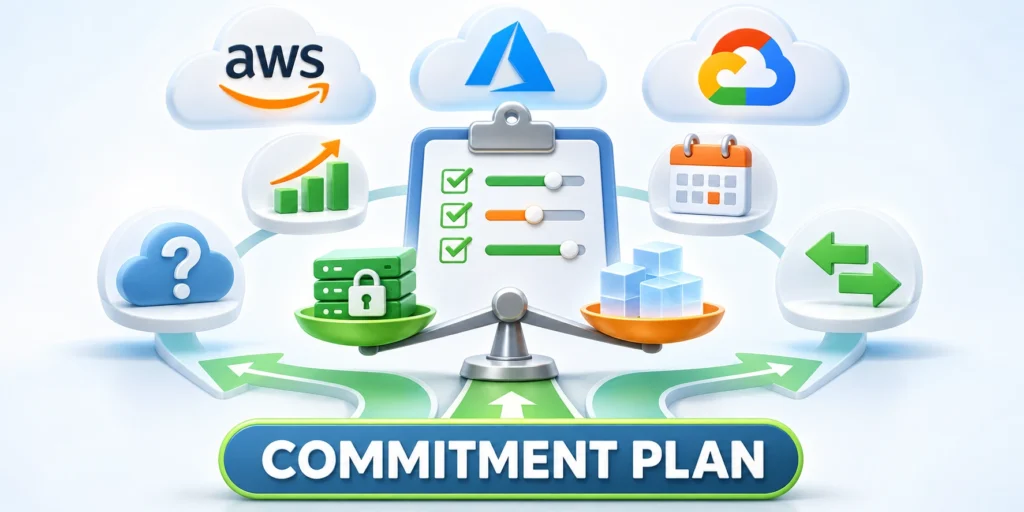
Commitment discounts can lower effective rates for predictable demand, yet an incorrect term. Scope, or quantity can preserve waste and restrict future architecture decisions.
Treat every commitment as a forecast-backed investment with an owner and utilization threshold. Document its expiry plan and alternatives before procurement.
Model stable demand and uncertainty
Separate the durable baseline from seasonal peaks, experiments, migrations, acquisitions, retirements. Roadmap changes that could reduce or redirect consumption during the term.
Compare on-demand exposure with utilization risk, flexibility, exchange options, payment timing, and the value of waiting for stronger evidence.
Use these actions to model stable demand and uncertainty:
- Estimate the durable demand baseline.
- Model optimistic and conservative scenarios.
- Include planned migrations and retirements.
- Calculate underuse consequences.
Create commitment guardrails
Limit early purchases to well-understood workloads, stagger renewal dates. Preserve flexible capacity for uncertain demand instead of maximizing the advertised discount percentage.
Review coverage and utilization regularly, but avoid forcing workloads into unsuitable configurations merely to consume a commitment already purchased.
Use these actions to create commitment guardrails:
- Assign one commitment owner.
- Track coverage and utilization separately.
- Stagger major renewal dates.
- Document exit and exchange options.
Govern the commitment lifecycle
Maintain a register of purchases, coverage, utilization, owners, renewal dates, and exit conditions. Review it before architecture decisions alter eligible demand.
Begin renewal analysis early enough to compare alternatives. Do not let automatic renewal convert yesterday’s forecast into an unexamined future constraint.
Key considerations for govern the commitment lifecycle include:
- Maintain a commitment register.
- Monitor coverage and utilization separately.
- Review alternatives before renewal.
Set Budgets, Forecasts, and Anomaly Alerts

Budgets describe an approved boundary, forecasts estimate likely outcomes, and anomaly alerts identify unexpected movement. Each control answers a different management question.
A mature system connects all three signals to accountable owners and defined responses. Notifications must provide enough context and authority for action.
Design controls around decisions
Set budgets where an owner can influence demand. Align forecast detail with product plans, release schedules, seasonal patterns, and commercial commitments.
Configure anomaly detection with materiality, rate of change, and service context. Account for expected events so harmless fluctuations do not mimic runaway usage.
Use these actions to design controls around decisions:
- Set budgets where owners can act.
- Forecast known product and demand changes.
- Define anomaly materiality thresholds.
- Route alerts with business context.
Create an escalation path
Every alert should identify scope, expected range, observed change, and likely drivers. Name the responsible team and acknowledgment deadline.
Track alert precision and response time because excessive false positives teach teams to ignore the cost signals that actually require investigation.
Use these actions to create an escalation path:
- Acknowledge material alerts promptly.
- Record the confirmed cost driver.
- Correct thresholds after false positives.
- Escalate unresolved high-impact anomalies.
Connect signals to decisions
Define which budget variance or anomaly requires investigation, escalation, or no action. Thresholds should reflect materiality and the owner’s ability to respond.
Link every confirmed anomaly to its cause and resolution. This history improves future forecasts and helps teams distinguish recurring demand from preventable operating errors.
Use these actions to connect signals to decisions:
- Document alert response thresholds.
- Record causes and resolutions.
- Feed confirmed changes into forecasts.
Prioritize Savings by Risk and Effort
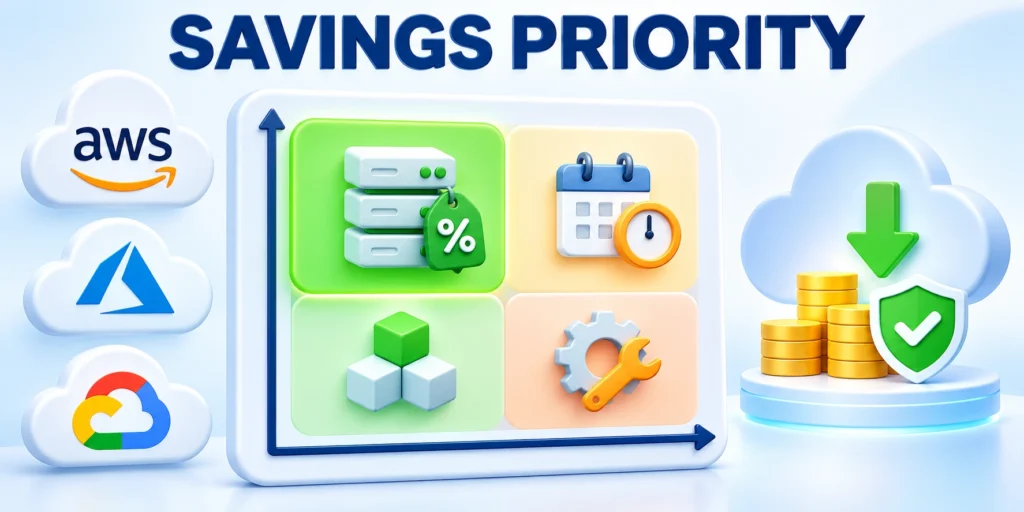
A savings estimate becomes a priority only after evaluating implementation effort and customer risk. Consider reversibility, dependencies, confidence, and verification time.
Rank opportunities transparently so easy cleanup proceeds quickly while architectural changes receive the testing, ownership, and sequencing their consequences require.
Create a decision-ready backlog
Record current cost, expected savings, and evidence quality for every opportunity. Include affected services, required work, failure modes, rollback, and ownership.
Use ranges instead of false precision, particularly when demand, credits. Shared allocation, or provider pricing could change before the action reaches production.
Use these actions to create a decision-ready backlog:
- Estimate savings as a range.
- Score evidence confidence.
- Identify customer and reliability risk.
- Describe effort and dependencies.
Sequence changes safely
Start with reversible actions such as confirmed orphan cleanup. Test right-sizing and scheduling before undertaking complex data or architecture changes.
Bundle related work only when joint testing improves safety; otherwise preserve small changes so teams can attribute the observed cost and reliability effect.
Key considerations for sequence changes safely include:
- Execute low-risk cleanup first.
- Pilot changes on representative workloads.
- Preserve a tested rollback path.
- Verify savings before expanding scope.
Maintain an evidence-based backlog
Rank opportunities with current evidence rather than headline savings alone. Refresh estimates when demand, architecture, pricing, or delivery plans materially change.
Remove stale opportunities that no longer apply. A smaller verified backlog produces better decisions than a large list of speculative recommendations.
Key considerations for maintain an evidence-based backlog include:
- Refresh evidence before prioritization.
- Remove stale opportunities promptly.
- Keep verified work visible.
| Opportunity | Risk | First action |
|---|---|---|
| Orphan cleanup | Low after ownership check | Delete in a controlled batch |
| Compute right-sizing | Performance regression | Test one workload |
| Storage lifecycle | Retrieval delay | Validate access patterns |
| Commitment purchase | Demand changes | Model conservative coverage |
Measure Unit Economics and Business Outcomes
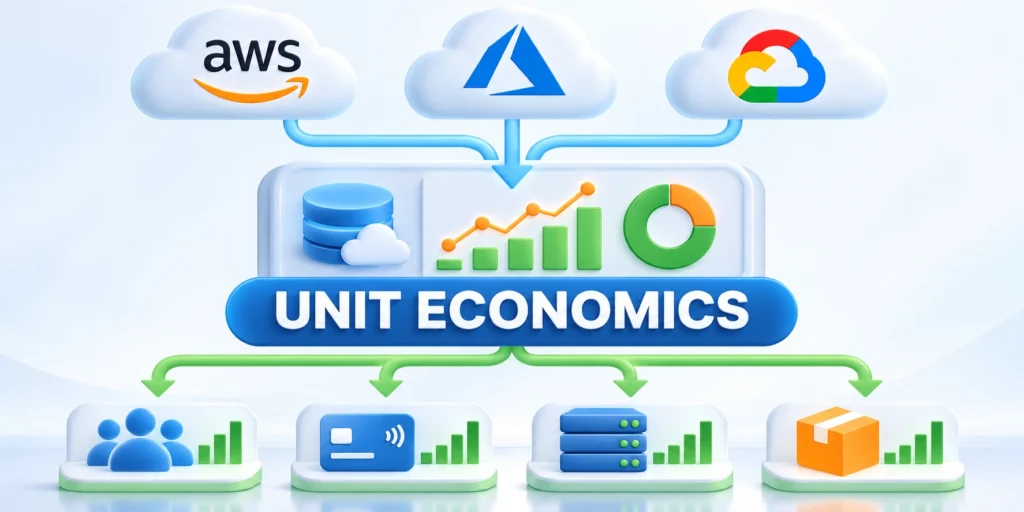
Total cloud spending shows financial exposure but cannot explain whether the platform is becoming more efficient as customers, transactions, workloads, or revenue change.
Unit economics connect consumption to a meaningful business denominator. Teams can then distinguish healthy growth from inefficient architecture or operations.
Choose stable and actionable units
Select units that reflect product value and drive technical demand. Examples include active customers, transactions, API calls, environments, or supported tenants.
Define the calculation, scope, timing, allocation, exclusions, and source systems so the metric remains comparable across releases and reporting periods.
Use these actions to choose stable and actionable units:
- Choose a business-relevant denominator.
- Document scope and allocation rules.
- Keep the calculation reproducible.
- Track volume and cost together.
Interpret outcomes with context
Review unit cost beside performance, reliability, customer experience, and delivery speed. Savings that damage service quality do not represent durable efficiency.
When unit cost changes, investigate both numerator and denominator. Review shared allocation, credits, product mix, demand shifts, and delayed infrastructure work.
Key considerations for interpret outcomes with context include:
- Compare cost with service outcomes.
- Explain material mix changes.
- Preserve negative operational evidence.
- Update decisions when conditions change.
Use metrics with context
Publish the definition, data source, owner, and update cadence for every unit metric. Changing denominators can otherwise create misleading improvement or deterioration.
Compare unit cost with service and commercial outcomes. Investigate whether movement came from efficiency, product mix, pricing, allocation, or customer behavior.
Apply these criteria to metrics with context:
- Document every metric definition.
- Track cost beside service outcomes.
- Explain material denominator changes.
FAQ
These questions address common decisions that arise when engineering, finance, and product teams establish a practical cloud cost optimization program.
What is cloud cost optimization?
Cloud cost optimization continuously aligns cloud spending with workload demand, reliability, delivery, and business value. It combines technical changes, purchasing decisions, ownership, measurement, and verification.
How is FinOps different from cost cutting?
FinOps creates shared financial accountability for cloud decisions. Cost cutting can be one outcome, but the practice also improves forecasting, allocation, unit economics, and investment choices.
Which cloud costs should be optimized first?
Begin with material, well-understood, reversible opportunities. Confirmed orphan resources, unused environments, avoidable retention, and obvious sizing mismatches often provide safer starting points.
Should every workload use reserved capacity?
No. Commitments fit predictable baseline demand. Variable, experimental, migrating, or retiring workloads may need flexible pricing until evidence supports a durable commitment.
How often should cloud costs be reviewed?
Review anomalies and urgent actions weekly, product trends and forecasts monthly, and commitments or architecture priorities quarterly. Adjust cadence to spending volatility and operating risk.
What is an unallocated cloud cost?
It is spending that cannot be reliably connected to a product, team, customer, environment, or shared service. Track it explicitly instead of hiding it in estimates.
Can autoscaling eliminate cloud waste?
Autoscaling can match capacity with demand, but poor limits, minimums. Requests, schedules, architecture, or workload behavior can still create substantial waste.
How do teams verify cloud savings?
Compare a reproducible baseline with post-change cost and usage, adjusting for demand, credits, seasonality, allocation changes, performance, and reliability outcomes.
What cloud unit economics should a SaaS company track?
Choose units tied to product demand, such as active tenant, transaction, API request, processed record, or workload. The best unit supports an actionable decision.
When should a company seek FinOps consulting?
External support can help when ownership or allocation remains unclear. It also helps when commitments are risky, costs grow unexpectedly, or internal teams lack implementation time.
Conclusion

Cloud cost optimization becomes durable when evidence and technical judgment guide decisions. Financial context, product ownership, and verification complete the operating system.
Start with a reproducible baseline, clarify allocation, remove proven waste. Improve rates carefully, and connect each action to service quality and business outcomes.
Run the next FinOps cycle
Choose a small portfolio of material opportunities with clear owners and evidence. Define rollback paths and deadlines instead of launching an unfocused campaign.
Review results at the established cadence, preserving failed experiments and unexpected effects so the next decision benefits from the complete operating record.
Use these actions to run the next finops cycle:
- Confirm the current baseline.
- Select bounded opportunities.
- Assign technical and business owners.
- Verify cost and reliability outcomes.
Keep optimization connected to value
A lower invoice is valuable only when the change supports customer experience and the product roadmap. It must also preserve resilience and sustainable economics.
Use the evidence to refine forecasts, architecture, commitments, and priorities. Preserve enough context for future teams to reproduce every decision.
Use these actions to keep optimization connected to value:
- Preserve customer-facing service quality.
- Update forecasts with verified evidence.
- Revisit commitments before renewal.
- Continue the ownership cadence.
Sustain the operating practice
Keep the baseline, ownership map, opportunity backlog, and decision record current. These artifacts allow new teams to continue optimization without restarting discovery.
Treat FinOps as ongoing operational governance. Regular evidence and bounded experiments create durable savings while protecting the reliability customers expect.
Key considerations for sustain the operating practice include:
- Maintain reusable decision evidence.
- Continue bounded optimization experiments.
- Protect customer-facing reliability.






Leave a Reply