

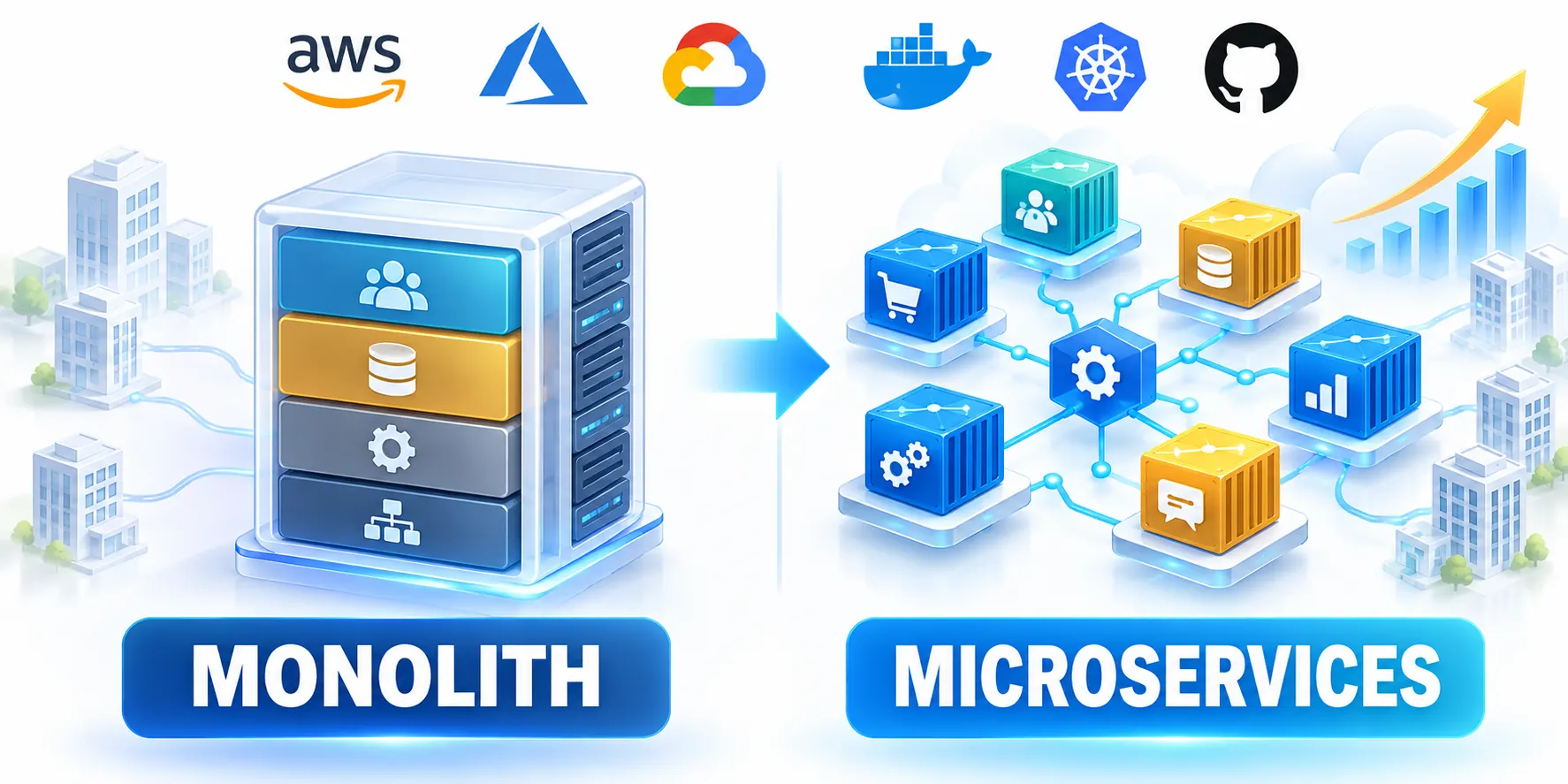
What decision should this architecture comparison support?
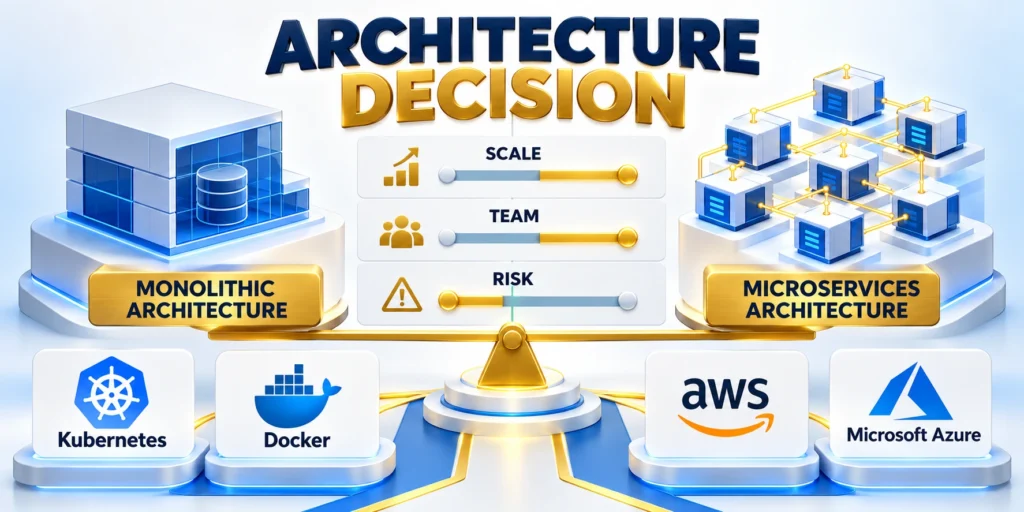
Microservices vs monolithic architecture is a choice about change boundaries, ownership, and operations. It is not a direct choice between modern and outdated software.
For a B2B platform, choose the structure that lets teams deliver customer workflows safely without adding more distributed-system work than they can support.
Start with a business constraint
Name the measurable constraint behind the comparison, such as slow releases, uneven scaling demand, recurring regressions, or teams blocking one another.
Document these decision inputs before comparing patterns:
- Customer workflow affected by the constraint.
- Current baseline and desired measurable result.
- Teams, systems, and data boundaries involved.
- Operational capability available for either option.
- Revisit date and accountable decision owner.
If evidence is weak, improve internal boundaries first. Distribution adds infrastructure and coordination work even when customers receive no additional capability.
Separate architecture from hosting
A monolith and microservices can both run on cloud infrastructure, containers, virtual machines, or managed platforms. Architecture does not select a provider automatically.
Keep these decisions separate during evaluation:
- Capability and data boundaries.
- Deployment and ownership model.
- Runtime and orchestration platform.
- Provider, region, and service tier.
- Scaling, recovery, and support approach.
- Cost and staffing implications.
- Migration scope and reversibility.
- Customer-impact measurement and monitoring.
- Security and regulatory constraints.
If the platform choice remains open, use our B2B web app architecture guide to compare product-level scaling and launch concerns.
Compare the structures, not their labels
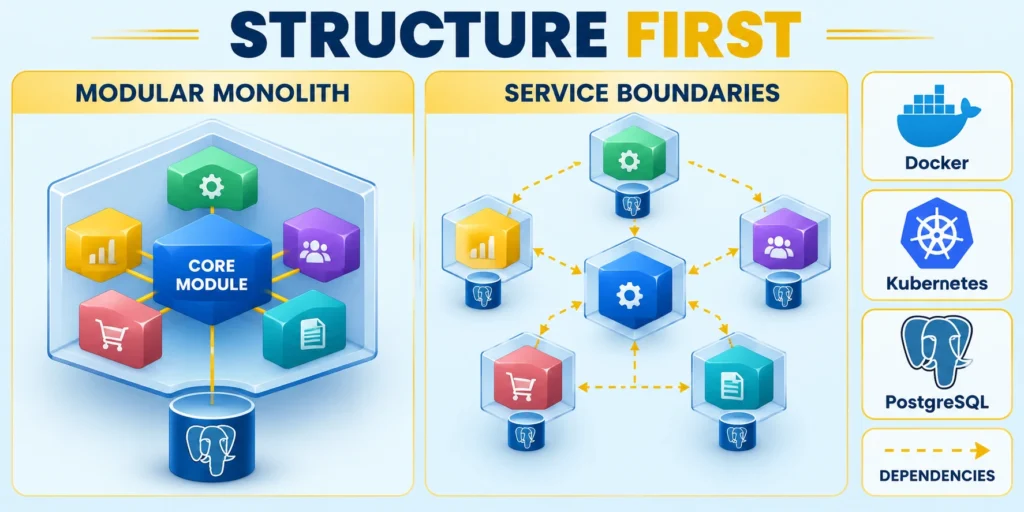
A monolith packages multiple capabilities into one deployable application. Its modules may still have clear boundaries and separate internal interfaces.
Microservices split selected business capabilities into separately deployed services. Each service owns a boundary and communicates through contracts, usually over a network.
Monolith and modular monolith
A tightly coupled monolith makes changes travel together. A modular monolith preserves one deployment while separating domain rules, interfaces, and data access.
Look for these modular design characteristics:
- Named capability boundaries and accountable owners.
- Explicit interfaces between internal modules.
- Restricted access to another module’s data.
- Tests that detect prohibited cross-module dependencies.
- Deployment and rollback as one application unit.
This structure keeps local calls and transactions while making responsibilities visible. It can support new products, consolidation, and gradual extraction without premature distribution.
Microservices and distributed responsibilities
Services can be released and scaled independently when the boundaries are real. They also bring network timeouts, retries, partial failures, distributed tracing, versioned contracts, and data consistency decisions.
A service boundary should follow a business capability that changes or operates independently. Splitting classes or database tables into network services does not create useful autonomy by itself.
| Decision factor | Modular monolith | Microservices |
|---|---|---|
| Deployment | One coordinated application release | Independent releases where contracts allow |
| Communication | In-process calls and shared runtime | Network calls, events, or both |
| Data | Shared database with enforced ownership | Owned data with explicit cross-service views |
| Scaling | Scale the application unit | Scale selected services independently |
| Operations | Fewer runtime components | More deployments, telemetry, and failure modes |
Use this comparison as a starting point, not a scorecard that automatically selects an architecture. Team ownership and workload evidence determine the practical trade-off.
When a modular monolith is the stronger fit

A modular monolith is a strong option when one team or a small group owns most changes. It can support growth while keeping deployments and debugging comparatively straightforward.
It is also a useful target when a legacy application has unclear boundaries. First make responsibilities visible; then decide whether any boundary needs independent deployment.
Use it when changes still move together
If billing, user management, and reporting often change in the same release, keeping them in one deployable application may reduce coordination.
Create module interfaces and restrict direct access to each module’s data. Enforce those rules with code review and automated tests so the monolith stays modular as teams add features.
Use it when operational maturity is still developing
Teams without reliable automation, ownership, incident response, and centralized observability may struggle to operate many independently deployed services safely.
Confirm these foundations before adding distribution:
- Repeatable builds, tests, deployments, and rollbacks.
- Named production ownership and on-call coverage.
- Centralized logs, metrics, traces, and alerting.
- Secrets, access, and dependency governance.
- Incident communication and recovery procedures.
- Documented service objectives and escalation paths.
- Contract testing across dependent capabilities.
- Capacity planning based on production telemetry.
- Recovery exercises with accountable owners.
- Runbooks tested by responsible teams.
A single application can still scale horizontally behind a load balancer. Measure bottlenecks first, then isolate only capabilities needing a different operating profile.
When microservices are worth the added complexity

Microservices can make sense when separate teams own distinct business capabilities and need independent release schedules. The organization must also be able to support the services in production.
Independent deployment is valuable only when teams can test compatibility, observe behavior, manage failures, and roll back a service without coordinating a full-system release.
Choose boundaries from domain behavior
Map workflows, decisions, and data ownership before naming services. A bounded context is useful when a business term or rule has a clear meaning inside one capability.
For example, subscription billing and product analytics may have different owners and release needs. Do not split them if they depend on synchronous, shared database updates for every request.
Verify independent scaling or reliability needs
Separate a component when measurements show it needs different capacity, release risk, security isolation, or recovery treatment. Record the evidence and what improvement the boundary should produce.
Define the expected result before implementation. Examples include reducing deployment lead time for one capability or scaling a high-volume ingestion path without duplicating the entire web tier.
Plan data ownership and failure behavior
Each service should control writes to its data. Other services should use contracts or events rather than querying private tables directly.
Define these behaviors for every proposed boundary:
- Authoritative data owner and write interface.
- Timeout, retry, and idempotency behavior.
- Consistency expectation for each workflow.
- Compensation after a partial business failure.
- Observability, escalation, and recovery ownership.
Decide whether eventual consistency is acceptable before extraction. A boundary is unsafe when a successful customer outcome still depends on hidden shared transactions.
Estimate total cost and operational load

Compare the full operating model, not just the compute line. Microservices can increase infrastructure, deployment, monitoring, security, and on-call costs.
They may reduce coordination costs when teams genuinely deploy independently. Capture both sides in the same time window and include engineering effort in the decision.
Build a comparable cost worksheet
Compare infrastructure and engineering effort over the same period. Include production, development, testing, recovery, and platform responsibilities for both structures.
Include these cost categories in both scenarios:
- Compute, storage, databases, messaging, and transfer.
- Deployment, monitoring, security, and backup tooling.
- Release, incident, and recovery engineering hours.
- Platform maintenance and contract governance.
- Support coverage and specialist staffing.
Record assumptions, utilization, peak capacity, and confidence beside every line. Update the worksheet with telemetry and incident records instead of preserving outdated estimates.
Account for the hidden cost of distribution
Every remote call adds latency and a possible failure point. A user workflow that crosses six synchronous services now depends on each network hop and its timeout behavior.
Distributed tracing, correlated logs, service discovery, secrets rotation, schema compatibility, and incident ownership become routine platform responsibilities. Budget time to build and maintain them.
Compare the cost of coordination
For the monolith, estimate how much teams wait for shared releases and how often changes create regressions across modules. Use ticket lead time and deployment records rather than anecdotes.
For services, estimate the time to maintain contracts, deployment pipelines, alerts, and on-call rotations. Do not assume that independent repositories automatically remove team dependencies.
Migrate incrementally instead of rewriting everything

A gradual migration reduces the scope of each change. Define the modernization plan around one measurable capability while preserving the existing customer path.
The strangler approach places a routing boundary in front of the legacy application, then redirects a selected workflow as the replacement becomes ready. Keep a tested path back during rollout.
Select one capability with a clear boundary
Choose a function with limited shared writes, a named owner, and an observable success measure. Avoid starting with a deeply entangled transaction merely because it is visible to executives.
Document the current request path, data owner, integrations, failure behavior, and deployment process. This baseline helps identify what the new service must preserve.
Move traffic in controlled stages
Build the new capability behind an interface. Begin with tests and internal traffic, then expand only when evidence meets the agreed release criteria.
Use these controls during every migration stage:
- Eligible cohort and traffic percentage.
- Error, latency, and business outcome limits.
- Data reconciliation and ownership checks.
- Stop condition and named decision owner.
- Tested rollback path and recovery window.
Avoid dual writes unless ownership, ordering, retries, and reconciliation are explicit. Increase exposure only after production behavior confirms the new path remains supportable.
Retire the old path only after evidence
Confirm that the new path handles the required workflows, reporting, access controls, and recovery tasks. Watch for clients or scheduled jobs still calling the monolith.
Remove the old implementation only after the owner approves the evidence and the rollback window closes. Update runbooks and data ownership documentation at the same time.
Run a decision-focused proof of concept

Use a small proof of concept to test the assumption driving the architecture choice. Do not build a broad demo that avoids real operational requirements.
Compare the same workflow, data volume, service-level target, security controls, and team responsibilities in both options. Make the result useful to the decision maker.
Define success and guardrails first
Pick a metric such as deployment lead time, p95 latency, failure recovery time, or monthly operational hours. State the baseline, target, measurement method, and test period.
Set guardrails for data integrity, authorization, error rates, and recovery. A faster release does not count as a win if it weakens control or increases customer-visible failures.
Test normal and failure conditions
Exercise a representative customer journey and the production failures most likely to expose differences between the candidate architectures.
Include these conditions in the proof:
- Normal workload at expected concurrency.
- Dependency timeout and unavailable downstream service.
- Duplicate event and delayed message delivery.
- Deployment failure and tested rollback.
- Data recovery and incident diagnosis.
Measure calls, contention, recovery time, and operator effort. Include the people who would deploy, monitor, and support the production system.
Decide with evidence and a revisit trigger
Record which option met the goals, what it cost, and which assumptions remain uncertain. If neither option wins clearly, keep the simpler structure and improve the boundaries.
Set a revisit trigger, such as a new team boundary, repeated release coordination delays, or measured scaling pressure. That avoids both premature splitting and indefinite delay.
Use a practical decision framework
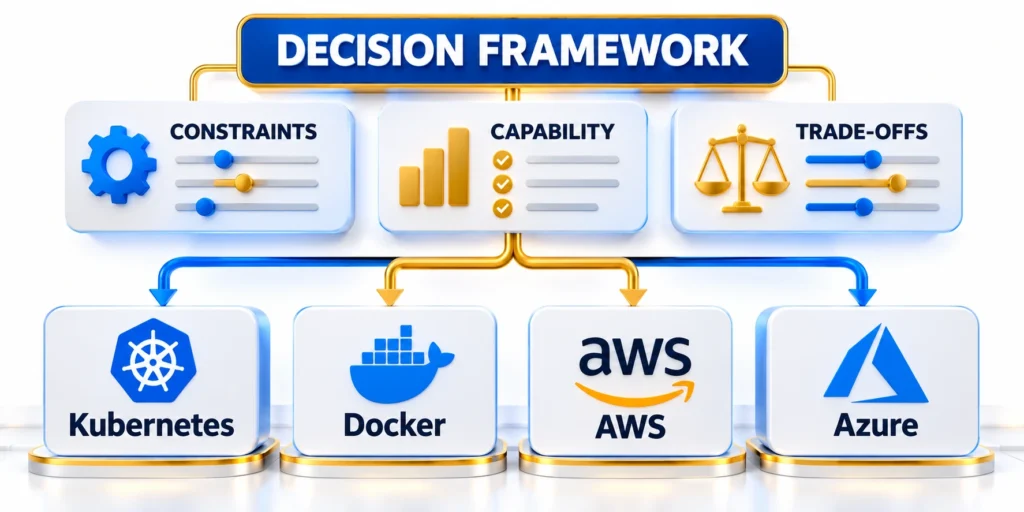
Start with a modular monolith when the application is still finding its product shape or teams share release ownership. That keeps options open without requiring a distributed runtime immediately.
Consider microservices when a business capability has independent ownership and measurable operational or delivery needs. Confirm that the team can operate the resulting services reliably.
Apply the same questions to each candidate boundary
Evaluate every candidate with consistent evidence so organizational enthusiasm does not excuse weak ownership, unclear data boundaries, or unsupported operating assumptions.
Use these actions to apply the same questions to each:
- Does the capability have a stable business responsibility and named owner?
- Can it own its data and expose a contract without frequent cross-boundary changes?
- Is there measured pressure to scale, release, secure, or recover it separately?
- Can the organization monitor, deploy, and support it without fragile manual steps?
- Is the expected benefit larger than the added platform and coordination cost?
If the answers are mostly no, improve modularity inside the current application. For related system-level trade-offs, see our cloud hosting architecture guide.
Put ownership and boundaries in writing
For each module or service, document the business capability, owner, API or internal interface, data authority, service-level expectations, and recovery path.
Review the boundaries after major product changes. When two services constantly change together, consider merging them or moving the shared behavior into a better-defined capability.
Define operating criteria before execution
For microservices versus monolithic architecture decisions, define business boundaries, team ownership, integration needs, and operating constraints before changing campaigns, code, content, or workflow.
That shared context gives every contributor a practical boundary for action.
Use these actions to define operating criteria before execution:
- Write the decision, owner, assumptions, and known constraints.
- Identify dependencies that could change the expected result.
- Set a reversible first step when uncertainty remains.
- Keep the decision record accessible to contributors.
- State what evidence is sufficient to proceed.
- Note which decisions cannot be reversed cheaply.
- Define the time frame for the decision.
- Record the intended business benefit.
- Confirm the available capacity and budget.
Test the workflow under realistic conditions
Evaluate microservices versus monolithic architecture decisions across the real architecture discovery, proof of concept, migration, and operations sequence.
A narrow test can hide handoff issues, exceptions, integration failures, or user behavior.
Follow this sequence to test the workflow under realistic conditions:
- Choose a representative task or audience segment.
- Run the workflow from its first input to the final outcome.
- Capture exceptions, delays, and manual work.
- Compare results with the agreed baseline.
- Decide whether to improve, repeat, or scale.
- Document the limits of the test.
- Confirm that owners can support the next step.
- Review assumptions with people doing the work.
- Capture feedback from affected customers or users.
Measure outcomes and tradeoffs together
Track deployment reliability, change lead time, operating cost, and service ownership together rather than optimizing a single favorable metric.
Costs, risk, quality, and effort can otherwise distort the apparent value.
Use these actions to measure outcomes and tradeoffs together:
- Use business and technical indicators in the same review.
- Record data gaps before interpreting a result.
- Explain material changes with evidence, not timing alone.
- Preserve the baseline and reporting period.
- Share findings with the teams responsible for follow-up.
- Check whether the outcome can be reproduced.
- State the confidence level behind each conclusion.
- Compare actual effort against the original estimate.
- Assign responsibility for the next reporting cycle.
Keep the practice current
Review the approach when product scope, traffic profile, team capability, or dependency changes.
Past decisions may still help, but their assumptions require current evidence.
Use these actions to keep the practice current:
- Schedule ownership and review dates with the operating team.
- Retire outdated instructions, definitions, and unsupported claims.
- Record the next action and accountable owner.
- Link related internal guidance when it helps execution.
- Decide whether to improve, replace, or stop the practice.
- Share changed instructions with affected contributors.
- Keep the latest decision record easy to find.
- Confirm whether the documented standard remains usable.
- Escalate material risks before the next release.
Evaluate Team and Platform Readiness

Architecture autonomy depends on teams and shared platform capabilities, not only service boundaries. Independent deployment creates value only when ownership extends through production support.
Assess current capability before increasing the number of deployable components, data owners, runtime dependencies, and incident paths.
Verify service ownership capabilities
Each team needs authority, skills, documentation, and capacity to build, deploy, observe, secure, recover, and improve its assigned capability.
Review these ownership capabilities with each team:
- Deployment, rollback, and release decision authority.
- On-call coverage and incident communication.
- Data migration and compatibility responsibility.
- Security remediation and dependency maintenance.
- Capacity planning and service-level review.
When ownership ends at code delivery, strengthen the operating model before extraction. Otherwise, shared platform teams inherit fragmented responsibilities without matching authority.
Confirm shared platform foundations
A service platform should make safe delivery repeatable without hiding important controls or forcing every product team to rebuild the same operational components.
Confirm these foundations support the proposed design:
- Standard pipelines and artifact governance.
- Identity, secrets, network, and policy controls.
- Central logs, metrics, traces, and alert routing.
- Service catalog and dependency visibility.
- Backup, recovery, and incident tooling.
Document gaps, owners, and completion dates. Treat platform work as part of the architecture investment rather than an unrelated project.
Set Architecture Review Triggers
Revisit the design after material changes in scale, ownership, regulation, reliability, deployment frequency, data boundaries, business capability, customer risk, or support capacity.
Require evidence from operations and product outcomes, not fashion or vendor preference, before introducing a more distributed architecture or changing an established boundary.
Record these details for every review trigger:
- Trigger condition and evidence source.
- Reviewer, decision, and effective date.
- Expected result and next review.
Preserve the record so future teams can understand why the architecture changed and which assumptions still require validation.
Conclusion
Choose the architecture that matches business boundaries, team ownership, measurable constraints, and the organization’s ability to operate the resulting system.
Microservices can improve independent change and scaling, but only when their additional runtime, data, governance, and support responsibilities create greater value.
Preserve a reversible architecture decision
Begin with explicit modules and measurable outcomes. Extract one capability only when its boundary, owner, data, operational need, and expected benefit are clear.
Keep these artifacts with the decision record:
- Constraint, baseline, target, and evidence source.
- Capability boundary and accountable owner.
- Data authority and integration contracts.
- Operational cost and platform dependencies.
- Migration stages, rollback, and revisit trigger.
- Service objectives and recovery expectations.
- Known uncertainties and validation schedule.
A modular monolith remains a valid long-term design when it supports customer demand and team delivery without harmful coupling or unacceptable operational risk.
Review outcomes after production adoption
Compare expected benefits with deployment lead time, reliability, support effort, infrastructure cost, incident recovery, and customer outcomes after the new design operates under real load.
Use these signals during the architecture review:
- Release independence and coordination delays.
- Reliability, latency, and recovery performance.
- Operating cost and on-call demand.
- Contract changes and cross-team dependencies.
- Customer outcomes tied to the change.
Merge, split, or strengthen boundaries when evidence changes. Architecture is an operating decision that should evolve with the product, teams, and workload.
FAQ
Teams comparing these architectures often need to resolve the same practical questions about scale, costs, ownership, and migration.
Are microservices always more scalable than a monolith?
No. A monolith can scale horizontally, and a modular design can improve performance. Microservices allow selective scaling, but add network and operational costs.
Is a modular monolith a temporary architecture?
It can be a long-term choice. If modules have clear ownership and acceptable scaling, there may be no business reason to split them into separate services.
When should a B2B company extract its first service?
Extract one capability when measurements show a distinct need, its domain boundary is clear, and a team can own its deployment, data, and support.
Can microservices share one database?
They can technically connect to one database, but shared writes and schemas weaken service autonomy. Define one owner per data area and use explicit interfaces.
How can a team migrate without a full rewrite?
Move one bounded workflow behind a routing boundary, release it to a controlled cohort, compare outcomes, and retain rollback until the new path is proven.
Can a monolith support independent teams?
Yes, when modules, ownership, interfaces, testing, and release coordination are explicit enough to limit cross-team interference.
How should service boundaries be chosen?
Use stable business capabilities, data ownership, change patterns, reliability needs, and accountable teams rather than arbitrary technical layers.
Do microservices always need separate databases?
Each service should own its data decisions, though physical storage may vary during controlled migration and transitional designs.
What is distributed-system overhead?
It includes network failures, latency, tracing, deployment coordination, data consistency, security, incident response, and platform operations.
When should an extracted service be merged back?
Consider merging when independence creates more cost than value and ownership, reliability, and migration risks can be controlled.







Leave a Reply