


Map the Existing System
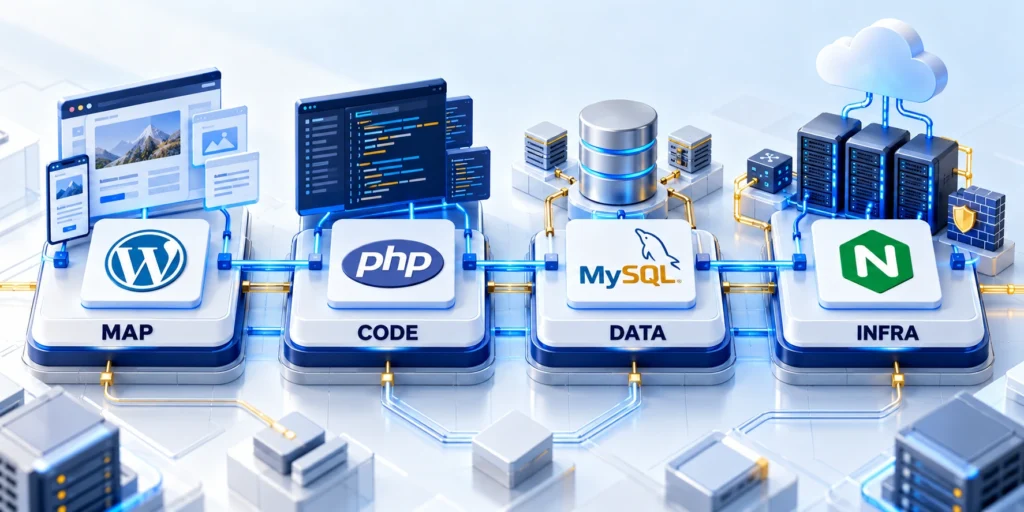
A legacy application audit is a structured investigation of how an existing system works, where it faces risk, and which changes are worth making.
Start with business-critical tasks, not a tool-generated list of files. The goal is a decision-ready view of the system, not a rewrite recommendation by default.
Set Scope and Outcomes
Set a boundary for the audit: applications, repositories, environments, teams, and decisions the findings must support. Name exclusions explicitly.
Agree on outcomes before scanning code. Examples include lowering incident risk, supporting a workflow, reducing release time, or preparing a migration.
Use these actions to set scope and outcomes:
- Name a business sponsor and technical owner.
- Choose the review period and environments.
- List teams and vendors that own components.
- Define the decisions the report must enable.
- Record systems explicitly outside the review.
- Set a date to review audit assumptions.
Inventory Critical User Journeys
List tasks users must complete for sales, service, finance, operations, or compliance. Rank them by business impact and failure cost.
Follow each journey across screens, APIs, background jobs, data stores, and human handoffs. A screen-level map misses operational dependencies.
Use these actions to inventory critical user journeys:
- Choose three to five high-impact workflows first.
- Record actors, entry points, decisions, and outcomes.
- Include exception paths and manual workarounds.
- Link journeys to supporting services and owners.
- Note where users switch tools or re-enter data.
- Validate the map with people doing the work.
Capture a Baseline Before Changing Anything

Gather recent incidents, support tickets, failed jobs, latency, release frequency, and recovery time. State each source and observation window.
Baselines make later changes testable. When metrics are unavailable, record the gap and use interviews or sampled traces instead of inventing precision.
Use these actions to capture a baseline before changing anything:
- Record service objectives if they exist.
- Sample incidents from a defined period.
- Track manual reconciliation and duplicate entry.
- Label missing telemetry as an audit finding.
- Separate measured values from estimates.
- Preserve a snapshot before remediation begins.
Inspect the Repository and Build Process
Confirm which repository and branch correspond to production. Read project documentation, build scripts, dependency manifests, and release configuration.
Run read-only commands from the repository root. Avoid commands that install packages, run migrations, or alter generated files during discovery.
git log --oneline --decorate -20
git ls-files
Key considerations for inspect the repository and build include:
- Check recent history and active branches.
- Locate application entry points and configuration.
- Identify test, build, and deployment commands.
- Compare release artifacts with production.
- Find ownership files and code review rules.
- Record the production version and date.
Interview Owners and Users
Interview maintainers about fragile areas, undocumented behavior, and release risks. Ask operators and users where documented workflows differ from reality.
Capture evidence separately from interpretation. A complaint is a useful lead; verify it against logs, tickets, code, or a reproducible task before ranking.
Key considerations for interview owners and users include:
- Ask which change is hardest to release.
- Ask which failures require manual recovery.
- Request a concrete incident or task example.
- Record confidence and evidence for each claim.
- Include support and operations perspectives.
- Confirm who can answer unresolved questions.
Trace Dependencies and Data Flows

Dependency risk often hides outside the main repository. A legacy application may rely on scheduled jobs, shared databases, identity services, vendor APIs, and manual exports.
Map the runtime path from a user action to its data changes and downstream effects. This helps teams estimate the blast radius of a proposed modification.
Trace Requests Across Components
Follow a representative request from browser or mobile client through the application, API, database, queue, and external service.
Use logs and traces where available, then compare the observed path with code references and deployment configuration. Document uncertainty instead of guessing.
Key considerations for trace requests across components include:
- Choose one valuable request and one failure case.
- Record service boundaries and synchronous calls.
- Identify retries, queues, and scheduled workers.
- Mark paths lacking trace or correlation IDs.
- Note shared infrastructure used by multiple systems.
- Keep diagrams linked to source evidence.
Map Data Ownership and Movement
For each important record, identify the authoritative store, writers, readers, retention rules, and duplicate copies maintained by another system.
Data ownership conflicts create defects during modernization. A report, export, or integration may depend on behavior no team considers its responsibility.
Use these actions to map data ownership and movement:
- List key entities and their authoritative source.
- Trace create, update, delete, and export flows.
- Note sensitive fields and retention requirements.
- Identify data copied into spreadsheets or vendor tools.
- Document reconciliation and deletion behavior.
- Ask owners to confirm boundary assumptions.
Inventory Third-Party and Internal Dependencies

Review package manifests, lockfiles, container images, shared libraries, and service catalogs. Record versions, support ownership, and upgrade constraints.
Confirm production dependencies from build artifacts and runtime configuration. A repository package may be unused; a manual runtime may be missing from source control.
Use these actions to inventory third-party and internal dependencies:
- Separate direct from transitive dependencies.
- Identify unsupported or unmaintained components.
- Record license and security review obligations.
- Confirm who can approve upgrades or replacements.
- Check whether versions are pinned and reproducible.
- Flag dependencies with no clear maintainer.
Review Configuration and Environment Differences
Compare development, staging, and production configuration without exposing secrets. Look for undocumented variables, feature flags, certificates, and manual steps.
Configuration drift can make a safe change behave differently after deployment. Record which values are managed, who changes them, and how changes are audited.
Use these actions to review configuration and environment differences:
- Use secret-safe configuration inventories.
- Compare feature flags across environments.
- Identify hand-maintained server settings.
- Document rollback and restore procedures.
- Check secret rotation and access ownership.
- Capture differences that affect behavior.
Create a Dependency Risk Register
Assign an owner and evidence link to every high-impact dependency. Distinguish a confirmed single point of failure from a dependency that lacks documentation.
Use a simple register rather than a complex platform. The map helps when teams update it during reviews and connect it to change decisions.
Use these actions to create a dependency risk register:
- Capture component, owner, purpose, and data handled.
- Rate impact and likelihood separately.
- Record confidence, evidence, and next check.
- Flag dependencies without accountable owners.
- State whether redundancy has been tested.
- Review the register after architecture changes.
Assess Quality and Operational Risk
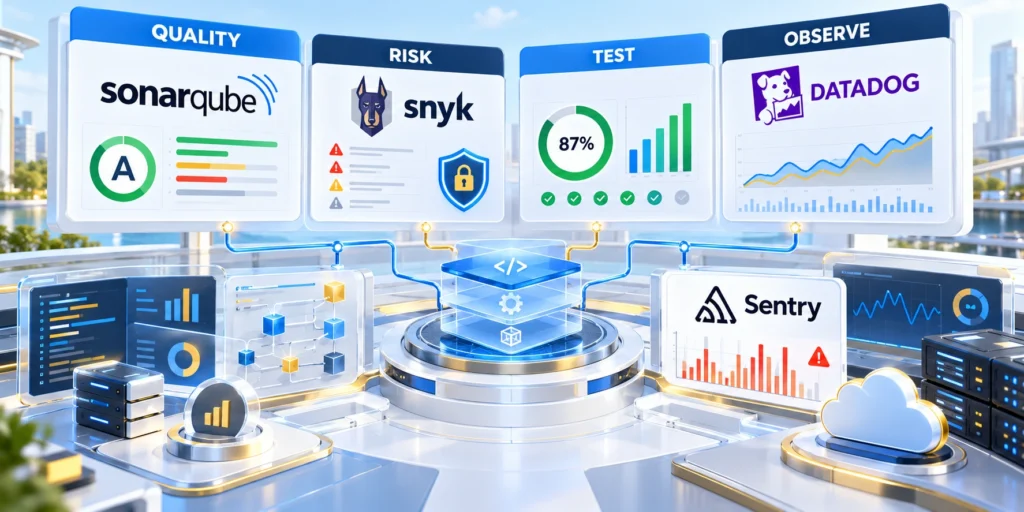
Once the system map is credible, assess the risks that could make a change unsafe, expensive, or difficult to recover. Separate observed evidence from assumptions.
Use a small set of repeatable checks, then connect each finding to a business consequence, an owner, and a practical next step.
Review Changeability and Test Coverage
Look for modules that are difficult to change because responsibilities overlap, dependencies are hidden, or important behavior has no reliable test.
Do not treat a low coverage percentage as a verdict. Identify critical user journeys and ask whether the team can detect regressions in those paths.
Use these actions to review changeability and test coverage:
- Choose three to five high-value journeys, such as sign-in, checkout, or account provisioning.
- Trace each journey from request to database and external services.
- Record existing unit, integration, and end-to-end checks for each path.
- Run the checks and note flaky tests, missing fixtures, and manual-only steps.
- For a risky journey, add a narrow characterization test before changing behavior.
Check Security Exposure with a Defined Scope
Security review should follow the application’s data and trust boundaries, not a generic checklist alone. Identify sensitive records, privileged actions, and internet-facing entry points.
For an adjacent security checklist, review our guide to protecting financial and health data in web applications and adapt its controls to this system’s actual exposure.
Use these actions to check security exposure with a defined:
- Inventory authentication, authorization, session handling, uploads, and administrative endpoints.
- Trace how sensitive data is collected, stored, logged, exported, and deleted.
- Review dependency alerts and confirm whether affected packages are reachable in production.
- Check secrets handling and confirm credentials are not committed or exposed in logs.
- Document each issue with evidence, severity rationale, affected component, and a remediation owner.
Measure Reliability and Recovery
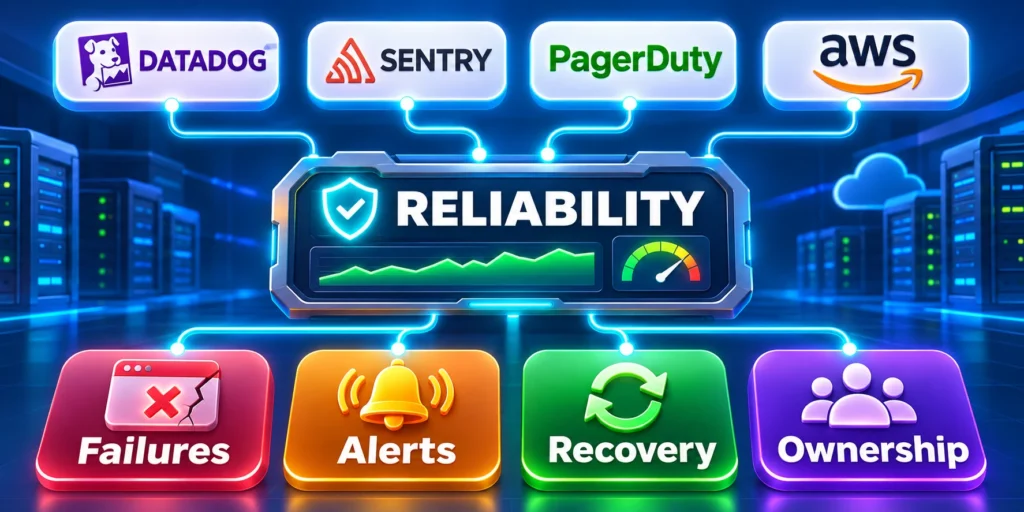
Operational risk appears in incidents, slow recovery, fragile deployments, and unclear ownership. Examine recent production evidence before assigning a reliability label.
Compare observed behavior with user-facing expectations: latency, error rate, availability, data integrity, and recovery time for important workflows.
Use these actions to measure reliability and recovery:
- Review incident reports and identify recurring failure modes.
- Confirm backups are restorable; a successful backup job alone does not prove recovery.
- Check whether deployments can be rolled back without losing data or creating incompatible schemas.
- Verify alert routing, on-call ownership, and runbooks for critical services.
- Record the last tested recovery date and the evidence produced by the exercise.
Estimate Maintenance Drag with Evidence
Maintenance cost is broader than developer sentiment. Track time spent waiting for builds, diagnosing defects, performing manual releases, and working around unsupported components.
Use a short observation window and distinguish recurring costs from one-time migration work. Avoid turning a rough estimate into a precise financial forecast.
Use these actions to estimate maintenance drag with evidence:
- Sample recent issues and classify causes such as regression, environment drift, or unclear ownership.
- Measure build and test duration for representative changes.
- Ask engineers to record repeated manual steps for one or two release cycles.
- Estimate the cost range and state the assumptions behind it.
- Compare the effort with the business impact of the affected capability.
Separate Facts from Risk Hypotheses
An audit is useful only if readers can tell confirmed defects from concerns that still need investigation. Label confidence and evidence explicitly.
For example, an end-of-life library in the dependency tree is a confirmed inventory fact; exploitability depends on exposure, configuration, and reachable code.
Use these actions to separate facts from risk hypotheses:
- Attach a repository path, incident, query, or measurement to each confirmed finding.
- Label assumptions and define what evidence would confirm or reject them.
- Keep severity separate from confidence so uncertainty is visible.
- Assign an owner and a review date to unresolved high-impact questions.
Prioritize Modernization Roadmap
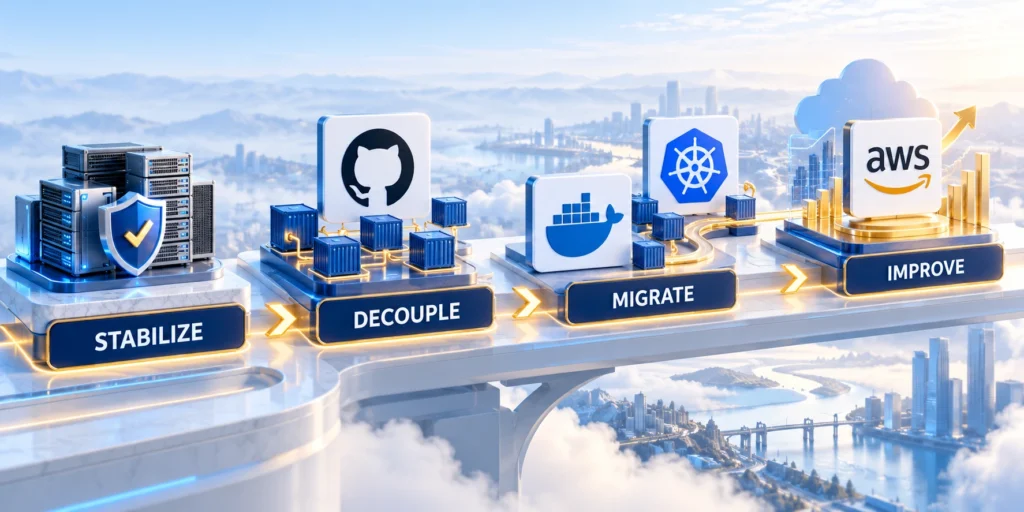
Turn findings into a sequence of decisions rather than a wish list of rewrites. Prioritize work that reduces a material risk or unlocks a valuable capability.
For each candidate, state the expected outcome, evidence, effort range, dependencies, and how the team will know whether the change helped.
Rank Work by Impact, Urgency, and Confidence
A simple scoring model helps compare unlike findings, but it should support discussion rather than create false precision.
Use consistent definitions for business impact, urgency, effort, and confidence. Revisit scores when new evidence appears.
Key considerations for rank work by impact urgency include:
- Describe the affected business workflow and consequence if the issue remains.
- Estimate urgency from exposure, deadlines, and likelihood of failure.
- Estimate effort as a range and include migration or coordination work.
- Rate confidence in the evidence separately from impact.
- Prioritize a small first batch and explain why deferred work can wait.
Choose a Modernization Pattern That Fits
Replace, refactor, encapsulate, or incrementally route around a component based on its coupling, business value, and risk. No single pattern fits every system.
The Strangler Fig pattern can help when a system can be divided behind stable interfaces, but it adds routing, data consistency, and dual-operation complexity.
Use these actions to choose a modernization pattern that fits:
- Keep a component when it is stable, understood, and inexpensive to operate.
- Refactor a bounded module when tests and ownership make change safer.
- Encapsulate a legacy dependency when callers can use a stable adapter.
- Replace a component when the business need is clear and migration risk is manageable.
- Use incremental routing only when ownership and rollback boundaries are explicit.
Run a Bounded Pilot Before Scaling

Choose a pilot that exercises a meaningful risk but can be isolated and reversed. Avoid selecting a showcase feature that cannot test the hard parts.
Define a baseline and success measures before implementation, including what would cause the team to stop or change direction.
Use these actions to run a bounded pilot before scaling:
- Select one workflow or service boundary with a clear owner.
- Write down current latency, failure rate, delivery time, and support burden where measurable.
- Set a timebox, acceptance criteria, rollback approach, and data migration plan.
- Run the pilot with representative users and operational conditions.
- Compare the results with the baseline and record unexpected costs.
Sequence Dependencies and Protect Delivery
Modernization competes with product work, so expose the dependencies that could delay delivery or increase risk. Coordinate architecture, data, security, and operations work.
Break large changes into milestones that produce a usable improvement. Preserve a supported path for critical fixes while the migration is underway.
Key considerations for sequence dependencies and protect delivery include:
- Identify prerequisite data cleanup, platform upgrades, and access decisions.
- Schedule compatibility work before dependent services switch over.
- Reserve capacity for incidents and critical product obligations.
- Keep old and new paths observable during any transition period.
- Define the criteria and date for retiring temporary compatibility layers.
Explain the Roadmap to Decision-Makers
Present the roadmap as a set of tradeoffs. Connect technical work to customer experience, delivery risk, operating cost, or regulatory obligations.
Show what the organization gains, what it must invest, and which risks remain. Include a decision point when evidence is incomplete.
Key considerations for explain the roadmap to decision-makers include:
- Summarize the current system and the most consequential evidence.
- Group work into near-term stabilization, bounded modernization, and later options.
- Show owners, dependencies, effort ranges, and measurable outcomes.
- State what will not be addressed in the current phase and why.
- Schedule a review after the pilot or first milestone to adjust priorities.
Deliver an Evidence-Based Audit Report
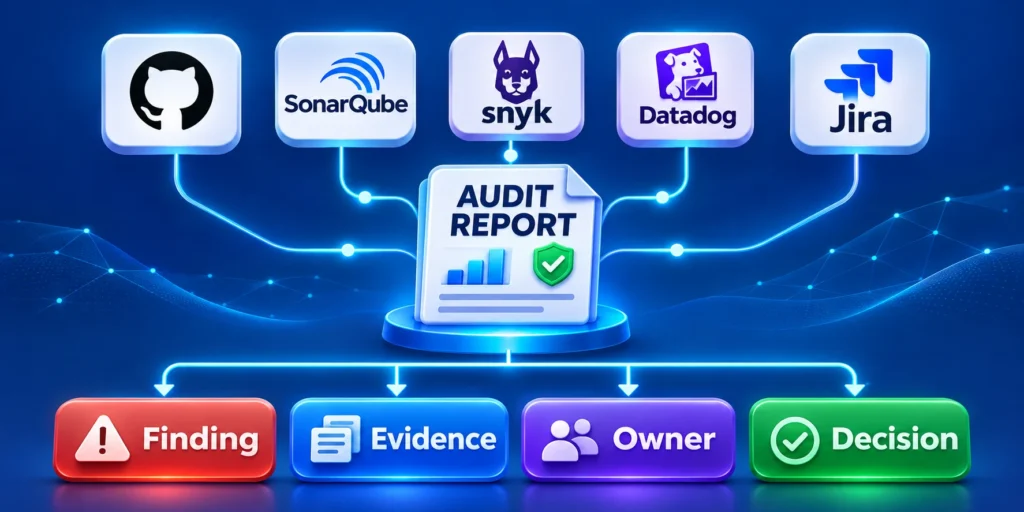
A useful legacy application audit turns uncertainty into a short list of decisions. Map the system, test high-risk assumptions, and connect each finding to an owner and evidence.
Start with a bounded pilot, measure its effect, and update the roadmap as new information arrives. This keeps modernization tied to business outcomes and recovery options.
Validate Findings With System Owners
Review technical evidence with people who operate, support, secure, and change the application before assigning severity or remediation priority.
Document disagreements, missing evidence, and the decision owner instead of presenting uncertain findings as established facts.
Protect Audit Access and Artifacts
Limit repositories, production data, credentials, logs, diagrams, and exports to approved participants with suitable retention and removal controls.
Use redacted or synthetic evidence when full data is unnecessary, and revoke temporary access after the audit phase ends.
Make Every Finding Decision-Ready
Present each finding with its observed consequence, evidence, uncertainty, affected scope, accountable owner, available options, dependencies, and the next decision.
Separate confirmed facts from hypotheses so leaders can prioritize immediate controls, further investigation, bounded modernization, or accepted risk transparently.
Record these fields for every material finding:
- Affected workflow and technical boundary.
- Direct evidence and collection date.
- Business consequence and confidence level.
- Owner, options, and next decision.
Use this compact evidence register for decisions:
| Finding | Evidence | Decision |
|---|---|---|
| Release failures | Deployment records | Stabilize pipeline |
| Unknown dependency | Runtime traces | Assign owner |
| Recovery gap | Restore exercise | Test recovery |
| High change cost | Delivery samples | Run pilot |
FAQ
These answers clarify common decisions about audit scope, evidence, automation, production data, technical debt, delivery impact, and roadmap maintenance.
How long should a legacy application audit take?
Scope it around a decision, not a calendar template. A bounded audit may take days; a system with many teams, integrations, or compliance needs may require staged discovery.
Should we rewrite the application from scratch?
Only when evidence supports the cost and risk. Compare a rewrite with incremental change, including data migration, feature parity, operating readiness, and the time before users receive value.
What should an audit deliver?
Deliver a system map, evidence-backed risk register, dependency overview, prioritized options, effort ranges, owners, and a next-step decision. Keep unresolved assumptions visible.
Can automated tools replace interviews and code review?
No. Scanners and repository metrics can find patterns, but they cannot reliably explain business constraints, ownership, undocumented workflows, or recovery practices by themselves.
How do we avoid disrupting product delivery?
Choose bounded changes, protect critical maintenance capacity, agree on rollback criteria, and measure effects on delivery. Reprioritize when production evidence changes the risk picture.
Should production data be copied for an audit?
Only when necessary and approved; prefer redacted, sampled, or synthetic data with controlled access and deletion.
How should undocumented dependencies be found?
Combine code, configuration, network, logs, scheduled jobs, interviews, support records, and controlled runtime observation.
What makes a finding actionable?
State evidence, consequence, affected scope, uncertainty, owner, options, dependencies, recovery, and the next decision.
Should every technical debt item be fixed?
No. Prioritize items whose risk, cost, or constraint exceeds the value of leaving them unchanged.
How is the audit roadmap maintained?
Review it after pilots, incidents, product changes, dependency updates, and new evidence, preserving decision history.
For the broader framework, read Custom API Development and Third-Party Integrations Playbook.
Conclusion

A legacy application audit should replace broad uncertainty with verified system boundaries, measurable risks, accountable decisions, and practical options for continued operation or modernization.
The report becomes useful when business and technical owners can trace every priority to evidence, understand uncertainty, and choose a reversible next step.
Turn Evidence Into Controlled Action
Begin with the highest-consequence workflow or operational risk, protect recovery capacity, and test one bounded improvement against the documented baseline.
Keep scope, success criteria, ownership, dependencies, rollback conditions, and observation periods explicit before engineering work begins.
Use these principles after the audit closes:
- Preserve evidence and decision history.
- Assign owners before starting remediation.
- Test recovery before expanding change.
- Measure outcomes against the baseline.
- Revisit assumptions when conditions change.
Keep the Roadmap Current
Update priorities after pilots, incidents, dependency changes, security findings, product decisions, and new measurements instead of treating the audit as a permanent verdict.
Retain accepted risks, deferred work, responsible owners, evidence dates, and review triggers so future teams understand why each decision was made.
Govern Modernization as an Operating Practice
Modernization succeeds when teams maintain observability, testing, dependency ownership, secure access, recovery procedures, and decision records alongside feature delivery.
That operating discipline lets leaders improve the application incrementally without losing the business context, production evidence, or recovery options uncovered by the audit over its remaining service life.






Leave a Reply