

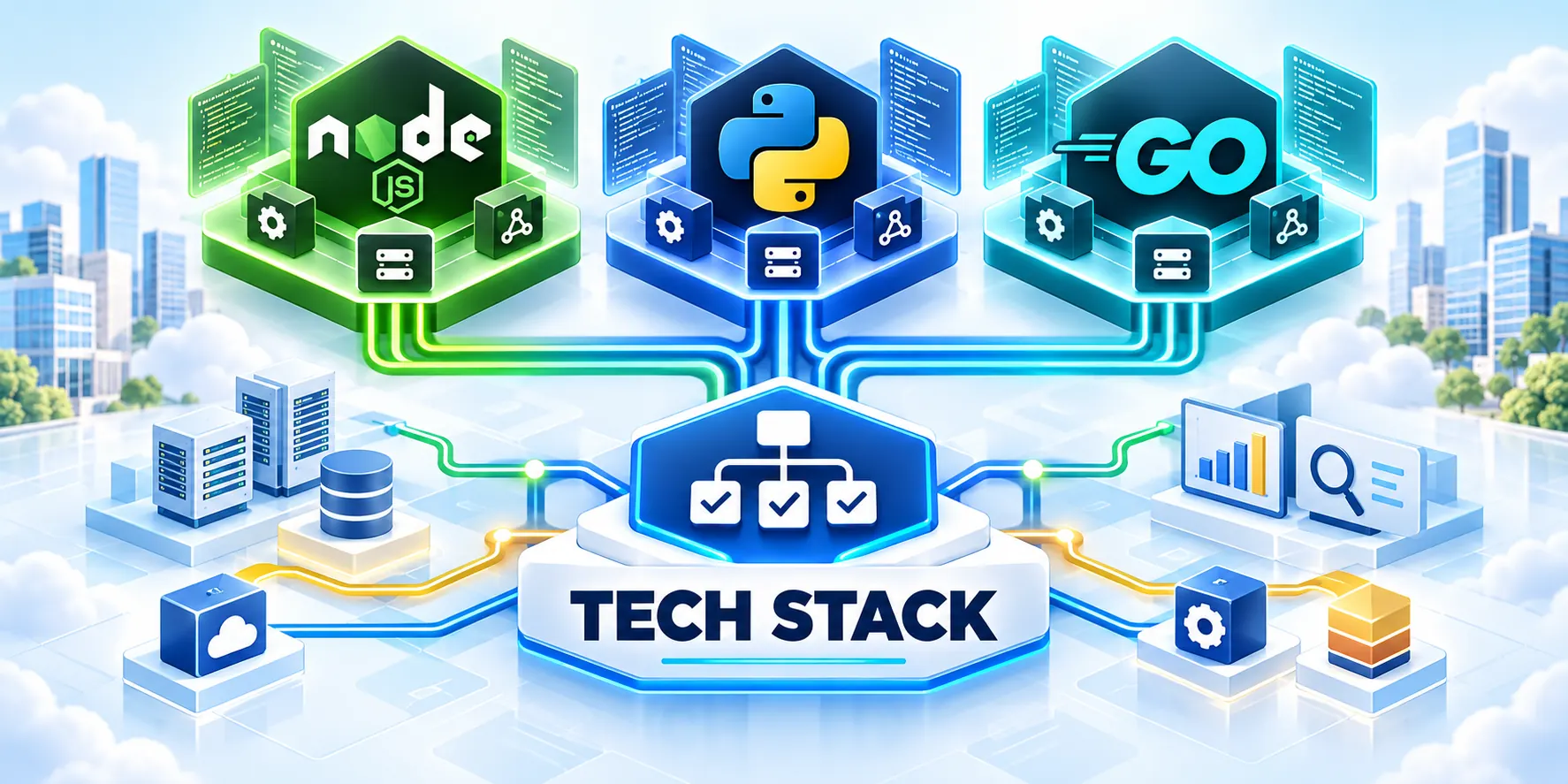
Build a Decision Around Workload, Not Language Popularity

When comparing Node.js vs Python vs Go for an enterprise app, start with its workload and operating team. Each runtime can support dependable software.
Start with request patterns, data processing, latency targets, deployment constraints, existing systems, and available skills. Then compare the costs of building and maintaining the actual product.
Use the site’s architecture as a starting point
For a broader view of architecture, tenancy, integrations, and launch planning, see our guide to B2B web application development.
Make the decision for a bounded service or product slice first. Avoid selecting a language because a benchmark, ranking, or hiring trend appears universally decisive.
Separate product needs from implementation preferences
Write down what the first release must do: handle concurrent requests, process files, run analytics, integrate with existing services, or deliver a browser-based experience.
Next, identify hard constraints. These may include a cloud platform, security controls, deployment model, support commitments, dependency policies, or a team already responsible for production operations.
Classify the workload before comparing runtimes
Classify the workload. I/O-bound work spends time waiting for databases, networks, or storage. CPU-bound work spends time calculating, transforming, or compressing data.
These categories are not language rankings. They indicate which runtime behavior, libraries, concurrency design, and operational practices should be tested.
Turn requirements into a testable decision brief
Before a pilot, write one representative transaction and its acceptance criteria. For example, an authenticated user uploads a file, receives a result, and can retry safely.
Record the expected request rate, peak load, data size, latency objective, failure tolerance, and team ownership. State which constraints are mandatory and which are preferences.
Capture these inputs in the decision brief:
- Representative workload and peak traffic shape.
- Security, compliance, and deployment boundaries.
- Team ownership and on-call responsibility.
- Acceptance evidence and reversal conditions.
Separate Platform Constraints From Language Preferences

Some decisions are already constrained by the environment. A regulated workflow may require specific logging, isolation, approved libraries, or deployment practices regardless of language.
Document deployment and security requirements before building prototypes. Use them to compare runtimes and review custom app development proposals.
Use these actions to separate platform constraints from language preferences:
- List non-negotiable requirements with an owner and a way to verify each one.
- Record preferences separately, such as a familiar syntax or a favored framework.
- Identify whether the service must share code, data contracts, or on-call ownership with existing systems.
Keep the decision reversible
Choose a service boundary that can be replaced without rewriting the whole application. Define its API contract, data ownership, and failure behavior first.
A narrow service lets the team learn from production behavior without treating the initial runtime choice as a permanent platform commitment.
Test Constraints Before Comparing Performance
Confirm build, security, deployment, observability, support, and recovery requirements before benchmarking. A fast candidate that cannot enter production is irrelevant.
Use the same representative environment for each candidate. Record exceptions, manual work, missing controls, and dependencies requiring organizational approval.
Record Assumptions and Reversal Triggers
Document workload assumptions, dependencies, and service objectives. If a nearshore engineering team will share ownership, confirm runtime experience and incident coverage before committing.
Define triggers for review, replacement, or isolation. Reversibility improves when contracts, data ownership, telemetry, and migration paths remain explicit.
Choose Node.js for I/O-Heavy Products With a JavaScript-Aligned Team
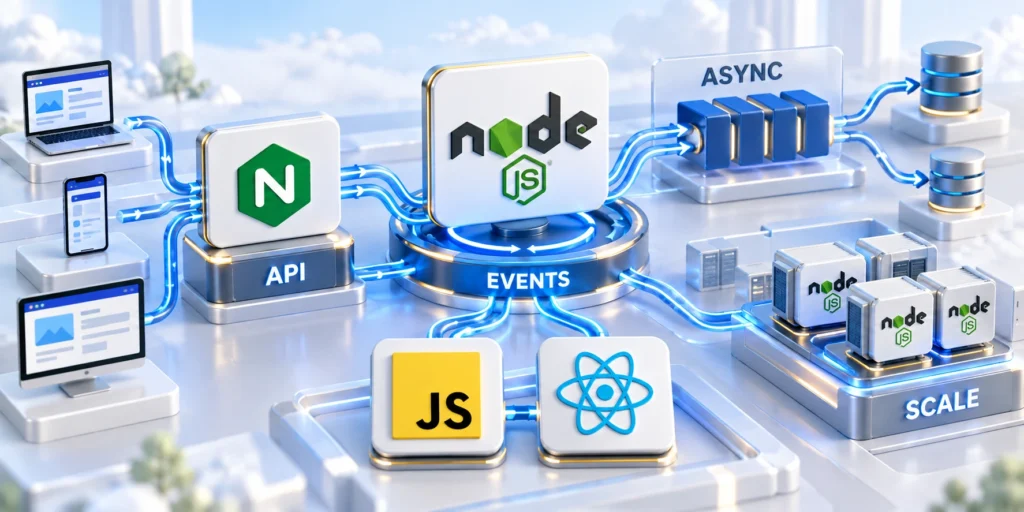
Node.js is a strong candidate when requests spend much of their time waiting on network or storage operations, and the application can keep individual callbacks short.
Its event loop coordinates asynchronous work, while a worker pool handles certain tasks. The model can serve many concurrent clients without one operating-system thread per request.
Where Node.js fits well
Key considerations for where node js fits well include:
- APIs that orchestrate calls to databases, payment providers, or other services.
- Real-time collaboration, notifications, and event-driven interfaces.
- Products where JavaScript or TypeScript skills already span browser and server teams.
- Backend-for-frontend layers that adapt services for a particular user interface.
A shared language can simplify code ownership across client and server teams. It does not eliminate separate security boundaries, deployment pipelines, or runtime expertise.
Confirm that the team can diagnose asynchronous failures, dependency latency, queue growth, and production memory behavior before treating shared syntax as operational readiness.
Manage blocking work deliberately
CPU-heavy synchronous work can occupy the event loop and delay unrelated clients. Large parsing, compression, image processing, or model inference needs an explicit execution strategy.
Measure event-loop delay and worker-pool saturation under representative traffic. Set limits for request size, concurrency, timeouts, and queued background work.
Separate slow jobs from the request path
For example, keep an API request focused on validation and scheduling when document conversion takes seconds. Put conversion behind a bounded queue and return a job identifier.
Define idempotency, retry limits, expiration, failure visibility, and ownership for that job. A queue moves responsibility; it does not remove it.
Validate failure behavior before committing
In the pilot, slow a downstream service and send several simultaneous requests. Check whether timeouts, retries, and queue limits protect unrelated users.
Inspect p95 latency, event-loop delay, rejected jobs, and recovery after the dependency returns. A fast average response can conceal a failing tail.
Pilot a Realistic Node.js API

Prefer Node.js when asynchronous I/O and team alignment match the product. Reconsider it when core requirements center on sustained CPU work or the team lacks asynchronous design experience.
Use a representative request path to verify concurrency, dependency limits, tracing, failure recovery, and team diagnosis under expected load.
Pilot a realistic API request
Use an endpoint that authenticates a user, reads a database record, calls an external service, and writes an auditable result. Include timeouts and a retry policy.
Run the endpoint with expected peak concurrency and a slow dependency. Measure p95 latency, event-loop delay, error rate, and queue growth.
Key considerations for pilot a realistic api request include:
- Confirm that one slow provider does not block unrelated requests.
- Limit simultaneous outbound calls and reject or queue excess work deliberately.
- Move sustained CPU work to an isolated worker process or service, then compare operational complexity.
- Ask an engineer outside the pilot to diagnose a simulated failure using logs and traces.
Record the point where the bottleneck appears. A queue that grows without recovery is a stronger warning than a single fast benchmark result.
Set a Node.js Pilot Decision Threshold
Define acceptable latency, error rate, event-loop delay, queue recovery, and diagnostic time before running the pilot. Keep thresholds tied to service objectives.
Reject or redesign the candidate when sustained CPU work, uncontrolled concurrency, or fragile asynchronous behavior requires disproportionate operational complexity.
Choose Python When Data Workflows and Integration Speed Dominate

Python is attractive when product value relies on data manipulation, automation, analytics, machine-learning libraries, or integrations that benefit from a broad ecosystem.
Its syntax can help teams express business workflows directly. That advantage matters when engineers must change rules frequently and explain them to analysts or domain specialists.
Use concurrency that matches the workload
For high-volume network I/O, Python’s asyncio library provides asynchronous tasks, network operations, subprocess control, queues, and synchronization primitives.
Async code is not automatically simpler. Mixing synchronous libraries, blocking operations, and asynchronous flows can make tracing failures and controlling backpressure harder.
Check every async boundary
For a service that awaits several external APIs, verify that the HTTP and database clients actually support async operation. A blocking client can still stall the event loop.
Set connection pools, task limits, cancellation rules, and timeouts. Test a slow provider to confirm that requests fail predictably instead of accumulating indefinitely.
Plan CPU-heavy work separately
For CPU-heavy processing, choose workers, processes, native libraries, or a separate compute service based on the workload. Benchmark production deployment instead of assuming a language feature removes bottlenecks.
Measure serialization, transfer, startup, memory, and recovery costs around the compute step. Isolation can improve reliability while adding operational boundaries.
Treat dependencies as part of the architecture
List the frameworks, connectors, and packages needed for the product. Confirm maintenance activity, security response, licensing fit, supported runtime versions, and replacement options.
Python may reduce effort where specialized data or automation libraries already solve difficult tasks. The team still needs dependency pinning, vulnerability management, isolation, observability, and upgrade ownership.
Verify the library advantage
For a data pipeline, test the exact parsing and transformation libraries against representative input. Compare runtime, memory use, error handling, and deployment size with the target environment.
Document supported versions and the owner of each critical dependency. This makes a library advantage measurable and exposes maintenance work before launch.
Verify these ecosystem requirements before selection:
- Supported runtime and dependency versions.
- Security response and release maintenance.
- Deployment compatibility and resource behavior.
- Team ability to diagnose library failures.
Pilot the Python Data Path
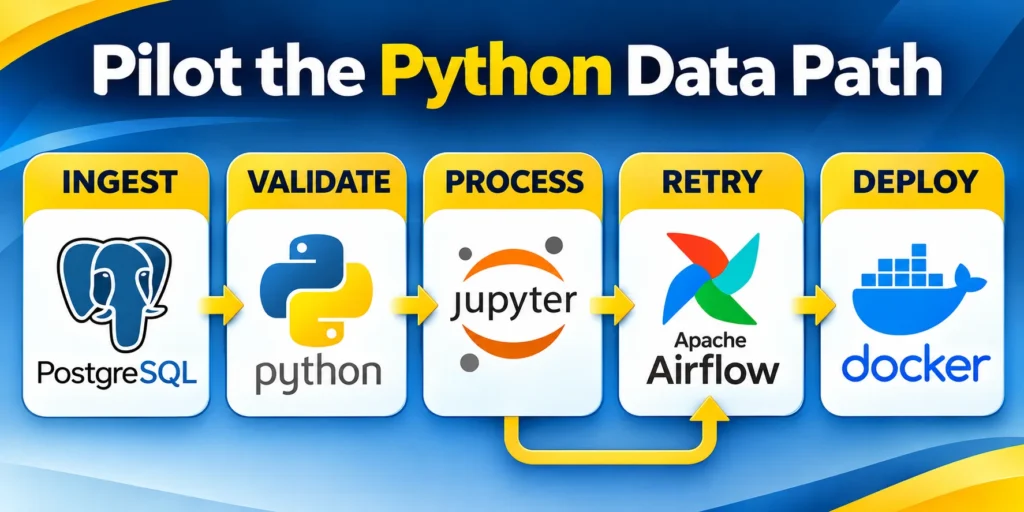
Prefer Python when its libraries and team skills accelerate the core workflow. Design explicitly for concurrency, CPU-intensive jobs, and dependency management instead of treating them as later deployment details.
Pilot the complete data path with representative volume, malformed input, partial failures, retries, and the deployment environment the team will operate.
Pilot the data path, not just the API
Select one real workflow: ingest a file, validate records, apply a business rule, and expose a result to another service. Use representative data volume and error cases.
Measure end-to-end time, memory, library behavior, and recovery after a partial failure. Separate parsing and computation from network waiting in the results.
Key considerations for pilot the data path not include:
- Pin the runtime and package versions used in the pilot.
- Check whether a required library supports the deployment environment and security policy.
- Test a malformed input and a dependency outage, then confirm the job can retry safely.
- Have another engineer update one rule and deploy the change.
If the workload spends most time in a specialized library, compare that library’s behavior and maintenance burden. Generic language comparisons will not answer the actual product question.
Set a Python Pilot Decision Threshold
Define acceptable workflow time, memory use, retry behavior, dependency support, and change effort before testing. Include operator diagnosis and recovery.
Choose Python when ecosystem leverage remains valuable after deployment and maintenance costs are visible. Reject assumptions that depend on unsupported or opaque libraries.
Choose Go When Concurrent Services and Bounded Operations Matter

Go deserves consideration for network services, internal platforms, command-line tools, and distributed components where concurrency and operational simplicity matter.
Goroutines offer a lightweight way to run concurrent functions. Channels and synchronization tools help coordinate work, but they do not prevent every race or resource leak.
Keep concurrency bounded and observable
Review Effective Go concurrency guidance as a language-specific reference, then verify limits and failure behavior in the actual service.
Creating a goroutine for every incoming job without limits can exhaust memory or downstream capacity. Use bounded worker pools, queues, timeouts, and cancellation.
Use these actions to keep concurrency bounded and observable:
- Define concurrency limits, cancellation behavior, and observable failure signals before load testing.
- Profile scheduler and memory behavior under realistic production load.
- Verify backpressure protects dependent services during traffic spikes.
Instrument queue depth, active workers, request latency, errors, and downstream saturation. A concurrency primitive is an implementation tool, not a complete capacity plan.
Test downstream limits
For example, cap concurrent outbound calls to a billing provider. Propagate request cancellation and apply deadlines so abandoned requests do not occupy capacity.
Test a provider outage at peak traffic. Observe whether queues drain, memory stabilizes, and the service recovers without manual intervention.
Include packaging and team ownership
Go’s compiler produces deployable binaries, which can simplify some container and service packaging workflows. Validate image size, patching, runtime libraries, startup needs, and supply-chain controls in your own environment.
Choose Go when its service model suits the workload and the team can maintain idiomatic code. Its concurrency tools do not make every application automatically faster or easier.
Pilot a Bounded Go Service

Implement a service that fans out to several dependencies and aggregates their results. Set a maximum number of active calls and a deadline for the whole request.
Cancel remaining work when the client disconnects or a required dependency fails. Verify that database queries and outbound calls receive the cancellation signal.
Key considerations for pilot a bounded concurrent service include:
- Observe active goroutines, queue depth, memory, and p95 latency under sustained load.
- Test whether a slow dependency exhausts connection pools or holds work after the request ends.
- Run race detection and integration tests on the representative code path.
- Document who will maintain the service, its build process, and incident response.
A compact binary can simplify deployment, but the team still owns dependencies, secrets, telemetry, and upgrades. Include that work in the comparison.
Set Concurrency and Cancellation Contracts
Define limits for active work, queues, connections, retries, and memory. State how deadlines and cancellation propagate across dependencies.
Test overload and partial failure deliberately. Verify that abandoned requests release resources and downstream services receive bounded demand.
Set a Go Pilot Decision Threshold
Measure latency, resource use, queue recovery, race findings, build simplicity, and incident diagnosis. Compare results with explicit service objectives.
Select Go when bounded concurrency and operational clarity remain understandable to the owning team. Do not treat a compact binary as complete operability.
Compare Total Delivery Cost With a Production-Like Pilot

Compare the cost of delivering, operating, changing, and supporting the system. Cloud compute alone is an incomplete measure of total ownership cost.
Team familiarity, hiring reach, package quality, deployment controls, incident diagnosis, and upgrade work can outweigh small differences in a synthetic benchmark.
| Runtime | Common fit | Watch closely |
|---|---|---|
| Node.js | Async APIs and real-time services | Blocking and async complexity |
| Python | Data and integration workflows | CPU work and dependency operations |
| Go | Concurrent network services | Limits and ecosystem fit |
Run a small decision pilot
Follow this sequence to run a small decision pilot:
- Implement the same narrow business workflow in the strongest one or two candidates.
- Use representative data, external calls, authentication, error paths, and expected peak concurrency.
- Measure response percentiles, throughput, memory, CPU, queue depth, and recovery behavior.
- Ask another engineer to deploy, inspect logs, reproduce an error, and make a small change.
- Estimate first-year ownership, including staffing, cloud resources, monitoring, upgrades, and support.
Keep the pilot short and decision-focused. Do not build three miniature products if two candidates already fail a hard requirement.
Record the workload, environment, versions, test method, and tradeoffs. Measurements apply to that scenario; they are not universal language rankings.
Compare equivalent candidates
Agree on pass criteria before measuring: for example, a stated p95 latency under expected load, bounded memory, successful recovery, and a deployable change by another engineer.
Run each candidate with equivalent infrastructure and realistic dependencies. If one implementation lacks authentication or error handling, its lower latency is not a fair comparison.
Choose with service-level evidence
Prefer the candidate that meets service objectives with a design the team can explain and operate. If results are close, favor existing skills and a simpler migration path.
Record which thresholds passed, which tradeoffs remain, and who accepts residual risk. Preserve rejected candidates so future reviews can reuse valid evidence.
Count delivery and operating costs together
Estimate the first release, the next likely change, and a year of support. Include development, review, testing, hosting, monitoring, incident response, and dependency upgrades.
A runtime that saves compute but slows delivery may cost more overall. A familiar runtime can be cheaper when it lets the current team diagnose failures quickly.
Key considerations for count delivery and operating costs include:
- Record implementation and deployment effort separately for each candidate.
- Estimate the cost of training or hiring only when the current team lacks required skills.
- Include vendor or managed-service fees that the runtime choice actually changes.
- Compare migration and rollback effort if the new service replaces an existing one.
Write a decision record another team can challenge
State the workload, candidates, constraints, measurements, and tradeoffs. Explain why the chosen option meets the requirements and what evidence could reverse the decision.
Keep rejected alternatives in the record with their strongest advantages. This makes later reviews faster when traffic, team skills, or product scope changes.
Conclusion

Node.js can fit asynchronous products and JavaScript-aligned teams. Python can fit data, automation, and integration-heavy workflows. Go can fit bounded concurrent services.
None is a universal enterprise winner. Define the workload, test the difficult path, and compare maintainability, operational controls, team skills, and service objectives.
Close the runtime decision with this evidence:
- Representative workload and failure conditions.
- Measured service-level and recovery behavior.
- Deployment, security, and observability controls.
- Team ownership and diagnostic capability.
- Documented reversal and review triggers.
Revisit the decision as constraints change
Use the pilot to make a reversible decision where possible. Revisit it when product requirements, operating limits, or team capabilities materially change.
A practical review point is the first significant traffic increase or architectural change. Compare new measurements with the pilot assumptions before expanding the chosen runtime across services.
Connect runtime choice to the product lifecycle
For the broader product framework, read the SaaS product development lifecycle guide.
Runtime choices affect release cadence, hiring, incident response, integrations, and migration options. Review them alongside product maturity and operating ownership.
Preserve the Decision Evidence
Store the brief, pilot implementation, measurements, exceptions, thresholds, costs, and final rationale where future teams can inspect them for governance, onboarding, audits, and migration planning.
When constraints change, rerun only the affected evidence. Avoid replacing a working runtime because another language, framework, or hiring trend becomes fashionable.
FAQ
These answers clarify enterprise runtime selection, benchmarks, rewrites, mixed-language systems, team experience, realistic pilots, and review triggers.
Which language is best for enterprise apps?
There is no universal winner. Match the language to workload, team capability, ecosystem, operating requirements, and evidence from a representative pilot.
Is Node.js suitable for large business applications?
It can be suitable for I/O-heavy services and teams strong in JavaScript or TypeScript, provided blocking work, dependencies, security, and operations are managed.
Is Python too slow for enterprise software?
Language alone does not determine service performance. Measure the real workflow; move CPU-heavy tasks to suitable workers, native libraries, or separate services when evidence calls for it.
When should a team choose Go?
Consider Go for concurrent network services or platform tools when the team can build, monitor, and maintain bounded concurrency and idiomatic Go code.
Should we rewrite an existing service in another language?
Only when measurable product or operational needs justify the migration cost. Compare incremental improvements with a rewrite, then test a narrow slice before committing.
How should a team compare language benchmarks?
Use benchmarks only as hypotheses. Recreate the relevant workload with equivalent dependencies, security, observability, failure handling, and deployment conditions.
Can one enterprise product use more than one language?
Yes, when service boundaries and ownership justify the added complexity. Keep interfaces, observability, deployment, support, and incident responsibilities explicit.
How important is the current team’s experience?
It affects delivery speed, review quality, diagnosis, and support. Compare training or hiring costs with the measurable advantage of another runtime.
What should a production-like pilot include?
Include representative data, authentication, external calls, peak concurrency, timeouts, retries, observability, deployment, rollback, and a small change by another engineer.
When should the stack decision be reviewed again?
Review it when workload, service objectives, dependencies, staffing, operating costs, or product boundaries change enough to invalidate the original evidence.






Leave a Reply