


Define the SLA Scope and Service Window
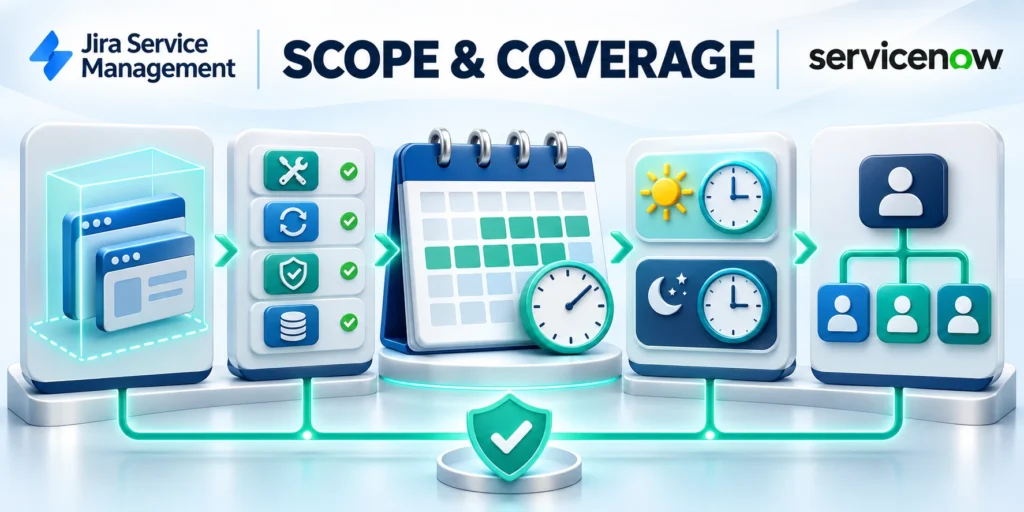
A software maintenance SLA should describe a service that both parties can identify, operate, measure, and govern. Vague coverage creates disputes before performance becomes measurable.
Define applications, environments, components, users, locations, channels, responsibilities, and supported activities. Separate maintenance commitments from project work and product development.
Describe the supported service precisely
List production applications, integrations, databases, scheduled jobs, cloud resources, interfaces, and operational tooling. Connect each item to an accountable owner and support tier.
Clarify whether coverage includes incidents, defects, configuration, monitoring, backups, security patches, vendor coordination, releases, small enhancements, reporting, and service reviews.
Key considerations for describe the supported service precisely include:
- Name supported applications.
- Identify covered environments.
- Define supported activities.
- Assign accountable owners.
Set service hours for intake, acknowledgment, technical work, monitoring, change execution, and customer communication. These periods may differ by severity.
Document time zone, business calendar, holidays, after-hours rules, on-call coverage, and how clocks pause or continue while awaiting customer information.
Separate service windows from resolution promises
A support window defines when resources and commitments apply. It does not automatically guarantee that every defect can be permanently resolved within that period.
Use restoration targets for urgent service impact and planned delivery expectations for complex fixes. This distinction protects reliability without promising unknowable engineering duration.
Use these actions to separate service windows from resolution promises:
- Define the governing time zone.
- Publish the business calendar.
- Explain clock pauses.
- Specify after-hours activation.
Record intake channels and required ticket information. Requests submitted through unapproved channels should not silently start a contractual timer without traceable receipt.
Validate the scope against architecture, contracts, operational practice, and customer expectations. Remove any commitment that cannot be observed, owned, or delivered consistently.
Classify Severity and Business Impact

Severity converts customer and business impact into a consistent response level. It should not depend on who reports the issue or how dramatic the symptom appears.
Define levels through affected journeys, customer scope, data risk, revenue exposure, legal obligations, workarounds, duration, and expansion potential. Include recognizable examples.
Use observable impact criteria
Describe what users cannot complete, which services are degraded, how many customers are affected, and whether data confidentiality, integrity, or availability is threatened.
Include the effect of workarounds. A reliable low-effort alternative may reduce urgency, while a risky manual process can preserve high severity.
Apply these criteria to observable impact criteria:
- Measure affected customer scope.
- Identify blocked business journeys.
- Assess data and revenue risk.
- Evaluate workaround safety.
Separate incident severity from defect priority. Severity reflects current operational impact, while priority also considers recurrence, strategic importance, effort, and planned releases.
Allow severity to change as evidence develops. Record the reason, timing, approver, and effect on targets whenever classification changes.
Prevent severity inflation and suppression
Customers should have a route to challenge classification through evidence. Providers should not lower severity simply to protect reported performance.
Likewise, every urgent request cannot receive the highest level. Persistent inflation diverts specialists from genuine outages and weakens the operating model.
Key considerations for prevent severity inflation and suppression include:
- Require evidence for reclassification.
- Record classification decisions.
- Review repeated disagreements.
- Train intake teams consistently.
Audit examples against recent incidents and support cases. Revise wording when teams repeatedly interpret the same customer outcome differently.
Keep severity definitions short enough for urgent use. Detailed playbooks can provide examples, escalation steps, communication templates, and technical response guidance.
Set Response and Restoration Targets
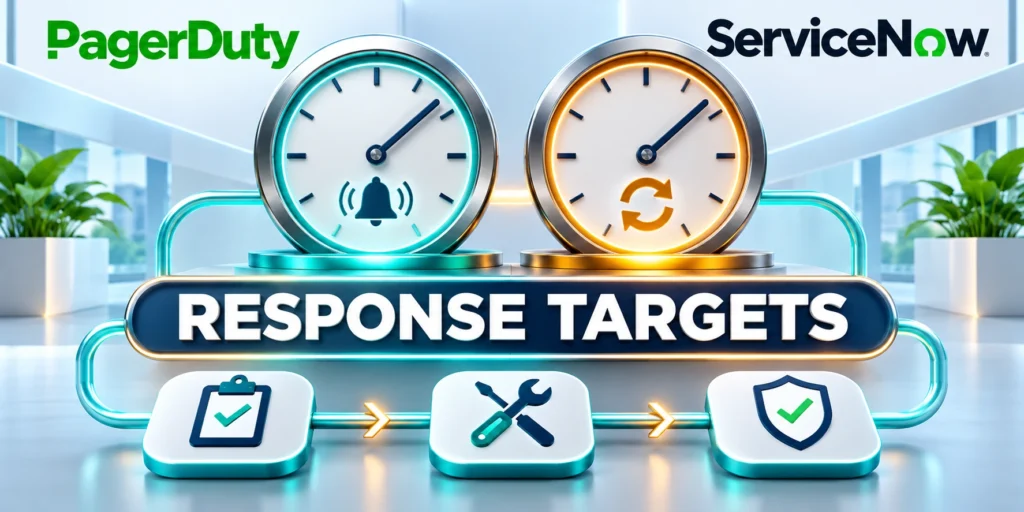
Response, engagement, workaround, restoration, and resolution are different milestones. Combining them into one target hides whether the service actually recovered.
Choose targets from customer impact, service hours, staffing, architecture, dependencies, recovery capability, and observed performance. Aspirational numbers alone do not create capacity.
Define each measured milestone
Acknowledgment confirms receipt and ownership. Engagement means an authorized responder is actively working. These milestones require timestamps and responsible roles.
Restoration returns an essential customer journey to acceptable operation, possibly through mitigation. Resolution removes the underlying condition and completes required validation.
Use these actions to define each measured milestone:
- Define acknowledgment clearly.
- Measure active engagement.
- Distinguish restoration from resolution.
- Require recovery validation.
Use a clock definition that covers start events, service calendars, pauses, dependencies, reclassification, customer delay, and closure. Avoid manual interpretations after a breach.
Set internal objectives tighter than contractual commitments when practical. Operational headroom helps teams act before customer-facing obligations are threatened.
Connect targets to operational capability
Test whether on-call coverage, access, monitoring, runbooks, rollback, vendor support, and communication paths can meet every promised target under realistic conditions.
Measure percentile performance and breach distribution, not only averages. A small group of severely delayed cases can disappear inside acceptable mean results.
Use these actions to connect targets to operational capability:
- Test targets through exercises.
- Measure percentile performance.
- Track pause reasons.
- Review repeated target breaches.
| Milestone | Meaning | Evidence |
|---|---|---|
| Acknowledge | Receipt and ownership | Ticket timestamp |
| Engage | Responder actively working | Assignment record |
| Restore | Essential service returns | Journey validation |
| Resolve | Underlying condition closed | Verified release |
Treat restoration targets as reliability design inputs. Architecture, deployment, observability, backups, and support staffing must support the commitments customers receive.
Reconcile contractual SLA terms with operational SLOs and measurable SLIs. Each serves a different purpose and should remain explicitly governed.
Define Availability and Maintenance Windows

Availability commitments require a clear service, measurement point, observation period, success condition, and treatment of planned or excluded events. Percentages alone remain ambiguous.
Measure critical customer journeys rather than isolated infrastructure uptime. A running server does not prove that authentication, transactions, integrations, or data processing work.
Specify how availability is calculated
Define numerator, denominator, sampling interval, aggregation, customer segmentation, time zone, data source, and rounding. Document how partial degradation affects the result.
Use separate indicators for availability, correctness, latency, throughput, and recovery when customer experience depends on each dimension. One percentage cannot represent every service quality.
Key considerations for specify how availability is calculated include:
- Name the measured journey.
- Define success and failure.
- Specify the observation period.
- Document aggregation rules.
Planned maintenance should have notice requirements, permitted windows, maximum duration, affected services, communication channels, validation steps, and cancellation authority.
Avoid broad exclusions that remove any provider-controlled maintenance from availability. Customers still experience disruption, and incentives should support safer change practices.
Plan maintenance around customer risk
Use traffic patterns, customer calendars, release risk, recovery options, and dependency schedules when choosing windows. Low usage does not eliminate business impact.
Define blackout periods for critical events, financial close, campaigns, regulatory deadlines, or peak seasons. Establish an emergency exception path with explicit authority.
Use these actions to plan maintenance around customer risk:
- Set minimum customer notice.
- Limit planned downtime.
- Define blackout periods.
- Validate service after maintenance.
Record actual maintenance duration and customer effect. Compare planned windows with observed availability, support volume, failed changes, and recovery time.
Review whether frequent planned exclusions conceal an unstable delivery process. Better automation, rollback, testing, and deployment design may reduce both risk and contractual complexity.
Document Dependencies and Exclusions
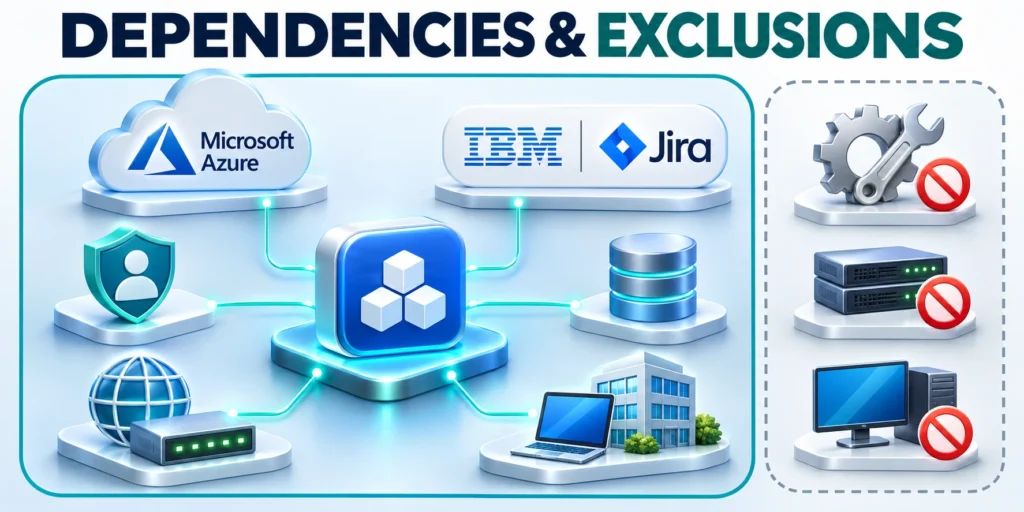
Applications depend on cloud platforms, vendors, networks, identities, data services, customer environments, and internal teams. The SLA should show how those boundaries affect commitments.
An exclusion should describe a specific condition, evidence standard, responsibility, and impact on measurement. Broad disclaimers undermine trust and operating accountability.
Map dependencies to customer journeys
List third-party APIs, infrastructure, licenses, certificates, data feeds, integration endpoints, customer systems, and shared platforms supporting each critical service flow.
Record ownership, published commitments, escalation contacts, monitoring, fallback behavior, change notice, recovery expectations, and known single points of failure.
Use these actions to map dependencies to customer journeys:
- Map critical dependencies.
- Record dependency ownership.
- Define vendor escalation.
- Document fallback behavior.
Clarify what happens to service targets during vendor disruption. When contracting nearshore development services, document who communicates with customers and coordinates recovery.
Define customer responsibilities for access, supported versions, connectivity, timely information, approvals, data quality, and required configuration. Connect each responsibility to measurable evidence.
Write narrow and testable exclusions
Examples may include unauthorized changes, unsupported software, customer-controlled outages, force majeure, or specific vendor failures. Each exclusion requires a documented causal connection.
Do not exclude consequences caused by weak provider design, delayed escalation, missing monitoring, or unavailable recovery capabilities merely because an external dependency participated.
Use these actions to write narrow and testable exclusions:
- Name the excluded condition.
- Require supporting evidence.
- Preserve communication duties.
- Review recurring exclusions.
Track exclusions used during reporting and dispute review. Repeated dependence on one clause may expose an architectural, contractual, or relationship problem.
Revisit boundaries after migrations, vendor changes, acquisitions, new integrations, or customer responsibility shifts. The written model should follow the operational system.
Build a Clear Escalation Path

Escalation protects commitments when normal ownership, expertise, authority, or capacity cannot resolve risk quickly enough. It should activate before a target is missed.
Separate functional escalation for deeper expertise from hierarchical escalation for priority, resources, risk acceptance, or executive decisions. Both need current contacts and triggers.
Define escalation levels and authority
Start with service desk ownership, then technical leads, incident command, service management, vendors, and executive sponsors. Assign alternates for every critical role.
Connect each level to severity, elapsed time, customer scope, data risk, repeated failure, blocked access, missing expertise, or approaching contractual breach.
Use these actions to define escalation levels and authority:
- Name every escalation level.
- Assign primary and alternate contacts.
- Define activation triggers.
- Document decision authority.
An escalation should carry the incident record, current impact, completed actions, evidence, blockers, requested decision, and next deadline. Avoid forcing recipients to reconstruct context.
Automate reminders and routing where dependable, but preserve a manual path. Tool failure cannot remove the ability to reach authorized responders.
Escalate before commitments fail
Set warning thresholds before response, restoration, communication, or resolution targets. Use remaining time and risk rather than waiting for formal breach.
Allow customer escalation through defined channels without bypassing technical coordination. Account teams should add context while preserving one authoritative response structure.
Key considerations for escalate before commitments fail include:
- Warn before target breach.
- Preserve incident context.
- Provide manual escalation.
- Test contacts regularly.
Align this path with the broader IT incident management process so roles, communications, and decision authority remain consistent.
Review failed, late, and unnecessary escalations after incidents. Correct stale contacts, ambiguous authority, missing evidence, excessive layers, and alert fatigue.
Measure Service Quality and Backlog Health

SLA compliance provides only one view of maintenance performance. Teams also need measures for customer outcomes, reliability, recurring defects, change quality, and backlog risk.
Use a balanced set that supports decisions without rewarding superficial closure. Metrics should reveal service health and improvement opportunities, not rank individuals.
Measure operational outcomes and flow
Track availability, correctness, latency, incident recurrence, acknowledgment, engagement, restoration, resolution, communication cadence, reopen rate, failed change rate, and customer impact.
Segment performance by severity, application, customer group, dependency, age, source, time, and resolution path. Aggregated compliance can hide concentrated failures.
Use these actions to measure operational outcomes and flow:
- Measure customer-facing reliability.
- Track target attainment.
- Monitor repeated incidents.
- Review failed changes.
Backlog health includes age, business risk, recurrence, dependencies, blocked items, technical debt, security exposure, support volume, and release readiness.
Do not treat ticket count as value. Closing low-risk requests quickly can improve volume statistics while critical defects continue aging.
Connect metrics to service decisions
Set thresholds for staffing, problem management, architecture review, vendor escalation, release restrictions, preventive maintenance, and contractual review. Assign owners for each response.
Compare trends with incident narratives, customer feedback, exercises, and release history. Quantitative improvement without better customer outcomes deserves investigation.
Use these actions to connect metrics to service decisions:
- Prioritize backlog by risk.
- Review aging critical defects.
- Connect thresholds to actions.
- Validate improvements with outcomes.
Preserve metric definitions across reporting periods and explain changes. New classification or instrumentation can create an apparent improvement or decline without operational change.
Use reviews to choose a bounded improvement set. Name the expected effect, accountable owner, deadline, and evidence required to confirm progress.
Review Reporting and Service Credits

SLA reports should let both parties reproduce results, understand exclusions, identify recurring risk, and agree on corrective action. A compliance percentage without evidence is insufficient.
Define report cadence, audience, delivery method, data sources, calculation rules, dispute window, retention, and owner. Protect customer and security information appropriately.
Build a transparent service report
Include service scope, ticket volumes, severity mix, target performance, availability, maintenance events, exclusions, breaches, repeated incidents, backlog health, and action status.
Show numerator, denominator, observation period, time zone, sampling, rounding, missing data, and corrections. Readers should distinguish measured facts from commentary.
Use these actions to build a transparent service report:
- Publish calculation methods.
- List applied exclusions.
- Explain missing data.
- Track corrective actions.
Review material breaches individually and trends collectively. One isolated miss and repeated near-breaches require different operational and commercial responses.
Create a dispute process with evidence requirements, responsible reviewers, decision deadline, escalation, and correction procedure. Preserve the original and revised calculations.
Use service credits carefully
Define eligibility, calculation, caps, claim process, deadlines, exclusions, and payment method. Credits should be predictable without becoming the sole remedy for poor service.
A credit does not restore customer trust or remove operational risk. Pair repeated breaches with corrective plans, leadership review, capacity changes, or contract reconsideration.
Apply these criteria to service credits carefully:
- Define credit eligibility.
- Set calculation and caps.
- Document the claim process.
- Require corrective action for recurrence.
Review whether incentives support reliability, transparency, and early escalation. Poorly designed terms can encourage severity suppression or broad exclusion use.
Use quarterly or monthly governance to address patterns before renewal. Contract language should reflect observed capability and a credible improvement path.
Update the SLA as the Application Changes
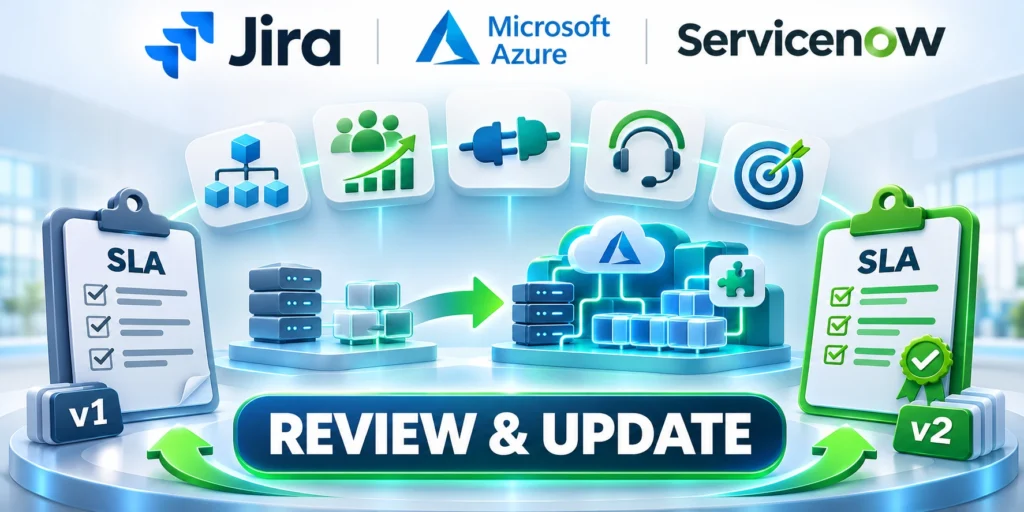
Applications, customers, dependencies, risks, teams, and operating models change. An SLA becomes misleading when its scope and targets remain fixed while the service evolves.
Define regular reviews and event-driven triggers. Every revision should preserve version, effective date, approvals, rationale, customer notice, and operational readiness evidence.
Use meaningful review triggers
Review after major releases, migrations, integrations, acquisitions, vendor changes, customer growth, support model changes, repeated breaches, or material incidents.
Consider new regulations, contracts, traffic patterns, data classifications, business calendars, recovery capabilities, and customer journeys that change service impact.
Apply these criteria to meaningful review triggers:
- Schedule recurring reviews.
- Trigger reviews after major changes.
- Use breach and incident evidence.
- Include customer expectations.
Compare written commitments with observed performance, staffing, architecture, monitoring, escalation, recovery testing, backlog health, and vendor support. Identify unsupported promises and unused clauses.
Tighten targets only when capability and business value justify them. Lowering a target should require transparent evidence and consideration of customer consequences.
Manage revisions as operational changes
Update runbooks, monitoring, reports, ticket workflows, contacts, training, automation, and customer communications alongside contract language. Documentation alone does not create readiness.
Test changed targets through exercises and representative cases before the effective date. Confirm that clocks, escalations, dashboards, and reporting calculations behave correctly.
Key considerations for manage revisions as operational changes include:
- Version every agreement.
- Record approval and rationale.
- Update operational tooling.
- Test before effective dates.
Preserve prior versions for disputes and historical reporting. Never apply revised definitions retroactively unless all parties explicitly agree and the change is documented.
Treat the SLA as a living service governance instrument. It should make expectations clearer as the application changes, not accumulate contradictory exceptions.
Conclusion

A useful software maintenance SLA connects precise scope, impact-based severity, measurable targets, customer-centered availability, bounded exclusions, early escalation, and transparent reporting.
Its commitments must reflect real architecture, staffing, monitoring, recovery, vendor support, and governance. Contract language cannot compensate for missing operational capability.
Build the agreement from observable service behavior
Start with one critical application and map customer journeys, components, service hours, owners, dependencies, incident paths, recovery options, and current performance.
Translate that evidence into commitments that each party can interpret and reproduce. Keep operational objectives tighter where practical to create recovery headroom.
Use these actions to build the agreement from observable service:
- Define the supported service.
- Connect targets to customer impact.
- Test escalation and recovery.
- Publish transparent measurement rules.
Use service reports to improve decisions, not merely prove compliance. Recurrence, aging risk, failed changes, and customer outcomes reveal problems percentages may hide.
Review credits and exclusions alongside corrective action. Commercial remedies matter, but sustainable value comes from reducing disruption and improving recovery capability.
Choose the next SLA improvement
Select the ambiguity or operating gap most likely to delay response, restoration, escalation, reporting, or customer understanding. Assign one accountable owner.
Define the expected improvement and verification evidence. Test the change through a representative ticket, incident, maintenance window, or service review.
Use these actions to choose the next sla improvement:
- Name the priority gap.
- Assign one accountable owner.
- Define measurable evidence.
- Verify the operational result.
A mature SLA creates shared expectations before pressure arrives. It also gives teams the data and authority needed to act before commitments fail.
Continue revising the agreement as the application and customer context evolve. Reliable maintenance requires alignment between promises, systems, people, and evidence.
FAQ
These answers address common questions about software maintenance SLA scope, targets, severity, availability, escalation, reporting, credits, metrics, and ongoing review.
What is a software maintenance SLA?
It is a formal agreement defining supported software services, performance commitments, measurement rules, responsibilities, escalation, reporting, exclusions, and remedies between a provider and customer.
How is an SLA different from an SLO?
An SLA is a contractual commitment with possible commercial consequences. An SLO is an operational reliability target used to manage and improve service performance.
What should a maintenance SLA include?
Include scope, service hours, severity, response and restoration targets, availability, maintenance windows, dependencies, exclusions, escalation, reporting, dispute handling, credits, and review triggers.
Should resolution time be guaranteed for every defect?
Usually not. Restoration targets can protect urgent customer journeys, while permanent resolution depends on diagnosis, complexity, dependencies, testing, and safe release planning.
How should severity be determined?
Use customer impact, affected scope, blocked journeys, data risk, revenue exposure, duration, expansion potential, and workaround quality rather than reporter seniority.
Does planned maintenance count as downtime?
The agreement should state that explicitly. Define notice, permitted windows, maximum duration, affected services, validation, and any exclusions narrowly enough for reproducible reporting.
What happens when a target is close to breach?
Warning thresholds should trigger functional or hierarchical escalation before the deadline, carrying current impact, evidence, actions, blockers, requested decisions, and remaining time.
Which metrics should maintenance reports include?
Use availability, correctness, response, restoration, recurrence, communication, failed changes, reopen rate, backlog age, exclusions, breaches, and corrective-action completion.
When should service credits apply?
Define eligibility, calculation, caps, claim deadlines, evidence, exclusions, and payment method. Repeated breaches should also require operational corrective action.
How often should the SLA be reviewed?
Use a regular cadence and additional reviews after major releases, migrations, vendor changes, customer growth, repeated breaches, material incidents, or support model changes.







Leave a Reply