

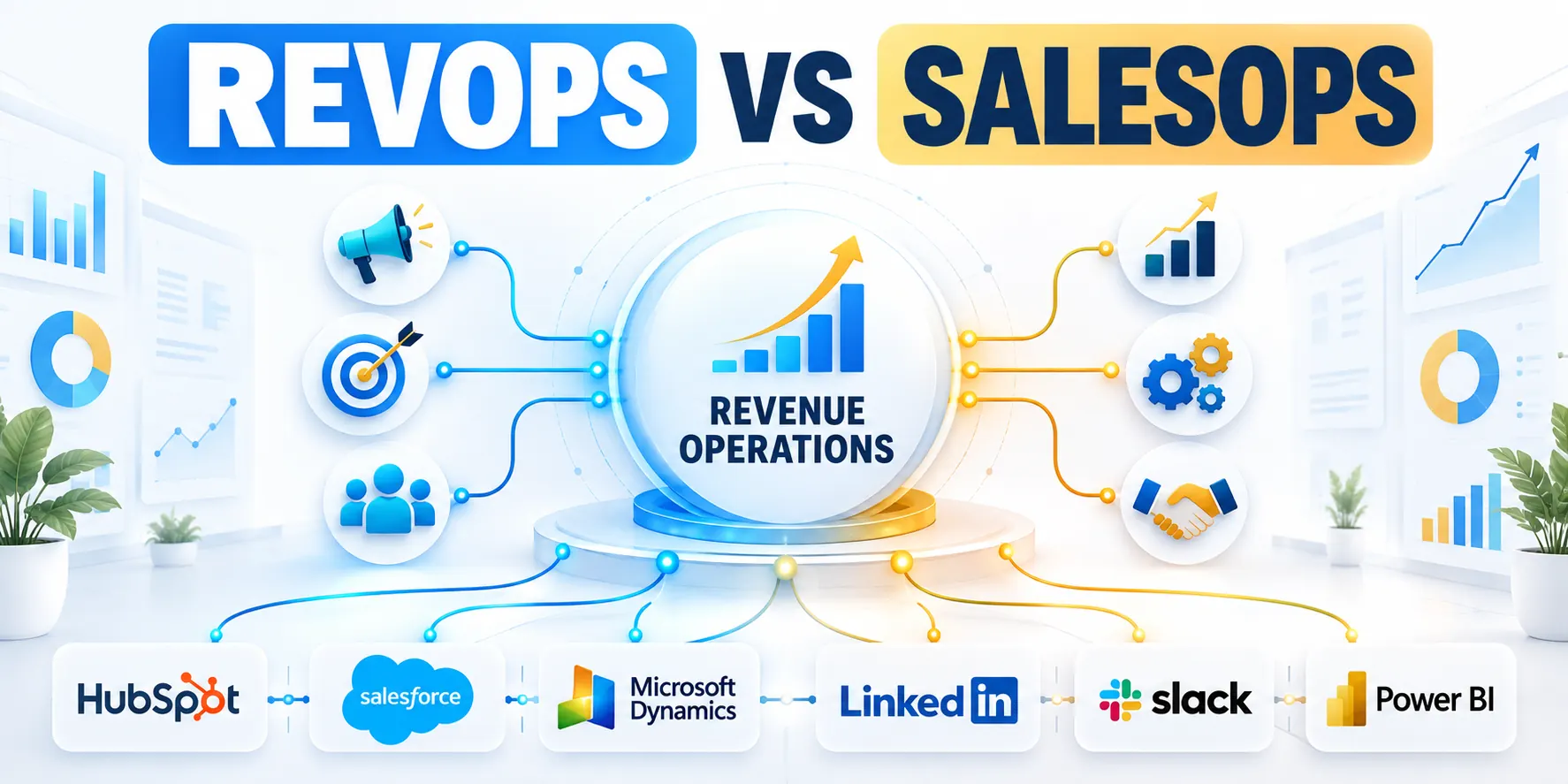
Define RevOps and SalesOps by the work they own
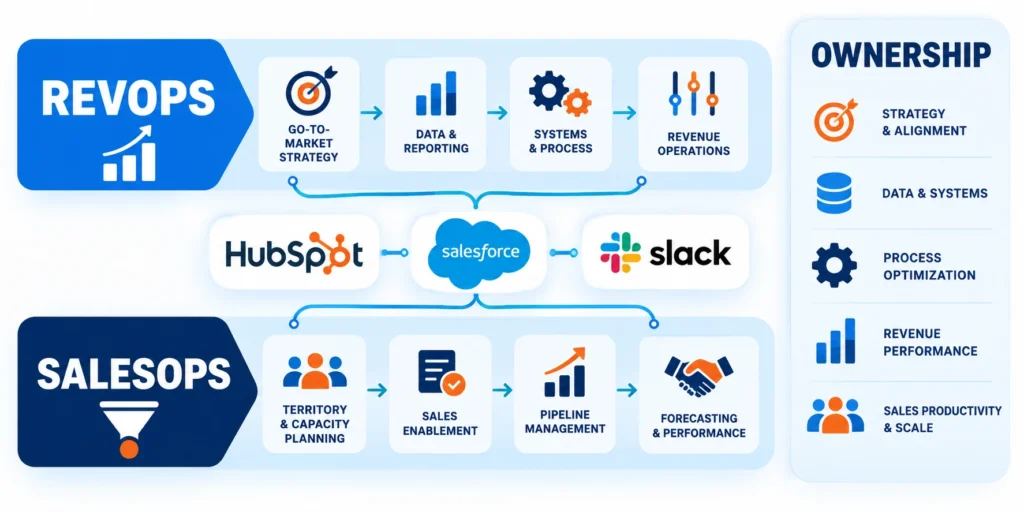
A RevOps vs SalesOps model choice determines which work needs a sales-team focus and which coordination spans marketing, sales, service, or delivery.
However, companies use these names differently. Decide from responsibilities, decisions, and results rather than assuming every organization uses identical job titles.
Use scope to distinguish the two functions
SalesOps, or Sales Operations, improves the sales organization’s ability to execute. Common work includes pipeline process, forecasting support, territory rules, sales tools, and reporting.
RevOps, or Revenue Operations, coordinates operating processes that cross revenue teams. In practice, it may align marketing, sales, customer success, finance, or service delivery.
Treat the definitions as a working convention
This distinction is a practical convention, not a mandatory organization chart. HubSpot describes SalesOps as sales-focused and RevOps as a wider cross-functional mandate in its RevOps versus SalesOps comparison.
Your firm may place SalesOps inside RevOps, make it a separate sales function, or assign both responsibilities to one generalist.
Start with repeated work, not department names
List the decisions and processes that repeatedly fail or consume leadership time. Then assign an accountable owner for each problem before creating a new title.
A firm with unreliable sales forecasts may need SalesOps first. By contrast, a firm with broken marketing-to-sales and sales-to-delivery handoffs may need cross-functional ownership.
Inventory these recurring operations responsibilities first:
- Pipeline definitions and sales-stage governance
- Lifecycle handoffs and shared data rules
- Platform changes and release ownership
- Reporting definitions and exception resolution
Compare the mandates, stakeholders, and decisions

SalesOps concentrates on sales execution and the conditions that help salespeople manage opportunities. RevOps focuses on consistency across the customer-facing lifecycle.
To see the boundary, ask who the work serves, which decisions it governs, and whether the process crosses team boundaries.
SalesOps decisions usually sit close to the sales motion
Key considerations for salesops decisions usually sit close include:
- Define opportunity stages, required evidence, close dates, and forecast categories.
- Support territory design, account assignment, quota planning, compensation data, and pipeline review.
- Maintain sales CRM workflows, dashboards, data quality rules, and seller-facing tools.
SalesOps typically governs sales stages, territories, quotas, forecasting routines, seller tools, pipeline inspection, and the operating details required for consistent execution.
Its decision rights should remain explicit when marketing, finance, customer success, or shared platforms influence the same workflow.
RevOps decisions usually span multiple functions
Key considerations for revops decisions usually span multiple include:
- Set shared lifecycle definitions and handoff criteria between marketing, sales, and customer success.
- Coordinate revenue data rules, process ownership, reporting logic, and cross-team change management.
- Surface bottlenecks across acquisition, selling, onboarding, retention, and expansion.
RevOps coordinates definitions, handoffs, data, platforms, and performance across marketing, sales, customer success, finance, and other revenue stakeholders.
It should not absorb every functional task; it resolves cross-team dependencies and governs decisions that no single department can optimize alone.
Shared tools do not automatically mean shared ownership
Both functions may work in the same CRM. However, that does not mean every CRM setting or report should have one undifferentiated owner.
For example, SalesOps may own opportunity stage rules, while RevOps owns the definition that links qualified demand, accepted opportunities, and post-sale outcomes.
Connect system decisions to the implementation plan
To plan broader process design and migration, see the enterprise CRM implementation guide.
Translate each ownership decision into platform roles, data rules, workflow requirements, reporting definitions, release responsibilities, and support procedures.
| Decision area | SalesOps lead | RevOps lead |
|---|---|---|
| Sales stages | Owns execution rules | Aligns lifecycle impact |
| Forecast process | Runs sales cadence | Aligns shared definitions |
| Lifecycle handoff | Supplies sales requirements | Governs cross-team policy |
| CRM releases | Validates seller workflow | Coordinates shared impact |
Assign ownership at cross-functional handoffs
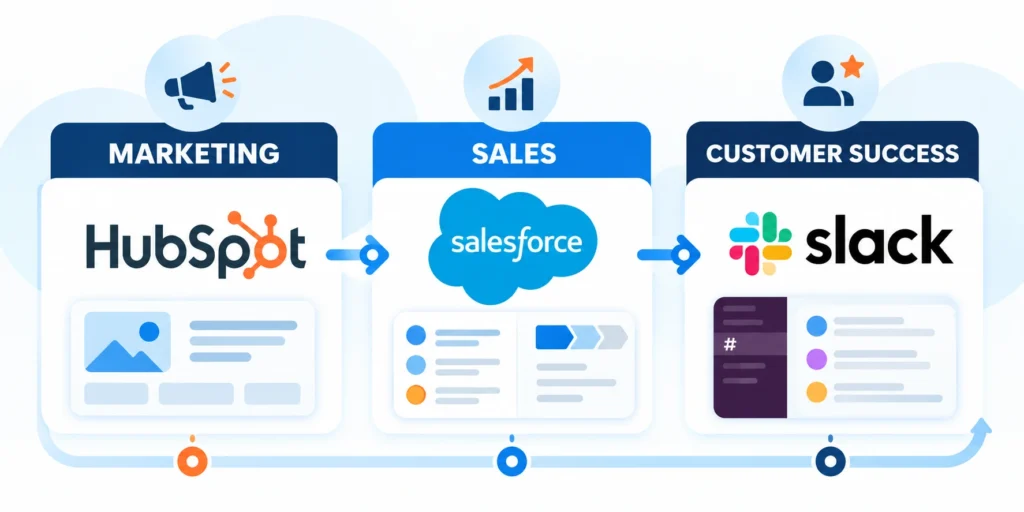
A cross-functional problem should have one accountable owner, even when several teams contribute. Without a final decision-maker, shared ownership often creates delay.
Use a simple responsibility map for each workflow. Name who proposes the rule, approves it, configures the system, and handles exceptions.
Map one workflow from trigger to outcome
Follow this sequence to map one workflow from trigger to:
- Choose a real journey, such as a marketing-qualified inquiry becoming a sales opportunity.
- Record the current trigger, required data, receiving team, response target, and exception path.
- Assign one accountable owner for the whole handoff and a responsible operator in each team.
- Test with real records, then review missed, duplicated, and delayed handoffs after rollout.
Choose a recurring revenue workflow and document its trigger, participants, decisions, data changes, systems, handoffs, exception paths, and measurable outcome.
Use the map to identify where local SalesOps execution ends and cross-functional RevOps governance begins.
Use a compact responsibility agreement
A one-page agreement is enough for many teams. For clarity, it should identify the process owner, system owner, data steward, approver, service-level target, and escalation route.
Keep the rule specific. “Sales accepts a qualified request within one business day” is testable; “teams collaborate quickly” is not.
Separate policy from CRM administration
The person who configures a field should not automatically define the business meaning of that field. Ask the process owner and finance or data steward to approve definitions.
In turn, this separation prevents a technical workaround from changing how teams count qualified pipeline, forecast revenue, or report client retention.
Choose metrics that match each mandate
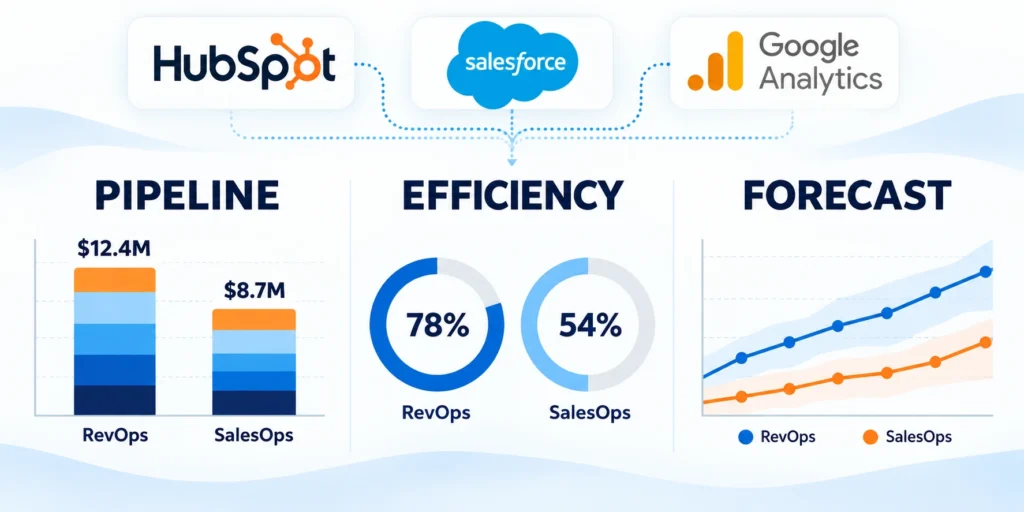
A team can improve a dashboard while the business result stays flat. Choose measures that reflect the function’s authority and connect them to real decisions.
Use a small set of operational and outcome measures. Define each formula, data source, owner, review period, and action threshold before publishing a scorecard.
Measure SalesOps around sales execution
Use these actions to measure salesops around sales execution:
- Forecast accuracy by period and segment, using the same submitted forecast and closed result.
- Stage conversion and time in stage, with consistent entry and exit criteria.
- Seller capacity or administrative time only when the method and sample are documented.
- Data completeness for fields that actually support qualification, planning, or forecast decisions.
Use metrics that reflect seller readiness, pipeline discipline, forecast reliability, territory coverage, opportunity progression, and the quality of sales-system operation.
Define every measure with eligible records, timing, exclusions, source, owner, and the decision it informs.
Measure RevOps around lifecycle reliability
Use these actions to measure revops around lifecycle reliability:
- Handoff acceptance, rejection reasons, and elapsed time between revenue teams.
- Definition consistency across acquisition, opportunity, booked work, onboarding, and renewal.
- Cohort-based retention or expansion, reconciled to finance-approved records.
- Cost or rework tied to a documented process failure rather than a broad activity count.
Measure whether definitions, ownership, data, and handoffs remain reliable from demand creation through sales, onboarding, retention, expansion, and revenue reporting.
Cross-functional measures should reveal where one team improves locally while shifting cost or friction to another stage.
Do not use activity as a substitute for impact
Records created, logged calls, automation runs, and dashboard visits show activity. However, they do not prove that a process improved or revenue increased.
When an outcome depends on several teams, report the contribution of each measure with the limitations. Avoid giving one operations group causal credit for every change.
Pair sales outcomes with seller readiness
The related CRM sales enablement metrics guide covers sales-facing measures and their calculation.
Track whether sellers can complete required workflows accurately, find trusted information, resolve exceptions, and receive timely support before attributing performance changes to operations.
Review definitions and incentives together
A metric can change behavior even when the workflow stays the same. Check whether teams can improve their score by shifting records, delaying handoffs, or redefining stages.
Compare the measure with client outcomes and downstream work. If one team’s improvement creates more rework for another, the operating metric needs a shared guardrail.
Decide which operations function to build first
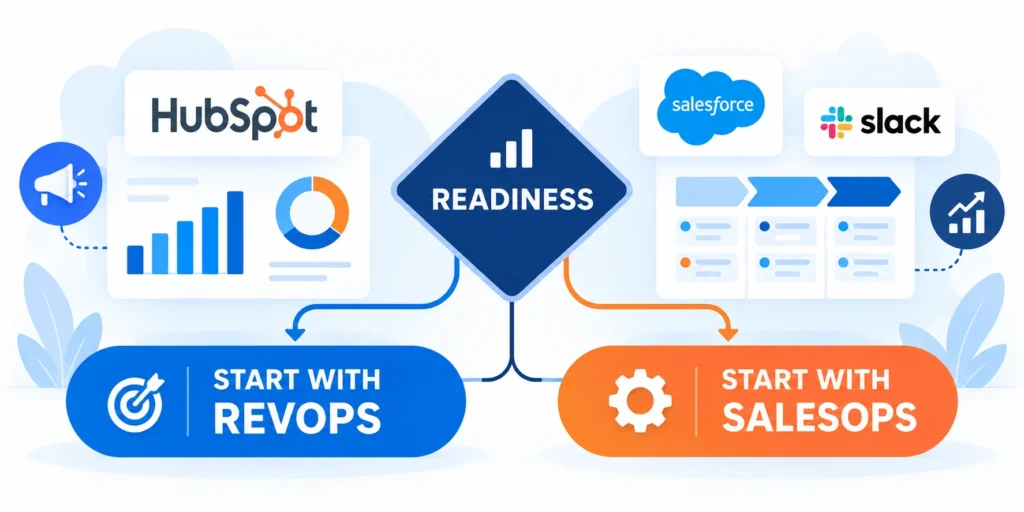
Choose the smallest operating capability that resolves the most costly recurring problem. Therefore, a new department is not the default answer to a process gap.
Assess where the failure begins, which teams it affects, whether the data is trusted, and who has authority to change the workflow.
Build SalesOps first when sales execution is the bottleneck
Start with SalesOps when sales stages, forecasts, territory coverage, seller tools, or opportunity data are inconsistent within the sales organization.
In turn, a focused SalesOps owner can standardize the workflow, improve forecast routines, and make sales leadership decisions more repeatable.
Build cross-functional RevOps when handoffs are the bottleneck
Start with cross-functional RevOps when teams define lifecycle stages differently, systems disagree, or important client transitions have no accountable owner.
However, do not centralize every decision immediately. Give the cross-functional owner clear authority for shared definitions and handoffs while functional leaders retain local execution decisions.
Use a pilot when the diagnosis is uncertain
If the root cause is unclear, pilot one customer journey with a named sponsor, limited scope, baseline, and review date.
The pilot should test the operating model, not merely install another dashboard or CRM automation.
Check the solution against decision criteria
Before proposing a new role, define what would count as success: shorter handoff time, fewer duplicate records, more reliable forecasts, or clearer decision ownership.
Assign an owner to each measure and confirm the source system. If the data is incomplete, make data repair part of the pilot rather than assuming the dashboard is trustworthy.
Use these actions to check the solution against decision criteria:
- Can a current team resolve the problem with clearer authority?
- Does the work cross departments often enough to justify a shared owner?
- What will the firm stop doing if it creates this new responsibility?
Size the operating model to the company

Professional-services firms differ in client mix, delivery model, team size, and data maturity. Their operations design should fit those conditions.
One person may cover multiple responsibilities in a small firm. Even so, the work needs explicit ownership without separate SalesOps and RevOps teams.
Small firm: establish one accountable generalist
A small firm can assign a sales-operations generalist to maintain pipeline rules, CRM hygiene, and forecast routines, with a leadership sponsor for cross-team decisions.
Document which lifecycle changes require marketing, delivery, finance, or client-success input so one person does not make unsupported policy decisions alone.
Growing firm: separate execution from cross-team governance
As teams add specialists, keep sales workflow administration close to sales while assigning a cross-functional owner to shared definitions and handoffs.
A weekly operating meeting can resolve exceptions; a monthly review can check whether shared measures still reflect the actual client journey.
Enterprise: federate execution with common definitions
Large firms may have marketing operations, SalesOps, customer-success operations, and regional teams. A central RevOps function can govern common terms and integration rules.
However, local teams can retain workflows required by contracts or service lines, provided exceptions are documented and reports remain comparable.
Keep decision rights visible as roles scale
When responsibilities split across specialists, publish a short ownership map and review it after reorganization, acquisition, or major CRM changes.
A clear escalation path keeps cross-team disputes from turning into duplicate fields, conflicting dashboards, or unapproved changes to client commitments.
Reconfirm these decision rights whenever the team grows:
- Functional workflow and service ownership
- Cross-functional definitions and policy governance
- Platform administration and release approval
- Prioritization, escalation, and capacity decisions
Run a 90-day operating model pilot
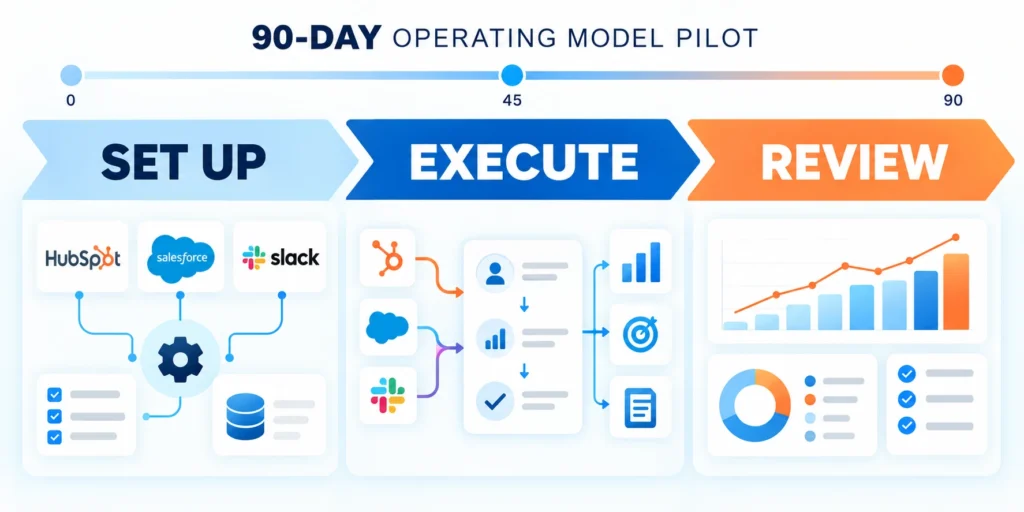
Before restructuring, a time-boxed pilot can test whether new ownership improves a real process.
Choose a journey with enough volume to observe but small enough to correct safely. Meanwhile, keep the existing workflow available until the replacement is stable.
Days 1–30: establish the baseline and decision rights
Follow this sequence to days 1 30 establish the baseline:
- Select one measurable handoff or sales process and name an executive sponsor.
- Document the current steps, owners, delays, rework, exceptions, and data sources.
- Agree on terms, definitions, success thresholds, and who approves changes.
Document the selected workflow, current performance, ownership conflicts, service expectations, data definitions, and decisions the pilot must clarify during its first month.
Publish a compact responsibility agreement so participants know who decides, executes, advises, supplies evidence, and resolves exceptions.
Days 31–60: operate the pilot and log exceptions
Follow this sequence to days 31 60 operate the pilot:
- Train the affected users with the actual workflow and escalation instructions.
- Review a sample of records weekly for handoff completion, definition quality, and missed cases.
- Log configuration changes and keep a recovery route if the new process fails.
Run the workflow with real participants, record requests and exceptions, and measure response time, rework, data quality, decision delays, and unresolved ownership questions.
Use weekly reviews to correct the operating model without quietly expanding scope or inventing new responsibilities.
Days 61–90: compare results and decide
Follow this sequence to days 61 90 compare results and:
- Compare pilot results with the baseline using the same population and metric definitions.
- Ask frontline users and receiving teams where the process adds friction or removes rework.
- Continue, revise, expand, or stop against the thresholds agreed before the pilot.
Compare pilot results with the baseline, including stakeholder experience, service load, adoption, decision quality, and business outcomes that the model could reasonably influence.
Choose whether to retain, revise, expand, specialize, or stop the model, documenting evidence and unresolved risks behind the decision.
Prevent common RevOps and SalesOps failures
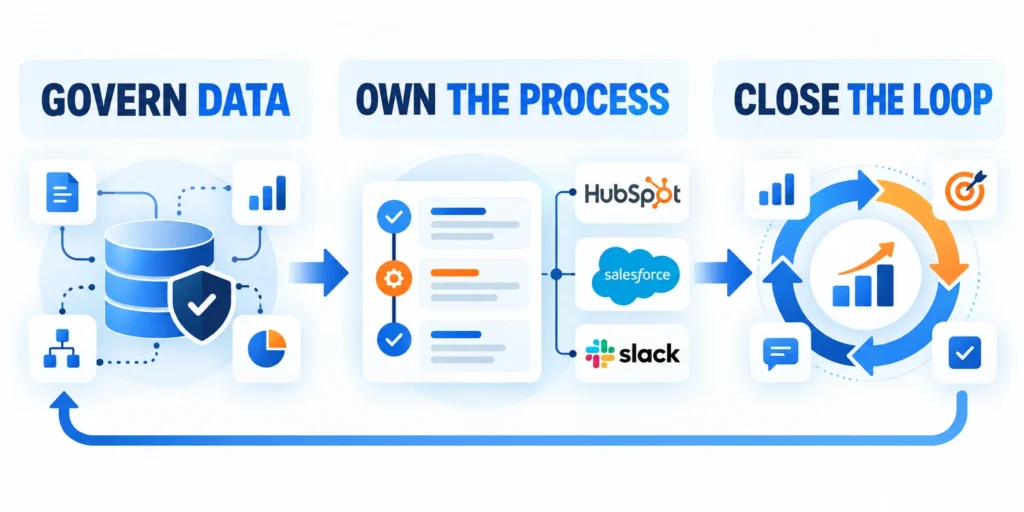
The labels alone cannot repair broken handoffs. Failures usually come from unclear authority, duplicate work, weak data definitions, or a design detached from frontline use.
Review the operating model when a new team, service line, acquisition, or CRM change alters the customer journey.
Avoid two teams owning the same CRM task
Document who proposes, approves, configures, validates, and supports each important change. Use one change queue or one named coordinator for shared workflows.
A configuration task may have one administrator, while business approval belongs to the accountable process owner. Keep those roles visible.
Avoid a RevOps title without cross-functional authority
If the RevOps owner cannot convene teams, maintain shared definitions, or escalate unresolved handoffs, the role may become a reporting layer without operational authority.
Secure a sponsor and a written decision path. Ultimately, leaders must resolve tradeoffs that cross department budgets or client commitments.
Avoid forcing a universal org chart
Do not reorganize teams simply because another company uses a particular title. Define the capability needed, assign ownership, and adjust reporting lines only when coordination problems persist.
HubSpot’s comparison of the two functions presents one common framing; adapt it to the firm’s actual structure and responsibilities.
Test the proposed model against these failure signals:
- Duplicate ownership for one operational decision
- Cross-functional work without accountable authority
- Platform administration confused with governance
- Requests accepted without capacity or priority rules
Choose a clear operating model and review it
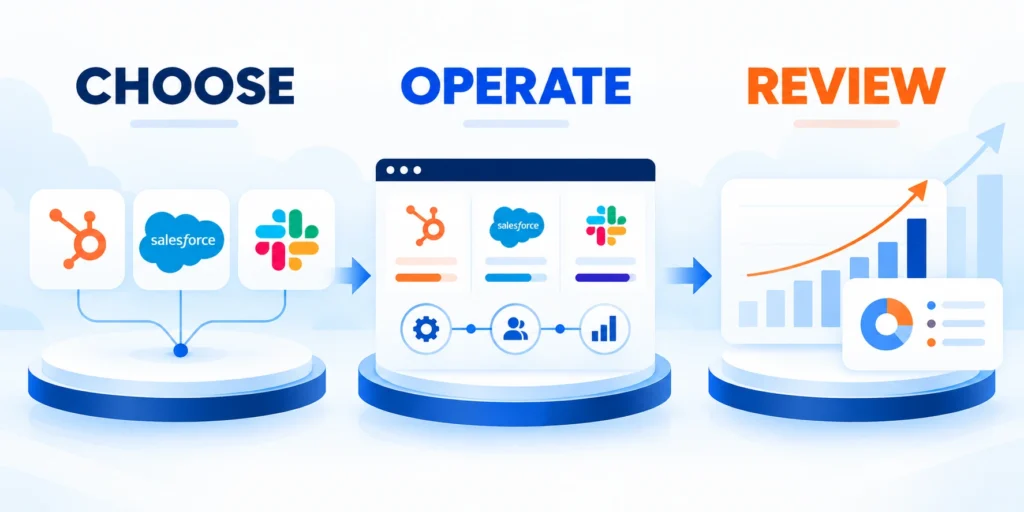
SalesOps is usually closest to the sales team’s operating system. RevOps is usually responsible for processes and definitions that cross customer-facing teams.
These are useful distinctions, not universal job-title rules. In practice, the firm’s decision rights, workflows, and reporting responsibilities matter more than labels.
Make ownership testable
Assign an accountable owner to each process, metric, CRM rule, and handoff. Then give the role authority, access, and an escalation path that match its responsibility.
Review the model after a pilot and whenever the customer journey changes. Keep functions separate where focus helps; coordinate them where work crosses boundaries.
Use a practical decision rule
If the problem remains inside sales execution, strengthen SalesOps. When shared definitions and handoffs fail across teams, establish cross-functional RevOps ownership.
When both problems exist, clarify sales execution ownership first and create a shared governance layer for cross-team work. Finally, scale the structure only as evidence requires.
Map Decision Rights Before Drawing the Org Chart
List who decides sales process, lifecycle definitions, CRM configuration, data standards, routing, forecasting, campaigns, handoffs, and customer operations.
Then assign execution, consultation, approval, and escalation. Reporting lines cannot compensate for ambiguous authority across shared workflows.
Separate Platforms From Operating Ownership
A RevOps team may govern shared definitions while SalesOps owns sales configuration and execution; the exact boundary should be explicit.
Do not centralize every tool automatically. Place ownership where expertise, accountability, access, support, and change demand can be sustained.
Use a Service Catalog for Operations Work
Define recurring services such as user access, routing changes, dashboards, campaign support, data corrections, integrations, and incident response.
Record intake, priority, owner, expected response, dependencies, evidence, approval, and completion criteria for each service.
Plan Capacity and Prioritization
Compare recurring administration, strategic projects, incidents, compliance work, and technical debt against available operations capacity.
Use an agreed portfolio decision when demands conflict instead of allowing the loudest team to bypass shared priorities.
Measure the Operating Model
Track request age, change failure, data quality, adoption, forecast reliability, handoff exceptions, recovery, and stakeholder outcomes.
Interpret measures together. Faster delivery is not improvement when errors, rework, customer friction, or unmanaged risk increase.
Design the Evolution Path
Begin with the highest-impact verified bottleneck, assign authority, document interfaces, and review the result before adding roles.
Expand specialization when sustained work volume and consequence justify it, while preserving clear cross-functional governance.
Review these signals before changing the operating model:
- Request volume and service-level reliability
- Repeated ownership conflicts or escalations
- Data and platform complexity across teams
- Evidence supporting specialized operational roles
FAQ
These answers clarify common RevOps and SalesOps questions about scope, reporting, staffing, CRM ownership, hiring, priorities, specialization, and organizational evolution.
Is RevOps the same as SalesOps?
No. SalesOps typically supports sales execution, while RevOps typically coordinates processes across revenue teams. Organizations use the terms differently, so compare responsibilities.
Should SalesOps report to RevOps?
It depends on company size, leadership authority, and workflow needs. Reporting lines matter less than clear ownership for sales decisions and cross-functional processes.
Can one person handle both functions?
Yes, especially in a small firm. Assign separate responsibilities and decision rights even when one generalist performs the work.
Which function should a services company hire first?
Hire or assign the capability that addresses the primary verified bottleneck. Use SalesOps for sales-process problems and cross-functional RevOps for recurring lifecycle handoff failures.
How do you know when to expand a RevOps team?
Expand when cross-team work has sustained volume, measurable impact, and ownership gaps that a generalist or existing operations team cannot handle reliably.
Does RevOps replace department leaders?
No. It coordinates shared systems and processes while accountable leaders retain decisions within their commercial and customer functions.
Can SalesOps own the CRM?
Yes, when scope, authority, cross-team interfaces, security, data governance, support, and escalation are explicit.
What should a first RevOps hire own?
Assign a verified cross-functional problem with authority, measures, access, support, and boundaries the organization can sustain.
How are RevOps priorities chosen?
Compare business impact, customer friction, risk, effort, dependency, urgency, evidence, and capacity through shared portfolio governance.
When should operations specialize?
Specialize after sustained work volume, consequence, expertise, and ownership needs exceed a generalist model’s reliable capacity.
For the broader framework, read RevOps Playbook: Aligning Sales, Marketing, and Customer Success.
Conclusion

The difference between SalesOps and RevOps is best understood through recurring work, decision rights, stakeholders, dependencies, and outcomes rather than titles or fashionable organization charts.
SalesOps strengthens sales execution, while RevOps governs cross-functional revenue dependencies. Many companies need both capabilities, even when one team or person initially carries them.
Choose the model from the operating constraint
Start with the bottleneck the company can observe: inconsistent sales execution, unreliable lifecycle handoffs, fragmented definitions, overloaded platforms, or decisions without accountable owners.
Assign the narrowest authority that can resolve the constraint, then test whether the model improves workflow reliability without shifting hidden work elsewhere.
Use these criteria to select the initial operations model:
- Location of the repeated revenue bottleneck
- Teams affected by each operating decision
- Authority required to resolve dependencies
- Available capacity and specialized expertise
- Evidence the pilot can produce quickly
Evolve ownership through measured evidence
Run a bounded pilot with explicit decision rights, service expectations, baseline measures, exception logging, and a review date before redesigning the wider organization.
Use results to decide whether responsibilities remain combined, move into specialist roles, or require stronger cross-functional governance.
Review these outcomes before expanding the operations structure:
- Decision ownership remains clear in practice
- Requests meet agreed service expectations
- Handoffs and data definitions become reliable
- Stakeholders understand escalation and priorities
- Business outcomes improve without hidden rework
A clear operating model is not permanent. Revisit it when company scale, services, markets, platforms, staffing, or revenue processes materially change.
The durable goal is accountable revenue work: decisions made by the right owners, supported by reliable data, practical services, and measurable outcomes.







Leave a Reply