


Why Marketing and Sales Need a Shared SLA

A marketing and sales SLA is a working agreement between teams that exchange demand, context, follow-up, and feedback.
It makes the handoff observable: both groups know which records qualify, who acts next, what action counts, and what happens when rules fail.
Treat the agreement as an operating contract
The document is not a guarantee that every lead becomes revenue. It describes controllable actions and the evidence each team records.
Marketing can commit to agreed qualification and context. Sales can commit to timely review, disposition, and useful feedback within defined coverage.
Clarify what each team can control
Salesforce describes an SLA as shared expectations that can include qualification definitions, follow-up windows, feedback, and pipeline responsibilities. Salesforce’s sales and marketing alignment guide
Use those components as a starting point, then adapt them to the customer journey, team capacity, and the systems your company actually uses.
Separate shared outcomes from team commitments
The shared outcome might be qualified pipeline or a smoother buying experience. Neither team should be measured only on activity it cannot control.
Marketing controls campaign design and qualification inputs. Sales controls outreach execution and disposition. Leaders own priorities, capacity, and conflict resolution.
Use these actions to separate shared outcomes from team commitments:
- Agree on one shared outcome that reflects customer and business value.
- Name the owner for each handoff and each unresolved exception.
- Review the agreement when products, territories, capacity, or qualification rules change.
For broader cross-functional ownership, compare this agreement with the site’s RevOps operating model guide.
A short agreement that people use is more valuable than a long policy that nobody can explain during a live handoff.
Define a Qualified Lead and an Accepted Handoff
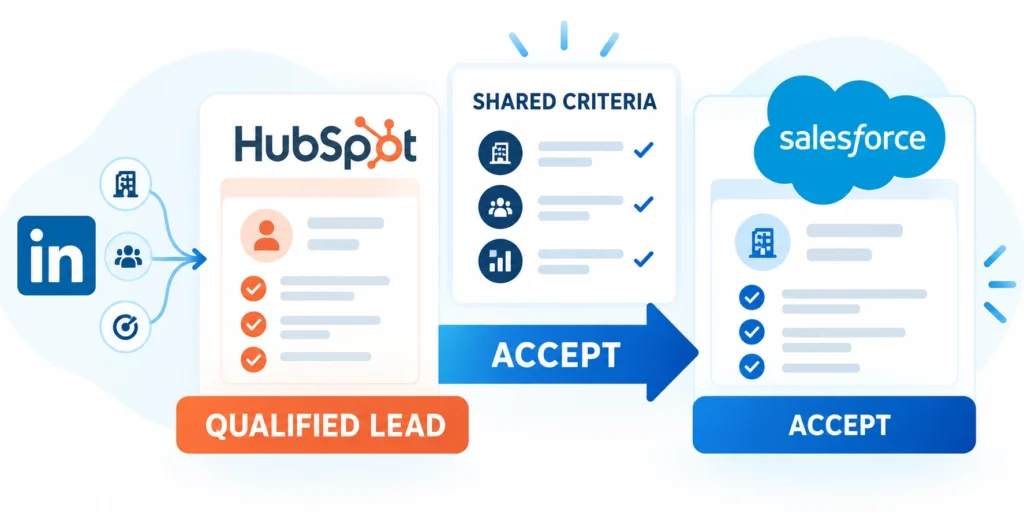
Start by defining the record and event covered by the SLA. A form submission, marketing-qualified lead, and sales-accepted lead are different states.
Write observable criteria for each state, including account fit, contact role, expressed need, consent, and the evidence that triggered qualification.
Describe evidence, not labels alone
Labels such as MQL or SQL vary between organizations. The agreement should state what data and behavior make a record eligible for the next step.
Require observable fit, need, authority, timing, engagement, or customer-context evidence that both teams can inspect and apply consistently.
Translate lifecycle terms into local rules
HubSpot explains that lifecycle stages represent where a contact or company sits in a process, while lead status can describe a substage.
Use your CRM’s stages consistently and document any local definitions beside them. HubSpot’s lifecycle stage reference
Make stage transitions testable
For example, a target account’s demo request may qualify when it has a valid work email, an in-scope region, and a supported use case.
For every transition, define the required evidence, timestamp, responsible team, allowed exception, and destination status when criteria remain incomplete.
Create acceptance and rejection rules
| Decision | Evidence to record | Next owner |
|---|---|---|
| Accept | Named owner, timestamp, and first action | Sales owner |
| Return for data repair | Missing or conflicting required field | Marketing operations |
| Reject as out of scope | Specific exclusion reason and supporting field | Marketing or nurture owner |
| Hold for review | Ambiguous fit, consent, or account ownership | Named exception queue |
Avoid a catch-all rejection reason such as “bad lead.” It gives marketing no actionable signal and makes quality discussions subjective.
Allow a reasonable review path when a record is incomplete but potentially valuable. Distinguish repairable gaps from genuine disqualification.
Keep lifecycle definitions aligned across tools
If marketing automation and CRM use different stage names, maintain a mapping with one accountable owner for each transition and field.
Document whether stage changes are automatic, manual, or both. Include the event that advances or reverses a record so reports remain interpretable.
Use these actions to keep lifecycle definitions aligned across tools:
- Stage name and business meaning.
- Required evidence before advancement.
- Owner responsible for the change.
- Fallback when information is missing or disputed.
The qualification rules should also fit your existing CRM lead routing design.
This avoids turning the SLA into a duplicate routing manual; it governs the service promise while the CRM workflow handles assignment mechanics.
Set Response and Coverage Standards That Match Capacity
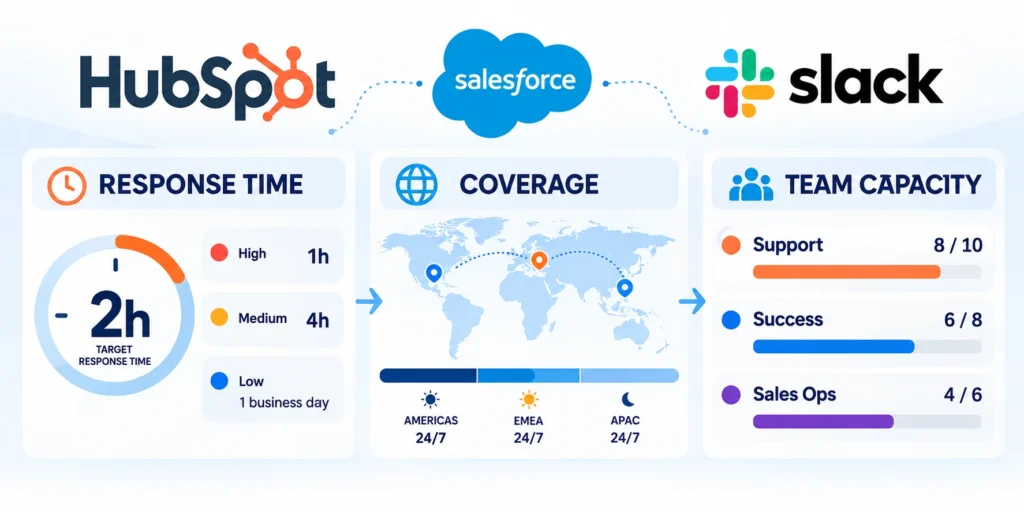
A response target is useful only if someone can meet it. Define the coverage calendar, eligible owners, queue monitoring, and escalation path first.
Specify business hours, holidays, time zones, and how the clock behaves outside coverage. Do not imply round-the-clock service when staffing is limited.
Choose a meaningful first action
A CRM assignment is not always a customer response. Define whether the SLA measures assignment, human review, attempted contact, or a substantive reply.
For an inbound request, a meaningful first action might be a personalized call or email that acknowledges the stated need and proposes a next step.
Match the clock to the customer action
Choose the measurement that matches the buyer experience you can support. An automated acknowledgment may confirm receipt without satisfying human follow-up.
Use different clocks only when customer expectations, staffing coverage, and business impact genuinely differ, documenting which records follow each standard.
Calculate a target from actual capacity
Review incoming volume by hour, staffing schedules, workload, and the time needed to provide a useful response. Use observed data instead of copying a benchmark.
Separate priority classes only when they lead to different service paths. Each class needs a clear eligibility rule, owner pool, and monitored target.
| Operating case | Define in the agreement | Example decision |
|---|---|---|
| During staffed hours | Start event and clock boundary | Clock starts when required fields are present |
| Outside coverage | Queue owner and next opening behavior | Queue is monitored at the next staffed period |
| High-priority request | Eligibility and escalation owner | Alert a named on-call role if one exists |
| Owner unavailable | Fallback and reassignment record | Move to monitored queue and log reason |
Make the clock auditable
Store the qualification time, assignment time, first human action, and any pause reason separately when the CRM supports those fields.
Define exclusions narrowly. Duplicates, invalid details, or opt-outs may pause a workflow, but the reason must remain visible.
Record these timing fields for every eligible handoff:
- Qualification and routing timestamps
- Assigned owner and coverage calendar
- First meaningful action timestamp
- Pause, exception, and completion reasons
Make handoff timing traceable
For detailed assignment mechanics, refer to the lead routing strategy guide.
Review target attainment by cohort and coverage period. A weekly average can hide missed requests during evenings or regional handoffs.
Design Acceptance, Rejection, and Feedback Paths
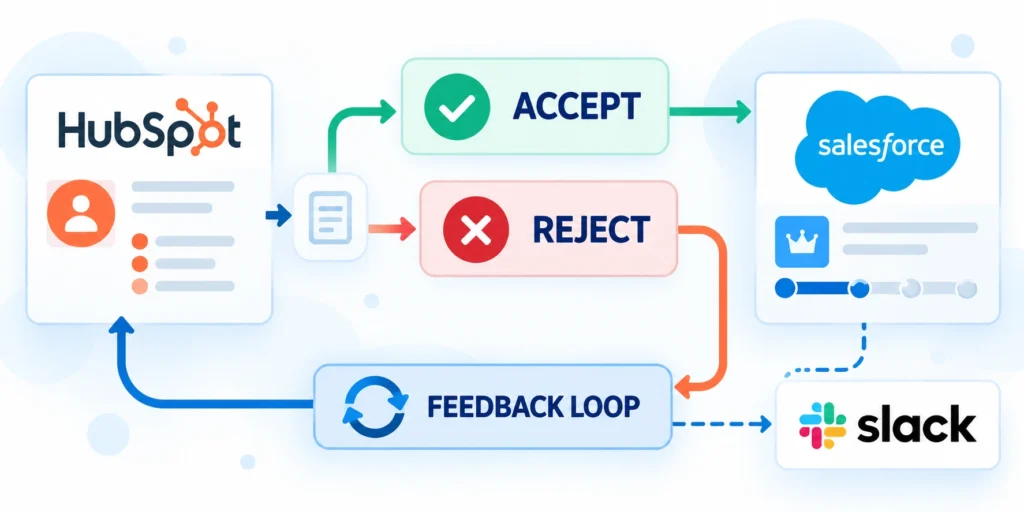
The SLA should describe the complete handoff, not only the first transfer. Every acceptance, rejection, or exception needs a next owner.
Define where feedback is entered, which reason codes are available, and how quickly an unresolved record returns to an accountable queue.
Require feedback that can improve the system
Use a compact reason taxonomy that separates poor fit, missing information, duplicate, timing, unsupported location, and an active opportunity.
Let representatives add a short note when the standard reason does not explain the case. Avoid an open-ended comment as the only feedback field.
Key considerations for require feedback that can improve include:
- Accept: record the owner and initial action.
- Return: choose a repair reason and identify the missing input.
- Reject: record a specific exclusion and evidence.
- No response: trigger the agreed escalation or recovery queue.
Protect against silent handoff failures
A notification is not proof that the intended owner saw a record. Monitor queue age, failed assignment, missing owner, and unresolved feedback.
Use a named exception owner for cases that cannot be routed. Keep the exception visible until someone resolves or explicitly closes it.
Set a respectful rework loop
Marketing operations should investigate recurring data defects, while sales operations should investigate response gaps and misassigned ownership.
Discuss patterns in a recurring joint review, not through individual blame. Bring anonymized examples and decide which rule or input should change.
Close the loop without blame
A return should not reset the SLA clock silently. Document whether correction begins a new service window or resumes the original one.
Review recurring return reasons as system evidence, then improve targeting, enrichment, definitions, routing, training, or capacity instead of blaming individual teams.
Preserve the record and decision trail
The supporting data definitions belong with your CRM data governance rules.
Preserve an audit trail when owners, criteria, or statuses change. This helps explain missed handoffs and prevents disputed reports becoming personal accusations.
Measure SLA Performance Without Gaming the Funnel

Measure commitments that each team can influence, then pair them with shared outcomes. A single speed metric can reward rushed or low-quality work.
Compare qualified volume, acceptance, response distribution, feedback completion, and later pipeline progression by cohort and source.
Use leading and outcome measures together
| Measure | What it helps diagnose | Guardrail |
|---|---|---|
| Time to meaningful first action | Whether coverage and follow-up work | Separate staffed and unstaffed periods |
| Acceptance and return reasons | Whether criteria fit sales needs | Review sample records, not totals alone |
| Feedback completion | Whether the loop produces usable information | Check note quality and reason consistency |
| Qualified pipeline progression | Whether handoffs contribute to opportunities | Account for segment and cycle differences |
Pair operational measures such as response distribution, acceptance, return reasons, and data completeness with qualified pipeline, conversion, customer experience, and revenue outcomes.
No single metric proves alignment, so review the combined evidence and investigate contradictions before changing commitments or incentives.
Define calculations before comparing teams
Write the numerator, denominator, date window, and eligible population for each metric. Specify whether duplicates, disqualified, or reopened records are included.
Report a median or distribution alongside target attainment when delays vary widely. Averages can conceal a small group of severely delayed records.
Compare segments with care
Segment only where the sample supports a useful comparison, such as region, product, source, or priority class. Protect privacy in small groups.
Separate populations when geography, product, account tier, channel, staffing, or customer behavior changes the meaning of a fair comparison.
Prevent metric gaming
If sales is measured only on speed, representatives may log a low-value touch. If marketing is measured only on volume, qualification may become loose.
Pair speed with acceptance quality, customer experience, and a later outcome. Investigate shifts in context instead of assuming a change proves causation.
Use measures to guide a decision
For a practical reporting foundation, see the CRM dashboards guide.
Use metrics to find friction and capacity gaps. They should support a decision about what to change, not simply create another scorecard.
Review these signals before changing SLA commitments:
- Response distribution across eligible records
- Acceptance and rejection reason patterns
- Qualified progression and customer outcomes
- Capacity, rework, and exception backlog
Write a Practical Marketing-Sales SLA
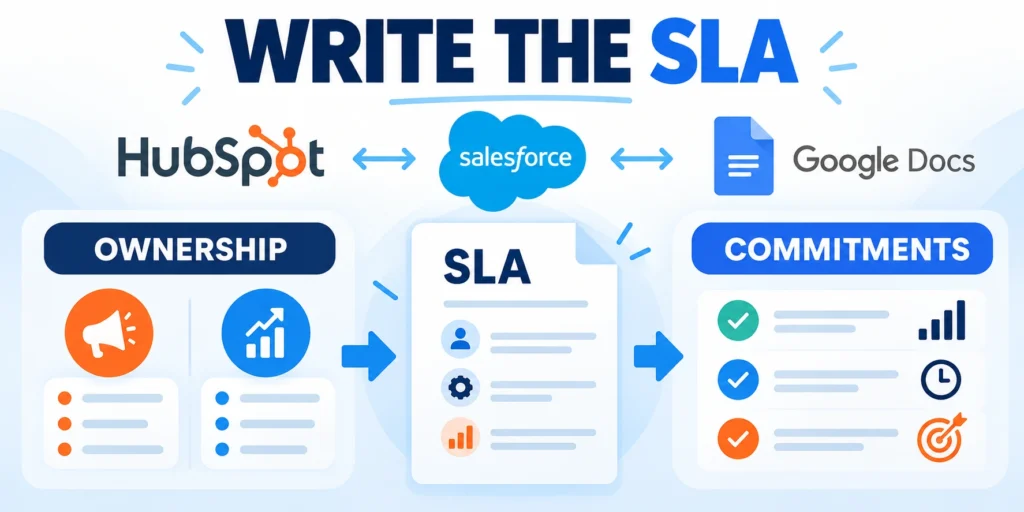
Keep the agreement short enough for working teams to use. Store detailed CRM configuration separately and link to its owner and change log.
Start with the decision fields below, then ask both teams to test the rules against recent records before approving the pilot.
Use this agreement template
Apply these criteria to this agreement template:
- Purpose and customer outcome: what the handoff should improve.
- Eligible record: required fit, intent, contact, consent, and evidence.
- Marketing service: what context accompanies each qualified handoff.
- Sales service: who reviews, what counts as action, and the coverage target.
- Acceptance and return: valid reasons, evidence, and next owner.
- Exceptions: fallback queue, escalation contact, and clock behavior.
- Measures: definitions, data sources, review frequency, and segment rules.
- Governance: owners, version date, approval roles, and change triggers.
Adapt the template to one real handoff and name the accountable owners responsible for definitions, execution, system configuration, reporting, and exception resolution.
Keep detailed implementation rules in controlled documentation while the agreement remains concise enough for working teams to apply during daily decisions.
Translate commitments into CRM fields
Map each agreement decision to an existing property or clearly named field. Avoid adding fields when a reliable standard property captures the event.
Typical fields include qualification timestamp, acceptance status, disposition reason, first meaningful action time, exception owner, and agreement version.
Assign a source of truth to each field
Choose one source of truth for each field. If two systems write the value, define the authoritative system and sync behavior.
Document which system creates, updates, synchronizes, and reports each field so automation cannot silently overwrite an authoritative decision.
Test with real examples before approval
Select recent records across accepted, rejected, incomplete, duplicate, and after-hours cases. Ask both teams to apply the written rules independently.
Compare decisions, identify ambiguous wording, and revise before automation. The same example should produce the same disposition under documented criteria.
Resolve ambiguity before automation
Use the data governance guide as the companion reference for ownership and field definitions.
Record who approves the agreement and when it will be reviewed. A version date makes later changes easier to interpret in reports.
Govern CRM Automation and SLA Changes

Automation should enforce an approved agreement, not silently invent qualification, ownership, timing, or exception rules that working teams cannot explain across connected campaigns and segments.
Govern every workflow change through documented requirements, representative tests, named approvers, monitored release evidence, and a recoverable previous configuration.
Translate commitments into controlled automation
Map each commitment to its trigger, required data, decision rule, action, timestamp, owner, exception path, notification, and reporting field before configuration begins.
Keep policy decisions separate from technical implementation so administrators cannot unintentionally redefine qualified demand or customer coverage through convenient workflow settings.
Document these elements before automating any SLA rule:
- Approved trigger and eligibility criteria
- Authoritative fields and decision owner
- Action, timing, and exception behavior
- Monitoring, rollback, and reconciliation evidence
Release changes with traceable evidence
Test accepted, rejected, duplicate, incomplete, after-hours, unavailable-owner, and integration-failure cases using representative records before releasing a changed workflow.
After release, compare expected and observed routing, timestamps, assignments, exceptions, and customer-facing actions for the affected segment.
Require these controls for every material SLA change:
- Versioned requirement and accountable approver
- Representative test cases and expected outcomes
- Limited release with monitored results
- Restoration plan and post-release reconciliation
Record the effective date and affected population so dashboards can distinguish a genuine trend from a policy or automation change.
Retire obsolete rules only after teams confirm that no active routing, report, integration, or exception process still depends on them.
Prepare Teams to Adopt the Shared Agreement
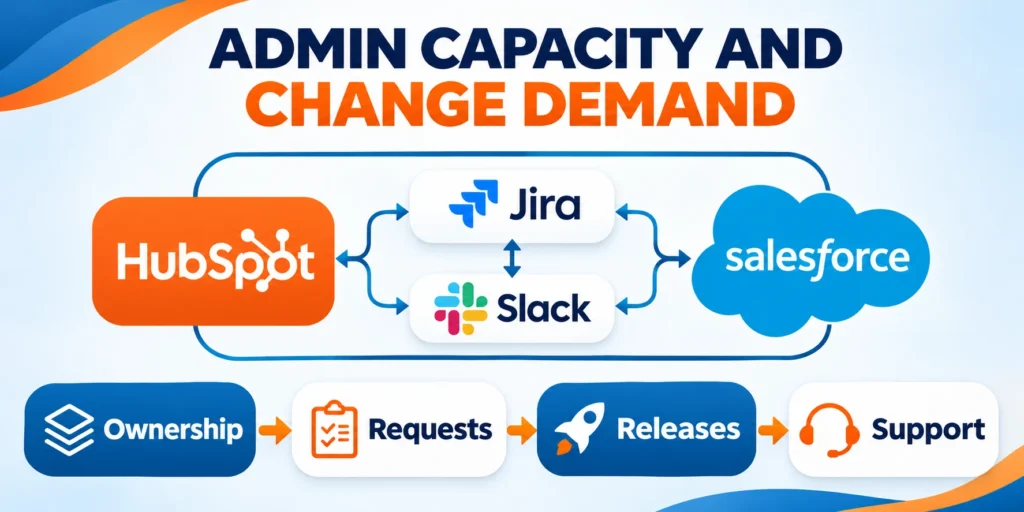
An accurate SLA can still fail when teams do not recognize eligible records, understand decisions, trust the data, or know how to resolve exceptions.
Enablement should prepare marketing, sales, operations, managers, and administrators for the specific actions and evidence required by the agreement.
Train with real handoff scenarios
Use recent accepted, rejected, duplicate, incomplete, delayed, and disputed records to practice qualification, routing, response, return, escalation, and recovery decisions.
Ask participants to explain the rule and evidence behind each decision, then revise ambiguous language before measuring individual or team compliance.
Include these scenarios in practical SLA enablement:
- Complete qualified handoff during staffed hours
- Incomplete record requiring marketing correction
- Duplicate record with an existing sales owner
- Unavailable owner and escalation routing
- Disputed qualification requiring governed review
Support the agreement after launch
Publish a concise reference for definitions, clocks, owners, fields, valid reasons, exceptions, escalation routes, reporting sources, and the current agreement version.
Give one operational owner responsibility for intake and triage while policy owners retain authority for decisions that change qualification or service commitments.
Maintain these support mechanisms during normal operation:
- Accessible rules and current version history
- Named support and escalation contacts
- Review queue for disputed records
- Regular feedback and change cadence
Use repeated questions and exceptions as evidence for better definitions, training, automation, capacity planning, or customer communication.
Avoid judging teams against a changed rule until the effective date, affected population, training, and reporting logic are clearly communicated.
Pilot, Review, and Improve the Agreement
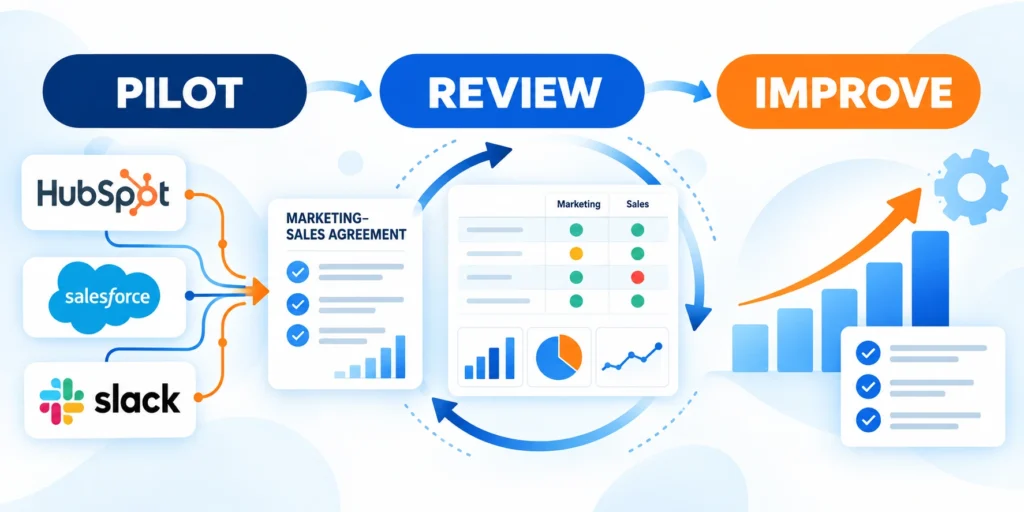
Do not switch every campaign and territory at once. A limited pilot reveals unclear criteria and capacity issues while the old process remains recoverable.
Choose one segment with enough activity to learn, but a manageable operational scope. Tell participants what changes and where to report exceptions.
Run a four-week operating pilot
Use these actions to run a four-week operating pilot:
- Week 1: confirm definitions, field mapping, owners, and test cases.
- Week 2: run new rules for a small segment and inspect exceptions daily.
- During week 3, review response distribution, acceptance reasons, and feedback.
- Week 4: resolve rule gaps, compare outcomes, and decide whether to expand, revise, or pause.
Use the four weeks to observe actual volume, timing, exceptions, staffing constraints, ambiguous definitions, customer impact, and the work required to maintain evidence.
Do not treat the calendar alone as proof; expand only when the pilot produces stable decisions and recoverable operations.
Set explicit expansion and pause criteria
Expand only when ownership is clear, required fields are populated, exceptions have an owner, and teams can explain metric calculations.
Pause expansion when routing fails silently, commitments exceed staffing capacity, consent handling is unclear, or data cannot support fair comparison.
Keep rollout changes recoverable
Keep the previous workflow configuration or a written restoration plan. Record the change, date, affected segment, and person responsible for reverting it.
Test restoration before expansion and retain the prior configuration until the new rules produce stable, explainable outcomes across the selected segment.
Review causes, not only compliance percentages
A missed target may reflect understaffing, an inaccurate territory, poor data, an unclear definition, or an automation defect.
Assign one corrective action to a named owner and set a review date. Avoid changing several rules simultaneously when measuring the effect.
Preserve comparisons during expansion
When expanding, preserve event definitions and note any scope changes. Otherwise, trend comparisons may mix different populations.
Annotate effective dates, segment additions, staffing changes, and definition revisions so later trends do not mix incompatible operating conditions.
Revisit the agreement after scope changes
For a broader operating model connecting marketing, sales, and customer success, revisit the RevOps playbook.
Revisit the agreement after a territory redesign, product change, staffing shift, or repeated customer handoff complaint.
Test Capacity Before Promising Response Times
Compare expected eligible volume with staffed coverage, territory ownership, expertise, absences, business hours, and escalation capacity.
Use a monitored fallback when demand exceeds capacity instead of assigning records to unavailable owners or hiding delays.
Reconcile SLA Definitions in Reporting
Keep lifecycle stages, acceptance reasons, clocks, exclusions, and ownership consistent across CRM fields, dashboards, alerts, and team documentation.
When a definition changes, annotate the effective date and avoid comparing incompatible populations as one continuous trend.
Design a Dispute and Escalation Path
Give teams a defined route for disputed qualification, ownership conflicts, unavailable representatives, missing evidence, and repeated customer complaints.
Set the reviewer, response window, required context, temporary owner, and final decision record for each material exception.
Review Customer Experience Alongside Compliance
Check whether handoffs feel timely, informed, and consistent to buyers, not merely whether internal clocks were technically satisfied.
Use feedback and lost-opportunity evidence to improve commitments without promising service levels the operating team cannot sustain.
FAQ
These answers clarify common marketing-sales SLA questions about scope, response timing, rejected leads, reviews, coverage, duplicates, segmentation, breaches, and reporting ownership.
What should a marketing and sales SLA include?
Define qualified records, ownership, meaningful response, coverage windows, acceptance and return reasons, exceptions, measures, and review owners.
Is an SLA the same as an agreement with customers?
Here, SLA means an internal marketing-sales agreement. External customer service-level agreements define commitments to customers and have different scope.
How quickly should sales follow up with a lead?
Set a target from customer expectations, staffing coverage, volume, and observed capacity. Do not copy a universal number without checking that your team can meet it.
What happens when sales rejects a marketing-qualified lead?
Require a specific reason, supporting evidence, and a next owner. Marketing can repair data, return the record to nurture, or review a disputed qualification.
How often should the teams review the agreement?
Set a regular cadence and trigger an earlier review after changes in product, territories, staffing, qualification criteria, or customer experience.
Should an SLA use business hours?
Use the clock that reflects staffed coverage and customer expectations, with documented holidays, regions, pauses, and exceptions.
How are duplicate leads handled?
Match existing records and ownership first, preserve relevant history, and route uncertain duplicates for review before outreach.
Can different segments have different commitments?
Yes, when eligibility, staffing, expectations, routing, and reporting clearly identify which commitment applies to each record.
What should happen after an SLA breach?
Record the cause, protect the customer handoff, assign recovery, correct systemic issues, and review whether commitments remain realistic.
Who owns SLA reporting?
Assign one operational owner while marketing, sales, revenue operations, and leadership review the measures they influence.
Conclusion

A useful marketing and sales SLA turns an ambiguous handoff into observable work with shared definitions, accountable owners, sustainable coverage, recoverable automation, and measurable customer outcomes.
Build the agreement around evidence and operating capacity rather than copied response-time claims or labels that different teams interpret differently.
Start with one governed handoff
Choose one campaign, segment, or customer journey with enough activity to reveal ambiguity while keeping routing, staffing, automation, and recovery manageable.
Write acceptance rules, test recent records, and define a meaningful action that the assigned sales team can sustain during staffed coverage.
Confirm these elements before starting the SLA pilot:
- Evidence-based qualification and acceptance rules
- Named owners and realistic coverage windows
- Valid return, exception, and escalation paths
- Traceable fields, timestamps, and definitions
- Baseline measures and customer guardrails
Expand only after teams can operate the agreement
Review real examples, response distribution, acceptance reasons, exceptions, customer experience, staffing capacity, and downstream outcomes before adding campaigns, territories, or products.
Keep every breach visible and owned, then correct the cause through definitions, data, routing, training, capacity, automation, or a more realistic commitment.
Require these outcomes before expanding SLA coverage:
- Teams apply definitions consistently
- Routing failures remain observable and recoverable
- Exceptions reach accountable owners promptly
- Reporting populations stay comparable
- Customer outcomes support continued rollout
Revisit the agreement after material product, territory, staffing, channel, system, consent, or customer-experience changes affect either team’s ability to perform.
The goal is dependable collaboration: qualified context reaches the right owner, customers receive meaningful action, and teams improve the system through shared evidence.









Leave a Reply