


Define a Competitor Set That Matches Your Market

SEO competitor analysis is useful when it explains which search opportunities matter to your business and what readers still need.
It is not a copying exercise or a race to reproduce every page that ranks above you.
Separate search competitors from business competitors
A search competitor is a page or site that appears for queries you want to serve. It may not sell the same product.
A business competitor sells an alternative to your offer. Some companies are both, while publishers and marketplaces may compete only in search.
Example: a B2B software company
For example, a B2B software company may compete in search with a consulting firm, an integration directory, and a software vendor.
Each domain can win a different query set or page type. Record that distinction before comparing coverage, authority, or commercial position.
Build a small, relevant comparison set
Start with three to five domains that repeatedly appear for commercially relevant searches. Add a specialist only when it owns a distinct topic area.
Choose peers with similar audiences, geography, language, and business model. A national publisher may have resources your local service firm cannot match.
Document why each competitor qualifies
Record why each domain belongs in the set. This prevents a large brand from dominating the analysis simply because it ranks for many unrelated terms.
Use these actions to document why each competitor qualifies:
- Include direct commercial alternatives.
- Include search publishers only for topics they genuinely cover.
- Exclude sites whose audience or market is materially different.
- Recheck the set when the target market changes.
Use the same country, language, device, and date range in every comparison. Search visibility varies by market, so mismatched settings create misleading gaps.
Find Keyword Gaps Worth Investigating

A keyword gap is a discovery signal: another site appears for a query your site does not currently cover well.
It does not prove that the query is valuable, achievable, or appropriate for your business.
Run a focused gap comparison
In a keyword research platform, enter your domain and a few relevant competitors. Compare matching domain scopes and the market you actually serve.
Ahrefs documents a Content Gap workflow that compares keywords competitors rank for against a target domain or exact URL. Treat its results as estimates.
Keep page-level context in the export
Export the results with keyword, ranking page, estimated position, volume, difficulty, and country when the tool provides those fields.
Keep the competitor page beside each term. A domain-level report can hide whether a ranking comes from a useful service page, a glossary, or an unrelated page.
Filter brand and irrelevant demand
Remove competitor brand names unless your company has a legitimate comparison page and can describe the alternative accurately.
Exclude topics outside your services, unsupported locations, job searches, and queries that signal a different audience.
Group close variants by reader problem
Group close variants by the problem they express. Ten similar phrases may represent one page opportunity, not ten separate articles.
Key considerations for group close variants by reader include:
- Keep the search phrase and observed ranking page.
- Tag each item as product, problem, comparison, implementation, or support intent.
- Record exclusions with a short reason.
- Do not treat estimated search volume as a forecast.
For a useful follow-up on demand selection, connect this work to the site’s B2B keyword research process rather than making a new page for each phrase.
Inspect the Ranking Pages and Their Search Intent
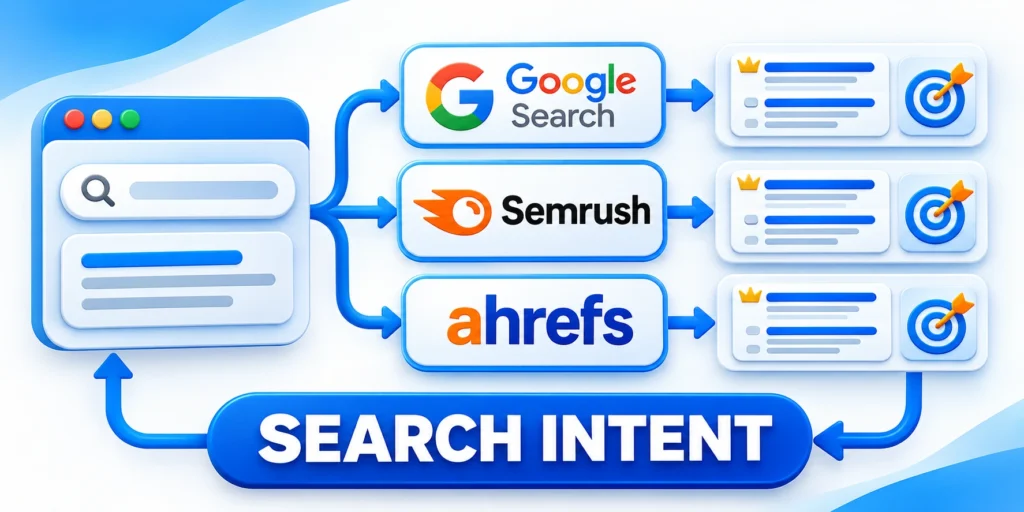
Metrics can shortlist competitors, but the page itself shows what the searcher is being offered.
Review a sample of real results before deciding whether your site should compete for the query.
Classify the result before judging it
Search the phrase in the same country and language as your target audience. Note whether results are guides, product pages, tools, directories, videos, or local listings.
Record the dominant reader task: learn, compare, choose a vendor, solve a problem, or complete a specific action.
Use results as evidence, not a template
Search results are not a fixed blueprint. They reflect one query, market, and moment, so use them to understand the task rather than copy their headings.
Compare multiple representative queries and dates. For recurring samples, automate competitor analysis with AI and Python. Separate durable reader needs from temporary features, promotions, and result layouts.
Use a consistent page review sheet
For each sampled page, note its audience, promise, evidence, depth, freshness, next action, and meaningful omissions.
Check whether the page answers the question early, explains tradeoffs, uses first-hand evidence, and gives a practical next step.
Separate observations from assumptions
Separate visible facts from interpretation. “Includes a pricing table” is observable; “converts better” requires performance data you may not have.
A competitor’s word count is not a target. Google says there is no preferred word count; cover the reader’s task completely without padding.
Use these actions to separate observations from assumptions:
- Intent match: does the page answer the same question?
- Evidence: are claims supported with examples or sources?
- Usefulness: can readers take a clear next step?
- Distinctiveness: does the page add information beyond common summaries?
- Maintenance: are dates, screenshots, prices, and product details current?
Compare your own material with Google’s people-first questions and the broader enterprise SEO strategy.
Then identify a specific reader need the competitor set leaves unresolved.
Turn Content Gaps Into a Distinctive Page Brief

A content gap is valuable only when it reveals an unanswered need your organization can serve credibly.
Translate observations into a brief that states the audience, task, evidence, and boundaries of the proposed page.
Look for omissions with practical consequences
Useful gaps often involve missing implementation detail, unclear eligibility, weak comparisons, unsupported claims, inaccessible explanations, or overlooked operational risks.
For example, several articles may describe CRM migration benefits without explaining how to map fields, validate records, and manage rollback.
Confirm that your team can fill the gap
That observation can support a practical guide only if your team can explain the process accurately. Otherwise, narrow the topic or find a qualified reviewer.
Confirm access to subject expertise, evidence, examples, and maintenance ownership before assigning the page. A visible gap is not automatically a credible opportunity.
Write the brief before drafting
Follow this sequence to write the brief before drafting:
- State the reader and the decision or task they need to complete.
- Summarize what current results already explain.
- List the unanswered questions supported by research or customer evidence.
- Identify original examples, data, expertise, or tools you can contribute.
- Define exclusions so the page does not overlap an existing guide or service page.
- Choose the best format for the task, such as a guide, comparison, checklist, or calculator.
Do not copy competitor wording, diagrams, examples, or proprietary research. Use public pages to understand the market, then build an independently sourced explanation.
Google’s guidance asks whether content adds original information and substantial value beyond simply rewriting other sources. That is a sound editorial test for this brief.
Prioritize Opportunities With a Transparent Score

A ranked gap list helps teams decide what to investigate first, but its score should support judgment rather than pretend to predict results.
Use a small scoring model that exposes assumptions and leaves uncertain inputs visible.
Score business fit, reader value, and feasibility
Rate each opportunity from one to five on audience fit, business relevance, evidence of demand, ability to add value, and production effort.
For a simple spreadsheet, calculate a weighted priority score as business relevance plus reader value plus feasibility, each multiplied by its agreed weight.
Write the weighting assumptions down
Example: assign relevance 30%, reader value 35%, demand evidence 20%, and feasibility 15%. A score can be calculated as:
Document the scale and evidence behind every input. Adjust weights only when business strategy changes, not to force a preferred opportunity upward.
Priority = (Relevance × 0.30) + (ReaderValue × 0.35) + (DemandEvidence × 0.20) + (Feasibility × 0.15)Interpret the score as a comparison aid
Use a consistent one-to-five scale, document the evidence behind each rating, and treat the total as a comparison aid, not a traffic forecast.
If demand data is weak, lower confidence instead of inventing a volume estimate. If an opportunity requires expertise you lack, feasibility should reflect that constraint.
Compare opportunity types fairly
A low-volume problem tied closely to a high-value service may deserve attention before a broad query with weak intent.
Likewise, improving an existing page may outperform publishing a new one when the current URL already attracts relevant impressions.
Treat the score as conditional
Show the score beside its evidence and caveats. Avoid declaring an absolute “winner” when competitors, resources, or market conditions differ.
Recalculate when demand, capacity, product fit, or existing coverage changes. Preserve the earlier assumptions so reviewers can explain the movement.
Compare opportunities through these decision safeguards:
- Use one documented scoring scale.
- Keep evidence beside every input.
- Review cannibalization before creating URLs.
- Separate demand estimates from business value.
- Recalculate when assumptions materially change.
Turn the Priority List Into an Execution Plan
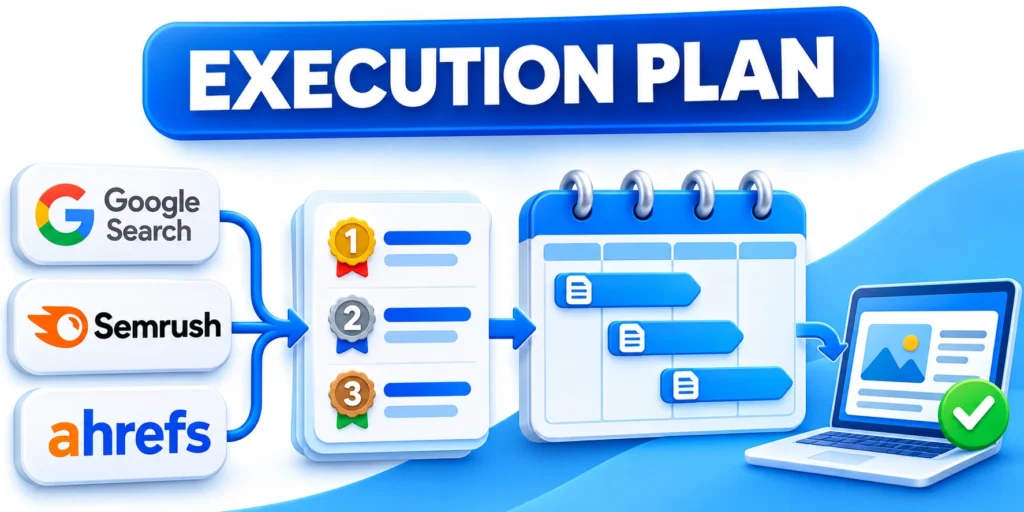
Analysis becomes useful when each selected opportunity has an owner, a deliverable, and a measure tied to the reader’s task.
Start with a limited set of changes so you can learn which actions produced useful outcomes.
Choose between updating and creating
Update an existing URL when it already serves the same intent and needs better evidence, clarity, coverage, or usability.
Create a new page when the audience or task is distinct and the new resource adds meaningful value without duplicating another URL.
Protect the role of each URL
Before drafting, compare the proposed page with your published guides, service pages, and planned topics. Record the boundary between their jobs.
Strengthen the existing canonical page when intent overlaps. Apply the same rule to programmatic SEO before adding a new template or URL family.
Assign work in a practical sequence
Follow this sequence to assign work in a practical sequence:
- Validate the opportunity with customer questions, sales notes, product expertise, or first-party performance data.
- Choose the existing page or new URL that best matches the intent.
- Collect primary sources and confirm facts, dates, product behavior, and examples.
- Write a brief that identifies unique contribution and excluded scope.
- Publish the improvement, then annotate the date and exact changes.
- Review performance only after enough time has passed to interpret the data responsibly.
Do not change title, URL, content, links, and templates simultaneously if you need to learn what affected performance.
Large coordinated changes may be necessary, but document them so later analysis does not attribute every movement to a single edit.
Measure Results and Refresh the Analysis

Competitor rankings and keyword estimates are snapshots; first-party performance data shows how your own pages reach searchers.
Use a repeatable measurement window and connect changes to the pages and queries affected.
Track leading and business indicators separately
Search Console reports clicks, impressions, click-through rate, and average position across dimensions such as queries, pages, countries, and devices.
Use those measures to observe search visibility. They do not tell you by themselves whether new leads are qualified or profitable.
Connect search visibility to business outcomes
Pair search data with analytics or CRM outcomes when your setup supports reliable attribution. Define the conversion event before comparing pages.
State identity, consent, attribution, and observation-window limits. Search visibility and assisted conversions do not independently prove causation.
Compare like with like
Compare equivalent date ranges and segment by page, query group, country, device, and search type when relevant.
Check seasonality, tracking changes, site releases, and external events before treating a change as a content effect.
Set a baseline and observation date
Record your baseline before publication, then compare at a consistent review date. Small samples and short periods can move sharply by chance.
Use these actions to set a baseline and observation date:
- Impressions rise without clicks: inspect intent match, title clarity, and search-result context.
- Clicks rise but qualified leads do not: review audience fit and the page’s next step.
- One competitor gains visibility: inspect the specific queries and pages before changing your strategy.
- No measurable movement: confirm implementation and allow a suitable observation period.
Refresh competitor research when your market, offer, or search landscape changes. Reuse prior observations only while their date, market, and underlying page remain relevant.
Validate Competitor Evidence Before Execution

Competitor-analysis tools estimate rankings, demand, difficulty, and traffic from different databases. Validate the market, query, page, date, and intent before acting.
Define the decision and evidence threshold first. This prevents large domains, branded demand, or unrelated rankings from dominating the priority list.
Define operating criteria before execution
Record the search market, competitor set, content gap, commercial relevance, owner, assumptions, dependencies, and constraints before changing campaigns or content.
Keep the decision record accessible so research, editorial, SEO, sales, and subject experts use the same boundaries.
Define evidence sufficiency through these controls:
- Use the same market and date range.
- Confirm the ranking page and intent.
- Exclude branded and irrelevant demand.
- Document assumptions and data limitations.
- Name the decision owner and reviewer.
Test the workflow under realistic conditions
Run one representative opportunity from query discovery through competitor review, brief creation, overlap review, prioritization, assignment, and measurement.
Capture exceptions, delays, manual work, unavailable evidence, and handoff failures. A narrow tool export can conceal problems that appear during execution.
Test the workflow through this practical sequence:
- Select a representative query and audience.
- Validate its ranking pages and intent.
- Compare existing site coverage and overlap.
- Draft a distinct evidence-based brief.
- Score value, fit, and feasibility.
- Record workflow limits and next action.
| Evidence | Primary question | Decision use |
|---|---|---|
| Ranking page | What task does it serve? | Intent review |
| Keyword estimate | Is demand relevant? | Demand screen |
| Site inventory | Does coverage exist? | Overlap review |
| Team evidence | Can we add value? | Feasibility check |
Measure Outcomes and Refresh Priorities

Measure visibility, qualified traffic, conversion assistance, content coverage, effort, quality, and risk together rather than optimizing one favorable metric.
Preserve the baseline, reporting period, and assumptions. Bring changes in the market, offer, or competitor set into the next digital marketing strategy review.
Measure outcomes and tradeoffs together
Separate leading indicators from business outcomes. Improved impressions or rankings can precede qualified visits, inquiries, opportunities, or revenue.
State attribution and sample limitations before connecting page performance to commercial impact. Timing alone does not prove the competitor analysis caused an outcome.
Review these measures in the same cycle:
- Visibility across the intended query group.
- Qualified traffic and engagement quality.
- Content coverage and internal-link support.
- Assisted conversions and sales feedback.
- Actual effort, quality, and maintenance cost.
Keep the practice current
Review assumptions when search demand, competitor pages, product positioning, customer questions, conversion definitions, or available expertise changes materially.
Retire outdated exports, unsupported claims, and obsolete priorities. Keep the latest decision record and accountable owner easy for contributors to find.
Refresh the practice through these governance actions:
- Schedule review dates and ownership.
- Recheck competitor and query relevance.
- Update evidence and capacity assumptions.
- Close completed or invalid opportunities.
- Assign the next measurable action.
Reconcile conflicting performance signals
Investigate when visibility, traffic, conversions, and sales feedback move differently. Confirm page groups, time windows, tracking changes, and sample size.
Keep the opportunity open only when current evidence supports another action. Otherwise, document the result and redirect capacity toward stronger priorities.
Conclusion

Strong competitor analysis turns search observations into a clearer picture of reader needs, current alternatives, coverage gaps, and work your team can credibly deliver.
Use competitors as evidence about the market, not templates to copy. Validate intent, distinctiveness, feasibility, overlap, and commercial relevance before assigning work.
Move from observation to a distinct decision
Define a relevant competitor set, group keywords by reader problem, inspect ranking pages, and record what each result visibly provides.
Compare those observations with existing site coverage and subject expertise. A gap becomes actionable only when the organization can add credible value.
Use this sequence for the next analysis cycle:
- Define the search market and competitors.
- Validate gaps against pages and intent.
- Review overlap with existing coverage.
- Write a distinctive evidence-based brief.
- Score fit, value, and feasibility.
- Assign ownership and measurement timing.
Protect originality and page roles
Do not reproduce headings, claims, examples, or structure merely because a competitor ranks. Build independently from verified audience needs and qualified expertise.
Strengthen existing pages when intent overlaps. Create a new URL only when it serves a genuinely distinct task, audience, or outcome.
Refresh priorities from measured outcomes
Review visibility, qualified traffic, coverage, assisted outcomes, effort, and maintenance together. Disclose attribution and sample limitations.
Revisit the competitor set and scoring assumptions when demand, products, results, customer questions, or organizational capacity changes.
Record the decision trail
Preserve the evidence, exclusions, weights, selected page, owner, release date, and expected outcome behind every approved opportunity.
This record helps later reviewers distinguish changed market evidence from inconsistent scoring or undocumented preference.
FAQ
These answers address competitor sets, keyword gaps, copying, cadence, page comparisons, cannibalization, smaller sites, and execution planning.
What is SEO competitor analysis?
It is a structured review of pages competing for relevant searches, used to find audience needs, content gaps, and practical opportunities.
How many competitors should I analyze?
Begin with three to five relevant search competitors. Expand only when another site contributes a distinct market or topic perspective.
Do keyword gap tools show guaranteed opportunities?
No. Their databases and metrics are estimates. Validate each term against intent, audience, business fit, and your ability to add value.
Should I copy a competitor’s best pages?
No. Study what readers need, then create an independently researched page with useful evidence and a distinct contribution.
How often should I repeat the analysis?
Review it when strategy or market conditions change, and on a consistent cadence suited to your publishing cycle. Avoid reacting to daily ranking shifts.
Which competitors matter most for SEO analysis?
Prioritize domains that repeatedly appear for searches tied to the same audience and intent. A commercial rival that never competes in search may be less useful.
What should I compare besides rankings?
Compare search intent, topic coverage, evidence, page format, internal links, update cadence, and the action offered to readers. These factors reveal opportunities that a ranking snapshot alone cannot explain.
How do I avoid keyword cannibalization during the analysis?
Map each opportunity to an existing or planned page before publishing. When two pages serve the same intent, strengthen the better destination instead of creating more overlap.
Can a smaller site compete with a large publisher?
Yes. A smaller site can address a narrower need with stronger expertise, clearer evidence, or a more useful workflow for selected searches.
How should findings become an action plan?
Group findings by intent and business value, then assign an owner and outcome. Explore how Fase Network connects SEO opportunities with the wider marketing strategy.







Leave a Reply