

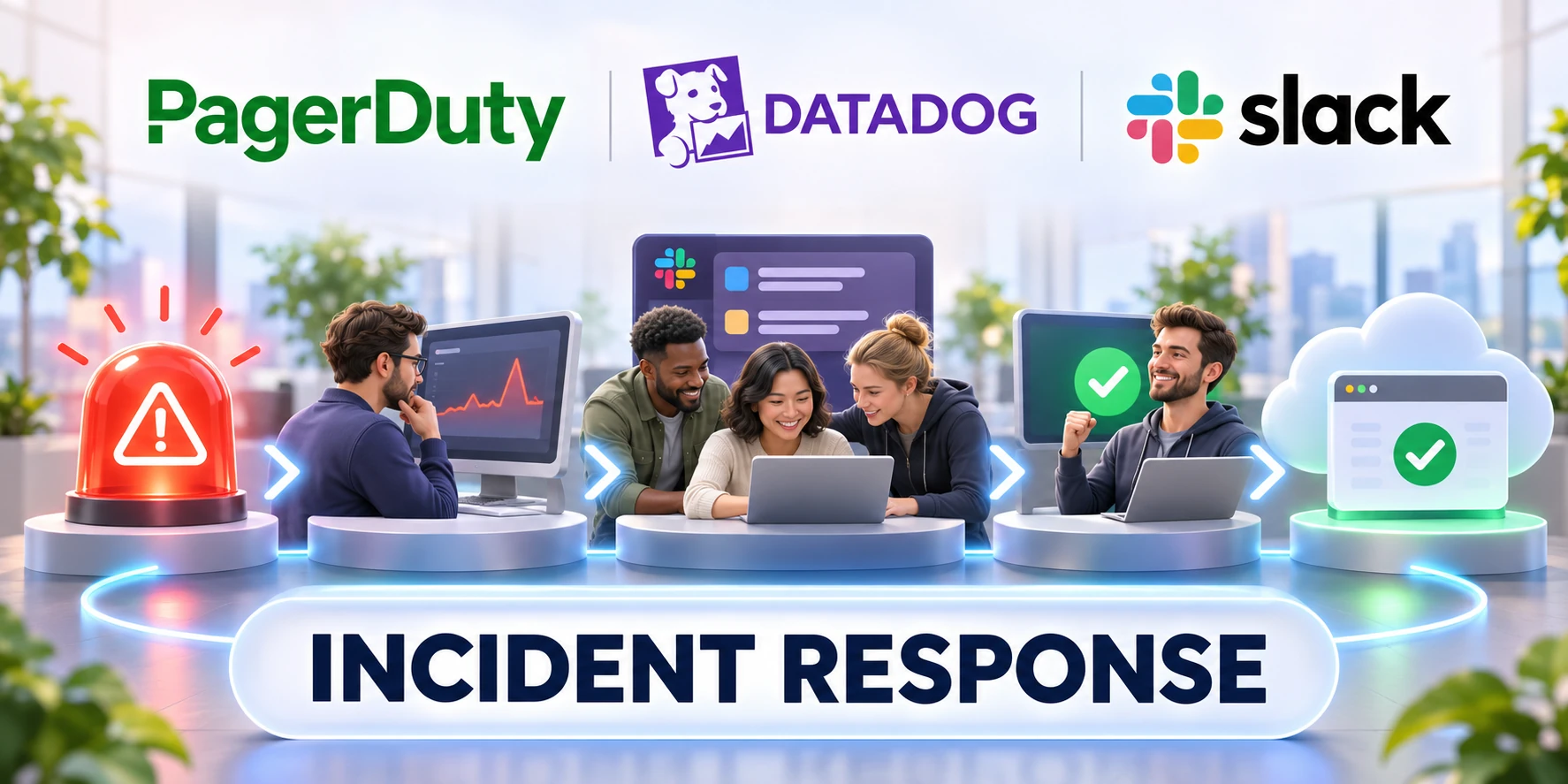
Define Incident Severity and Ownership

An IT incident management process begins with shared definitions for impact, urgency, severity, ownership, and decision authority. Ambiguity creates delay when every minute matters.
Define severity from customer and business consequences rather than technical novelty. A familiar database failure can deserve more urgency than an unusual internal defect.
Create severity levels teams can apply consistently
Describe each level through affected journeys, customer scope, data risk, revenue exposure, contractual obligations, and available workarounds. Include examples from the actual service.
Separate current impact from potential impact. A contained defect may require urgent prevention without the same communications used for an active customer outage.
Use these actions to create severity levels teams can apply:
- Define customer impact clearly.
- Include business consequences.
- Document usable workarounds.
- Set escalation triggers.
Assign one incident commander for coordination and one technical lead for diagnosis. Other participants should understand their responsibilities and reporting lines.
Give those roles authority to stop releases, restrict features, reroute traffic, escalate vendors, request specialists, and approve customer communications within documented boundaries.
Separate ownership from expertise
The incident commander does not need the deepest technical knowledge. That role protects priorities, removes obstacles, maintains cadence, and keeps the response aligned.
The technical lead organizes hypotheses, evidence, tests, mitigation, and recovery validation. Specialists contribute through that structure instead of creating competing command paths.
Use these actions to separate ownership from expertise:
- Name the incident commander.
- Name the technical lead.
- Assign communications ownership.
- Confirm executive escalation.
Review role coverage across time zones, holidays, vendors, and critical dependencies. A process that assumes one available expert is not operationally ready.
Test severity decisions during exercises and compare them with real incidents. Revise definitions when teams repeatedly disagree or customer consequences differ from documented examples.
Detect and Record the Incident

Detection should connect customer symptoms, service objectives, telemetry, support reports, vendor notices, and business signals. No single source identifies every important SaaS incident.
Create one incident record as soon as credible impact appears. Early records can contain uncertainty while preserving time, evidence, ownership, and decisions.
Use multiple detection paths
Monitor critical journeys through service-level indicators, synthetic tests, real-user evidence, application signals, infrastructure telemetry, and transaction outcomes. Route actionable findings to current owners.
Teach support and customer teams how to report reproducible symptoms. Their evidence may reveal browser, geography, account, workflow, or integration failures before monitoring does.
Apply these criteria to multiple detection paths:
- Monitor critical journeys.
- Capture support signals.
- Watch vendor notices.
- Track business outcomes.
Record the detection source, first observed time, affected service, environment, suspected scope, customer symptoms, current owner, and next review time.
Preserve relevant dashboards, traces, logs, deployment records, configuration changes, and screenshots according to access and retention requirements. Avoid copying sensitive data unnecessarily.
Maintain one operational timeline
Use one authoritative timeline for events, hypotheses, actions, evidence, decisions, communications, and recovery. Link specialized tools rather than duplicating conflicting narratives.
Timestamp entries consistently and identify their author or source. Distinguish observed facts, interpretations, proposed actions, completed actions, and verified outcomes.
Key considerations for maintain one operational timeline include:
- Record facts before theories.
- Timestamp important decisions.
- Link supporting evidence.
- Protect sensitive information.
Keep the initial record concise enough for responders to use. Add detail when it supports diagnosis, coordination, communication, audit, or later learning.
After restoration, reconcile automated and manual timestamps. Reliable chronology helps teams understand detection delays, decision points, dependencies, and the effects of mitigation.
Triage Impact and Set Priorities

Triage turns incomplete evidence into a bounded response plan. Teams must identify affected customers, journeys, regions, integrations, data, and operational dependencies quickly.
Prioritize customer safety and service restoration before elegant diagnosis. The initial hypothesis should guide testing without becoming an unsupported conclusion.
Assess impact with explicit questions
Ask what customers cannot do, when the problem began, which segments are affected, whether data is at risk, and whether a workaround exists.
Compare symptoms across accounts, regions, versions, devices, browsers, plans, deployments, and dependencies. This segmentation narrows scope without assuming a root cause.
Use these actions to assess impact with explicit questions:
- Define affected journeys.
- Estimate customer scope.
- Check data exposure.
- Identify available workarounds.
Confirm whether impact is active, intermittent, expanding, contained, or recovered. Update severity whenever evidence changes instead of defending the original classification.
Separate restoration work from longer investigation. A safe rollback may deserve priority even when responders still lack a complete causal explanation.
Choose the next safest action
Rank actions by expected customer benefit, implementation time, reversibility, blast radius, evidence quality, required authority, and risk of additional harm.
Run one controlled action at a time when possible. Record the expected signal before execution so responders can evaluate whether the action helped.
Use these actions to choose the next safest action:
- Favor reversible mitigations.
- Limit the change scope.
- Define expected evidence.
- Set a decision deadline.
| Priority factor | Question | Response effect |
|---|---|---|
| Customer impact | What cannot work? | Sets severity |
| Scope | Who is affected? | Guides escalation |
| Data risk | Is integrity at risk? | Limits actions |
| Workaround | Can users proceed? | Shapes updates |
Use a shared decision log when several workstreams run in parallel. Coordinated testing prevents contradictory changes from obscuring results or worsening impact.
Reassess priorities at a fixed cadence. New customer reports, telemetry, vendor information, or mitigation results can change the best next action.
Coordinate Technical Response Roles

Effective response requires clear roles, communication channels, and decision boundaries. Large unstructured calls create noise, duplicated work, and hidden assumptions.
Scale participation to the incident. Small events may need two people, while shared platform failures require specialized workstreams under one command structure.
Organize response around distinct responsibilities
The incident commander maintains objectives, assignments, cadence, escalation, and decision quality. The technical lead directs investigation, mitigation, and recovery validation.
A communications lead translates verified operational facts for customers, support, leaders, and partners. A scribe protects the timeline and action record.
Key considerations for organize response around distinct responsibilities include:
- Command the overall response.
- Lead technical investigation.
- Own stakeholder communications.
- Maintain the incident timeline.
Create workstreams for application, infrastructure, data, security, vendor, or customer analysis only when each has a clear question and owner.
Require concise updates describing evidence, action, result, blocker, and next step. Long narratives consume attention and make cross-team coordination harder.
Protect responder focus
Separate the technical channel from executive and customer discussions. Route requests through the communications lead so specialists can continue restoration work.
Rotate exhausted responders during long events and document handoffs. Continuity depends on current hypotheses, completed tests, risks, permissions, and unresolved decisions.
Use these actions to protect responder focus:
- Limit unnecessary participants.
- Create bounded workstreams.
- Use structured status updates.
- Plan responder handoffs.
Escalate missing authority, access, expertise, vendor support, or capacity early. Waiting for certainty can turn a manageable incident into prolonged customer harm.
Close obsolete channels and assignments after restoration. Preserve the authoritative record while preventing lingering emergency structures from becoming normal operations.
Communicate with Customers and Stakeholders
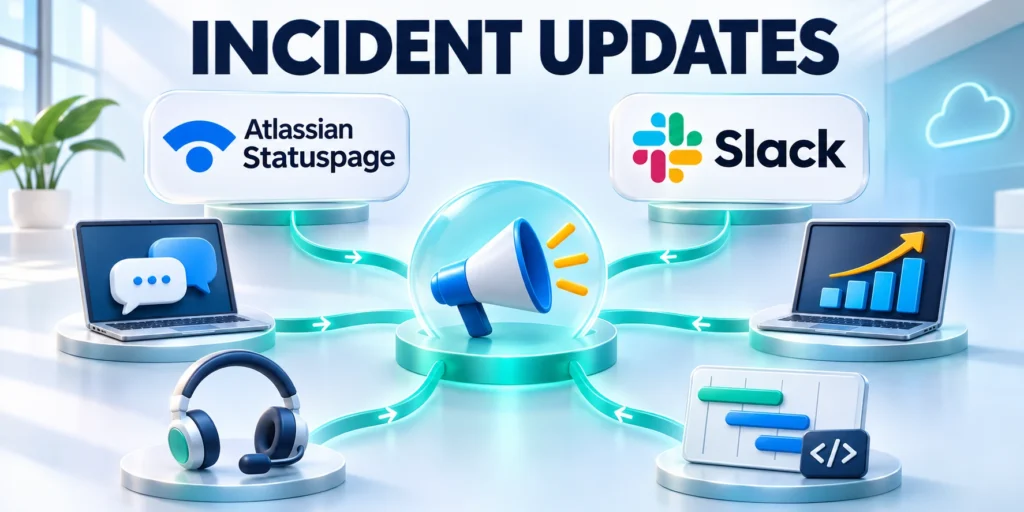
Incident communication should be timely, accurate, useful, and proportionate to impact. Silence encourages speculation, while unsupported certainty damages trust later.
Define audiences, channels, owners, review paths, and update cadence before incidents. The process should still work when senior leaders or usual approvers are unavailable.
Communicate verified impact and action
State what customers may experience, which services or regions are affected, what the team is doing, available workarounds, and the next update time.
Avoid premature root-cause claims, optimistic recovery promises, internal jargon, and irrelevant technical detail. Explain uncertainty directly when evidence remains incomplete.
Key considerations for communicate verified impact and action include:
- Describe customer symptoms.
- Share verified scope.
- Offer safe workarounds.
- Set the next update time.
Keep status pages, support scripts, account communications, executive updates, and partner notices consistent. Tailor depth without creating conflicting facts.
Use templates for speed, but require current evidence. A polished message with stale scope or timing can mislead more effectively than an imperfect update.
Set an update cadence by impact
Base the update frequency on customer impact, contractual expectations, uncertainty, and material change. Publish a brief update even when investigation continues without resolution.
Record every public and private update in the incident timeline. Responders should know what customers were told before selecting later language or actions.
Use these actions to set an update cadence by impact:
- Coordinate every audience.
- Use one verified narrative.
- Record published updates.
- Correct mistakes promptly.
After recovery, confirm restored capabilities, remaining limitations, monitoring status, and future follow-up. Do not declare closure before customer journeys are verified.
Review communication feedback with support and account teams. Their questions reveal missing context, unclear terms, ineffective channels, and customer expectations for future incidents.
Restore Service Safely
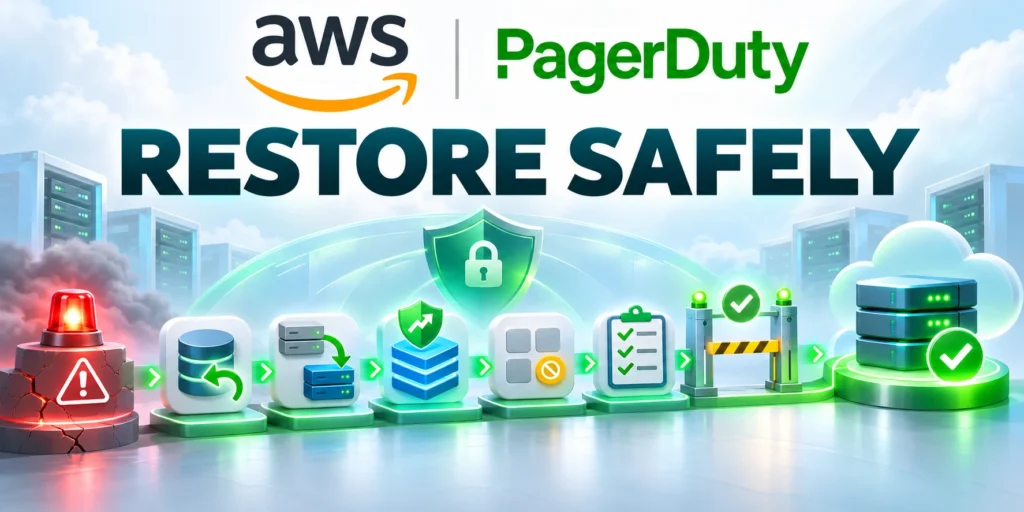
Restoration is the priority, but hurried changes can expand impact or destroy evidence. Prefer bounded, reversible actions with explicit validation and rollback criteria.
Possible mitigations include rollback, failover, capacity changes, traffic shaping, feature restrictions, queue controls, vendor escalation, or temporary manual processing.
Choose mitigation with controlled risk
Evaluate each option through customer benefit, blast radius, reversibility, implementation time, dependencies, data integrity, required authority, and observability.
Freeze unrelated changes when they could complicate diagnosis or recovery. Preserve emergency exceptions through documented approval rather than informal access expansion.
Use these actions to choose mitigation with controlled risk:
- Prefer reversible actions.
- Limit the blast radius.
- Protect data integrity.
- Define rollback triggers.
Assign one owner for execution and one for validation. Announce the action, expected result, observation window, risks, and rollback conditions before starting.
Verify user journeys, service objectives, data consistency, queues, dependencies, support signals, and business outcomes. A green server does not prove customer recovery.
Separate mitigation from permanent repair
Temporary restrictions may restore essential service while reducing functionality. Document affected features, customer guidance, operational burden, and removal criteria.
Create follow-up work for permanent correction only after immediate risk is controlled. Avoid combining restoration with broad redesign during an active incident.
Use these actions to separate mitigation from permanent repair:
- Validate critical journeys.
- Monitor recovery stability.
- Document temporary controls.
- Assign permanent repairs.
Observe the system long enough to detect recurrence, backlog release, delayed data problems, or dependency instability. Define who can end hypercare.
Communicate recovery only after validation. Include remaining limitations, monitoring status, customer actions, and the expected timing for additional information.
Run a Useful Post-Incident Review

A post-incident review should improve the operating system, not assign personal blame. Focus on conditions, signals, decisions, safeguards, and organizational context.
Review material incidents, near misses, repeated minor events, and response failures. A narrow outage threshold can hide valuable evidence about emerging risk.
Reconstruct events from evidence
Build a concise timeline covering first impact, detection, escalation, major hypotheses, decisions, mitigation, communications, restoration, and later validation. Reconcile conflicting timestamps.
Identify contributing conditions across design, change, testing, capacity, dependencies, access, monitoring, documentation, staffing, incentives, and decision boundaries.
Key considerations for reconstruct events from evidence include:
- Reconstruct the timeline.
- Separate facts from inference.
- Identify contributing conditions.
- Include customer perspective.
Ask why safeguards did not prevent, detect, contain, or accelerate recovery. Avoid stopping at the action closest to failure when broader conditions mattered.
Recognize practices that worked, including useful telemetry, reversible changes, clear ownership, effective communication, and fast vendor response. Preserve those capabilities intentionally.
Create corrective actions with measurable value
Write actions that name the affected risk, accountable owner, deadline, expected operational improvement, and verification method. Vague recommendations rarely change outcomes.
Prioritize a small set by customer risk, recurrence, shared exposure, response delay, and implementation effort. Do not convert every observation into backlog noise.
Use these actions to create corrective actions with measurable value:
- Name one accountable owner.
- Define expected risk reduction.
- Set a bounded deadline.
- Verify the completed change.
Share appropriate lessons across teams without exposing sensitive customer, employee, security, or vendor information. Reusable patterns can prevent similar failures elsewhere.
Track actions to verified completion and revisit outcomes after later releases or exercises. Closing a ticket is not evidence that resilience improved.
Automate Repetitive Response Tasks

Automation can reduce detection, coordination, and documentation delays when it performs bounded, observable, reversible work. It should not hide uncertainty or remove necessary judgment.
Start with repetitive actions responders already understand. Automating an unstable process can make mistakes faster and harder to diagnose.
Automate context before consequential actions
Enrich alerts with service ownership, dependencies, changes, dashboards, runbooks, customer scope, and escalation contacts. Create the incident record and communication channel automatically.
Synchronize assignments, acknowledgments, status cadence, timeline events, and follow-up tasks across tools. Preserve one authoritative source for each type of information.
Key considerations for automate context before consequential actions include:
- Enrich incoming alerts.
- Create incident records.
- Notify current owners.
- Capture timeline events.
Use approval gates for rollback, failover, access changes, data operations, customer messaging, and expensive capacity actions. Define authority by severity and service.
Make every automated action idempotent where possible and record its inputs, outputs, actor, timing, target, result, and rollback path.
Design automation for failure
Set timeouts, retries, concurrency limits, circuit breakers, and safe defaults. Automation should fail visibly without blocking manual response or creating repeated harmful actions.
Protect credentials through least privilege, short-lived access, environment separation, and audit. Emergency automation must not become a permanent path around normal controls.
Use these actions to design automation for failure:
- Require consequential approvals.
- Log every automated action.
- Provide manual fallback.
- Test rollback behavior.
Exercise automation against representative incidents and unavailable dependencies. Measure whether it improves detection, context, coordination, mitigation, or communication without adding new failure modes.
Retire unused workflows and update ownership after organizational changes. Stale response automation can route incidents to absent teams or execute outdated procedures.
Measure and Improve Incident Readiness

Metrics should reveal customer impact and operating capability rather than reward fast closure. A short incident can still expose severe readiness gaps.
Use quantitative trends with incident narratives, exercises, responder feedback, and customer evidence. Counts alone cannot explain decision quality or hidden risk.
Measure the complete response lifecycle
Track time to detect, acknowledge, engage owners, communicate, mitigate, restore, and verify. Segment by severity, service, source, time, dependency, and customer scope.
Measure recurrence, alert quality, escalation delay, customer reports before detection, rollback success, communication timeliness, action completion, and exercise findings.
Use these actions to measure the complete response lifecycle:
- Measure detection delay.
- Track restoration time.
- Review alert quality.
- Monitor incident recurrence.
Avoid ranking individuals or teams through raw response speed. Such incentives encourage premature closure, severity downgrades, weak documentation, and avoidance of difficult incidents.
Compare trends using stable definitions and explain measurement changes. Process improvements may initially increase reported incidents because detection and classification become more reliable.
Test readiness before customers do
Run tabletop exercises, dependency failures, rollback tests, access checks, communication drills, and recovery validations. Include after-hours coverage and unavailable specialists.
Use realistic scenarios with bounded risk. Exercises should expose decisions, permissions, handoffs, evidence, and escalation gaps rather than reward scripted completion.
Use these actions to test readiness before customers do:
- Exercise critical services.
- Test after-hours coverage.
- Verify emergency access.
- Review corrective actions.
Connect readiness work with a broader cloud monitoring program so detection, ownership, and response evidence remain aligned.
Select a small improvement set each cycle and define the expected effect. Verify results during later incidents, releases, or exercises before declaring success.
FAQ
These answers cover severity, ownership, incident records, customer updates, mitigation, reviews, automation, measurement, and readiness exercises for SaaS teams.
What is an IT incident management process?
It is the coordinated method for detecting, classifying, responding to, communicating, restoring, reviewing, and improving service disruptions or risks affecting customers and business operations.
How should a SaaS team define incident severity?
Define severity through customer impact, affected scope, data risk, revenue exposure, contractual obligations, duration, expansion risk, and available workarounds rather than technical novelty.
Who should lead a major incident?
An incident commander should coordinate priorities and decisions, while a technical lead directs investigation and restoration. Communications and timeline ownership should remain explicit.
When should an incident record be created?
Create it when credible customer or business impact appears. Early records may contain uncertainty but should preserve ownership, timestamps, evidence, decisions, and next actions.
How often should customers receive incident updates?
Set cadence from impact, uncertainty, contractual expectations, and material change. Publish a brief update at the promised time even when investigation continues.
What is the difference between mitigation and resolution?
Mitigation reduces current customer impact, often through temporary controls. Resolution addresses the underlying condition and confirms that service remains stable without those temporary measures.
Should post-incident reviews be blameless?
Yes. They should examine conditions, signals, decisions, safeguards, incentives, and organizational context while preserving accountability for corrective actions and professional conduct.
Which incident response tasks should be automated first?
Begin with enrichment, record creation, notifications, timeline capture, status reminders, and evidence gathering. Keep approval gates for consequential or difficult-to-reverse actions.
Which metrics show incident readiness?
Use detection, engagement, communication, mitigation, restoration, recurrence, alert quality, corrective-action completion, customer reports, and exercise findings alongside qualitative review.
How often should incident exercises run?
Choose a cadence based on service risk and change rate. Run additional exercises after major architecture, ownership, vendor, process, or recovery changes.
Conclusion
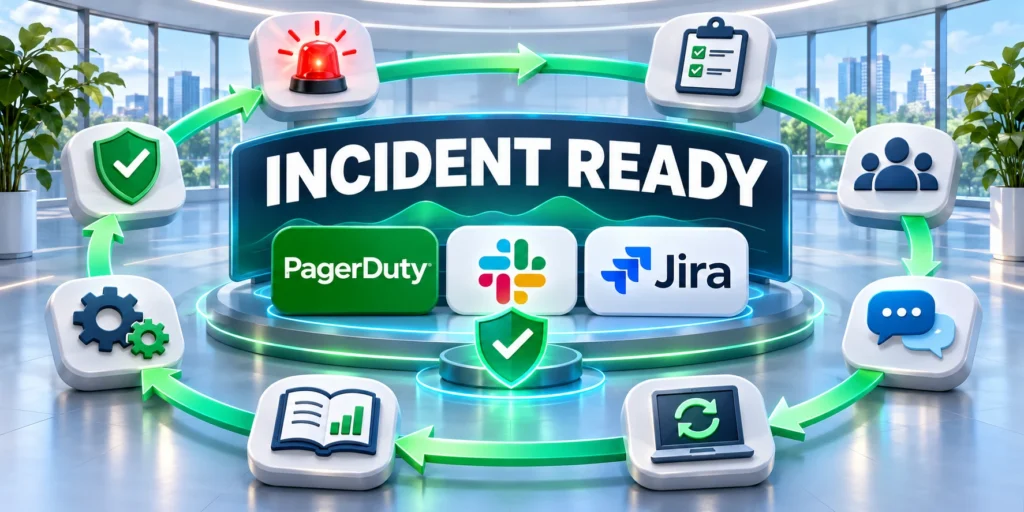
A reliable IT incident management process connects customer impact, clear ownership, useful detection, disciplined triage, coordinated roles, transparent communication, and safe restoration.
Post-incident learning, bounded automation, and readiness exercises turn individual responses into a durable SaaS operating capability rather than recurring emergency improvisation.
Build capability through one complete response path
Start with one critical customer journey and map its services, owners, severity triggers, detection signals, escalation routes, communication channels, mitigation options, and validation evidence.
Exercise that path under realistic constraints. Include missing specialists, degraded tools, vendor delay, uncertain scope, and customer pressure to reveal fragile assumptions.
Use these actions to build capability through one complete response:
- Choose one critical journey.
- Map complete response ownership.
- Exercise realistic failure conditions.
- Correct the highest-risk gaps.
Standardize common roles, records, templates, and automation while preserving service-specific context. Shared process should reduce confusion without flattening meaningful architectural differences.
Use incidents as operational evidence, not performance theater. Measure customer outcomes, decision quality, response friction, recurrence, and verified improvement.
Choose the next readiness improvement
Select the gap most likely to delay detection, coordination, mitigation, communication, or recovery. Assign one accountable owner and a measurable verification method.
Prefer changes that strengthen several services, such as ownership data, emergency access, telemetry standards, rollback capability, communication workflows, or dependable escalation coverage.
Use these actions to choose the next readiness improvement:
- Name the priority gap.
- Assign one accountable owner.
- Define verification evidence.
- Review the observed result.
Incident readiness is never finished because products, dependencies, teams, customers, and threats continue changing. Review the process after meaningful change and evidence.
A mature program makes uncertainty visible, decisions faster, mitigations safer, communications clearer, and learning measurable while protecting customers and responders from avoidable disruption.








Leave a Reply