


Map Sensitive Data and Trust Boundaries

Web app security for financial and health data starts with knowing what the application collects, where it travels, and which people or services can access it.
Map the application architecture alongside its data flows; our B2B web app development guide covers tenant models, service boundaries, and scaling choices.
Inventory records, fields, and destinations
List sensitive fields separately from business identifiers. A name, account number, diagnosis, payment token, and support attachment can each carry different exposure and retention risks.
For each field, record its source, purpose, storage location, recipients, retention period, deletion path, and owner. Include observability systems because request logs often receive data unintentionally.
Use these actions to inventory records fields and destinations:
- Trace form input through browser code, application services, databases, queues, analytics, exports, and backups.
- Mark trust boundaries where data crosses a user, service, vendor, or administrative role.
- Identify copies created by support tools, debugging, test fixtures, and downloadable reports.
- Remove collection that has no defined product or operational purpose.
Turn the map into a threat model
For every boundary, ask what an unauthorized user could read, change, export, or interrupt. Consider account takeover, a compromised employee account, a misconfigured integration, and accidental disclosure.
Write threats as concrete scenarios. “A contractor changes a record ID in a request and retrieves another clinic’s record” is testable; “the API needs security” is not.
Prioritize scenarios by impact
Rank scenarios by affected data, reachable users, exploit conditions, and recovery difficulty. This is a working engineering model, not a substitute for a required organizational risk analysis.
Record the assumptions behind each ranking. Revisit priority when architecture, integrations, access paths, or incident evidence changes the expected impact.
Apply the right compliance context
For U.S. electronic protected health information, covered entities and business associates should map the environment and perform the risk analysis required by the HIPAA Security Rule.
HHS guidance describes risk analysis as foundational and environment-specific; it does not offer a one-size-fits-all technical checklist. Involve privacy, security, legal, and system owners as appropriate.
Scope payment systems separately
For payment card data, determine whether the application stores, processes, transmits, or can affect the cardholder data environment. Confirm scope with your acquirer or qualified assessor.
Do not label a product “HIPAA compliant” or “PCI compliant” because one feature is enabled. Compliance depends on scope, operating procedures, evidence, contracts, and the applicable assessment.
Enforce Identity, Authorization, and Session Controls

Authentication establishes who is signed in; authorization decides whether that identity may perform this action on this specific record.
Financial and health applications often serve multiple organizations, teams, and roles. Enforce permissions on the server for every request, including exports, background jobs, and administrative tools.
Authorize each object and action
Never trust a record identifier merely because it came from a signed-in browser. Check tenant membership, user relationship, record state, and permitted action before returning or changing data.
A useful policy asks: “Can this user view this record now?” It should not rely only on a broad role such as “staff” or a hidden button in the interface.
Keep checks close to the operation
For a record endpoint, resolve the record and authorize it inside the same server-side service that performs the operation.
Avoid separate checks that can become stale or apply to a different object.
record = records.find(request.record_id)
if record.tenant_id != current_user.tenant_id:
    return forbidden()
if not policy.allows(current_user, "read", record):
    return forbidden()
return serialize_minimal_fields(record)
Apply the check in the service layer
This pseudocode illustrates the decision order; adapt it to your framework and policy model. Return only fields required for the task, even after access is granted.
Keep authorization policy inputs explicit and reviewable. Hidden defaults make failures difficult to reproduce across services, exports, and background jobs.
Evaluate these inputs for every protected operation:
- Authenticated identity and current session state.
- Tenant, role, and record relationship.
- Requested action and workflow status.
- Required fields and permitted response scope.
Strengthen Account and Session Controls

Account security must reflect the sensitivity of each action, the device context, and the recovery path available when risk signals change.
Session controls should limit exposure without trapping legitimate users. Define expiration, reauthentication, revocation, and support procedures together.
Apply Risk-Based Session Safeguards
Key considerations for strengthen account and session handling include:
- Require multi-factor authentication for privileged and sensitive administrative access.
- Offer phishing-resistant factors where the organization can support them.
- Set session expiration and reauthentication rules based on action sensitivity and device context.
- Revoke sessions when accounts are disabled, credentials are reset, or risk signals require it.
- Protect recovery flows against enumeration, takeover, and weak support procedures.
Use secure, HTTP-only, appropriately scoped cookies for browser sessions. Set transport protections and a deliberate cross-site request forgery defense for state-changing requests.
For sensitive changes such as changing payout details or exporting a large patient cohort, consider step-up authentication and a clear audit event.
Test authorization failures deliberately
Use test users assigned to separate tenants and roles. Confirm that changed record references or expired sessions cannot expose another customer’s data.
Use these actions to test authorization failures deliberately:
- Test read, create, update, delete, search, export, and bulk actions independently.
- Include records that are archived, assigned to another team, or in a restricted workflow state.
- Check API responses and generated files, not only what the user interface displays.
- Verify that denied requests disclose no sensitive fields in errors or logs.
OWASP’s API Security Top 10 calls out broken object-level authorization and broken authentication among major API risks. Use the project as a threat checklist, then test your actual access model.
Protect Data and APIs Across the Lifecycle

Encryption, secure configuration, and API controls work together. Protect data while it moves, while it is stored, and while teams maintain or restore the application.
Start with the data map and threat scenarios. Then specify which systems hold keys, how services authenticate, what fields each endpoint returns, and how exceptions are reviewed.
Use encryption with key ownership
Use modern TLS for browser, service, and vendor connections. Validate certificates and avoid silently downgrading to insecure transport when a request fails.
Encrypt sensitive stored data and backups according to the threat model. Encryption does not protect data from an application account that can decrypt everything.
Limit access to decrypted data
Combine encryption with access limits and monitoring.
Restrict decryption to named workloads and approved administrative paths. Monitor unusual volume, location, identity, and timing without copying protected values into alerts.
Manage keys and secrets deliberately
Keep encryption keys separate from the data they protect. Restrict key use to named services, rotate credentials through a documented process, and log administrative key operations.
Never commit secrets to source control or paste them into issue trackers. Use a managed secret store, separate credentials by environment, and remove credentials when a service is retired.
Confirm these protections for encrypted application data:
- Name the service permitted to decrypt data.
- Separate production keys from other environments.
- Rotate credentials through an owned procedure.
- Audit administrative key and secret operations.
Reduce API Exposure and Browser Risk

Define an API inventory with owners, authentication method, data classification, and lifecycle status. Remove obsolete endpoints and reject unexpected methods, fields, and content types.
Use these actions to reduce api exposure:
- Validate input with allowlisted schemas and server-side business rules.
- Use parameterized database queries rather than building SQL from user input.
- Limit page size, request frequency, file size, and expensive operations.
- Apply idempotency to retryable financial operations to prevent duplicate effects.
- Use explicit timeouts and safe response handling for outbound integrations.
For example, pass user values as parameters through the database driver rather than concatenating them into query text:
query = "SELECT id, status FROM claims WHERE id = ? AND tenant_id = ?"
result = database.execute(query, [claim_id, current_user.tenant_id])
The placeholders and parameter syntax depend on the driver. The security property is that values remain data, not executable SQL; verify this with your framework’s database documentation.
Validate input and protect browser output
Validate values on the server using the expected type, format, length, and allowed state. Client-side validation improves usability but can be bypassed.
Encode data for the output context and use framework protections against cross-site scripting. Avoid rendering user-supplied HTML unless a reviewed sanitizer and clear business need exist.
Use these actions to validate input and protect browser output:
- Use anti-CSRF protections for browser actions that change state.
- Restrict upload types, size, storage location, and retrieval permissions.
- Allowlist outbound destinations for server-side fetch features and webhooks.
- Return generic errors to users while preserving safe diagnostic details for operators.
- Review third-party scripts and integrations that can read page content or tokens.
For integrations, document which fields leave your service, the receiving party, purpose, retention, authentication, and failure behavior before enabling production traffic.
Keep logs useful and non-sensitive
Log identity, action, target, outcome, time, and a request correlation identifier. Avoid logging passwords, session tokens, full payment details, medical narratives, or raw request bodies.
Use structured redaction before data reaches log pipelines. Review error reporting, analytics, tracing, customer support tools, and third-party monitoring for accidental sensitive payloads.
Set audit-log retention
Set retention and access rules for security logs. A log platform may contain sensitive metadata even when application databases are encrypted.
Match retention to investigation, contract, and regulatory needs. Document deletion, legal holds, privileged access, and integrity checks for every audit destination.
Plan retention and recoverability
Define deletion behavior for the primary database, search indexes, replicas, exports, and backups. Explain any backup retention window and how restored data is reconciled with deletion requests.
Test restoration with controlled data and restricted access. A backup that has never been restored is an assumption, not evidence that the application can recover safely.
Operationalize Testing, Monitoring, and Response
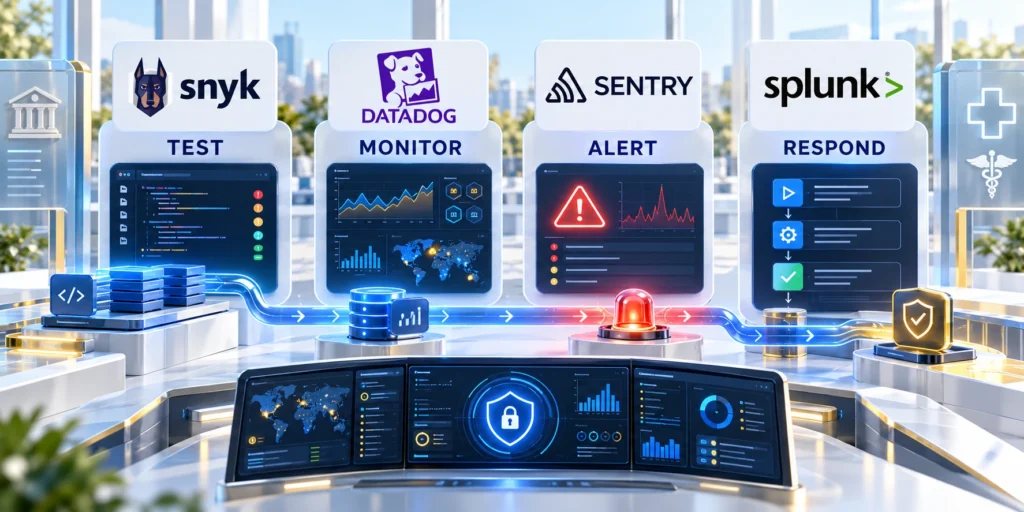
Security controls need an owner and a way to detect failure. Put verification into development, release, production monitoring, and incident response.
Choose checks from the application’s actual risks. A financial transfer, patient export, and public marketing form have different consequences and should not share an undifferentiated test plan.
Build security checks into delivery
Run automated code and dependency checks on changes, but route findings to owners with severity, affected component, and a due date.
A scanner without triage can create noise instead of risk reduction.
Use these actions to build security checks into delivery:
- Review authorization changes and data-flow changes in code review.
- Test dependency updates and build artifacts in an isolated pipeline.
- Protect production credentials and require approval for privileged deployments.
- Test rollback and database migration recovery before high-impact releases.
- Retest confirmed fixes and record the evidence with the release.
For critical workflows, add negative tests that prove an unauthorized user is denied. Include tenant boundaries and resource-level checks in the service test suite.
Monitor behavior, not only uptime
Alert on unusual authentication failures, privilege changes, bulk exports, repeated denied access, unexpected service-account use, and changes to security configuration.
Set thresholds from normal product behavior and route alerts to people who can respond. A volume alert without context may be ignored.
Make alerts actionable
An alert linked to the actor, service, and affected boundary is actionable.
Keep monitoring data minimal. Correlation identifiers help connect events without copying sensitive records into every dashboard and notification.
Prepare a data incident playbook
Write down how to contain a compromised account, disable an integration, preserve evidence, assess affected records, and restore a safe service.
Assign incident roles before an event: technical lead, privacy or compliance contact, communications owner, executive decision-maker, and vendor escalation contact.
Use these actions to prepare a data incident playbook:
- Practice a scenario involving a cross-tenant record exposure or stolen support credential.
- Confirm emergency access can be revoked without disabling all business operations.
- Document evidence handling and decision records.
- Review notification duties with qualified counsel and the relevant contracts.
- Track follow-up actions to completion after the exercise.
Do not improvise legal timelines from a generic security article. Notification obligations depend on jurisdiction, data type, role, contracts, and incident facts.
Define Security Operating Criteria

For web application security for financial and health data, define data classification, risk boundary, control, and accountable owner before changing campaigns, code, content, or workflow.
That shared context gives every contributor a practical boundary for action.
Use these actions to define operating criteria before execution:
- Write the decision, owner, assumptions, and known constraints.
- Identify dependencies that could change the expected result.
- Set a reversible first step when uncertainty remains.
- Keep the decision record accessible to contributors.
- State what evidence is sufficient to proceed.
- Note which decisions cannot be reversed cheaply.
- Define the time frame for the decision.
- Record the intended business benefit.
- Confirm the available capacity and budget.
Test the workflow under realistic conditions
Evaluate web application security for financial and health data across the real risk assessment, design, implementation, testing, and response sequence.
A narrow test can hide handoff issues, exceptions, integration failures, or user behavior.
Follow this sequence to test the workflow under realistic conditions:
- Choose a representative task or audience segment.
- Run the workflow from its first input to the final outcome.
- Capture exceptions, delays, and manual work.
- Compare results with the agreed baseline.
- Decide whether to improve, repeat, or scale.
- Document the limits of the test.
- Confirm that owners can support the next step.
- Review assumptions with people doing the work.
- Capture feedback from affected customers or users.
Measure outcomes and tradeoffs together
Track access anomalies, vulnerability status, incident response, and control coverage together rather than optimizing a single favorable metric.
Costs, risk, quality, and effort can otherwise distort the apparent value.
Use these actions to measure outcomes and tradeoffs together:
- Use business and technical indicators in the same review.
- Record data gaps before interpreting a result.
- Explain material changes with evidence, not timing alone.
- Preserve the baseline and reporting period.
- Share findings with the teams responsible for follow-up.
- Check whether the outcome can be reproduced.
- State the confidence level behind each conclusion.
- Compare actual effort against the original estimate.
- Assign responsibility for the next reporting cycle.
Keep the practice current
Review the approach when data type, regulation, integration, threat model, or architecture changes.
Past decisions may still help, but their assumptions require current evidence.
Use these actions to keep the practice current:
- Schedule ownership and review dates with the operating team.
- Retire outdated instructions, definitions, and unsupported claims.
- Record the next action and accountable owner.
- Link related internal guidance when it helps execution.
- Decide whether to improve, replace, or stop the practice.
- Share changed instructions with affected contributors.
- Keep the latest decision record easy to find.
- Confirm whether the documented standard remains usable.
- Escalate material risks before the next release.
Validate Authorization Through Misuse Cases
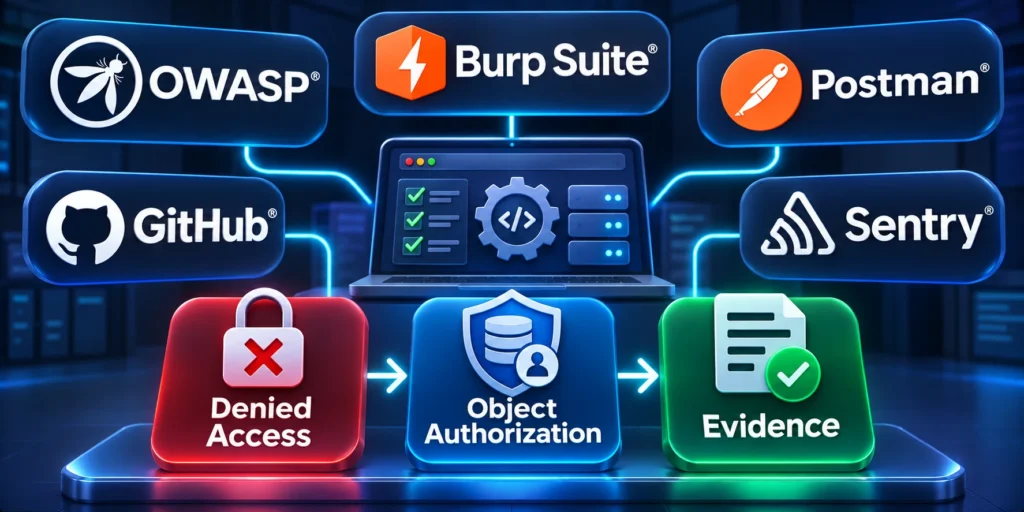
List the records and actions available to each role, tenant, service, administrator, and support function. Include exports, reports, search, attachments, and background jobs.
Test prohibited paths deliberately. A hidden button or filtered interface does not prove that the server rejects an unauthorized request.
Exercise Object and Tenant Boundaries
Use accounts from different customers and roles. Try changed references, old links, reused sessions, bulk actions, direct downloads, and relationships crossing tenant boundaries.
Verify authorization at the service handling the data, not only at navigation or interface layers. Return minimal information when access is denied.
Use these actions to exercise object and tenant boundaries:
- Test every role against permitted records.
- Include exports, files, and background work.
- Check stale and revoked sessions.
- Record expected and observed outcomes.
Protect Administrative and Support Access
Separate routine support from privileged investigation. Require approved elevation, narrow scope, time limits, strong authentication, and reviewable audit evidence.
Test emergency access and removal. A break-glass process should not become a permanent route around ordinary authorization controls.
Keep Regression Evidence
Retain misuse cases in automated and manual regression suites. Recheck them after relationship, permission, API, identity, or data-model changes.
Link failures to the affected control and business impact. A passing interface test cannot close a server-side authorization defect.
Review Denial Evidence Across Execution Paths
Review denial evidence for consistency across APIs, exports, files, and asynchronous work. Differences often reveal duplicated policy logic or an unprotected execution path.
Track each defect through remediation and retest. Preserve the account, object, action, expected denial, observed result, and release containing the verified correction.
Govern Sensitive Data Through Its Lifecycle

Define how financial and health data enters, changes, moves, appears, persists, archives, and is deleted. Assign an owner and approved purpose to each stage.
Minimize collection and duplication before adding controls. Information that the application does not need should not remain available for accidental exposure.
Control Nonproduction Data
Use synthetic or appropriately de-identified data where possible. Restrict copies, exports, support attachments, backups, and developer access under the same risk model.
Verify that logs, traces, screenshots, crash reports, analytics, and test fixtures exclude secrets and unnecessary personal or payment information.
Use these actions to control nonproduction data:
- Inventory copies and derived datasets.
- Limit access by role and purpose.
- Apply retention and deletion schedules.
- Test backup restoration and disposal.
Review Third-Party Data Paths
Document processors, regions, fields, purposes, credentials, retention, incident contacts, and exit procedures. Confirm that integrations return only required data.
Reassess when vendors, contracts, product features, or data categories change. Remove unused credentials and routes after migration or termination.
Align Retention With Recovery
Define when primary records, replicas, indexes, exports, and backups expire. Document temporary differences caused by restore points and required legal holds.
Use these lifecycle controls for accountable ownership:
| Lifecycle stage | Primary control | Evidence |
|---|---|---|
| Collection | Purpose and field minimization | Approved data map |
| Active use | Role and purpose access | Access review |
| Retention | Owned deletion schedule | Deletion result |
| Recovery | Restricted restore process | Restore test |
Test deletion after restoration and confirm that recovered services reapply approved restrictions. Recovery must not silently revive access or data beyond policy.
FAQ
These answers address recurring implementation questions about financial and health data security, authorization, testing, logging, support access, and changing threat models.
What is the first security step for a health data web app?
Map the ePHI flows, systems, vendors, users, and safeguards, then complete the risk analysis applicable to your organization. Bring system owners and privacy or compliance staff into the process.
Does encryption make an application compliant?
No. Encryption is one safeguard. Compliance depends on scope, risk analysis, access management, procedures, contracts, evidence, and applicable assessment requirements.
How do I prevent one customer from seeing another customer’s records?
Enforce tenant and record-level authorization on the server for every request. Test direct API calls, exports, background jobs, and object identifiers using accounts from separate tenants.
Should sensitive data appear in application logs?
Usually avoid full sensitive values in logs. Record the event and a safe identifier, redact payloads before collection, and restrict log access and retention.
How often should web application security be tested?
Test continuously where automation is reliable, and reassess when architecture, data flows, vendors, or threat conditions change. High-impact changes need targeted review before release.
How should support staff access sensitive records?
Use approved, time-limited, narrowly scoped elevation with strong authentication, reason capture, logging, and review. Remove access when the support task ends.
Can production data be copied into a test environment?
Prefer synthetic or appropriately de-identified data. Any exception needs a documented purpose, authorization, safeguards, retention, and deletion verification.
What should a security audit log contain?
Record relevant actor, action, target, result, time, and context without storing unnecessary secrets or sensitive content. Protect integrity and access.
How should failed authorization appear to users?
Provide a clear safe message and recovery route without revealing protected record existence, internal policy details, or another customer’s information.
When should threat models be updated?
Update after material data, architecture, identity, integration, vendor, feature, regulatory, or incident changes, and at an approved risk-based cadence.
Conclusion
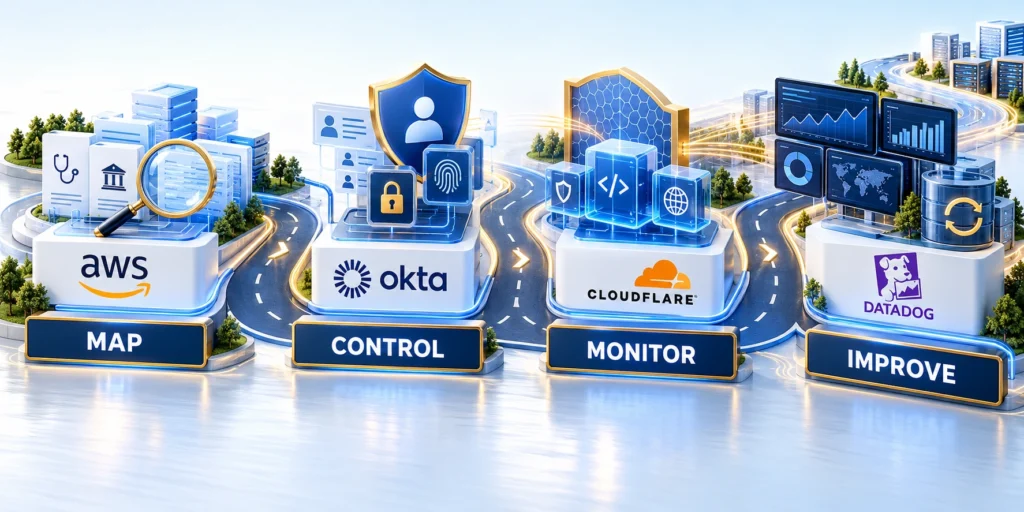
Protect financial and health data by connecting safeguards to real workflows, accountable owners, and evidence that the controls work.
Close the roadmap with these accountable actions:
- Prioritize risks by consequence and reachability.
- Assign each control to an accountable owner.
- Define evidence before implementation begins.
- Retest corrections under representative conditions.
- Review assumptions after material system changes.
Start with the highest-consequence scenarios, close authorization and logging gaps, and improve delivery so new features preserve the protections already in place.
Sequence the work and prove it
Turn the risk map into a short backlog. For each item, name the risk, affected data, accountable owner, implementation, validation method, and residual concern.
For example, if a test reveals that changing a claim identifier exposes another tenant’s record, block that access at the service layer, add regression tests, and review prior access logs.
Keep Evidence Tied to Business Impact
Keep the backlog tied to business impact and current evidence. Do not let broad compliance labels replace specific records, workflows, controls, and validation results.
Review residual risk with accountable owners and affected teams. Record accepted exposure, temporary controls, funding decisions, and the evidence required for closure.
Reassess when the system changes
Keep evidence practical: test results, access review records, incident exercises, restore outcomes, and approved risk decisions. Review it when the application or operating environment changes.
Update the roadmap after material identity, data, vendor, architecture, or threat changes. Preserve earlier decisions so reviewers can trace why priorities moved.






Leave a Reply